Twenty-Fourth Annual Report of the Data Protection
Commissioner 2012
FOREWORD ... 4
INTRODUCTION ... 5
CUSTOMER SERVICE... 6
MEDIA RELATIONS... 6
IRISH LANGUAGE SCHEME... 7
GOVERNANCE... 7
COMPLAINTS AND INVESTIGATIONS... 7
USE OF STATUTORY ENFORCEMENT NOTICES... 10
DATA BREACH NOTIFICATIONS ... 12
PRIVACY AUDITS... 15
AN GARDA SÍOCHÁNA... 17
FACEBOOK-IRELAND FOLLOW-UP REPORT... 19
INFOSYS ... 20
POLICY ISSUES... 20
HOUSEHOLD CHARGE... 20
DATA PROTECTION GUIDANCE FOR PRIMARY AND SECONDARY SCHOOLS PREPARED BY SCHOOL MANAGEMENT BODIES... 21
CREDIT REPORTING BILL... 21
INVESTIGATION IN RELATION TO INACCURATE RECORDS HELD BY THE IRISH CREDIT BUREAU... 22
EU & INTERNATIONAL RESPONSIBILITIES... 26
NEW EUDATA PROTECTION LAWS... 26
ARTICLE 29WORKING PARTY... 27
DATA PROTECTION IN EUSPECIALISED BODIES... 27
INTERNATIONAL ACTIVITIES... 28
ADMINISTRATION... 29
RUNNING COSTS... 29
PART 2 ... 30
CASE STUDY 1:INSURANCE COMPANIES PROSECUTED FOR REGISTRATION OFFENCES... 31
CASE STUDY 2:UNACCEPTABLE DELAY BY O2 IN PROCESSING AN ACCESS REQUEST... 34
CASE STUDY 3:ACCESS RESTRICTION UNDER SECTION 5(1)(A)REQUIRES APREJUDICE TEST... 37
CASE STUDY 4:DISCOVERY PROCESS REVEALS DATA PROTECTION BREACH... 39
CASE STUDY 5:HIGH COURT RULES THAT PERSONAL DATA CAN BE ACCESSED BY LITIGANT... 41
CASE STUDY 6:OUTSTANDING DEBT DETAILS LEGITIMATELY PASSED ON TO DEBT COLLECTION AGENCY... 47
CASE STUDY 7:COLLECTION OF PHOTOGRAPHIC IDENTITY BY A FERTILITY CLINIC... 49
CASE STUDY 8:EXCESSIVE USE OF CCTV IN A NURSING HOME... 51
CASE STUDY 9:DISCLOSURE OF STUDENT PERSONAL DATA BY SECONDARY SCHOOL... 53
CASE STUDY 10:CUSTOMER DATA TRANSFER FOR WASTE COLLECTION SERVICE IN DUBLIN... 55
CASE STUDY 11:DEPARTMENT OF EDUCATION CIRCULAR LEADS TO COMPLAINT ABOUT SICK LEAVE INFORMATION... 58
CASE STUDY 12:PROSECUTIONS -UNSOLICITED MARKETING... 61
CASE STUDY 13 STOLEN LAPTOPS -PHONE COMPANIES PROSECUTED FOR LOSS OF PERSONAL DATA... 67
CASE STUDY 14:CLIENT LIST TAKEN BY EX-EMPLOYEE TO NEW EMPLOYER... 71
CASE STUDY 15:ALLIED IRISH BANKS – POSTAL BREACHES... 72
CASE STUDY 16:MAJOR RETAILER –CREDIT CARD SLIPS DISCARDED... 73
CASE STUDY 17:O2–MISSING MEDIA TAPE... 75
CASE STUDY 18:HEALTH SERVICE EXECUTIVE... 77
Appendices ... 79
APPENDIX 2-REGISTRATIONS2012 ... 82
APPENDIX 3-ABSTRACT* OF RECEIPTS AND PAYMENTS IN THE YEAR ENDED 31DECEMBER 2012.. 83
APPENDIX 4–INFOSYSINVESTIGATION... 84
Index of Tables and Figures TABLE 1BREAKDOWN OF COMPLAINTS OPENED...9
TABLE 2COMPLAINTS RECEIVED SINCE 2003...9
TABLE 3–ENFORCEMENT NOTICES* ISSUED IN 2012 ...10
TABLE 4–SELECTED INFORMATION NOTICES* ISSUED IN 2012...11
TABLE 5- NUMBER OF BREACH NOTIFICATIONS RECEIVED 2012...13
TABLE 6-NUMBER OF ORGANISATIONS MAKING BREACH NOTIFICATIONS,2012 ...13
TABLE 7–BREACH NOTIFICATIONS – BY CATEGORY...13
TABLE 8–COMPARISON OF BREACH NOTIFICATIONS – BY YEAR...14
TABLE 9–COMPARISON OF ORGANISATIONS MAKING BREACH NOTIFICATIONS...14
FIGURE 1COMPLAINTS...10
Foreword
In last year’s annual report, I referred to the increased pressure on the resources of our Office. I noted that this pressure was likely to increase under the “one-stop-shop” arrangement being proposed at EU level for oversight of multinational companies. The Government has responded by providing additional staffing and funding. A recent statement from the Minister for Justice and Equality, Alan Shatter TD, further confirmed that: “The Government, and I as Minister, will continue to keep the resourcing of the Office of the Data Protection Commissioner actively under review and will ensure that any additional necessary resources will be made available to the Office of the Data Protection Commissioner”.
We are therefore well-placed to discharge the additional responsibilities that arise for our Office from the increasing number of information-rich multinational companies that are choosing Ireland as a base from which to provide services on an EU-wide basis.
Our necessary focus on multinational companies has not led us to neglect our responsibilities in relation to domestic issues. The Report includes information on the extensive work carried out by the Office on data protection issues arising in many sectors. In most cases we succeeded in achieving compliance with the law by persuasion but, where necessary, we used our enforcement powers to the fullest extent.
The Report includes a special report on our extensive investigation of data sharing in the public sector through the INFOSYS system provided by the Department of Social Protection. The report reveals a disturbing failure of governance in some of the public bodies investigated. Data sharing can bring benefits in terms of efficient delivery of public services. But it must be done in a way that respects the rights of individuals to have their personal data treated with care and not accessed or used without good reason. The failures revealed by the INFOSYS audit need to be addressed on a public-service-wide basis before any other such sharing arrangements are put in place.
Proportionality is the key. Such data sharing in the public sector should have a clear basis in law; be clear to individuals that their data may be shared and for what purpose; have a clear justification for individual data sharing arrangements, with minimum data shared to achieve the stated public service objective; strict access and security controls; and secure disposal of shared data These principles are set out in more detail on our website.
The achievements during the year would not have been possible without the commitment and dedication of our staff. Such commitment was always evident in the work of Gary Davis, Deputy Commissioner, who left us earlier this year to pursue other opportunities. I wish him well.
Billy Hawkes
Introduction
2012 was another busy year for our Office. Activity across our four main functions – Investigation and Enforcement, Guidance and Education, Audits/Inspections and Notifications (Registration) - increased significantly. The first prosecutions were taken against Telecommunications Companies for failure to comply with the new security and breach notification requirements under Statutory Instrument SI 336 of 2011.
Data protection issues related to the activities of multinational companies continued to absorb an increased amount of resources – especially the time of senior
management. This increased activity put significant strain on our limited resources – an issue highlighted in last year’s report.
Allocation of Resources
Note: Staff costs = 85% of Budget
Investigations & Enforcement1 35% Guidance & Education2 25%
Audits/Inspections 15%
Notifications3
10% EU/International Cooperation 10%
Administration4 5%
In recognition of the increased responsibilities which are likely to fall to our Office, when the legislative proposals on data protection currently under discussion in the Council of Ministers of the European Union and European Parliament are passed into law, extra staffing was allocated to the Office at the end of 2012. These resources included a Chief Technology Advisor and a Legal Advisor, as well as additional
1
Includes investigating complaints and data breaches; issuance of Enforcement Notices; prosecuting offences under the Data Protection Acts and the Electronic Privacy Regulations
2
Includes Help-Desk; oral and written guidance to organisations (including meetings); presentations and other public education activities.
3
A limited number of organisations are required to register annually with the Office. Information on the types of information they process etc is provided in the Register on the Office’s website
4
administrative staff. The non-pay budget allocation to the Office for 2013 was also increased.
Customer Service
This year, once again, the Office continued to provide services to our customers, both data controllers and data subjects, by phone, in person, by email and by post. We responded to large numbers of phone calls to our Helpdesk from members of the public on a very broad range of issues, from access rights to registration obligations. Emails were the next most common method of contact. Approximately 9500 queries were dealt with in 2012 via our dedicated information email address – [email protected]. In addition we received queries by post.
Our practice of involving the entire staff of the Office in providing service on our helpdesk, which we started in late 2006, has continued with great success. The benefit to members of staff providing this service is a greater awareness of the data protection issues facing members of the public and organisations alike.
The website remains our main source of public information which we review and update regularly to make sure that relevant data protection developments are highlighted to visitors to it.
In the last 12 months, we have given 76 presentations to various organisations, details of which are available in Appendix 1– Presentations & Talks.
Media Relations
Irish Language Scheme
Our most recent Irish Language Scheme under the Official Languages Act 2003 was put into effect in 2010 and will be in effect until October 2013. The scheme will fall for review during 2013. We continue to maintain our commitment to provide an effective service to our customers, including by providing comprehensive information on our Irish language website, www.cosantasonrai.ie.
Governance
A Revised Code of Practice for the Governance of State Bodies was issued on 9th June 2009 by the Department of Finance and was circulated to all Heads of Agencies. It is mandatory for all State bodies.
The Office utilises core systems and services provided by the Department of Justice & Equality - payroll, general payments, HR, and IT (Citrix) - which are subject to that Department's procedures. The Office is also subject to the Department's internal audit system. In so far as matters under its control are concerned, the Office is in full compliance with the requirements of the Code.
Complaints and Investigations
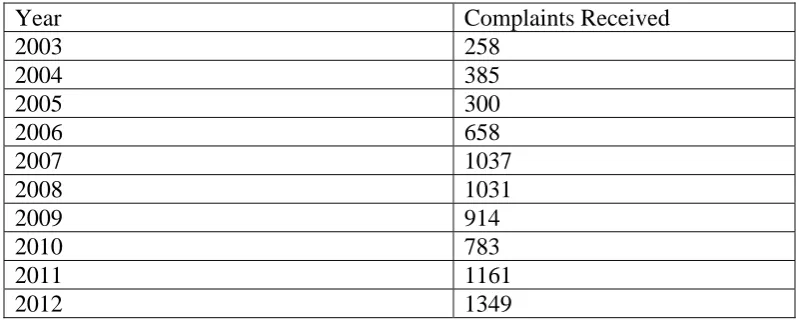
During 2012, the Office received 1,349 complaints which were opened for investigation. This was a new record high number of complaints and it compares with 1,161 complaints in 2011. For the sake of clarity, it is worth noting that 369 complaints related to one particular matter.
the offending businesses concerned are unaware of the law which applies to such communications with regard to subscriber consent and the requirement to provide an opt-out mechanism in each marketing message. As stated in previous Annual Reports, our prosecution powers will be used against entities who continue to infringe the law. The Case Studies section of this Annual Report carries details of the types of prosecutions taken in 2012. In total there were 195 prosecutions against 11 entities.
Table 1 Breakdown of complaints opened
2012 - Breakdown of complaints by data protection issue
2012 Percentages Totals
Electronic Direct Marketing 44.93% 606
Access Rights 32.77% 442
Disclosure 7.86% 106
Unfair Processing of Data 2.59% 35
Unfair Obtaining of Data 0.96% 13
Use of CCTV Footage 2.37% 32
Failure to secure data 2.59% 35
Accuracy 1.41% 19
Excessive Data Requested 1.78% 24
Unfair Retention of Data 1.26% 17
Postal Direct Marketing 0.74% 10
Other 0.74% 10
TOTALS 100.00% 1349
Table 2 Complaints received since 2003
Year Complaints Received
2003 258 2004 385 2005 300 2006 658 2007 1037 2008 1031 2009 914 2010 783 2011 1161 2012 1349 As in previous years, the vast majority of complaints concluded in 2012 were
[image:9.595.88.488.457.618.2]Figure 1 Complaints
0 200 400 600 800 1000 1200 1400 1600
2012
Complaints opened in year
Total Complaints Concluded in year
Total Complaints Outstanding at end of year
Use of Statutory Enforcement Notices
Details of Enforcement Notices and selected Information Notices served in 2012 are set out in the following tables. Most relate to the right of access. It is to be hoped that publication of these lists encourages all organisations that are the subject of complaints to co-operate fully with our Office in relation to our statutory investigations. While an Enforcement Notice may be issued in relation to a number of aspects of the Data Protection Acts, it is not normally necessary to do so. The vast majority of organisations voluntarily engage with the Office without the need for a formal legal notice to advance an investigation.
Table 3 – Enforcement Notices* issued in 2012
Data Controller: In relation to:
Sin Bar & Nightclub Section 4(1) of the Data Protection Acts JN Cummins (Engineering) Limited Section 4(1) of the Data Protection Acts Zevas Communications Limited Section 4(1) of the Data Protection Acts Munster Soft Drinks Limited Section 4(1) of the Data Protection Acts Nightline Section 4(1) of the Data Protection Acts SAS Institute Limited Section 4(1) of the Data Protection Acts Paintridge Limited Section 4(1) of the Data Protection Acts Paintridge Limited Section 4(1) of the Data Protection Acts Flexhaven Limited t/a Dinn Rí Hotel Section 4(1) of the Data Protection Acts Ashjen Limited t/a At Risk Security Section 4(1) of the Data Protection Acts Mason's Bar Sections 2(1)(a) and 2(1)(c) of the Data
Protection Acts
Tower Plant & Civil Engineering Section 4(1) of the Data Protection Acts
*Under Section 10 of the Data Protection Acts, 1988 and 2003, the Data Protection Commissioner may require a data controller or data processor to take whatever steps the Commissioner considers appropriate to comply with the terms of the Acts.
Table 4 – Selected Information Notices* issued in 2012
Data Controller: Scancor Limited The Old Forge SIPTU
Data Breach Notifications
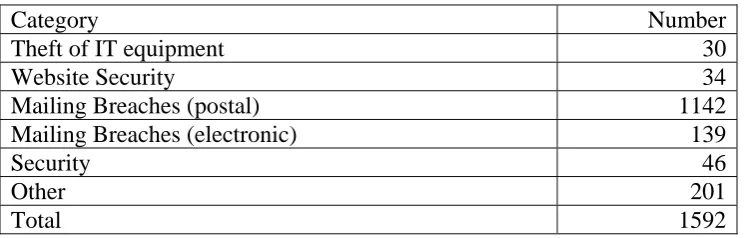
During 2012, the Office dealt with 1,666 personal data security breach notifications. This is again an increase in the numbers dealt with compared to previous years. Of the 1,666 notifications received, it was found that 74 cases were not deemed to be personal data security breaches on the part of the data controller making the notification. This was due to either appropriate security measures, such as encryption, being in place to protect the data or to individuals failing to update their contact details with the data controller, resulting in letters issuing to an incorrect address. A total of 1,592 valid data breach notifications were therefore recorded. This is an increase of over 400 on last year.
The introduction, in July 2011, of S.I. 336 of 2011 made it a legal requirement for telecommunication companies and Internet Service Providers (ISPs) to notify this Office, without undue delay, of a data security breach and to also notify affected individuals of such a breach. In September 2012, two telecommunications companies were prosecuted for failing to meet their legal obligation in this regard. In the first full year of S.I. 336 being in effect, a total of 60 data security breach notifications were received from Telecommunications companies and ISPs.
Due to the year on year increase in the number of data security breach notifications received by the Office, additional resources were allocated to the area. A Technology Advisor has also been appointed to allow the Office properly investigate the more complex Information Technology (IT) related matters that are brought to its attention. During 2012, we have taken a more proactive stance in relation to potential data security breaches and have initiated investigations into matters that have been identified through mention in areas such as social media sites.
by post (see Table 7), either to an incorrect address or containing a third party’s personal data.
A new matter that is beginning to grow in terms of notifications is the issue of staff leaving the employment of one company and joining another, bringing with them the details of customers of their original employer. There are several facets to this issue. Firstly, the original employer has a duty under the Data Protection Acts to keep personal data under its control safe and secure. Secondly, the new employer can now hold personal data which it does not have consent to process. Thirdly, the new employer, in contacting these individuals, is potentially committing an offence under S.I. 336 of 2011 by sending marketing communications to non-customers from whom it does not have such consent. An example of this is set out in Case Study 14 in part 2 of this Report.
Table 5 - Number of Breach Notifications received 2012
Total Number of Breach Notifications Received 1666
Number considered as non-breach 74
Number of Breach Notifications 1592
Table 6 - Number of Organisations making Breach Notifications, 2012
Private Sector Organisations 220
[image:13.595.90.465.589.708.2]Public Sector Organisations 84
Table 7 – Breach Notifications – by Category
Category Number
Theft of IT equipment 30
Website Security 34
Mailing Breaches (postal) 1142
Mailing Breaches (electronic) 139
Table 8 – Comparison of Breach Notifications – by Year
2009 60 2010 – introduction in July of Code of Practice 410
2011 – Introduction in July of S.I. 336 1167
2012 1592
Table 9 – Comparison of Organisations making Breach Notifications
Year Private Sector Public Sector Total
2009 60 26 86 2010 89 34 123 2011 146 40 186 2012 220 84 304
[image:14.595.89.462.213.286.2]Figure 2 – Breaches by Category – breakdown of postal breaches
Breaches - by Category
0 100 200 300 400 500 600 700 800 Th eft o f IT eq ui pme nt W ebs ite S ecu rity Ma iling br eac
hes ( post
al) Acco
unt se tup i
ss ue Chang e of A ddr es
s inc or
rec t Ma
iling br eac hes (el ec tron ic) Se curit y Oth er Breach type
Measures which were put in place to address the issue of postal breaches in Allied Irish Banks are described in Case Study 16 in Part II of this Report.
Part II of the Report also includes three further case studies – one involving a major retailer and discarded credit card slips, one involving a missing backup media tape in O2 and one involving the disclosure of patient data to an incorrect fax number by the Health Service Executive.
Privacy audits
carried out by the Office in response to specific complaints. Priorities and targets for audit are identified taking account of complaints and enquiries to the Office. During 2012, we continued to adopt a proactive role in this regard. The Office also continued with its programme of unscheduled inspections under powers conferred under section 24 of the Data Protection Acts.
Similar to the strategy adopted in 2011, we chose to tailor the programme of audits to allow us to focus on a few carefully selected targets and analyse them in intensive detail: namely An Garda Síochána; Facebook Ireland by way of a follow-up audit; and the conclusion of the investigation into INFOSYS.
Organisations audited in 2012:
In the course of 2012, 40 audits and inspections were carried out by this Office. This is an increase on the previous year – 2011 - in which 33 audits were completed in total. Included in the list of the audits/inspections, is the INFOSYS investigation which, although initially a ‘desk audit’, eventually led to a large number of meetings and visits to agencies within the public sector who had access to INFOSYS.
Our inspection teams found that, in general, there was a reasonably high awareness of, and compliance with, data protection principles in the organisations that were inspected. Notwithstanding this, the majority of organisations had areas where immediate remedial action was necessary. The majority of the data controllers audited have demonstrated a willingness to put procedures in place to ensure they are meeting their data protection responsibilities in full. We would like to thank all of the organisations audited and inspected throughout the year for their cooperation.
List of Organisations audited/inspected
O2
Anotherfriend.com Irish Cancer Society
De La Salle College, Waterford (issue specific) An Garda Síochána
Cork Co Council - Infosys
Dun Laoghaire Rathdown CC - Infosys
HSE Dublin Mid Leinster, Cherry Orchard - Infosys HSE Dublin Mid Leinster, Naas - Infosys
Dublin City Council - Infosys HSE South Kilkenny - Infosys
Ulster Bank (reporting procedures with the Irish Credit Bureau) Permanent TSB (reporting procedures with the Irish Credit Bureau) National Irish Bank (reporting procedures with the Irish Credit Bureau) Bank of Ireland (reporting procedures with the Irish Credit Bureau)
St Raphael’s Garda Credit Union (reporting procedures with the Irish Credit Bureau) Waterford Credit Union (reporting procedures with the Irish Credit Bureau)
Cowper Care Centre Ltd - Glebe House Nursing Home, Kilternan, Dublin 18 (issue specific)
Dublin Coach (issue specific) BOI Cabinteely (issue specific) Trinity College (issue specific)
Permanent TSB (Open 24) Blackrock (issue specific) Dublin Castle (OPW) (issue specific)
The Red Door School, Monkstown, Co. Dublin (issue specific) The Criminal Courts of Justice (CCJ) (issue specific)
Spar, Finglas (issue specific)
Largo Foods Ashbourne Co Meath (issue specific) Certus, St. Stephen's Green (issue specific)
Irish Bank Resolution Corporation, St. Stephen's Green (issue specific) Dublin Bus, Phibsboro (issue specific)
Department of Arts Heritage and the Gaeltacht (issue specific) Soho Bar, Grand Parade, Cork (issue specific)
OIS Services, Carrigaline, Co. Cork (issue specific) Electric Ireland (issue specific)
Injuriesboardireland.com (desk audit) National-accident-helpline.ie (desk audit) Injury-Compensation- Ireland (desk audit) Personal Injury Line (desk audit)
An Garda Síochána
The scope of the audit was acknowledged in advance by both parties as vast in terms of the datasets maintained by AGS. In view of this, it was agreed to refine and identify particular areas for examination such as the recording of incidents and crimes on PULSE (An Garda Síochána’s primary computer system), inappropriate access to PULSE by members of AGS and also to examine specific areas administered by AGS such as the Garda Information Service centre in Castlebar, CCTV and Garda vetting. The audit focused on PULSE - a system onto which data regarding all individuals who come to the attention of the Gardaí are entered.
In partial response to the finding of inappropriate access, (in any case a circular on the subject was already drafted and was referred to by AGS in advance of the audit), the Commissioner of An Garda Síochána issued a HQ Circular to all members of the Force on 06 December 2012 which inter alia stated “it is essential when enquiries are carried out on Items of Interest i.e. Persons Vehicles Locations, full information should be included in the “reason” for enquiry field in accordance with instructions at Code 32.15(3) and HQ Directive 14/2001. There will be no exceptions to this.”
We intend to follow-up and to examine evidence of the new audit review programme.
Facebook-Ireland Follow-up Report
In 2011, a major audit of Facebook Ireland (FB-I) was conducted, the report of which was published in December 2011. Arising from the audit, FB-I agreed to a wide range of “best practice” improvements with a formal review of progress to take place in July 2012.
In September 2012, the Office published the outcome of our review of Facebook Ireland’s (FB-I) implementation of recommendations made in our Audit.
The Review found that the great majority of the recommendations were fully implemented to our satisfaction, particularly in the following areas:
The provision of better transparency for the user in how their data is handled, The provision of increased user control over settings,
The implementation of clear retention periods for the deletion of personal data or an enhanced ability for the user to delete items,
The enhancement of the user’s right to have ready access to their personal data and the capacity of FB-I to ensure rigorous assessment of compliance with Irish and EU data protection requirements.
continues to maintain an ongoing dialogue with FB-I on the data protection implications of all new services as these are rolled-out.
Throughout the year the Office consulted extensively with colleagues in other Data Protection Authorities on matters which were arising in the context of the Audit process and matters that were of concern or interest to colleagues more generally. In so far as possible we sought to take these issues on board and to achieve satisfactory outcomes. This arose from our recognition that, while we had lead responsibility for the supervision of Facebook in Europe via its Irish establishment, that it was necessary to fully consult with and take account of the views of colleagues whose citizens had concerns about aspects of Facebook’s use of their personal data.
INFOSYS
INFOSYS is a social welfare database administered by the Department of Social Protection. The INFOSYS investigation focused on the authorised use of INFOSYS by a whole range of external third parties, including local authorities, the HSE and other state agencies. The report of our investigation is published in full as an appendix (appendix 4) to this report.
We wish to particularly commend the Department of Social Protection on the monitoring systems it has in place for identifying any staff member inappropriately accessing records held by it. The Department has a clear focus on the protection of its customers' personal data. Unfortunately, as the findings in the report outline, the external agencies provided with access to INFOSYS did not always demonstrate the same good practices.
Policy issues
Household Charge
already raised concerns with the Department of the Environment & Local Government in relation to the operation of the data sharing provisions in the legislation. The Department responded to those concerns and agreed to the development of a data sharing protocol with the Office that would address the circumstances in which data would be sought by the Local Government Management Agency; the data that would be sought; the immediate deletion of data once it was used; and the security conditions under which it would be transmitted and stored. The Protocol was published on the household charge website on 27 April 2012. The substance of the Protocol was reflected in the Local Property Tax Bill, 2012, which provides for a property tax to replace the household charge.
Data Protection Guidance for primary and secondary schools prepared by School Management Bodies
During 2012, we were approached by a working group of representatives from School Management Bodies to review draft data protection guidance for primary and secondary schools. We met with the working group and also reviewed two draft versions of the guidelines. This initiative by school management bodies to produce comprehensive data protection guidance specific to schools and how they process both personal and sensitive personal data is very much welcomed. Schools themselves have been the source of a large amount of queries to this Office in relation to their data protection responsibilities. The finalisation and dissemination of these guidelines, hopefully during 2013, will facilitate a better understanding of the requirements of the Acts as they apply to both primary and secondary schools.
Credit Reporting Bill
In September, the Minister for Finance published the Credit Reporting Bill 2012. The Bill provides for the establishment and operation of a statutory Central Credit
The Bill provides for the establishment of a mandatory credit reporting and credit checking system. It is intended that this system will be regulated and operated by the Central Bank of Ireland, its objective being to ensure that lenders have access to the most accurate and up to date information regarding a borrower’s ability to repay.
During 2011, the Office participated in an Inter-Agency Group on Credit Histories established by the Department of Finance. The Credit Reporting Bill is based on the report which the Working Group produced. Given the role envisaged for this Office in the draft legislation, we closely engaged with the Department of Finance in relation to the drafting of the legislation itself.
We will continue to engage with the Department and other relevant stakeholders in relation to this draft legislation and its implementation, when finalised, to ensure that data protection considerations are satisfactorily addressed.
Investigation in relation to inaccurate records held by the Irish Credit Bureau
In May of 2012, the Office was contacted by Allied Irish Banks (AIB) concerning a serious data security breach relating to the data it passes on to the Irish Credit Bureau (ICB) in respect of the repayment history of some of their customers.
A key principle of data protection is the right to have personal information kept accurate and up to date. The ICB is wholly reliant on the accuracy of the data transmitted to it by its members and this subsequently forms the basis for an individual’s credit report. The ICB do not decide who should get credit, but an individual’s ICB report is an important factor in a financial institution deciding whether or not to award credit. Having regard to the volumes of personal data held by the ICB, this Office receives relatively few complaints regarding the accuracy of data held by it. However, in all such complaints, the issue can only be resolved by this Office clarifying the position with the financial institution concerned rather than with the ICB, and by the subsequent transmission of the corrected data concerned, where appropriate, from the financial institution to the ICB.
In the particular incident reported to this Office by AIB, it transpired that, for the previous 6 years, AIB had been supplying incorrect data to the ICB in relation to a number of its customers. Where customers paid loans on a weekly or fortnightly basis, AIB was reporting these repayments as if it were a monthly repayment. Therefore, if a customer missed 1 or 2 weeks on a repayment, this was being recorded with the ICB as 1 or 2 months where repayments were not made. This could have had a negative impact on the customer if they applied for credit and an ICB check was carried out by another lender. Following detailed discussions with this Office, the matter was resolved by AIB writing to the potentially impacted customers (circa 12,000) informing them of the error and ensuring that all historical customer payment records currently held at the ICB had been corrected. In addition AIB put in place system changes to prevent a recurrence of this issue. AIB also offered to request a copy of the customer’s ICB statement from the ICB at its expense.
inspections was that we noted that there is now an individual/section tasked with overall responsibility for reporting to the ICB. However, it was acknowledged that, in the main, this was relatively new and that in some instances the AIB issue had served as a wake up call to financial institutions as to the importance of their responsibilities in regard to the ICB reporting process. Due to the previous lack of overall responsibility in this area, the team discovered that, in two of the banks inspected, up to very recently, there were entirely separate processes for managing ICB reporting within the institution itself.
The ICB issues monthly reports to financial institutions concerning what they
consider may be inconsistencies in their ICB reporting, such as what happened in AIB where the arrears profile may not have been in a linear sequence. However, in one of the banks audited, it transpired that, while the Mortgage Unit had a systematic approach to dealing with such reports by checking each of the accounts concerned, the other lending arms of the bank did not. The bank concerned had informed this Office, prior to the inspection, that it had an issue with the misreporting of loans with a weekly/fortnightly repayment profile, similar to that which happened in AIB. It was acknowledged that, had the processes in place in the Mortgage Unit for checking monthly reports from the ICB been in places across all the bank’s credit portfolios, this issue would not have arisen. Similarly, it was discovered that, while one lending area in one of the banks audited had comprehensive processes for dealing with ICB error reports, the other lending areas in that bank had no such defined processes. Our view on this is that, if there is no defined uniform process in place in a financial institution to review monthly reports received from the ICB, this can
potentially lead to the failure of identifying any emerging systemic ICB reporting issues. However, it is certainly anticipated that the new roles and responsibilities in this area will greatly improve this issue.
The team discussed with the various institutions how they reported loans which have been restructured and again considered that practices in relation to reporting of such agreements varied across the financial institutions inspected. The ICB manual
this period”. In two banks inspected the team was informed that the code “M” is used only in cases of an agreed payment break i.e. the bank had agreed to suspend all payments, both capital and interest, for a defined period of time. In all cases where a mortgage has been restructured and where payments are being made in accordance with the restructuring agreements, these were being reported in the normal way i.e. 0, 0,0, 0,0,0. However, this was not the case in the two other banks where the position was that, where a customer entered into a forbearance /restructuring agreement with reduced capital and/or interest repayments, these were being reported as “M” i.e. Moratorium to the ICB. The Office expects that consistency in the reporting of repayment arrangements such as those outlined above will be clarified as part of changes to the credit reporting system envisaged in the Credit Reporting Bill 2012.
Another aspect of these inspections was the information supplied to customers as to how any alternative repayment arrangement will be reported to the ICB and the impact of this on the borrower’s credit rating, in line with Paragraph 37 of the Code of Conduct on Mortgage Arrears issued by the Central Bank in 2010 which states, among other things, that where an alternative repayment arrangement is offered by a lender, the lender must provide the borrower with a clear explanation, in writing, of the alternative repayment arrangement, including how the alternative repayment arrangement will be reported by the lender to the Irish Credit Bureau and the impact of this on the borrower’s credit rating. This is in line with the data protection principle, to have personal information obtained and processed fairly. In general, the team was satisfied that this provision was being complied across the financial institutions inspected. A sample of the wording being supplied to the customer included “I/We acknowledge that the taking of any Capital Payment Holiday will appear on the records of the Irish Credit Bureau (or other credit reference agency or agencies which the bank may use) and my/our ability to borrow in the future may be affected accordingly”.
Overall the inspection team considered that there was good awareness across the financial institutions inspected of the importance of ICB reporting. We consider that the incident in AIB which gave rise to this issue in the first instance served to highlight to financial institutions as well as the general public the importance of the accuracy of ICB reporting.
EU & International Responsibilities
New EU Data Protection Laws
In January the European Commission published its proposals5 for a strengthening of EU data protection law, reflecting the enhanced status given to data protection by the Lisbon Treaty. The Commission proposals provide for a directly-applicable Regulation imposing stricter obligations on data controllers and processors and enhanced rights for data subjects. The Commission proposes a separate Directive covering the area of criminal justice.
The proposals have been the subject of much discussion in the course of the year, particularly by the co-legislators, the European Parliament and the Council of Ministers. The Minister for Justice, Equality and Defence invited submissions on the proposals in March. The Article 29 Working Party issued two Opinions6 on the proposals.
It was expected that an effort would be made in the first half of 2013 – during the Irish Presidency of the Council – to reach broad agreement on the proposals.
The proposals, if passed into law, will involve increased responsibilities for our Office under the so-called “one-stop-shop” arrangement for multinational companies
5
http://ec.europa.eu/justice/newsroom/data-protection/news/120125_en.htm
6
http://ec.europa.eu/justice/data-protection/article-29/documentation/opinion-recommendation/files/2012/wp191_en.pdf
providing services to EU users from an Irish base. While the exact division of labour between data protection authorities has yet to be finalised, it clearly will involve a greater degree of responsibility for our Office in relation to multinational companies which choose Ireland as an EU base.
Article 29 Working Party
The Article 29 Working Party acts as an adviser to the European Commission on data protection issues. It also promotes a uniform application of the provisions of the EU Data Protection Directive 95/46/EC throughout the European Economic Area.
In the course of 2012, the Working Party continued to give close attention to issues relevant to the future EU data protection regime. It produced Opinions on the data protection reform proposals; cloud computing; biometrics; international data transfers; and "cookies".
The Working Party also gave its views on various other issues under consideration by European institutions or of relevance to its general data protection advisory role.
The Office continued to be represented at subgroup level at the subgroup on Borders, Travel and Law Enforcement and the Technology subgroup.
Further information on the Working Party is available on its website.
Data Protection in EU Specialised Bodies
International Activities
We were represented and spoke by invitation at the 33rdd International Conference of Data Protection and Privacy Commissioners hosted by our colleagues in Uruguay and the European Conference hosted by our colleagues in Luxemburg.
We continued to follow the useful work being done in the OECD, especially in the area of cross-border enforcement of data protection.
We continue to assist our colleagues, in the EU and elsewhere, where they were dealing with complaints in relation to Irish-based organisations or seeking information on our data protection practices. We also participated in a number of EU-funded outreach activities towards EU candidate countries.
Accountability of organisations for the personal data processed under their control is a key underlying concept in data protection law and practice. It is reflected in various articles of the draft revised data protection laws put forward by the European Commission. The renewed focus on accountability has been greatly facilitated by a project led by the US-based Centre for Information Policy Leadership. The project has been exploring what an organisation needs to do to demonstrate that it can be trusted to handle personal data. We have been participating in the project from its inception. A key output from the project in 2012 was a self-assessment tool designed to facilitate the internal review of an organisation’s privacy and data protection programmes and practices.
Administration
Running Costs
The costs of running the Office in 2012 were as follows:
2012 € Overall running costs 1,552,468
Receipts 647,721
Part 2 CASE STUDIES
CASE STUDY 1:INSURANCE COMPANIES PROSECUTED FOR REGISTRATION OFFENCES... 31 CASE STUDY 2:UNACCEPTABLE DELAY BY O2 IN PROCESSING AN ACCESS REQUEST... 34 CASE STUDY 3:ACCESS RESTRICTION UNDER SECTION 5(1)(A)REQUIRES APREJUDICE TEST... 37
CASE STUDY 4:DISCOVERY PROCESS REVEALS DATA PROTECTION BREACH... 39 CASE STUDY 5:HIGH COURT RULES THAT PERSONAL DATA CAN BE ACCESSED BY LITIGANT... 41 CASE STUDY 6:OUTSTANDING DEBT DETAILS LEGITIMATELY PASSED ON TO DEBT COLLECTION AGENCY... 47
CASE STUDY 7:COLLECTION OF PHOTOGRAPHIC IDENTITY BY A FERTILITY CLINIC... 49 CASE STUDY 8:EXCESSIVE USE OF CCTV IN A NURSING HOME... 51 CASE STUDY 9:DISCLOSURE OF STUDENT PERSONAL DATA BY SECONDARY SCHOOL... 53 CASE STUDY 10:CUSTOMER DATA TRANSFER FOR WASTE COLLECTION SERVICE IN DUBLIN... 55 CASE STUDY 11:DEPARTMENT OF EDUCATION CIRCULAR LEADS TO COMPLAINT ABOUT SICK LEAVE
INFORMATION... 58 CASE STUDY 12:PROSECUTIONS -UNSOLICITED MARKETING... 61 CASE STUDY 13 STOLEN LAPTOPS -PHONE COMPANIES PROSECUTED FOR LOSS OF PERSONAL
DATA... 67 CASE STUDY 14:CLIENT LIST TAKEN BY EX-EMPLOYEE TO NEW EMPLOYER... 71 CASE STUDY 15:ALLIED IRISH BANKS – POSTAL BREACHES... 72 CASE STUDY 16:MAJOR RETAILER –CREDIT CARD SLIPS DISCARDED... 73
Case Study 1: Insurance Companies Prosecuted for Registration Offences
In February 2012 three insurances companies, Zurich Insurance Plc, FBD Insurance Plc and Travelers Insurance Company Limited appeared in the Dublin District Court on charges relating to the processing of personal data by them in contravention of Section 19 of the Data Protection Acts.
Background
A formal data breach report was received by the Office in December 2010 from the Department of Social Protection concerning the alleged leaking to third parties by one of its officials of personal data held on the Department’s computer systems. We immediately launched an investigation which identified two suspect entities engaged in ongoing contact with the official in question. Having established the identity of these entities we carried out an unannounced inspection at a firm of private investigators, Reliance Investigation Services Ltd, in Co. Kildare. During the course of that inspection, we obtained a copy of that firm's active client list for 2010. Having examined the client list, we identified that Zurich Insurance Plc, FBD Insurance Plc and Travelers Insurance Company Ltd were active clients of the private investigator. To progress the investigation of the data breach, the Commissioner requested Authorised Officers to conduct inspections at all three insurance companies. These inspections took place in December 2010.
number of cases which were of interest in the context of the data breach investigation. Amongst some of those cases were reports submitted by the private investigator which contained information of a social welfare nature. The Authorised Officers sought and were provided with copies of private investigator reports in respect of several cases of the five individuals. The information which appeared to us to contain social welfare data of the individuals concerned was presented by us to the Department of Social Protection in August 2011 for examination. We subsequently received written confirmation from the Department of Social Protection in respect of each of the individuals concerned that the Department's computer system contained a data set of information relating to the individuals, that the data was used by the Department for the performance of its functions, that the data was "social welfare data," that the information on the sheets matched the social welfare data stored on the Department's computer system and that the social welfare data concerned was stored securely on the Department's computer systems and was not publicly accessible.
Register Entry
Court Hearing
On 13 February, 2012 the Dublin District Court accepted jurisdiction in the matter. Each of the defendant insurance companies pleaded guilty to ten charges in respect of breaches of Sections 19(2)(a) and 19(2)(b) of the Data Protection Acts. Having heard the prosecution evidence, the Court was satisfied that the prosecution case had been proven. Section 1(1) of the Probation of Offenders Act was applied in the case of each defendant company. Each of the defendant companies made an offer of a charitable donation of €20,000 to be paid to a charity of the Court’s choosing. In each case, the Court accepted the offer and it directed that all three payments be made to the Capuchin Day Centre within two weeks. The Office also recovered from the defendants the legal costs arising from the prosecution.
Other Matters Arising
Case Study 2:Unacceptable delay by O2 in processing an access request
We received a complaint in March 2012 in relation to the alleged failure of O2 (a Telecommunications company) to comply with an access request made to it in January 2012 seeking a copy of call records in respect of a mobile phone number from November 1999 to the date of the access request. In response to an access request, a data controller must supply the personal data to the individual within forty days of receiving the request.
We commenced our investigation initially by way of telephone contact with O2 during which we were assured by the company that it would immediately contact the requester's legal representatives to progress the matter of the access request. O2 subsequently wrote to the requester's legal representatives requesting a fee of €6.35 for the processing of the access request. It also informed them of the two year retention period applying to such data as set out in the Communications (Retention of Data) Act, 2011 and it informed them that call records beyond two years were not available.
The requester rejected the suggestion that there were limitations on the availability of call records beyond two years. They were informed by O2 that it was not simply a technical limitation but a legislative limitation and obligation incumbent on it on foot of the Communications (Retention of Data) Act, 2011 which obliges telecommunications service providers not to retain any such call data after a period of two years has elapsed.
In April 2012 O2 provided us with a copy of a letter which it sent to the requester's legal representatives informing them, among other things, that the mobile number for which the data was requested was an unregistered number. We urged the requester's legal representatives to provide O2 with any information available to substantiate ownership of the mobile number.
that the phone number was registered to the requester. We instructed O2 to commence the process of retrieving the call records immediately.
O2 informed us in August 2012 that the retrieval process had been completed and that a copy of the call records for the previous two years had been provided to the requester's legal representatives in response to the access request.
The requester's legal representatives subsequently requested a formal decision under Section 10 of the Data Protection Acts. The Commissioner found in his decision that O2 contravened Section 4(1)(a) of the Data Protection Acts by not providing the relevant personal data within the time limit specified in respect of the access request submitted to it in January 2012.
There were several failings on the part of O2 in the processing of this access request:
The Data Protection Acts provide at Section 4(1)(c)(i) that a fee may be payable to the data controller in respect of an access request. O2 requested the fee of €6.35 more than two months after the receipt of the access request and it did not commence processing the request until the fee was received. As the application of the fee is entirely discretionary on the part of the data controller, it is our view that if the data subject does not submit the fee with the access request, the onus lies on the data controller who intends to apply the fee to request payment at the earliest possible opportunity within the forty day statutory period. In the meantime, the data controller should continue to process the access request with a view to meeting the forty day timeframe for release of a copy of the personal data, subject to the fee being received within that timeframe. If the fee is not submitted until after the statutory timeframe, the data controller is not obliged to release a copy of the data sought until it receives it. However, a data controller may not delay the processing of a data access request and the release of a copy of personal data by failing to request payment of the fee until the statutory timeframe of forty days has either elapsed or is about to elapse within a few days.
requesting the fee and the fact that its initial search for records was conducted using an incorrect number. As a result of these delays, four months of data which the data subject wished to access was no longer in existence by the time the data retrieval process commenced.
Case study 3: Access Restriction Under Section 5(1)(a) Requires A Prejudice Test
We received a complaint from an individual in relation to an access request he submitted to the Health Information and Quality Authority (the Authority). The complainant had worked as a healthcare assistant in a nursing home and was allegedly involved in an incident there. Details of this alleged incident were reported to the Authority and the individual concerned sought to access any personal information now held by the Authority.
The Authority refused to provide the requester with a copy of the personal data held by it as it was of the opinion that the data was exempt from disclosure under Section 5(1)(a) of the Data Protection Acts 1988 and 2003. This provision states that Section 4 of the Act does not apply to personal data “kept for the purpose of preventing, detecting or investigating offences, apprehending or prosecuting offenders …. in any
case in which the application of that section to the data would be likely to prejudice
any of the matters aforesaid.” The Authority stated that the data it held in relation to
the requester was kept for the purpose of preventing, detecting or investigating offences under Section 79 of the Health Act 2007.
We commenced an investigation by contacting the Authority, we informed it of the nature of the complaint and we requested that it explain how it had come to the view that the requester’s personal data in this case was exempt from disclosure under Section 5(1)(a). It was not immediately clear to us that personal data relating to an alleged incident involving a healthcare assistant came within the ambit of the offences which the Authority had power to investigate and/or prosecute.
welfare perspective. However, the Authority indicated that it intended to keep the file on the matter active until the relevant statute of limitations period has elapsed.
We advised the Authority that a prejudice test applied to the applicability of the exemption under Section 5(1)(a). We also pointed out that the requester's right to access personal data is confined to that data which relates to them, or by which they can be identified. We pointed out that this does not provide a basis for the requester to access from a report or files information which is not their personal data. We informed the Authority that while it was a matter for it to determine in the first instance, it was not immediately obvious to us what prejudice would arise in relation to an investigation by releasing the personal data to the requester in this case.
The relevant issue for the Authority to consider was whether the provision of the requester’s personal data would be likely to prejudice the Authority’s ability to investigate the alleged non-compliance by the care home with the Health Act 2007. Following a further examination, the Authority concluded that no prejudice would arise by the release of the personal data concerned. The requester was subsequently provided with a copy of the personal data concerned.
Case study 4: Discovery Process Reveals Data Protection Breach.
We received a complaint in September 2011 from an individual in relation to the alleged failure of the Dublin Airport Authority to comply in full with an access request made to it in May 2005. Dublin Airport Authority had responded to this access request in July 2005 stating that it held no personal data in relation to the requester. Some years later, however, a number of documents were produced following a discovery process undertaken by the Dublin Airport Authority pursuant to High Court proceedings. In that context, the data subject was given access to a copy of three documents which contained some personal data relating to him. These documents pre-dated the access request made in 2005. The data subject complained that his right of access had been wrongly denied six years previously.
Having examined the documents concerned, we were satisfied that they did contain some personal data relating to the data subject and that those items of personal data did fall due for release at the time of the access request in 2005. We commenced an investigation by contacting the Dublin Airport Authority on the matter and we sought a full explanation in relation to the handling of the access request in 2005.
We received correspondence from Dublin Airport Authority’s legal representatives informing us that, following receipt of the access request in May 2005, Dublin Airport Authority identified a small number of documents in its possession relating to the request. They informed us that, at the time of the access request, an assessment of the documents was made in conjunction with legal advice obtained by the Dublin Airport Authority. This concluded that the documents did not constitute personal data within the meaning of the Data Protection Acts given that only passing reference was made to the data subject and that the data subject was not the focus of the documents in question. Consequently, a letter issued to the requester in July 2005 stating that Dublin Airport Authority held no data in relation to him which would be regarded as personal data.
Case study 5: High Court Rules That Personal Data Can Be Accessed By Litigant
My Office received a complaint in February 2010 from the legal representative of an individual concerning the alleged failure of Dublin Bus to supply her, in response to an access request, with a copy of CCTV footage of an incident involving her which occurred on one of its buses.
Córas Iompair Éireann Group Investigations Department responded to the access request stating that:
"All documents and records in this office are prepared in contemplation of litigation. These days every incident is a potential claim and our files fall within legal professional privilege. In those circumstances, information in any form, is not disclosed pursuant to a Data Subject Access Request nor is our defence evidence disclosable. In the event of disputes on that point, you can apply to Court for a Discovery Order”
The complainant also informed us that, at the invitation of Dublin Bus, the legal representative of the data subject had attended, on its client's behalf, at CIE Offices to view the footage concerned prior to the submission of the access request to the company.
Investigation
In commencing our investigation of the complaint we asked Dublin Bus to outline the specific circumstances under which the data subject's image was captured by CCTV systems operating in Dublin Bus and to provide an explanation as to why a copy of the CCTV footage was not provided to the data subject in response to her access request. We stated that it was unlikely that CCTV footage of an incident would fall under the legal professional privilege exemption provided for at Section 5(1)(g) of the Data Protection Acts.
Dublin Bus responded by claiming “the CCTV footage was preserved solely for use in the defence of any litigation arising out of the accident and regardless of whether
or not litigation is yet in being it is privileged.”
In attempting to progress our investigation we gave Dublin Bus a number of opportunities to re-consider its position on the application of the Section 5(1)(g) exemption. However, it maintained its position and it refused to supply a copy of the footage in response to the access request.
Enforcement
An Enforcement Notice was served on Dublin Bus in January 2011 requiring it to provide the data subject with a copy of the CCTV footage concerned. The Notice stated that the Commissioner was of the opinion that Dublin Bus was in contravention of Section 4(1) of the Acts in failing to comply with an access request made to it in February 2010. Dublin Bus appealed the Enforcement Notice to the Circuit Court. Subsequently, Dublin Bus requested that the Enforcement Notice be withdrawn as the data subject sought discovery in April 2011 in the context of High Court proceedings of all information held by Dublin Bus relating to the incident which had allegedly taken place on the bus. The Commissioner did not accede to this request.
Circuit Court
In its appeal to the Circuit Court in May 2011 and relying heavily on the UK Durant case, Dublin Bus submitted
that the Enforcement Notice was an attempt to subvert the jurisdiction of the courts;
that the CCTV footage did not constitute personal data within the meaning of the Data Protection Acts;
that the CCTV footage was not held or maintained on a relevant filing system; and
that the CCTV footage was downloaded solely for the purposes of the defence of anticipated litigation and is, as such, privileged.
Counsel for the Data Protection Commissioner submitted
that by allowing an inspection of the CCTV footage to the data subject's legal representatives, Dublin Bus thereby waived any privilege it claimed;
that even if any privilege was not waived, Dublin Bus does not come within the exception provided at Section 5(1)(g) in relation to the CCTV footage in this case;
that there is no provision in the Acts which precludes a data subject from exercising their right to access personal data to which they are entitled because they are litigating before the Court; and
that there are no exemptions from the right of access where civil legal proceedings are contemplated or ongoing.
On 5 July, 2011 the Circuit Court judgment was delivered (Record No. 1316/2011). It ruled that:
the CCTV footage concerned is personal data within the meaning of the Data Protection Acts;
Dublin Bus does not come within the exception relating to privilege under Section 5(1)(g) of the Data Protection Acts from the obligation to comply with a data access request under Section 4;
there are no exemptions under the Data Protection Acts from the right of access under Section 4 where civil legal proceedings are contemplated or ongoing; and
the UK Data Protection Act 1998 is distinct from the Irish legislation in that it confers a discretion on the Court as to whether to grant an order for access.
The appeal by Dublin Bus was accordingly dismissed and costs were awarded to the Data Protection Commissioner.
High Court
that the Circuit Court erred in law in holding that, subsequent to the commencement of legal proceedings, the High Court did not have the sole competence to deal with and adjudicate upon all of the matters arising between the parties relating to the accident;
that the proper forum for adjudicating on matters of Discovery between the parties is the court which has seisin of the proceedings, in this instance, the High Court;
that any attempt to seek disclosure outside of the High Court is a mistaken and inappropriate attempt to usurp the function of the High Court;
that the role of the Data Protection Commissioner is protecting the data of the citizens of the state. The Commissioner should have no role in the conduct of litigation;
that by affording an appellant the right to first appeal to the Circuit Court, and thereafter to the High Court on a point of law, the drafters of the legislation clearly intended that the Courts would have discretion in deciding upon the interpretation of the Acts. Therefore, the purposive effect of the Acts provisions must be considered, and it is on this basis that the dicta of Auld LJ in the Durant case retains very strong persuasive value in terms of the interpretation of the Irish Acts; and
that the High Court should take cognisance of the dicta of Auld LJ that the purpose of data protection law is not "to assist [a litigant].... to obtain discovery of documents that may assist him in litigation or complaints against
third parties."
Counsel for the Data Protection Commissioner submitted:
that the Circuit Court was correct in its finding;
that the serious and significant error test (in Ulster Bank v Financial Services Ombudsman [2006] IEHC 323) is of long standing in Irish law and is the appropriate standard to apply to this appeal;
personal data and the Commissioner is not required to demand of a requester why they want their personal data;
that if the drafters of the legislation wished to impose limitations on the right of access to personal data in circumstances where litigation had been instituted they would have done so expressly;
that there is nothing about making a data access request pursuant to the statutory right of access that amounts to subverting the jurisdiction of the courts, indeed quite the opposite, since the courts expect parties to see if they can obtain information from other sources before taking up the time of the court with a discovery request;
that any exemption to data protection law should be narrowly construed since it is an exemption from a fundamental right.
On 8 August 2012 Hedigan J delivered judgment. He noted that no attempt had been made in the appellant's notice of appeal to identify any points of law. He stated "From the Courts perspective this is completely unsatisfactory. Simply saying that you are
appealing the whole of a judgment does not amount to a valid appeal on a point of
law. An appeal on a point of law is just that. The point of law should be identified and
the submissions should be directed to that point. When pressed on the matter, the
appellant did identify the point of law which it wished to raise on appeal as follows:
'Whether the existence of legal proceedings between a data requester and a data
controller precludes a data requester making an access request under the Act.'"
Hedigan J found that the English case law relied upon by Dublin Bus was not relevant. He found that in effect the appellant was "seeking to carve out a new exception in the Acts, to the effect that whenever a data requester has instituted
litigation against a data controller he or she is precluded from making a data access
request under the Acts." Hedigan J accepted Counsel's submission that "if the drafter
of the legislation wished to place such limitations on the right of access to personal
data then they would have done so expressly."
an access request under the Act nor justifies the data controller in refusing the
request. I am not therefore satisfied that the appellant has raised a point of law giving
rise to grounds for overturning the decision of the learned circuit judge. I must
therefore dismiss this appeal."
The High Court subsequently made an Order for costs in favour of the Data Protection Commissioner.
Case study 6: Outstanding debt details legitimately passed on to debt collection agency
In January 2012, the Office received a complaint from an individual alleging that her personal data had been unfairly processed by the telecommunications company Hutchison 3G Ireland (Three). The complainant alleged that her personal data had been passed by Three to a debt collection agency without her consent.
The complainant informed us that she had entered into a twelve month broadband contract with Three and paid for the service by direct debit. She informed us that after the twelve months had expired, she cancelled her direct debit for payment of the service as she considered the contract was up. She stated that she also contacted Three to cancel her contract. The complainant alleged that she began to receive phone calls from Three querying the cancellation of her direct debit and in relation to an outstanding debt on her account. The complainant further informed us that, despite her communications with Three in relation to the matter, a number of months later she received a letter from a debt collection agency regarding her debt to Three. This matter was raised with Three and in its response, it informed us that the complainant had originally signed up for a twelve month minimum term contract. It also informed us that all of Three's minimum term contracts remain in place following the expiry of the minimum term which is standard in the industry. According to Three, under the terms of its customer contracts, if a customer wishes to cancel a contract, they must provide thirty days written notice. In this case, Three informed us that the complainant continued to use the account long after the minimum term of twelve months had expired. Three further informed us that the complainant cancelled her direct debit payment for the broadband service prior to her cancellation of the contract and it sought to recoup the monies owed in respect of the broadband usage which occurred after the direct debit had been cancelled.
of any debts on an account and that this may include the use of debt collection agencies to collect debts on its behalf. In this case, Three used a debt collection agency to obtain repayment of the complainant's debt.
It was our view, following the investigation of this complaint, that Three did not unfairly process the complainant's personal data when it passed her details to a debt collection agency in order to have any outstanding debt collected.
Case study 7: Collection of photographic identity by a fertility clinic
In November 2011 the Office received a complaint from an individual regarding what she considered excessive personal data being sought by a fertility clinic. The complainant informed us that she had been attending at the clinic, that she had been told at one of her appointments that the clinic required a photograph of her and her partner and that, without it, she could not proceed with the fertility treatment. The complainant allowed the clinic to take the photograph but she felt that it was excessive. The complainant alleged that she had not been informed at the initial consultation of the compulsory condition to provide a photograph. Following further communication with the clinic, the complainant was informed that the photograph was necessary to prevent and diminish any potential mistakes with identification of tissue tests and embryos.
We wrote to the clinic and we asked it to outline the basis for the collection of photographs, and the need for them to be retained on the clinic's database. We also asked if the same level of security could otherwise be achieved by having sight of the patient's photographic identification, without retaining a copy of it.
In its response, the clinic indicated that the basis for the collection of the photographs was to verify the identity of each patient when they presented for an appointment. It informed us that it believed this to be an appropriate security measure to minimise the risk of unauthorised access to or disclosure of medical records to anyone other than the presenting patient. It also informed us that it was not possible to maintain and provide the same level of security by having sight of photographic identity without retaining a copy.
Case study 8: Excessive use of CCTV in a Nursing Home
In April 2012, we received a complaint from an individual in relation to the operation of CCTV cameras at a nursing home. The nursing home had installed CCTV cameras in the corridors, day room, kitchen, front entrance, staff room, residents' dining room, games room and drug therapy room. Concerns were also raised that the CCTV system was linked to the owner’s private residence allowing the cameras to be checked remotely during the night.
Images of people captured by CCTV cameras are personal data and the processing of such images is covered by the provisions of the Data Protection Acts. The use of CCTV cameras must be proportionate and transparent. We asked the nursing home to outline to us the circumstances under which CCTV footage was recorded and accessed. We also asked the nursing home to confirm if there was a linkage of the CCTV system to a private residence and its purpose.
In its reasoning for the use of CCTV, the nursing home informed us that it was to ensure the safety, protection and quality of care to its residents and also to ensure the safety and protection of staff. It also informed us that the CCTV system was not connected to a private residence but it was connected to the smart phones of both directors to allow them to maintain the quality and care of residents from a distance. It said that this alleviated the need for the directors to constantly make unannounced visits at night.