Two-Step Resource Block Allocation Algorithm for Data
Rate Maximization in LTE Downlink Systems
*
Baorong Jiang
1, Li Sun
1,2, Pinyi Ren
1 1School of Electronic and Information Engineering, Xi’an Jiaotong University, China 2
National Mobile Communications Research Laboratory, Southeast University, China Email: [email protected], [email protected], [email protected]
Received June, 2013
ABSTRACT
This study focuses on resource block allocation issue in the downlink transmission systems of the Long Term Evolution (LTE). In existing LTE standards, all Allocation Units (AUs) allocated to any user must adopt the same Modulation and Coding Scheme (MCS), which is determined by the AU with the worst channel condition. Despite its simplicity, this strategy incurs significant performance degradation since the achievable system throughput is limited by the AUs hav-ing the worst channel quality. To address this issue, a two-step resource block allocation algorithm is proposed in this paper. The algorithm first allocates AUs to each user according to the users' priorities and the number of their required AUs. Then, a re-allocation mechanism is introduced. Specifically, for any given user, the AUs with the worst channel condition are removed. In this manner, the users may adopt a higher MCS level, and the achievable data rate can be increased. Finally, all the unallocated AUs are assigned among users without changing the chosen MCSs, and the total throughput of the system is further enhanced. Simulation results show that thanks to the proposed algorithm, the system gains higher throughput without adding too many complexities.
Keywords: Resource Block Allocation; Allocation Unit (AU); Two step; Re-allocation Mechanism
1. Introduction
Compared with 2G and 3G networks, The LTE systems can provide higher data rates and better transmission quality. Given limited radio resources, one challenge in LTE systems is to support a large number of users and satisfy different users' data rate requirements. Orthogonal Frequency Division Multiplexing (OFDM) is used as the basic transmission scheme in LTE downlink systems, which can achieve high system capacity. By using OFDM technique multiple users can share OFDM sub-carriers in a certain time slot [1-4]. In LTE systems, sub-carriers are grouped into Resource Blocks (RBs), and each RB con-sists of 12 adjacent sub-carriers. Two consecutive RBs are called an Allocation Unit (AU) [5]. In practical sys-tems, all AUs allocated to a given user should use the same MCS, which is determined by the AU with the worst channel condition for this user.
Resource block allocation has been extensively studied in LTE systems. Proportional Fairness (PF) resource
al-location mechanisms were presented in [5] and [6], which in reference [5] is composed of a priority adjust-ment scheme and a resource block allocation scheme. The priority adjustment scheme determines users’ priori-ties according to channel conditions and average bit rate. The resource block allocation scheme allocates resource block to the user by PF mechanism, so the user’s fairness is guaranteed. However, the users’ data rate requirements are not taken into consideration in this allocation scheme. Resource block allocation scheme for data rate maximi-zation is proposed in [7-9], the algorithm in reference [7] allocates AUs to the users according to their priorities determined by users’ average channel conditions. In this manner, the minimum rate requirement of each user is satisfied. Nevertheless, for any user, the throughput is limited by the worst channel condition, and the AUs with better channel condition cannot be made full use of. In addition, if the users’ minimum data rate requirements are too high, the users with lower priorities will not meet their minimum data rate requirements. It is not reasona-ble that the remaining AUs are just assigned to the user with the highest priority. In order to solve those problems presented above, a two-step resource block allocation algorithm is proposed in this paper.
The proposed algorithm consists of initial allocation
scheme and re-allocation scheme. The initial allocation scheme allocates AUs to each user based on the number of AUs required by each user and its priority. The num-ber of required AUs and the user's priority are deter-mined by proportional fairness scheme. Next, for a cer-tain user, the re-allocation scheme removes the AUs with the worst channel condition if the user’s data rate is in-creased by doing so. Those removed AUs are saved as free AUs to re-allocate to the other users. If there are some AUs remained after each user has reached its minimum data rate requirement, the remaining AU is assigned to the user whose MCS is not higher than those of AU. As a result, the capacity of the proposed alloca-tion algorithm has a better performance than the Qos algorithm and PF algorithm, while its complexity has not promoted so much.
The rest of this paper is organized as follows. Section 2 introduces the system model and presents the optimiza-tion objective funcoptimiza-tion of resource block allocaoptimiza-tion for LTE systems. In section 3, the proposed resource block allocation algorithm is described. The simulation results are shown in Section 4. Finally, Section 5 makes a con-clusion of this paper.
2. System Model
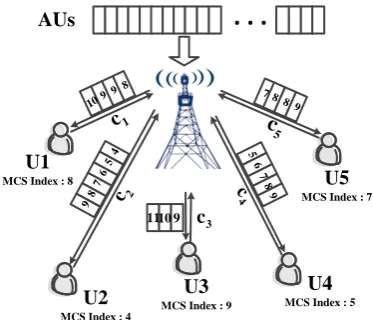
In LTE downlink transmission systems, we assume thatKactive mobile users are distributed in a cell, and the total number of AUs is denoted by N. The considered system is shown in Figure 1. There are five users in one cell. Vector [ ,1, ,1, , ]T
k = ck ck ck N
c indicates the Chan-nel Quality Indicator (CQI) of user k for N AUs. The boxes at the top of figure represent the total AUs in LTE systems. The eNB allocates AUs to each user according to the feedback of CQI. The numbers in the boxes are the MCS indexes of corresponding AUs. We can see the AUs allocated to the same user have different MCS in-dexes, and the MCS of the user is determined by the AU with worst channel condition [10].
1
c
2
c
3
c
4 c
5
c
. . .
AUs
98 7 8
8 9
U1
MCS Index : 8
9
10
U2
MCS Index : 4
1110
U3
MCS Index : 9
U4
MCS Index : 5
9
U5
MCS Index : 7 6
7 8 9
4 5
5 6
7 8
[image:2.595.316.542.380.504.2]9
Figure 1. System model of resource block allocation in LTE downlink systems.
Let ck n, denote the CQI of user k on AU n. The minimum data transmission rate of the user k is indicated byRk.rjis the symbol transmission rate for a given
Modulation and Coding Scheme (MCS)j, and J is the total number of MCS supported in the transmission [11]. Define Nau as the number of symbols for data transmis-sion in one AU. Set Ts as the OFDM symbol duration time. Then, the bit rate transmitted in one AU can be calculated by:
j
j au
au s r N r
T
= (1)
Variable ak n, represents the resource allocation indi-cator, with value 1 if AUn is allocated to user k and 0 otherwise. Furthermore, define the variable bk j, as the choice of MCS of user k, and bk j, =1 indicates that the MCS j is chosen for user k. The data rate achieved by user k can be described as:
, ,
1 1
N J
j
k k n k j au
n j
r a b r
= =
=
∑ ∑
(2)As the resource block allocation in this paper aims to achieve maximum sum data rate, the optimization prob-lem is formulated as follows:
,, , 1 1 , 1 ,
max
k n k j
N J
K
j k n k j au a b
k n j
a b r
= = =
∑∑ ∑
(3)Subject to:
,
k k
r ≥R ∀k (4)
, ,
1
1, n, {0,1}
K
k n k n
k
a a
=
= ∀ ∈
∑
(5), ,
1
1, , b {0,1}
J
k j k j
j
b k
=
= ∀ ∈
∑
(6)Constraint (3) is the objective function stating the achievable total rate, (4) ensures that each user can satis-fy its minimum data rate requirement, (5) means that one AU can only be allocated to one user, (6) presents the fact that each user must use the same MCS, which is de-termined by the AU with the worst channel condition. It should be pointed out that finding the optimal solution would face high computational cost, so the suboptimal algorithm with low complexity is preferable
3. Proposed Algorithm
[image:2.595.79.266.547.707.2]first step of proposed algorithm initially allocates re-source block by PF mechanism. The next step re-allocates the AUs with the worst channel condition of each user.
3.1. Initial Allocation Scheme
1) Estimating the number of required AUs:
In this paper, we calculate the number of AUs required based on the ratio of user’s minimum data rate require-ment to channel condition [4]. Let be the average CQI of user k. is defined as the number of AUs allocated to user k. should satisfy the following conditions:
(7)
which means the number of AUs each user needs is pro-portional to its minimum data rate requirement, and in-versely proportional to the average channel condition. The number of AUs allocated to user k is calculated by:
(8)
2) Calculating the priority of each user:
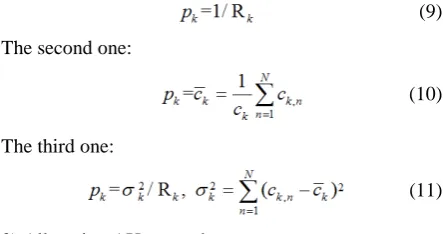
Reference [12] represents two methods to calculate the priority. The one is stated in Eq. (9), which means that the users with lower minimum rate requirements have higher priorities. The next one is formulated in Eq. (10), which indicates that the user with better channel condi-tion could be first allocated. In this paper, we adopt a new way to calculate user’s priority based on the va-riance of channel conditions and minimum data rate re-quirements simultaneously. The new method is given by Eq. (11), which implies that the user with better channel condition and lower data rate requirement has higher priority.
The first one:
(9)
The second one:
(10)
The third one:
(11)
3) Allocating AUs to each user
The initial allocation scheme is described in Table 1, which allocates AUs to the user k according to the users’ priorities and the number of AUs each user needs.
Meanwhile, the minimum data rate requirement of each user is guaranteed.
3.2. Re-allocation Scheme
In LTE systems, if AUs allocated to the same user have different channel qualities in terms of CQI, the MCS is determined by the lowest CQI to make sure that the data transmitted by each AU can be correctly received. Ob-viously, the users’ data rate is limited by the AUs with the worst channel condition, and the AUs with better channel condition cannot be made full use of. A solution for above problem is proposed, which is explained in
Figure 2. The number of AUs allocated to each user in
[image:3.595.317.532.548.733.2]Figure 2 is the same as Figure 1. Assuming that each AU only consists of one symbol, the symbol transmission rate can be found in Table 2. `Before' in Figure 2 is MCS index and data rate obtained by the user without removing any AUs. `DR' in Figure 2 is abbreviation of data rate. Take user 2 for example, if the AU with the worst channel condition is removed, MCS index of this user turns into 5, and the data rate of this user is in-creased. The dotted boxes indicate the removed AUs, Which is saved as free AUs to allocate to other users, such as the first AU adopted to user 3 is removed by user 2, and the MCS indexes of AUs allocated to user 3 turn into higher level.
Table 1. The Initial Allocation Scheme.
Initial Allocation
01. Estimate the number of AUs required by according to the Eqs. (8) and (9);
02. Calculate users' priorities based on the Eqs. (10), (11) or (12), and sort them in descending order;
03. Find out the first AUs with better channel condition
from available AUs for user ;
[image:3.595.66.288.575.692.2]Figure 2. The example to illustrate proposed scheme.
Moreover, there are several AUs remaining in practic-al applications after users have reached their minimum data rate requirements. Those remaining AUs should be assigned without changing the MCS of each user, that is to say, we allocate the remaining AUs to users, whose MCS are not higher than those of remaining AU. By this way, the total number of AUs allocated to some users is added, so the data rates achieved by these users are im-proved. The re-allocation scheme is stated in Table 2.
4. Simulation Results
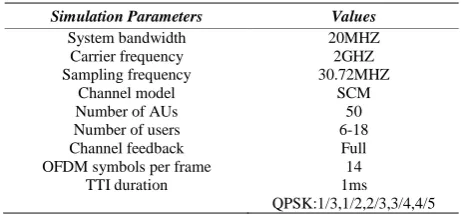
This section compares the performance of the proposed scheme, Qos algorithm [7], and PF algorithm [5] and max-rate algorithm. The simulation parameters are shown in Table 4. All simulations are obtained by aver-aging over 1000 channel realizations [13-14].
Table 2.MCS Table in LTE Systems.
MCS Index 1 2 3 4 5
r(bit/symbol) 0.1523 0.2344 0.3770 0.6010 0.8770
MCS Index 6 7 8 9 10
r(bit/symbol) 1.1758 1.4766 1.9141 2.4063 2.7305
MCS Index 11 12 13 14 15
r(bit/symbol) 3.3223 3.9023 4.5234 5.1152 5.5547
Table 3. The Re-allocation Scheme.
Re-allocation scheme 01. For k=1:K
02. AllocateNkAUs to userk, and calculaterkof this user;
03. While rk <Rk
04. allocate one more AU to the user; 05. End While
06. Calculate data rate ' k
r without allocation of AUs with
07. the worst channel condition; 08. If '
k k
r ≥r
09. Remove AUs with the worst channel condition. 10. Then k= +k 1, go to step 1;
11. End If 12. End For
[image:4.595.56.287.622.729.2]13. Allocate the remaining AUs to users, whose MCS are not higher than those of remaining AU.
Table 4. Simulation Parameters.
Simulation Parameters Values System bandwidth
Carrier frequency Sampling frequency
Channel model Number of AUs Number of users Channel feedback OFDM symbols per frame
TTI duration
20MHZ 2GHZ 30.72MHZ
SCM 50 6-18 Full 14 1ms
QPSK:1/3,1/2,2/3,3/4,4/5
Simulation Parameters Values Modulation and coding 16QAM:1/2,2/3,3/4,4/5
64QAM:2/3,3/4,4/5
To illustrate user’s fairness achieved by each algo-rithm, the fairness factor is introduced [2], which is stated as:
2 2
1 1
( ) /
K K
k k
k k
I T K T
= =
=
∑
∑
(12)where I is the fairness factor. Tk is the average data rate of user k. The closer the fairness factor obtained by algo-rithm approximates to 1, the better the fairness of the algorithm is.
Figure 3 compares fairness index of the proposed scheme, Qos algorithm, PF algorithm and max-rate algo-rithm. As the max-rate algorithm aims to maximize the system throughput without considering users' require-ments, it displays the worst in terms of fairness. With the increasing of the number of users, the fairness factor of max-rate algorithm is decreased sharply. The fairness factors of the other three algorithms are close. Their fairness factors are all more than 0.9 when the number of users is less than 14. The proposed algorithm exhibits the best fairness in these three algorithms, and Qos and PF algorithm are slightly lower than it.
6 7 8 9 10 11 12 13 14 0.65 0.7 0.75 0.8 0.85 0.9 0.95 1
The number of users
[image:5.595.64.282.85.268.2]F a irn es s f a ct o r Proposed algorithm Qos algorithm PF algorithm Max-rate algorithm
Figure 3. The fairness factors of four algorithms.
The unreached rate is used to illustrate the Qos guar-anteed of each algorithm. The smaller the unreached rates gained by the algorithm, the better the user’s Qos guaranteed is. The unreached rate can be calculated by:
1
, ,
0, otherwise
K
k k k k
u k k
k
R r R r
r P P
=
− >
= =
∑
(13)where ru is the total unreached rate in the system. rk
[image:5.595.310.537.89.471.2] [image:5.595.308.538.528.594.2]is the data rate achieved by user k. Pk is the unreached rate of user k.
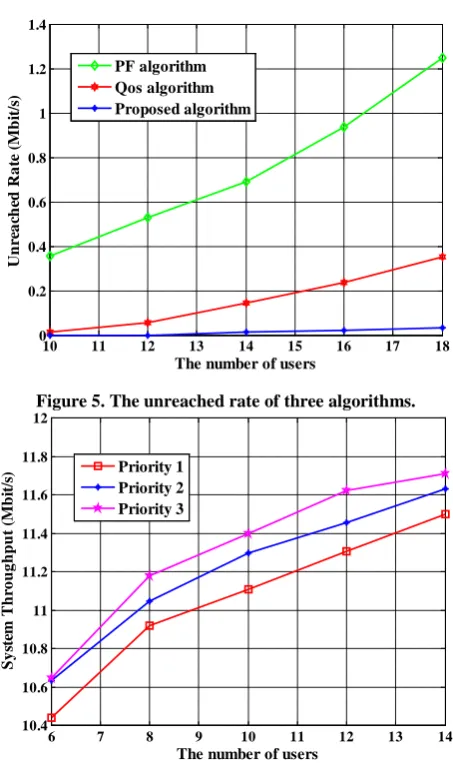
Figure 5 demonstrates the unreached rate of the users among the proposed algorithm, Qos algorithm, and PF algorithm. The PF algorithm allocates AUs without con-sidering the requirements of users, so unreached rates gained by PF algorithm rapidly increase as the number of users increases. It can be found that Qos algorithm guar-antees users' requirements well, and the unreached rate achieved by Qos algorithm is not too high. The proposed algorithm keeps the unreached rate at the lowest level,
6 7 8 9 10 11 12 13 14
9.5 10 10.5 11 11.5 12
The number of users
Sy st em T hr o ug hput ( M bi t/ s) PF algorithm Qos algorithm Proposed algorithm Max-rate algorithm
Figure 4. System throughput of four algorithms.
10 11 12 13 14 15 16 17 18
0 0.2 0.4 0.6 0.8 1 1.2 1.4
The number of users
U n rea ch ed R a te ( M b it /s ) PF algorithm Qos algorithm Proposed algorithm
Figure 5. The unreached rate of three algorithms.
6 7 8 9 10 11 12 13 14
10.4 10.6 10.8 11 11.2 11.4 11.6 11.8 12
The number of users
Sy st em T hr o ug hput ( M bi t/
s) Priority 1 Priority 2 Priority 3
[image:5.595.61.284.530.710.2]Figure 6. System throughput of proposed algorithm with different methods for determining the priorities.
Table 5. Computational complexity of four algorithms.
Algorithms Max-rate PF Qos Proposed
Initial allocation Qos guarantee Re-allocation Total complexity ( ) O KN \ \ ( ) O KN 2 ( ) O KN \ \ 2 ( ) O KN 2 ( ) O KN ( ) O KN \ 2 ( ) O KN 2 ( ) O KN ( ) O KN ( ) O KN 2 ( ) O KN
close to zero. The unreached rate attained by proposed algorithm is not more than 0.1 Mbit/s when the number of users is less than 18.
Table 5 shows the computational complexity of the four algorithms. We can easily learn that the complexity of max-rate algorithm is O KN( ), and the complexity of PF and Qos algorithm are all O KN( 2). For the proposed
algorithm, the complexity of initial allocation is O KN( 2),
and the complexity of re-allocation scheme is O KN( ), Therefore, the overall complexity of proposed algorithm is O KN( 2)+O KN( )=O KN( 2). It is observed that, the
proposed algorithm gains the quadratic complexity, which is the same as that of PF and Qos algorithm. The last column of Table 5 explains that the max-rate algo-rithm gets the lowest computational complexity, and the other three algorithms have the same computational complexity.
5. Conclusions
In this paper, we propose a two-step resource block allo-cation algorithm for LTE downlink systems. The first step of proposed algorithm initially allocates AUs to each user based on the proportional fairness scheme. Then, the proposed scheme re-allocates the AUs with the worst channel condition of each user to improve the perfor-mance restriction by those AUs. The algorithm can pro-vide us with a higher data rate and a flexible allocation scheme, and ensures the user's fairness. Simulation re-sults show that the proposed algorithm provides higher throughput and ensures the fairness of each user.
REFERENCES
[1] G. Ioannis, Fraimis and S. A. Kotsopoulos, “QoS-Based Proportional Fair Allocation Algorithm for OFDMA Wireless Cellular Systems,” IEEE Communications Let-ters, Vol. 15, No.10, 2011, pp. 1091-1093.
[2] C. F. Tsai, C. J. Chang, F. C. Ren and C.-M. Yen, “Adap-tive Radio Resource Allocation for Downlink OFD-MA/SDMA Systems with Multimedia Traffic,” IEEE Trans. Wireless Commum., Vol. 8, No. 5, 2009, pp. 2927-2937.
[3] J. C. Fan, Q. Y. Yin, G. Li and B. G. Peng, “Adaptive Block-Level Resource Allocation in OFDMA Networks,”
IEEE Transactions on Wireless Communications, Vol. 10, No. 11, 2011. pp. 3966-3972.
[4] Leinonen, Jouko, Hamalainen, Juntti and J. Markku, “Performance Analysis of Downlink OFDMA Resource Allocation with Limited Feedback,” IEEE Transactions on Wireless Communications, Vol. 8, No. 6, 2009, pp.
2927-29
[5] R. Kwan, C. Leung and J. Zhang, “Proportional fair mul-tiuser scheduling in LTE,” IEEE Signal Processing Let-ters, Vol. 16, No. 6, 2009, pp. 461-464.
[6] I-Hong Hou, Chungshu Chen, “Self-Organized Resource Allocation in LTE Systems with Weighted Proportional Fairness,” Proceedings of the IEEE International Confe-rence on Communications, Ottawa, June 2012, pp. 5348-5354.
[7] Y. Q. Zhou, L. Tian, G. Sun and J. L. Shi, “QoS guaran-teed resource block allocation algorithm for LTE sys-tems,” Proceedings of the IEEE 7th International Confe-rence onWiMob, Wuhan, Oct. 2011, pp. 307-312. [8] R. Kwan, C. Leung and J. Zhang, “Resource allocation in
an LTE cellular communication system,” Proceedings of the IEEE International Conference on Communications,
Dresden, June 2009, pp. 1-5.
[9] L. Q. Zhao, Y. Qin, M. Ma, X. X. Zhong and L. Li, “QoS Guaranteed Resource Block Allocation Algorithm in LTE Downlink,” Proceedings of the 7th International ICST Conference on CHINACOM, Kun Ming, Aug. 2012, pp. 425-429.
[10] L. Sun, P. Wang and F. Q. Liu, “Particle Swarm Optimi-zation based Resource Block Allocation Algorithm for Downlink LTE Systems,” Proceedings of the 18th Asia-Pacific Conference on Communications, Jeju Island, Oct. 2012, pp. 970-974.
[11] J. C. Fan, Q. Y. Yin, G. Y. Li, B. G. Peng and X. L. Zhu, “MCS Selection for Throughput Improvement in Down-link LTE Systems,” Proceedings of the 20th International Conference on ICCCN, Maui HI, Aug. 2011, pp. 1-5. [12] C. C. Wen, C. J. Chang and L. C. Wang, “An Intelligent
Priority Resource Allocation Scheme for LTE-A Down-link Systems,” IEEE Commun. Lett., Vol. 1, No. 3, 2012, pp. 241-244.
[13] 3GPP TS 36.211 v.9.1.0, Evolve Universal Terrestrial Ratio Access; Physical Channel and Modulation, May 2010.