Corner-Based Image Alignment using Pyramid Structure
with Gradient Vector Similarity
Chin-Sheng Chen1, Kang-Yi Peng1, Chien-Liang Huang1, Chun-Wei Yeh2
1
Graduate Institute of Automation Technology, National Taipei University of Technology; 2Department of Electronic, Electrical & Computer Engineering University of Birmingham, UK.
Email: [email protected], [email protected], [email protected], [email protected]
Received May, 2013.
ABSTRACT
This paper presents a corner-based image alignment algorithm based on the procedures of corner-based template matching and geometric parameter estimation. This algorithm consists of two stages: 1) training phase, and 2) matching phase. In the training phase, a corner detection algorithm is used to extract the corners. These corners are then used to build the pyramid images. In the matching phase, the corners are obtained using the same corner detection algorithm. The similarity measure is then determined by the differences of gradient vector between the corners obtained in the template image and the inspection image, respectively. A parabolic function is further applied to evaluate the geometric relationship between the template and the inspection images. Results show that the corner-based template matching outperforms the original edge-based template matching in efficiency, and both of them are robust against non-liner light changes. The accuracy and precision of the corner-based image alignment are competitive to that of edge-based image alignment under the same environment. In practice, the proposed algorithm demonstrates its precision, efficiency and robustness in image alignment for real world applications.
Keywords: Corner-Based Image Alignment; Corner Detection; Edge-Based Template Matching; Gradient Vector
1. Introduction
In automatic optical inspection (AOI) systems, speed, precision, and robustness are the key requirements in real world applications. The technique of image alignment can be used to achieve these requirements. The common image alignment technology can be categorized into two kinds [1]: (1) area-based matching, and (2) feature-based matching. In the area-based template matching, normal- ized cross correlation (NCC) method is a popular one that can be used to evaluate the degree of similarity be- tween template and scene images. However, it is not ro- bust against non-liner light changes and occluded objects [2].
The main advantage of the feature-based image align- ment is its efficiency. Chen et al. [1,3] proposed an im- age alignment algorithm based on Fourier descriptor. This is a kind of feature-based alignment algorithm, so-called contour-based image alignment. Here, the Fou- rier descriptor is used to describe the contour information of an object. The contour information is extracted using the maximally stable extremal regions (MSER) method. The MSER method can be used to effectively extract the contour information in an unstable environment. How- ever, the contour-based alignment algorithm is based on
the contour information that has been strongly influenced by the results of segmentation. Thus, this algorithm is not suitable for occluded object recognition.
To adapt the complicated environment for template matching, Steger [4] presented a similarity measure based on the difference of gradient direction in edges that is robust against non-linear illumination changes, and it can also be utilized to recognize occluded objects. How- ever, the computation of this similarity measure is not efficient enough for real-time applications.
To speed up the computation of the edge-based simi- larity measure, we have presented a corner-based simi- larity measure that is based on the difference of gradient direction in corners instead of in edges. This corner- based similarity measure has the same characteristic with the edge-based similarity measure as mentioned before. Additionally, we have further developed a corner-based template matching algorithm based on the presented similarity measure. A corner-based image alignment combines two procedures of the corner-based template matching and geometric parameter estimation.
Moravec [5] detected corners using a rectangular window that these corners are determined according to the varia- tion of intensity. Harris and Stephens [6] improved the algorithm of Moravec to reduce the noise of the image. Smith [7] further used a circular window instead of a rectangular window to detect corners. Tran [8] consid- ered the geometric relationship of corners with their gray values. Tran’s method has been adopted in the corner- based template matching because of its efficiency and robustness for corner detection.
2. Architecture of the proposed image
alignment algorithm
The flow chart of this algorithm is shown in Figure 1. The algorithm consists of two phases, including a training phase and a matching phase.
The corner points are obtained by the intuitive corner detection, and the gradient of corner points are deter- mined using Sobel operator. The corner-based pyramid image technique is used to speed up the computation in the matching process. Here, the corner-based pyramid image is constructed by using the geometric relationship between each corner point. The similarity measure used here is based on the difference of gradient direction of corner points instead of that of edges points. It can therefore decrease the complexity of computation in the matching process.
3. Corner-Based Image Alignment
Algorithm
There are four parts in the corner-based image alignment algorithm, including: 1) intuitive corner detection; 2) corner-based pyramid image; 3) similarity measure and search strategy; 4) refinement. The detail of each part is described in the following subsections.
3.1. Intuitive Corner Detection
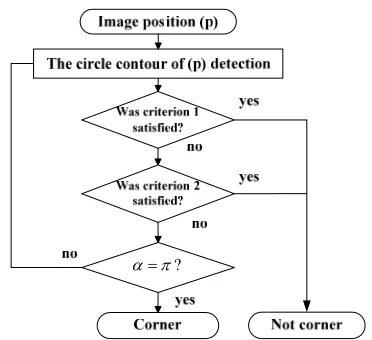
Chen [9] proposed an intuitive corner detection, and it is much faster than Harris corner detector. Hence, the intui- tive corner point extraction algorithm has been adopted here. Figure 2 shows the flow chart of the intuitive corner point extraction algorithm. This method makes a circle around and detects all the candidate points. There are two criterias to check each interesting point whether it is a corner or not.
p
p
The two criteria are defined as: Criterion 1
1
1I p I pdR and I p I pdR
Criterion 2
2 2
( ) ( 2) ( ) ( 1)
I pdR I a and I pdR I a where pdRandpdR are two diametrically opposed
pixels on the circle point p. dR
Rcos , sin R
, Rbeing a chosen radius and varying in the range [0, ]. I(p) is the intensity of center, and
) (p dR
I
)
dR p
(
I are the intensity of a pair of diametrically opposed pixels.
*
[image:2.595.307.535.153.365.2]
Figure 1. Architecture of the proposed algorithm.
?
Figure 2. Architecture of the feature point extraction algo- rithm.
Criterion 1 is a first step to detect whether the candi- date point is corner or not. If the two diametrically op- posed pixels have approximately the same intensity (smaller than a threshold 1), we will decide that this
[image:2.595.329.515.394.564.2]3.2. Corner-Based Pyramid Image
[image:3.595.334.518.264.330.2]The image pyramid technique represents the original image in the multiple resolutions using a factor of k in each level. The image pyramid architecture is shown in Figure 3. In general, the basic image pyramid is an im- age array. The width and the height of each level are re- duced using a factor, k, compared with the previous level. The pixel value at level l in the image pyramid is constructed from the previous level. To reduce the computational complexity, we use the mean operator to obtain the pixel values at level l. Based on the image pyramid technique; the appropriate number of levels is mainly defined by the size of the template. On the top pyramid level, the relevant features of the template should be distinguished. Figure 3 shows the MCU image using the image pyramid technique, and the number of pyramid levels is equal to 3. In the level 3 of the image pyramid, the features of the template is difficult to be recognized. Consequently, we can only set the top level up to 2 in the image pyramid.
) , (i j fl
The feature points, so-called intuitive corner points, can be used to evaluate the similarity measure between the template and the inspection images. As mentioned in Section 3.1, this corner detector usually obtains several positive responses that simultaneously satisfy Criterion 1 and Criterion 2 around the corner locations.
We adopted a score computed in each response that retains the local optimum locations as corner. The Lapla- cian of Gaussian (LOG) is a commonly used score that has been proven to obtain stable corners. It could be ap- proximated up to a scale factor by:
0
LOG p I p dR I p I p dR
(1)According to image pyramid technique, the higher level images are blurred by using mean operator. Thus, the locations of the feature points are unstable.
To improve the robustness of the feature points, we have proposed a new criterion, which is based on the geometric relationship for constructing the image pyra- mid structure. This criterion uses the feature points to build the image pyramid structure. In the corner pyramid image (CPI), the width and the height of each level are reduced using factor kc. At level l, the pixel value
is obtained from the previous level, i.e., ( , )
l
pf i j
1 ( , ) arg max( ( ( , )))
l l
pf i j LOG p i j (2) where is obtained using a maximum LOG value in each specific region. The size of the region is
, and i and represent the location of the specific region at the previous level l-1.
( , )
l
pf i j
[image:3.595.332.515.357.530.2]NN j
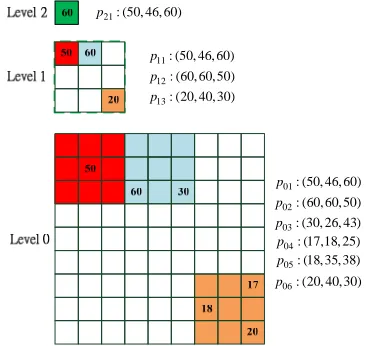
Figure 4 illustrates a simple example of the CPI struc- ture which has 3 levels and the specific region is a 3 3 mask. There are 9 regions in level 0, where 3 regions
including the corners indicated as red, blue, and orange are demonstrated the process of gradient vector inheri- tance between two consequent levels. Here, the LOG values are used to suppress the non-maximum value in 3 3 mask. As shown in Figure 4, the corners in level 0, level 1 and level 2 are 0 , i=1…6,
1 , i=1, 2, 3 and 2 , i=1, respectively. In this case, the corners 01, , and 06 in level 0 are inherited to 11, 12, and 13 cor-
responding to red, blue, and orange regions in level 1. And the gradient vectors of the corresponding three points are stored in 11, 12and 13. Similarly, the
point 12 is inherited to point in level 2, and the
gradient vector is also stored in . ( , ,
i
p LOG Gx Gy
( ,
i
p LOG Gx p p p
p p
21
p
21
p
)
) )
( OG Gx Gy, ,
p
i
p L
p
,Gy
02
p p
p
Figure 3. The images of the image pyramid technique.
01: (50, 02: (60, 03: (30, 04: (17, 05: (18, 06: (20, 21: (50, 46, 60)
p
4 p
60 p
2 p
18 p
3 p
4 p
11: (50, 46, 60)
p
12: (60, 60, 50)
p
13: (20, 40, 30)
p
[image:3.595.320.530.568.627.2]6, 60) , 50) 6, 43) , 25) 5, 38) 0, 30)
Figure 4. The CPI architecture, the levels of this case is equal to 2.
(a) (b) (c)
Figure 5. The results of Intuitive corner detection on con- ventional image pyramid and CPI. (a) The original image, (b) The CPI at level 1 (N = 3), (c) The conventional image pyramid at level 1.
conventional method abandons damages the original structure. The CPI is more robust and stable to the con- ventional one with the image pyramid technique.
These feature points will be considered in the deter- mination of the similarity measure between the template and the inspection image. The detail of the similarity measure is described in next section.
3.3. Similarity Measure and Search Strategy
Similarity measure is used to recognize the template ex- isted within the scene image. The use of the difference of gradient direction shows its robustness to light changes. The gradient of the selected corner points with the coor- dinate information are stored as the template model which contains a set of points . These points are relative to the center of gravity, and the feature points of the template are represented using gradients
, . The points and their corre- sponding gradients are respectively denoted as
and , ,
i i i i
i r c r c , , in the candidate objects. If there is not rotation angle between the template and the inspection image, the similarity measure is defined as follows
( , )T
i i i
p x y
)T i1, , ( , )T
i i i
d t u
( , )T
i i i
q r c
1, ,
i
e v
n
n
( ,w
, ,2 2 2 2
1
, ,
1
, i i i i
i i i i
n
i x r y c i x r y c
i
i x r y c i x r y c
x y n
t v u wt u v w
(3)
where n is the amount of the feature point.
In contrast, if there is a rotation angle between the template and the search image, the similarity measure should be modified by
, ,
2 2 2 2
1 , ,
1
( , , ) i i i i
i i i i
n
i x r y c i x r y c
eg
i i x r y c i x r y c
x y n
t v u wt u v w
(4)
where
is a rotation angle; the is the gradient vectors after rotation.( , )T i i
t u
Perfect match corresponds to 1 in similarity measure. The search strategy will be the subject of a separate pa- per.
3.4. Refinement
The rotation angle is obtained using the neighbor- hood of that notes - 2 opt, opt, opt and
opt
2 . The optimal rotation angle is defined as
1 2 cos 1 opt d l
(5)
where is the maximum distance between the corner point and the center, is the pixel displacement. The d is equal to 1 here. The above five rotation angles and their corresponding similarity coefficients are fed into the fitting model to obtain the refinement angle. The compu- tation of the best-fitting parabola is achieved by solving a
system equation, where each rotation angle provides one equation of the form
l
d
2, 1...5
i i i i
(6) The whole system can be written as
(7) The three unknown parameters , and , rep- resented by vector in the Eq. 7, are calculated from the known variables
X
i and i (matrix and
vector in the Eq. 7, respectively). Taking the values of i for the five nodes described above, the matrix
and the vector are filled with these five nodes as:
2 2 2 2 1 1 2 2 1 1 2 2 2 2 1 1 1, = 1
1 1 2 1 n n n n n n n n n n n n n n n
. (8)
The following equation yields the three unknown pa- rameters , and as:
1T T
(9)
After the determination of the parabola parameters ,
and , the optimal refinement angle * can be cal-culated by
*
/ 2
(10)
4. Results and Discussion
The experiments are divided into three cases as (1) rota- tion estimation, (2) computation cost and (3) robustness for comparison. Figure 6 shows the two cases of the in- spection images and their corresponding template images. The sizes of two template images are 160120 and 120110, respectively, and the inspection images are 640480 and 512512, respectively. These experiments were performed with Visual C++ on Intel core i3 530 2.93 GHz with 4GB of memory.
4.1. Rotation Estimation
(a) (b)
Figure 6. The inspection image and template image: (a) Case 1: PCB image, (b) Case 2: BGA image.
(a)
(b)
[image:5.595.57.289.180.441.2]Figure 7. The comparison in accuracy for different cases in the corner-based and edge-based alginment algorithms, respectively: (a) Case 1: PCB image, (b) Case 2: BGA im-age.
Table 1. The alignment results.
Proposed image alignment
Edge-based image alignment
Case 1 Case 2 Case 1 Case 2
Average error (o) 0.124 0.144 0.273 0.297
Standard deviation
error (o) 0.144 0.167 0.321 0.342
angle. As can be seen, the corner-based image alignment outperforms the edge-based one in accuracy and preci- sion estimation of Case 1 and Case 2.
This interprets that the corners obtained from the tem- plates of Case 1 and Case 2 are more distinctive than the edges. Although our algorithm demonstrates that it is more accurate and precise than the edge-based one for rotation estimation in these two cases, it would be failure when none or only fewer corners are obtained from the images. This means that we have to select the template
[image:5.595.307.537.209.462.2]image carefully in corner-based image alignment. 4.2. Computation Cost
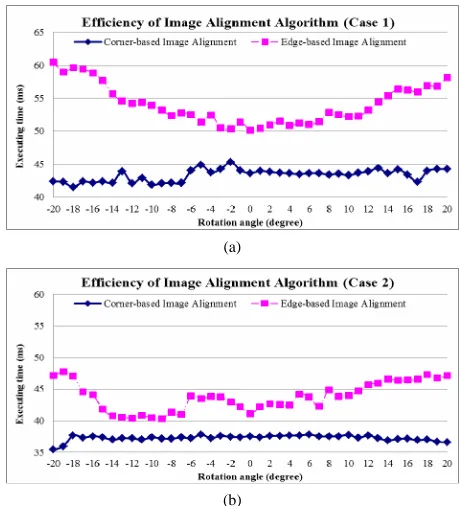
Figure 8 shows the computation cost of the two com- pared alignment algorithms. These figures clearly show that our algorithm is more efficient than edge-based one in these two cases. The average computation times of the proposed algorithm in Case 1 and Case 2 are 43.3 ms and 37.25 ms, respectively.
(a)
(b)
Figure 8. Executing time of case 1 and case 2 with the com-peting method.
The computation cost of the corner-based and the edged-based algorithms are both influenced by the amount of feature points. Hence, the corner points are used in similarity measure calculation and pyramid im- age reconstruction instead of using edge points to speed up the computation. Results interpret that this is an effec- tive way to simultaneously reduce the computational complexity and remain the accuracy for image align- ment.
4.3. Robustness
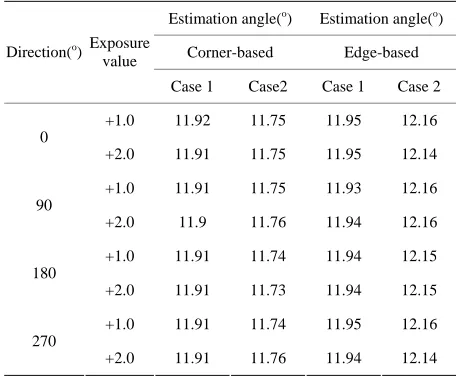
[image:5.595.60.286.516.603.2]shows that it is comparative to the edge-based one in robustness evaluation. Both of the corners and the edges were not influenced by the illumination variation in this experiment.
(a) (b)
[image:6.595.66.286.147.236.2]Figure 9. (a) Case 1: PCB image, (b) Case 2: BGA image.
Table 2. The image alignment results for robust test.
Estimation angle(o) Estimation angle(o)
Corner-based Edge-based Direction(o) Exposure
value
Case 1 Case2 Case 1 Case 2
+1.0 11.92 11.75 11.95 12.16 0
+2.0 11.91 11.75 11.95 12.14
+1.0 11.91 11.75 11.93 12.16 90
+2.0 11.9 11.76 11.94 12.16
+1.0 11.91 11.74 11.94 12.15 180
+2.0 11.91 11.73 11.94 12.15
+1.0 11.91 11.74 11.95 12.16 270
+2.0 11.91 11.76 11.94 12.14
5. Conclusions
The main contribution of the corner-based image align- ment algorithm is to introduce the corner-based pyramid image (CPI) and the corner-based similarity measure. The CPI architecture and the intuitive corner detection are integrated to improve the efficiency and robustness in the matching process. The gradient vectors of corner points are considered in the corner-based similarity measure. Results show that the proposed corner-based algorithm outperforms the edge-based one in accuracy and efficiency estimation for the two cases. The robust- ness of the proposed algorithm is also competitive to the
edge-based one. This algorithm especially suits to the template image which contains enough distinctive cor- ners. In the nearly future, the search strategy and the full comparison of NCC-based, edge-based and corner-based similarity measures for image alignment will be pre- sented in a separate paper.
REFERENCES
[1] C. S. Chen, “A Novel Fourier Descriptor Based Image Alignment Algorithm for Automatic Optical Inspection,”
Journal of Visual Communication and Image Representa-tion, 2009, pp. 178-189. doi:10.1016/j.jvcir.2008.11.003
[2] S. D. Wei and S. H. Lai, “Fast Template Matching Based on Normalized Cross Correlation with Adaptive Multilevel Winner Update,” IEEE Transactions on Image
Processing, Vol. 17, No. 11, 2008, pp. 2227-2235.
doi:10.1109/TIP.2008.2004615
[3] C. S. Chen, C. L. Huang and C. W. Yeh, “An Efficient Sub-Pixel Image Alignment Algorithm Based on Fourier Descriptor,” Advanced Science Letters, Vol. 9, No. 1, 2012, pp. 762-766. doi:10.1166/asl.2012.2537
[4] C. Steger, “Similarity Measures for Occlusion, Clutter, and Illumination Invariant Object Recognition,” Lecture
Notes in Computer Science, Vol. 2191, 2001, pp.
148-154.
[5] H. P. Moravec, “Toward Automatic Visual Obstacle Avoidance,” Proc. Fifth of International Joint Conference
on Artificial Intelligence, Vol. 1, Cambridge, MA, August
1977, pp.584.
[6] C. Harris and M. Stephens, “A Combined Corner and Edge Detector,” Proc. of 4th Alvey Vision Conference,
Manchester, 31 August – 2 September 1988, pp. 147-151. [7] S. M. Smith and J. M. Brady, “SUSAN-A New Approach
to Low Level Image Processing,” International Journal
of Computer Vision, Vol. 23, No. 1,1997, pp. 45-78.
doi:10.1023/A:1007963824710
[8] T. T. H. Tran and E. Marchand, “Real-Time Key points Matching: Application to Visual Servoing,” IEEE
Con-ference on Robotics and Automation, Roma, 10-14 April
2007, pp.3787-3792.
[9] C. S. Chen, Y. H. Ku and S. H. Tsai, “Fast Object Recog-nition Based on Corner Geometric Relationship,” SICE
Annual Conference, Taipei, 18-21 August 2010, pp.
[image:6.595.57.285.279.467.2]