Munich Personal RePEc Archive
Fairness and Desert in Tournaments
Gill, David and Stone, Rebecca
University of Southampton
12 January 2010
Online at
https://mpra.ub.uni-muenchen.de/21322/
Fairness and Desert in Tournaments *
David Gill
; aRebecca Stone
b01 January 2010
Abstract
We model the behavior of agents who care about receiving what they feel they deserve
in a two-player rank-order tournament. Perceived entitlements are sensitive to how hard an
agent has worked relative to her rival, and agents are loss averse around their
meritocrati-cally determined endogenous reference points. In a fair tournament su¢ciently large desert
concerns drive identical agents to push their e¤ort levels apart in order to end up closer to
their reference points on average. In an unfair tournament, where one agent is advantaged,
the equilibrium is symmetric in the absence of desert, but asymmetric in the presence of
desert. We …nd that desert concerns can undermine the standard conclusion that
competi-tion for a …xed supply of status is socially wasteful and explain why, when the distribucompeti-tion
of output noise is fat-tailed, an employer might use a rank-order incentive scheme.
Keywords: Desert, Equity, Tournament, Loss Aversion, Reference-Dependent Preferences, Reference Point, Psychological Game Theory, Status, Relative Performance Evaluation
JEL Codes: D63, J33
* Thanks to Jacob Goeree, Meg Meyer, David Myatt, and Matthew Rabin for comments and sugges-tions on a very preliminary version of this paper, as well as to Roman Sheremeta and seminar audiences at Essex, George Mason, Oxford, Southampton, Warwick and Wissenschaftszentrum Berlin. Finally, David Gill would like to thank Trinity College, Oxford, where this research was initiated.
** Corresponding author. Email: [email protected]. Phone: +44 (0) 77 1475 6170.
a Division of Economics, School of Social Sciences, University of Southampton, Southampton SO17
1BJ, United Kingdom.
bUS Court of Appeals for the Seventh Circuit, Chambers of Judge Richard A. Posner, 219 S Dearborn
1
Introduction
Rank-order tournaments, where agents compete for a …xed prize or set of prizes, are ubiquitous.
Promotional tournaments are common in consulting, law partnerships, academia and industry.
Firms frequently use bonus schemes based on relative performance. Sports contests,
examina-tions, patent races, elections and competition for status can all be thought of as tournaments.
We claim that in a competitive setting such as a tournament, agents often care about receiving
their ‘just deserts’. We adopt a meritocratic notion of desert according to which an agent’s
perceived entitlement will be sensitive to how hard she has worked relative to her rival.
Desert-motivated agents will feel hard done by if they receive less than what they perceive to be their
fair recompense, while feelings of elation or guilt are possible if they do better than they deserve.
We analyze how the introduction of desert alters equilibrium play and payo¤s in tournaments,
and we apply our …ndings to analyze competition for status/rank and the design of incentive
schemes.
While little work has been carried out to formally introduce desert concerns into a theoretical
economic model,1 there exists an empirical literature which supports the idea that people are
indeed motivated by a meritocratic notion of desert. According to a review of relevant literature
by Konow (2003), “a common view is that di¤erences owing to birth, luck and choice are all
unfair and that only di¤erences attributable to e¤ort are fair” (pp. 1207-1208). Konow (1996)
distills anaccountability principle from the responses to his attitude survey according to which
a person’s entitlement varies in direct proportion to the value of his relevant discretionary
variables, relative to others (p.19). This is closely related to the claims of equity theory, a social
psychological theory of fairness that has its origins in Aristotle’s claim that the equitable ratio
of outcomes is proportional to the ratio of inputs (Konow, 2003). In its modern manifestation
equity theory goes back to Adams (1965), whose work led him to conclude that “when [a
person] …nds that his outcomes and inputs are not in balance in relation to those of others,
feelings of inequity result” (p. 280) and that “there can be little doubt that inequity results in
dissatisfaction, in an unpleasant emotional state, be it anger or guilt” (p. 283). The signi…cance
of equity theory is also noted by Rabin (1998) who writes that “desert will obviously be relevant
in many situations - and the massive psychological literature on ‘equity theory’ shows that
people feel that those who have put more e¤ort into creating resources have more claim on
those resources” (p. 18).
Experimental economics provides further evidence in favor of the idea that people are
sen-sitive to considerations of desert. In a bargaining experiment, Burrows and Loomes (1994) …nd
1 An exception is Konow (2000) who develops a model in which people are in‡uenced by the departure of the
that bargained outcomes tend to exhibit greater inequality, awarding higher …nal payo¤s to the
party that began with a greater initial endowment, when endowments were allocated according
to parties’ performances in a simple word game than when the endowments were allocated at
random. They conclude that the results of their experiment are consistent with the proposition
that “many people believe that when di¤erent individuals have a similar ability and
opportu-nity to put in e¤ort, those that put in more e¤ort should get a greater reward because they are
relatively deserving” (p. 220). Konow (2000), Frohlich et al. (2004) and Cappelen et al. (2007)
provide evidence that, in their allocation decisions, dictators are sensitive to agents’ relative
e¤orts or investments. Frohlich et al. state that“the just deserts response is modal” (p. 109).2
We suppose that two agents compete in a Lazear and Rosen (1981) type simultaneous-move
rank-order tournament and that each agent is sensitive to deviations of her monetary payo¤ from
an endogenous reference point given by her perceived entitlement. We assume that these desert
payo¤s are more steeply increasing in the loss domain than the gain domain. This captures the
central stylized fact - loss aversion - that has emerged from the empirical literature on
reference-dependent preferences more generally (Kahneman and Tversky, 1979; see also Rabin, 1998, for
a survey).3 As one agent’s undeserved bonus entails another’s undeserved loss, we might expect
any sensation of elation the agent experiences as a result of having her reference point exceeded
to be somewhat muted. Indeed, our model permitsdesert guilt, whereby exceeding the reference
point is painful.
We consider fair tournaments, in which the agents are identical, and unfair tournaments,
in which one agent is given an advantage. In a fair tournament, or an unfair one in which the
advantage is felt to be fully deserved, the reference point is given by the agent’s expected payo¤
given the chosen e¤ort levels.4 The idea is that an agent’s average payo¤ is a re‡ection of the
useful e¤ort she has exerted relative to her rival and thus plausibly represents the proportion
of the prize that she feels she deserves. In an unfair tournament in which the advantage is not
felt to be fully deserved, the reference point is given by the counterfactual expected payo¤ had
the advantage been as big as is felt to be deserved.
If desert payo¤s are falling in the gain domain, then desert preferences will be structurally
similar to the preferences of the inequity-averse agents of Fehr and Schmidt (1999).5 However,
desert payo¤s are de…ned with respect to a di¤erent reference point. Inequity-averse agents
2 Güth (1988) surveys some earlier relevant experimental evidence.
3 In the speci…c context of fairness judgments, Kahneman et al. (1986) …nd strong evidence for loss aversion. People
apparently perceive that it is more important that …rms avoid hurting customers relative to a “fair” reference transaction than that they attempt to increase customer surplus relative to this reference level.
4 Experimental evidence from the psychology literature supports the thesis that agents’ emotional responses when
receiving the payo¤ associated with a lottery depend on expectations. See, for instance, Mellers (1999).
exhibit a preference for equality of payo¤s across agents in a reference group: when there are
only two agents in the group, each agent’s reference point is simply the payo¤ of the other agent.
By contrast, in our setup reference points are functions of agents’ e¤ort levels. In this sense, our
agents adopt a more sophisticated conception of fairness than those of Fehr and Schmidt. They
care about the relationship between the distribution of material payo¤s and the distribution of
agents’ e¤orts, not just about the brute distribution of material payo¤s.6
The structure of our agents’ preferences also clearly resembles that of other models of
reference-dependent preferences such as Kahneman and Tversky (1979) and K½oszegi and Rabin
(2006). However, the reference point of the value function in Kahneman and Tversky’s (1979)
Prospect Theory is exogenous, while our reference points are endogenously determined (since
they depend on agents’ e¤orts). K½oszegi and Rabin’s (2006) agents are sensitive to deviations
from their endogenous expectations, but they consider only a single agent problem and the
reference point is not sensitive to the agent’s actual choices, instead depending on her prior
expectations. Models of disappointment aversion (e.g., Bell, 1985; Loomes and Sugden, 1986;
K½oszegi and Rabin, 2007, Sect. IV) allow the expectations-based reference point to depend on
an agent’s chosen action. Assuming elation rather than desert guilt, and when the reference
point is given by the expected payo¤—which will be the case in fair tournaments or unfair
tour-naments where each agent’s (dis)advantage is felt to be deserved—our model can be interpreted
as an extension of disappointment aversion to strategic situations in which agents compete. Gill
and Prowse (2009) provide experimental evidence for disappointment aversion in a
sequential-move tournament. However, in unfair tournaments in which each agent’s relative (dis)advantage
is not felt be to be deserved, desert and disappointment aversion come apart, which suggests
a way to distinguish desert and disappointment aversion experimentally, a possibility discussed
in Section 4.2.
Summary of Findings
In the absence of desert, there is a unique and symmetric Nash equilibrium in both fair and
unfair tournaments, as winning probabilities are a function of the di¤erence in the agents’ e¤orts
in a Lazear and Rosen (1981) type tournament.
In a fair tournament, weak desert concerns do not a¤ect this equilibrium. However,
su¢-ciently large desert concerns drive the identical agents to push their e¤orts apart. Intuitively,
when the agents exert the same e¤ort, one ends up winning and the other losing even though
6 Extending Fehr and Schmidt’s notion of inequity aversion to allow aversion to di¤erences in payo¤s net of e¤ort
neither is more deserving than the other. The greater the di¤erence in the agents’ e¤orts, the
greater the probability that an outcome emerges in which the more hardworking and therefore
more deserving agent wins and the closer on average are both agents’ reference points to their
actual payo¤s.
In an unfair tournament, the equilibrium can no longer be symmetric: the advantaged agent
has a stronger marginal incentive to exert e¤ort as she is more likely to win and so su¤ers
less in expectation from increasing her deserved reference point. In a linear example, we show
that as the strength of desert preferences, the size of the advantage and the extent to which the
advantage is felt to be deserved go up, the di¤erence between the advantaged and disadvantaged
agents’ e¤orts increases.
We develop two applications of our model. First, we …nd that desert concerns can undermine
the standard conclusion that competition for a …xed supply of status is socially wasteful. Second,
we consider an employer’s choice of relative performance compensation scheme, …nding that an
employer prefers a tournament to relative performance pay linear in the di¤erence in employees’
outputs when the distribution of output noise is su¢ciently fat-tailed. Thus, we provide a new
explanation for why employers might choose to use tournament-style incentive schemes.
The paper proceeds as follows. Section 2 sets out the model. Section 3 derives general
results. Section 4 presents a linear example. Section 5 considers the two applications. Section
6 concludes. Omitted proofs are provided in the appendix.
2
Model
Two agents are competing to win a …xed prize of monetary value v >0 in a Lazear and Rosen
(1981) type rank-order tournament.7 (Later, in Section 5, the prize will be chosen optimally by a
…rm.) The agents simultaneously choose e¤ort levelsei 2[0;1)and share a twice continuously
di¤erentiable cost function C(ei); where C(0) = 0; C0(0) 0, C0(ei) > 0 for ei > 0, and
C00(e
i)>0. Agenti0soutput is given by i =ei+ai+ i where the noise term i vf( i) with
E[ i] = 0and V ar[ i] = 2:The i’s are i.i.d. across the two agents. The agent with the higher
output wins the prize. Letk ai aj 0represent the advantage enjoyed by agenti: In afair
tournament,k= 0:In anunfair tournament k >0:8
7 Introducing a prize for the loser has no e¤ect on the analysis, as all payo¤s are increased by a constant. vwould
then be the di¤erence between the winner’s prize and the loser’s prize.
8 Without loss of generality, agent iis always the advantaged agent. We adopt the fair / unfair terminology as
it is standard in the literature (anuneven tournament is one in which the agents have di¤erent costs of e¤ort): we do not intend that these terms denote how the agents perceive the advantage. Tournaments might be unfair because of discrimination (e.g., a¢rmative action) or ability di¤erences which do not a¤ect marginal productivity (note we can think ofei= 0as a minimum level of e¤ort that produces a di¤erent amount of output for di¤erent
Let Pi(ei; ej) represent i’s probability of winning and let j i. As the i’s are i.i.d.,
vq( ) with E[ ] = 0, V ar[ ] = 2 2 and q( ) is symmetric about zero. We assume that the
c.d.f. of ; Q( ), is twice continuously di¤erentiable, that q( )>0 8 ;and that vq(k)> C0(0):
Then:
Pi(ei; ej) = Pr i j = Pr [ei+ai+ i ej+aj+ j]
= Pr [ei ej+k ] =Q(ei ej +k)2(0;1) ;
Pj(ei; ej) = 1 Pi(ei; ej) = 1 Q(ei ej+k):
We capture the agents’ desert concerns by supposing that each cares not only about her
monetary payo¤yi, but also about the comparison of this payo¤ with an endogenous reference
point ri that represents the payo¤ that she perceives that she deserves. Our notion of desert
is meritocratic in the sense that the harder an agent works relative to her rival, the more she
feels she deserves. Thus, ri(ei; ej) is a function of both agents’ e¤orts, and increases in agent
i0sown e¤ort and decreases in her rival’s e¤ort:
@ri(ei; ej)
@ei >0;
@ri(ei; ej)
@ej <0:
We assume that the agents share a common notion of desert, so they agree on what each
deserves. Let 2 [0;1] represent the degree to which any advantage for agent i is felt to be
deserved, so the deserved advantage is given by k: In a fair tournament (k= 0), or an unfair
tournament where agent i0s advantage is felt to be fully undeserved (k >0; = 0), an agent
feels she deserves more than her rival if and only if she works harder:
riTrj ,eiTej:
In an unfair tournament where the advantage is felt to be partially or fully deserved(k >0; >0),
the advantaged agent i feels she deserves more when she works as hard as her rival, while the
disadvantaged agent feels she deserves less, i.e., ei =ej )ri > rj:Furthermore, when ei =ej;
ri is increasing in whilerj falls in :
To operationalize these notions, we assume that the agents feel they deserve their expected
monetary payo¤ conditional on the chosen e¤orts and any advantage being as big as is felt to
be deserved. Let
e
be agenti0sprobability of winning under the deserved advantage, so:
ri(ei; ej) = vPei(ei; ej) ;
rj(ei; ej) = vPej(ei; ej) =v 1 Pei(ei; ej) :
In a fair tournament (k= 0)or an unfair one where the advantage is felt to be fully deserved
(k > 0 and = 1); Pi =Pei so the reference point is given by the actual expected payo¤ given
the chosen e¤orts, i.e., ri =E[yi] =vPi. In a fair tournament, ei =ej ) ri =rj = v2: When
the tournament is unfair and the advantage is not felt to be fully deserved (k >0; <1), the
reference point is based on expectations in a counterfactual setting.9
The agents are assumed to be loss averse around their endogenous reference points. Each
agent’s instantaneous utility is assumed to be separable in money, desert and e¤ort cost as
follows:
Ui(yi; ei; ej) =yi+Di(yi ri(ei; ej)) C(ei);
where the desert payo¤ Di(x) has the following piecewise linear reference-dependent form:
Di(x) =gxifx >0;Di(x) = 0 ifx= 0;and Di(x) =lxifx <0:
lx represents the payo¤ associated with situations in which yi < ri and the agent receives
less than she deserves. In that case we say that the agent su¤ers a desert loss and we assume
that such losses are unambiguously painful, so l >0:
gx represents the payo¤ associated with situations in which yi > ri and the agent receives
more than she deserves. g can be positive or negative depending on whether the agent’s
pref-erences exhibit desert elation or desert guilt. (We suggest that elation is likely to be more
prevalent when agents positively choose to enter the tournament, e.g., professional poker
play-ers, or when the interaction is anonymous). We restrictg > 1to avoid giving the tournament
winner an incentive to forgo part of her monetary payo¤ to reduce guilt (either by burning
money or making a transfer to the loser).
Let l g: The assumption of loss aversion implies that > 0; i.e., l > g; so desert
losses resonate more strongly than any desert elation, as is consistent with Prospect Theory
9 This expectations-based framework is tractable, incorporates advantages in a natural way and allows changes in
the reference point to re‡ect the productivity of e¤ort to the agent (in terms of its marginal impact on winning probabilities). When the tournament is fair, or the tournament is unfair but each agent’s (dis)advantage is felt to be fully deserved, our model can also be interpreted as an extension of disappointment aversion to situations where agents compete. A disadvantage is that ri bears no relationship to the cost of e¤ort, but, given that
(see Kahneman and Tversky, 1979, p. 279). The value of measures thestrength of desert due
to agents’ loss aversion. The above entails the following formulation for expected utility:
EUi(ei; ej) = Pi
h
v+g v vPei
i
+ (1 Pi)
h
0 +l 0 vPei
i
C(ei)
= vPi v Pi 1 Pei vl Pei Pi C(ei): (1)
We restrict attention to pure strategy Nash equilibria, which we calldesert equilibria. Taking
her rival’s e¤ort as given, each agent chooses her own e¤ort to maximize her expected utility
EUi(ei; ej). Having exerted their chosen e¤ort levels, the agents receive their monetary payo¤s
and also observe the e¤ort level exerted by the other agent.10 Implicitly, we are assuming that
the problem of moral hazard precludes the agents’ use of insurance and that narrow framing of
losses and gains (see Barberis et al., 2006) prevents the agents from diversifying the variability
of their desert payo¤s across multiple tournaments or other events.
Relationship to Psychological Game Theory
Although we have modelled desert using standard game theory, our game is psychological
(Geanakoplos et al., 1989) as agenti0sutility depends on her belief about the e¤ort of agentj
via the reference point. In particular, our game falls under Battigalli and Dufwenberg’s (2009)
framework of a dynamic psychological game as utility depends on terminal node (ex post)
be-liefs, so beliefs can update during the course of the game (in contrast to Geanakoplos et al.,
in which utilities only depend on initial beliefs). As we have assumed that the agents observe
each other’s e¤orts ex post, the actual e¤orts pin down these beliefs at the terminal nodes. This
explains why we do not need to introduce the apparatus of psychological games: we can write
payo¤s as a function of actions alone, given the actions determine the …rst-order beliefs.
Suppose, on the other hand, that the agents could not observe each other’s e¤orts. Then
payo¤s would depend on terminal node beliefs which in turn would depend on the agents’
inferences. However, restricting attention to pure strategy Nash equilibria of the one-shot game,
as we do throughout the paper, the equilibria are the same as with observation. To see this, note
that with or without observation the agents’ optimization problem is equivalent: in equilibrium,
agentioptimizes givenej and a correct terminal node belief arising from thisej. Whether this
1 0Although we focus on the case where e¤orts are ex post observable, we note in the subsection below that in the
belief comes from a direct observation or an inference which in equilibrium must be correct is
technically immaterial (the noise draws have full support, so any tournament outcome and set
of outputs are consistent with a given equilibrium).
If we wanted to consider mixed strategies or repeated play in the absence of ex post
obser-vation, Battigalli and Dufwenberg’s (2009) framework would have to be introduced explicitly.
With mixing, each agent would form an ex post distribution of beliefs over their rival’s e¤ort as a
function both of the ex ante mixing distribution and the outcome of the tournament, and would
anticipate this when choosing how hard to work. With repeated play, the absence of observation
would a¤ect responses to a rival’s deviation as such deviations would not be observable directly.
Other psychologically motivated preferences have been modelled using psychological game
theory. For example, higher-order beliefs are fundamental to modelling reciprocity (Rabin, 1993;
Dufwenberg and Kirchsteiger, 2004; Falk and Fischbacher, 2006) and guilt aversion (Battigalli
and Dufwenberg, 2007). Guilt aversion depends on beliefs about how much you let others down
relative to what they initially expected (simple guilt) or about the terminal node beliefs of
others about the extent to which you let them down (guilt from blame). In contrast, our notion
of desert guilt from doing better than deserved depends only on …rst-order beliefs. K½oszegi
and Rabin’s (2006) model of reference-dependent preferences is also technically a psychological
game, but one in which utilities depend only on initial beliefs, rather than terminal node beliefs
as in our model of desert.
3
General Results
3.1 No Desert
We start by showing that in the absence of desert, all (pure strategy) Nash equilibria must be
symmetric and unique. The result is known in the literature, but we repeat it here to provide
a clear comparator for our later results. To understand the result, note that at any (ei; ej) pair
the agents face the same marginal impact of e¤ort on their probability of winning:
@Pi(ei;ej)
@ei =
@Q(ei ej+k)
@(ei ej) =q(ei ej +k) ; (2)
@Pj(ei;ej)
@ej =
@Q(ei ej+k)
@(ei ej) ( 1) =q(ei ej+k): (3)
This is because an increase ineiis equivalent to a decrease inej as winning probabilities depend
on ei ej;while the impact of ei on Pi is the opposite of its impact onPj asPi = 1 Pj. The
…rst order conditions then give any symmetric equilibrium as ei = ej = C0 1(vq(k)): The
incentive to work, so all symmetric equilibrium e¤orts are interior. Asymmetric equilibria are
not possible, as at any(ei; ej)pair the agents’ marginal impact of e¤ort on winning probabilities
q(ei ej +k) are identical, as explained above.11
Proposition 1 In the absence of desert (l =g = = 0); any pure strategy Nash equilibrium will be unique, symmetric and interior, and will be given by ei =ej =C0 1(vq(k)):
As noted by Lazear and Rosen (1981) and by Nalebu¤ and Stiglitz (1983), for the case with
k = 0 even if the local second-order conditions are satis…ed, a pure strategy equilibrium may
not exist (if 2 is too low, vq(0) may be so high that at the local symmetric equilibrium the
agents prefer to deviate to zero e¤ort). When q is unimodal (e.g., is normally distributed),
equilibrium e¤orts fall in the size of the advantage k: the advantage demotivates both agents
equally.
In the absence of desert, introducing risk aversion over monetary payo¤s (as done by Nalebu¤
and Stiglitz, 1983) does not change qualitative behavior, so our simple tournament structure
disentangles the e¤ects of desert from those of risk aversion. Assuming that Ui= (yi) C(ei)
with concave ,EUi=Pi[ (v) (0)] + (0) C(ei):Normalizing (0)to zero, we can simply
replace v with (v): A corollary is that if our agents were loss averse around …xed reference
points they would behave qualitatively as in the standard model, as such loss aversion can be
represented by a risk-averse concave utility function. Thus the endogeneity of the reference
points is crucial to our later results with desert.
3.2 Fair Tournaments with Desert
When the tournament is fair,k= 0soPi =Pei and the agents are identical. Using (1) we get:12
EUi(ei; ej) =vPi v Pi(1 Pi) C(ei): (4)
As >0and Pi 2(0;1), expected desert payo¤s are always strictly negative. Letting
i(ei ej) Pi(1 Pi) =Q(ei ej) (1 Q(ei ej)); (5)
we call the expressionv i(ei ej);which is strictly positive, agenti’sdesert de…cit. From (5)
we can see that the desert de…cit is a concave function of Pi that is maximized at Pi = 12, i.e.,
1 1Formally, supposee
i > ej 0: ei >0)vq ei ej+k =C0(ei):But then vq ei ej+k > C0 ej ;soj
has a strict incentive to work harder. The argument is the same when ej > ei 0. Note that this argument
does not depend on the assumption thatvq(k)> C0(0):
1 2Although we have assumed preferences are kinked at the reference point, an unkinked quadratic loss function with
Di(x) =gx2 for x >0,Di(x) = l( x)2 for x 0andl= gwould give EUi=vPi v2lPi(1 Pi) C(ei);
when ei =ej: It follows that the desert de…cit is strictly quasi-concave in the e¤ort di¤erence
and symmetric about zero.
Lemma 1 Each agent’s desert de…cit is given by the function v i(ei ej) where i(x)
Q(x) (1 Q(x)). i(x)is (i) strictly positive and strictly quasi-concave for allx;(ii) maximized
at x= 0 where Pi= 12; and (iii) symmetric about zero.
Proof. See Appendix.
Intuitively, when agents exert equal e¤orts and thus have equal chances of winning, both
the winner and loser end up far from their common reference point. As one increases her e¤ort
above the other and so the chances of winning become less equal, the expected payo¤ of the
favorite and the underdog become less equal, and it becomes more likely that the favorite wins.
Thus, the average departure between agents’ monetary payo¤s and their reference points falls,
reducing the scope for both desert losses and desert elation or guilt. Since losses loom larger
than any elation by assumption, the overall desert de…cit falls for both agents.
Using (4), (2) and (3), whenever e¤orts are strictly positive the …rst order conditions (FOCs)
are:
@EUi
@ei = vq(ei ej) v [(1 2Pi)q(ei ej)] C
0
(ei) = 0; (6)
@EUj
@ej = vq(ei ej) v [(1 2Pj)q(ei ej)] C
0
(ej) = 0;
while the second order conditions (SOCs) are:
@2EU
i
@(ei)2 = v
@q(ei ej)
@ei v
h
(1 2Pi)@q(e@eiiej) 2 [q(ei ej)]2
i
C00(ei) 0; (7)
@2EU
j
@(ej)2 =
v @q(ei ej)
@ei v
h
(1 2Pj) @q(ei ej)
@ei 2 [q(ei ej)]
2i C00
(ej) 0:
3.2.1 Symmetric Equilibria in Fair Tournaments
The following summarizes properties of any symmetric desert equilibrium in a fair tournament.
Proposition 2
Any symmetric desert equilibrium must be the same as without desert.
For 2 C00(C0 1(vq(0)))
4v[q(0)]2 ;
C00(C0 1(vq(0)))
2v[q(0)]2 ; such a symmetric desert equilibrium will be as-ymptotically unstable.
For > C00(C0 1(vq(0)))
2v[q(0)]2 ; i.e., for su¢ciently strong desert, such a symmetric desert equilib-rium cannot exist (as the second order conditions will be violated).
The result in Proposition 2 that in a symmetric desert equilibrium e¤ort is the same as
without desert is driven by the fact that at such a symmetric desert equilibrium, each agent
has an equal chance of winning. As a result, i is maximized, and so from Lemma 1 the
desert de…cit is at its strongest. Because i is at an extremum, the e¤ect of desert on marginal
incentives is zero. The result should be contrasted with Grund and Sliwka’s (2005) …nding that
in tournaments inequity-averse agents put in more e¤ort in equilibrium. Grund and Sliwka’s
agents care about the equity of outcomes irrespective of e¤ort levels and hence don’t care
whether outcomes were deserved or not. Receiving more than the rival inducescompassion and
receiving less gives rise to envy. Agents want to work harder to avoid envy and less hard to
avoid compassion, and because envy is assumed to be a stronger emotion than compassion, the
agents work harder in a symmetric equilibrium.
Around a symmetric desert equilibrium, if ej goes up slightly,Pi;and hence i;falls. Thus,
agent i’s incentive to exert e¤ort is reduced compared to the no desert case. Increasing e¤ort
raises the desert de…cit by making the expected winnings more symmetrical, and so the reaction
functions (RFs) becomestrictly downwards sloping rather than ‡at as in the no desert case.13
With su¢ciently strong desert, the RFs become su¢ciently downwards sloping that in (ei; ej)
space;RFj crosses RFi from above, and so any symmetric desert equilibrium becomes unstable
(in the absence of desert stability is automatic). For very strong desert, the objective function
becomes locally convex around the no desert symmetric equilibrium as the agents have too
strong an incentive to create an asymmetry in order to reduce the large desert de…cit, so the
SOCs no longer hold and there is no symmetric desert equilibrium.14
3.2.2 Asymmetric Equilibria in Fair Tournaments
The …nding that when we introduce desert, the symmetric equilibrium might be unstable, or
indeed no longer exist at all, leads one to ask whether asymmetric equilibria are possible with
desert. We saw above that without desert asymmetric equilibria are impossible. Furthermore,
introducing inequity aversion with identical agents does not alter this basic …nding, as discovered
by Grund and Sliwka (2005). In this section, we investigate whether in a fair tournament
asymmetric equilibria can arise with desert. We start by showing that for su¢ciently weak
desert concerns, there can be no asymmetric equilibrium.
1 3This means that, by contrast to the no desert case, ifj can precommit to a level of e¤ort beforeichooses her
e¤ort,jwill have a local strategic incentive to choose e¤ort above the desert equilibrium level. See Gill and Stone (2006, p. 12).
1 4Similarly to the case without desert, the need for global optimality may rule out a symmetric desert equilibrium
Proposition 3 For strictly positive close enough to zero, no asymmetric desert equilibrium can exist.
Proof. See Appendix.
Next we show that for su¢ciently strong desert concerns, asymmetric equilibria can indeed
exist. We prove the existence of equilibria in which one agent works hard while the other slacks
o¤ completely, but, depending on ; the shape of the noise distribution and the cost of e¤ort
function, less extreme interior asymmetric equilibria may also exist. Since the two agents are
identical, they will have identical reaction functions. Let e (ej; ) denote agent i’s reaction
function or global optimum given ej and .15 Let e (0; ) denote the best response to an
opponent exerting zero e¤ort (throughout, if more than one exists, we takee (0; ) to refer to
the lowest one).
We start by showing that e (0; ) > 0: Because we have assumed vq(0) > C0(0); even
without desert the best response to no e¤ort is strictly positive. Desert considerations simply
increase the incentive to work when the rival slacks o¤, as doing so reduces the expected desert
de…cit. As rises, the desert de…cit gets stronger for any di¤erence in the e¤orts, so the agent
has a stronger incentive to push e¤ort up to reduce the desert de…cit, i.e.,e (0; ) goes up.
Lemma 2 (i) e (0; ) > 0; (ii) e (0; ) is strictly increasing in ; and (iii) e (0; ) is un-bounded above as rises.
Proof. See Appendix.
By raising su¢ciently, we can raise e (0; ) so high and make desert considerations so
important that in response to e (0; ) >0 the rival wants to choose zero e¤ort to reduce the
desert de…cit as much as possible (without incurring the huge cost of working harder than her
rival), so we get asymmetric equilibria. Asymptotic stability follows in non-pathological cases.16
Proposition 4 For su¢ciently large : (i) there exist two asymmetric desert equilibria in each of which one agent exerts strictly positive e¤ort e (0; ) > 0 and the other agent exerts zero
e¤ort as the unique best response; and (ii) such equilibria are asymptotically stable, so long as
e (ej; ) changes smoothly in ej at ej = 0:
1 5vP
iand v Pi(1 Pi)are bounded, whileC00(ei)>0implies thatC(ei)is unbounded. Thus, given the continuity
ofPi and C(ei);a global optimum must exist, as iwill not wish to raiseei inde…nitely. In general, more than
one might exist.
1 6Cornes and Hartley (2003) introduce loss aversion into a Tullock-style rent-seeking contest. They focus on
Proof. See Appendix.
Intuitively, in an asymmetric equilibrium in whichiis exerting zero e¤ort and j is exerting
high e¤orte (0; ),j is more likely to win and feels that such a win is deserved whileiis more
likely to lose but feels that such a loss is deserved. Ifj lowers her e¤ort or iincreases hers then
on average the departure between monetary payo¤s and agents’ reference points will increase,
increasing the desert de…cit (see Lemma 1). Thus, agents have an incentive not to reduce the
di¤erence in their e¤orts. For su¢ciently large this deters ifrom increasing her e¤ort above
zero, even if doing so would increase her probability of winning su¢ciently for the increase in
expected monetary payo¤ to cover the increase in her e¤ort costs. Given agent i exerts zero
e¤ort, j will increase her e¤ort up until the point at which the marginal disutility of e¤ort
overwhelms the resulting marginal reduction of the desert de…cit and marginal increase in her
expected monetary payo¤.
Of course, the existence of such asymmetric equilibria raises the question of how the players
could coordinate on one of them. Exiting from the strict con…nes of the game at hand, some
form of pre-play communication might aid coordination, or, with repeated play, a tâtonnement
adjustment process could lead to one of the equilibria (Proposition 4 tells us that the equilibria
are stable to such a process once they are reached). Note also that if the game was played twice,
one equilibrium of the repeated game would be for the agents to play an asymmetric equilibrium
in each period, but reversing the role of the hard worker and slacker across the periods. In the
absence of discounting, the payo¤s would become symmetric across the two periods. Again,
pre-play communication could help coordinate on the roles.
3.3 Unfair Tournaments with Desert
We now consider unfair tournaments with desert, i.e., k >0 and >0: In particular we focus
on symmetric equilibria: Section 4 considers asymmetric equilibria in a linear environment.17
Proposition 5 There can be no interior symmetric desert equilibrium. When the advantage k >0is felt to be su¢ciently deserved, i.e., is su¢ciently close to 1, nor can there be a corner
symmetric desert equilibrium in which both agents exert zero e¤ort.
Proof. See Appendix.
In an unfair tournament, interior symmetric desert equilibria cannot arise, as when e¤orts
are equal the advantaged agent always has a higher marginal incentive to increase e¤ort. The
1 7Without solving for equilibrium, Ederer & Fehr (2006, Sect. 2.2.2) brie‡y consider advantaged agents with loss
disadvantaged agent is more likely to lose, and so su¤ers more in expectation from increasing her
deserved reference pointvPej; at the same time, the disadvantaged agent starts with a (weakly) lower reference point, so losing is less painful and hence the agent bene…ts less in expectation
from increasing her winning probability. This result, which holds however much the advantage
is felt to be deserved (i.e., for any 2[0;1]), should be contrasted with our …ndings for the no
desert case, where any equilibrium is symmetric and interior, and fair tournaments with desert,
where interior symmetric desert equilibria can arise when desert preferences are not too strong.
However, for low enough we cannot in general rule out a symmetric equilibrium where
neither agent exerts any e¤ort. As Propositions 1 and 2 show, such a zero-e¤ort equilibrium
cannot arise in the absence of either desert or an advantage. Suppose for instance that q
is unimodal. Then q( k) > q(k) for < 1; so increasing e¤ort above zero increases the
advantaged agent’s deserved reference point faster than her expected monetary payo¤. It is
therefore possible for her expected desert payo¤ to go down given losing becomes more painful,
and for this e¤ect to outweigh the incentive to exert e¤ort in the absence of desert.
4
Linear Example
In this section, we introduce a linear example to aid the understanding of the general results
above and to analyze asymmetric equilibria of unfair tournaments. The results help to explain
puzzling experimental results about unfair tournaments, and suggest a way to distinguish
ex-perimentally our theory of desert from pure disappointment aversion. Finally, we use the linear
setup to illustrate that asymmetric equilibria can arise even when the uncertainty e¤ect cannot.
4.1 The Example
In the example, we assume that noise is uniformly distributed, so winning probabilities are
linear in the di¤erence in the agents’ e¤orts, which together with quadratic e¤ort costs gives
linear reaction functions.
Assumptions:
8 > > > > > > < > > > > > > :
(a) vU[ ; ]
(b) ei k
(c) C(ei) = ce
2
i
2
Under (a), and given ei ej kand ej ei kby the upper bound on e¤orts (b):
Pi(ei; ej) = Q(ei ej+k) =
ei ej+k+
2 2[0;1] ; (8)
e
Pi(ei; ej) = Q(ei ej+ k) =
ei ej+ k+
2 2[0;1] ; (9)
q(ei ej +k) = q(ei ej+ k) =
1
2 >0; (10)
so the model is consistent with our general framework over the permitted range of e¤orts.18
The restriction (b) on e¤orts could for instance be interpreted as a time restriction. The
parameter is a measure of noise: the greater the noise, the lower the marginal e¤ect of e¤ort
on the probability of winning. (d) ensures global concavity of the objective functions, and also
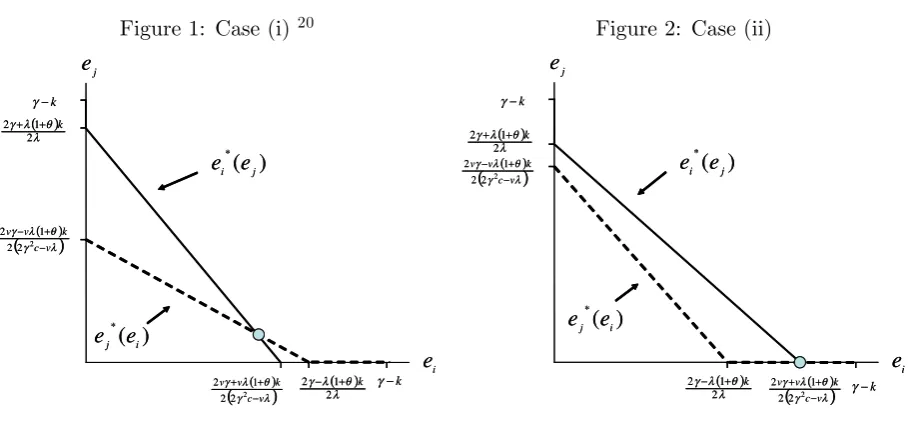
ensures that (b) does not bind on any agent’s choice. The following proposition is illustrated in
Figures 1 and 2.
Proposition 6
(i) If < 2v+2c(1+ )2c k; there is a unique, interior and stable desert equilibrium, which is
symmetric in a fair tournament and in which the advantaged agent works harder in an unfair
tournament.
(ii) If 2 h2v+2c(1+ )2c k;2v 2c(1+ )2c k ; which can only occur in an unfair tournament, there
is a unique and stable desert equilibrium, in which the advantaged agent exerts strictly positive
e¤ort and the disadvantaged agent exerts zero e¤ort.19
In both cases, when the tournament is unfair, the di¤erence between the e¤orts rises as the
advantage k gets bigger, the extent to which the advantage is felt to be deserved increases or
desert preferences become stronger.
Proof. See Appendix.
The equilibria should be compared to those in the absence of desert (Proposition 1), in which
the advantaged agent exerts the same e¤ort as the disadvantaged agent. Section 3.3 explained
why, in general and starting from symmetry, the advantaged agent has a stronger marginal
incentive to exert e¤ort in the presence of desert. As is intuitive, the e¤ort di¤erence induced
by the advantage increases in the size of the advantage, the extent to which the advantage is
1 8No standard underlying noise function that we are aware of would give uniformly distributed. However, we
have chosen a uniform distribution here for its analytical and pedagogical convenience. We can also think of the noise as arising from the measurement of the di¤erence in e¤orts rather than of each agent’s separate e¤ort level.
1 9In the special case where2v c(1 + )k; the upper bound does not apply. Gill and Stone (2006, pp. 16-17)
felt to be deserved and the strength of desert preferences. The bigger the advantage, the more
likely the advantaged agent is to win for any given e¤ort pair, so an increase in the deserved
reference pointvPeifrom working harder is less painful in expectation. The greater the extent to
which the advantage is felt to be deserved, the bigger is the reference point, which means that
losing becomes more painful for the advantaged agent giving her a greater incentive to exert
[image:18.595.71.529.189.408.2]e¤ort to reduce the chance of losing.
Figure 1: Case (i) 20 Figure 2: Case (ii)
k − γ ( ) λθ λ γ 2 1 2 + + k
( )
(γ λ) θ λ γ v c k v v − + − 2 2 2 1 2 ( )
(γ λ) θ λ γ v c k v v − + + 2 2 2 1
2 ( )
λθ λ γ
2 1 2 − + k γ−k ) ( * j i e e ) ( * i j e e j e i e k − γ ( ) λθ λ γ 2 1 2 + + k
( )
(γ λ) θ λ γ v c k v v − + − 2 2 2 1 2 ( )
(γ λ) θ λ γ v c k v v − + + 2 2 2 1
2 ( )
λθ λ γ
2 1 2 − + k γ−k ) ( * j i e e ) ( * i j e e j e i e ) ( * j i e e ) ( * i j e e ( ) λθ λ γ 2 1 2 + + k
( )
(γ λ) θ λ γ v c k v v − + − 2 2 2 1 2 k − γ k − γ ( )
(γ λ) θ λ γ v c k v v − + + 2 2 2 1 2 j e i e ( ) λθ λ γ 2 1 2 − + k
) ( * j i e e ) ( * i j e e ( ) λθ λ γ 2 1 2 + + k
( )
(γ λ) θ λ γ v c k v v − + − 2 2 2 1 2 k − γ k − γ ( )
(γ λ) θ λ γ v c k v v − + + 2 2 2 1 2 j e i e ( ) λθ λ γ 2 1 2 − + k
4.2 Experimental Evidence and Testing
Our results may help to explain two puzzling results from tournaments in the laboratory and
suggest an experiment to distinguish desert from disappointment aversion (see Gill and Prowse,
2009, for an experimental test of disappointment aversion in a sequential-move tournament).
First, the experimental evidence on fair tournaments has found excess variability in mean
e¤ort choices (see for instance the classic paper by Bull et al., 1987, and, more recently, van
Dijk et al., 2001). This excess variability is consistent with the agents attempting to coordinate
on an asymmetric equilibrium, as predicted by Proposition 4 for su¢ciently strong desert.21
Interestingly, in a setting with multiple prizes where the theoretical prediction was for the
agents to all exert maximal e¤ort, Harbring and Irlenbusch (2003) report commonly …nding
highly asymmetric behavior, with some agents in a particular group putting in maximal e¤ort
and the others exerting very low e¤ort, while Sheremeta (2009) …nds evidence of ‘drop-outs’ in
a symmetric Tullock-style rent seeking contest.
2 0Figure 1 is drawn assuming k > 2 + (1+ )k
2 :Gill and Stone’s (2006) Figure 2 illustrates the alternative in a
fair tournament: the unfair tournament is a natural generalization.
2 1The experimental evidence on fair tournaments tends to report only the mean of e¤ort choices across pairs of
Second, Schotter and Weigelt (1992) found that in unfair tournaments advantaged agents
tend to work harder than their disadvantaged counterparts. These results are contrary to
standard theory, under which the equilibrium remains symmetric, but consistent with the results
in Propositions 5 and 6.
Finally, the results suggest that we may distinguish experimentally between desert concerns
and disappointment aversion by manipulating the extent to which any advantage is felt to
be deserved. For example, we could introduce a prior stage in which the advantage is either
arbitrarily allocated or allocated in an e¤ort-sensitive manner according to performance in a
task. If agents are disappointment averse (i.e., they are loss averse around their expected
monetary payo¤), they will always act like agents with desert preferences who feel the advantage
is fully deserved, i.e., with = 1, even if the advantage was allocated arbitrarily rather than
meritocratically. Thus, unlike standard agents, advantaged disappointment averse agents will
work harder than their disadvantaged counterparts, but unlike desert-concerned agents they will
not be sensitive to the source of the advantage. Accordingly, if only disappointment aversion is
motivating agents, the method of allocating the advantage will not a¤ect tournament outcomes.
4.3 The Uncertainty E¤ect
Gneezy et al. (2006) recently provided experimental evidence for what they call theuncertainty
e¤ect, whereby a lottery is valued at less than the lottery’s lowest possible outcome. The
uncertainty e¤ect is a breach of monotonicity as stochastically dominating gambles are rejected.
Gneezy et al. note that certain models of disappointment aversion (e.g., Bell, 1985) can explain
such preferences. When >1andPiis su¢ciently small, our model also predicts the uncertainty
e¤ect. This follows as in a fair tournament (or an unfair one with = 1), for a given level of
e¤ort an agent prefers a zero chance of winning to the lottery implied byPi >0if and only if
0 vPi v Pi(1 Pi),Pi
1
:
K½oszegi and Rabin’s model of reference-dependence with a choice-acclimating reference point
(2007, Section IV) shares the same feature, and the authors claim that >1 is calibrationally
plausible (our parameter is equivalent to (1 ) in their model). Nonetheless, we show by
example that asymmetric equilibria can exist and be unique in a fair tournament when 1
so the uncertainty e¤ect cannot arise. Take a simple linear example with sU[ 1;1]; so the
probability of winning is Pi = ei e2j+1 given an upper bound of 1 on e¤ort (which ensures that
q= 12 >0 for all permitted e¤orts),k= 0,v= 1 and C(ei) = ce
2
i
Claim 1 Suppose = 12:When c= 25;there exist two asymmetric equilibria, in each of which one agent exerts zero e¤ort while the other sets ei= 23:There is also a symmetric equilibrium,
but it is unstable. Whenc= 15;we get uniqueness of the asymmetric equilibrium (up to reversing
the role of the agents), with one agent setting zero e¤ort and the other setting e¤ort at the upper
bound of 1.
Proof. See Appendix.
5
Applications in Fair Tournaments
We now turn to two applications of our theory of desert in fair tournaments, the …rst using
asymmetric equilibria and the second symmetric ones.
First, we analyze competition for status in the presence of desert concerns. We show that
when desert is strong enough that agents play an asymmetric equilibrium, competition for status
can dominate a random allocation of status / rank, even though e¤ort is socially wasteful. Thus
desert considerations can provide a psychological basis for allowing agents to compete for a …xed
supply of status.
Second, we consider an employer’s choice of relative performance compensation scheme.
We show that when desert is not too strong, so employees play a symmetric equilibrium, an
employer will choose a tournament over relative performance pay linear in the di¤erence in the
employees’ outputs if output noise is su¢ciently fat-tailed. Desert considerations thus provide
a new explanation for why employers might choose to use tournament-style incentive schemes.
5.1 Status Competition
Agents often compete for status within a group, where an agent’s status is de…ned as her ordinal
rank in the group. Within a group the supply of rank is …xed, which is why a number of authors
have considered competition for status to be a socially wasteful zero-sum game. Recent notable
examples of such a perspective are presented by Hopkins and Kornienko (2004, pp. 1091-1092)
and Frank (2005, p. 137), who consider agents competing for status by spending on positional
goods.
We can interpret our tournament as a competition for status. Agents care about their
relative rank in the distribution of ; with i distributed as before, and they value a higher
rank atv:Much of the literature has focused on status as determined by spending on positional
goods, and we can think of as such spending, where agents exert e¤ort to increase the budget
concerns. For example, we can think of winning the tournament as being allocated a position
of higher importance in an organization.
In the absence of desert concerns, the zero-sum nature of the …nal status allocation does
indeed lead to the conclusion that competition over status is socially wasteful. In the unique
equilibrium of the game, the agents exert the same level of e¤ort so each has an equal opportunity
of winning and losing. Thus, the agents would be better o¤ if they could somehow enforce an
equal reduction in their e¤orts, since this would reduce wasteful expenditure on e¤ort while
leaving the winning probabilities unchanged. It follows that both agents would be better o¤ if
competition was banned and social rank was instead determined randomly.
The conclusion that banning competition is good for welfare may be undermined when agents
have desert concerns.22 This is true whenever asymmetric equilibria can arise. An asymmetric
equilibrium has the feature that, more often than not, it will allocate the higher status to the
agent who exerted higher e¤ort and therefore deserves it more and the lower status to the agent
who deserves it less. By contrast, when status is allocated randomly, as when competition is
banned or when competing agents exert identical e¤orts, the outcome is less satisfactory in
desert terms: although neither agent is more deserving than the other, one agent is always
deemed the winner and the other the loser at the end of the tournament. Thus, on average,
the discrepancy between what an agent receives ex post and what she deserves given agents’
e¤orts is larger than in any asymmetric equilibrium - as shown in Lemma 1, the desert de…cit is
always lower the more unequal the winning probabilities. When competition is not permitted,
the higher desert de…cit can overwhelm the bene…t of lower e¤ort, compared to an asymmetric
equilibrium under competition. Thus desert considerations can provide a psychological basis
for preferring competition, even in what appears to be a zero-sum game such as a competition
for status. Gill and Stone (2006, pp. 18-20) provide technical details.
5.2 Relative Performance Pay Schemes
Firms commonly use tournament-type incentive schemes to motivate sta¤.23 In this section, we
analyze how desert preferences impact on the design of relative performance incentive schemes,
thus contributing to the literature which considers when …rms might choose to implement
tour-naments and to the rapidly growing behavioral contract literature.24 Throughout, we assume
2 2Of course, the conclusion is also undermined if positive externalities from e¤ort are su¢ciently strong. We show
that even absent any such externalities, desert considerations can reverse the standard argument.
2 3For some recent evidence see DeVaro, 2006. See also Conyon et al., 2001, Prendergast, 1999, and the references
therein.
2 4For a survey of the literature on behavioral contract theory more generally, see Englmaier (2005). Bartling and
that from the perspective of …rms e¤orts are either unobservable or unveri…able, so compensation
must be based on output.
A number of papers have compared tournaments to individual performance-based
compen-sation (such as piece rates). A …rst strand of literature emphasizes that tournaments iron out
common output shocks that are unobservable to the employer. In the presence of risk aversion
they will thus be preferred if the variance of the common shock is su¢ciently large (see for
instance Green and Stokey, 1983). However, tournaments are not the only incentive scheme
which iron out such shocks: other schemes which base payments on the relative output of
work-ers can also do the trick. A second strand of literature points out that tournaments …x total
payments in advance, so employers do not have the incentive to under-report performance that
occurs with individual performance schemes (see Malcomson, 1984). Yet again, however, not
just tournaments but any relative performance scheme with …xed total payments solves the
problem.
We compare how our tournament (which is the simplest rank-based incentive scheme) fares
relative to the simplest incentive scheme which takes the magnitude of the di¤erence in outputs
into account, namely pay linear in the output di¤erence of the workers. We call the latter linear
relative performance pay (LRPP). Both schemes iron out common additive output shocks25 and
entail a …xed total wage bill. In the absence of desert, we …nd that the employer is
indi¤er-ent between the two schemes, while in the presence of desert considerations the shape of the
noise distribution has a fundamental impact on an employer’s choice between these two relative
performance pay schemes.26
We assume that an employer is designing an incentive scheme for two identical workers with
weak desert preferences. The employer is required to induce a total e¤ort be >0:However, our
results are robust to allowing the employer to choose productive e¤ort to maximize pro…ts (see
Gill and Stone, 2006, Corollary 1, p. 24). Under the fair tournament, the employer chooses a
…xed payment ofFT to each worker and a prize v: For low enough ;any desert equilibrium is
symmetric by Proposition 3, and we assume that such a symmetric equilibrium exists. Under
LRPP, the employer pays each worker a wagewi linear in the di¤erence in their outputs. The
employer chooses the strength of incentives plus a …xed payment FLRP P:
wi = i j +FLRP P: (11)
2 5We abstract from such shocks in the analysis below, but introducing an additive common output shock does not
alter any of our results.
2 6Nalebu¤ and Stiglitz (1983, pp. 36-37) analyzed LRPP, comparing it to the use of piece rates. The only existing
As in the fair tournament, under LRPP each worker’s reference point is taken to be her expected
monetary payo¤,27 so:
ri=E i j +FLRP P = (ei ej) +FLRP P: (12)
The employer must design the scheme to satisfy the workers’ participation constraint. In
par-ticular each worker’s expected utility must cover her outside optionU :For simplicity we assume
that the workers face no ex post credit constraints28
Proposition 7 For low enough that target e¤ort beis induced by a symmetric desert equilib-rium in a fair tournament, wage costs are lower under the tournament than under linear relative
performance pay if and only if 2q(0)E[j j] 1: In the absence of desert, the two schemes cost
the same.
Proof. See Appendix.
In the absence of desert, the employer has to compensate the workers just for their cost of
e¤ort and outside option, so the two schemes have the same cost. With desert, the employer also
has to compensate the workers for their expected desert losses. Remarkably, the comparison of
the two payment schemes depends only on the shape of the noise distribution. In particular,
it is independent of the size of the target be; and the strength of desert (within the relevant
range).
A higher q(0) favors the tournament, as marginal incentives at the symmetric equilibrium
are higher and so the prize required to induce a given level of e¤ort is lower. In the absence of
desert this would not make the tournament any cheaper, as the …xed payments would have to
rise correspondingly to satisfy the participation constraint. However, in the presence of desert
a lower prize lowers the desert de…cit, as the workers’ wages will be closer to their reference
points on average, and so wage costs are lower. Under LRPP, on the other hand, q(0) has no
e¤ect on marginal incentives.
Fatter tails as measured by E[j j] also favor the tournament. With fatter tails, is more
likely to be far from its mean, and hence under LRPP the workers are more likely to receive
wages far from their reference point, increasing the …xed payments necessary to compensate
them for their expected desert losses. Under a tournament, however, the desert de…cit depends
only on the prize and the probability of winning, which are independent of E[j j]for a given
q(0)at the symmetric equilibrium.
2 7As in the tournament, the reference point re‡ects the marginal impact of e¤ort on the expected payment and is
meritocratic.
For normally distributed noise, LRPP is always strictly cheaper whatever the variance. As
the variance rises, q(0) falls, while E[j j] rises in an exactly compensating fashion. However,
under a fatter-tailed distribution the tournament can dominate, for example when noise is
distributed according to the Student’s t-distribution with z 2 (1;2) degrees of freedom. Gill
and Stone (2006, pp. 24-26) provide the details and use an example based on the Student’s
t-distribution to show that choosing the right compensation scheme can have a signi…cant impact
on the wage bill.
We have found that wage costs are lower under a tournament than under LRPP if the
distribution of noise is su¢ciently fat-tailed, given that the required e¤ort level is induced by
a symmetric desert equilibrium in the tournament. Tournaments may also be preferred if the
required e¤ort can be induced by an asymmetric desert equilibrium or if the employer chooses
to induce an asymmetric equilibrium when she selects e¤ort optimally. Pushing the workers’
e¤ort levels apart lowers the desert de…cit, which in turn lowers the …xed fee needed to satisfy
the workers’ participation constraint. Of course, this is counterbalanced by the fact that it is
less e¢cient to make one worker take on the whole task: C(be) > 2C(be2) by the convexity of
costs. See Gill and Stone (2006, Section 5.2) for an analysis of this issue.
6
Conclusion
In this paper, we have merged the literatures on tournaments, equity and loss aversion in order
to model the behavior of desert-motivated agents in competitive situations. In line with existing
psychological and experimental evidence, our agents adopt a meritocratic notion of desert. Our
model has allowed us to develop novel conclusions about the play of identical, advantaged and
disadvantaged agents in tournaments. In doing so, we have contributed to the understanding of
strategic behavior in the presence of endogenous reference points. Applying our model has also
permitted us to generate insights into when competition for status might be socially bene…cial
and when employers might choose tournaments over other more continuous forms of relative
performance pay.
Fruitful extensions to our framework might analyze situations with many agents and prizes
or apply our concept of desert to other strategic settings such as bargaining and the provision
of public goods. Empirical and experimental evidence could also be collected to test whether
agents behave according to the theoretical predictions of our model and so do in fact act as if
Appendix
Proof of Lemma 1. i(x) > 0 given Q(x) 2 (0;1): Clearly i(x) is maximized when
Q = 12; so x = 0: i(x) is strictly quasi-concave in the e¤ort di¤erence, and hence in each
agent’s e¤ort, since
@ i(ei ej)
@ei =
@ i(ei ej)
@(ei ej) =q(ei ej) (1 2Q(ei ej)) (13)
which is strictly positive wheneverei< ej since then Q(ei ej)< 12, strictly negative ifei> ej
and zero ifei =ej. Finally, note that Pi = 1 Pj; soPi(1 Pi) =Pj(1 Pj);and the agents
always face the same desert de…cit, i.e., i(x) = j( x): By the symmetry of the agents,
j( x) = i( x): Putting these two facts together, we see that i(ei ej) is symmetric
about zero.
Proof of Proposition 2. Assuming symmetry, ei = ej so Pi = Pj = Q(0) = 12:
Thus, 1 2Pi = 0 and the desert terms in the derivatives in (6) drop out, so any symmetric
equilibrium must be the same as without desert. The symmetry of q( ) about zero implies
that @q@e(0)
i = 0;so given symmetry, agenti’s SOC (7) reduces to
C00(C0 1(vq(0)))
2v[q(0)]2 :Finally, we
consider asymptotic stability (see Fudenberg and Tirole, 1991, pp. 23-25, for more on asymptotic
stability and tâtonnement adjustment processes). Consideri0sreaction function (RF) when the
symmetric equilibrium exists. On this RF,d@EUi
@ei =
@2EU
i
@(ei)2dei+
@2EU
i
@ej@eidej = 0; so
dei dej =
@2EUi @ej @ei @2EUi @(ei)2 :
The cross-derivative is:
@2EU
i
@ej@ei =v
@q(ei ej)
@ei v
h
(1 2Pi) @q(@eeii ej)+ 2 [q(ei ej)]2
i
: (14)
At a symmetric equilibrium @q@e(0)
i = 0; 1 2Pi = 0 and the SOC must hold, so the slope ofi
0s
RF is:
dei dej =
2v [q(0)]2
C00(C0 1(vq(0))) 2v [q(0)]2 <0:
The RFs are downwards sloping and have the same slope, so any symmetric equilibrium will be
asymptotically stable if and only if:
dei
dej > 1,4v [q(0)]
2 < C00 C0 1(vq(0)) :
Note that if instead of having a well-behaved RF, agenti0sbest response jumps discontinuously
(because of multiple best responses at the symmetric equilibrium, e.g., because the SOC is
Proof of Proposition 3. Suppose that an asymmetric equilibrium ei; ej exists with
ei > ej. From the FOCs in (6), noting that 1 2Pj = 2Pi 1 and allowing for the possibility
thatej = 0:
@EUi
@ei
@EUj
@ej = 2v (2Pi 1)q ei ej C
0
(ei) +C0 ej 0:
Let q supq( ); which must exist as q( ) is a density continuous on ( 1;1): Then
v [(2Pi 1)q(ei ej)] v q; so 2v q C0(ei) C0 ej : Now C0(ei) > C0 ej and as
!0; 2v q!0:Thus as !0; C0(ei) C0 ej goes to zero, soei ej goes to zero. Thus
from the FOCei goes toC0 1(vq(0))>0 soe
j does so as well.
Let ex be "near" toC0 1(vq(0)) i¤
ex C0 1(vq(0)) max ei C0 1(vq(0)) ; ej C0 1(vq(0)) :
We now consider the slope of the agents’ reaction functions (RFs) for e¤orts near toC0 1(vq(0)):
The slope of RFiis given by
@2EUi @ej @ei @2EUi
@(ei)2
:As !0, (14)!0and (7)! C00(ei)(remember @q@e(0)i = 0
and q0 is continuous) for e¤orts near to C0 1(vq(0)); so the slope of the RFs go to zero. In
(ei; ej)space, RFitends to a vertical line while RFj tends to a horizontal line. Thus there exists
a >0such that for all < , the RFs can only cross once near toC0 1(vq(0));so there must
be a single equilibrium near to C0 1(vq(0)). But by the symmetry of the problem there must
be (at least) two asymmetric equilibria near to C0 1(vq(0)), so we get contradiction.
Proof of Lemma 2. Note …rst that given ej = 0; 0i(0) = 0atei = 0and 0i(ei)<0for
ei>0from Lemma 1.
(i) Suppose e (0; ) = 0: 0i(0) = 0and by assumption vq(0)> C0(0):Thus, @EUi(ei;0; )
@ei =
vq(0) C0(0)>0ate
i= 0;soihas a strict incentive to increase e¤ort, a contradiction.
(ii) We suppose that for 2 > 1,e (0; 2) e (0; 1) and …nd a contradiction.
Case (a): e (0; 2)< e (0; 1):As e (0; ) >0 and 0i(ei)<0 forei >0; i(e (0; 1))
i(e (0; 2))<0. By de…nition of global optimality:
[EUi(e (0; 1);0; 1) EUi(e (0; 2);0; 1)]+[EUi(e (0; 2);0; 2) EUi(e (0; 1);0; 2)] 0:
But:
EUi(e (0; 1);0; 1) EUi(e (0; 1);0; 2) = ( 1 2)v i(e (0; 1)) ;
so we require that ( 2 1)v[ i(e (0; 1)) i(e (0; 2))] 0, a contradiction.
Case (b): e (0; 2) =e (0; 1): Given e (0; 1) >0 the FOCs imply the following which,
together with 0
i(e (0; 1))<0;contradicts 2 > 1:
vq(e (0; 1)) v 2 0i(e (0; 1)) =vq(e (0; 1)) v 1 0i(e (0; 1)):
(iii) Given ej = 0and ei >0, 0i(ei)<0:Thus for anyx >0, we can …nd a >0such that
for8ei2(0; x]:
@EUi(ei;0; )
@ei =vq(ei) v
0
i(ei) C0(ei)>0;
soe (0; )> x:
Proof of Proposition 4. We start by using a proof by contradiction in two parts to show that forej >0;the di¤erence between an agent’s global optimum e¤orte (ej; )and her rival’s
e¤ortej is always less than the best response to zero e¤ort, i.e.,
e (ej; ) ej < e (0; ): (15)
Case (1): suppose that e (ej; ) ej > e (0; ):By de…nition of global optimality:
[EUi(e (0; );0; ) EUi(e (ej; ) ej;0; )]+[EUi(e (ej; ); ej; ) EUi(e (0; ) +ej; ej; )] 0:
But:
EUi(e (0; );0; ) EUi(e (0; ) +ej; ej; ) = C(e (0; )) +C(e (0; ) +ej)>0;
EUi(e (ej; ); ej; ) EUi(e (ej; ) ej;0; ) = C(e (ej; )) +C(e (ej; ) ej)<0;
so we require that C(e (0; ) +ej) C(e (0; )) C(e (ej; )) C(e (ej; ) ej): Because
C00(ei)>0; an increase in e¤ort ofej from the higher base of e (ej; ) ej increases costs by
strictly more29, so we have a contradiction.
Case (2): suppose that e (ej; ) ej =e (0; ):This implies that:
vq(e (ej; ) ej) v 0i(e (ej; ) ej) =vq(e (0; )) v 0i(e (0; ));
so, given e (0; ) > 0 from Lemma 2 and C00(e
i) > 0; from the FOCs we immediately get a
contradiction.
2 9d(C(x+y) C(x))
dx =C