Munich Personal RePEc Archive
Investor Protection and Corporate
Performance: Comparing Auditing Issues
across countries
D’Agosto, Elena
May 2007
Investor Protection and Corporate Performance:
Comparing Auditing Issues across countries.
∗
Elena D’Agosto
Department of Economics
University of Rome "Tor Vergata"
†May 28, 2007
Abstract
This paper focuses on the effect of auditing activity on corporate per-formance. To this end, an auditing measure is derived for six countries based on their national auditing laws. A study is then made of the im-pact of this legislation on corporate values in the market. The findings show that auditing rules positivly affect company performance. This link is then confirmed with several robusteness checks.
Keywords: Investor Protection, Auditing, Corporate Performance
JEL : G3; M42.
1
Introduction
Corporate failures involving large and well known companies in the last twenty years have led to renewed discussion on the role of corporate governance in the
operating offinancial market mechanisms. Scandals1have also concerned audit
firms failing in their role of monitoring corporate accounts, suggesting that an
accurate consideration of the true meaning of auditing is also required. In recent
financial literature, a series of studies have applied a legal approach to corporate
governance to focus on investor protection and its affects on both development
of the financial market and corporate valuation. In this strand of literature,
seminal contributions are due to Shleifer and Vishny (1997)2 and La Porta et
al. (1998). In the former work, the authors point out that corporate governance
∗This paper is part of the project on Governance supervised by Prof. Bagella. The author is grateful to Prof. Bagella and Prof. Becchetti for their comments and patience. Other thanks go to Rocco Ciciretti, Diana Nicoletti, Nazaria Solferino, Giovanni Trovato, Robert J. Waldmann and an anonymous referee for conversation and comments. Any defects in this paper remain the sole responsibility of the author.
†E-mail address: [email protected]
1In the late of 1990s, numerous corporations were involved in scandals. Notorious cases
included : WorldCom, Enron, Tyco.
consists of mechanisms that assure that outside financiers of a company get a return on their investments. This statement entails the possibility that agency
problems may arise in the wake of a conflict of interest between managers and
shareholders. The authors also document that differences among countries in
terms of investors protection laws are due to the legislative bases of a
partic-ular country, and that the degree of protection is associated with differences
in the development of financial markets across countries. Indeed, LLSV (1998)
find that common law countries have stronger laws and enforcement than civil
law countries, which in turn are characterized by weaker laws and enforcement mechanisms. As a result of these features, the authors argue that common law
countries have more developedfinancial markets than civil law countries.
Further steps in this strand of literature focus on the effect of investor protec-tion on corporate valuaprotec-tion (Claessens et al.,1999; Johnson et al.,2000; Gorton and Schmid, 2000;La Porta et al., 2002). A common result of these studies is that companies have higher market values in economic systems with reliable rules protecting their investors.
Finance scholars admit the importance of auditing in investor protection. As Jensen and Meckling (1976) hypothesized, auditing is a mechanism for
mon-itoring the parties involved in the management of a firm. Indeed, in agency
models, auditing aims to alleviate the asymmetric information between man-agers (agents) and outside investors (shareholders as principals) in order to align the interests of the agents to those of the principals and to reduce the
incentive for an opportunistic behaviour. Auditors’ financial reporting intends
to prevent that false information from affecting share prices.
In spite of this, scholars attention to the implication of auditing activity
on financial markets has been scarce. Conversely, accounting literature has
recognized its role in corporate governance as an enforcement mechanism in the
verification of accounting data (Watts and Zimmerman, 1986) for some
con-siderable time. Historical evidence on auditing activities has documented that companies previously employed reputable auditors to assure outside investors of the credibility of accounting information and hence mitigate the agency problem (Watts and Zimmerman, 1983).
This paper intends to contribute to the financial literature analysing the
role that auditing has (as an investor protection instrument) in determining the corporate market valuation. To this end, this study works in accordance with the legal approach to corporate governance. We recall a few contributions in the
area offinancial literature devoted to the audit issues, since we refer to them in
order to carry out our analysis.
Interestingly, Newman, Patterson and Smith3 (2005) suggest a simple model
to present the auditing issue. The authors extend the model of Shleifer and
Wolfenzon4 (2002) on the role of investor protection, adding auditors services.
Their hypothesis is based on the assumption that the ability of legal jurisdi-tion to protect the interests of investors depends on the enforcement of law in
detecting and detering the violations of their rights. Auditing aims to detect expropriation by insiders (managers or controlling shareholders). NPS (2005) link investor protection to auditors incentives to detect insider expropriation. These incentives take the form of penalties for failure to detect irregularities.
The authorsfind that an increase in the auditor’s penalty leads to an increasing
external investment of capital. Moreover, increases in the insiders penalty for detecting expropriation lead again to an increase in total investment of capital. NPS (2005) assess the implication of the model empirically. They show that, for instance, countries with higher auditor penalties and insider penalties have higher total investment level and more dispersed ownership.
Francis, Khurana and Pereira (2003) argue that the degree of investor protec-tion creates, as a consequence, a consistent demand for timely and transparent accounting and auditing in corporate governance. Their empirical analysis sug-gests that civil law countries have less demand for auditing than common law
ones. Also theyfind that civil law countries with relatively transparent/ timely
accounting procedure have a greater demand for auditing compared with the other civil law countries.
Fan and Wong (2005) study the nexus between auditor choice and company value in emerging markets. These are characterized by high ownership concen-tration which may be the signal of a weak legal environment (also shown in LLSV, 1998). As a consequence of concentrated ownership, agency problems
may arise. Scholars find that firms oppointing high quality auditors are
asso-ciated with higherfirm valuation. From the few contributions proposed in the
literature, differences in the peculiarities of economies make the investigation of
audit activity effects onfinancial development an interesting empirical issue.
Our study aims to take a step towardsfilling this gap in the financial
lit-erature namely the implication of auditing activity on financial market. Our
contribution is twofold. First we use a new and original measure of auditing quality to document the variation among countries. This original measure pro-vides evidence of how a country’s auditing standards are the direct consequence
of investor protection laws5. Second, we show that investor protection laws, in
terms of auditing quality, have an effect on corporate performance.
The paper is organized as follows. In the next section we review prior
re-search about the effect of both corporate governance and investor protection on
company value, in order to identify how literature deals with this relationship. In section 3, we present our analysis. We introduce our measure of audit quality, the control variables and the source of data; next, we illustrate the estimation
method and econometricfindings. Section 4 considers several robustness checks.
Section 5 concludes the paper by summarizing the empirical results.
2
Review of theoretical and empirical literature
Prior theoretical and empirical studies on the investor protection and corporate performance relationship do not provide homogenous results. However, there
are few contributions and new reaseach should yield further evidence. In this section we provide a short literature review dealing with the issue. The seminal paper of La Porta, Lopez, Shleifer and Vishny (1996) has provided the bases
for research on the law and finance nexus. Their main results show that laws
concerning investor rights vary a great deal across countries, to some extent as a consequence of differences in legal origin. In turn, the legal environment affects
the quality of enforcement of legal rules. They offer empirical evidence which
shows that common law countries have stronger enforcement than French civil
law countries. The authors find that countries with poor investor protection
develop a higher concentration of ownership as a substitution mechanism for the lack of legal rules for defend their rights.
In LLSV (1997), the authorsfind strong evidence that the legal environment
has large effect on the size and breadth of capital markets across countries.
There are few works devoted to theoretically modelling the role of legal
envi-ronment in corporatefinance (Grossman and Hart, 1988; Hart, 1995; Friedman
and Johnson, 2000). Through a simple model, LLSV (2002) show the effects of
both corporate ownership structure and investor protection on firm valuation.
As law andfinance literature states, common law countries have better investor
protection which, in turn, creates higher corporate valuation. Moreover, they
empirically find that companies with controlling shareholders have higher
val-uations in common law rather than civil law countries. Shleifer and Wolfenson
(2002) set up a market equilibrium framework of corporatefinance in the
pres-ence of weak shareholder protection, in which they demonstrate many empirical regularities. A better legal environment in terms of investor protection gives
rise to lower ownership concentration along with more larger and valuablefirms.
Moreover stock markets are more developed in countries with better protection for shareholders. A similar setting is presented in the empirical work of Jong,
Gispert, Kabir and Renneboog (2002). They seek to understand how differences
in corporate governance systems lead to differences in corporate performance.
Although theyfind a variation of across countries common corporate governance
characteristics (i.e. board size, ownership structure), specific corporate
gover-nance features of a country play an important role in determining corporate
performance relative to the common characteristics. A different approach is
applied by Daines (2001). This paper provides evidence that corporate law in
Delaware State results in an improvedfirm value. Delaware State attracts most
of the public firms in the U.S. and this fact revealed particularly convinient
conditions for incorporated firms in this State6. Daines’ original contribution,
compared to previous studies, consists of collecting a large sample of USfirms.
The author provides consistent evidence that state law affects corporate value.
Delawarefirms show a positive and significant relationship to Tobin’s Q, used
as a performance measure. These results are robust when measured against a variety of controls.
Some areas of the literature deal with the relationship with specific aspects
6This is becausefirms are run according to the rules of the state in which they are
of corporate governance (mechanisms to control the agency problems between manager and shareholders) and company value. Other empirical papers take into account general measures of corporate governance, such as Black, Jang and
Kim (2003). The authorsfind a positive relationship between a composite
cor-porate governance index and Tobin’s Q, a proxy for firm performance, within
a sample of Korean public companies. Once more, similar results are provided
by Klapper and Love (2003) for a sample of firms in emerging markets.
Gom-pers, Ishii and Metrick (2003) construct an index, at company level, based on the existence or not of provisions, laws or regulations related to the takeovers.
Interestingly these authors find that corporate governance and firm value are
highly correlated. Stronger shareholder rights are positively associated with
higherfirm performance, after many robusteness checks.
Drobetz et al. (2004) also focus their analysis on corporate level governance. For a sample of German public listed companies, they create a measure of
thefirm level governance quality on the basis of survey questions and study its
relationship with corporate performance. The results show that better corporate governance is highly correlated with better operating performance, higher stock returns and higher market valuation. A similar approach has been employed by Beiner et al. (2004) in the case of Swiss listed companies. They develop
a firm-specific corporate governance index and add other control mechanisms
(leverage, outside blockholdings, board size, the fraction of outside directors on the board) in the analysis. The results are consistent with the hypothesis of a positive link between corporate governance and company value.
Each of these papers has focused on specific aspects of legal investor
pro-tection but not involving auditing issues. In the next paragragh we present an empirical assessment of the nexus between auditing as an investor protection mechanism and corporate valuation.
3
Auditing quality and corporate performance
In this section we empirically explore whether a country- level auditing measure affectsfirm valuation, considering our original measure as a proxy for an investor
protection mechanism in a given country7. We intend to estimate our hypothesis
within the legal framework proposed by La Porta et al. (1998).
The auditing quality in a country is obtained byfirst creating an appropriate
database and then adopting a specific statistical methodology to derive the
index. We assess our hypothesis by applying two measures of corporate value and different specification methods.
3.1
A measure of auditing quality
In this paragraph we briefly describe how we derived our audit dimension,
re-ferring to D’Agosto8(2005) for more details.
Firstly, we have sought legal sources for audit regulation in each country investigated. Then we have listed a set of characteristics suitable for represent-ing the audit rules framework operatrepresent-ing in a country, basrepresent-ing the selection of attributes on the Sarbanes Oxley Act (2002). This Act, issued by the U.S Par-liament in the wake of numerous US corporate failures, estabilished standards
for all US. public company boards, management and accounting firms. Using
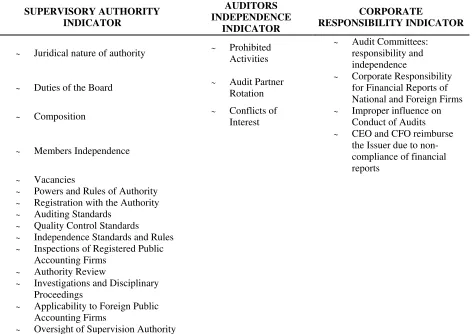
this law, we consider several main auditing characteristics to compare the au-dit regulations in the other countries. Further we have checked these features over a period of twenty years in order to capture the changes in the regula-tions. The list of attributes has been grouped into three clusters denoted as: Supervisory Authority, Auditors Independence and Corporate Responsibility.
Thefirst group lists key issues concerning the authority that oversees auditing
firm activities. The second cluster describes several aspects related to Auditors’
Independence and the last group illustrates aspects of Corporate Responsibility in the audit process (see table 7).
To compare audit regulations across countries, wefirst turn each of the audit
rules into qualitative variables. To this end, we create variables which assume
value 1 if the specific audit rule is present in the country legislation and zero
otherwise. We obtain a matrix of binary variables called the indicator matrix. We repeat this exercise for each year of the sample period from 1980 to 2002 turning out a total indicator matrix which consists of 132 rows (22 years times 6 countries) and 22 columns (qualitative variables). The total matrix represents our auditing database.
We then explore the data collection by mean of a suitable technique: multiple correspondence analysis. This statistical technique allows the reduction of the listed characteristics into a small number of attributes (latent factors).
This multivariate method is accurate for the study of qualitative data and add features of not assuming an underlying distribution and not hypothesising a model for the data (Greenacre, 1984). This procedure allows an overview of the fundamental relationships among the variables and removes irrelevant information. In broad terms, correspondance analysis explores the structure of associations among a set of qualitative variables and brings out underlying dimensions which can be interpreted as latent variables. The dimensions we
derived from the analysis identify a profile of the country audit legislation over
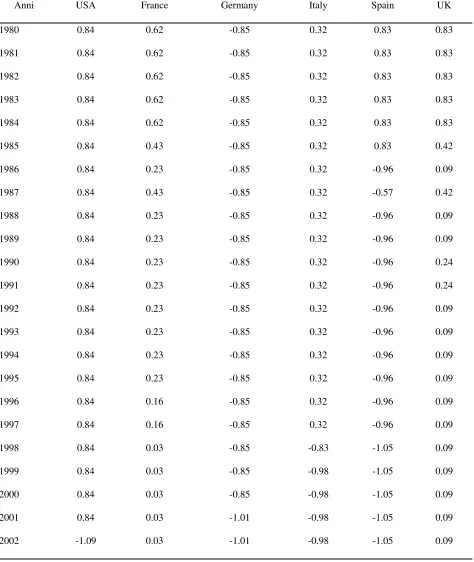
time. We have derived this measure in D’Agosto (2005) and denoted it asdegree
of regulation guarantees. This represents our assessment of audit quality in the country. The label applied to this measure means that the information it
sum-marizes is related to the definition of rules which specify the supervisory and
auditing activities. Indeed, this latent variable includes rules concerning
stan-8This paper gives more details on methodological aspects of building audit measure and a
dards of auditing and quality control, others related to powers and duties of the authority and regulations on auditors’ independence with respect to the
certi-fiedfirms. There is then a measure for each country over time which expresses
how country legislation, compared to other nations, assures investor protection through rules regulating contents and actors involved in auditing activities.
3.2
Data sources and Variables description
Our empirical analysis on the relationship between audit quality and corporate valuation is restricted to the six countries for which our audit dimension has been derived. The United States and the United Kingdom (denoted as com-mon law countries) and France, Germany, Spain and Italy (denoted as civil law countries). The corporate data source for these markets is DATASTREAM,
from which we have selected 1830firms listed in national stock exchanges. Our
sample is composed of: i) 500 from the New York Stock Exchange (NYSE); ii) 550 from the London Stock Exchange (FTSE index) ; iii) 250 from the French Stock Exchange (FCHI); iv) 250 from the German Stock Exchange (GDAXI);
v) 120 from the Spanish Stock Exchange and finally vi) 160 from the Italian
Stock Exchange (MIB). The data was collected yearly from 1980 to 2002. We take into account Tobin’s Q and Market-to-Book ratio for corporate valuations.
Tobin’s Q represents the firm’s market value divided by its replacement cost.
We estimate this ratio as the market value of assets (calculated as book value of assets minus book value of equity plus market value of equity) over book value of assets. Market-to-book ratio has been taken directly from DATASTREAM and
is defined as market value of equity over book value of equity. From the main
literature on corporate governance, we have selected a list of appropriate control variables as follows: the logarithm of book asset value denoted as ln(ASSETS) is considered as a control forfirm size. Our debt-equity ratio is defined as the ratio of total debt to capital, where capital is total debt plus equity. This measure
of leverage focuses on the capital employed and best represents the effects of
financing decisions, denoted as LEVERAGE. We include BETA as a measure of
riskiness of afirm. Return on assets (ROA) is a measure of afirm’s profitability
and we only consider its current value. To capture the effect of legal origin we
introduce a dummy variable (LEGAL) which assumes value one if the firm is
in a common law country. Finally, we add our auditing variable (Auditindex). This denotes our original measure of the quality of the audit in the country: the grater the value of the measure, the lower the quality of auditing in that country. Conversely, a decreasing value of the index expresses an increasing country auditing quality.
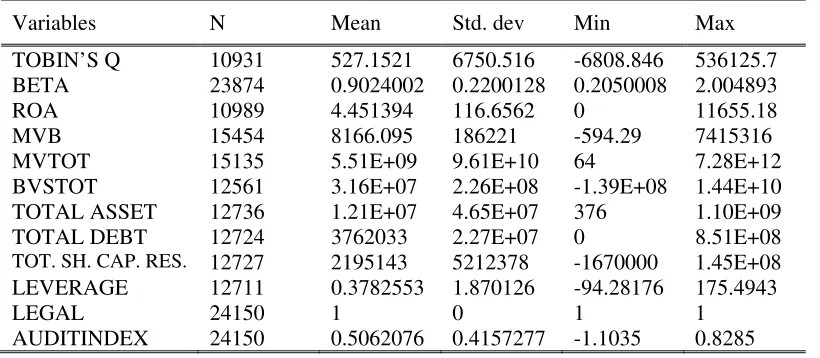
In table 1 we summarizefinancial characteristics of thefirms in the sample
while in tables 2 and 3 we provide descriptive statistics for the sub-samples, respectively common law and civil law countries. The latter two tables show
that there are significant differences in the samples. Mean Tobin’s Q differs a
great deal when we compare common law to civil law countries. Similarly, other
variables report higherfigures such as Beta, Roa. On the other hand, leverage
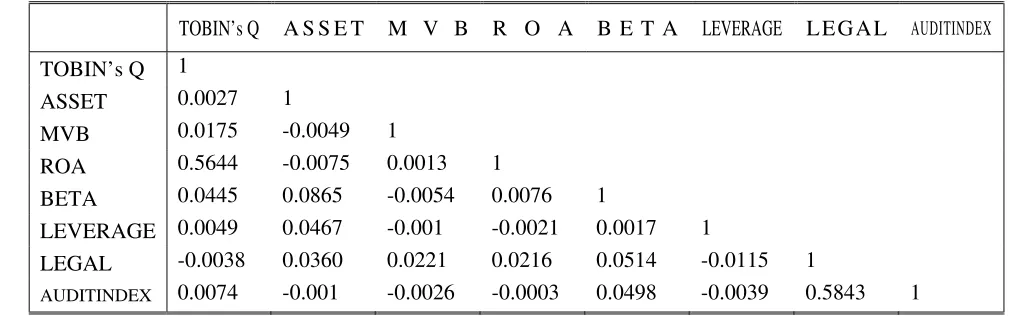
correlation matrix for our explanatory variables.
3.3
Estimation methods and econometrics
fi
ndings
This subsection reports the estimation strategies and outcomes of the empirical analysis. Before addressing econometric issues we sum up our estimation hy-pothesis as follows. According to the framework of La Porta et al. we deem
that legal investor protection influences corporate valuations. We also argue
that enforcement mechanisms as auditing rules may influence corporate market
performance; it is proposed that company valuation will be higher in markets (countries) which are more inclined to put such mechanisms in force.
This hypothesis is tested by using the following equation:
ln(f mv)ijt =β0+β1ln(asset)+β2leverage+β3beta+β4roa+β5legal+β6Auditindex+ ijt
(1) whereln(f mv)ijtis the logarithm of the variables taken into account asfirm
values respectively Tobin’s Q and Market to Book Value(MBV);ln(asset)is the
logarithm of book asset value; leverage is a measure of the debt-equity ratio;
beta is a measure of firm risk; roa is the return on assets; legal specifies if a
firm is in a common law country;Auditindexis our audit quality dimension in
a country.
In order to test this hypothesis we have to plan suitable estimation tech-niques. In this respect an important issue is to account for the law varibility over time of the auditing variable. To take advantages of our longitudinal data we control for the existence of unobserved heterogeneity. We apply a random
effects model as a consequence of the few changes over time in the auditing
rules; this could lead thefixed effect alternative to force the identification of the
auditing coefficient or to drop variables due to multicolinearity. The random
method uses variation both within and between countries to estimate its effects
on valuation, but does not treatfirms in a given country as independent
obser-vations. Standard errors are adjusted to reflect the cross correlation between
observations due to common country components.
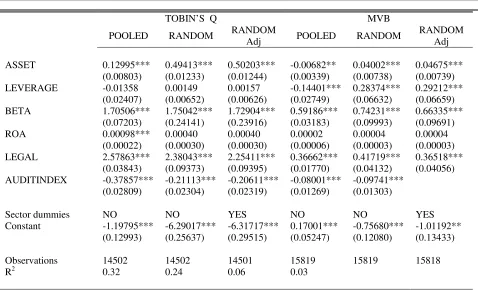
In table 5 we present comparative results for bothfirm valuation variables
(Tobin’s Q and MBV) of the random estimates, where we also account for sector dummies. In the same table we also show pooled estimates. The Breusch-Pagan test rejects the null hypothesis that errors are independent within countries,
that is individual effects are important. As far as the explanatory variables
are concerned we obtain the following findings. The logarithm of ASSETS is
positive and significant when either Tobin’s Q or the MBV ratio is used as
the independent variable. The coefficient on LEVERAGE is positive but only
significant in the case of MBV as the independent variable, as found in Black,
Jang, and Kim (2003). The LEGAL dummy variable captures the valuation
effect forfirms belonging to common law countries. The LEGAL coefficient is
always positive and significant in both dependent variables. To be a firm in
nations. Turning to the auditing variable, its significant coefficient shows that an increase in the quality of auditing (that is, a reduction in the auditing measure)
positively affects both Tobin’s Q and Market to Book Value. This result is
slightly more pronounced if Tobin’s Q is used as the dependent variable. We also
take sector dummy into account in both specifications. We confirm all results
for the previous models even though slightly less accentuated. For our purpose it is interesting that the audit rating is robust once these control variables are considered.
From the outcomes of this preliminary examination we deduce that country
audit characteristics seem to affect market valuation of thefirms, a fact which
remains true, after also controlling for country legal origin.
4
Robustness check
In this section we examine whether the previous results concerning our key
variable are robust when compared to other alternative econometric specifi
ca-tions. Thefirst of these concerns a recent methodology developed by Plumper
and Troeger9 (2004) to treat comparative political variables which present law
time variation. There are no standard methods in the econometric literature to deal with the problem of time-invariant variables. Usually, it is avoided
by controlling for fixed effects because the unit effect dummies and the
time-invariant variables are perfectly collinear. An alternative procedure is to run
random effects (in spite of inconsistant estimates) 10, as we have done;
other-wise, disregarding individual effects, a pooled OLS model can be run . All these
procedures, in the presence of time-invariant variables and unit effects, suffer
from drawbacks. Plumper and Troeger (2004) suggest a method for treating time invariant variables which comes out less biased than others listed above.
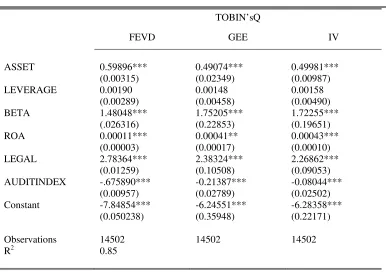
We apply this technique, the results for which are summarized in thefirst
col-umn of Table 6. The coefficient for our key regressor, the auditing variable, is
confirmed in its sign and significance. Also the coefficient related to country
9The technique developed by Plumper and Troeger consists of a vector decomposition
procedure that allows us to estimate time-invariant variables in an augmented fixed effects approach. The model consists of three stages: in thefirst stage we run afixed-effects model, in the second stage the unit-effects vector is decomposed into a part explained by the time-invariant variables and an error term and in the third stage we re-estimate the first stage including the time invariant variables and the error term obtained in stage 2 by pooled-OLS. The authors assess the small-sample properties of the procedure and compare them to the pooled OLS, random effects and Hausman-Taylor. Monte Carlo simulations demonstrate that xtfevd is on average less biased than the available alternatives. Moreover, xtfevd has better small sample properties than Hausman-Taylor. At the same time it is less biased than random effects and pooled OLS when unit effects are correlated with time-variant variables. xtfevd outperforms pooled OLS and random effects in estimating timevariant variables that are correlated with the unit effects (ui) and it is more adequate than Hausman-Taylor in calculating the effect of time-variant variables that are correlated with the unit effects. Thus, employing the unitfixed effects vector decomposition technique appears to be superior for the analysis of data generating processes typical for panel data in comparative politics.
1 0Another alternative procedure is to apply the Hausman - Taylor technique but its results
legal origin validates the previous outcomes. Moreover, we control for cross-sectional heteroskedasticity using the Huber-White Sandwich estimator. As a further check we apply (see Table 6, column 2) a Generalized Estimating Equa-tion (GEE) which corrects for error term correlaEqua-tion over time without reducing the number of observations in the case of unbalanced data. It is also the case
here that country auditing quality seems to affect Tobin’s Q.
An important issue that arises in the analysis of corporate governance and
firm valuations nexus is the endogeneity problem. If corporate governance, in
our case at country level, was endogenously determined, we could not make an
assessment of the causal link. Countries which have higherfirms market values,
e.g. more developed stock markets, could simply be more likely to define better
auditing rules. Accordingly, there is a causal relationship, but ordinary least
square coefficients will tend to overstate the actual connection.
One way to mitigate the problem of causality is to add appropriate control
variables. Specifically, to test whether the relationship between our auditing
dimension and corporate valuation could be spuriously caused by some omitted variables, we added variables which are supposedly associated higher auditing rankings. Our auditing variable has a low variation over time but allows us to address the issue of causality using the instrumental variable method. There
is a strand of thefinancial literature which linksfinancial market development
with economic growth (see i.e. Levine and Zervos, 1998). We adopt the gross national product per capita as an instrument. In table 7, we show the results of
this specification. Econometric outcomes show the existence of a significant and
positive relationship between auditing quality andfirm performance, confirming
the validity of the previous analysis.
5
Conclusion
This paper investigates the effect of national auditing rules on corporate
per-formance. We analyzed yearly company observations in six countries during the period 1980-2002. We derived an original auditing measure that allows us to assign an audit quality score to each country within the sample. We have
shown that quality auditing rules positivily affect company performance. We
have shown that this link is confirmed even when the endogeneity is taken into
account. Furthermore, the overall results are consistent across the different
spec-ifications. Thus, thefindings suggest the importance of considering institutional
factors such as auditing rules when formulating policies in investor protection.
References
[1] Auci S. and D’Agosto E. (2004) "Corporate Governance and Firm Perfor-mance: a comparative analyisis on auditing matters", mimeo.
[3] Beiner, S., Drobetz, W., Schmid, M.M. and Zimmermann, H. (2004) "An Integrated Framework of Corporate Governance and Firm Valuation: Evi-dence from WSwitzerland", ECGI Working Paper n.34.
[4] D’Agosto, E. (2005) “Auditing Issues across Countries: an Explorative Approach to the Regulation Framework”, mimeo.
[5] Daines, R. (2001) "Does Delaware law improve firm value?" Journal of
Financial Economics, 62: 525-558.
[6] Drobetz, W., Schillhofer, A. and Zimmermann, H. (2004) "Corporate Gov-ernance and Firm Performance: Evidence from Germany" European Fi-nancial Management.
[7] Fan, J.P.H. and Wong, T.J. (2005) "Do External Auditors Perform a Cor-porate Governance Role in Emerging Markets? Evidence from East Asia" Journal of Accounting Research, 43(1): 35-72.
[8] Francis, J.R., Khurana, I. K. Pereira, R. (2003) "The Role of Accounting and Auditing in Corporate Governance and the Development of Financial
Markets Around the World" Asia Pacific Journal of Accounting and
Eco-nomics, 10(1): 1-30.
[9] Greenacre, M. J. (1984), Theory and Applications of Correspondence Analysis, Academic Press, London.
[10] Gompers, P. A., Ishii, J.L. and Metrick, A. (2003) " Corporate Governance and Equity Prices", Quarterly Journal of Economics 118(1): 107-155.
[11] Jensen M.C. and Meckling W.H.,(1976) "Theory offirm: managerial
behav-ior, agency costs and ownership structure" Journal of Financial Economics, 3: 305-360.
[12] La Porta, R., Lopez-De-Silanes and F., Shleifer (2006) "What works in Securities Laws?", Journal of Finance, 61(1): 1-32.
[13] La Porta, R., Lopez-De-Silanes, F., Shleifer, A. and Vishny, R. (2002) "Investor Protection and Corporate Valuation", Journal of Finance, 57(3): 1147-1170.
[14] La Porta, R., Lopez-De-Silanes, F., Shleifer, A. and Vishny, R. (2000) "In-vestor Protection and Corporate Governance", Journal of Financial Eco-nomics, 58(1-2): 3-27.
[15] La Porta, R., Lopez-De-Silanes, F., Shleifer, A. and Vishny, R. (1996) "Law and Finance", NBER Working Paper. n.5661.
[17] La Porta, R., Lopez-De-Silanes, F., Shleifer, A. and Vishny, R. (1998) "Law and Finance", Journal of Political Economy, 106(6): 1113-1155.
[18] Levine, R., Zervos, S., (1998) "Stock markets banks and economic growth" American Economic Review 88, 537-58.
[19] Newman, P., Patterson, E.and Smith, R. (2005) "The Role of Auditing in Investor Protection", The Accounting Review, 80(1): 289-313.
[20] Shleifer, A. and Vishny, R. (1997) "A Survey of Corporate Governance", Journal of Finance, 52(2): 737-783.
[21] Shleifer, A. and Wolfenzon, D. (2002) "Investor Protection and Equity Market", Journal of Financial Economics, 66(1): 3-27.
Table 1 Descriptive Statistics on the overall sample
Variables N Mean Std. dev Min Max
TOBIN’S Q 17338 377.8592 5423.347 -6808.846 536125.7
BETA 41538 0.8900905 0.2786561 0.2050008 8.221819
ROA 16365 3.009591 95.61497 0 11655.18
MVB 23288 5709.231 155873.8 -594.29 7415316
MVTOT 23861 4.14E+09 7.74E+10 6.24 7.28E+12
BVSTOT 19582 2.05E+07 1.82E+08 -1.39E+08 1.44E+10
TOTAL ASSET 21947 1.23E+07 4.74E+07 37 1.10E+09
TOTAL DEBT 21932 3947419 2.15E+07 0 8.51E+08
TOT.SH.CAP. RES 21938 1817236 4519667 -9951000 1.45E+08
LEVERAGE 21919 0.3923619 1.437953 -94.28176 175.4943
LEGAL 42090 .5737705 0.4945338 0 1
AUDITINDEX 42090 0.1825548 0.6426865 -1.1035 0.8285
Table 2 Descriptive Statistics Common law Sample
Variables N Mean Std. dev Min Max
TOBIN’S Q 10931 527.1521 6750.516 -6808.846 536125.7
BETA 23874 0.9024002 0.2200128 0.2050008 2.004893
ROA 10989 4.451394 116.6562 0 11655.18
MVB 15454 8166.095 186221 -594.29 7415316
MVTOT 15135 5.51E+09 9.61E+10 64 7.28E+12
BVSTOT 12561 3.16E+07 2.26E+08 -1.39E+08 1.44E+10
TOTAL ASSET 12736 1.21E+07 4.65E+07 376 1.10E+09
TOTAL DEBT 12724 3762033 2.27E+07 0 8.51E+08
TOT. SH. CAP. RES. 12727 2195143 5212378 -1670000 1.45E+08
LEVERAGE 12711 0.3782553 1.870126 -94.28176 175.4943
LEGAL 24150 1 0 1 1
AUDITINDEX 24150 0.5062076 0.4157277 -1.1035 0.8285
[image:14.612.66.476.451.630.2]
[image:15.612.67.500.147.328.2]
Table 3 Descriptive Statistics Civil law Sample
Variables N Mean Std. dev Min Max
TOBIN’S Q 6407 123.1503 1321.917 -3.789874 47461.74
BETA 1766 0.8734532 0.3416095 0.4484704 8.221819
ROA 5376 0.0624235 0.5640196 0 34.49863
MVB 7834 862.616 61509.51 -88.43 5318500
MVTOT 8726 1.75E+09 1.87E+10 6.24 6.86E+11
BVSTOT 7021 791125.2 3429937 -9107196 8.11E+07
TOTAL ASSET 9211 1.25E+07 4.86E+07 37 9.26E+08
TOTAL DEBT 9208 4203592 1.99E+07 0 4.24E+08
TOT. SH. CAP. RES 9211 1295075 3262582 -9951000 6.10E+07
LEVERAGE 9208 0.4118351 0.3060643 -7.687813 5.722189
LEGAL 17940 0 0 0 0
AUDITINDEX 17940 -0.2531316 0.6368592 -1.0482 0.8285
Table 4 Correlation Coefficients Matrix
TOBIN’s Q A S S E T M V B R O A B E T A LEVERAGE L E G A L AUDITINDEX
TOBIN’s Q 1
ASSET 0.0027 1
MVB 0.0175 -0.0049 1
ROA 0.5644 -0.0075 0.0013 1
BETA 0.0445 0.0865 -0.0054 0.0076 1
LEVERAGE 0.0049 0.0467 -0.001 -0.0021 0.0017 1
LEGAL -0.0038 0.0360 0.0221 0.0216 0.0514 -0.0115 1
AUDITINDEX 0.0074 -0.001 -0.0026 -0.0003 0.0498 -0.0039 0.5843 1
[image:15.612.52.558.460.618.2]
Table 5. Pooled and Random Estimation Methods: coefficients for Tobin’s Q and Market Value to Book (MVB)
Annual data for the period 1980- 2002. Dependent variable (Tobin’s Q or MVB). Tobin’s Q represents the firm's market value divided by its replacement cost. We estimate this ratio as the market value of assets (calculated as book value of assets minus book value of equity plus market value of equity) over book value of assets. Market-to-book ratio has been taken directly from DATASTREAM and is defined as market value of equity over book value of equity; ln(ASSETS) is the logarithm of book asset value; LEVERAGE is defined as the ratio of total debt to capital; BETA is a measure of riskiness of a firm; ROA, Return on assets is a measure of a firm's profitability (current value); LEGAL is a legal origin dummy which assumes value one if the firm is in a common law country; Auditindex denotes our original measure of the quality of the audit in the country: the grater the value of the measure, the lower the quality of auditing in that country. Conversely, a decreasing value of the index expresses an increasing country auditing quality.
POOLED indicates pooled OLS; RANDOM states for random effect model; RANDOM Adj. states for random effect model adjusted for sector dummies.
TOBIN’S Q MVB
POOLED RANDOM RANDOM
Adj POOLED RANDOM
RANDOM Adj
ASSET 0.12995*** 0.49413*** 0.50203*** -0.00682** 0.04002*** 0.04675***
(0.00803) (0.01233) (0.01244) (0.00339) (0.00738) (0.00739)
LEVERAGE -0.01358 0.00149 0.00157 -0.14401*** 0.28374*** 0.29212***
(0.02407) (0.00652) (0.00626) (0.02749) (0.06632) (0.06659)
BETA 1.70506*** 1.75042*** 1.72904*** 0.59186*** 0.74231*** 0.66335***
(0.07203) (0.24141) (0.23916) (0.03183) (0.09993) (0.09691)
ROA 0.00098*** 0.00040 0.00040 0.00002 0.00004 0.00004
(0.00022) (0.00030) (0.00030) (0.00006) (0.00003) (0.00003)
LEGAL 2.57863*** 2.38043*** 2.25411*** 0.36662*** 0.41719*** 0.36518***
(0.03843) (0.09373) (0.09395) (0.01770) (0.04132) (0.04056)
AUDITINDEX -0.37857*** -0.21113*** -0.20611*** -0.08001*** -0.09741***
(0.02809) (0.02304) (0.02319) (0.01269) (0.01303)
Sector dummies NO NO YES NO NO YES
Constant -1.19795*** -6.29017*** -6.31717*** 0.17001*** -0.75680*** -1.01192**
(0.12993) (0.25637) (0.29515) (0.05247) (0.12080) (0.13433)
Observations 14502 14502 14501 15819 15819 15818
R2 0.32 0.24 0.06 0.03
Robust standard errors in parentheses *** p<0.01, ** p<0.05, * p<0.1
Table 6 Robustness checks
Annual data for the period 1980- 2002. Dependent variable (Tobin’s Q or MVB). Tobin’s Q represents the firm's market value divided by its replacement cost. We estimate this ratio as the market value of assets (calculated as book value of assets minus book value of equity plus market value of equity) over book value of assets. Market-to-book ratio has been taken directly from DATASTREAM and is defined as market value of equity over book value of equity; ln(ASSETS) is the logarithm of book asset value; LEVERAGE is defined as the ratio of total debt to capital; BETA is a measure of riskiness of a firm; ROA, Return on assets is a measure of a firm's profitability (current value); LEGAL is a legal origin dummy which assumes value one if the firm is in a common law country; Auditindex denotes our original measure of the quality of the audit in the country: the grater the value of the measure, the lower the quality of auditing in that country. Conversely, a decreasing value of the index expresses an increasing country auditing quality.
FEVD indicates Plumper and Troeger method; GEE states for Generalized estimating equation model; IV states for instrumental variable model : instrument: GDP per capita
TOBIN’sQ
FEVD GEE IV
ASSET 0.59896*** 0.49074*** 0.49981***
(0.00315) (0.02349) (0.00987)
LEVERAGE 0.00190 0.00148 0.00158
(0.00289) (0.00458) (0.00490)
BETA 1.48048*** 1.75205*** 1.72255***
(.026316) (0.22853) (0.19651)
ROA 0.00011*** 0.00041** 0.00043***
(0.00003) (0.00017) (0.00010)
LEGAL 2.78364*** 2.38324*** 2.26862***
(0.01259) (0.10508) (0.09053)
AUDITINDEX -.675890*** -0.21387*** -0.08044***
(0.00957) (0.02789) (0.02502)
Constant -7.84854*** -6.24551*** -6.28358***
(0.050238) (0.35948) (0.22171)
Observations 14502 14502 14502
R2 0.85
Table 7: List of audit characteristics
SUPERVISORY AUTHORITY INDICATOR
AUDITORS INDEPENDENCE
INDICATOR
CORPORATE
RESPONSIBILITY INDICATOR
∼ Juridical nature of authority ∼ Prohibited Activities
∼ Audit Committees: responsibility and independence
∼ Duties of the Board ∼ Audit Partner Rotation
∼ Corporate Responsibility for Financial Reports of National and Foreign Firms
∼ Composition ∼ Conflicts of
Interest
∼ Improper influence on Conduct of Audits
∼ Members Independence
∼ CEO and CFO reimburse the Issuer due to non-compliance of financial reports
∼ Vacancies
∼ Powers and Rules of Authority
∼ Registration with the Authority
∼ Auditing Standards
∼ Quality Control Standards
∼ Independence Standards and Rules
∼ Inspections of Registered Public Accounting Firms
∼ Authority Review
∼ Investigations and Disciplinary Proceedings
∼ Applicability to Foreign Public Accounting Firms
∼ Oversight of Supervision Authority
Table 8: Values of the audit indicator by country
Anni USA France Germany Italy Spain UK
1980 0.84 0.62 -0.85 0.32 0.83 0.83
1981 0.84 0.62 -0.85 0.32 0.83 0.83
1982 0.84 0.62 -0.85 0.32 0.83 0.83
1983 0.84 0.62 -0.85 0.32 0.83 0.83
1984 0.84 0.62 -0.85 0.32 0.83 0.83
1985 0.84 0.43 -0.85 0.32 0.83 0.42
1986 0.84 0.23 -0.85 0.32 -0.96 0.09
1987 0.84 0.43 -0.85 0.32 -0.57 0.42
1988 0.84 0.23 -0.85 0.32 -0.96 0.09
1989 0.84 0.23 -0.85 0.32 -0.96 0.09
1990 0.84 0.23 -0.85 0.32 -0.96 0.24
1991 0.84 0.23 -0.85 0.32 -0.96 0.24
1992 0.84 0.23 -0.85 0.32 -0.96 0.09
1993 0.84 0.23 -0.85 0.32 -0.96 0.09
1994 0.84 0.23 -0.85 0.32 -0.96 0.09
1995 0.84 0.23 -0.85 0.32 -0.96 0.09
1996 0.84 0.16 -0.85 0.32 -0.96 0.09
1997 0.84 0.16 -0.85 0.32 -0.96 0.09
1998 0.84 0.03 -0.85 -0.83 -1.05 0.09
1999 0.84 0.03 -0.85 -0.98 -1.05 0.09
2000 0.84 0.03 -0.85 -0.98 -1.05 0.09
2001 0.84 0.03 -1.01 -0.98 -1.05 0.09