http://dx.doi.org/10.4236/opj.2014.42005
First Order Phase Transitions as Radiation Processes,
Part Two
Vitali A. Tatartchenko*, Pavel V. Smirnov, Hongrong Jin Shanghai CEC ZhenHua Crystal Technology Co. Ltd., Shanghai, China
Email: *[email protected]
Received November 24,2014; revised December 25, 2014; accepted January 21, 2014
Copyright © 2014 Vitali A. Tatartchenko etal. This is an open access article distributed under the Creative Commons Attribution License, which permits unrestricted use, distribution, and reproduction in any medium, provided the original work is properly cited. In accordance of the Creative Commons Attribution License all Copyrights © 2014 are reserved for SCIRP and the owner of the intellectual property Vitali A. Tatartchenko etal. All Copyright © 2014 are guarded by law and by SCIRP as a guardian.
ABSTRACT
This paper presents new experimental results concerning the PeTa effect—infrared characteristic radiation un-der first orun-der phase transitions, especially during deposition and condensation of vapours/gases and the crystal-lisation of melts. The abbreviation “PeTa effect” means Perel’man-Tatartchenko’s effect. The nature of the PeTa effect is transient radiation that a particle (i.e., atom, molecule or/and cluster) emits during a transition from a meta-stable higher energetic level (in a super-cooled melt or super-saturated vapour) to the stable condensed lower level (in a crystal or liquid). The radiation removes latent heat with photons of characteristic frequencies that are generated under this transition. This paper is the second in a set describing the appearance of PeTa ra-diation under air cooling with deposition and condensation of air components. The rara-diation was recorded using an IR Fourier Spectrometer with a highly sensitive MCT detector. Certain peculiarities of the recorded radiation as well as its applications in the physics of the atmospheres of Earth and Jupiter are analysed.
KEYWORDS
PeTa Effect; First Order Phase Transitions; Vapour Condensation; Vapour Deposition; Melt Crystallisation; Infrared Radiation; Atmospheric Phenomena; Igloo Effect; Jupiter
1. Introduction
This paper presents new experimental results for the PeTa effect—a physical phenomenon of infrared characteristic radiation (IRCR) under first order phase transitions, es-pecially during deposition and condensation of vapours/ gases and crystallisation of melts. The effect was theo-retically predicted by M. Perel’man [1] and was investi-gated by V. Tatartchenko for several alkali halides [2,3] and sapphire [4]. The nature of the PeTa effect is that a particle (i.e., atom, molecule or/and cluster) emits tran-sient radiation during transition from a meta-stable higher energetic level (in a super-cooled melt or super-saturated vapour) to a stable and condensed lower level (in a crys-tal or melt). The radiation removes latent heat by photons with characteristic frequencies that are generated under this transition. Previous papers present theoretical [1,5-9] and experimental [2-4,7,10-21] evidences of the PeTa
effect, but as highlighted in [22], additional investiga-tions concerning atmospheric phenomena are needed. This paper is the second paper of a set. In the first paper [23], a striking demonstration of the PeTa effect is pre-sented. The paper describes the presence of infrared ra-diation during the deposition and condensation of air com-ponents at the temperature of liquid nitrogen. The ex-periments consist of a simple scheme of deep cooling air, while recording the emissive spectra using an IR Fourier Spectrometer with a highly sensitive MCT detector (Figure 1from [23]). The experiments allow estimation of both the range and order of intensity of PeTa radiation under these conditions. The main objective of the experiments is to eliminate all doubts that the PeTa effect not only exists, but that the power of PeTa radiation is significant, and has to be taken into account in all calculations of energetic balance for the atmospheres of Earth and other planets. Why did we use the temperature of the liquid nitrogen? In the experiments, we would like to be
27
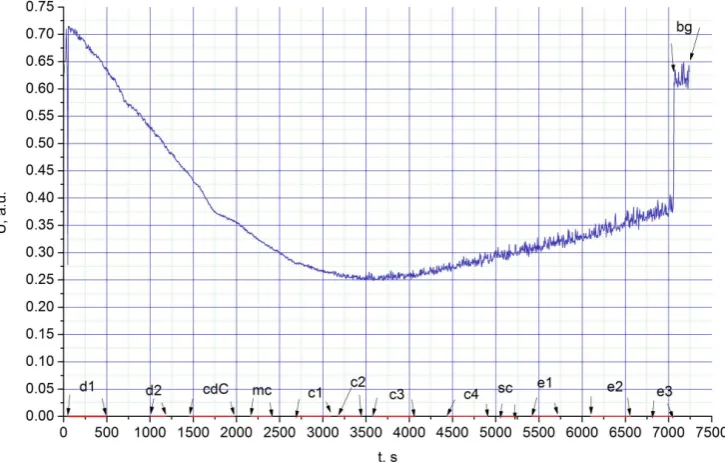
Figure 1. Integral intensity of IR radiation,U,in a.u. (arbitrary units), between 1 and 25 µm from the glass cup heated from
the temperature of liquid nitrogen (77 K) to room temperature (298 K) vs. experiment time.
sure that Planck’s radiation does not influence our results. Deep air cooling allowed these conditions. If we decrease the temperature from 298 K to 77 K, the maximum am-plitude of Planck’s radiation will move from 9.9 µm to 37.6 µm, and the integral intensity of equilibrium radia-tion in the range of our measurement, 1 to 25 µm, has to be decreased by a factor of 3500. In our experiments [23], the increase of integral radiation was
approxi-mately by a factor of 3 in comparison with the Planck’s radiation at room temperature. Thus, the obtained four orders effect is sufficient to ascertain that PeTa radia-tion exists. Certainly, this estimaradia-tion is rather approxi-mate because we did not protect the spectrometer from the parasitic surrounding sources of Planck’s radiation. However, in any case, the PeTa effect in the experi-ments is sufficiently large that any student would be able to observe the effect with a rather simple infrared detector. In this paper, which is a sequel of the previous paper [23], we investigate certain peculiarities of PeTa radiation, and demonstrate the presence of PeTa energy sources in the atmospheres of Earth and Jupiter.
2. Experiments
For the recording of IR radiation, the same Fourier spec-trometer utilised in previous experiments [23] was used; and as before [23], the irradiative object, a 200 ml cup, was placed approximately 4 cm from the input window of the spectrometer (Figure 1from [23]).
2.1. PeTa Radiation during Increasing of the Temperature from 77 K to 298 K
An objective of the first experiment was to analyse the peculiarities of PeTa spectra under gradual changes of
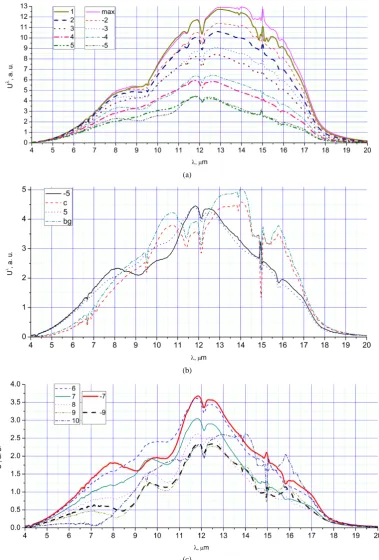
conditions during condensation and/or deposition of dif-ferent air components, by increasing the temperature of the target, from the temperature of liquid nitrogen (77 K) to room temperature (298 K). The integral radiation in-tensity within the range of 1 - 25 µm was continuously recorded from the irradiative cup wall. In this instance, a glass cup was used. For radiation spectra, a time of 1.09 s was chosen for the accumulation of data for one spec-trum, and an average of 5 spectra was used. Thus, we had a new spectrum every 5.44 s, with a resolution of 2 cm-1. The temperature of the laboratory was 25˚C (298 K) and the relative humidity was 47% (corresponding to 286 K for the water vapour dew point).On the integral radiation curve (Figure 1), we demonstrate that points in the vi-cinity of the irradiation spectra were averaged, and dif-ferent manipulations were performed. First (Figure 1, point b), the background irradiation spectrum correspond-ing to room temperature was recorded from the empty cup (Figure 2(b), curve bg). Several seconds after be-ginning measurements, the glass cup was filled with the liquid nitrogen (Figure 1, c point). The intensity of the integral radiation naturally decreased because of de-creasing temperature (Figure 1, −9 point), but after the beginning of condensation and deposition of air compo-nents, the PeTa radiation appeared and the intensity grew to a maximum value (Figure 1, range “max”) through points −7, −5, −4, −3, −2. Approximately 180 s later (Figure 1, point N2), the cup was emptied of liquid
(a)
(b)
[image:3.595.110.490.83.644.2](c)
Figure 2. The radiation spectra, Uλ, in a.u., corresponding to different time points of the Figure 1: (a) 1 - 5, max, (−2) - (−5);
(b) −5, c, 5, bg; (c) 6 - 10, −7, −9.
PeTa radiation and increasing Planck’s radiation. At point 9, the speed of radiation change is equal to zero. At this point, the speed of decreasing PeTa radiation is equal to the speed of increasing Planck’s radiation. Approximately
29
Here are the critical temperature ranges of our experi-ment for normal atmospheric pressure, and possible physi-cal processes for equilibrium conditions (without super- cooling, besides a well-known super-cooling of water up to 40 K):
77 K - 88 K: deposition of H2O and CO2,
condensa-tion of Ar and O2.
88 K - 90 K: deposition of H2O and CO2,
condensa-tion of O2.
90 K - 195 K: deposition of H2O and CO2.
195 K - 233 K: deposition of H2O.
233 K - 273 K: deposition and condensation of H2O.
273 K - 286 K (dew point): condensation of H2O.
286 K - 298 K: evaporation of H2O.
Thus, on the Figure 1, it would be interesting to obtain dependence of the PeTa radiation intensity, U, vs. T. But U was found to have a temperature hysteresis. This in-teresting phenomenon has to be investigated in details. We will publish results in the following paper.
Let us compare consequent spectra.
Increasing the temperature moves the main peak from 13.5 µm to the shorter wavelength of 11.5 µm (spec-tra 1 - 9). However, for spectrum 10, the peak moves back to 13.5 µm. This effect can be connected with the condensation of water, as well as with augmenta-tion of Planck’s radiaaugmenta-tion.
The spectra obtained during very fast cooling have more intensive peaks near 8 µm in comparison with spectra of the same integral intensity obtained during slow heating. It is especially clear for spectra −5 and 5 of Figure 2(b). This phenomenon is most likely
connected with intensive condensation and crystalli-sation of super-cooled water.
2.2. PeTa Radiation during Increasing of Temperature from 253 K to 298 K
An objective of the second experiment was to obtain PeTa radiation during deposition and condensation of water vapour on a cooled cup wall at a temperature range of 253 K to 286 K with synchronised recording of hoar-frost grains, or the dew droplets on the surface, with an optical microscope (magnification X10 - X500).
The temperature of the laboratory was 25˚C (298 K) and the relative humidity was 47% (corresponding to 286 K for the water vapour dew point).An irradiative object, a 200 ml plastic cup containing alcohol-water solution cooled in a refrigerator, was placed approximately 4 cm from the input window of the spectrometer (Figure 1
from [23]). The integral radiation intensity, U, within the range 1 - 25 µm was continuously recorded from the wall of the irradiative cup (Figure 3). At the beginning, the temperature of the cup was 255 ± 2 K. On the photo (Figure 4(b)), we can see a deposition of hoarfrost grains on the cooled surface. This means that at this moment, the recorded radiation is the sum of PeTa radiation and Planck’s radiation. Evidently, the temperature of the cup begins to grow, but the integral intensity of radiation begins to decrease. This can only be the result of a de-crease of PeTa radiation intensity.
[image:4.595.118.481.476.707.2]We divided the interval of time of cup heating from this temperature to room temperature over twelve ranges (Figure 3):
Figure 3. Integral intensity of IR radiation, U,in a.u. (arbitrary units), between 1 and 25 µm from the glass cup heated from a
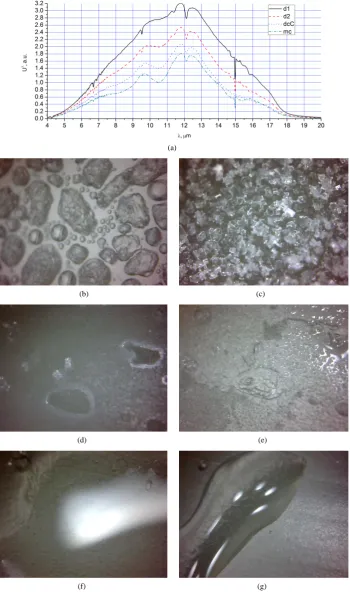
First, we explain the notifications that we use for all: 1. Ranges: d1, d2; 2. Time interval: 100 - 1200 s; 3. Physical process: the water vapour deposition; 4. The averaged spectra of radiation for each range: Figure 4(a), d1, d2; 5. Peculiarities of spectrum: appearance of peaks 9.7 µm; 6. The pictures of the surface at the beginning and at end of the interval: Figures 4(b) and
(c); 7. Comments: At the end of d2 interval, the grains cover all surface of the cup.
1. cdC; 2. 1486 - 1986 s; 3. Water vapour condensa-tion, deposicondensa-tion, and crystallisation of formed droplets; 4. Figure 4(a), cdC; 5. Relative augmentation of the peak 9.7 µm; 6. Figures 4(d) and (e); 7. The peak 9.7 µm is most likely connected with water vapour con-densation.
1. mc; 2. 2200 - 2400 s; 3. Ice melting and water va-pour condensation; 4. Figures 4(a) and 5(a), mc; 5. Relative augmentation of the peak at 9.7 µm; 6. Fig-ures 4(f) and (g); 7. As in the previous point, the peak at 9.7 µm is most likely connected with water vapour condensation.
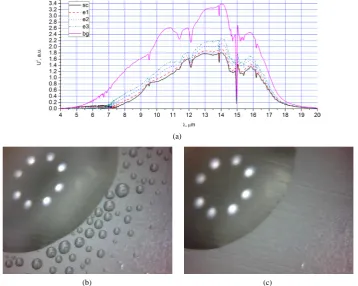
1. c1 - sc; 2. 2700 - 5244 s; 3. Water vapour conden-sation up to stop condenconden-sation; 4. Figure 5(a), c1, c2, c3, c4, sc; 5. Appearance and relative increasing of the peak at 6.7 µm, relative augmentation of the peak at 9.7 µm, appearance of the peak at 15.8 µm, dis-placement of the main peak from 12 µm to 13.5 µm; 6. Figures 5(b) and (c); 7. The peaks at 6.7 µm and 9.7 µm are most likely connected with water vapour condensation.
1. e1 - e3; 2. 5444 - 7044 s; 3. Water vapour droplet evaporation; 4. Figure 6(a), e1, e2, e3; 5. ; 5. Disap-pearance of the peaks at 6.7 µm and 9.7 µm, growth of the intensity of radiation; 6. Figures 6(b) and (c); 7. Evidently, peaks 6.7 µm and 9.7 µm are connected with water vapour condensation; growth of the inten-sity of radiation is connected with Planck’s radiation.
1. bg; 2. 7100 s; 3. Planck’s radiation at room tem-perature; 4. Figure 6(a), bg.
2.3. Comparison of the Intensities of PeTa and Planck’s Radiations
The objective of the third experiment was to compare the sources of PeTa and Planck’s radiations. All conditions of the experiment were the same as in the previous two experiments.
1) We filled the Al cup with liquid nitrogen (77 K). The wall of the cup was covered with an ice film. We measured the integral intensity of radiation, U1, in the range of 1 to 25 µm from the cup wall. We filled the plastic cup with water heated to a temperature higher than the dew point. We measured the integral intensity of radiation, U2, in the range of 1 to 25 µm from the cup
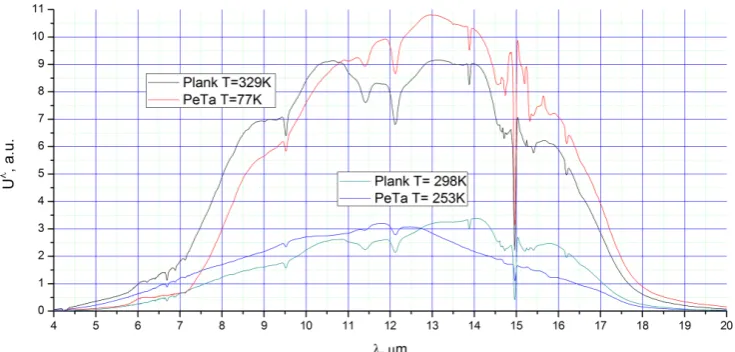
wall. We increased the temperature of the water up to the equalisation point of both (U1 and U2) intensities. We repeat once more, if we decrease the temperature from 298 K to 77 K, the maximum amplitude of Planck’s ra-diation will move from 9.9 µm to 37.6 µm, and the inte-gral intensity of equilibrium radiation in the range of our measurement has to be decreased by a factor of 3500. This means that Planck’s radiation from the cup with liquid nitrogen is a negligible quantity, and the cup will emit only PeTa radiation. Thus, we found that at the temperature of the laboratory 298 K and relative humid-ity 47% (corresponding to 286 K for water vapour dew point), the integral PeTa radiation at 77 K corresponds to Planck’s radiation at 329 ± 2 K. The spectra of both radiations are shown in Figure 7. Certainly, this com-parison is rather approximate because:
We did not protect the spectrometer from the parasitic surrounding sources of Planck’s radiation.
We used a plastic cup so the emissions of the ice and plastic do not significantly differ.
2) We performed the same experiment with two plastic cups filled with a cooled alcohol solution and water heated to a temperature higher than the dew point. We found that the integral intensity of the radiation at 253 ± 2 K corresponds to the intensity of Planck’s radiation at 298 ± 2 K. However, at 253 K, we cannot neglect Planck’s radiation. Thus, we found that at the temperature of the laboratory (298 K) and a relative humidity of 47% (cor-responding to 286 K for the water vapour dew point), the integral at the range of 1 - 25 µm for the totality of PeTa and Planck’s radiations at 253 ± 2 K, corresponds to Planck’s radiation at 298 ± 2 K. The spectra of both radiations are shown in Figure 7.
3. PeTa Radiation in Nature, in the
Atmospheres of Earth and Jupiter
In the paper [23], we mentioned several cases of PeTa radiation recorded in nature. Here are some others:
3.1. Igloo Effect
31
(a)
(b) (c)
(d) (e)
(f) (g)
Figure 4. (a) The four radiation spectra, Uλ, in a.u., as the integral radiation intensity decreases between times 0 s and 2500 s;
[image:6.595.125.476.86.679.2](a)
(b) (c)
Figure 5. (a) The six radiation spectra, Uλ, in a.u., as the integral radiation intensity decreases between times 2500 s and 5250
s; (b, c) View of water vapour condensation at the beginning of interval c1 (5b) and at the end of interval sc (5c); X120.
(a)
(b) (c)
Figure 6. (a) The five radiation spectra, Uλ, in a.u., as the integral radiation intensity decreases between times 5250 s and 7100
[image:7.595.123.475.81.382.2] [image:7.595.120.479.419.705.2]33
Figure 7. The four radiation spectra, Uλ, in a.u., corresponding to the four different temperatures of irradiative objects.
emitted by the sheet, heated to approximately 30˚C. Cer-tainly, inside the house, the metallic sheet has to be pro-tected against thermo-conductive heat loss.
3.2. Hot Ice-Cream
Evidently, the same effect has to exist for an ice-cream.
3.3. Stuffiness before Thunderstorm
The stuffiness is a well-known effect that ceases with the first droplets of rain [25]. Most likely, the effect is a result of PeTa radiation during intensive cloud formation.
3.4. PeTa Radiation Sources in the Earth’s Atmosphere
Detected by satellites, IR radiation would allow very im-portant information concerning the atmospheric and earth’s surface processes to be accumulated if interpretation of IR images is definite. Let us analyse an anomalous dis-tribution of IR radiation mainly obtained from the Ad-vanced Very High Resolution Radiometer data in the channels of 10.3 - 11.3 µm, and 11.5 - 12.5 µm [26-36]. The zones of permanent or periodical increased intensity of radiation were detected on the images of tectonic breaks located in the west part of the North American continent, in the south part of East Siberia, in the Tarim Valley in China, in the Rhine Graben in Germany, and in zones of rift-genesis of the Afar Depression in north- eastern Africa. As a result, the authors conclude that the anomalies in earth’s infrared radiation at regions of tec-tonic breaks have a global character. Four types of ano-malies were detected: 1. Linear; 2. Contour; 3. Striped; 4. Isolated. Respectively, they had the lengths: 1. 200 - 600 km; 2. 100 - 200 km; 3. 40 - 60 km; 4. 1.0 - 1.5 km; and the widths: 1. 5 - 15 km; 2. 1 - 6 km; 3. 10 - 20 km; 4. 1.0 - 1.5 km. Emission of 1st, 2nd, 4th types had a permanent
character, and the 3rd type was most noticeable at the rain seasons and became weak during winters. Some of the anomalies were located in ocean or lake coast strips, but the most were situated on the middles of slopes in moun-tain ranges. The last anomalies were narrower for the steeper slopes, and the intensity of their radiation was distributed with the most contrast on alternate mountain ranges and valleys. Typical values of measured infrared flows were arranged as 50 - 90 mW/(m2∙str∙μm). The authors have mainly explained these anomalies as the sources of endogen heat flow exiting through tectonic breaks.
We think this explanation is false. Given that the ano-malies are located in places with ideal conditions for fog and cloud formation, it would seem to follow as a natural consequence that the recorded IR radiation is PeTa
(a) (b)
Fiure 8. Distribution of bright temperature on the slopes of mountains: (a) from [33] - Primorsky fault (Siberia, Russia); (b) from [26] - Taibai west slope (California, USA).
the process of vapour condensation.
With respect to Morozova [38] analysing linear clouds anomalies (LCA) with satellite imagery, the appearance of LCA above breaks in the lithosphere over various earth regions is a well-known natural phenomenon. LCA length can reach several hundreds of kilometres. A uni-fied opinion concerning the nature of LCA is absent. Letnikov [39] asserts that the breaks of lithosphere are the sources of ionised radon which initiates the LCA formation. Other geologists support orographic factors of LCA appearance. In any case, existence of LCA, as well as the seasonal and diurnal change of sources’ intensities [36] supports the PeTa model.
It has to be mentioned that, sometimes, together with endogen heat, authors of [26-36] discuss a water vapour condensation as a possible infrared source: “Water va-pour is transformed in a fog. The heat of the phase tran-sition is liberated, the radiometers of satellites ‘see’ this heat” [30]. This does not contradict our model in which only a part of the phase transition energy is emitted as PeTa radiation. However, only heat of condensation ap-pear not to be a reason for the anomalies. Let us estimate this effect. If a reasonable quantity, 5 g/m3, of water va-pour during fog or cloud formation is condensed, and the energy of transition is completely thermalised, it will increase the air temperature by 1˚C. In reality, this effect exists [30]: A systematic measurement of three weather stations in the Tunka Valley (near Baikal) recorded a thermo-dynamical temperature on the mountain slope at the centre of the thermal line that was 1˚C higher than on the bottom of valley. On the other hand, bright tempera-tures systematically measured by satellites in the same region were 5 - 15 K higher [33] (Figure 8). This fact can be explained if we assume that dew points coincide with the centres of thermal lines, and are located at the middle of mountain slopes. The thermodynamic temper- ature difference of 1˚C higher here than on the bottoms
of valleys, and the recorded higher bright temperature
(Figure 8) is a result of non-equilibrium PeTa
radia-tion.
3.5. Qualitative Model of Juvenal Atmospheric Phenomena on the Basis of PeTa Radiation
In this part of the paper, a qualitative model of Juvenal increased infrared emission is proposed. The model ex-plains the nature of Juvenal unusual colour, and, espe-cially, its red spots, which are a subject of numerous scientific discussions. The famous images of Jupiter cap-tured by NASA’s Voyager spacecraft and the Hubble Space Telescope, show that Jupiter has many shades of white, orange, brown, yellow and even red. Only the fol-lowing explanation of this phenomenon has been se-riously discussed [40,41]. The coloration in the clouds of Jupiter is caused by upwelling compounds, known as chromophores, which change colour when they are ex-posed to ultraviolet light from the Sun. The substances are believed to be phosphorus, sulphur, or possibly hy-drocarbons. These chromophores mix with the warmer, lower deck of clouds. The zones of different colours are formed when rising convection cells form crystallising ammonia that masks out these lower clouds from view. A criticism of the model is not the aim of this paper, but the main weak points of this model will be mentioned. First of all, only quantities of chromophores less than 1 ppm have been detected in the Juvenal atmosphere. In addi-tion, the statement from the paper [41]: “Despite many decades of ground-based, space-based, and in situ ob-servations of Jupiter’s atmosphere, the chemical agent(s) responsible for the varying colours observed in visible images of Jupiter remain unidentified”, leaves the ques-tion open.
pla-35
net with circulation of its atmosphere. Our model may be briefly presented as follows: The intensive circulation in the Juvenal atmosphere lifts heated vapours, particularly of ammonium and water, which are condensed and soli-dified in the upper layers of the atmosphere. PeTa emis-sion taking place during condensation and crystallisation seems to be the reason for the emission of infrared tion, complementary to the equilibrium Planck’s radia-tion in Jupiter. Under high pressure, emission of red cha-racteristic radiation (RCR) seems to be a possible part of PeTa radiation. Next, it would follow as a natural conse-quence, that PeTa emission displaces the visual colour of the planet into the red range. The red spots are the stable atmospheric vortexes. The processes of condensation and solidification, and hence coloration due to PeTa radiation, must be more intensive there. In [11-15], we have men-tioned a possibility of these processes in the Juvenal at-mosphere.
The Juvenal cloud structure and atmospheric pressure is notably important for our model. The only spacecraft to have descended into Jupiter’s atmosphere and to have taken scientific measurements is Galileo. This spacecraft sent an atmospheric probe into Jupiter upon arrival in 1995: next, it entered Jupiter’s atmosphere, where it burned up in 2003. Ice clouds of ammonia (NН3), ammonium
hydrosulphide (NH4SH), and water were recorded. The
average content of water and ammonia in the Juvenal atmosphere is 0.1% and, 0.02% [42]. As for the atmos-pheric pressure, it has been found to be 0.2 bar in the high cloud boundary, and 20 bars at the depth of 50 km.
We are aware of the weak points of our brief model. This model is a first step of applying the PeTa effect to Juvenal atmospheric processes. There are many further analyses to perform. First, spectra of PeTa emission have to be determined for the atmospheric components. Se-condly, the windows of transparency, absorption and ree-mission, have to be taken into account. However, in any case, the PeTa effect exists, and it has to be accounted for in all atmospheric models.
4. Conclusions
In our experiments, radiation occurs during condensation or/and the deposition of air components. Only the PeTa effect can explain this radiation.
According to the principles of quantum electro dy-namics, the presence of the described spontaneous transi-tions, and as a result, PeTa radiation, should lead to an opportunity to stimulate such transitions. For example, crystallization by irradiation of the substance close to the temperature of crystallisation at a resonant frequency corresponding to the particular transition, can be stimu-lated. Such opportunities, which have not been investi-gated experimentally to date, should uncover new effects.
For instance, fog or ice cloud formation may occur as a result of atmosphere irradiation by characteristic radia-tion. At the same time, the primary laser beam will be amplified. In this way, the PeTa energy of water con-densation or freezing in the atmosphere can be accumu-lated.
The second method of atmospheric PeTa energy ac-cumulation could use an infra-red laser and be based on water vapour condensation or freezing in atmosphere. Let us imagine a system of two parallel mirrors (one of them is semi-transparent) of area of 1 m2 and at the dis-tance of 1 m each from each other. Let us locate this sys-tem in the atmosphere where water vapour is saturated but is not yet condensed, for instance, on the slope of the mountain Primorski (approximately lower 1000 m), or on the slope of Taibei (approximately lower 2800 m) (Figures 8(a) and (b)). Let us provoke condensing of vapour with a special salt spray, radioactive source radiation, charac-teristic PeTa radiation, etc. In this case approximately 5 g (the temperatures are 271 K and 284 K, respectively) of water vapour will be condensed in our system. This means that 12.4 kJ of energy will be liberated and the system would work as a laser. For 8% laser efficiency, the energy of 1kJ would be radiated. The movement of air inside the system with a speed of 1 m/s (a result of a natural convection) would provide a generator with 1 kW power. This could be a pulse generator with a frequency of 1 Hz. For comparison, a silicon solar cell of area 1 m2, with an efficiency of 14%, provides 100 W of power. Thus, PeTa radiation would be used for atmospheric energy accumulation, and together with the solar, wind, geothermal and falling water energies, provides the fifth source of ecologically pure energy.
Our experiments allow estimation of both range and order of intensity of PeTa radiation. We demonstrate that the PeTa effect not only exists, but the power of PeTa radiation is significant and must be considered in all cal-culations of energetic balance for the atmospheres of Earth and other planets [43]. Many sources of infrared radia-tion appear to be a result of PeTa radiaradia-tion during fog and cloud formation in the window of atmospheric trans-parency (7 - 14 µm).
Our experiments explain why 6.7 µm wave-length IR radiation is used for water vapour registration in the Earth’s atmosphere.
Although theory [6,8] seemed to give a satisfactory, and, to a certain extent, quantitative explanation of the phenomenon under investigation, this explanation lacked full quantitative basis.
radiation yield at the same conditions. We hope to be able to present these results in the near future.
We could also use these radiation measurements to find if there is water in the atmospheres of other planets, for instance, Mars.
This radiation may explain Jupiter’s red colour and its infrared emission. It is well-known that Jupiter emits more energy than it receives from the sun. Circulation in Jupiter’s atmosphere lifts the heated ammonium and wa-ter vapours, which are condensed and solidified in the upper part of the atmosphere. The PeTa radiation of these processes seems to be the reason for the emission of infrared radiation which displaces the planet’s colour in the red range.
A similar process could be applied for artificial cool-ing of Earth: creatcool-ing upper cirrus clouds uscool-ing characte-ristic PeTa radiation and, as a result, leading to heat emission into space.
REFERENCES
[1] M. E. Perel’man, “Phase Transitions Caused by the Open- ing of New Channels in Electron-photon Interactions,” PhysicsLettersA, Vol. 37, No. 5, 1971, pp. 411-412.
http://dx.doi.org/10.1016/0375-9601(71)90609-8
[2] V. A. Tatarchenko, “Appearance of Distinguishing Fea- tures in Emission Spectra during Crystallization of Sub- stances Transparent in the IR Region,” SovietPhysics— Crystallography, Vol. 24, No. 2, 1979, pp. 238-239.
[3] L. M. Umarov and V. A. Tatarchenko, “Differential Spectra of Crystallization Radiation of Alkali-Metal Ha-lides”, SovietPhysics—Crystallography, Vol. 29, No. 6, 1984, pp. 670-673.
[4] V. A. Tatarchenko and L. M. Umarov, “Infrared Radia-tion Accompanying the CrystallizaRadia-tion of Sapphire,” So-vietPhysics—Crystallography, Vol. 25, No. 6, 1980, pp. 748-749.
[5] V. A. Tatarchenko, “Shaped Crystal Growth,” Kluwer, London, 1993, p. 3.
http://dx.doi.org/10.1007/978-94-017-2988-8
[6] M. E. Perel’man and V. A. Tatartchenko, “Phase Transi-tions of the First Kind as Radiation Processes,” arXiv: 0711.3570, 2007, pp. 1-17.
[7] V. A. Tatartchenko, “Characteristic IR Radiation Ac-companying Crystallization and Window of Transparency for It,” Journal of Crystal Growth, Vol. 310, No. 3, 2008, pp. 525-529.
http://dx.doi.org/10.1016/j.jcrysgro.2007.11.155
[8] M. E. Perel’man and V. A. Tatartchenko, “Phase Transi-tions of the First Kind as Radiation Processes,” Physics LettersA, Vol. 372, No. 14, 2008, pp. 2480-2483.
http://dx.doi.org/10.1016/j.physleta.2007.11.056
[9] M. E. Perel’man, G. M. Rubinstein and V. A. Tatart-chenko, “Mechanisms of Dendrites Occurrence during Crystallization: Features of the Ice Crystals Formation,” PhysicsLettersA, Vol. 372, No. 22, 2008, pp. 4100-4103.
http://dx.doi.org/10.1016/j.physleta.2008.03.009
[10] V. A. Tatartchenko, “Some Peculiarities of First Order Phase Transitions,” Reviews on Advanced Materials Sci- ence, Vol. 20, No. 1, 2009, pp. 58-69.
[11] V. A. Tatartchenko, “Infrared Laser Based on the Prin-ciple of Melt Crystallization or Vapor Condensation. Why Not?” Optics&LaserTechnology, Vol. 41, No. 8, 2009, pp. 949-952.
http://dx.doi.org/10.1016/j.optlastec.2009.04.001
[12] V. A. Tatartchenko, “Infrared Characteristic Radiation of First Order Phase Transitions in Connection with Optics of Atmosphere”, Atmosphericand OceanicOptics, Vol. 23, No. 4, 2010, pp. 169-175.
[13] V. A. Tatartchenko, “Nature of Some Sources of Atmos-pheric Infrared Radiation,” Investigation of Earth from Space, No. 2, 2010, pp. 88-90.
[14] V. A. Tatartchenko, “The Nature of Specific Sources of Infrared Radiation Recorded by Satellites,” ModernPro- blemsofDistanceProbesofEarthfromSpace, Institute of Space Research of Russian Academy of Sciences, Moscow, Vol. 7, No. 4, 2010, pp. 310-318.
[15] V. A. Tatartchenko, “Infrared Characteristic Radiation of Water Condensation and Freezing in Connection with Atmospheric Phenomena,” Earth Science Reviews, Vol. 101, No. 1-2, 2010, pp. 24-28.
[16] V. A. Tatartchenko, “Infrared Characteristic Radiation of Water Condensation and Freezing in Connection with Atmospheric Phenomena; Part 2: New Data,” Earth ScienceReviews, Vol. 107, No. 3-4, 2011, pp. 311-314.
[17] V. A. Tatartchenko, Y. F. Liu, W. Y. Chen and P. V. Smirnov, “Infrared Characteristic Radiation of Water Condensation and Freezing in Connection with Atmos-pheric Phenomena; Part 3: Experimental Data,” Earth ScienceReviews, Vol. 114, No. 3-4, 2012, pp. 218-223. [18] V. A. Tatartchenko, Y. F. Liu, W. Y. Chen, J. J. Zhou, Z.
Y. Zhu, P. V. Smirnov, S. J. Niu, D. Z. Li and Y. F. Lu, “Cloud Power,” LectureNotesinInformationTechnology, Vol. 9, 2012, pp. 191-196.
[19] V. A. Tatartchenko, Y. F. Liu, W. Y. Chen, P. Smirnov and D. W. Sun, “Characteristic IR Radiation during Crystallization,” Proceedingsofthe 7th IWMCG, Taipei 2012, p. 26.
[20] V. Tatartchenko, Y.-F. Liu, Y. Wu, J.-J. Zhou, Sun D.-W., J. Yuan, Z.-Y. Zhu, P. Smirnov, A. Rusanov, S.-J. Niu, D.-Z. Li, Z.-Y. Zong and X.-F. Chen, “Infrared Characte-ristic Radiation under First Order Phase Transitions-Melt Crystallization and Vapor Condensation or Deposition,” Acta Physica Sinica, Vol. 62, No. 7, 2013, Article ID: 079203.
[21] V. A. Tatartchenko, “Characteristic IR Radiation under Crystallization, Sublimation, and Condensation (PeTa ef-fect),” Scientific Programand bookofabstractsof 17th InternationalConferenceonCrystalGrowthandEpitaxy, Warsaw, 11-16 August 2013, p. 34.
[22] K. Ravilous, “Cloud Power,” NewScientist, Vol. 208, No. 2788, 2010, pp. 38-41.
http://dx.doi.org/10.1016/S0262-4079(10)62951-X
37
http://dx.doi.org/10.4236/opj.2013.38A001
[24] R. Holihan, D. Keeley, D. Lee, P. Tu and E. Yang, “How Warm Is an Igloo,” BEE 453, Cornell University, 2003. http://www.ecommons.cornell.edu/bitstream/1813/125/2/I gloo.pdf
[25] Stuffy Day & Thunderstorm!
www.youtube.com/watch?v=HEL9jm4jZoI
[26] N. V. Vilor, N. A. Abushenko and S. A. Tastchilin, “Infrared Radiation of Earth in Region of Joining Ocean- Continent,” InvestigationoftheEarthfromSpace, No. 2, 2004, pp. 17-24.
[27] N. V. Vilor and N. P. Min’ko, “Infra-Red Radiation of the Baikal-Sayan Mountain Area and Baikal Rift Zone on the Basis of Data of Satellite’s Monitoring,” Reportsof Rus-sianAcademyofSciences, Vol. 379, 2001, pp. 666-669.
[28] N. V. Vilor and N. A. Abushenko, “The Contemporary IR-Radiation of Regional Faults, Its Nature and Applica-tion for Satellite Monitoring of Seismic Active Tension State of Central Asia,” ProceedingsoftheInternational Seminar Asia-Pacific Space Geodynamics Program, Ir-kutsk, 2002, pp. 199-205.
[29] N. V. Vilor and N. P. Min’ko, “Satellite’s Monitoring of Infrared Radiation of Structural Elements in the Baikal- Sayan Mountain Area,” Investigation oftheEarth from Space, No. 4, 2002, pp. 55-61.
[30] N. V. Vilor, “Invisible Earth’s Aureole,” Chemistryand Life, No. 5, 2003, pp. 40-42.
[31] N. V. Vilor, N. A. Abushenko and V. S. Lepin, “Infrared Radiation of Earth’S Surface in the Zone of Arid Climate,” ReportsofRussianAcademyofSciences, Vol. 388, No., 2003, pp. 647-650.
[32] N. V. Vilor and N. P. Min’ko, “Infrared Radiation of Structural Elements in the Baikal-Sayan Mountain Area”, GeographyandNaturalResources, No. 2, 2003, pp. 50- 55.
[33] N. V. Vilor, N. A. Abushenko and S. A. Tastchilin, “Sa-tellite’s Method of Investigation of Correlation between Infrared Emission Flux and Elements of Geological Earth’s Structure in the North’s Hemisphere,” Actual Problems in Remote Sending of theEarth from Space- ProceedingsofInstituteofSpaceResearch, Vol. 3, No. 2, 2006, pp. 215-224.
[34] N. V. Vilor, N. A. Abushenko and S. A. Tastchilin, “Infrared Radiation of Earth in the Zones of Spreading and Riftogenesis (on the Examples of Afar Depression in
North-East Africa),” Investigation of the Earth from Space, No. 3, 2006, pp.76-82.
[35] N. V. Vilor, S. A. Tashchilin, A. Kluchevsky, V. De-myanovich, A. Kuznetsova, O. Zarubina, V. A. Rusanov and Yu. D. Sharpinsky, “Remote Sensing in Investigating the Infrared Radiation Escaping from Regional Faults, and Its Geophysical and Geochemical Components,” Ab-stract of 33rd IGC International Geological Congress, Oslo, 6-14 August 2008.
[36] N. V. Vilor, V. A. Rusanov and Yu. D. Sharpinsky, “The Escaping Infrared Radiation Dynamic of Terrestrial Sur-face Geology Structure Elements in Survey Dates by NOOA and Terra Satellites”, Investigation ofthe Earth fromSpace, No 3, 2009, pp. 3-15.
[37] V. I. Gorny, I. S. Latypov, T. E. Tepliakova and E. Y. Voyakina, “Verification of Remote Geothermal Method Results at the Big Solovetskii Island While Investigation of Reasons of Extra Zonal Ecosystem Formation,” Actual Problems in Remote Sending of the Earth from Space, ProceedingsofInstituteofSpaceResearch, Moscow, Vol. 6, No. 2, 2009, pp. 36-45.
[38] L. I. Morozova, “Detection of Linear Cloudy Anomalies above the Caspian Sea Faults Using Satellite Imagery,” Investigationof theEarthfromSpace, No. 2, 2005, pp. 27-30.
[39] F. A. Letnikov, “Synergetic of Geological Systems,” Novosibirsk, Science, 1992, p. 228.
[40] S. K. Atreya, A. S. Wong, K. H. Baines, M. H. Wong and T. C. Owen, “Jupiter’s Ammonia Clouds—Localized or Ubiquitous?” PlanetaryandSpaceScience, Vol. 53, No. 5, 2005, pp. 498-507.
http://dx.doi.org/10.1016/j.pss.2004.04.002
[41] Paul D. Strycker, N. Chanover, M. Sussman and A. Si-mon-Miller, “A Spectroscopic Search for Jupiter’s Chro- mophores,” Bulletin of the American Astronomical So-ciety, Vol. 38, 2006, p. 498.
[42] V. G. Kunde, etal., “Jupiter’s Atmospheric Composition from the Cassini Thermal Infrared Spectroscopy Experi-ment,” Science, Vol. 305, No. 5690, 2004, pp. 1582-1586.
http://dx.doi.org/10.1126/science.1100240