RATE CONTROL FOR MULTI-VIEW VIDEO CODING
BASED ON VISUAL PERCEPTION
1
YI LIAO, 1,2MEI YU, 1XIAODONG WANG, 1,2GANGYI JIANG, 1ZONGJU PENG, 1FENG SHAO
1
Faculty of Information Science and Engineering, Ningbo University, Ningbo, China
2
National Key Lab of Software New Technology, Nanjing University, Nanjing, China
E-mail: [email protected], [email protected]
ABSTRACT
A rate control algorithm for multi-view video coding based on visual perception is proposed. The algorithm is performed on four levels, namely view level, group-of-picture (GOP) level, frame level and macro-block level. In the view level, we pre-encode a GOP to obtain the bitrates proportion among the views. In the GOP level, the initial quantization parameter and the target bits are calculated for the GOP combined with the feature of hierarchical B pictures (HBP). In the frame level, bits allocation is decided by the predicted complexity of the frame. In the macro-block level, the rate distortion model is adjusted based on the visual perception. Experimental results show that the proposed algorithm can increase the quality of visual sensitive region by 0.18 dB to 0.54 dB and improve the subjective quality compared with the conventional approach.
Keywords: Rate control, Multi-view video coding, Visual perception, Hierarchical B pictures
1. INTRODUCTION
Multi-view video is a development direction of the new generation multi-media network [1]-[2]. It is obtained by multiple cameras shooting the same scene from different viewpoints which can bring audiences a feeling of reality to the video scene. However, the huge amount of data makes it difficult for multi-view video to be widely used. The Joint Video Team (JVT) presents the Multi-view Video Coding (MVC) and the joint multi-view video model (JMVM). MVC mainly researches on motion compensation and disparity compensation [3], encoding structure [4], virtual viewpoint synthesis [5] and so on.
Rate control in MVC is still lacking in maturity and no rate control standard has yet been defined for multi-view video. However, some researches of rate control for multi-view video have been published. Kamolrat et al. [6] investigated the effect of bitrates of color and depth on the quality of virtual view generation in depth image-based rendering, then went through all the candidate pair of QP of color and depth as to find the optimum QPs to encode. Liu et al. [7] proposed a jointly coding method and set the target rate proportion between depth and video for 1:4, which can reduce the virtual view PSNR fluctuation between consecutive frames for multi-view video rate
control. Yan et al. [8] improved the encoding structure of the JMVM and achieved the continuous controlling of bitrates among viewpoints, then allocated the bits rationally based on the correlation of the inter-view.
This work introduces a rate control algorithm for multi-view video coding based on visual perception. The two referenced frames information are used to predict the complexity of current frame as to allocate bitrates rationally in the frame level. In macro-block level, we extract motion region and segment the foreground and background firstly, then we set four regions based on the different degrees of importance for human visual to adjust the Lagrange multiplier. The proposed rate control method can accurately control the bitrates and provide a good visual effect for multi-view video.
The rest of the paper is organized as follows. In Section 2, related works is introduced. In Section 3, we briefly describe the visual importance division based on the depth and motion characteristic. A rate control algorithm for multi-view video based on the visual importance is proposed in Section 4. Then, the experimental results are analyzed in Section 5. Finally, the conclusions are given in Section 6.
In MVC, rate distortion optimization (RDO) technique is adopted to choose the best encoding mode for macro-block (MB) in MVC. RDO goes through all the modes for inter-frame encoding and selects the mode of the least rate distortion cost to encode each MB. However, the RDO cannot choose the mode which is consistent with human visual perception, hence, a number of projects have worked on this problem. In [9], Lagrange multiplier was adjusted for motion estimation at the MB level based on the Lagrange costs of neighboring MBs. In [10], structural similarity index was used to optimize the rate distortion model which can be integrated with human perception. In [11], the Lagrange multiplier was adjusted according to the bitrates of the encoded macro-blocks which can control the rate more accurately.
Meanwhile, it can be known from the human visual characteristics that audiences tend to be more sensitive to the motion region than motionless region in the video [12], and be more interest in the foreground region than the background [13]. Obviously, it is imperative for us to design the rate control algorithm to allocate more bits for the regions of foreground and motion as to control the video more comfortable for audiences.
3. VISUAL ATTENTION REGION
3.1 Foreground Region Detection
The foreground and background are divided by the OSTU method. For a depth image, let t be a dynamic threshold, g(t) be the inter-class variance,
w0(t) and w1(t) be the probabilities of foreground and background, respectively, and u0(t) and u1(t) be the average luminance of foreground and background, respectively.
2) ( 1 ) ( 0 ) ( 1 ) ( 0
)
(t w t w t u t u t
g (1)
Let the value of t go through all the gray scale. When g(t) get the maximum, we define t is the best threshold. If the depth value is larger than t, it is defined as foreground.
3.2 Motion Region Detection
Let D(j,n) be the mean absolute difference between the n-th MB in the j-th frame and the (j -1)-th frame, respectively, and I(j,n)(w,h) be the
luminance of the pixel (w,h) in the n-th MB in the j -th frame. D(j,n) can be calculated as
15
0 (,) ( 1,)
15
0
) , ( )
, ( 256
1 ) , (
h w I jn wh I j n wh
n j
D (2)
When D(j,n) is larger than threshold TD, the current MB is defined as a moving MB and motionless otherwise, and TD is a constant and its
value is 2.5. However, in order to improve the accuracy of motion region detection, the MB of less than five motion pixels is defined as a motionless MB. In addition, if a motion MB is all around for motionless MB, it means that it is not obvious for the global and then it is defined as motionless MB.
3.3 Visual Attention Importance
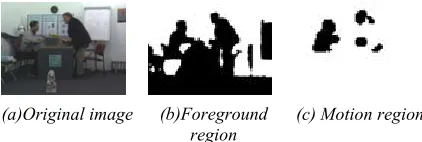
The foreground and motion extraction results are shown in Figure 1.
(a)Original image (b)Foreground
region (c) Motion region
Figure 1. Foreground and motion region for Leavelaptop
[image:2.612.316.527.210.281.2]We define four regions based on the different degrees of importance for human visual, as shown in Table 1, where P denotes the importance. The larger of the P, the more important it is for human visual.
Table 1.Importance division based on the depth and motion characteristic
Depth Characteristic
Motion
Characteristic Importance
Foreground Motion P =3 Motionless P =2
Background Motion P =2 Motionless P =1
4. THE PROPOSED RATE CONTROL
ALGORITHM FOR MVC
After the above discussion, we propose a new rate control algorithm for multi-view video encoding. It consists of four stages: 1) view level rate allocation; 2) group-of-pictures (GOP) rate allocation; 3) frame level rate allocation; 4) macro-block level rate allocation.
4.1 View Level Rate Allocation
In the hierarchical B pictures (HBP) structure, views are classified as I-view, B-view and P-view, these three views are on different degrees of importance for multi-view video encoding. In [8], a statistical method of pre-encoding several frames in each view is as to get the approximate rate proportion among views. In this paper, we pre-encode a GOP of 8 frames on the off-line stage and obtain the proportion to guide the online bits allocation for each view.
In the GOP level, the total number of bits for each GOP and the QP of the key frame are calculated, In MVC, I-frame, P-frame and the first B-frame in B-view in each GOP are defined as key frames. Before encoding the i-th GOP, the bits allocated for the GOP are computed by
)) , 1 ( 8 ( * ) 1 , ( ) 0 ,
( c gop
s gop r
r B i N
B N F i u i
T (3)
where u(i,1) denotes the bandwidth, Fr denotes the frame rate of the video, Ngop denotes the total number of frames in each GOP, Bs is the capacity of the buffer and BC(i-1,Ngop) is the buffer fullness after coding the (i-1)-th GOP. In the case of constant bandwidth, Tr(i,j) is updated frame by frame as ) 1 , ( ) 1 , ( ) ,
(i j T i j Ai j
Tr r (4)
The hierarchical B pictures structure is taken into consideration in the proposed algorithm, the QP of the key frame is computed by
15 ) 0 , ( ) , 1 ( 8 1 gop r gop r B BQP key N i T N i T N S
QP (5)
where NB is the total number of B-frames in a GOP and SBQP is the sum of QPs for all B-frames in the previous GOP.
4.3 Frame Level Rate Allocation
By considering the buffer constraints, the first candidate target bits for the j-th frame in the i-th GOP are calculated as
)) , ( ) , ( ( * ) , ( ~ j i CB j i TB F B j i f r
(6)
where CB (i, j) denotes the current buffer fullness,
TB (i, j) denotes the target buffer level, B is the constant bandwidth, and is a constant and its value is 0.75.
Meanwhile, considering the remained bits, the second candidate target bits for the j-th frame in the
i-th GOP are calculated as
) ( 2 1 ) , ( 2 2 1 1 r r r r PSNR R PSNR R j i
C (7-a)
) , ( ) 1 ( ) , ( ) , ( ) , (
ˆ T i j
j N C j i C j i C j i f r RB ave
(7-b)
where Rr1 and Rr2 are the bitrates of forward reference frame and backward reference frame, respectively, PSNRr1 and PSNRr2 are the PSNR of forward reference frame and backward reference frame, respectively, C(i,j) denotes the predicted complexity of j-th frame in the i-th GOP, Cave
denotes the average complexity of the coded B- frames, and NRB(j-1) denotes the number of the remaining B-frames.
The target bitrates for the j-th frame in the i-th GOP are finally expressed as a weighted combination of ~f(i,j) and fˆ(i,j)
) , ( ˆ * ) 1 ( ) , ( ~ * ) ,
(i j f i j f i j
f (8)
where is a constant and its value is 0.5.
4.4 Macro-block Level Rate Allocation
In the MVC, RDO technique is adopted to choose the best encoding mode for the macro-block (MB), RDO goes through all the modes for inter-frame encoding and selects the mode of the least rate distortion cost to encode each MB. The rate distortion cost is calculated as
) , , ( ) , , ( ) | , , ( MODE c s R MODE c s SSD MODE c s J MODE MODE (9)
where s is the original data and c is its reconstruction data, MODE denotes the prediction mode, SSD(s,c,MODE) is the sum of absolute differences, and R(s,c,MODE) denotes the number of bits with the MODE to encode the MB. λMODE is the Lagrange multiplier which is calculated by
2 3 8 2 85 . 0 step
MODE Q
(10)
where Qstep is the quantization step-size which is calculated by the R-Q quadratic model [14], as the
MAD get larger, the Qstep and the λMODE get smaller, then the rate distortion model will choose the complex mode and allocate more bits for the MB. But it is not worth allocating too many bits on a MB which is not sensitive to human visual. Consequently, theλMODE could be adjusted as
2 3 8 ) 1 ( 2 85 .
0 P P step
MODE Q
(11)
where βP denotes the probabilities of P region, it is used to avoid that the P is too large to lead to the bit allocation sharp inequalities between two types of region, and αP is a parameter and it is decided by the visual importance P described in Table 1.
1 0 . 3 2 7 . 0 3 6 . 0 P P P P
(12)
5. EXPERIMENTAL RESULTS
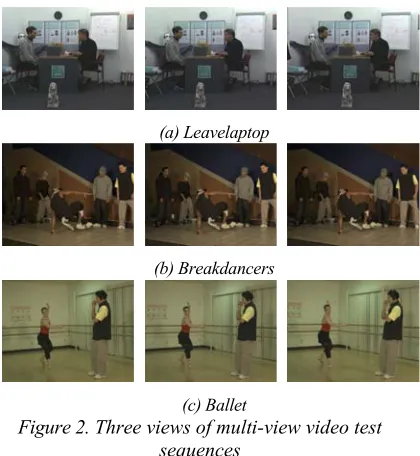
added by JVT-G012 [14]. Several experiments were performed with multi-view video sequences of “Leavelaptop”, “Breakdancers” and “Ballet” with the size of 1024×768.
(a) Leavelaptop
(b) Breakdancers
[image:4.612.98.308.142.370.2](c) Ballet
Figure 2. Three views of multi-view video test sequences
In the experiments, the three views (view5, view 6, view 7) for “Leavelaptop”, the three views
(view0, view 1, view 2) for “Breakdancers”, the three views (view4, view 5, view 6) for “Ballet”, Figure 2 shows the three test sequences. The total number of frames in each view was 81.
Table 2 indicates that the absolute inaccuracy of the JMVC-RC method and the proposed method are within 1.03% and 1.01%, respectively, they both can provide certain degree of rate control accuracy. In the region of P=3, the PSNR of the proposed method can raise by an average of 0.32 dB because there are more meticulous modes and more bits set for these MBs.
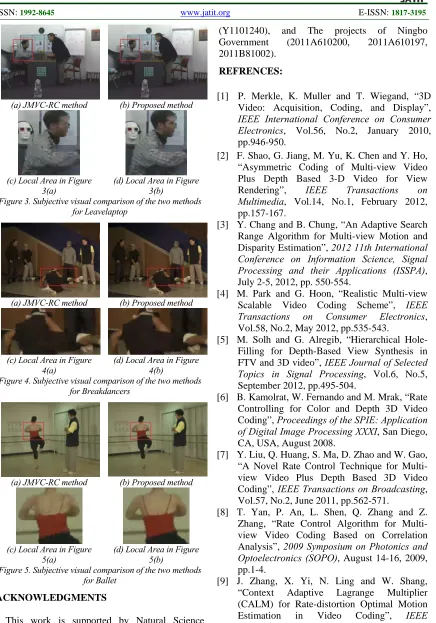
[image:4.612.93.532.410.606.2]The subjective visual of the reconstructed images are shown in Figure 3-5, where the local images are the regions of both foreground and motion. In the Figure 3, it is clear that the clothes and the face of the sitting man are more distinct in the proposed method. Figure 4 shows that the edge of the dancing man is more clear in the proposed method. Figure 5 shows that the proposed method can achieve better texture of the ballet dancer compared with the JMVC-RC. Therefore, the proposed algorithm can provide more comfortable visual image quality for audiences.
Table 2. Simulation results of the proposed method and the JMVC-RC method
Sequence
Target bitrates (kbps)
Actual bitrates
(kbps) Inaccuracy (%)
PSNR(dB) Region P=3
JMVC-RC Proposed JMVC-RC Proposed JMVC-RC Proposed Gain
Leavelaptop
3420.72 3426.32 3424.26 0.16 0.10 38.74 38.94 0.20
1412.12 1415.96 1415.02 0.27 0.21 35.71 36.02 0.31
712.59 713.80 713.83 0.17 0.17 32.64 32.87 0.23
401.45 401.53 401.11 0.02 0.09 29.47 29.84 0.37
Breakdancers
6020.66 6046.94 6052.76 0.44 0.53 38.48 38.66 0.18
2167.81 2185.73 2188.01 0.83 0.93 36.74 36.96 0.22
1033.32 1043.94 1043.80 1.03 1.01 34.65 34.94 0.29
591.02 595.13 595.02 0.70 0.68 32.14 32.58 0.44
Ballet
2324.61 2332.66 2334.45 0.35 0.42 38.81 39.10 0.29
1036.23 1040.36 1040.41 0.40 0.40 36.92 37.26 0.34
574.52 576.35 576.29 0.32 0.31 34.97 35.46 0.49
348.73 350.71 350.11 0.57 0.39 32.75 33.29 0.54
6. CONCLUSIONS
This paper presented a rate control algorithm for multi-view video coding with four levels. In the view level, the bitrates proportions among the views are decided by pre-encoding a group-of- pictures (GOP). In the GOP level, the initial quantization parameter and the target bits are calculated for the GOP. In the frame level, the characteristics of the two reference frames are used
(a) JMVC-RC method (b) Proposed method
(c) Local Area in Figure
3(a) (d) Local Area in Figure 3(b)
Figure 3. Subjective visual comparison of the two methods for Leavelaptop
(a) JMVC-RC method (b) Proposed method
(c) Local Area in Figure
4(a) (d) Local Area in Figure 4(b)
Figure 4. Subjective visual comparison of the two methods for Breakdancers
(a) JMVC-RC method (b) Proposed method
(c) Local Area in Figure
[image:5.612.98.534.69.692.2]5(a) (d) Local Area in Figure 5(b)
Figure 5.Subjective visual comparison of the two methods for Ballet
ACKNOWLEDGMENTS
This work is supported by Natural Science Foundation of China (61171163, 61071120, 61271270, 61271021, 61111140392), Natural Science Foundation of Zhejiang Province
(Y1101240), and The projects of Ningbo Government (2011A610200, 2011A610197, 2011B81002).
REFRENCES:
[1] P. Merkle, K. Muller and T. Wiegand, “3D Video: Acquisition, Coding, and Display”,
IEEE International Conference on Consumer
Electronics, Vol.56, No.2, January 2010,
pp.946-950.
[2] F. Shao, G. Jiang, M. Yu, K. Chen and Y. Ho, “Asymmetric Coding of Multi-view Video Plus Depth Based 3-D Video for View
Rendering”, IEEE Transactions on
Multimedia, Vol.14, No.1, February 2012,
pp.157-167.
[3] Y. Chang and B. Chung, “An Adaptive Search Range Algorithm for Multi-view Motion and Disparity Estimation”, 2012 11th International
Conference on Information Science, Signal
Processing and their Applications (ISSPA),
July 2-5, 2012, pp. 550-554.
[4] M. Park and G. Hoon, “Realistic Multi-view Scalable Video Coding Scheme”, IEEE
Transactions on Consumer Electronics,
Vol.58, No.2, May 2012, pp.535-543.
[5] M. Solh and G. Alregib, “Hierarchical Hole-Filling for Depth-Based View Synthesis in FTV and 3D video”, IEEE Journal of Selected
Topics in Signal Processing, Vol.6, No.5,
September 2012, pp.495-504.
[6] B. Kamolrat, W. Fernando and M. Mrak, “Rate Controlling for Color and Depth 3D Video Coding”, Proceedings of the SPIE: Application
of Digital Image Processing XXXI, San Diego,
CA, USA, August 2008.
[7] Y. Liu, Q. Huang, S. Ma, D. Zhao and W. Gao, “A Novel Rate Control Technique for Multi-view Video Plus Depth Based 3D Video Coding”, IEEE Transactions on Broadcasting, Vol.57, No.2, June 2011, pp.562-571.
[8] T. Yan, P. An, L. Shen, Q. Zhang and Z. Zhang, “Rate Control Algorithm for Multi-view Video Coding Based on Correlation Analysis”, 2009 Symposium on Photonics and
Optoelectronics (SOPO), August 14-16, 2009,
pp.1-4.
[9] J. Zhang, X. Yi, N. Ling and W. Shang, “Context Adaptive Lagrange Multiplier (CALM) for Rate-distortion Optimal Motion
Estimation in Video Coding”, IEEE
Transactions on Circuits and Systems for
Video Technology, Vol.20, No.6, June 2010,
[10]T. Ou, Y. Huang and H. Chen, “SSIM-Based Perceptual Rate Control for Video Coding”,
IEEE Transactions on Circuits and Systems for
Video Technology, Vol.21, No.5, May 2011,
pp.682-691.
[11]Q. Lin and G. Feng, “The Bit Allocation and RDO Mode Based Rate Control Algorithm”,
2010 International Conference on Anti-Counterfeiting Security and Identification in
Communication (ASID), Quanzhou, China,
July 18-20,2010, pp.154-157.
[12]S. Park and M. Kim, “Extracting
Moving/Static Objects of Interest In Video”,
Lecture Notes in Computer Science, Vol.4261,
November 2006, pp.722-729.
[13]Y. Zhang, G. Jiang and M. Yu, “Stereoscopic Visual Attention-Based Regional Bit Allocation Optimization for Multi-view Video Coding”, EURASIP Journal on Advances in
Signal Processing Archive, Vol. 2010, No. 60,
February 2010.
[14] ISO/IEC JTC1/SC29/WG11 and ITU-T