DECwindows Program
Digital Technical Journal
X Toolkit lnt1in.dc
..
XUb
Digital Equipment Corporation
Cover Design
This issue features papers on DECwindows architecture and applications. Our cover design is a display of several windows called up on a VAXstation 3500 screen. The DEC windows applications used to create the display are DEC write, DEC paint, and DEC image.
The cover was designed by David Comberg of the Corporate Design Group with technical assistance from Victor Bah/ of the Image Systems Advanced Development Group.
Editorial Jane C. Blake, Editor
Barbara Lindmark, Associate Editor Richard W. Beane, Managing Editor Circulation
Catherine M. Phillips, AdministratOr Suzanne ). Babineau, Secretary Production
Helen L. Patterson, Production Editor Gaye Tatro, Typographer
Peter Woodbury, IllustratOr and Designer Advisory Board
Samuel H. Fuller, Chairman Robert M. Glorioso John W. McCredie Mahendra R. Patel F. Gram Saviers
Robert K. Spitz
William D. Strecker VictOr A. Vyssotsky
The Digital Technicaljournal is published quarterly by Digital Equipment Corporation, 146 Main Street MLOI-3/Il68, Maynard, Massachusens 01754-2571 . Subscriptions to the Journal are S40.00 for four issues and must be prepaid in U.S. funds. University and college professors and Ph.D. students in the electrical engineering and computer science fields receive complimentary subscriptions upon request. Orders, inquiries, and address changes should be sent to the Digital Technical journal at the published-by address. Inquiries can also be sent electronically 10 [email protected].
Single copies and back issues are available for S 16.00 each from Digital Press of Digital Equipment Corporation, 12 Crosby Drive, Bedford, MA 01730-1493.
Digital employees may send subscription orders on the ENET to RDVAX,JOURNALor by interoffice mail tO mailstop MLOI-3/Il68. Orders should include badge number, cost center, site location code and address. u.s. engineers in Engineering and Manufacturing receive complimentary subscriptions; engineers in these organi zations in countries outside the u.s. should contact the Journal office to receive their complimentary subscriptions. All employees must advise of changes of address.
Comments on the content of any paper are welcomed and may be sent to the editor at the published-by or network address. Copyright<tl 1990 Digital Equipment Corporation. Copying with out fee is permiued provided that such copies are made for use in educational institutions by faculty members and are not distributed for commercial advantage. Abstracting with credit of Digital Equip ment Corporation's authorship is permiued. All rights reserved. The information in this Journal is subject to change without notice and should not be construed as a commitment by Digital Equipment Corporation. Digital Equipment Corporation assumes no responsibility for any errors that may appear in this Journal. ISSN 0898-90 I X
Documentation Number EY-E756E-DP
The following are trademarks of Digital Equipment Corporation, ALL-IN- 1, CDA, DEC net, DECstation 3100, DECwindows, DECwrite, Digital, the Digital logo, MicroVAX, ULTRIX, VAX, VAX 8000, VAX 8650, VAXC, VAX SCAN, VAXcluster, VAXset, VAXstation, VAXstation 100, VAXstation 2000, VAXstation 3100, VAXstation 3540/3520, VAXstation IIIGPX, VAXstation 8000, VMS, XU I. Apple II, HyperCard, and Macintosh are trademarks of Apple Computer, Inc.
MS-DOS is a registered trademark and MS-Windows is a trademark of Microsoft Corporation.
os/2 and Presentation Manager are trademarks of International Business Machines Corporation.
OSF/Motif is a trademark of Open Software Corporation. PostScript is a registered trademark of Adobe Systems, Inc. UNIX is a registered trademark of American Telephone & Telegraph Company.
X Window System is a trademark of the Massachuseus Institute of Technology.
I
Contents
7 Foreword Richard Treadway
9
An Overview of the DECwindows Architecture Scott A. McGregor16
The Sample Xll Server Architecture Susan Angebranndt and Todd D. Newman24
Development of the XU/ Toolkit Leo P. Treggiari and Michael D. Collins34
The DECwindows User Interface Language Stephen R. Greenwood44
The Evolution of the X User Interface Style Thomas M. Spine and Jacob L. VanNoyDEC windows Program
52
PEX: A Network-transparent Three-dimensional Graphics System Randi). Rost, jeffrey D. Friedberg, and Peter L. Nishimoto64
XDPS: A Display PostScript System Extension for DECwindows Christopher A. Kent7 4
The Development of DECwindows VMS Mail Michael R. Ryan and James H. VanGilderI
Editor's Introduction
Jane
C.Blake
Editor
This issue of the Digital Technical journal focuses on Digital's DECwindows program, its architecture, and applications for the window environment. The DECwindows program begins with the X Window Svstem, which was developed at ;VIIT with the sup p-ort of Digital and IBM. Parers herein describe how Digital's engineers have built on X as well as con tributed to related industry standards that help to ensure comratibi lity across systems.
Involved early in b01h the X Window and the OECwindows projects, Scott McGregor describes the DECwindows architecture as an upwardly com patible superset of X. In his overview paper for this issue, Scott reviews aspects of the X design and the significant enhancements made by Digital in the development of its DEC windows program.
The backbone of this program is the XU protocol for which Digital has developed a sample server implementation. In their paper, Susan Angebranndt and Todd Newman review the development of the X 1 1 server, which is the basis for all Digital product servers. Now publicly available, the XII server is also a sample for all developers of X server product implement:aions.
Several layers above the X11 server is the XUI toolkit. Leo Treggiari and Mike Collins discuss this set of run-time routines and application develop menr tools, which is the primary programming interface to OECwindows applications. This toolkit was chosen as the base programming interface for the Oren Software roundation's Motif toolkit.
The Xlll toolkit contains hundreds of attributes, actions, and widgets, which can contain thousands of lines of code. Steve Greenwood relates how the user interface language (UlL) was developed to manage the complexity of the toolkit. UIL pre serves the conceptual simplicity of the toolkit by allowing :1pplicttion developers to specify inter faces without writing the multitude of code lines normally required.
2
The style of user interaction with computers is then addressed by Tom Spine and jake VanNoy. As they point out, the XUI style represents a change in approach for Digital to modern, graphic, direct manipulation user interfaces and to consistency across applications. XUI has evolved to provide a consistent means of user interaction for applica tions across the VMS, ULTRIX, and MS-OOS systems. Extensions to the X architecture are the topics of two papers. PEX, an extension of X to support the PHIGS standard, is the subject of a paper by Randi Rost, jeff Friedberg, and Peter Nishimoto. The authors describe some unique features of PEX and present the major design decisions made in its development
Chris Kent is the author of a paper about XDPS. another extension supported by DECwindows. XDPS was jointly developed by Digital and Adobe Systems Inc. to integrate the X imaging model and Display PostScript. As Chris explains, XDPS was designed to give application programmers the best features of t he X and PostScript systems.
Our last two papers address the topics of appli cation development for the DECwindows environ ment and explain how the performance of such applications can be measured. The implementation of DECwindows VMS mail is an example of an appli cation development effort described here by Mike Ryan and jim VanGilder. Among the develop ment issues discussed is the coordination needed between the VMS and ULTRlX mail applications developers to design a common interface for both mail applications.
Dinesh Mirchandani and Prabuddha Biswas then present the results of a study made to determine whether distributed DECwindows applications have an impact on the Ethernet network. The Juthors developed a simulation model running on a local area VAXcluster (LAVe) on the Ethernet to predict the limiting system configuration in this scenario.
Biographies
Susan Angebranndt A consulting engineer for the Open Systems Group in Digital 's Western Software Laboratory, Susan Angebranndt was the project leader for the sample Xll server. Susan also worked on the team that designed and implemented the Display PostScript extension for the DECwindows X servers. She joined Digital in 1986 and is a graduate of Carnegie-Mellon University (1980) with a B.S. in applied mathematics.
Prabuddha Biswas Prabuddha Biswas joined Digital in 1985 after receiving a B . Tech. from liT, Delhi, India , and an M.S. from the University of Massachuset ts. Among the projects with which he has been involved are the performance analysis and modeling of software systems for the Business and Office Systems Engineering (BOSE) Group and characterization of file system activity from com mercial
J/0
traces. Prabuddha has applied for a patent and has authored papers for presentation to IEEE,ACM,
andCMG
con ferences. He has received the BOSE Achievemen t Award for outstanding contribution.Michael D. Collins A member of the XUI toolkit team , Michae l Collins con tributed to the design and implementation of the toolkit version 1 ancl version 3, and served as project leader for version 2. He is a principal software engineer in the Commercial Languages and Tools Group of the Software Development Technology organization. Mike is a member of
ACM
andAAAS
and joined Digital in 1987. He received a Bachelor of Environmental Design (1981) from theUniversity of Minnesota's School of Architecture.
Jeffrey D. Friedberg One of the chief architects of PEX , Jeffrey Friedberg is a principal engineer in the Workstations Advanced Technology Group. Jeff is the
principal architect and document editor of the X multibuffering extension and
developer of a suite of software tools that allow distributed source control within a networked ULTRIX environment. Currently, he is the project leader of the
group implementing PEX on the DECstation 5000 Model 200 workstation. Jeff
received a B.S. ( 1980) in computer science from Cornell University and is a
member of ACM and
ACM
SIGGRAP H .I
Biographies
Stephen R. Greenwood Stephen Greenwood is a consulting soft\varc engineer in the Commercial Languages and Tools Group. At presem, he is a member of the team building a new OF.Cw indows design roo! . He was the pro ject leader and chief designer of t he OECwindows user interface language (llll.) and
VAX
SCAN programming language. Prior to joining Digital in 19�1. Steve was a principal engineer for Sperry Univac. He received a B . S . (1973) in physics from Bucknell University and an M.S.(
1975) in computer science from the University of W isconsin.Christopher A. Kent The project leader for the Display PostScript server extension, Christopher Kent is a principal engineer in Digital's Western Software Laboratory. He was also one of the developers of the TCP/JP version of the PrintServer 40 software and was a member of the development t<:::.tm for the MultiTitan processor board . Chris received a
B.S.
( 1979, magna cum laude) in physics from Xavier University, and a Ph . D. ( 1986) in compmer science from Purdue University. He is a member of AC:M and Uscnix Association.Scott A. McGregor Scott McGregor manages the Western Software Labora tory in Palo Alto and is responsible for
ULTRIX
workstation software at Digital. Previously, he was the DECwindows Program Architect and was one of the designers of the X Window System . Before joining Digital in 1985 , Scott led the design and implementation of Microsoft's MS-W indows, and spent se\'en years at the Xerox Palo Alto Research Center working on the Xerox Star and tht.: Cedar programming environment. He has degrees in Psychology and Computer Science from Stanford Un iversity.Dinesh Mirchandarti As a senior software engineer in the W•IS Engineering Group, Dinesh M irchandani is now working on the advanced development of
VAX
cluster systems. Since joi ning Digital in 1985, he has evaluated the per formance ofRdb/V,vtS
and CI)J) Plus and, through modeling , characterized the performance of distributed systems based on DECwindows software. Dinesh received a B.E. (19HL honors) in EEE from Birla Institute of Technology and Science, India, and anM.S.
(19H5) in computer science from North Carolina University. He is a member of Upsilon Pi Epsilon .Peter L. Nishimoto Peter Nishimoto was project leader for the
PEX
imple mentations on the DECstation 3100 and VAXstation 3100/SPX workstations. He is also the coarchitect of thePEX
protocol and a member of the multi vendorPEX
architecture team. Peter is a principal software engineer in the Workstations Software Group. Before joining Digital in 1986, he worked for Daisy Systems and Vulcan Software. He holds a B. A . (1976, cum laude) in mathematics from Colgate University and is a member ofIEEE,
ACM, and ACI'vlSIGGR.APH.
RandiJ. Rost Principal engineer Randi Rost was the project leader for the PEX specification effort, one of PEX's chief architects, and the
PEX
document editor. Randi currently manages a group within the Workstations Advanced Tech nology Group that is concentrating on photorealistic rendering. He has published over a dozen technical papers and is the author of the X/J'v!otif Quick Reference Guide. He received aB.S.
( 1980, summa cum laude) from Mankato State University and an M.S. from the University of California, both in computer science.Michael R. Ryan Since joining Digital in 1984, Michael Ryan has worked on several software development projects. He is the project leader for the DKwindows VMS mail application and a contributing member of the develop ment team for ALL-IN-I MAIL for DECwindows mail on the VMS system. Prior to his i nvolvement with the mail program, Mike did advanced development for Business Communications Systems Engineering and VMS DIBOL compiler development. Mike holds a B.S. and M.S. in computer science from Rensselaer Polytechnic Institute.
Thomas M. Spine As a principal software engineer in the Software Usability Engineering Group , Thomas Spine is developing software usability engineering methodologies and contr ibuting to the user interface design of several produc ts. Tom has published a number of papers on the usability of speech recognition devices, file management with interactive computers, and usability engineering . He received an A.B. (1982) i n mathematics and psychology from Washington University and an M.S. (1984) in industrial engineering from Virginia Polytechnic Institute and State University.
Leo P. Treggiari Currently responsible for the development of the architec ture of the XUI and Motif toolkits, Leo Treggiari is a consulting software engineer with the Commercial Languages and Tools Group. He has acted as project leader for a number of products within the group, including version 1.0 of the XU! toolkit. Leo was a senior software engineer for Wang Laboratories before joining Digital in 1979 He is a member of ACM and holds a B.S. ( 1975, summa cum laude) in chemistry from Boston College.
I
Biographies
6
James H. VanGilder James VanGilder has developed several products for Digital since joining the company in
1979,
including the PDP-II RPG I I , VAXDI BOL, BCSE advanced development, and DEC windows VMS mail version 1 .0. He is a principal software engineer in the Commercial Languages and Tools Group, where he is at present acting as project leader for the development of the DECwindows implementation of the OSF!Motif toolkit . Jim worked for Motorola, Inc., and Kollsman, Inc. before coming to Digital. He has a B .S
(
1973) from Arizona State University.I
Foreword
Richard Treadway Director
Open Software Strategy
I n 1986 Digital's desktop strategy could only be described as fragmented. On VMS workstations we offered a proprietary windowing system, on
U LTRJX
workstations we offered an early version of the X Window System , and on PCs we offered MS-Windows. Because of the diversity of systems, it was very difficult to convince an application builder to support our range of desktop systems. Furthermore, this strategy was unsatisfactory to customers. Our customers wanted a consistent user interface that would allow them to access and execute applications on the appropriate processor anywhere in the distributed network.In January I987, Digital announced the DECwindows system, which was a major design change intended to solve these problems. The system would provide a single application pro gramming interface for application builders and give users network-wide access to applications through a common graphic user interface. The DECwindows system also would have the exten sibility and flexibility to grow into the next decade and provide access to not only Digital systems , but to any system in a multi vendor network. In essence, the DECwindows system would bring the resources of the network to a single point on the desk.
To rally the entire corporation behind such a major change in direction, the DECwindows pro gram put forward a simple vision to Digital's engineers and customers. Unified access to the VMS and
U LTRIX
operating systems would be provided through a single programming interface for i nterac tive graphic applications and a common user inter face for all the desktop devices we support. This simple and concerted focus made it possibleto manage the complexity involved in delivering more than 50 components built by nine separate groups located throughout the world in Nashua, New Hampshire, Reading, England, Littleton, M assachusetts, Palo Alto, California, and Valbonne, France.
Our strategy was to base the DECwindows system on standards and enhance that base. Standards enable application designers to port applications between different hardware and software plat forms. I n late 1986, no standards existed for networked windowing systems. Therefore, i n choosing a basis for the DECwindows program , we had to select a technology that not only met our requirements but could be put forward to the industry as a potential standard. For this reason, we chose to base the DECwindows architecture on
MIT's
X W indow System.After Digital's endorsement of the X Window System in january 1987, eight other vendors, includ ing Apollo and Hewlett-Packard, announced the X Window System as the basis for their future graphics-based computers.
Because the X Window System is hardware and software platform-independent, we could provide it on the VMS,
ULTRlX,
and MS-DOS operating systems. The X architecture allows applications to be transparently distributed throughout the net work. This capability is critical in fulfilling our goal to be the leader in distributed computing. The X system allows applications executing anywhere in the network ro be displayed and conrrolled from the user's desktop computer. I n addition, the win dowed computing model offers significant benefits over the time-sharing , character-cell terminal model. For example, sharing data among simulta neously executing character-cell applications is difficult, bur in the X system , data-sharing is a fun damenral property. Finally, the X system protocol can be extended to include future subsystems. This feature is important in providing a path for the inte gration of future tech nologies. As you will read i n this issue o f the Digital Technicaljoumal, we used this capability to develop Display PostScript as an extension to X.The value the DECwindows system adds to the X system is a consistenr user interface, and a high performance, robust, and flexible toolkit. The
XUI
toolkit and style guide make possible the implemen tation of applications that offer good interactiveI
performance. Because the same X 1 toolkit runs on both the
VMS
and ULTR!X systems, developers can provide their applications on both operating systems with a single implementation.To test the robustness, performance, and usabil ity of the toolkit and style guide, we committed ro develop a highly complex interactive application, the DECwrite editor, on both the
VMS
and ULTR!X operating systems. We learned a great deal about DECwindows performance and quality from that project. The ability to test our enabling technology while we were building it was fundamental to our success.In :�ddition to performance and completeness, the DECwindows toolkit separates the definition of user interfaces from application coding. The user interface can be specified with a nonprocedural language, called the user interface language (UIL). The resultant definition is accessed at run-time by the application. Separating form and function in the OECwindows system is very important for the development of international applications and for the separation of user interface design from application implementation.
For international applications, the user interface can be completely translated without changes to application code. This approach significantly reduces the cost and complexity of translating applications. Since the toolkit supports multiple user interfaces, applications can switch languages dynamically.
For user interface design, UlL 's separation of form and function allows rapid prototyping in the user interface. With UIL the user interface design need no longer be entirely the programmer's respon sibility. User interface design specialists can con centrate solely on the interactive aspects of the application without making programming changes. All this can lead to better designed and easier ro use applications.
The DECwindows system is very significant to Digital in two important ways. First, it is our first open systems product. We initially thought the value added by the DECwindows user interface and toolkit would be our competitive advantage. However, we came to realize that in a fully dis tributed computing environment the user really
8
needs that same interface for all applications regardless of the vendor's system. Therefore, the DECwindows user interface had to support mul tivendor systems to encourage application builders to base their designs on it. That conclusion and the opportunity to create a de facto standard led us to create the X user interface (Xlil) :.�s a separate component of the DECwindows system that we would license to run on any system. When the Open Software Foundation
(
OSF)
announced a request for technology to specify the user envi ronment component, XU! was submitted and eventually accepted as OSF/Motif. Xlll marked the first time Digital released technology that it once considered proprietary to the industry.Second, the OECwinclows system initiated a new design center for applications. The system was a fundamental change from a time-sharing, character cell model to a graphic, windowed, distributed computing model. In this regard, the OECwindows system presented application designers with a whole set of opportunities for new application capability and an associated set of complex problems to solve.
Scott A. McGregor
I
An Overview of the
DECwindows Architecture
The DECwindows architecture builds on industry standards and adds enhancements to provide greater performance and reliability in the window environment. The architecture is based on the X Window System developed at MIT, which consists of three main components -the X server, X lib, and the toolkit intrinsics. The DECwindows implementation extends X in several ways. DECwindows uses algorithms that expose additional interfaces, supports a broader choice of pro gramming languages, provides a complete set of tools for application development, and promotes ease of use and user-interface consistency by means of a style guide. In addition, the DECwindows architecture includes industry-standard interfaces and extends the server to take advantage of PostScript, three-dimensional graphics, and imaging.
The DEC windows architecture provides a complete set of mechanisms that control windowing, graphics, the user interface, and data interchange in order to make easy the task of building high quality applications that work well cogether. In this role, the DECwindows architecture is a key com ponent in Digital's Network Application Support (NAS) in conjunction with other components such as networking and printing.
It can be argued that the move from character cell-oriented applications co window-based appli cations is as significant as the move from batch computing to time-sharing. The reasons for choos ing to adopt the
X
Window System are as many as they are varied; some of the most important are as follows:• Windowing systems provide a richer computing
environment that includes detailed graphics art work and significantly improved ease of use.
• The direct manipulation of objects on the screen is a more intuitive model of computer applications.
• The prevalence of windowing systems has led
to increased expectations on the part of our users. For example, users can start any number of applications simultaneously, allow them to remain running all day, and shift between them by using a pointing device.
• Window-based applications allow for a natural separation of form and function.
Digital Tecbnicaljournal Vol. 2 No. 3 Summer
1990
• _lust as time-sharing allowed the creation of
applications that were inconceivable or impos sible in batch-oriented systems, windowing systems support problem-solving approaches that cannot be made to fit the time-sharing model. For example, sharing data between applications has often been cumbersome for applications designed to run on character-cell terminals. In contrast, the ability to share data among cooperating applications is a fundamen tal property of the
X
window model.The DECwindows theme is to build on standards and to add incremental value. Standards make sense because application designers want portability between hardware platforms. Users of applications also want standards because it rarely makes sense to learn new interaction techniques that are unique to specific applications. The DECwindows architec ture is built on and compatible with industry stan dards such as the
X
Window System from MIT, Motif from the Open Software Foundation, and Adobe's PostScript page-description language. The architecture is designed to allow easy integration with various personal computer (PC) systems such as those produced by IBM and Apple. The value of Digital's offerings is in the performance and reliabil ity of the implementation, the set of additional lay ered libraries and services available, and integration with other services defined by NAS.Prior to the DECwindows "unification," there were different windowing and applications solu tions for each of the operating systems supported
DECwindows Program
by Digital (VMS,
U LTRI X ,
and MS-DOS). A goal of the
DECwindows architecture is to provide a common
user interface that spans all three operating
systems, and a programming interface common
across V!'v!S and
ULTRIX .Although memory limita
tions of the MS-DOS environment prevent us from
supporting the full DECwindows applications inter
face for current PCs (that is, until OS/2), the intent
is to make it easy to port DECwindows applications
between VMS and
ULTRIXoperating systems, and
straightforward to port applications that use
MS-Windows, the Presentation Manager, or Apple's
Macintosh.
Although the DECwindows architecture is based
on the X Window System, DECwindows is an
upward-compatible superset of that design. This
means that the DEC windows architecture has all the
advantages of the X Window System, as well as the
advantages of the Digital enhancements. The bal
ance of this paper presents a summary of the
X Window System and the additional components
and design enhancements that make up the
DEC windows products.
The X Window System
The history of the X Window System seems surpris
ing, given the role it plays today as a workstation
industry standard. X started out at Stanford
University as
W.W became X when it was jointly
adopted by MIT's Laboratory for Computer Science
and Project Athena (an educational program jointly
funded by Digital and IBM). The first version of X
to be widely usee! and shipped as a product
was version
10(XlO). X had three important fea
tures that made it popular: it provided a high
performance network protocol for windowing and
graphics, it was independent of workstation hard
ware, and it was available in source form to anyone
for the cost of the media.
Work on X version
ll (Xll )
began in
1986.
This
effort was a serious attempt to reconsider some of
the original design ideas in order to make X into a
more functional system that would meet the needs
of a larger class of application developers. Graphics
state was added for performance, and precise
semantics were defined for the output routines.
Input events were generalized, and perhaps most
important, work began on a toolkit for applications
developers. Digital agreed to implement the sample
server, Xlib (the library of X routines), and the
toolkit that are available on the MIT
X l l
tape.
MIThas agreed to continue to support X and to control
the architecture and evolution of the system design.
10
X consists of three main components: the
X server, Xlib, and the toolkit intrinsics (also
known as Xt). The substructure of each of these
components is briefly described in the following
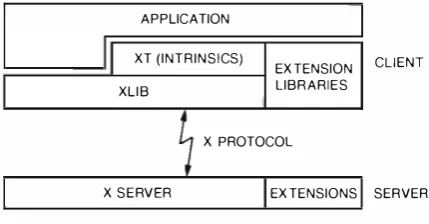
sections.u The overall architecture of the
X Window System, showing the relationship of
the server, network protocol, Xlib, Xt, and appli
cations is shown in Figure
1.The X Server and the X Protocol
The task of an X server is to implement the
requests defined in the protocol and encoding
specifications.
The X server runs on the hardware where the
display and keyboard are located and provides low
level graphics, windowing, and user input func
tions. It relies on a very low-level interface that is
supplied for each type of supported workstation.
Clients communicate with an X server by means of
the network or "wire" protocol. This protocol, also
known as the X protocol, is a very precisely defined
interface. By tightly defining the semantics of the
wire protocol, it is made independent of the operat
ing system, the network transport technology, and
the programming language.
The X protocol defines the data structures used
to transmit requests between applications and
user-interface stations over the network_�
Applications do not normally generate protocol
requests themselves, but instead use Xlib or other
layered libraries.
Most X requests are asynchronous, meaning that
a client can send requests without waiting for the
completion of previous requests. This approach
allows for fast request processing through the use
of pipelining techniques in the server implemen
tation and in Xlib, and it means that the application
usually does not have to wait for the completion of
an operation. Some X requests (state queries, for
example) have return values, which the server
APPLICATION
II
XT (INTRINSICS) X LIBEXTENSION LIBRARIES
1
X eROTOCOCCLIENT
[image:12.595.313.528.590.702.2]X SERVER EXTENSIONS SERVER
Figure
1 XArchitecture
handles by generating a reply and sending it to
the client. Although the protocol does not provide
any explicit synchronization requests, any request
that depends on the completion of other requests
will block, pending execution of those requests.
(For example, Xlib synthesizes the XSync interface
by making a XGetlnputFocus request and discard
ing the return value.) Errors are also generated
asynchronously, and clients must be prepared to
receive error replies at arbitrary times after the
offending request.
The X protocol also describes the following:
•
Connections, which provide the communication
path between server and client
•
Windows, which provide the mechanism for
interaction between the user and the application
•
Events, which provide notification of mouse
and keyboard actions, as well
asa mechanism
for control of (and communication between)
multiple, simultaneous applications
•
Graphics routines, which provide the mech
anism for an application to draw information on
a display
X lib and the Xt Intrinsics
Xlib is the basic library of X routines. Xr, or
intrinsics, is a library of routines that introduces the
"widget" model and that can be thought of as a
toolkit for builders of user interfaces.
The distinction between Xlib and the intrinsics is
partly architectural and partly due to the incremen
tal evolution of the X standard. Originally, X lib was
simply a procedural interface ro the X wire proto
col; but it soon became a repository for commonly
used utility routines as well. During the design
phase of X version
1 1 , it made sense to create a sepa
rate " toolkit" library to introduce ( I ) more con
ventions for windows (that is, "widgets") than were
originally envisioned in the protocol, and (2) a
mechanism for dispatching events.
Because of the difficulty of separating widget
functionality from the calling interface, a distinc
tion was made between the Xt intrinsics and the
widget set. The intrinsics supplied a mechanism for
creating widgets without imposing policy, and
the widget set (with its associated calling interface)
defined a particular look and feel. Thus, the
DEC windows toolkit (now known as XU!) was born,
consisting of the standard intrinsics library shared
with
MIT
and a set of widgets unique to Digital.
The
X l ' I
toolkit is described further below. MIT also
Digital Tecbnlcaljournal Vol. 2 No. 3 Summer 1990
An Overview of the
DECwindows Architecture
provides some sample widgets, known
asthe
Athena widgets.
X
lib
X lib provides a " veneer" library over the wire
protocol so that applications can use a procedure
call interface. Xlib converts the parameters passed
to the procedural interface into the network proto
col format and translates messages from the server
into return values for the application. Xlib also pro
vides a set of utility routines needed by most
applications.
The Xlib interface consists of almost
300
routines
that either map directly to X protocol requests or
provide utility functions on the client side.
DECwindows follows the standard
MITdefinition of
Xlib very closely, with a few additions noted below.
The functions available in Xlib include setting up
connections with a server, querying the server, cre
ating resources and windows, performing graphics
output, and obtaining user input events from the
keyboard and pointing device.
The Xlib interface is the lowest level interface
that applications are expected to use; in other
words, an application should not use the worksta
tion hardware interface directly, nor should it
directly generate X protocol requests.
Intrinsics
The intrinsics are a set of routines that
make it easy to create the window types that imple
ment user-interface features such as scroll bars,
dialog boxes, and editable text fields. Such a win
dow type is called a widget. Since intrinsics aid
in building widgets, the intrinsics are sometimes
called a toolkit for builders of toolkits. Although
the definition of the widget model is the primary
task of the intrinsics, utility routines are also
included to handle user input (event management)
and to provide caching services so that widgets can
share graphics contexts.
Like the lower layers of X, the intrinsics layer
is "policy free" in that it seeks to provide a mech
anism rather than to enforce a particular style
of user-interface or program interaction. The
X U !
toolkit, described briefly below, is the layer
that specifies DECwindows user-interface policies
by providing a common set of widgets layered on
the intrinsics.
DECwindows Enhancements to X
DECwindows extends the X Window System in a
number of significant ways.
•
Quality of implementation for the standard
X components -DEC windows enhances the
DECwindows Program
sample
M IT
implementation by using algorithms
that expose additional interfaces, or by allowing
more flexibility. Examples include faster win
dow repositioning algorithms, international key
board support, and font caching. Robustness
is another important implementation quality;
Digital has led the effort in developing an
X validation test suite.
•
A choice of programming languages -
M I T
supports only a C and a Common
L I S P
interface
for Xlib. DECwindows supports standard
U N I X
C as well as the complete set of
VAX
stan
dard language bindings, including
FORTRA N ,
A DA ,
and
PASCAL.
•
XUJ
toolkit - The X Window System compo
nents stop short of rroviding a complete set
of tools needed for application development.
DECwindows provides libraries for user
interface primitives (widgets), resource man
agement, and internationalization. Additional
development tools are also included. The XU!
toolkit makes it easy to write applications that
follow the
X U !
Sty le Guide.
•
X U !
Style Guide - To promote ease of use and
user-interface consistency among applications,
DECwindows includes a set of guidelines for
application developers. All applications devel
oped by Digital conform to these guidelines.
•
Industry-standard interfaces - In addition to the
X interfaces, DECwindows includes industry
standard libraries such
asPH IGS
and
G KS.
•
Extension libraries - X provides a mechanism
for extensions to the server's capabilities.
The DECwindows architecture takes advantage
of this feature to provide PostScript, three
dimensional graphics, and imaging capabilities.
•
Base applications - DEC windows includes a
set of base applications useful to all work
station users, such as window and session
managers, terminal emulators, and personal
productivity tools.
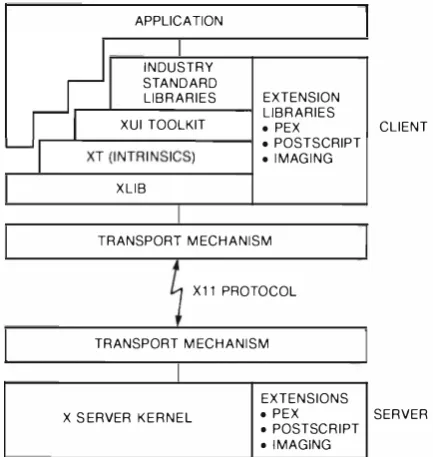
The X architecture (shown in Figure I ) is
expanded in DEC windows as shown in Figure
2 .
In Figure 2 , the X I I wire protocol denotes the
line between client and server. On the client side,
the "staircase layering" of the application layer
shows the ability for applications to intermix calls
to any of the client-side libraries. In other words,
the application can use whatever level of abstrac
tion is most appropriate for the job at hand.
1 2
APPLICATION
I
L£1
'N DUSOAYSTANDARD
LIBRARIES EXTENSION LIBRARIES XUI TOOLKIT • PEX
'I
XT (INTRI NSICS)• POSTSCRIPT • I MAG ING
X LIB
I
TRANSPORT M ECHANISM
7
W e<OWCOL TRANSPORT M ECHANISMI
EXTENSIONS X S ERVER KERNEL • PEX
[image:14.595.316.533.87.316.2]• POSTSCRIPT • I MAGING
Figure 2 DEC windows Architecture
CLIENT
SERVER
The remaining sections of this paper describe
DECwindows enhancements to the X server, the
extension of Xlib, the
X U I
toolkit and style guide,
and the extension and industry-standard libraries.
DECwindows Enhancements to the
X Server
Although the semantics of the server operations
are tightly constrained by the X protocol, there
is a fair degree of freedom in the design and
implementation of the server itself. The
ULTRIX
implementation has tracked the
M IT
version quite
closely, whereas the
VMS
implementation diverged
early on in an attempt to add value. In both cases,
there are some significant enhancements that
Digital has made to the standard
MIT
server.
The
M I T
sample server is divided into two major
components: device-dependent
X
( DDX) and
device-independent X (DIX). The
DIX
code is highly
portable and designed to be independent of operat
ing system and hardware. The DDX code contains
both operating system (e.g. , memory management)
and display hardware dependencies. The goal for
the original server design was to maximize the
portability of the code, making the DIX component
as large as possible, even at the cost of performance.
Re-implementing the server to be entirely device
dependent would provide the best performance,
but would require a major effort to support each
new workstation product. The goal for the
DECwindows server is to seek a compromise that
provides higher performance without completely
sacrificing portability.
The DECwindows X server implementation dif
fers from the MIT X server implementation in the
following ways:
•
Font and glyph caching - In the MIT X server,
a font is either in memory or it is not. The
DECwindows X server provides glyph caching,
so that a portion of a font may be stored in
memory. Glyph caching is especially important
for users of ideographic (e.g. , Far Eastern) fonts.
•
Run-time loading of DDX, DlX, transport mecha
nisms, and extensions (on VMS) - The advantage
of run-time loading is that an application need
not load code until it is actually needed. Thus the
apparent performance of an application can
improve, because it does not need to initialize all
functions before it invokes any function.
•
Multiple, simultaneous transport mechanisms
The X server can have an arbitrary number of
open connections at a time, and these connec
tions can use the transport mechanism available
(e.g. , to a given remote node) or most desirable
(e.g. , shared memory for a local client).
DECwindows Extension to Xlib
As noted earlier, the DECwindows X lib implemen
tation follows the standard MIT definition of Xlib
very closely. Some of the few differences from the
X implementation are summarized below.
Exteru:kd Keyboard Support
The XLookupString
routine has been extended to support international
character sets. The DECwindows Xlib implemen
tation supports the Alt-Space (Compose-Space)
introducer sequence to enter key sequences that
generate characters not available on the user's key
board. The intention is to expand these capabilities
further to support Asian languages and "soft" key
board displays on the user's screen.
Asynchronous Event Notification
Events from the
X server are synchronous, meaning the events must
be read from a queue by the application. A
DECwindows specific enhancement allows for an
asynchronous notification of the arrival of an event,
through an AST on the VMS system, and a signal on
the ULTRlX system. In addition, Xlib may be called
from this asynchronous event call.
Digital Tecbnicaljourna/ Vol. 2 No. 3 Summer
1990
An Overview of the DECwindows Architecture
VMS-speci.fic Extensions
Under the VMS operating
system, Xlib (along with the other layered libraries)
is a shareable library. Shareable libraries reduce the
size of an application's image.
XU/ Toolkit
The XUI toolkit is layered on top of X lib and the Xt
intrinsics and is the first layer that defines the user
interface policy of the DECwindows architecture:�
The XU ! toolkit consists of three major com
ponents:
•
The XU! toolkit widgets
•
The DECwindows resource management facil
ities
•
The cut-and-paste interfaces
The goal of the XU! toolkit is to make it easy for
an application designer to write an application by
providing the designer with widgets for almost all
the common user-interface components. Applica
tions are expected to write widgets for their own
unique function, but functions that are common
across applications are supported by the XU!
toolkit. For example, a spreadsheet application
would likely create its own widget class for the
cell array, but it would use XU! toolkit widgets to
display error messages and menus. Although the
application needs to create its own widgets to
differentiate it from other applications, sharing
the commonly used widgets has two advantages:
the application writer has less code to write and
maintain, and consistency between application
is increased.
To achieve the goal of interapplication consis
tency, the XU! toolkit is closely tied to the
xurStyle
Guide in its selection of widgets to implement, and
in the functions and visual appearance of those
widgets. In other words, the XUI toolkit is an imple
mentation of the user interface specified by the
style guide.
XU/ Style Guide
The XU! Style Guide is a set of user-interface guide
lines that describe preferred screen appearance,
types of application/user interactions, proper use
of keyboard and mouse functions, and so on. In
human terms, it might be described as a guide to
effective communication.4·5
The
xurStyle Guide has three main areas of
emphasis:
DECwindows Program
•
Use of graphics to present information
•
Use of direct manipulation, in cases in which
users point at and directly interact with objects
on the screen
•
User-interface consistency
The style guide provides enough detail to let
application designers achieve a high level of consis
tency, but by itself, it cannot guarantee that the
designer will do a good job. Guiding the creation of
consistent applications might be compared to guid
ing the creation of musical compositions in a
specific style, like jazz or the blues. Although a good
guide might provide the fundamentals, the com
poser still needs to hear examples of the music in
order to copy the style. And a composer can still
write bad compositions even
ifthe guide is followed
to the letter.
Extension Libraries
The X architecture supports an extension facility so
that functions can be added to the core routines.
Extensions allow support for special workstation
hardware capabilities as well as for operations that
are seldom used.
An extension consists of two components: a
hardware-dependent extension to the X server, and
a client-side library that sends requests to the server
using the extension protocol. Figure
2
illustrates
the position of the extensions within the X server.
A routine is provided in Xlib to rest whether a par
ticular named extension is supported in a server or
ro query the set of supported extensions.
Extension libraries supported by DECwindows
include the following :
•
P
E
X
,a high-performance three-dimensional
graphics library
•
Display PostScript, a graphics output library that
uses Adobe's PostScript imaging model
In addition, some anticipated extension libraries
include the following:
•
Input, extended support for tablets, dial boxes
and other user input devices (part of the
MIT
Xll
R4release)
•
Nonrectangular windows, which permits win
dows to be defined as arbitrary shapes rather
than limited to rectangles
14
•
Imaging, a library of functions that support oper
ations on scanned images
•
Multimedia, support for sound and video
Industry-standard Libraries
Industry-standard libraries are either officially sanc
tioned or de facto standards that enjoy wide popu
larity in the industry. Application developers use
these interfaces when they want ro minimize the
cost of supporting multiple graphics and/or win
dowing environments (including DECwindows)
from a single application.
DECwindows implements
G KS, PHIGS,
and other
industry-standard programming interfaces by: ( I )
providing shells on top of Xlib and other standard
X libraries, (2) by extending the X l l wire protocol
and using it directly, or (3) by some combination of
the two.
Since
GKS
is a two-dimensional interface, it is
strictly layered on top of Xlib and the
X LII toolkit.
Since
P H IGS
seeks to take advantage of three
dimensional hardware capabilities nor exposed by
Xlib,
PHIGS
uses a combination of the
PEX
three
dimensional extension to X
I I
and the existing pro
gramming libraries.
Summary
The DECwindows architecture offers significant
new technology for building applications; it is
based on the graphical user interface and the use
of an operating-system-independem "diem-server"
model to distinguish between where an application
is run versus where it appears to the user. The archi
tecture also provides a high degree of source-level
compatibility between
ULTRIXand
VMS,
which per
mits applications to be easily ported between the
two operating systems.
DECwindows is based on the industry-standard
X Window System, including the X server, the
X wire protocol, Xlib, and the Xt inrrinsics. It offers
value beyond these standards through improved
implementation as well as by incremental func
tionality. The architecture has proven both robust
and extensible, making it the preferred base for
new applications created by Digital and by our
software partners.
A Postscript
Since the original creation of the DECwindows
product, a new organization came into being to
drive convergence of open systems standards. The
Open Software Foundation
(OSF)
evaluated
nology from a number of companies and created a toolkit called Motif that combines X U I from D igital and the visual appearance from M icrosoft and Hewlett-Packard. In 1990, Motif will replace XUI as the toolkit in Digital's DECwindows architecture.
Given the w ide acceptance of X and Motif, the DECwindows architecture has truly become an industry standard, much to the credit of the many Digital engineers who put in their imagination and hard work.
References
1 . R. Scheifler, ]. Gettys, and R . Newman,
X Window System C Library and Protocol Reference (Bedford: Digital Press, 1988).
2. ]. McCormack, P. Asente, and R . Swick, X Toolkit
Digital Tecbnicaljournal Vol. 2 No. 3 Summer 1990
An Overview of the DECwindows A rchitecture
Library - C Language Interface, X Version 11 Release 3 (Cambridge: Massachusetts Institute of Technology, 1988).
3. L. Treggiari and M . Collins, "Development of the XLII Toolkit," Digital Technical]ournal, vol . 2 , no. 3 (Summer 1990, this issue): 24-33.
4. T. Spine and ). VanNoy, "The Evolution of the X User Interface Style," Digital Teclmical]ournal, vol . 2 , no. 3 (Summer 1990, this issue): 44 -51 . 5 . XU/ Style Guide (Maynard: Digital Equipment
Corporation, Order No. AA-MB20A-TE, 1988).
General Reference
R. Scheifler and ]. Gettys, "The X Window System,"
ACM Transactions on Graphics, vol . 5, no. 2 (April
1986).
Susan Angebranndt
I
Todd D. NewmanThe Sample Xll Server
Architecture
The Xll protocol is the backbone of Digital's DECwindows program. The sample seroer is an implementation of the protocol. The seroer was developed by Digital and has become the basis for all Digital product seroers. As part of Digital's commitment to support open system standards within the industry, the seroer code was donated to
MIT. Because the software is now publicly available, the seroer is the starting point for the X seroer product implementations for all other vendors. Ibis paper describes
the architecture of the sample server and comments on the implementation.
The Need for a Sample Server
The
X
Window System protocol was developed
jointly by MIT and Digital.1 The protocol permits
network-transparent access to the input, window
ing, and two-dimensional graphics capabilities
of workstations and display systems. Further, the
protocol presents a high-performance, device
independent graphics model. As such, it provides
a hierarchy of resizable, overlapping windows,
which support the easy building of a wide variety
of applications and user interface styles.
The server is an implementation of the
X
protocol. Its job is ro arbitrate access to the
display and to the keyboard and pointing device,
generally a mouse. Applications that use the
X
protocol are called clients. Clients communi
cate with a server through an 8-bit byte stream.
A simple packet stream protocol is layered on top
of the byte stream. For example, a packet of com
mands might create a window and draw an arc.
Our goal was to design and implement a sample
server based on the X Window System version
1 1
(X I I ) protocol. By sample we mean an example
implementation of the protocol that other devel
opers can use to implement the
X
protocol on
their workstations. When we began, there was a
sample implementation of version
10 (XlO)
of the
X
Window System already in use on UNIX system
based products. This
X lO
sample server had been
ported to Digital, Sun, Apollo, and IBM Pc/RT
workstations, among others. But the
X lO
protocol
was not suited to advanced graphics devices. The
X IO
implementation was based on the VAXstation
100
graphics primitives and architecture. There
fore, it was difficult to make performance enhance
ments on hardware other than the VAXstation
100
16
workstation because of assumptions in the
X IO
protocol and its sample code.
X ll
was more advanced that
X 10 2 X I I
com
pletely overhauled the
X IO
protocol. It considered
the needs of operating systems other than the UNIX
system, as well as graphics devices other than the
VAXstation
100.
Because of the massive changes
from
X lO
to
Xll,
the sample server had to be
reimplemented from scratch . It was important
that this implementation not depend on a specific
device but apply to a wide range of workstations.
Digital wanted to develop and promote
X I I
as a
de facto standard in the workstation market, just as
we promote the UNIX system (in the form of
Digital's U LTRIX system) as a standard. We felt a
common, open windowing environment was as
important as a common, open operating system
environment.
XlO
was too limited in scope and
capabilities to become popular on workstations
with advanced graphics. By making the sample
implementation publici y available, other vendors
would be more likely to adopt
X
I I as a standard.
Digital receives several direct benefits from
making the sample server publicly available. It is
the basis for all current Digital server implementa
tions on the VMS, ULTRIX, and PC systems. MIT
maintains the bulk of the source code. Therefore,
Digital benefits from the changes, enhancements,
and bug fixes done not only by MIT but by other
companies that use the server. Also, we can easily
incorporate server extensions, such as Hewlett
Packard's input extension. Over
75percent of the
code in the ULTRIX system-based DECstation
3100
color server is from MIT. Therefore, this server can
be ported easily to new graphics devices because
few lines of code need to be modified.
Design Goals and Constraints
Designing and writing software to be used on a wide class of machines is a lesson in compromises. In this section, we list our goals and constraints. In the sections following, we give an overview of the server architecture and some porting concerns. Finally, we evaluate our end result.
Tailorable
The primary technical goal of the project was to provide code that would remain useful on current and future operating systems and graphics devices. Writing portable code is not new. Software is often ported. Just as often, performance is decreased in favor of the increased portability. For example, the UNIX operating system has been ported often, but the system's performance is diminished on all but a few architectures.-1 Customization is needed to regain the speed lost in favor of generality. There fore, our server design had to emphasize portability and customization in equal measure. We term the software design using this approach as tailorable. Almost every other design consideration or con straint grew out of the requirement tailorability.
Standards
The sample server is used by a wide audience, on a variety of workstations. Our implementation was constrained by some of the " least common denomi nator" features found on most workstations. We wanted to be assured that most vendors would be able to use our implementation.
An example of such a constraint was in the choice of language used for the server. We preferred to implement the X protocol in a multithreaded, object-oriented language. However, the implemen tation is in the C language because most other vendors provide C compilers. Therefore, the C language would provide a more universal s�an dard. The problems with using the C language are discussed in more detail in the Sample Server in Retrospect section of this paper.
Firewalls and Layering
Modularity makes software easier to maintain and modify. Whole modules can be reimplemented with different internal data structures and proce dures. As long as interfaces and ftrewalls are main tained, the rest of the system will continue to function.
We also chose to use modularity because we could reuse software by partitioning the software
Digital Tecbnical]ounral Vol. 2 No. 3 Summer
1990
The Sample Xll Server Architecture
into layers. Layers that were machine-independent could be completely portable. Machine-defined layers required modification to port to a new archi tecture. Therefore, our goal was to provide as much machine-independent code as possible.
Simplicity
Because of our time constraints , we opted to keep our approach simple. Simplicity meant adding an extra level of indirection or an extra procedure call in some cases. However, it is easier to optimize the code later by deletion than by addition .
Simplicity was also achieved by setting restric tions and understanding l im its. The bitmap graph ics workstations that might run the X protocol currently range from the 8-bit Apple II through the 1 6-bit I BM PC to Digital's 32-bit VA.Xstation 3520 workstation. Frame buffers range from the 1 -bit-deep VAXstation 2000 workstation to the 24-bit-deep frame buffer of the VAXstation 3520 workstation. The X protocol supports frame buffers up to 32 bits deep. As a practical observation, no machines with 8-bit integers would have enough performance to run the X protocol.
Although the X protocol supports many different graphics devices, we had to implement for only one device for practical purposes. We chose the most general device, one with no graphics hard ware, which would enable us to write all the drawing algorithms in software. When other developers use the sample code, they can replace our software algorithms with calls to their hard ware graphics routines. We selected the mono chrome VAXstation 2000, running the ULTRJX operating system. The frame buffer is treated as main memory. However, it is impossible to gen eralize from one example. Therefore, as we were writing the sample, we had two other development engineers port it to the VAXstation 8000 and VAXstation 11-GPX workstations.
Architecture
The server architecture reflects our perception of how the code would be ported to new machines and operating systems. The architecture has three major layers: device-independent
X
(DIX), operat ing system (OS), and device-dependent X (DDX).The DIX layer contains device-independent routines,