1 | P a g e
University of Salford
School of Computing, Science & Engineering, Salford
MSc by research dissertation report
Optimum parameter machine learning classification and
prediction of Internet of Things (IoT) malwares using static
malware analysis techniques
By
Syed Usman Shaukat
2018
Supervised By
3 | P a g e
DECLARATION ON CONDUCT OF ASSESSED WORK
Programme MSc by Research Cyber Security 2016/18
Module Dissertation
Supervisor Dr. Mo Saraee
Assignment title
Optimum parameter machine learning classification and prediction of
Internet of Things (IoT) malwares using static malware analysis techniques
Briefly, unfair means in assessed work is likely to fall into one or more of the following categories:
• Plagiarism.
Plagiarism involves taking the work of another person or source and using it as if it were one’s work. Work
includes, but is not restricted to, written work, ideas, musical compositions, computer programs, laboratory
or survey results, diagrams, graphs, drawings and designs.
• Collusion.
Collusion involves working with others on tasks that should be carried out on an individual basis.
Collusion should not be confused with collaborative work which is sometimes used as a means of
learning. I will be clearly stated when collaborative work is permitted in an assessment. Unless advised
otherwise, any work which is submitted for assessment must be produced by individual students.
• Falsifying experimental or other investigative results.
This could involve a range of things that make it appear that information has been collected by scientific
investigation, the compilation of questionnaire results, etc. whereas in reality it has been made up or altered
to provide a more favourable result.
• Contracting another to write a piece of assessed work.
This involves any means whereby a person does work on behalf of another. It includes assessments done for
someone else in full or in part by a fellow student, a friend or family member. It includes sitting an
examination for someone else. It also covers obtaining material from internet ‘cheat sites’ or other sources of
work. Penalties for this type of unfair means are likely to apply both to a student who does work on behalf of
4 | P a g e
I declare that
• This work is my own
• If this is a group project, each student has contributed to the work in accordance with the set criteria
• The work of others used in its completion has been duly acknowledged • Experimental or other investigative results have not been falsified • I have read and understood the Academic Misconduct Procedure*
*http://www.salford.ac.uk/__data/assets/pdf_file/0005/653648/AcademicMisconductProcedure.pdf
It is the student’s responsibility to be aware of this policy and procedure.
Signature
Name Syed Usman Shaukat
5 | P a g e
TABLE OF CONTENTS
ABSTRACT ... 9
CHAPTER 1: INTRODUCTION ...11
1.1-PROBLEM STATEMENT ... 13
1.2-RESEARCH AIMS AND OBJECTIVES ... 14
CHAPTER 2. LITERATURE REVIEW ...19
2.1-INTERNET OF THINGS ... 19
2.2 – ARCHITECTURE OF IOT ...22
Generic architecture ... 22
2.3 – IOT ENVIRONMENT ...23
2.4 – IOT ECOSYSTEM AND THE WORLD OF CONNECTED SERVICES ...26
2.4.1. Smart Energy ... 26
2.4.2. Smart Home ... 28
2.4.3. Smart Buildings ... 28
2.4.4. Smart Health ... 28
2.4.5. Smart Wearables ... 29
2.4.6. Smart Security and defense ... 29
2.4.7. Smart Retail ... 29
2.4.8. Smart Industries ... 29
2.4.9. Smart Transportations ... 30
2.4.10. Smart IT & Network ... 30
2.4.11. Smart Cities ... 31
2.4.12. Smart Supply Chain ... 31
2.4.13. Smart Agriculture ... 31
2.5 – SECURITY AND PRIVACY CHALLENGES RELATED TO THE IOT ...32
2.5.1. Access control: ... 34
2.5.2. Authentication: ... 68
2.5.3. Confidentiality, Integrity, and Availability (CIA): ... 68
2.5.4. Crisis management: ... 68
2.5.5. Cryptography: ... 69
2.5.6. Data privacy and protection: ... 69
2.5.7. Data processing and computation ... 69
2.5.8. Digital forensics: ... 70
2.5.9. Heavy network traffic: ... 70
2.5.10. Heterogeneous interactions: ... 70
2.5.11. Identity and access management (IAM) ... 71
2.5.12. Inadequate infrastructure or bad design: ... 71
2.5.13. Inadequate or limited support: ... 71
2.5.14. Physical and environmental security ... 72
2.5.15. Risk treatment, countermeasures, and strategies (RTCS): ... 72
2.5.16. Safety and compliance (SAC): ... 73
2.5.17. Secure and trusted communication (SATC) ... 73
2.5.18. Security considerations ... 73
2.5.19. Security measures and good practices (SMAGP) ... 74
2.5.20. Security mechanisms: ... 74
2.5.21. System safety and reliability (SSaR) ... 74
6 | P a g e
2.5.23. Visible gaps in IoT: ... 75
2.5.24. Vulnerable to attacks: ... 75
2.5.25. Attack detection and prevention: ... 75
2.6– MALWARE ATTACKS AS A BIG SECURITY/PRIVACY RISK AND RELATED WORK ...76
2.7– OVERVIEW OF MALWARE ... 89
2.7.1 What is malware? ... 89
2.7.2 Characteristics of malware and its variants ... 89
2.7.3 Malware variants ... 90
2.7.4 Malware analysis techniques... 91
2.8-MACHINE LEARNING ... 93
Malware detection and role of machine learning ... 96
Static malware analysis ... 98
Feature selection methods in machine learning ... 99
PERFORMANCE MEASURES OF STATIC MALWARE ANALYSIS ... 101
CHAPTER 3: RESEARCH METHODOLOGY ... 105
3.1-THE PROPOSED RESEARCH STAGES ... 105
3.2. DATA COLLECTION ... 105
3.3.FEATURE EXTRACTION ... 106
3.3.1. Datasets created... 106
3.4-FEATURE SELECTION AND EVALUATION ... 107
3.5. CLASSIFICATION... 110
CHAPTER 4: RESULTS AND DISCUSSION ... 114
FEATURE WORTH ... 114
MALWARE CLASSIFICATION AND DISCUSSION OF RESULTS.... 119
CHAPTER 5: FUTURE WORK AND ACHIEVEMENTS ... 127
ACHIEVEMENTS ... 128
CONCLUSION ... 130
7 | P a g e
TABLE OF FIGURES
Figure 1: History of malware... 12
Figure 2: Common malware attacks ... 12
Figure 3: Showing how we reached at the stage of static malware analysis ... 15
Figure 4: Proposed research stages for static malware analysis with machine learning ... 16
Figure 5: Illustrating the characteristics of IoT ... 21
Figure 6: IoT architectural layers ... 23
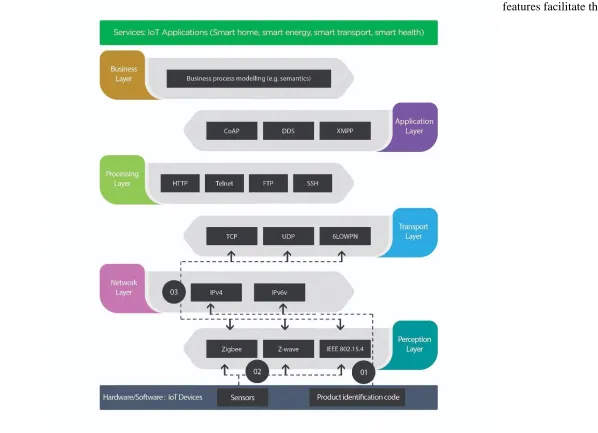
Figure 7: IoT Environment containing architectural layers and protocols for bringing interoperability among IoT devices and applications where various IE features facilitate this process. ... 25
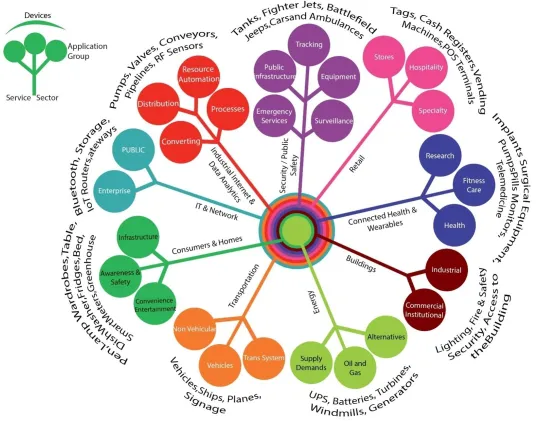
Figure 8: The Internet of Things (IoT) - The World of Connected Services ... 27
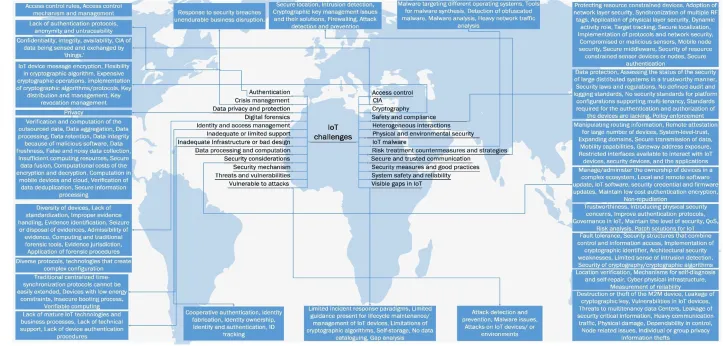
Figure 9: Summary of IoT security, privacy and trust challenges... 33
Figure 10: A structural explanation of malware analysis ... 92
Figure 12: Research proposed framework ... 105
Figure 13: Data collection process ... 106
Figure 14: Feature selection process used in this dissertation ... 108
Figure 15: Machine learning classifiers used in our approach ... 111
Figure 16: Main header variable worth ... 115
Figure 17: Program header variable worth ... 116
Figure 18: Section header variable worth ... 118
Figure 19: Main header ROC Chart ... 120
Figure 20: Program header ROC Chart ... 121
8 | P a g e
TABLE OF TABLES
Table 1: Showing some definitions of IoT ... 20
Table 2: Showing security, privacy and trust challenges: ... 35
Table 3: The summary of IoT attacks reported in literature related directly or indirectly with malware ... 77
Table 4: Different types of a malware ... 91
Table 5: Machine learning algorithms and their purpose ... 94
Table 6: Overview of literature concerning different platforms, their features extracted, classifiers and accuracies about static malware analysis ... 97
Table 7: Showing static features extracted in various literature ... 99
Table 8: Showing various feature selection method ... 100
Table 9: Showing performance evaluation measures used in this study ... 101
Table 10: Recent papers and their performance measures ... 102
Table 11: Datasets created ... 107
Table 12: Feature selection methods ... 109
Table 13: Feature combining rules ... 117
Table 14: Shows the performance measures of different classifiers belong to Group A ... 124
Table 15: Shows the performance measures of different classifiers belong to Group B ... 125
Table 16: Shows the performance measures of different classifiers belong to Group C ... 126
Table 17: Shows the performance measures of different classifiers belong to Group D ... 126
9 | P a g e
Abstract
Application of machine learning in the field of malware analysis is not a new concept, there
have been lots of researches done on the classification of malware in android and windows
environments. However, when it comes to malware analysis in the internet of things (IoT), it
still requires work to be done. IoT was not designed to keeping security/privacy under
consideration. Therefore, this area is full of research challenges. This study seeks to evaluate
important machine learning classifiers like Support Vector Machines, Neural Network,
Random Forest, Decision Trees, Naive Bayes, Bayesian Network, etc. and proposes a
framework to utilize static feature extraction and selection processes highlight issues like
over-fitting and generalization of classifiers to get an optimized algorithm with better
performance. For background study, we used systematic literature review to find out research
gaps in IoT, presented malware as a big challenge for IoT and the reasons for applying malware
analysis targeting IoT devices and finally perform classification on malware dataset. The
classification process used was applied on three different datasets containing file header,
program header and section headers as features. Preliminary results show the accuracy of over
90% on file header, program header, and section headers. The scope of this document just
discusses these results as initial results and still require some issues to be addressed which may
10 | P a g e
Acknowledgments
I would like to thank everyone who has stood by me through this journey. My gratitude goes
to Dr. Mo Saraee mainly. Thanks for your patient, guidance, serenity, and encouragement.
I am thankful to the staff at Salford Energy Hub for their assistance and guidance about
energy devices.
To my family (My wife Bushra Javed) for all the constant support and encouragement.
Finally, to Allah God Almighty for giving life and everything I am today. You are just as
11 | P a g e
Chapter 1: Introduction
In the last few years, the internet has started playing a vital role in everyone’s life when the
concept of “Internet of Things” (IoT) emerged. IoT has fundamentally changed the paradigm
of traditional information technology (IT) to a new era of innovation involving sensor chips. In
a concise time, the current conceptualization of IoT led to deploying over 9 billion
interconnected devices in the market; this figure is expected to rise to 24 billion in 2020, it
seems like nearly everything will become connected in future for effective communication
(Gubbi et al., 2013). With the increased connectivity of the internet with all the luxuries, IoT
devices bring the concept of security to the consumer (e.g., controlling home automation). This
development of technology makes their hectic life enjoyable and under controlled. For
instances, the idea of the customized theme in smart-lights is a best example of an IoT device,
another concept of smart fridges with content management not only gives the consumer a useful
real-time experience, but it also provides a flexible solution for this busy generation. Ease of
life made IoT as an inevitable reality of life what we could only think in the early 80's. Now
researchers claim that IoT devices are the first choice of the consumers. Therefore, an enormous
number of IoT devices are getting developed, according to a survey the total number of smart
IoT devices are expected to reach the figure of approximately 50 billion in 2020 and an estimate
of over 75 billion in 2025. With the rise of IoT associated insecurities have also evolved rapidly
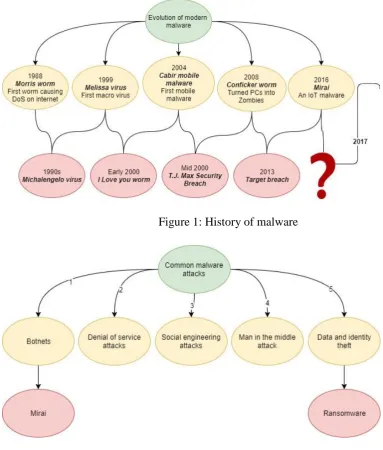
in the form of malware, denial of service attacks (DoS) and botnets. Figure 1 shows the
evolution of famous malicious attempts (Nordrum, Aug 2016, IHS, 2016).
In recent years, cybercriminals have developed malware targeting these IoT devices. Imagine!
Your smart fridge sends fake content update requests to your local Tesco, you receive a bill that
you were not supposed to pay, or your smart home meter has been infected by malware which
is sending wrong meter reading, it would cause insecurity to the users and lack of trust to the
product or service provider. Different kind of malware targeting IoT device, Figure 2
12 | P a g e
Figure 1: History of malware
Figure 2: Common malware attacks
Mirai is a recent example of IoT malware which converts its target into a Botnet.Mirai got the
focus of researcher’s attention for targeting more than 148k IoT devices, making CCTV
cameras and DVR recorders running on ports 23 and 2323 particularly and turning them into
Botnets to cause Distributed Denial of Service Attack (Angrishi, 2017). To complicate the
situation, malware authors used techniques to camouflage the primary activity of a malware
causing more damage to the infected devices. Therefore, there is a significant need to employ
malware detection techniques which incorporate Data Mining and Machine Learning
Algorithms to enhance the detection capability.
Over the last one decade, plenty of research has been conducted in the field of malware analysis;
13 | P a g e
malware. Therefore, we need research which predominantly focuses on enhancing automated
malware analysis using potentially malicious IoT executables that detect their malicious
activities with the help of classification and prediction for better performance.
1.1 - Problem statement
Malware have been threatening the privacy of internet users for a very long time, with every
day passing cybercriminals are using advanced programming skills to create more destructive
malware. A malware of any class contributes to the revenue loss to the society. Recently, in a
study, it was claimed that in 2016 the famous attack on Dyn (Oracle’s infrastructure service
provider company specializing in DNS and Email related services) by Mirai Botnet caused a
revenue loss of $110 million (Kochetkova, 2016). The damage did not stop here, author of the
malware released its source code on GitHub leaving the doors open for more powerful attacks.
IoT malwares have special features that enable them to run on huge range of architectures and
target multiple platforms. Of course, this special feature makes the IoT malware a smarter form
of malware, however, IoT malwares also take the advantage of weaknesses present in IoT
devices such as firmware loopholes, no encryption mechanism etc. and exploit these weakness
in a clever way. These malwares have an ability to scan heterogeneous devices using open ports,
hostile these devices by applying various commands /or saved default usernames / or passwords
in their database. Furthermore, another feature that contribute to make it different from other
malwares is the instruction set to avoid IPs of Government Agencies.
Billions of IoT devices are already present in the market on vast number of architectures. Main
weak point of these devices is their resource constrained nature. Due to rapid growth in their
importance and the weaknesses present, these devices soon became a prime target of malware
attacks. It has also been noted from published work that there have been numerous ongoing
studies done in Windows and Mobile devices related malware mainly involving Android.
Unfortunately, this area did not get much attention and till this date there is no published
literature available to analyse malware with respect to IoT. This research work attempts to
systematically review the literature to study the vulnerabilities reported in IoT and how these
are related to malware attacks. This work also aims to analyse IoT malware and work focused
on various distinct directions of malware analysis. First such direction was the collection of IoT
malware/goodware. Second was extraction of meta-information, headers, strings, and symbols
14 | P a g e
study gives us insight useful information about the patterns of IoT malware/goodware,
classification and prediction.
Furthermore, there is no optimum framework for the classification of IoT application.
Additionally, no work has been done to observe generalization of classifiers, hyper tuning the
parameters (to figure out best parameter for a chosen algorithm) and analyze whether a
particular classifier is overfitting or not? These factors motivate us to carry out work in this
domain.
1.2 - Research aims and objectives
Based on the literature reviewed it is clear that further studies into IoT malware are needed. The
proposed project will investigate the published literature through the bibliometric approach and
summarize the gaps reported in the previous section of the problem statement, IoT
environments suffer malware detection, classification, prediction and pattern recognition.
Meanwhile, we can also observe the lack of application of feature scoring algorithms which can
be used for feature selection. Here, I will not discuss the individual status of static or dynamic
features of IoT malware; both require comprehensive research. In the light of this, the
dissertation has three overriding objectives:
1. Malware as a severe threat to IoT: To review the literature to identify what kind of threats and vulnerabilities being faced by IoT devices. And how it becomes security, privacy, and
trust related concern.
2. Systematically review the literature: To capitalize on public available malware detection tools and libraries of machine learning algorithms for data mining to support annotation of
critical malware in IoT for which no information is available.
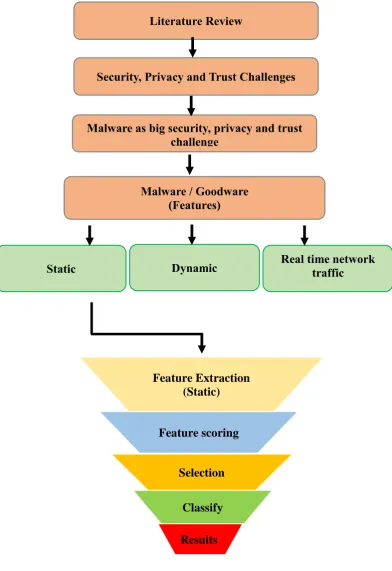
3. IoT malware analysis: To conduct IoT malware analysis using selected classifiers (shown in figure 3) and by observing optimum parameters. Sub-objectives are following:
a) To study the results using a minimum number of features determined with the help of
feature reduction/scoring techniques.
b) To evaluation different feature scoring techniques and choosing best feature
selection/reduction method for our datasets.
c) To analyze the performance of the algorithms using false positive rates, overfitting issues
15 | P a g e
Figure 3: Showing how we reached at the stage of static malware analysis
Feature Extraction (Static)
Feature scoring
Selection Classify Results Malware / Goodware
(Features)
Static Dynamic Real time network traffic
Security, Privacy and Trust Challenges Literature Review
16 | P a g e
1.3 - Research contribution
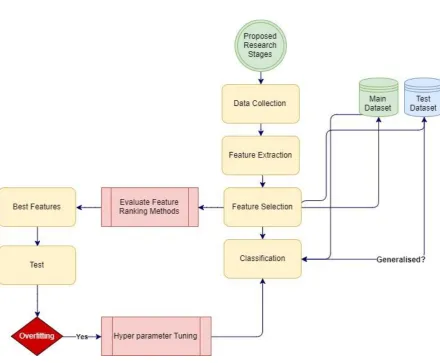
This section discusses the research contributions; figure 4 shows the representation of our
research contributions. Supervised learning-based machine learning algorithms help to
predict/determine relevant IoT malware features (only static features). These relevant features
also help to detect different patterns of the applications being analyzed and create a logical
linking between good or bad, predicting the ability of the malware attack on the basis of feature
ranking and provide a coherent framework to classify the differences between malware and
[image:16.595.87.528.288.651.2]goodware.
17 | P a g e
This section presents the research contribution and personal commitment. In addition to this,
these contributions also help to perform the comparative analysis between IoT malware and
goodware (malware belonging to UNIX System V malware family and clean ELF executables
collected from Raspberry Pi based Qemu emulator) and also to differentiate between them by
a minimum set of features. Therefore, we propose providing an optimum framework for
malware classification and evaluation using selected classifiers. In other words, the
recommended tool to help better prediction by involving a comparative analysis of various
feature selection methods as well. I would explain these research contributions in more detail
in later sections.
The rest of the document can be structured as follows: Chapter 2 contains information about
malware analysis primarily static malware analysis and background literature review of static
malware analysis. Chapter 3 (Data Collection and The Proposed Approach) describes research
methodology to achieve research aims and objectives, while CHAPTER FOUR: Research
18 | P a g e
19 | P a g e
Chapter 2. Literature review
The overall aim of the literature review is to perform background study of existing literature
related to the internet of things, its related challenges, identify the research gaps to understand
the theoretical and conceptual framework of the research in question. The presentation of
literature being reviewed in chronological order helps to observe the quality of work, its growth,
current gaps in the knowledge and future progress. Therefore, a literature review can be treated
as an essential part of the research used to remodel the elements of the work done and create
the basis of future work (Webster and Watson, 2002).
2.1 - Internet of Things
In simple words internet of things (IoT) consists of two important elements “internet” and
“things.” The name IoT was first used in 1999 in which radio frequency (RF) application
extension took place forming the basis of IoT infrastructure (Khodadadi et al., 2017). During
early days of the introduction of IoT, RF chips used to be the force behind IoT but later on
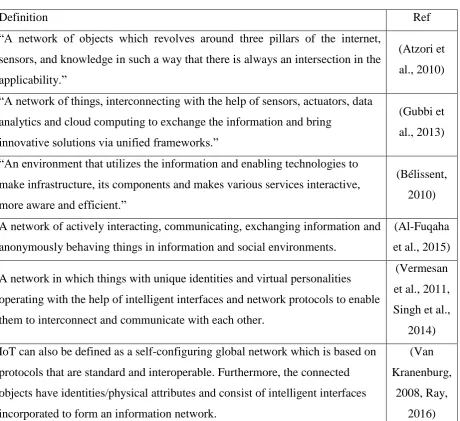
replaced by wireless sensor chips. There are various definitions of IoT in the literature as shown
20 | P a g e
Table 1: Showing some definitions of IoT
Definition Ref
“A network of objects which revolves around three pillars of the internet,
sensors, and knowledge in such a way that there is always an intersection in the
applicability.”
(Atzori et
al., 2010)
“A network of things, interconnecting with the help of sensors, actuators, data
analytics and cloud computing to exchange the information and bring
innovative solutions via unified frameworks.”
(Gubbi et
al., 2013)
“An environment that utilizes the information and enabling technologies to
make infrastructure, its components and makes various services interactive,
more aware and efficient.”
(Bélissent,
2010)
A network of actively interacting, communicating, exchanging information and
anonymously behaving things in information and social environments.
(Al-Fuqaha
et al., 2015)
A network in which things with unique identities and virtual personalities
operating with the help of intelligent interfaces and network protocols to enable
them to interconnect and communicate with each other.
(Vermesan
et al., 2011,
Singh et al.,
2014)
IoT can also be defined as a self-configuring global network which is based on
protocols that are standard and interoperable. Furthermore, the connected
objects have identities/physical attributes and consist of intelligent interfaces
incorporated to form an information network.
(Van
Kranenburg,
2008, Ray,
2016)
Based on above-mentioned definitions, IoT can be considered as a complex cyber-physical
ecosystem with following six characteristics: (i) Dynamic infrastructure; (ii) Self-configuring;
(iii) Well integrated; (iv) Interoperable; (v) Identities and physical attributes; (vi) Intelligent
Interfaces.
These six characteristics make a “smart device” that is considered as a significant part of the
scientific revolution. The tremendous growth in smart IoT devices and their innovative features
is self-evident of their importance. IoT technology became more promising when researchers
claimed that in the future every ordinary device will be transformed into a smart device and IoT
21 | P a g e
Along with the rise of IoT, top technology giants have also started focusing towards it for
example Google acquired Nest to step into smart home automation business, Apple introduced
HomeKit and Cisco launched various products in the areas of network connectivity, data
analytics, embedded systems, security and digital transformation (DevNet) and made a bold
statement that IoT market worth at least 14 trillion dollars (Dijkman et al., 2015). This is the
beginning as numerous European companies are making their products in the areas of health
care, energy and in the vehicle industry, etc. Furthermore, the good thing about IoT is that
researchers have started performing quality research in it and trying to address associated
challenges of security, privacy and in particular malware threats. As of now, research scientists
continue to produce high-quality technical approaches including Robotics, Cloud Computing,
[image:21.595.144.476.315.639.2]Big Data and development of IoT machine learning frameworks.
Figure 5: Illustrating the characteristics of IoT
Internet of things
Dynamic infrastructure
Id
en
tit
ies
an
d
p
h
ysical
att
rib
u
te
22 | P a g e
2.2 – Architecture of IoT
Due to billions of heterogeneous IoT devices, all proposed IoT architectures in the literature
have considerable variations. There is no single consensus on IoT architecture, and everyone is
agree with this statement (Sethi and Sarangi, 2017). Consequently, researchers often described
the architecture based on their study purpose.
Generic architecture
The most basic architecture of IoT devices consists of three layers (Figure 1):
(i) Physical or Perceptive layer or remote sensing layer: this layer is responsible for sensing and collecting information about the environment. It has the ability to sense the
physical parameters or identify the other objects present in the environment.
(ii) Network or communication layer: this layer is responsible for the communication by connecting with other smart things, network devices, and servers. This layer provides
the means of data transmission by processing the sensor data.
(iii) Application layer or software layer: this layer is responsible for communicating with the end-user to deliver various application-specific services and defines various IoT
applications that can be deployed.
This underlying architecture was introduced in the early stage of research in the field of IoT
(Jammes and Smit, 2005, Yan and Huang, 2009), but this kind of architecture is not sufficient
to provide in-depth aspects of IoT for the advanced research (Sethi and Sarangi, 2017).
Therefore, detailed, layered architecture has been proposed in the literature where some
researchers have also included some additional layers (Figure 1): (i) physical layer; (ii) transport
layer: (iii) processing layer; (iv) application layer; and (v) business layer. The roles of physical
layer, network layer, and application layer are same as the three-layer architecture, and other
layers have been described below (Rayes and Salam, 2017, Sethi and Sarangi, 2017, Bozdogan
and Kara, 2015).
(iv) Transport layer: transport layer is responsible for transferring the sensor data from the physical layer to the processing layer through networks (such as wireless, 3G, LAN,
Bluetooth, RFID, and NFC) to perform network operations and identify the connected
23 | P a g e
(v) Processing layers: processing layer is the middle layer that is responsible for performing multiple functions such as storing data, analyzing data and processing data
that comes from the transport layer. Many enabling technologies such as cloud
computing, big data processing modules and database management, etc. are
incorporated to provide a diverse set of services.
[image:23.595.167.557.223.383.2](vi) Business layers: business layer is responsible for managing whole IoT system including user details, applications, etc.
Figure 6: IoT architectural layers
Advanced architecture
In a recent article, another architecture has been proposed which is a somewhat advanced form
of IoT. This architecture consists of seven layers, e.g. (i) application layer; (ii) application
support and management layer; (iii) service layer; (iv) communication layer; (v) network layer;
(vi) hardware layer; (vii) environment layer, etc.
Advanced architecture
In a recent article, another architecture has been proposed which is a somewhat advanced form
of IoT. This architecture consists of seven layers, e.g. (i) application layer; (ii) application
support and management layer; (iii) service layer; (iv) communication layer; (v) network layer;
(vi) hardware layer; (vii) environment layer, etc.
2.3 – IoT environment
The key objectives of IoT devices are (i) To exchange secure and reliable information between
connected devices; (ii) To identify the relevant objects; and (iii) To take part as an essential
24 | P a g e
environment (IE). The IoT devices with multiple architectural layers, associated protocols and
enabling technologies to increase the heterogeneity in the IoT environment. It creates a model
where numerous smart things or objects connected with each other by using compatible
wired/wireless networks. The multiple interactions bring interoperability to the environment
and help to reach common objectives for various IoT user-specific applications (Figure 7).
IoT environment typically consists of six important features (Al-Fuqaha et al., 2015):
(a) Identification: Identification is an essential feature of IoT. There are various techniques to identify a smart thing/object within the IE such as unique object code (present at the hardware
level) (Koshizuka and Sakamura, 2010) and unique addresses, e.g. IPv4or IPv6 present at
network layers (Al-Fuqaha et al., 2015).
(b) Sensing: In the IoT, sensing feature means communicating with IoT device, gathering data and report it back to the data handling or storing mechanism. Example of sensors/communicator
is smart sensors, actuators, and radio frequency tags.
(c) Communication services: These features help IoT devices to connect with each other and provide various services while working in a low power mode and establishing a communication
channel to send or receive the information to the sensor. Typical examples of communication
services include Zigbee, Z-wave, WIFI etc.
(d) Hardware/software: IoT environment uses various hardware platforms and operating systems software to manage individual IoT devices, the combination of both these referes to as
a computation platform or a controller. There are various examples of IoT hardware platforms
like Intel Edison, Intel Galileo and Raspberry Pi etc, while Contiki OS, TinyOS etc are the
examples of operating systems or softwares.
(e) Services: IoT devices, protocols and enabling technologies work on interoperability framework for providing various services explained in following section.
(f) Semantic: This feature creates an ability to extract information from an IoT device and apply knowledge representation techniques to bring sense into a raw data delivered by the
sensor. Semantic services bring intelligence into IoT by using data analytics. Example of IoT
25 | P a g e
Figure 7: IoT Environment containing architectural layers and protocols for bringing interoperability among IoT devices and applications where
various IE features facilitate this
26 | P a g e
2.4 – IoT ecosystem and the world of connected services
The world of IoT is redefining the relationship between the machines and humans; it allows
the automation of everything around us. IoT devices and its enabling technologies are working
on interoperability framework where they exchange information with each other and coordinate
decisions and making a smart “cyber-physical ecosystem” (ENISA, 2017). This is an
innovative ecosystem with billions of heterogeneous physical devices manufactured around the
world to improve quality of life, efficiency, productivity, profitability, effectiveness, and
decision-making. The application of the IoT devices is diverse, distributed into various services
and benefitting ordinary people, industrialists, governments, health professionals, energy
providers in simple words everyone. Pictorial view in Figure 8 illustrates the proliferation of
devices and most exciting applications within different services.
2.4.1. Smart Energy
Smart energy is the conversion of a traditional energy distribution system that consists of some
distribution lines, substations, transformers and Supervisory Control and Data Acquisition
(SCADA) field devices and converts into modern networks that are not only smart, intelligent
but also having the default capabilities of information exchange, maintainability and easy
interoperability of individual components (Sajid et al., 2016). The examples of smart energy
include UPS, batteries, generators, fuel cells, ambient energy harvesting, telemetry, power
stations, smart grid and power controls, etc. (Fraga-Lamas et al., 2016). Among these smart
grid is a popular application of IoT which consists of devices such as meters (gas, electric and
water) and other energy appliances. Traditional energy transmission/distribution systems used
to be unidirectional, smart grid makes them intelligent to sense the transmission requirements
to avoid the congestion, effective communication between the utility services and the customer.
Moreover, there are specific advantages smart grid gives to the users, for example, the efficient
transmission, congestion control, smarter restoration of energy, less hassle to maintain,
controlled peak hour energy supply and better integration of various controls (Min et al., 2014).
Smart grid consists of four major components including power plants (source), transmission
(energy transfer in bulk from power source generators and the sub-station), distribution (a
connection between power source and the customer), customer area to generate store power at
home or anywhere and service provider to deliver the energy products to end-users (Min and
27 | P a g e
28 | P a g e
2.4.2. Smart Home
Smart home or smart living is often referred to as Home Area Network (HAN) is the
incorporation of communication techniques to form a network that connects the essential home
appliances and services like lighting, heating, air conditioning and security in such a way that
they can control and monitor these appliances anytime anywhere. These devices often use
twisted pair cables and RF/IR sensor chips. Most importantly many of the device use mains
power and use a gateway or controller to manage (connection and authentication) for all the
devices associated with the home network (Jiang et al., 2004).
There have been numerous smart home devices in the market these days; prominent “smart”
home devices include pen, wardrobes, table, lamp, picture frame, fridges/freezers, bed, pillow,
digital cameras, power system, dishwasher, e-readers, smart utility meters, greenhouses and
home surveillance system (Alvarez et al., 2017).
2.4.3. Smart Buildings
Incorporating energy management system (EMS) and security/safety systems within the
building is the key aspect of smart building. It is useful for competitive management of
resources, improve building visibility and manageability. It provides tools to reduce the
operational cost and provide cost-effective benefits to the consumers, employees, and tenants.
It also brings intelligent IoT ecosystem that includes sensor and gateway vendors, system
integrators and application developers (Shenoy, 2016).
2.4.4. Smart Health
IoT being a game-changer in every industry playing its role in the healthcare sector as well by
transforming healthcare into smart healthcare or connected health in which all medical
appliances are always connected to give more useful and important information about patients.
The healthcare market is going to hit 117 billion USD in 2020. With the help of connected
health we may get the benefit of efficient risk analysis and healthcare asset management, drug
management, monitoring for patients and hospitals e.g., smart pills a major contribution
towards smart healthcare in which patient’s clinical trials, activity monitoring, and
self-reporting is performed and finally early medical intervention for critically ill patients (Patel et
29 | P a g e
2.4.5. Smart Wearables
Smart wearables include medical appliances, fitness equipment, and smartwatches help to
monitor not only the health of the patients but also lets the athletes to maintain their routine
fitness chart. According to Cisco till 2020, there will be at least 600 million smart-wearables
used around the globe (Sun et al., 2017a). Smart wearables play an essential role in IoT world,
according to the researchers, the reliance of people-centric aspect of IoT is heavily on these
wearables to handle remote objects (Liu and Sun, 2016). There have been various products in
the market, e.g., Samsung Gear and Fitbit, etc. are the widely used products. These intelligent
devices have low-constrained architecture particularly the sensors.
2.4.6. Smart Security and defense
Various IoT devices are getting deployed throughout the cities that are undeniably transforming
the public safety aspects. Wherever unplanned, emergency events and catastrophic disasters
occur in the cities, these devices enable the interoperability and transform the critical
information to the organization who deals with scenarios in which defense and public safety
could influence and respond to emergency events (Fraga-Lamas et al., 2016).
2.4.7. Smart Retail
Another implementation of IoT concepts where analytical abilities, predicted outcomes and
efficient results help retail industry. Smart retail includes supply chain, in-store applications,
and customer specific applications as well. It helps to identify when the certainty customer
needs help. Furthermore, smart retail also helps (i) identifying when there a maintenance
required on a retail machine, (ii) transportation of merchandise by intelligently optimizing the
route, tracking and temperature control, (iii) making retail warehouses automated by
monitoring sales, stock levels and smart pallets which automatically report missing stock, (iv)
proactive customer focus to identify when a customer needs an incentive as a highly valued
customer retention scheme or autonomous doorstep product delivery and (v) to help to monitor
automatic foot count for retail stores, analyse that information with other stores and
re-modelling store to maintain customers (SAS).
2.4.8. Smart Industries
The concept of smart industries or industrial internet (II) was introduced by a company called
GE, according to this concept complex machinery is used along with RF sensors and software
forming a specialized IoT environment (Greenough and Camhi, 2015). II is a complex
30 | P a g e
heterogeneous device communication as enabling technologies giving high-performance
analytics to the users (Kevin, 2009, Jeff Kelly, 2013). With the evolution in IoT, data from the
government is getting readily available to relevant people and with the help of industrial
internet and big data analytics people can handle raw information and transform into more
structured and valuable form of knowledge (Lohr, 2012). The examples of industrial devices
ready for transformation into II include Pumps, Valves, Conveyors, Pipelines, Motors, and RF
Sensors, etc.
2.4.9. Smart Transportations
In recent years, some cities have become more crowded, and millions of people commute
through public transports on a daily basis. Integration of IoT into transportation system helps
to optimize public transportation routes, assess congestions and plan safer roads for the journey
by avoiding traffic congestions and reduce infrastructure costs (Gubbi et al., 2013)
Connected cars are another important IoT applications, vehicles connected with their gateways
with the help of WLANs providing drivers benefits, e.g. automatic breakdown support, location
services, driver assistance, entertainment, eHealth and fitness and advanced road traffic
assistance in case of an incident (Kirk, 2015). Recently the CEO of Apple Tim Cook confirmed
about the work on self-driving cars and the ability of Apple mobile devices to control the
vehicles (Harris, 2015) which may give IoT another dimension to enable car to car
communications, interaction with smart traffic lights, and most important connection with
external access points (Bonomi et al., 2012). By 2020, it has been reported that approximately
75% of cars worldwide will be IoT enabled (Javed et al., 2018). For the public transportation,
the concept of smart taxi system has also been introduced. Furthermore, another use of smart
transportation system can be in train services by providing smart ticket for data collection &
analytics, the management of public safety/security and the inclusion of smart tablets with the
drivers (Zanella et al., 2014).
2.4.10. Smart IT & Network
IoT is constantly offering new devices and tools that helps to interact and connect IT and
network professionals to perform network administration, monitoring network traffic, status of
nodes connected and software updates etc. to assess the status of working and delivering better
solutions. Furthermore, IoT also helps network support teams to perform better network fault
finding and tolerance, handle cloud services, effective network usage and manage
31 | P a g e
2.4.11. Smart Cities
A smart city is a new vision of the technology that incorporates all infrastructures of a city into
a controllable network. The infrastructure of a smart city may include almost everything for
example homes, schools, streets (lights), hospitals, transportation system, gas/electric/water
supplies and much more (Zanella et al., 2014). All of these technologies use different sort of
gateways depending on the scope and use, but one thing in the smart city in comparison with
other application is the use of cloud services for information exchange. With the advancement
of IoT smart city has been emerged as an essential concept to bring comfort to the lives of
residents of the town. Not only this, this idea has become a hub of other emerging technologies
as well like data science (big data, malware threat analysis, and information governance) but
also a complex challenge of heterogeneous and scalable computing challenges (Zhang et al.,
2017, Schaffers et al., 2011, Hernández-Muñoz et al., 2011).
2.4.12. Smart Supply Chain
IoT is bringing revolutionary advancements into supply chains and not only shaping up the
industry but also solving the majority of the problems consumers face. With the rapid
expansion in the business everyday organizations require smart solutions that make companies
connect their systems efficiently, communicate with different businesses, share information
and reinforce their sales/supply chains departments. Not only this, it can help customers in
placement, delivery, and tracking of orders. In addition to this, IoT can help consumers of
supply chain products by introducing smart labeling system to give total control of the products.
Therefore, with the help of IoT sensor chips, every aspect of supply chains can be controlled
to provide efficient service (Javed et al., 2018, Kärkkäinen, 2003, McFarlane and Sheffi, 2003).
2.4.13. Smart Agriculture
In the last few decades, climate has been changed drastically that brings various challenges for
local and global food security. Agricultural commodities are highly sensitive to climatic
conditions such as temperature, rain, and humidity. These changes are likely to affect
agriculture production (crops, fruits and vegetables, etc.) and livestock (fisheries, poultry
farming, etc.). In this situation, it is prerequisite to monitor the climate change and utilize all
available resources for sustainable agriculture production by monitoring and better resource
utilization effectively which is only possible with the help of smart IoT devices (Javed et al.,
2018, Na and Isaac, 2016, Nukala et al., 2016). Smart agriculture system is an automated
32 | P a g e
is making a significant contribution towards a better agriculture system people were looking
for (Patil and Kale, 2016).
2.5 – Security and privacy challenges related to the IoT
IoT is connecting more and more devices every day; this emerging technology promises to
provide access to the devices anywhere to carry out everyday tasks using different IoT
applications discussed in the previous section. This advancement offers undoubtedly several
benefits to the humanity. Although IoT is playing a transformational role in the lives of people,
on the other hand, it also brings a large number of challenges. Security, privacy, and trust are
probably the most challenging issues in IoT, and various authors have extensively discussed
them in published literature. In this section, we tried to collate a list of most important
challenges reported in the literature; these challenges were divided into 24 key groups defined.
This grouped taxonomy is depicted in figure 9, table 2 summarising the challenges and
33 | P a g e
34 | P a g e
2.5.1. Access control:
Access control let only authorized users to access a resource. It enables to control the software
update, data sharing, maintenance and protection of sensitive data. Access control usually
consists of three important building blocks: (i) access control mechanism; (ii) access control
rules and (iii) access control management (Ouaddah et al., 2017). Due to the low power
requirements and low constrained environment, access control is one of the major challenges
in IoT (Alrawais et al., 2017a, Lin and Bergmann, 2016, Roman et al., 2013, Sicari et al., 2015,
Pirbhulal et al., 2017, Yu et al., 2017, Tiburski et al., 2015, Ouaddah et al., 2017).
Rules/policies/privileges for the access control are not well defined for most of the IoT devices.
These rules are usually implemented on a high-level architecture which is ineffective due to
resource constraints in most of the IoT devices. Without clear access control rules, access to
the IoT devices get compromised that leads to more sophisticated attacks (Yaqoob et al., 2017,
35 | P a g e
Table 2: Showing security, privacy and trust challenges:
Group Challenge Finding and comments References
Access control
Access control rules
Effective implementation of access control is only possible with
the help of predefined rules, policies or privileges that are not well
defined for IoT devices. Without clear access control rules, access
to the IoT devices may get compromised.
(Yaqoob et al., 2017,
Zarpelão et al., 2017,
Ouaddah et al., 2017)
Access control mechanism and
management
Application of adequate access control is a critical element of
information security that requires comprehensive work on its
mechanisms and management system. Due to the low power and
low constrained environment, access control is one of the major
challenges in IoT.
(Du and Chen, 2008,
Zarpelão et al., 2017,
Sicari et al., 2015,
Ouaddah et al., 2017,
Miorandi et al., 2012,
Alrawais et al., 2017a,
Pirbhulal et al., 2017)
Authentication Lack of authentication protocols
A large number of heterogeneous IoT devices being
manufactured, their diverse protocols, poor architecture, and
complex configuration makes implementation of authentication
protocols a challenge. This deficiency causes more complex
security and privacy issues.
(Alrawais et al., 2017a,
Amadeo et al., 2016,
Zhang et al., 2013,
Al-Fuqaha et al., 2015,
Tiburski et al., 2015,
Venckauskas et al.,
2016b, Pirbhulal et al.,
36 | P a g e
Anonymity and untraceability
Heterogenous IoT devices are developed and distributed in the
dynamic environment. The big challenge lies in the design and
development of secure and privacy-preserving services that are
not well-defined. Personally identifiable information has
maximum disclosure due to anything,
anytime and anywhere nature of the IoT that raises issues of
anonymity and untraceability. Here anonymity refers to something
that nobody knows about yourself or your real identity, while the
untraceability refers that no one can predict your actions.
(Gope and Hwang,
2015, Challa et al.,
2017)
CIA
Confidentiality
Confidentiality or privacy is a severe issue in IoT because of many
reasons, e.g. the massive amount of data/traffic being generated,
and the ineffectiveness of security controls, etc. The design and
build of these devices have a limited sense of hiding the sensitive
information from unauthorized people to view it.
(Mendez et al., 2017,
Tiburski et al., 2015, Liu
and Sun, 2016, Lin and
Bergmann, 2016,
Pirbhulal et al., 2017,
Maple, 2017, Sicari et
al., 2015)
Integrity
The issues of IoT like fault tolerance, malware attacks and
untrusted communication effect integrity of devices resulting in
physical damage or unavailability of the resources.
(Mendez et al., 2017,
Tiburski et al., 2015, Liu
and Sun, 2016, Lin and
Bergmann, 2016,
37 | P a g e
Maple, 2017, Sicari et
al., 2015, Juma et al.,
2008, Kwon et al., 2016)
Availability
Availability makes sure that resources are available for the use
when needed. The availability of IoT resources becomes an issue
when confidentiality and integrity of objects are compromised
(e.g., malicious attacks etc.). It directly or indirectly affects CIA
where availability of resources becomes a big challenge.
(Mendez et al., 2017,
Pirbhulal et al., 2017,
Maple, 2017, Sicari et
al., 2015)
CIA of data being sensed and
exchanged by ‘things.'
CIA of data being sensed and exchanged means (i) a node is free
from malware; (ii) no unconcerned party has access to data
generated or stored; (iii) maintain the reliability and privacy of
communication where sometimes both relevant and irrelevant
information is kept as well. maintaining (i), (ii) and (iii)
simultaneously without compromising CIA is a serious challenge.
(Mayer, 2009, Liu and
Sun, 2016, Juma et al.,
2008)
Crisis
management
Response to security breaches
unendurable business
disruption.
Maintaining uninterrupted and safe operation, even when the
system is compromised is the highest priority target for the IoT
industry.
(Chiang and Zhang,
2016)
Cryptography IoT device message encryption
A massive number of IoT devices increase network vulnerability.
A process of encoding a message/information in a way that only
authorized parties can access is a big challenge.
38 | P a g e
Flexibility in a cryptographic
algorithm
Most of the IoT devices were designed without considering
security and privacy. Moreover, IoT lacks flexibility in hardware
operations and only support limited operations. The flexible
cryptographic operations can give more support to hardware and
offer better protection. These algorithms have not been
implemented so far and require many efforts.
(Amadeo et al., 2016,
Ambrosin et al., 2016)
Expensive cryptographic
operations
Cryptographic operations often require much more resources and
computation power to implement which is a challenge in IoT.
(Li et al., 2014a, Zhou et
al., 2017)
Implementation of
cryptographic
algorithms/protocols
Cryptography techniques of storing/transmitting the data are
concerned due to the architectural limitation of IoT. IoT devices
are based on either 8 or 16-bit architectures, and implementation
of cryptographic algorithms for getting the right security is a
challenge.
(Ning et al., 2015,
Venckauskas et al.,
2016a, Roman et al.,
2013)
Key distribution and
management
The distribution and management of cryptographic keys is a
critical issue when integrating cryptographic algorithms. If these
keys are compromised then entire communication process may be
disturbed. So there is a need to store keys at a safe/centralized
location and distribute them when needed.
(Xiao et al., 2017,
Alrawais et al., 2017a,
Bu et al., 2017, Ciccozzi
et al., 2017,
Venckauskas et al.,
2016a, Chandramouli et
39 | P a g e
Key revocation management
Cryptographic key management becomes an issue in IoT due to
the lack of key revocation techniques that may allow
cybercriminals to utilize the keys obtained in the process of a
system breach.
(Ambrosin et al., 2016,
Touati and Challal,
2015, Chandramouli et
al., 2014, Sawand et al.,
2015)
Data privacy
and protection
Privacy
(General, attacks, preservation,
and privacy-preserving data
mining)
Data privacy is a major concern for the people which always
requires preservation. The unrestricted access to the data poses
significant security and privacy risks to consumers. The critical
data privacy-challenges are: (i) most IoT devices fail to encrypt
data that are being transferred; (ii) user sensitive information can
be compromised due to unencrypted data.
(Barki et al., 2016b,
Mayer, 2009, Sicari et
al., 2015, Wang et al.,
2014, Liu and Sun,
2016, Ning et al., 2015,
Pirbhulal et al., 2017)
Data processing
and computation
Verification and computation
of the outsourced data
The process of outsourced data (a data produced or governed by
another company) to the cloud to perform computational
operations, and then request results may lead to security problems,
e.g., password crack and DoS/DDoS attacks. Non-verified
outsourced data in IoT lead to duplication of data or opens up
doors for further complexities.
(Yu et al., 2017, Liu et
al., 2015)
Data aggregation
One of the biggest challenges in IoT is the gathering of
unprecedented data generated from a multitude of devices every
second. Due to multiple related issues with IoT like heterogeneity,
complexity, an ever-increasing number of devices, data
(Pandey et al., 2010,
Sawand et al., 2015,
40 | P a g e
aggregation is an issue where both active and passive attacks,
eavesdropping, lack of confidentiality/integrity/trust, etc. play an
essential role to degrade the value of the precious data collected.
Moreover, computation is more difficult when noisy or duplicated
data is also present in the collection.
Data processing
A huge amount of unprecedented IoT data processing (i.e.,
acquiring and managing) is a challenge for the data analytics
particularly when data is coming from multiple sensors, devices
of complex configurations and various vendors, from outsourced
companies, etc. The processing of massive data, elimination of
ambiguities, noise and deduplication for processing without
violating/harming data confidentiality and integrity is a very tough
job. Processing or manipulation of data in this complex
environment becomes an issue when data comes from edge
devices in which computation and handling is a very tough
challenge.
(Mineraud et al., 2016,
Alrawais et al., 2017a,
Gaona-Garcia et al.,
2017, Luong et al.,
2016)
Data retention
IoT devices generate a massive amount of data every day and
preservation of that data for continued storage, for compliance or
business reasons is a nightmare for organizations. Due to
undefined/agreed governance laws defined by the government to
(Kumarage et al., 2016,
41 | P a g e
help legal matters related to IoT, it is a challenge for the businesses
to maintain a set standard for data retention.
Data integrity because of
malicious software
Data integrity is a fundamental aspect of IoT security and
reliability; a malware may cause issues related to data integrity in
which an attacker may gain administrative permissions to make
changes in the environment.
(Kwon et al., 2016,
Mendez et al., 2017)
Data freshness
Dealing with massive amount of data is a big challenge not only
to store recent /relevant data without any adversaries replayed old
messages but also manage the uncertainties in the data as well.
(Pirbhulal et al., 2017,
Jing et al., 2014, Islam
et al., 2015, Chen et al.,
2009)
False and noisy data collection
Malicious attacks may cause issues (such as hardware failures or
unreliable communication etc.). As a result IoT sensors may give
noisy/false data. The resolution of this problem is an open issue.
(Sawand et al., 2015,
Mavromoustakis et al.,
2016, Chen et al., 2015)
Insufficient computing
resources
IoT devices have limited computing resources especially when
considering IoT enabled medical devices where authentication
schemes employ complex algorithms that require more
computational resources. The techniques that focus on the need to
do any computation of data with limited resources are challenging
to apply.
42 | P a g e
Secure data fusion
The process of combining or synthesizing multiple data sources to
produce more reliable information that is consistent and accurate
as compared to the information provided by any individual data
source is known as data fusion. The archival of data that is being
generated in every second from in IoT and managing the
dimension of uncertainty associated with data fusion is a big
challenge.
(Venckauskas et al.,
2016a, Chen et al.,
2009)
Computational costs of the
encryption and decryption
In IoT environment, many copies of encrypted data get generated
which requires a computational cost. This issue is also linked with
the resource-constrained environment.
(Xiao et al., 2017,
Usman et al., 2017, Yu
et al., 2017)
Computation in mobile devices
and cloud
IoT devices are unable to deal with big size databases; these
devices share their data with cloud environment get the advantage
of computing. But due to the limitations of power, storage, and
computation capabilities results obtained from cloud may get
compromised. Therefore, there is a need for IoT devices to have
onboard computing capabilities.
(Yu et al., 2017)
Verification of data
deduplication
In the cloud, there exist a lot of highly redundant data, which
wastes the storage and bandwidth of the cloud servers. The
correctness and verification of this redundant data is a significant
challenge.
(Yu et al., 2017, Yan et
al., 2016a, Yan et al.,
43 | P a g e
Secure information processing
Processing of information in such a way that is only detectable by
the analyst and provides a secure mechanism to avoid information
mishandling when data is coming from numerous sources is a
serious issue that may lead to privacy breaches.
(Zhang et al., 2017)
Digital forensics
Diversity of devices
IoT devices have a high diversity/heterogeneity (i.e., different
operating systems, vendors, and methods of communication)
making it difficult for traditional forensic tools to work. There is a
continuous need to update these tools to support varied
architecture of IoT to conduct the examination effectively.
(Zulkipli et al., 2017)
Lack of standardization
Various authors have reviewed IoT challenges and proposed their
solutions, yet they do not provide implementation guidelines that
fit almost every scenario and their possible frameworks for future
development in the area.
(Harbawi and Varol,
2017, Zulkipli et al.,
2017)
Improper evidence handling
IoT evidence has some important characteristics (i.e., they are
volatile, fragile and with short lifespan) that make forensic
examination difficult. These evidence can be easily tampered or
even overwritten. Another issue is that, to collect/preserve
evidence, IoT devices needed to be switched off to avoid change
in metadata (i.e., accessed time), but it is not possible to shut down
these devices. Therefore, investigators need to equip themselves
with techniques to cope with these situations.
44 | P a g e
Evidence identification
In IoT where data is coming from a variety of different sources
(i.e., from different vendors, data centers, clouds or even from
different countries), an important forensic challenge is not only to
identify the potential sources of evidence but make them
accessible as well which at the moment is impossible. This
challenge becomes more complicated when we consider it in a
relationship with interoperability, heterogeneity and scalability
issues of IoT.
(Harbawi and Varol,
2017, Brown et al.,
2005, Quick and Choo,
2014, Taylor et al.,
2010, Zulkipli et al.,
2017, Liu, 2015)
Seizure or disposal of evidence
IoT environments are full of both reliable and unreliable
information in which seizure or disposal of crime scene evidence
may also take place either by forensic experts or by cybercriminals
to hinder the investigation process. Orientation and location of
digital evidence at such places where the collection, disposal or
seizure of the evidence may not possible makes forensic
examination a challenging task.
(Yakubu et al., 2016,
Conlan et al., 2016, Liu,
2015)
Admissibility of evidence
Researchers claim that the ever-increasing number of IoT devices
and volume of data generated by them required more time to
conduct the forensic investigation. On the other hand, the
vulnerability of IoT creates doubts on the admissibility of
evidence that is an open challenge.
(Vlachopoulos et al.,
2013, Quick and Choo,