PERFORMANCE PORTFOLIO
LYNDON BRETT BAKER
Performance Portfolio
LYNDON BRETT BAKER
SCHOOL OF ARTS AND MEDIA
SALFORD MUSIC RESEARCH
UNIVERSITY OF SALFORD
SALFORD, UK
Table of Contents
Performance Portfolio Author Acknowledgements ix
Author Declarations x
Abstract xi
Recording projects undertaken whilst researching the DMA xii Composers’ works premiered whilst researching for the DMA xii
Aims & Overall Purpose xiii
Introduction 1
Methodology 1
Premieres performed for the project 3
Compilation of Folio 4
Project 1:
Novus Vox: Sacred Compositions for Trombone & Band, Enfield Citadel 5
Description and Summary 6
Context 7
Process 11
Critical Commentary 11
Programme Notes for Novus Vox 14
Project 2A:
Salute to Sousa: and Other Forgotten Trombone Solos 30
Influences of classical & American Wind Band Music 31
Critical Commentary 31
Methodology & Process 33
Context of Salute to Sousa with other recordings 53
Project 2B:
Slide Projections: Contemporary Concertos for Trombone & Wind Band 54
Influence of Contemporary Wind Band Solos 55
Critical Commentary 56
Methodology and Process 57
Explanation of the CD project by M D Jonathan Crowhurst 57-60
Programme Notes for slide Projections 60
Project 3:
Premiere of Significant Works 64
Choice of commissions for the DMA 65
Project 3A: 66
Premiere of Gregson Trombone Concerto with Brass Band 66 Premiere Recording of the Gregson Concerto Methodology and process 67-69
Additional email from Edward Gregson 69
Summary 72
External Review by Jeremy West of the Gregson Concerto Premiere 73-75
Project 3B:
Premiere of Peter Graham’s Commission Radio City 76
Context 76
Peter Graham 77
Methodology and process for Radio City 77
External Review of Premiere Radio City by Jeremy West 82-85
Project 4:
A Presentation of significant solos for trombone and brass band 86 Public Lecture Recital Notes – Significant Solos for 87-103
Trombone and Brass Band
Programme Notes for Rob Wiffin Trombone Concerto Premiere 104
Project resources: Appendices:
Appendix I: Novus Vox project 1 (Song of Joy): 108
CD Cover & Disc 108
Track List 109
CD Booklet & Template 110-112
Personal emails from organisers and Composers 113-114 Unsolicited review by Peter Bale for 4barsrest.com 115-116 Unsolicited review by Becky Syratt for the Trombonist 116 Solicited review from Don Jenkins for Glissando 117-118 Programme from launch concert for the CD Project 119-122
Appendix II: Salute to Sousa and other forgotten trombone solos
Project 2: 123
CD Cover, Booklet & Disc 123
Track List 124
CD Booklet & Template 125-127
Unsolicited review by Andrew Justice for Trombonist 128 Unsolicited review by Scott Shelsta Retired SGM 129-130 Unsolicited review by Chris Thomas for BBW 130-131 Unsolicited review by Peter Bale for 4barsrest.com 131-132 Unsolicited review by Don Jenkins for the Trombonist 133-134 Unsolicited review by Ron Holz for Brass Herald 134-135
Appendix III: Slide Projections project 2B:
CD Cover & Disc 136
Track List 136
CD Booklet 137-140
Unsolicited review from R Newton for Bandsman 143-144
Unsolicited review from Peter Bale 145-146
Solicited personal email from Scott Shelsta 147
Appendix IV: Gregson Concerto Premiere Project 3A: 148
Concert Programme from Newbury Festival 148-149
CD & Track Listing 150
Solicited testimony of recording by Paul Hindmarsh 151 Unsolicited Review of Premiere by Jonathan Corry 151-152 Review of Symphony CD by Iwan Fox 4barsrest.com 153-154 Full Brass Band Score to Concerto for Trombone 155-226
Appendix V: Peter Graham Radio City Premiere Project 3B: 227 Live recording of CD at Festival of Brass 227 Unsolicited email from Dr Robert Childs 228 Unsolicited email from composer Prof Peter Graham 228 Unsolicited email from Editor of the Bandsman
Magazine Kenny Crookson 229
Unsolicited Review by Iwan Fox 4barsrest.com 230-231 Studio Recording of Electra & track listing 232 Score to Radio City revised February 2013 233-285
Appendix VI: Public Performance lecture recital Project 4: 286
Lecture Recital Programme 286-293
Appendix VII: Lyndon Brett Baker Curriculum Vitae 294-300
Appendix IX: Commissions 315-318
Appendix X: Summary of Professional Activity 319-324
Appendix XI: Other CD projects between 2012-2014 325
CD & Booklet for Freeh Spirit 326
Track listing 325
Unsolicited Review by Dave Lea for the Trombonist 327 CD & Booklet for World of the Trombone 328
Tracking Listing 329
Unsolicited review by Peter Bale for 4barsrest.com 330-331 CD & Booklet for Brett Baker & Friends 332
Track listing 333-334
List of Figures and Tables:
Figure 1 Strategy diagram 2
Figure 2 Compilation of Folio 4
Figures 3, 4 & 5 CD covers Eternal Quest, Bakers Dozen and Credo 7 Figures 6 & 7 CD covers for Boscombe & Foden’s Live & Faith Encounter 8
Figure 8 Picture of myself Jonathan Corry and Richard Scott 10
Figure 9 Excerpt of Solo Rejoice 14
Figure 10 Excerpt from Solo Song of Joy 15
Figure 11 Excerpt from Solo Song of Joy 16
Figure 12 Excerpt from Solo Song of Joy 17
Figure 13 Excerpt from Solo Beneath the cross of Jesus 21
Figure 14 Excerpt from Solo His Provision 22
Figure 15 Excerpt from Solo the Follower 23
Figure 16 Excerpt from 1st Cadenza for Solo the Follower 24 Figure 17 Excerpt from 2nd Cadenza for Solo the Follower 24
Figure 18 Excerpt from Solo Sweet Hour of Prayer 25
Figure 19 Excerpt from Solo He Gave me Joy 27
Figure 20 Excerpt from Quartet Soul Origin 28
Figure 21 Brett Baker & John Wilson at Salute to Sousa recording 36
Figure 22 Excerpt from Solo La Hieronyma 38
Figure 23 Excerpt from Solo Meyer Concertino 40
Figure 24 Excerpt from Solo Novakovsky Concertino 40
Figure 25 Excerpt from Solo Sea Shells Waltz 42
Figure 26 Excerpt from Solo Sweetest Story 42
Figure 27 Excerpt from Solo Harbour Lights 44
Figure 28 Excerpt from Solo Leona Polka 44
Figure 30 2nd Excerpt from Solo Priscilla Valse Caprice 45
Figure 31 Excerpt from Solo Devotion 46
Figure 32 Excerpt from Solo Salute to Sousa 47
Figure 33 Excerpt from Solo My Heaven of Love 48
Figure 34 Excerpt from Solo The Hyperion Polka 50
Figure 35Excerpt from Solo A Vous 50
Figure 36 Excerpt from Solo Beautiful Colorado 51
Figure 37 Salute to Sousa CD Cover 52
Figure 38 Slide Projections CD Cover 54
Figure 39 Excerpt from Rob Wiffin Trombone Concerto 61
Figure 40 Picture of Edward Gregson 66
Figure 41 Edward Gregson’s errata notes 67
Figure 42 Edward Gregson’s email errata 68
Figure 43 Gregson Symphony CD Cover 70
Figure 44 Symphony CD Track Listing 70
Figure 45 Picture of Edward Gregson & myself at the recording 71 Figure 46 Bob Childs & myself at the recording of the Gregson Concerto 72
Figure 47 Picture of Peter Graham 76
Figure 48 Excerpt from original Solo part of Radio City 3rd movement 78 Figure 49 Excerpt from intermediate Solo part of Radio City 79
Figure 50 Excerpt from final solo part of Radio city 81
Figure 51 CD Cover Boneman Walking 105
Figure 52 CD Cover Slide projections 105
Performance Portfolio Author Acknowledgements:
I would like to thank the following people for their help, inspiration and guidance during this research programme.
Robin Dewhurst, Peter Graham and Howard Evans; for their help and
encouragement on this DMA, they have all been a massive source of enthusiasm and inspiration.
Nicholas and Robert Childs; for their input and advice on many aspects of the portfolio. This includes solo performances with Black Dyke Band.
Richard Scott; for his excellent recording and editing skills in the recordings used as part of this project.
Richard Rock and Duncan Winfield; for all their help regarding venues, also Richard for his arrangements and compositions over this period.
Jonathan Corry; for his assistance and flexibility as Conductor of the Novus Vox CD project.
My performance and recording projects would not have been possible without the composers; Andrew Mackereth, Andrew Wainwright, Dorothy Gates, Roger Trigg, Martin Cordner, Philip Wilby and Kenneth Downie; for their compositions for Part 1 of this portfolio the Novus Vox recording.
Peter Graham and Edward Gregson; for providing stunning compositions for part three of this portfolio.
The Black Dyke Band and the Enfield Citadel Band; for their excellent accompanying in various projects.
Author Declarations
During the period of registered study in which this portfolio was prepared, the author has not been registered for any other academic award or qualification.
The material included in this portfolio has not been submitted, wholly, or in part for any academic award or qualification other than that of which it is now submitted.
Lyndon Brett Baker
Abstract
This DMA portfolio contains materials and a written critical commentary of over 10,000 words relating to the work I have completed towards a Doctor of Musical Arts in Performance, at the University of Salford. My doctoral programme consists of four performance projects and a public performance in the form of a lecture recital.
The study consists of an exploration and contextualisation of compositions, written for the virtuoso trombone player in differing genres and an analysis on how these genres have influenced music, written for the brass band trombone soloist in the 21st Century.
The work explores historical repertoire that has not been represented either in live performance or by recording in the last one hundred years along with newly commissioned compositions by leading and new composers. Works were discovered by visiting libraries, band-rooms and archives around the world.
The evidence is achieved through several CD releases including Novus Vox (Song of Joy): Music of the Salvation Army, Salute to Sousa and Slide Projections which explore the trombone in solo with wind bands both in an historical and contemporary frame. The large scale premieres of compositions by Peter Graham and Edward Gregson are the stated commissions and finally a public performance lecture recital provides evidence on how the genres influence my performances.
In addition the portfolio compilation contains:
A) Copies of excerpts of parts and featured pieces.
B) Published reviews and critical evaluations of the performances on premieres. C) The public lecture recital programme and live recording.
D) Supporting material showing my international standing, significant past and current activity as a performing artist in my field.
submission, which illustrates how I am an ambassador of the trombone through chamber, brass band and wind band genres. I have been involved in the projects on various levels, not just as a solo performer but also as a recording artist, an arranger, executive producer, editor, and in writing programme notes and hand-outs.
Recording Projects undertaken whilst researching for the
DMA: 2012-2014
World of the Trombone Volume 3 QPRZ 028D recorded February 2012 released October 2012
Freeh Spirit – The Music of Mark Freeh WR12-05 Recorded February 2012 released November 2012
Slide Projections – WR12-06 Three contemporary concertos for Trombone and
Wind Band recorded July 2012 released November 2012
Salute to Sousa WR12-07 recorded September 2012 released January 2013
Brett Baker & Friends WR13-09 Recorded January 2013 released May 2013 a double CD.
Novus Vox (Song of Joy) WR13-10 Recorded May 2013 released October 2013
Composers’ works premiered whilst researching for the
DMA July 2012-July 2014:
With Piano: Ray Steadman Allen (Faith Encounter), Rodney Newton (Dick Turpins Ride to York), Kenneth Downie (Abide With Me), Andrea Price (Nightfall in Joao Passoa, and Café Life), Jonathan Bates (Peregrines Flight), Gareth Churcher, (Klavji), Martin Ellerby (Sonata), Rob Wiffin (Concerto).
With Brass Ensemble: Richard Rock (The Crack’d Mirror).
Composers Works Premiered with Band: Edward Gregson’s Concerto, Paul Lovatt
Aims & Overall Purpose:
This portfolio aims to give a critical evaluation of the compact disc recordings and premieres of compositions that I have been involved in from July 2012 – June 2014. It is a presentation of music types and an analysis of the influences of various genres that occur in this study. I will discuss these genres in each chapter and highlight the issues and challenges arising from each project. It will also discuss the perceptive and imaginative interpretations involved in my performance of these works and the collaboration that occurred with each composer. I will demonstrate the versatility of the tenor trombone as a solo instrument and its ability to play in different genres as well as appealing to different audiences.
Gaining ideas from previous performances and recitals over the years, the objective was to create fresh, exciting and accessible music for the brass band trombone player through commissions. I was also to advance the repertoire for this solo instrument looking to other genres in which the trombone is present. My research from band-rooms, libraries, archives and specialists in their field around the world led to the discovery of a number of unknown pieces for the instrument. Each individual project sought to cast the instrument in a new light and to illustrate the influence of a variety of genres.
Introduction
Tenor Trombone World Premieres - Research, Collaboration & Performance
This portfolio submission contains; three commercially produced CD recordings, two commissioned works with critical evaluations, a public performance lecture recital, and a summary of my professional activity, completed for the award of Doctor of Musical Arts. This is a culmination of researching and discovering previously forgotten repertoire and from efforts in encouraging new and leading composers to write for the trombone.
This submission contains evidence of major performance-based projects, shown in figure 2. The studio recordings of projects 1 and 2 represent performances of perceptive and imaginative musical interpretations which demonstrate artistic stature and excellence. Critical reviews and testimonial evidence contained within these projects support this claim. Recordings of the commissions in projects 3 and 4 are also presented in this portfolio, representing significant repertoire for the instrument and demonstrate artistic stature and imaginative excellence.
Methodology
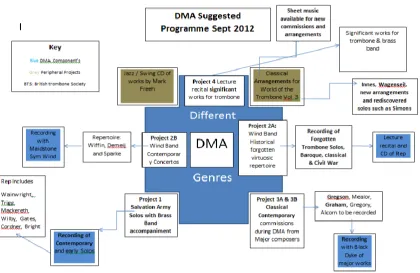
To understand how I could organise the four required projects for this award I created a diagram, seen below in figure 1, which illustrates the various genres that have influenced my playing and that of most brass band trombone players of my generation.
In categorising the areas of music that influence the brass band trombonist I produced the following strategy diagram.
Figure 1: Strategy Diagram
I discovered that the main genres influencing my music making were:
a) The Jazz, Swing and Big Band genre,
b) Classical compositions (explored during my M.A. studies at Salford University), c) Music of the Salvation Army,
d) Wind Band / Concert Band compositions.
I listed all the composers that I had worked with and which ones would be flexible and be prepared to collaborate with me on realising new works for the trombone.
Composers such as Kenneth Downie and Dudley Bright, Roger Trigg and Mark Freeh have contributed compositions that had been played previously, but that had not received sufficient exposure.
Premieres performed for the DMA for Project 1 were:
Brand new compositions from Andrew Mackereth, Martin Cordner, Andrew Wainwright and Dorothy Gates for the Novus Vox project.
Major premieres that took place during the DMA for Project 3 were:
The Gregson Trombone Concerto (1979), transcribed for brass band by the composer, premiered at Newbury Festival May 2013.
“Radio City”, a new work by Peter Graham, influenced by Jazz and Swing bands of New York, premiered at the Festival of Brass in Manchester in January 2013.
Other premieres included Martin Ellerby’s Sonata for Trombone and Piano, premiered at the International Trombone festival in Paris in July 2012; Paul Lovatt-Cooper’s Slipstream, premiered in Cardiff St David’s Hall in March 2013, and Alan Fernie’s composition Brave, which was premiered in Switzerland in September 2013.
Figure 2: Compilation of folio for DMA – Summary of components:
September 2012
Candidate: L Brett Baker
Course requirement Evidence required Evidence provided
Title / description PROJECT 1 Explore new
repertoire, preferably
premieres of large scale works
Two testimonial s / reviews
STUDIO / LIVE RECORDING
Recording of brand new works for
Trombone and Enfield Brass Band ‘Novus Vox’
PROJECT 2 Explore new repertoire, preferably
premieres of large scale works newly discovered
Two testimonial s / reviews
STUDIO / LIVE RECORDING
Recording of
Historically Significant solos rarely heard and never recorded in last 100 years and never performed in the UK, Including Novakovsky Concertino and Meyer Concertino; released March 2013
PROJECT 3A Premiere of large scale work by a major composer in the field
Two testimonial s / reviews
STUDIO RECORDING
Gregson Concerto Newbury Festival 11th May 2013
PROJECT 3B Premiere of large scale work by a major composer in the field (possibly by postgrad / member of faculty of University)
Two testimonial s / reviews
LIVE
RECORDING
Peter Graham
Concerto (2013) FOB 25th
January 2013
PUBLIC PERFORMAN CE
Presented at UoS during year of submission
May include one piece that exists already as a recorded performance elsewhere in the folio
Lecture recital on significant rarely heard works for trombone and brass band, including Premiere of Wiffin Concerto November 2013
Project 1:
Novus Vox
(Song of Joy)
Sacred Compositions for Trombone & Band
Enfield Citadel Brass Band
Project 1: Description and Summary
Music of the Salvation Army: Novus Vox (New Voice)
Project one; a recording celebrating brand new compositions and arrangements for solo trombone from composers in and connected with, the Salvation Army.
Influences of Salvation Army Music:
It would be difficult for a contemporary trombone soloist in the brass band genre not to be influenced by the music of the Salvation Army, due to the numerous talented composers that have written excellent music for the instrument over the years, but also the fact that many Salvationists have been part of the very fabric of brass banding. The most obvious example of this is Eric Ball, the father of modern brass band scoring. There has been a certain bias towards the trombone, which may be, in part, due to some excellent pioneers of the instrument who have played for leading orchestras, such as Maisie Ringham and Dudley Bright, who both had their musical roots in the Salvation Army. Also, composers such as Ray Steadman-Allen, a giant in Salvation Army music over the past 60 years, is himself a trombone player, which is likely to be a factor in his composing and arranging many solos for the trombone.
Many of the current writers for Salvation Army bands, as well as, for instance Robert Redhead, Ivor Bosanko and Norman Bearcroft, have written solos for the instrument. In some instances trombone players have adapted compositions and arrangements written for other instruments, by these composers. For example, Ivor Bosanko’s arrangement of Joy Webb’s Share my Yoke for cornet has been played by almost every brass instrument, and in many settings within the wider brass community, rather than just in Salvation Army brass bands and was originally a choral work.
in the 21st century. This, therefore, has greatly influenced the music making of the brass band trombonist.
Context:
I was first exposed to the music of the Salvation Army when visiting Star Lake Music Camp. This is a summer camp for the Salvation Army music department in New Jersey, USA. Many Salvationist players, as well as composers, have joined the ranks of contesting bands over the years and therefore my introduction to Salvation Army music goes back to my association with the ‘Peacock’ family in Fairey’s Band who introduced me to Salvation Army bands in Canada and the USA in the early 1990’s, also whilst at the Flowers Band the ‘Jenkins family’ introduced me to the wider Salvation Army family in the UK in the late 1990’s.
I built contacts that led to several recordings of Salvation Army repertoire. For instance I met Jonathan Corry whilst he studied at the RNCM and also worked with him at Star Lake Music Camp where we came up with the idea of the Fuoco Brass project in 2001. I premiered a composition by Dorothy Gates entitled Come into our World. In 2002/3 I was introduced to the music of Leslie Condon by recording his Song of Exuberance with the Mississauga Temple Band in Canada on a CD entitled Credo.
Whilst in a second project, this time with a Salvation Army Band, Boscombe from the UK, entitled Faith Encounter the title track of the album which I premiered Ray Steadman-Allen’s significant work for the instrument, which I commissioned Steadman-Allen to write in 2006.
The Star Lake association also introduced me to the work entitled The Eternal Quest, one of the Salvation Army’s most significant works for trombone, again composed by Ray Steadman–Allen. I recorded this on an album with the same name in 2001 with the Black Dyke Band. I had also previously recorded another well-known Salvation Army piece, Erik Leidzen’s Concertino for Trombone & Brass Band, with Flowers Brass Band on a CD entitled Bakers Dozen. Both of these well-known pieces of music were written and published in the 1950s.
Figure 6 Figure 7
Being introduced to these pieces inspired me to further investigate Salvation Army writing and contemporary composers.
Previous leading directors of brass bands with strong associations with the University of Salford, such as Professor David King and Dr. Howard Evans, have showcased the nature of Salvation Army writing to a general brass band public. This includes from the YBS Band and Professor David King the Essays for Brass series in the 1990s and The Music of Ray Steadman-Allen in 2005. In addition, for his DMA, Dr. Howard Evans produced a CD called Sanctuary which featured the music of Ray Steadman-Allen from 2005-2008.
some early Salvation Army repertoire for Trombone and piano on a CD recording entitled Fly me to the Moon.
The only other solo album of purely Salvation Army trombone solos was recorded by Andrew Justice and the International Staff Band in 1998/99. However, that album consisted of established traditional Salvation Army repertoire, whereas my project focuses on music composed within the past 20 years. Therefore, the Novus Vox project is unique in its presentation of works.
All the featured composers have an association with the Salvation Army and have in common a deep spiritual belief, which is very much evident in the nature of their writing. The only exception is Philip Wilby who is very much associated with the Church of England (his wife is a C. of E. Minister).
All the pieces on this recording are World Premières, with the exception of Roger Trigg’s Rejoice, which was first played and recorded in Australia in 2009. This version will be the second UK recording, as it has already been recently recorded by Andrew Justice and Enfield Band in 2011.
The reason I thought it necessary to champion this music is not only its deep religious nature but also the fact that the music in its own right is very emotional, stimulating, beautiful and rewarding to play. Also, it is apparent that trombone players of the Salvation Army show a great deal of virtuosity as extremely difficult trombone pieces have been written since the 1950’s, facilitated by their technical prowess.
copyright 1947) by W V Wallace as it would have made the project well over 80 minutes in duration.
The ecclesiastical nature and influence of all these works made it appropriate to use a Salvation Army Band to record the works with. The Enfield Citadel Band is one of the leading church bands of the Salvation Army. The solos from the Salvation Army repertoire selected for this project had not been recorded previously and were a mixture of new compositions and arrangements from within the past three years. The exceptions are He gave me joy and The Light has come, as these have only just been made available personally to me in manuscript form and as such have not been recorded on a commercial disc until now.
[image:25.595.156.468.433.733.2]I was keen to present solos from the Salvation Army using my stature as a leading voice for the Trombone and therefore become the first non-Salvationist to record and promote this music.
Figure 8
Process:
Many of the pieces were written for me and so collaboration took place to make sure the writing would work for me as a soloist. I also asked Steef Klepke, a renowned researcher in Salvation Army circles, to suggest pieces that have never been recorded and Mark Freeh, from the USA, to suggest pieces that would be possible and not previously highlighted.
Collaboration between Andrew Mackereth, Martin Cordner, Andrew Wainwright and Dorothy Gates (Gates and Mackereth are also trombone players) was necessary so that they could be informed about my strengths and weaknesses when writing solos for me. I also sent these composers previous CDs such as ’Shout’ and ‘Faith Encounter’ to aid inspiration and see what I have performed previously musically and technically.
The Kenneth Downie work had not been recorded previously, due to discrepancies between the manuscript score and parts. It was originally a euphonium duet, according to Andrew Blyth the Assistant Territorial Music Director of the Salvation Army, and then changed to a trombone solo and premiered in Japan by the International Staff Band of the Salvation Army (ISB) and trombonist Andrew Justice. Sorting out the parts took a considerable amount of editing but allowed this unknown piece by a leading composer to be showcased. The composer could not remember much about the piece, but Andrew Justice who premiered the work, and Andrew Blyth who played in the first performance were useful contacts to advise on putting the piece together.
Critical Commentary:
I achieved the objectives of presenting various genres and their influences on the brass band trombonist by presenting these new works that were commissioned by me, performing works that were rarely performed, along with researching and discovering existing pieces that needed re-working to be performed. I provided new exciting repertoire and showcased other works that had not received any limelight such as the works by Bright, Downie and Redhead.
Many of the Salvation Army works from the likes of Eric Ball and Steadman-Allen have influenced other composers such as those commissioned later in this portfolio (Peter Graham and Edward Gregson) and likewise the composers featured in project 1 were clearly influenced by others such as Leslie Condon and Steadman-Allen, when analysing Mackereth’s Song of Joy the title track, for instance.
In terms of interpreting the works I took guidance from leading Salvationist Trombonists such as Andrew Justice who was playing in the Enfield band section for the recording and has been principal trombone for the International Staff band for nearly 30 years, and also Don Jenkins a well-known conductor and soloist from the Salvation Army genre who was present at rehearsals and the recordings.
I also requested Kevin Lea a Salvationist in his early years and player now in Jaguar Landrover band to also advise me on the recording. Furthermore where possible I listened to live recordings of works but as most were new commissions, this was difficult to achieve and so many discussions with the selected composers took place.
This CD contributes new repertoire to the Trombonist and Salvation Army genre and will impact on the world of the trombonist in general in opening up such repertoire to a wider trombone audience. Research on works by Redhead, Downie, Heaton and Bright was fairly easy as these composers are well known within Salvation Army circles so material was straight forward.
Programme Notes from Novus Vox CD with added comments:
Rejoice – Trombone Solo
This trombone solo (with band accompaniment) was written for the Melbourne Staff Band’s Deputy Bandmaster, Paul Smith in 2007. This lively trombone solo is based around the traditional Fijian melody with the associated words, “This is the day that the Lord has made. We will rejoice and be glad in it”.
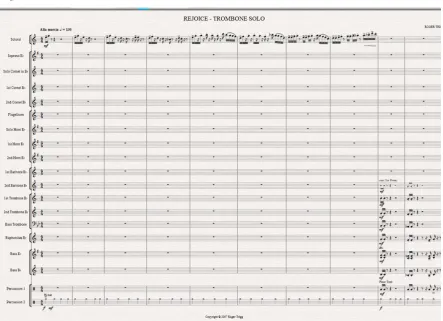
[image:29.595.87.531.439.760.2]The solo is set in a Latin-jazz style and includes some references to music from Bernstein’s West Side Story. I was privileged to play this solo with the Melbourne Staff Band in 2010 and have been a friend of Roger Trigg’s since meeting him in New York, back in 1999. Roger sent me the Sibelius file so that I could make any necessary changes, but the piece worked really well in its entirety without any alternations. The whole piece is based around the opening statement shown in figure 9.
Song of Joy by Andrew Mackereth
[image:30.595.91.549.360.683.2]Andrew’s earliest musical training was gained through the Salvation Army. By the time he had learnt to play the trombone at around 14, he was already keenly interested in every aspect of music, including composition. The trombone solos Andrew was raised on were the staples of that time, which for him included: Concert Piece: Alexandre Guilmant transcribed by Ray Steadman-Allen, Song of Exuberance: Leslie Condon and the Eternal Quest by Ray Steadman-Allen. Through his classical trombone studies Andrew was introduced to the popular works of the time, principally; Hommage à Bach by Bozza, the Rimsky-Korsakov Trombone Concerto and a number of works by Jacques Ed Barat. The opening statement of the solo can be seen in figure 10.
Figure 10
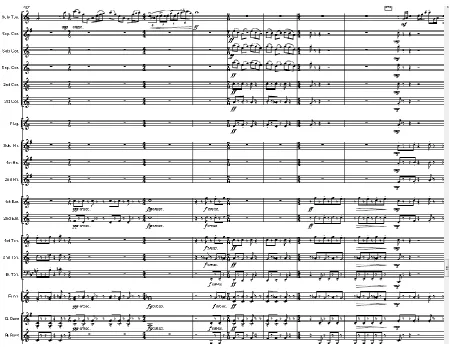
During Mackereth’s music degree he developed a particular appreciation of the music of Stravinsky and Shostakovich and whilst he had not intended that such composers should influence this composition in any way, when looking at the off-beat basses at letter G and again at I, it is apparent that they may have influenced him subconsciously shown below in figure 11.
The work is reminiscent of Spring Rounds from The Rite of Spring and a strong hint of Shostakovich Festival Overture in bars 161-165!” shown below in figure 12.
Figure 12
Thematic Material
Andrew wanted to mirror the choice of thematic material of Song of Exuberance. ‘He loves me Too’ is a long-since forgotten melody and lyric, more familiar to church goers of a bygone era. It has the same pentatonic and repetitive nature of the Trusting Jesus Now which features in the former.
Lyrics:
God sees the little sparrow fall, It meets His tender view; If God so loves the little
birds, I know He loves me, too.
Because He loves the little things, I know He loves me, too.
He paints the lilies in the field, Adds perfume to each bell; If He so loves the little
flowers, I know He loves me well.
God made the little birds and flowers, And all things big and small; He'll not forget His
little ones, I know He loves us all.
Words: Maria Straub Music: S.W. Straub 1874
Form and Structure of Song of Joy:
Andrew states,
“This piece was written as a close relative of Leslie Condon’s Song of Exuberance, a piece recorded and admired by Brett. This informed the choice of chorus, minor key and strongly contrasted middle section. Like Song of Exuberance, unusual rhythmic/harmonic twists are prominent.”
Hope: arranged by Andrew Wainwright
On the 11th June 2010 a nation stood united celebrating a dream come true at the official opening of the FIFA 2010 Soccer World Cup. However, amongst many was emptiness, mourning the death of South Africa’s greatest tenor Siphiwo Ntsehebe.
Ntsehebe was due to lead the opening anthem with his song called ‘Hope’ with words of Nelson Mandela. The Tenor had already recorded the song before he fell critically ill with bacterial meningitis.
He passed away in a hospital in Port Elizabeth, his hometown. Millions of spectators heard the song at the launch of the games, which not only touched the heart of all South Africans united, but the whole world. For the lyrics of ‘Hope’ touch one’s heart and give you a new perspective on life itself.
Your prayer sounds more beautiful than your name you bring the voice of hope to me again
and when you rise to find your dream
see your journey through.
When you find peace in your heart
When we are one beneath the stars
When your spirit wonders on the wind I’m your sanctuary
In your soul you’ll come
Spread thou word indeed. You’ll need hope
There is always hope
when you have a dream …….. Nelson Mandela
The Light has come by Kenneth Downie
In researching this piece Andrew Blyth states it was originally a euphonium duet that was then altered to become a trombone solo in the early 1990s.
Kenneth Downie States:
“The noble tune, main theme is called The Light has come. I felt that this title had a quality which suggested trombone to me. The work is built primarily on a modern hymn by Chick Yuill (not modern in musical language!), a Scotsman, who was a Salvation Army Officer when he wrote it. He is now a freelance preacher and writer, in the Manchester area.”
The opening statement, in a rather declamatory style, comes from the start of Chick's theme. I thought it summoned up the sound of a trombone in my mind. These are the words of his first verse, based on Isaiah 9:6,7:
Wonderful counsellor, Mighty God among us;
Everlasting Father, Prince who rules in peace.
To us a Child is born, To us a Son is giv'n.
In contrast with that, in the slow, quieter music, I use a little Army chorus, whose origins are unknown to me, but one that I remember singing many years ago. They are based on 2 Corinthians 4:6
God hath shined in our hearts,
God hath shined in our hearts,
To bring the light of the glory of the knowledge of God,
In the face of Jesus Christ.
I think it is a beautiful chorus, from a lovely bible verse and I felt it could benefit from being more widely known.
Beneath the Cross of Jesus by Clephane, Maker / Ray Starling arranged by Mark Freeh (tune: St. Christopher)
Beneath the Cross of Jesus was a poem written by Elizabeth Cecilia Clephane in 1868 and published posthumously in the Family Treasury, a Scottish Presbyterian magazine, in 1872 just one year before she died at age 39.
The magazine’s editor wrote:
“These lines express the experiences, the hopes and the longings of a young Christian. Written on the very edge of life, with the better land fully in view of faith, they seem to us footsteps printed on the sands of time, where these sands touch the ocean of Eternity.”
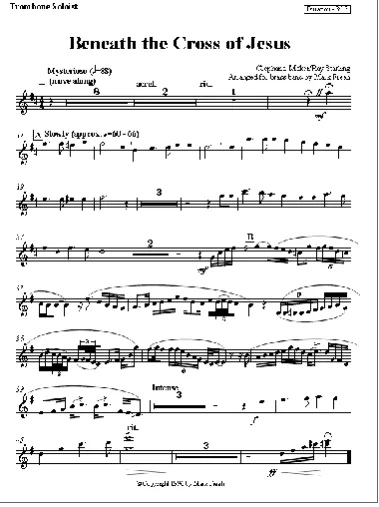
Elizabeth Clephane was born in Edinburgh, Scotland, but lived most of her life in the village of Melrose. The music was written by Frederick C. Maker, and published in the Bristol Tune Book in 1881 as St. Christopher. The solo part is technically very challenging for a slow melody and this can be seen in figure 13.
The words...
Beneath the cross of Jesus I fain would take my stand,
A home within the wilderness, a rest upon the way,
From the burning of the noontide heat, and the burden of the day.
O safe and happy shelter, O refuge tried and sweet,
O trysting place where Heaven’s love and Heaven’s justice meet! As to the holy patriarch that wondrous dream was giv’n, So seems my Savior’s cross to me, a ladder up to Heav’n.
There lies beneath its shadow but on the further side
The darkness of an awful grave that gapes both deep and wide;
And there between us stands the cross two arms outstretched to save
A watchman set to guard the way from that eternal grave.
Upon that cross of Jesus mine eye at times can see
The very dying form of One who suffered there for me;
And from my stricken heart with tears two wonders I confess; The wonders of redeeming love and my unworthiness.
I take, O cross, thy shadow for my abiding place;
I ask no other sunshine than the sunshine of His face;
Content to let the world go by, to know no gain or loss,
[image:36.595.221.411.489.743.2]My sinful self my only shame, my glory all the cross.
His Provision by Ivor Bosanko arranged by Dorothy Gates
[image:37.595.87.558.357.728.2]His Provision is a beautiful song written by Ivor Bosanko. It is well known in Salvation Army circles as a sacred song. It was arranged for trombone solo with piano accompaniment at the request of Gerard Klaucke for his brother Henk in memory of the passing of Henk’s wife, Herma van Dalen, who died aged 64 in 2010. She had translated many songs from English to Dutch and vice versa in the 1980s, including works by Eric Ball and this composition. Herma was the daughter of SA officers and the name van Dalen is well known in the Salvation Army in the Netherlands. This arrangement has a Latin flavour and a slightly faster pace than the original. Figure 14 shows the thematic material taken up by the flugel horn and the soprano before the soloist enters.
The Follower by Martin Cordner
The Follower is inspired by the story of Christian songwriter and poet John Newton. His conversion is captured in what is perhaps the most famous of his writings, the song Amazing Grace - a poem originally entitled Faith's review and expectation. The song is a personal testimony to how, in his own words, Newton once considered himself a 'wretch' but was then, by God's grace, gloriously saved:
“Amazing grace! How sweet the sound, That saved a wretch like me, I once was lost, but now am found; Was blind but now I see”.
John Newton (1725-1807).
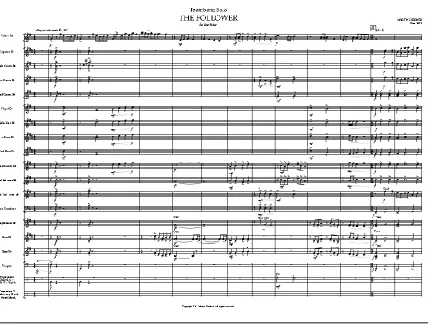
[image:38.595.96.525.342.668.2]Figure 15 shows the opening statement in the new work.
Figure 15
movement (shown in figure 15) features an original melody, noble in style and attempts to capture John Newton as a young man, proudly following in his father's footsteps which leads to the Cadenza shown in figure 16.
Figure 16
The second is a lively scherzo - depicting the wayward adolescent part of Newton's life. The third movement highlights Newton's conversion, the central tune is heard in its entirety for the first time. This section builds to a cadenza (figure 17) which leads to the final celebratory movement where all the aforementioned themes are drawn upon and the central tune sings high and loud.
Figure 17
A recapitulation of the initial 'noble' theme develops into an exciting finale, drawing the piece to a brisk and energetic conclusion.
Still Small Voices (Repton) Arranged by Philip Wilby
Sweet Hour of Prayer by Wilfred Heaton arranged by Paul Hindmarsh
Figure 18
touching arrangement for his son-in-law, Bryan Stobart. This version for brass band was completed in 2005.
He Gave Me Joy by Robert Redhead:
Robert Redhead was asked by Maisie Wiggins (nee Ringham) to write this solo for her to play as a 'tone' solo in the Salvation Army Royal Albert Hall Annual Bandmasters Councils Festival, in 1974 with the composer as piano accompanist. It was rehearsed and rehearsed, to get every little nuance out of the piece. Redhead had never rehearsed so much with one artist. It was amazing and a great lesson in preparing for a performance (Klepke, S. 2014).
Professionally she was the Principal Trombonist in the Halle Orchestra in Manchester of the 1950s, a great orchestra with a fine conductor - Sir John Barbirolli. She was also a fine Salvationist, Songster Leader at Wealdstone in North London for many years. But, in those days was not allowed to play in a 'good' band, as they only allowed men!
Robert Redhead later arranged it for brass band and recorded it with the legendary trombone soloist Robert Merritt and the Canadian Staff Band. The opening statement can be seen in figure 19.
This is a meditative solo based on the concept that there is a depth of joy in Christ which can only be known by the one who has first experienced sorrow for sin. The one who claims Salvation knows a joy beyond anything the world can offer is expressed in this solo He Gave Me Joy based on the words:
'He Gave me Joy where once was woe,
He healed my soul and bade me go,
My bondage never more to know,
Soul Origin by Dorothy Gates
This is a work for trombone quartet and brass band. It was written at the request of the Enfield Band of The Salvation Army specifically for a joint concert featuring guest soloists the trombone quartet Bones Apart in October 2009. Some of the thematic material is derived from the name Bones Apart itself.
However, the main inspiration for the piece is found in scripture, 1 Corinthians 12:13:
"For we were all baptised by one Spirit so as to form one body - whether Jews or Gentiles, slave or free - and we were all given the one Spirit to drink."
Soul Origin explores what is meant by the words ‘one body within the realm of multiple soloists and brass band. The lead trombone part can be seen in figure 20 below.
Life’s Command by Dudley Bright
Life’s Command is based on the chorus; Follow, follow, I will follow Jesus,
Anywhere, everywhere, I will follow on;
Follow, follow, I will follow Jesus,
Everywhere he leads me, I will follow on
Such is the importance of these superficially simple words that the melody never appears in its original form. With the demand for such wholehearted commitment, the theme is transformed, even from the beginning, into music with more gravity.
The soloist’s original theme remains detached from the band’s entreaties, for a while the band takes on and develops the soloist’s theme, and the solo voice avoids any reference to the chorus.
The two themes can easily be identified in various guises and developments, by motivic use of their first few notes. After a period in which the band and soloist compete for attention, the opening music returns and leads to a point where the soloist is left alone in reflection.
The words Jesus spoke the night before his crucifixion are recalled; ‘If you love me, you will keep my commands.’ (John:14:15) and the melody associated with the words:
O, I love him, yes I love him
Since for me he bled and died! O’ I love him, yes I love him
More than all the world beside!
Project 2A:
Salute to Sousa:
and Other Forgotten Trombone Solos
Project 2A:
Salute to Sousa: and other forgotten trombone Solos.
Project two involved research into forgotten trombone solos from the origins of writing for the trombone up to the 1930s and the solos of American Wind Bands.
Influences of Classical and American Wind Band Music:
The German and Austrian solos of the 17th and 18th Century have been a strong influence to me a brass band trombonist, as have the American compositions and performances of the 19th and early 20th century. The classical composers will have influenced the writing of most modern day brass band composers in some way as so influenced also the players of modern day compositions.
Up until 1913, brass band test-pieces were orchestral transcriptions so the movement was and is heavily influenced by the classical music trends. After 1913 we see original works being composed for brass bands by classically trained composers, the movement becomes a genre in its own right and eventually solos are composed or arranged for trombone and brass band. As material was short on supply in the early years it was necessary to borrow compositions from Wind Bands, Orchestras and arrange the popular songs of the period for instrumentalists. Therefore the solos from the ‘golden era’ of Concert Bands in the USA 100 years ago became a huge resource for trombone soloists in the brass band genre.
Arthur Pryor was the most prolific soloist with the Sousa Band from 1892-1903 before setting up his own band where he continued to play and compose solos up to the 1940s. His output has been a major influence on many current trombone soloists due to the sheer number of solo compositions but more importantly his passion for recording his compositions which took place from the 1890s to the 1930s. Many other soloists did not get their solos recorded and often they played from memory so the solo parts did not exist. Until my research many of these other pieces had been forgotten about and never recorded. That said works by Pryor and others virtuosi trombone soloists such as Zimmerman, Mantia, Clarke, Innes, are still played in concerts around the world due to their entertainment value and sheer virtuosity. This is partly due to my own performance practice of showcasing such material with bands around the world in New Zealand, America and Australia and Europe, as well as at International Trombone Festivals in for instance Paris, Las Vegas and New Orleans.
My chosen project was to investigate solos that have been forgotten and overshadowed due to the dominance of Arthur Pryor. There has been very much a trend to record the Pryor works at the expense of other similar composers of the era, as well as virtuosi from earlier periods that have therefore been ignored.
Critical Commentary:
To put the Salute to Sousa project into context it is necessary to explain that the trombone has not always been seen as a solo instrument and much of the more recent change in attitude towards the instrument came about with the introduction of solo recordings by Christian Lindberg in the late 1980s and early 1990s. However not so well known is that the trombone has been a popular solo instrument at several other times in history. Other such periods are explored in this project.
and demonstrates the impressive abilities of the players during that time on what would have been difficult instruments to perform on, based on my experience of playing copies of the original instruments, that are small bore and using uncomfortable mouthpieces.
Trombone use then declined significantly in Europe during the 17th and 18th Centuries, except in Austria, where its popularity and importance grew significantly. Solos began to emerge from composers such as Leopold Mozart, Georg Christoph Wagenseil, Michael Haydn and Johann Albrechtsberger in the form of concertos. The inspiration for many of these composers was no doubt the virtuosic playing of Thomas Gschladt, who worked in the court orchestra at Salzburg, and the renowned trombonists Leopold Christian Senior and Junior (New World Encyclopaedia 2011 / Wigness C.R.1978 P.34). The above pieces written for alto trombone have been performed and recorded extensively in the classical genre and therefore I have chosen to disregard this period for the purposes of this research and subsequent recording.
Following Thomas Gschladt’s decline we see Leipzig and Germany rise to become a centre of trombone pedagogy, during the beginnings of the Romantic period. For instance the trombone began to be taught at the new Musikhochschule in Leipzig founded by Felix Mendelssohn.
It appears that Frederick Belke and Karl Traugott Queisser who both played in the Gewandhaus Orchestra in Leipzig in the 1840’s were the influence for many composers to write for trombone as a solo instrument. The Ferdinand David (1810-1873) Concertino op. 4 has been a staple solo for many years and is believed to have been written for Queisser, and was premiered at the Gewandhaus in 1837. David was the leader of the Gewandhaus Orchestra and a virtuosi soloist himself.
Concertino. Novakovsky was a famous Polish piano virtuoso, who played trombone in his student days. Queisser, during the period 1815-1840 almost single-handedly helped to re-establish the reputation of the trombone in Germany and began a tradition in trombone playing that is still practised there today (W. W. Wells; 2005 p.34).
It is worth noting that the more famous Freidebald Grafe Concertino (1897) and Ferdinand David Concertino (1837) have been played, and recorded with brass band accompaniment by the likes of Andrew Berryman, Principal Trombone of the Halle Orchestra (1988- 2008), with both Wingates Brass Band, the GUS Band. However in contrast Berlioz’s Funeral Oration has never been performed with brass band and maybe is considered not virtuosic enough. The Ferdinand David Concertino was in fact arranged by Leslie Condon for Salvation Army brass bands in the 1980s. As only the second and third movements had been arranged for brass band, Bryan Hurdley arranged a version of the first movement for me in 1994.
In England 200 years ago, few of the English composers in the 18th and 19th Centuries wrote solos for the instrument. This may have been composers’ lack of understanding, but more likely would have been the lack of availability of instrumentalists (Guion D.M. 1998. p.6). This may be why this period did not influence greatly the soloists in the brass band movement 100 years later as very little solo material existed to influence the brass band genre. Although Gustav Holst wrote a test piece for brass band and was making a living as a professional trombonist in the early part of his musical career, his Duet for Trombone and Organ written in 1894. It has never been transcribed for Trombone and brass band, and once again is not a virtuosic solo when compared to the works of Arthur Pryor.
Frederick Innes was the trombonist in the Patrick Gilmore Band (1829-1892) which was in many ways the pre-cursor to the famous Sousa Band. Innes then set up his own band on the West Coast and many of the later trombone soloists were trained in the Innes Band such as Ernest Clarke (1865-1947), brother of the more famous Herbert, and Leo Zimmerman (1866-1935) who later joined the Sousa Band as its soloist after playing with several of the famous band’s including Pryor’s Band (Herbert T. 2006 P.148).
Frank Holton was Pryor’s predecessor in the Sousa Band, playing previously for Barnum and Baileys Circus, but on the appointment of Arthur Pryor he was overshadowed and became more famous for Trombone Manufacturing. Many immigrants went to the USA from Europe and immediately became virtuoso players, such as Simone Mantia (1873-1951). Mantia was Euphonium Soloist with the Sousa band and then assistant conductor with the Arthur Pryor Band, and importantly a trombonist with the Metropolitan Opera. Another example is Charles Cusimano (dates unknown) as Soloist with Sousa in the 1920s, and was also a soloist in the Pryor Band, and played again in the Metropolitan Opera Orchestra, as 1st assistant to Mantia. Others include Fred Jewel (1875-1936) who played with the Ringlng Brothers Circus Band, as well as Barnum and Baileys Circus Band before becoming a conductor and composer. Clay Smith (1878-1930) who was a multi-instrumentalist that soloed on trombone again for the famous circus bands before setting up a publishing company. Manuel Yingling (1872-1925) was another soloist with the Sousa band in the 1920s, and conducted the Hyperion Band. Finally there was Joseph de Luca (dates unknown), who was proficient on Euphonium and trombone and again played for Sousa’s Band. He played in the band from 1921 to 1928 soloing on all the Sousa Tours in that period. Many virtuoso players would play solos written for valve instruments on a slide trombone with ease during this period, partly because many were also valve players (Frye J.W. 2007).
as Tommy Dorsey and Glenn Miller, which again has been widely documented and the decline in popularity of the Wind and Concert Bands.
In summary, for this CD I have resurrected pieces that have been forgotten through the mists of time in the Baroque, Romantic and post American Civil War period.
Methodology & Process:
Finding material for this project has been easier than I thought as a result of trips to Australia, New Zealand and the USA from the period 2008-2012. This allowed me to uncover many solos in band-rooms and libraries all over the world. Some of the initial works found I recorded on several other recording projects such as Phenomenal Polka (written in the 1880s, published in 1942 by Chart Music as a cornet solo) by Frederick Innes (1854-1926) recorded with the Reg Vardy Band on the Freeh Spirit project and also with piano on the recording World of the Trombone Volume Three.
Figure 21
Phenomenal Polka (1942) was discovered as a cornet solo in Wanganui Band in New Zealand and had been rarely played for over 100 years. Valse Moderne (in process to be published) by Gardell Simons (1878-1945) discovered in manuscript by Steve Dillon in 2010. Steve Dillon is owner of Dillon Music in New Jersey, USA, and a speaker and writer on Arthur Pryor and other trombonists from the American Civil war period. Mr Dillon often gets sent material that people believe will be of interest as he is a leading authority on Pryor and discussions with him led to the discovery of Valse Moderne and another solo in manuscript solo called Salute to Sousa (publication in process) by Frank Burnell, the title track of the CD project.
Researching for these forgotten solos led to me reading a paper by ‘Frye’ detailing research on the solos played by trombone soloists in the Sousa Band (Frye J.W. 2007). I spent the next twelve months trying to locate as many of the pieces mentioned in his thesis as possible. Over two hundred and fifty new solos were unearthed so the CD project is a small fraction of the works that I managed to uncover. Since selecting and recording these solos others have come to light.
As well as researching band-rooms across the world, Steve Dillon managed to find several other manuscripts of previously unperformed solos such as Hyperion Polka which was found from an old cinema library archive in the USA. Many of the pieces needed to be reformatted as they were very difficult to read. Fortunately some pieces had library recordings, and these were available online and were used to determine note queries on some of these works for instance with Leona Polka (1903) by Leo Zimmerman (Zimmerman L. Internet Archive 2014).
Programme Notes: Salute to Sousa, with added comments:
La Hieronyma (1621) Giovanni Martino Cesare
Giovanni Martino Cesare (c.1590-16-67) was born in Udine, but worked outside Italy for most of his life. He was a cornettist at the court of the Margrave of Burgau at Günzburg, near Augsburg. He became connected to Duke Maximilian of Bavaria and played in the chapel in Munich in 1612; in 1615 he entered Maximilian’s service. His canzona La Hieronyma (1621) is remarkable in that it was the first piece of music written and published for solo trombone in Italy. Cesare wrote a collection of 28 pieces, written for a combination of instruments; the cornet – Cesare’s instrument - the violin, the trombone, the viola da gamba and the organ as a continuo instrument. Some pieces also feature vocalists. The collection also contains La Bavara for four trombones. Cesare was obviously held in high regard in Bavaria and his music was included in important publications of the time in Munich. Figure 22 shows the more recent Robert King publication.
St. Thomas Sonata (1660s) Anon
The St. Thomas Sonata was written around 1660-1670 and is so called because it was kept in the library of the Saint Thomas Augustinian Monastery, in the Czech Republic and is believed to have been written by a monk. It was discovered by Lubomir Klucar, a highly respected Moravian trombonist and teacher, but brought to the general public’s attention by his former student Jaroslav Kummer in the late 1970s. This piece is important as it is the first piece intended solely for trombone and basso continuo, as opposed to being a trombone solo within a collection of other chamber works. This work has been published twice in recent years (1978 and again in 1999 as the Saint Thomas Sonata).
Concertino (1820) Carl Heinrich Meyer
Little is known of the composer Carl Heinrich Meyer. His Concertino for bass trombone was premiered on April 6th 1815 by Freidrich August Belke and the Leipzig Gewandhaus Orchestra. Seven further performances with the Gewandhaus Orchestra took place with the soloist Karl T. Queisser and a set of parts was published in 1831. The piece contains a lively theme and variations, after a stately introduction.
Figure 23 Meyer Concertino Figure 24 Novakovsky Concertino
Concertino for Trombone and Piano (1840) Joseph Novakovsky (1805-1865)
Novakovsky was a famous Polish piano virtuoso, who had played trombone in his student days. This work was published posthumously by Fischer as both Theme and Variations and Concertino. The piece was probably also influenced by virtuosi trombonist Queisser. Figure 24 shows the first page of the work and birth and death years.
Sea Shells Waltz (1880s) Frederick Neil Innes
It has been said that Innes did for the trombone what the great Paganini did for the violin. As the latter created a school of violinists, Innes did likewise for trombone players; his trombone exercises and various tutors became the panacea for all budding trombonists. Innes was born in London, England, on October 28th 1854. As a young man he believed that the trombone should take a more prominent place as a solo instrument. He was always an innovator, even in his later advent into the musical society of America, where he arrived in 1874 to Boston. From 1875-1879, Innes toured Europe playing with various bands and orchestras, before returning to Paris, where he resumed playing at the Folies Bergère.
In 1879, Jules Levy was at his peak as a cornet soloist and was being featured with Gilmore’s Band at Manhattan Beach. Pat Gilmore was slightly jealous of the attention Levy was getting, so he sailed for Europe in the autumn of 1879, in quest of someone to “trim the sails” of the high-flying Levy. When he arrived in Paris, he was told of a young trombonist who was playing at the Folies Bergère. Quoting a written account
“Gilmore went to the Folies Bergère to hear Innes play, and was astonished by this young man’s virtuosity…As Gilmore was very convincing, it wasn’t long before Innes came to America to become trombone soloist of Gilmore’s Band.”
It was during this period that Levy played a new solo written by Aronson, entitled the Sweet Sixteen Waltz, in which Levy injected his own extemporaneous cadenza made up of everything he could do on the cornet. lnnes had been tipped off that Levy was going to do this. When his turn came to play, he also had something up his sleeve. Innes had written a new solo for the trombone, entitled Sea Shells Waltz, with a cadenza that lasted a minute and a half. Some of Levy’s followers had complained to the management about this rivalry. Mr. Gilmore decided that Innes could play anything he wished, including Levy’s solos, but it was to be played on separate programs from Levy. Unlike Arthur Pryor, few of Fred Innes’ solos were published and when they were published it was often as a cornet solo, such as Phenomenal Polka. Eventually, Innes set up his own band on the West Coast and many prolific soloists played in the Innes band before making names as soloists, including Leo Zimmerman, Simone Mantia, Ernest Clarke (brother of Herbert) and Chas Randall.
The Sweetest Story Ever Told (1894) R M Stults
The ornate covers for such printed songs can be seen in figure 26. This song from the 1880s also became popular with trombone soloists. Charles Stacey was a soloist with the Long Beach Band, who, unfortunately, is famous for dropping dead whilst playing this melody in 1926 (Herbert, T. 2006 p.148).
Harbor Lights (1914) Clay Smith
Clay Smith’s first documented musical activity involved playing E-flat cornet solos for exhibits at the 1893 Chicago World's Fair. At some point he became proficient on the saxophone and trombone, which seems to have been his primary instrument for most of his career. His teachers included Alfred F. Weldon (1862-1914), Gardell Simons (1878-1945) and Hale A. VanderCook (1864-1949). He performed with several famous bands, such as the bands of Hi Henry's Minstrels, Wallace Brothers Circus, the Barnum and Bailey Circus and the Ringling Brothers Circus. He was also a featured trombone soloist at the 1904 St. Louis World's Fair with Phinney's Band (Barnhouse Website 2014).
With Guy E. Holmes, Smith formed the Apollo Concert Company, which toured on a vaudeville circuit. Around 1914, he set up the Smith, Spring and Holmes Concert Company, which made several recordings.
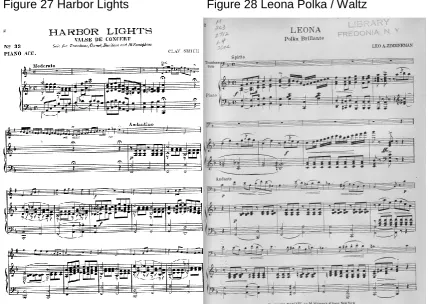
Figure 27 Harbor Lights Figure 28 Leona Polka / Waltz
Leona Waltz (1915) Leo Zimmerman
This piece was also known as Leona Polka as shown in figure 28 above. Leo Zimmerman was the trombone soloist with John Philip Sousa's Band after Arthur Pryor left the group. Zimmerman served as Sousa's first chair and trombone soloist from 1904-07 and also returned to the band for a brief stint in 1930-31. He had also played in the Innes band. One interesting fact about Leo Zimmerman is that he played with no vibrato (Zimmerman L. Internet Archive), which would have been in stark contrast to the trombone playing of Pryor (Crystal Records CD451). On losing such a prolific soloist as Pryor, Sousa was determined to find a headline soloist.
Dreams. Others solos that he composed but have not been found include Patriotic Melody, Waltz Caprice, Pride of the West and Aereo (Frye J. W. 2007).
Priscilla Polka (1921) by Simone Mantia
[image:60.595.88.531.361.684.2]Although more well-known today for his euphonium solos, Mantia was a very fine trombone player, having played in the Metropolitan Orchestra in New York and as trombone soloist, filling in for Pryor when he conducted the Sousa band in the absence of Sousa himself. Pryor invited Mantia to become his assistant conductor in 1903 at his newly formed “Pryor Band”. This rarely played trombone solo was a tribute to Sousa’s daughter, named Priscilla. Figure 29 shows the front cover of the solo that was for cornet and Euphonium and trombone, whilst figure 30 shows the main theme at letter A.
Devotion (1934) by Ernest Clarke
[image:61.595.139.478.319.758.2]Ernest Clarke played trombone in the Gilmore band and encouraged his more famous brother, Herbert, to join the band when a vacancy arose. In 1892, the Gilmore Band disbanded and Herbert joined the famous Sousa band, whilst still making appearances in both the Innes and newly reformed Gilmore band, under Victor Herbert. It appears that Ernest joined Innes’ band when the Gilmore band disbanded and he is most famous for his books of studies now rather than his trombone solos. This simple melody is a very different piece to the polkas of the day. Figure 31 shows the tune present in this solo which is very simple.
Salute to Sousa (1930s) Frank Burnell
[image:62.595.132.494.276.751.2]Frank Burnell played in Professor E. L. Weinn’s Orchestra, which in 1904 was a 10-piece group. He also played in the Sousa band on 2nd trombone after this period. The piece is very reminiscent of an Arthur Pryor solo and difficult to say the least. It was discovered as a manuscript on the desk of Steve Dillon, of Dillon Music, in New Jersey in 2011 and may not have been performed until this recording. The manuscript first page can be seen in figure 32.