Particle methods for a virtual patient
Buckley, O, Hughes, CJ, John, N and Pop, S
Title
Particle methods for a virtual patient
Authors
Buckley, O, Hughes, CJ, John, N and Pop, S
Type
Conference or Workshop Item
URL
This version is available at: http://usir.salford.ac.uk/id/eprint/50053/
Published Date
2009
USIR is a digital collection of the research output of the University of Salford. Where copyright
permits, full text material held in the repository is made freely available online and can be read,
downloaded and copied for noncommercial private study or research purposes. Please check the
manuscript for any further copyright restrictions.
1st International Conference on Mathematical and Computational Biomedical Engineering – CMBE2009 June 29 – July 1, 2009, Swansea, UK P. Nithiarasu and R. Löhner (eds)
PARTICLE METHODS FOR A VIRTUAL PATIENT
Oli Buckley
Bangor University, [email protected]
Chris Hughes
Bangor University, [email protected]
Nigel W. John
Bangor University, [email protected]
Serban Pop
*Bangor University, [email protected]
ABSTRACT
The particle systems approach is a well known technique in computer graphics for
modelling fuzzy objects such as fire and clouds. The algorithm has also been applied to
different biomedical applications and this paper presents two such methods: a charged
particle method for soft tissue deformation with integrated haptics; and a blood flow
visualization technique based on boids. The goal is real time performance with high
fidelity results.
Key Words:
Particle systems, boids, blood flow, soft tissue, virtual environments.
1.
INTRODUCTION
There is a growing trend to develop simulators for training a variety of medical procedures as there are obvious advantages to be gained from enabling training on a virtual patient instead of on real patients. Mistakes can be made without risk, different patient physiologies can be used, a variety of pathologies can be modelled and the trainee can practice as many times as they need. The challenge of a medical simulator is therefore to provide real time interaction (with 3D graphics and haptics interfaces) whilst maintaining a fidelity that is high enough to ensure that face, content and construct validity can be achieved in the training process. The Medical Graphics group at Bangor has been developing solutions to address this challenge, with a particular focus on interventional radiology (IR) procedures. This paper presents two novel ways in which we are using the well known particle systems algorithm in this work.
A particle system is a technique used in computer graphics to create certain fuzzy phenomena that are otherwise difficult to model [1]. Particle systems have been used to great effect in a wide variety of applications to model fire, water, clouds, etc. The technique has also been extended to model large collections of boids that exhibit emergent behaviour as a result of each boid following a simple set of rules, e.g. a flock of birds or a school of fish [2]. Within medical simulation, blood flowing from wounds, smoke and other effects have already been modelled with particle systems, e.g. [3, 4]. The algorithm has also been adapted for surface reconstruction and so applied to construct skeletal surfaces and organ interaction [5]. For the modelling of muscles, oriented particles were introduced to simulate elastic surfaces by using attraction-repulsion forces or virtual springs to model interactions between particles [6, 7]. However, the
integration of realistic tissue properties into particle models is not a trivial task. Previous work with particles has not included support for a force model that can be used with haptic feedback devices, which is an important requirement in a simulation of an IR procedure. In addition, we need to be able to accurately visualise the blood flow within an artery, e.g. for the dissipation of an injected contrast agent into the blood stream. The use of particle systems for modelling blood has not addressed blood flow within this context.
2.
MODELLING PHYSIOLOGY WITH PARTICLE SYSTEMS
The hypothesis of this research is that particle systems techniques can be used and adapted to provide an effective real time implementation for some of the key physiological processes that we need to model in a virtual patient. We demonstrate this by focussing on two important areas required in an IR procedure simulation: soft tissue deformation of skin and internal organs; and blood flow through a (possibly diseased) artery.
2.1 Charged Particle Method for Tissue Deformation with Haptics
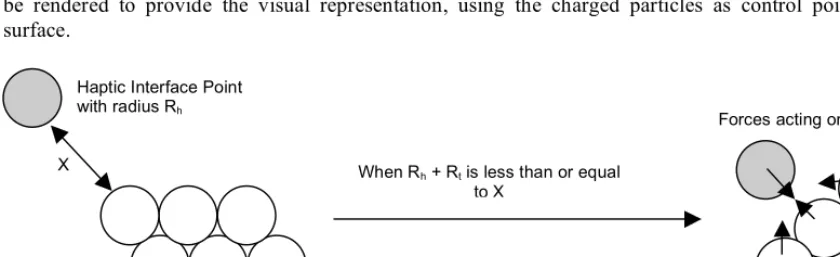
[image:3.595.82.502.473.601.2]Traditional soft tissue deformation methods are based on Finite Element Modelling (FEM) or a Mass Spring Model (MSM). A typical FEM solution e.g. [8], usually offers a deformation model that provides high levels of realism but at a high computational cost. This means that the simulation will either not provide real time interaction, particularly with haptics, or will require an expensive pre-processing step. Conversely a soft tissue model that uses a MSM [9] will trade off the quality of results attained for real time interaction. MSM and FEM are both mesh-based approaches, and the resolution of the mesh will also have an implication on the performance of any simulation. Cutting or re-structuring of soft tissue will require new elements to be created and the mesh to re-calculated, both of which are costly to implement. Our Charged Particle Model (CPM) [10] provides a visually and haptically realistic simulation that runs on a standard desktop machine, and also provides the ability to both deform and restructure soft tissue. Each particle within a CPM surface is given a notional electro-magnetic charge, and the haptic interaction point (HIP) is also given the same charge. Then the charged particles and the HIP are governed by the rules of electro-magnetic interaction i.e. like charges will repel and opposite charges will attract. As the charged particles and HIP have a like charge, once the HIP is within is a given distance of the particle surface, the surface will then deform accordingly (see Figure 1) with neighbouring particles moving to take up stress and slack within the surface in a method similar to that used in the ChainMail Model [11]. Multiple HIPs are also supported in the CPM, which provides support for different shaped tools. A Bezier surface can then be rendered to provide the visual representation, using the charged particles as control points for the surface.
Figure 1: As the HIP, the shaded disc, moves closer to the particles which represent the soft tissue to be deformed then
under the rules of electromagnetic interaction the particles are repelled accordingly
Results achieved using the CPM demonstrates that real time deformation with haptics can be achieved. We typically use around 6000 charged particles and 250,000 points in a Bezier surface, and run at over 30 frames per second.
Haptic Interface Point
with radius Rh
Soft Tissue made up of Particles with radius Rt
When Rh + Rt is less than or equal
to X X
2.2 Blood Flow Visualization using Boids
Simulation of blood flow is essential to interventional radiology simulators, such as the injection of contrast medium whilst using fluoroscopy. However, the blood flow generally plays a supporting role and must appear to behave realistically in real time. The flow does not need to be accurately computed in this case, which due to its complexity represents a challenge for conventional methods of simulation, even at a macroscopic scale (flow in arteries, veins). We therefore propose a new computer simulated model to visualize blood flow in arteries using boids [12].
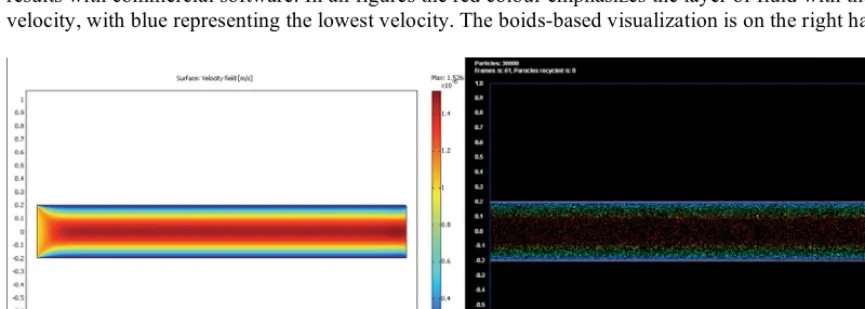
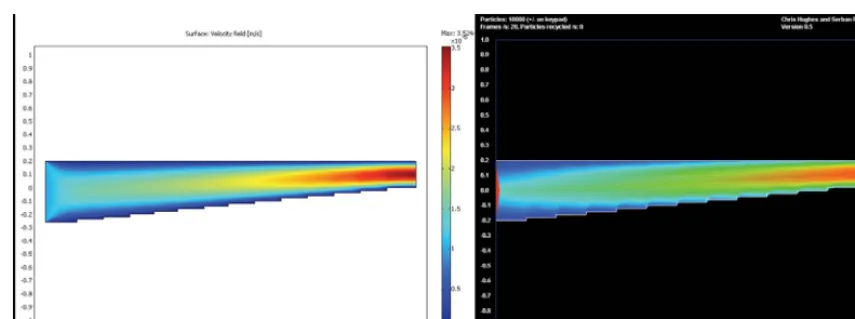
[image:4.595.51.484.361.515.2]The boids individual properties (separation, alignment, cohesion) cannot be used to describe individual particles of fluid; however their group behaviour, flocking, matches the characteristics of laminar flow (collision avoidance, velocity matching, flock centering) and it is suitable for modelling channel flows. Due to their nature, a model based on boids algorithm can be used for visualization purposes only; hence our method is compared with existing fluid particle based simulation, only qualitatively not quantitatively. Our model is based on the idea the each layer of fluid behaves as a flock, interconnected by the parameters which govern the flow dynamics. At the macroscopic level blood is seen as a Newtonian fluid and can be represented with a particle system. Many similarities with existing particle dynamics systems for fluids are kept (kernel function in SPH is replaced by the flock neighbourhood; however the search for nearby particles is done in the same way). In order to conserve mass properly we keep constant the number of particles inside the domain during the entire simulation. Each particle carry its own physical quantity as mass, speed, position, which means that we have control over the entire fluid’s main physical parameters. The results are compares with many existing benchmarks (non-uniform channel flows, with or without obstacles). The following benchmark comparisons (Figures 2 and 3) have been generated to compare our results with commercial software. In all figures the red colour emphasizes the layer of fluid with the highest velocity, with blue representing the lowest velocity. The boids-based visualization is on the right hand side.
3.
CONCLUSIONS
In this paper we have shown that we are able to deform and restructure a Charged Particle Model, that is both visually and haptically realistic and able to be run in real time on a standard desktop machine. We have also shown a particle model which enables the visualization of fluids flow in tubes with non-uniform radius considering also fluid interactions with stationary objects. In our simulations the trade of is accuracy for speed. The method can be successfully use in complex haptic simulators where the “real-time” aspect of the model is essential.
The research hypothesis is shown to be true for the above examples and particle systems techniques can indeed be used and adapted to provide an effective real time implementation for some of the key physiological processes that we need to model in a virtual patient. We are now working on further applications based on these techniques, for example, the simulation of Doppler ultrasound visualization effects.
REFERENCES
[1] W.T. Reeves, Particle Systems—a Technique for Modeling a Class of Fuzzy Objects. ACM Trans. Graph. 2, 2 (Apr. 1983), 91-108. 1983
[2] C.W. Reynolds, Flocks, Herds, and Schools: A Distributed Behavioral Model, Computer Graphics, 21(4), 25-34, 1987
[3] J. Brown, S. Sorkin, J.-C. Latombe, and K. Montgomery, Algorithmic Tools for Real-Time Microsurgery Simulation, Medical Image Analysis, vol. 6, no. 3, 289 – 300, 2002
[4] M. Agus, A. Giachetti, E. Gobbetti, G. Zanetti, and A. Zorcolo, Adaptive techniques for real time haptic and visual simulation of bone dissection, IEEE Virtual Reality Conference, 102 – 109, 2003 [5] M. Amrani, B. Crespin, and B. Shariat, Skeletal implicit surface reconstruction and particle system for organ's interactions simulation, Geometric modeling: techniques, applications, systems and tools, 172–192, 2004
[6] R. Szelinski and D. Tonnesen, Surface Modeling with Oriented Particle Systems, Computer Graphics, 26(2), 185-194, 1992.
[image:5.595.77.505.65.225.2][7] L.P. Nedel, D. Thalmann, Real Time Muscle Deformations using Mass-Spring Systems, Computer Graphics International (CGI'98), 156-165, 1998
[8] M. Bro Nielsen and S. Cotin, Real-time Volumetric Deformable Models for Surgery Simulation using Finite Elements and Condensation, Computer Graphics Forum, Volume 15 Issue 3, pp 57- 66, 1996
[9] Nedel L. P., Thalmann D.: Real Time Muscle Deformations using Mass-Spring Systems, p. 156, Computer Graphics International 1998 (CGI'98), 1998
[10] O. Buckley and N.W. John, Efficient Soft Tissue Modelling Using Charged Particle Control Points, Eurographics 2008 Short Paper, Crete, ISSN 1017-4656, 191-194, 2008
[11] Gibson S. F.: 3D ChainMail: A Fast Algorithm for Deforming Volumetric Objects, Proceedings of Symposium on Interactive 3D Graphics, pp 149 – 154, 1997