Mobile IPv4 based procedure for loose
coupling architecture to optimize
performance in heterogeneous wireless
networks
Khattab, OAO and Alani, OYK
Title
Mobile IPv4 based procedure for loose coupling architecture to optimize
performance in heterogeneous wireless networks
Authors
Khattab, OAO and Alani, OYK
Type
Article
URL
This version is available at: http://usir.salford.ac.uk/id/eprint/37505/
Published Date
2013
USIR is a digital collection of the research output of the University of Salford. Where copyright
permits, full text material held in the repository is made freely available online and can be read,
downloaded and copied for noncommercial private study or research purposes. Please check the
manuscript for any further copyright restrictions.
Mobile IPv4 Based Procedure for Loose Coupling
Architecture to Optimize Performance in
Heterogeneous Wireless Networks
Omar Khattab and Omar Alani
School of Computing, Science & Engineering University of Salford
Greater Manchester- M5 4WT,UK
[email protected] , [email protected]
Abstract— One challenge of wireless networks integration is the ubiquitous wireless access abilities which provide the seamless handover for any moving communication device between the different types of technologies (3GPP and non-3GPP), such as GSM (Global System for Mobile Communication), Wireless Fidelity (Wi-Fi), Worldwide Interoperability for Microwave Access (WiMAX), Universal Mobile Telecommunications System (UMTS) and Long Term Evolution (LTE). This challenge is important as mobile users (MUs) are becoming increasingly demanding for services regardless of the technological complexities associated with it. To fulfill these requirements for seamless Vertical Handover (VHO) two main interworking architectures have been proposed by European Telecommunication Standards Institute (ETSI) for integration between the different types of technologies; namely, loose and tight coupling. On the other hand, Media Independent Handover IEEE 802.21 (MIH) is a mechanism which has been proposed by IEEE group to provide seamless VHO between the aforementioned technologies by utilizing these interworking architectures to facilitate and complement its work. The paper presents the design and analysis of a Mobile IPv4 (MIPv4) based procedure for loose coupling architecture with MIH to optimize performance in heterogeneous wireless networks. Analytical results show that our procedure provides seamless VHO with minimal latency and low packet loss ratio.
Keywords- Vertical Handover (VHO), Media Independent Handover (MIH), Interworking Architectures, Heterogeneous Wireless Networks.
I. INTRODUCTION
With the advancement of wireless communication and computer technologies, mobile communication has been providing more versatile, portable and affordable networks services than ever. Therefore, the number of Mobile Users (MUs) communication networks has increased rapidly as an example; it has been reported that “today, there are billions of mobile phone subscribers, close to five billion people with access to television and tens of millions of new internet users every year” [1] and there is a growing demand for services over broadband wireless networks due to diversity of services which can’t be provided with a single wireless network anywhere anytime [2]. This fact means that heterogeneous environment of wireless networks, such as GSM (Global
System for Mobile Communication), Wireless Fidelity (Wi-Fi), Worldwide Interoperability for Microwave Access (WiMAX) and Universal Mobile Telecommunications System (UMTS) will coexist providing MU with roaming capability across different networks. One of the challenging issues in Next Generation Wireless Systems (NGWS) is achieving seamless Vertical Handover (VHO) while roaming between these technologies; therefore, telecommunication operators will be required to develop a strategy for interoperability of these different types of existing networks to get the best connection anywhere anytime. To fulfill these requirements of seamless VHO two main interworking architectures have been proposed by European Telecommunication Standards Institute (ETSI); namely, loose and tight coupling for integration between the different types of technologies (3GPP and non-3GPP). On the other hand, Media Independent Handover IEEE 802.21 (MIH) is a mechanism which has been proposed by IEEE to provide seamless VHO between different technologies by utilizing the above interworking architectures to complement its work. In the literature there are many procedures which have been presented to provide seamless VHO applied in conjunction with Mobile IPv4 (MIPv4) and Mobile IPv6 (MIPv6) based MIH [2, 3, 4, 6 and 10]; to achieve low latency and packet loss during VHO. In this paper we present and analysis a MIPv4 based procedure for loose coupling architecturewith MIH to optimize performance in heterogeneous wireless networks. Results of our procedure show that it can provide a seamless VHO with minimal latency and low packet loss ratio compared to that in the literature.
The rest of the paper is organized as follows: section II overviews VHO procedure, MIH mechanism and interworking architectures. In section III, our procedure is presented. In section IV, analysis of the procedure is presented and finally, we conclude the paper in section V.
II. VERTICAL HANDOVER PROCEDURE
The mechanism which allows the MUs to continue their ongoing sessions when moving within the same Radio Access Technology (RAT) coverage areas or traversing different
RATs is named Horizontal Handover (HHO) and VHO, respectively. In the literature most of the research papers divided VHO procedure into three phases: Collecting Information, Decision and Execution, e.g. [5, 7] as described below.
a) Handover Collecting Information
In this phase, all required information for VHO decision is gathered, some related to the user preferences (e.g. cost, security), network (e.g. latency, coverage) and terminal (e.g. battery, velocity).
b) Handover Decision
In this phase, the best RAT based on aforementioned information is selected and the handover execution phase is informed about that.
c) Handover Execution In this phase, the active session for the MU will be maintained
and continued on the new RAT; after that, resources of old the RAT are eventually released.
A. Media Independent Handover (MIH)
The IEEE group has proposed IEEE 802.21 standard Media Independent Handover (MIH) to provide a seamless VHO between different RATs [8, 9]. IEEE 802.21 defines two entities: first, Point of Service (PoS) which is responsible for establishing communication between the network and the MU under MIH and second, Point of Attachment (PoA) which is the RAT access point. Also, MIH provides three main services: Media Independent Event Service (MIES), Media Independent Command Service (MICS) and Media Independent Information Service (MIIS) [10], this is shown in Fig.1.
b) Media Independent Information Service (MIIS) It is responsible for collecting all information required to identify the need for handover and provide them to MUs, e.g. available networks, locations, capabilities, cost, etc. [11].
c) Media Independent Command Service (MICS) It is responsible to issue the commands based on the information which is gathered by MIIS and MIES, e.g. MIH handover initiate, MIH handover prepare, MIH handover commit and MIH handover complete [11].
B. Overview on Interworking Architectures
The NGWS will consist of heterogeneous wireless access networks, such as UMTS, Wi-Fi, WiMAX and LTE, these different RATs have significant different capabilities in terms of supported data rate, coverage area, mobility, cost, etc. For example, The UMTS provides high coverage area, high cost and low data rate from 144 Kbps to 2 Mbps at 10 Km/h to maximum 500 Km/h depending on propagation channel, while Wi-Fi provides low coverage area, low cost and high data rate from 1 Mbps to 54 Mbps at 30 m to maximum 450 m [12]. Therefore, complementarity of these technologies through interworking architectures is essential to provide ubiquitous wireless access abilities with high coverage area, high data rate and low cost to MUs. Consequently, the challenge would be the ability to move MUs seamlessly between these different types of wireless technologies.
The two main interworking architectures found in the literature are [13, 14 and 15]; these are discussed next.
a) Media Independent Event Service (MIES)
It is responsible to report the events after detecting, e.g. link up on the connection (established), link down (broken), link going down (breakdown imminent), etc. [11].
a) Loose Coupling.
In loose coupling architecture, each of the existing access wireless networks, such as UMTS, Wi-Fi and WiMAX is independently deployed. Both of WiMAX and Wi-Fi data do not pass through 3rd Generation Partnership Project (3GPP) core network this in turn means, there is no need to modify any architectural change, no additional cost and the interworking point occurs after 3GPP core network in particular, follow Gateway GPRS Support Node (GGSN) with internet. Also, the networks interconnection in this architecture based on MIP as for roaming service the Authentication, Authorization and Accounting server (AAA) connects between different RATs which allows the Wi-Fi and WiMAX data go directly to the internet without requiring for direct link between their components and 3GPP core network [16].
b) Tight Coupling.
[image:3.595.42.289.472.680.2]In tight coupling architecture, the Wi-Fi and WiMAX data pass through 3GPP core network before going to the internet and significant modifications of existing access wireless networks are necessary for providing seamless service to the MU to move from one network to another [17], this in turn impacts the 3GPP core network performance in terms of complexity, congestion and packet loss due to the overload.
The networks interconnection in this architecture is based on the existing 3GPP core network functionalities (e.g., core network resources, subscriber databases and billing systems) that ensure MUs to continue their ongoing sessions when moving within different RATs. There are two types of tight coupling [18]:
1. Tight Coupling Integration at GGSN Level. 2. Tight Coupling Integration at the RNC Level.
1) Tight Coupling Integration at GGSN Level.
In this architecture, all of the RATs are connected together by Virtual GPRS Support Node (VGSN) which is responsible to exchange subscriber information and route packets between the wireless access networks, the handover duration (latency) is equivalent with loose coupling where MIP is used (no need of MIP functionalities) and it requires less complexity modification in 3GPP core network [16].
2) Tight Coupling Integration at the RNC Level. In this architecture, Access Point (AP) and Base Station (BS) in Wi-Fi and WiMAX respectively are connected with Radio Network Controller (RNC) by Interworking Unit (IWU). The IWU main functionality is to translate protocol and signalling exchange between RNC and another RATs interface, such as AP and BS [18].
III. THE PROPOSED PROCEDURE
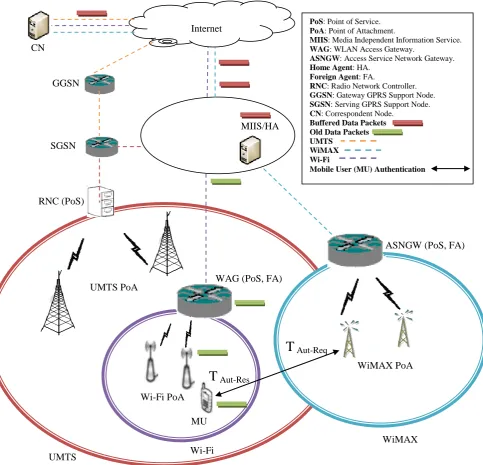
As conclusion from the above overview; loose coupling seems to supersede tight coupling for the majority of the compared characteristics. However, loose coupling suffers from handover latency and packet loss during VHO between heterogeneous wireless networks, such as Wi-Fi, WiMAX and UMTS. To solve these problems, we propose a procedure of loose coupling which could be applied in conjunction with MIPv4 based MIH mechanism and considering handover from Wi-Fi to WiMAX, as shown in Fig.2. We suggest using loose coupling over tight coupling interworking architecture because the mobility management for loose coupling is based on MIP, probability of packet loss due to overload in 3GPP core network is less than tight coupling, handover duration is equivalent to tight coupling at GGSN level when MIP is used and the modifications of existing access wireless networks are not necessary whereas in tight coupling are required. Home Agent (HA) is collocated with MIIS [2, 8], whereas Foreign Agents (FAs) are deployed in WLAN Access Gateway (WAG) and Access Service Network Gateway (ASN GW) in the Wi-Fi and WiMAX networks, respectively. The PoS location is inside the access wireless network for each RAT gateway i.e. WAG, ASN GW and RNC in Wi-Fi, WiMAX and UMTS, respectively. The PoA is located inside Node-B, AP and BS for UMTS, Wi-Fi and WiMAX, respectively. Each of existing access wireless networks (UMTS, Wi-Fi and WiMAX) is independent deployed and the Wi-Fi and WiMAX data do not pass through 3GPP core network. The common area between all RATs consists of MIIS/HA server. The MIIS
is responsible for collecting all information required to identify the need for handover and provide them to MUs for selecting target RAT, e.g. availability of PoAs, locations of PoAs, capabilities of PoAs such as emergency services, cost, etc. After selecting the target RAT (WiMAX PoA) and its resources availability have been checked by the Admission Control (AC) at WiMAX PoS, the new data packets which are sent by Correspondent Node (CN) server will be buffered by MIIS/HA server. This will achieve the following: a) reduced time interval in which the MU does not receive any packets as a result of handover (latency) and b) low packet loss ratio due to the MU makes use of data buffering period in MIIS/HA server to receive target RAT by Wi-Fi PoA and start its authentication with WiMAX PoA to obtain Care of Address (CoA). After that, Update/Acknowledge binding message notifies HA about the new CoA to start sending the buffered data and continuing the session within target RAT. Finally, the resources are released by MIH after completion of sending the buffered data.
IV. ANALYTICAL MODELING
In our analysis, we consider three VHO procedures between Wi-Fi and WiMAX, the performance of which have been evaluated in the literature these are: Proxy MIPv6 (PMIPv6), Proxy First MIPv6 (PFMIPv6) and IEEE 802.21-enabled PMIPv6 [6]. We compare our procedure with the above procedures in terms of handover latency and packet loss.
a) Latency
Vertical Handover Latency (VHL) is the time taken for a MU to obtain a new IP address from a target network and register itself with HA [19] during which the MU does not receive any packets as a result of handover. Latency is the main cause of packet losses during handover so it needs to be minimized [20].
In the PMIPv6 procedure, the MU attached to WiMAX after MU was detached from Wi-Fi and Source-Mobile Access Gateway (S-MAG) simultaneously sent Proxy Binding Update (PBU) with the lifetime value of zero to Local Mobility Anchor (LMA). The VHL of PMIPv6 procedure is given by (1) [6]:
VHLPMIPv6=2(TMAG-LMA)+TL2+4(TDOMAIN-AAA)+TMU-AN
+TAN MAG
Where TMAG-LMAis the latency between MAG and LMA, TL2 is the latency from when MU is detached from AP to when MU is attached to BS, TDOMAIN-AAAis latency between entities in PMIPv6-Domain and AAA/MIIS server, TMU-ANis latency between MU and AP/BS and TAN-MAG is latency between AP/BS and MAG.
In the PFMIPv6 procedure, the bi-directional tunnel between S-MAG and Target-MAG (T-MAG) utilized for sending and receiving handover initiate and handover acknowledge messages. The VHL of PFMIPv6 procedure is given by (2) [6]:
VHLPFMIPv6=2(TMAG-LMA)+TL2+2(TDOMAIN-AAA)+TMU-AN
+TAN-MAG
In the IEEE 802.21-enabled PMIPv6 procedure, the VHL was reduced compared with PMIPv6 and PFMIPv6 procedures because the layer 2 (L2) attachment process and the AAA process at T-MAG and LMA occurred before MU was detached from Wi-Fi. The VHL of IEEE 802.21-enabled PMIPv6 procedure is given by (3) [6]:
VHL802.21 = 2(TMAG-LMA)+TMU-AN+TAN-MAG
In our procedure, after resources availability have been checked by the AC at WiMAX PoS, concurrent notification informs both of MIIS/HA server to start buffering and Wi-Fi PoS to pass selected target RAT to Wi-Fi PoA; after that, the Wi-Fi PoA sends target RAT to MU for handover.
The MU makes use of data buffering period in MIIS/HA server to start/end authentication messages with WiMAX PoA
at T Aut-Req(Time of authentication request) and TAut-Res (Time
[image:5.595.53.537.64.529.2]of authentication respond) to obtain CoA, whereas the old data packets are still sent to the MU from CN server at the old IP address. After that, Update/Acknowledge binding message
Figure 2: Our procedureof loose coupling based on MIPv4 with MIH
PoS: Point of Service.
PoA: Point of Attachment.
MIIS: Media Independent Information Service.
WAG: WLAN Access Gateway.
ASNGW: Access Service Network Gateway.
Home Agent: HA.
Foreign Agent: FA.
RNC: Radio Network Controller.
GGSN: Gateway GPRS Support Node.
SGSN:Serving GPRS Support Node.
CN: Correspondent Node.
Buffered Data Packets Old Data Packets UMTS
WiMAX Wi-Fi
Mobile User (MU) Authentication
UMTS PoA
MU
WiMAX PoA
ASNGW (PoS, FA)
UMTS Wi-Fi
WiMAX
T
Aut-ReqWi-Fi PoA
WAG (PoS, FA)
T
Aut-ResRNC (PoS) GGSN
SGSN
Internet
CN
MIIS/HA
notifies HA about the new CoA to start sending the buffered data and continuing the session within target RAT. This will achieve the following: a) reduced latency and b) low packet loss ratio. The VHL in our procedure is given by:
VHLMIPv4=TUB+TBA
Where the TUB is latency of binding update and TBA is latency of binding acknowledgment with HA. Such that the registration time with HA is given by (5) [21] and can be expressed as:
VHLMIPv4=2(Sctrl/Bwl)+2(Lwl)+Px
Where Sctrlis average size of a control message, Bwl is bandwidth of the wireless link, Lwlis latency of the wireless link and Pxis router or agent route lookup latency and packet processing latency.
b) Packet loss
Equation (6) shows percentage of the number of packet loss with respect to the total packet sent, while MU receiving downlink real time IP packets taking into account VHL from the equations (1), (2), (3) and (5). It does not depend on the downlink bit rate or the length of the session. It depends on cell residence time and the time taken to discover and complete a MIP registration where Pkt_loss is percentage of packet loss, Tagt_advis mean period at which AP/BS sends agent advertisement over the wireless link and tcellis value of cell residence time [21].
(Pkt_loss)= (1/2 * Tagt_adv + VHL) / tcell
c) Analytical results of our procedure
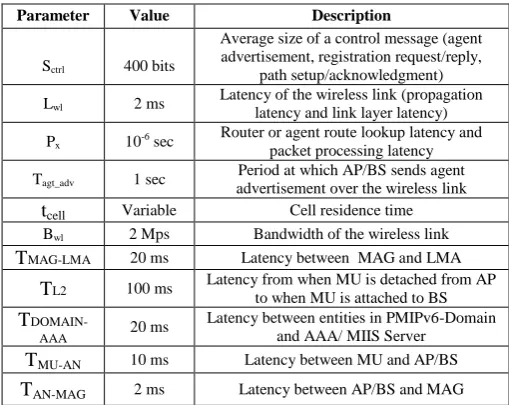
Based on the analysis above, we evaluate and compare our procedure against three other procedures found in the literature in terms of handover latency and packet loss: PMIPv6, PFMIPv6 and IEEE 802.21-enabled PMIPv6. Parameters values used in this evaluation are adopted from [6, 21] as shown in Table 1.
The results of equations (1), (2) , (3) and (5) are shown in Fig.3 for VHL in PMIPv6, PFMIPv6, IEEE 802.21-enabled PMIPv6 and our procedure, respectively, it shows that our procedure has scored a minimum latency of (4.4x10⁻³ sec) compared with other procedures. This is because the MU makes use of data buffering period in MIIS/HA server to start/end authentication messages with WiMAX PoA to obtain CoA. This means the time for registration with HA will represent the VHO latency (VHLMIPv4).
The results of equation (6) are shown in Fig.4. It illustrates our procedure with a minimum and maximum packet loss ratio of (50.4x10⁻⁴) and (50.4x10⁻³) respectively, due to the reduced latency (VHLMIPv4) achieved by buffering of data in MIIS/HA server as shown in Fig.3.
V. CONCLUSION
[image:6.595.307.562.248.389.2]In this paper, we have overviewed two main interworking architectures: loose coupling and tight coupling. Also, we have described MIH mechanism which provides seamless VHO between different RATs by utilizing the aforementioned interworking architectures to facilitate and complement its work. Finally, we have presented and analyzed a MIPv4 based loose coupling procedure with MIH for providing optimized
[image:6.595.306.560.413.571.2]Figure 4: Comparisons of vertical handover procedures performance (packet loss)
Table 1: Input parameters for performance evaluation
Parameter Value Description
Sctrl 400 bits
Average size of a control message (agent advertisement, registration request/reply,
path setup/acknowledgment)
Lwl 2 ms
Latency of the wireless link (propagation latency and link layer latency)
Px 10-6 sec Router or agent route lookup latency and
packet processing latency
Tagt_adv 1 sec Period at which AP/BS sends agent
advertisement over the wireless link
tcell Variable Cell residence time
Bwl 2 Mps Bandwidth of the wireless link
TMAG-LMA 20 ms Latency between MAG and LMA
TL2 100 ms Latency from when MU is detached from AP to when MU is attached to BS
T
DOMAIN-AAA 20 ms
Latency between entities in PMIPv6-Domain and AAA/ MIIS Server
TMU-AN 10 ms Latency between MU and AP/BS
TAN-MAG 2 ms Latency between AP/BS and MAG
(6)
Figure 3: Comparisons of vertical handover procedures performance (latency)
[image:6.595.37.292.510.712.2]performance in heterogeneous wireless networks. Results of our procedure have shown that it could provide seamless VHO with minimal latency and low packet loss ratio. In future work we plan to simulate our procedure and evaluate the system performance.
REFERENCES
[1] Our vision: Committed to connecting the world. ( 04/08/2011). International Telecommunication Union (ITU). Retrieved 5 Jan ,2012, from http://www.itu.int/en/about/Pages/vision.aspx.
[2] Angoma, B.; Erradi, M.; Benkaouz, Y.; Berqia, A.; Akalay, M.C.; , "HaVe-2W3G: A vertical handoff solution between WLAN, WiMAX and 3G networks," 7th International Wireless Communications and Mobile Computing Conference (IWCMC), 4-8 Jul 2011, pp.101-106. [3] Frei, S.; Fuhrmann, W.; Rinkel, A.; Ghita, B.V.; , "Improvements to
Inter System Handover in the EPC Environment," 4th IFIP International Conference on New Technologies, Mobility and Security (NTMS),7-10 Feb 2011, pp.1-5.
[4] Capela, N.; Soares, J.; Neves, P.; Sargento, S.; , "An Architecture for Optimized Inter-Technology Handovers: Experimental Study," IEEE International Conference on Communications (ICC), 5-9 Jun 2011, pp.1-6.
[5] Louta, M.; Zournatzis, P.; Kraounakis, S.; Sarigiannidis, P.; Demetropoulos, I.;,"Towards realization of the ABC vision: A comparative survey of Access Network Selection," IEEE Symposium on Computers and Communications(ISCC), 28 Jun 2011-1 Jul 2011, pp.472-477.
[6] Heecheol,S.; Jongjin,K..; Jaeki,L.; Hwang,S.L.;,"Analysis of vertical handover latency for IEEE 802.21-enabled Proxy Mobile IPv6," 13th International Conference on Advanced Communication Technology (ICACT), 13-16 Feb 2011, pp.1059-1063.
[7] Zekri, M.; Jouaber, B.; Zeghlache, D.;,"Context aware vertical handover decision making in heterogeneous wireless networks," IEEE 35th Conference on Local Computer Networks (LCN),10-14Oct 2010, pp.764-768.
[8] Neves, P.; Soares, J.; Sargento, S.;,"Media Independent Handovers: LAN, MAN and WAN Scenarios," IEEE GLOBECOM Workshops, 30 Nov 2009 –4 Dec 2009, pp.1-6.
[9] Lampropoulos, G.; Salkintzis,A.K.;Passas,N.;,“MediaIndependent Handover for Seamless Service Provision in Heterogeneous Networks,”
IEEE Communication Magazine, vol. 46, no. 1, Jan. 2008, pp.64-71. [10] Marquez-Barja, J.; Calafate, C.T.; Cano, J.-C.; Manzoni, P.;,"Evaluation
of a technology-aware vertical handover algorithm based on the IEEE 802.21 standard," IEEE Wireless Communications and Networking Conference (WCNC), 28-31Mar 2011, pp.617-622.
[11] IEEE 802.21 Tutorial. (2006).IEEE 802.21. Retrieved 5Jan ,2013, from http://www.ieee802.org/21/.
[12] Haji, A.; Ben Letaifa, A.; Tabbane, S.; , "Integration of WLAN, UMTS and WiMAX in 4G,"16th IEEE International Conference on Electronics, Circuits, and Systems (ICECS),13-16Dec 2009, pp.307-310. [13] Nguyen-Vuong,Q.-T.;Agoulmine,N.; Ghamri-Doudane, Y.;, "Terminal-controlled mobility management in heterogeneous wireless networks,"
IEEE Communication Magazine, vol.45, no. 4, Apr 2007, pp. 122- 129. [14] Lampropoulos,G.;Passas,N.; Kaloxylos,A.; Merakos,L.;, "A Flexible
UMTS/WLAN Architecture for Improved Network Performance", special issue on "Seamless Handover in Next Generation Wireless Mobile Networks",Springer Wireless Personal Communications Journal, vol. 43, no. 3, Nov. 2007, pp. 889 - 906.
[15] Kassab, M.; Bonnin,J.M.; Belghith, A.;, " Technology integration Framework for fast and low cost handovers-case study:WiFi –WiMAX network," Journal of computer systems, networks, and communications, Hindawi publishing corporation ,vol.2010, no.9, Jan 2010 ,pp.1-21. [16] Ronald,B.(2009). Integration of Heterogeneous Wireless Access
Networks.Ekram,H (ED), Heterogeneous Wireless Access Networks
Architectures and Protocols (1-18). US:Springer.
[17] Xu,F.; Zhang, L.; Zhou, Z.; , "Interworking of Wimax and 3GPP networks based on IMS [IP Multimedia Systems (IMS) Infrastructure and Services]," IEEE Communications Magazine, vol.45,no.3,Mar2007, pp.144-150.
[18] Benoubira, S.; Frikha, M.; Tabbane, S.; , "Hierarchical mobile IPv6 based architecture for heterogeneous wireless networks interworking,"
IEEE 3rd International Conference on Communication Software and Networks (ICCSN), 27-29 May 2011, pp.422-426.
[19] Haseeb, S.;Ismail, A.F.;, “ Handoff latency analysis of mobile IPv6 protocol variations,” Computer Communications, vol. 30, no. 4, 26 Feb 2007, pp. 849-855.
[20] Liyan,Z.; Li Jun.;Z.; Samuel,P.(2011). Performance Analysis of Seamless Handover in Mobile IPv6-based Cellular Network. Agassi;.M (ED). Cellular Networks - Positioning, Performance Analysis,
Reliability (1-26). InTech,
[21] Stephane, A. Aghvami, A.H., "Fast Handover Schemes for Future Wireless IP Networks: a Proposal and Analysis, " IEEE. Vehicular Technology Conference, 2001. vol.3, May 2001, pp.2046-2050.
AUTHORS
Mr. Omar Khattab is a Ph.D. student at the Department of Computing, Science and Engineering at Salford University, UK. He received MSc in Computer Information System, BSc in Computer Science and Diploma in Programming Language 2005, 2003 and 2000 respectively. He has seven years of teaching experience in Networks,
Computer Science and Information Technology. He has obtained a lot of international professional certificates in the
field computer networks. He is Microsoft Certified Trainer. His current research area is Computer Networking and Data
Telecommunication.
Dr. Omar Alani received his PhD degree in Telecommunication Engineering from De Montfort University, UK in 2005. He is currently a lecturer of telecommunications at the School of Computing, Science & Engineering, University of Salford in the UK. His research interests include Radio
resource management and location/mobility management in next generation mobile communication systems, diversity and adaptive modulation techniques as well as Ad hoc networks.
![Figure 1: Media Independent Handover (MIH) [11]](https://thumb-us.123doks.com/thumbv2/123dok_us/8715815.882955/3.595.42.289.472.680/figure-media-independent-handover-mih.webp)