Artificial Bee Colony algorithm using Structured
Swarm
Rajesh Rajaan
Computer Science Department
Abstract: Swarm Intelligence is a meta-heuristic approach in the field of nature inspired techniques that is used to solve optimization problems. It is based on the collective behaviour of social creatures. Social creatures utilize their ability of social learning to solve complex tasks. The swarm intelligence based algorithms which have emerged in recent years includes ant colony optimization (ACO), particle swarm optimization (PSO), bacterial foraging optimization (BFO), artificial bee colony optimization (ABC) etc. In ABC each bee stores candidate solution and modifies its candidate over time stochastically, based on the best solution found by neighboring bees and based on the best solution found by the bee its own experience. When tested over various benchmark function and real life problems, it has performed better than a few evolutionary algorithms and other search heuristics. However ABC, like other probabilistic optimization algorithms, has inherent drawback of premature convergence or stagnation that leads to loss of exploration and exploitation capability. In recent years, many researchers focus and suggested various optimization algorithms based on swarm intelligence. Therefore; this report resented a modified ABC. In the proposed strategy, search process in ABC is performed by smaller group of independent swarms of bees. A new control parameter named perturbation rate (pr) also introduced in the employed bee phase which control the perturbation in the food positions explore by employed bees. The experiments show that the proposed strategy has better diversity and faster convergence than the basic ABC.
Keywords: Swarm intelligence, Artificial Bee Colony, Structured swarm.
1. INTRODUCTION
Swarm intelligence is a subset of artificial intelligence that
studies about the social behavior and emergent properties of
complex system with social structure. Such type of system
consists of simple interactive agents unionized in small
societies or swarm. Although is no central control, the
aggregated behavior of whole swarm exhibits quality of
intelligence i.e. decision making capacities. The algorithms
which have emerged in recent years includes ant colony
optimization (ACO) [6], particle swarm optimization (PSO)
[12], bacterial foraging optimization (BFO) [14], artificial bee
colony optimization (ABC) [9] etc. This section provides
brief introduction of swarm intelligence based algorithms and
problem solved by the algorithms is reported. It also covers
the literature review done to solve the problem efficiently. In
section 1.1 brief introductions of ABC is given.
1.1 Artificial Bee Colony
The artificial bee colony (ABC) is new optimization
algorithm which can be de-fined under swarm intelligence.
Artificial bee colony algorithm is inspired by social behavior
of natural honey bees. ABC is introduced by Karaboga in
2005[9]. With reference to ABC, the potential solutions are
food sources of honey bees. The fitness is determined in terms
of the quality (nectar amount) of the food source. The total
numbers of bees in the colony are divided into three groups:
Onlooker Bees, Employed Bees and Scout Bees. Numbers of
employed bees or onlooker bees are equal to the food sources.
onlooker bees are those bees that stay in the hive and use the
information gathered from employed bees to decide the food
source. Scout bee searches the new food sources randomly.
Similar to the other population-based algorithms, ABC is an
iterative process.
ABC process requires cycles of four phases: Initialization
phase, Employed bees phase, Onlooker bees phase and Scout
bee phase. Each of the phase is explained as follows:
i. Initialization of the population
Initially, ABC generates a uniformly distributed initial
population of SN solutions where each solution xi(i= 1, 2, ..., SN) is a D-dimensional vector. Here D is the number of variables in the optimization problem and xi represent the ithfood source in the population. Each food source is generated as follows:
xij=xminj+rand[0, 1](xmaxj−xminj) (1.1)
Where xminjand xmaxjare bounds of xiin jthdirection and rand[0, 1] is a uniformly distributed random number in
the range [0, 1].
ii. Employed bee phase
In employed bee phase, employed bees modify the
current solution based on the information of individual
experience and the fitness value of the new solution
(nectar amount). If the fitness value of the new source is
higher than that of the old source, the bee up dates her
position with the new one and discards the old one. The
position up date equation for ithcandidate in this phase is
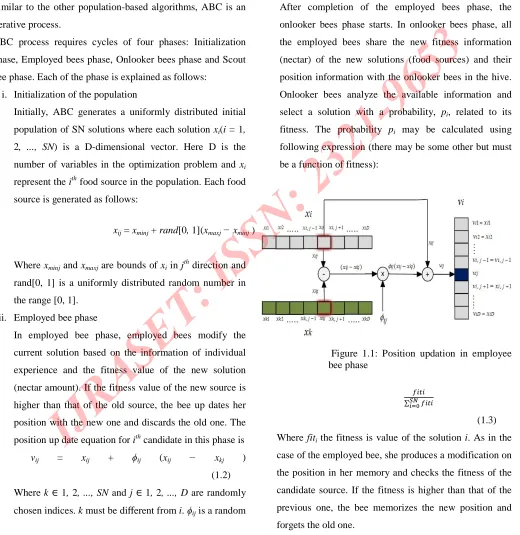
vij = xij + ϕij (xij − xkj ) (1.2)
Where k∈1,2, ..., SNand j∈1,2, ..., Dare randomly chosen indices. kmust be different from i. ϕijis a random
number between [-1, 1]. Figure (1.1) shows the position
update process in the Employed bee phase.
iii. Onlooker bee phase
After completion of the employed bees phase, the
onlooker bees phase starts. In onlooker bees phase, all
the employed bees share the new fitness information
(nectar) of the new solutions (food sources) and their
position information with the onlooker bees in the hive.
Onlooker bees analyze the available information and
select a solution with a probability, pi, related to its fitness. The probability pi may be calculated using following expression (there may be some other but must
be a function of fitness):
Figure 1.1: Position updation in employee bee phase
(1.3)
Where fitithe fitness is value of the solution i. As in the case of the employed bee, she produces a modification on
the position in her memory and checks the fitness of the
candidate source. If the fitness is higher than that of the
previous one, the bee memorizes the new position and
[image:3.612.52.572.160.695.2]iv. Scout bees phase
If the position of a food source is not up dated up to
predetermined number of cycles, then the food source is
assumed to be abandoned and scout bees phase starts. In
this phase the bee associated with the abandoned food
source becomes scout bee and the food source is replaced
by a randomly chosen food source within the search
space. In ABC, predetermined number of cycles is a
crucial control parameter which is called limit for abandonment. Assume that the abandoned source is xi. The scout bee replaces this food source by a randomly
chosen food source which is generated as follows:
xij=xminj+rand[0, 1](xmaxj−xminj), for j ∈1, 2, ..., D (1.4)
2. LITERATURE REVIEW
2.1 Related Work
Artificial Bee Colony (ABC) algorithm is established by
Karaboga in 2005 [9]. Since its inception, a lot of research has
been carried out to make ABC more and more efficient and to
apply ABC for different types of problems. The whole
performance of the ABC algorithm has been compared with
genetic algorithm (GA) [8], differential evolution, particle
swarm inspired evolutionary algorithm (PS-EA) [11],
evolutionary algorithm (EA) and PSO. PSO, ABC and DE
algorithms were studied for measuring the effect of search
space scaling in [5] .In order to get rid of the drawbacks of
basic ABC, researchers have improved ABC in many ways.
Qingxian and Haijun [7] in 2008 proposed a modification in
the initialization scheme by making the initial group
symmetrical, and for selection instead of roulette wheel
selection, Boltzmann selection mechanism was employed for
improvement in the convergence ability of the ABC
algorithm.
To improve the exploitation capacity of the onlooker bee
stage, Tsai et al. in 2009 introduced the concept of Newtonian
law of universal gravitation in the onlooker bee phase of the
basic ABC algorithm in which onlookers are selected based
on a roulette wheel (Interactive ABC, IABC) [14].
A modified version of the Artificial Bee Colony algorithm are
introduced and applied for efficiently solving real-parameter
optimization problems by Bahriye Akay and Dervis Karaboga
in 2010[1] by applying two search parameters such as
perturbation frequency and magnitude of the perturbation.
G. Zhu and S. Kwong [15] proposed an improved ABC
algorithm called gbest guided ABC (GABC) algorithm by
using the information of global best (gbest) solution into the
solution search equation of ABC to improve the exploitation.
In 2010, Turkay Derelia and Gulesin Sena Das [5] proposed a
hybrid bee(s) algorithm for solving container loading
problems. In the proposed algorithm, a bee(s) algorithm is
hybridized with the heuristic filling procedure for the solution
of container loading problems.
In [10], Karaboga presented an extended version of ABC for
constrained optimization problems. He applied it to train
neural networks, to medical pattern classification and
clustering problems [4] and to solve TSP problems.
Bilal Alatas in 2010 [2] proposed new modified ABC
algorithms that use chaotic maps to improve the convergence
characteristics and to prevent the ABC to get stuck on local
optima. For this chaotic number generators has been used
each time a random number is needed by the original ABC
algorithm.
3. OBJECTIVE AND MOTIVATION
This chapter describes the objective of research and
research, section 3.2 provides the motivation for research and
section 3.3 describes the methodology designed in solving the
problem.
3.1 Objective
Swarm intelligence based algorithms have been gaining much
popularity in re-cent years due to the fact that real world
optimization problems have become increasingly large,
complex and dynamic. The size and complexity of the
problems nowadays require the development of methods and solutions whose efficiency is measured by their ability to find acceptable results within a reasonable amount of time, rather
than an ability to guarantee the optimal solution. The main
objective of our research is:
• To study the behavior of different swarm intelligence based
algorithms.
• To check whether modification can be done on algorithm
by tuning of control parameter, hybridizing two algorithms or
introducing new control parameter.
3.2 Motivation
The exploration and exploitation are very important
phenomenon for the population based optimization
algorithms, such as DE, PSO, ABC, and so on. It is clear from
the solution search equation of the ABC that the new food
position is generated by directing the old one towards a
randomly selected food position’s from the swarm. However,
in this process there is equal chance to skip the global
minima, to get a good food solution and to get a bad one.
Further, the solution search equation is significantly
dominated by a coefficient ϕij which is a uniform random
number in [−1,1]. Therefore, the ϕijimproves the exploration at the cost of exploitation. Hence, the solution search equation
is better at exploration but poor at exploitation.
To set a trade-off between exploration and exploitation
capability of ABC, the search capability of each bee (onlooker
and employed) is guided by a local best food solution which
is the solution having best fitness in the local subgroup. The
updated solution search equation is shown below:
vij=xij+ϕij(xij− xkj) +U(0, 1)(Lj− xkj)
Here, Lj is the jth dimension of local best food solution and
U(0, 1) is a uniform random number between 0 and 1 and remaining symbols have their usual meanings. Further, to
implement the proposed strategy, the swarm is dynamically
divided into subgroups.
In the original ABC, all the bees are influenced from
whole swarm; .therefore, there is a chance to get stuck in a
local minima (stagnation). Therefore, to maintain better
diversity in the search process, the search capability of each
bee (onlooker and employed) is guided by a set of bees
(subgroup). Hence the whole swarm is divided into subgroups
of smaller size in both the phases (onlooker and employed
bees) of the algorithm. Now bees search the food positions by
learning within the subgroup i.e. every bee now influence by
the social behavior of its own group bees. This phenomena
improves local search capability i.e. exploitation in the search
space. It is described in equation (3.1) that in the proposed
strategy, randomly selected food position xkjwill be from the local subgroup of the solution space and Lj will be the local best food position of that subgroup. Next, each subgroup
search independently in the whole search space and size of the
subgroups changes dynamically, hence in the solution search
process, exploration is achieved. So, it is clear from
discussion that a good diversity and fast convergence can be
REFERENCES
[1] B. Akay and D. Karaboga. A modified artificial bee colony algorithm for real-parameter optimization.
Information Sciences, 2010.
[2] B. Alatas. Chaotic bee colony algorithms for global numerical optimization. Expert Systems with Applications, 37(8):5682–5687, 2010.
[3] B. Akay D. Karaboga. Effect of region scaling on the initialization of particle swarm optimization differential evolution and artificial bee colony algorithms on multimodal high dimensional problems. In International Conference on Multivariate Statistical Modelling and High Dimensional Data Mining (Kay-seri, TURKEY), June 1923, 2008.
[4] B. Akay D. Karaboga, C. Ozturk. Training neural networks with abc opti-mization algorithm on medical pattern classification. International Confer-ence on Multivariate Statistical Modelling and High Dimensional Data Min-ing (Kayseri, TURKEY), June 1923, 2008. [5] T. Derelia and G.S. Dasb. A hybrid’bee(s) algorithm’for
solving container loading problems. Applied Soft Computing, 2010.
[6] M. Dorigo and T. Stutzle. Ant colony optimization. the MIT Press, 2004.
[7] D. Haijun F. Qingxian. Bee colony algorithm for the function optimization. Science Paper Online, August 2008.
[8] D.E. Goldberg. Genetic algorithms in search, optimization, and machine learning. 1989.
[9] D. Karaboga. An idea based on honey bee swarm for numerical optimization. Techn. Rep. TR06, Erciyes Univ. Press, Erciyes, 2005.
[10] D. Karaboga and B. Basturk. Artificial bee colony (abc) optimization algorithm for solving constrained optimization problems. Foundations of Fuzzy Logic and Soft Computing, pages 789–798, 2007.
[11] D. Karaboga and B. Basturk. A powerful and efficient algorithm for numerical function optimization: artificial bee colony (abc) algorithm. Journal of Global
Optimization, 39(3):459–471, 2007.
[12] J. Kennedy and R. Eberhart. Particle swarm optimization. In Neural Networks,1995. Proceedings., IEEE International Conference on, volume 4, pages 1942– 1948. IEEE, 1995.
[13] K.M. Passino. Biomimicry of bacterial foraging for distributed optimization and control. Control Systems Magazine, IEEE, 22(3):52–67, 2002.
[14] P.W. Tsai, J.S. Pan, B.Y. Liao, and S.C. Chu. Enhanced artificial bee colony optimization. International Journal of Innovative Computing, Information and Control, 5(12), 2009.
[15] Guopu Zhu and Sam Kwong. Gbest-guided artificial bee colony algorithm for numerical function optimization.