Review Paper to increase the throughput in
WiMax by solving the bottleneck problem of a
network
Bhavya singla1, Nisha2, Taruna Sikka3
1Bhavya singla , P.hd. scholar. (ECE), Suresh Gyan Vihar University, Jagatpura-2Nisha, P.hd. scholar (ECE), Suresh Gyan Vihar University, Jagatpura-India 3Taruna sikka, p.hd. scholar (ECE), Suresh Gyan Vihar University, Jagatpura-India
Abstract - Wi-MAX is a wireless data transmission technology which is used to transmit the data at very high speed over a large distance. The WiMax methodology provides 72 Mega Bits per second without any requirement of physically connected installation. WiMax technology is based on Standard that is IEEE 802.16, it usually also called as Broadband Wireless Access. In WiMax technology data is transmitted through wireless methodology which gives a great technological improvements compare to the other data transmission or broadband access technology. It has a no. of advantage over other transmission technologies, high speed transmission and long coverage area. But, by the huge researcher WiMAX technology is ignored. So it is required to examine the various methods for enhanced the quality of WiMAX in terms of the highest data rate with minimum error. The given study will provide a clear understanding of importance of WiMAX techniques by using OFDM. OFDM enables the best use of available bandwidth and the spectrum to represent a cost efficient network. But in a network there is always the requirement to increase the security and the efficiency or the throughput of a multiuser communication in the OFDM network. The results of the study will be give the idea about the possibility of Enhance of throughput of wimax by using OFDM.
Keywords - Wi-MAX, speed, OFDM, topologies
1. INTRODUCTION OF COMMUNICATION SYSTEM
For transmission of data from one place to another place different modulation technology is used. Basic block diagram is shown in fig. 1 which is given below. Or Communication is defined as “The activity of conveying Information such as (voice, data, pictures or graphs and video) which is originated at one place (source) and sent to another place (destination), that is some distance away from the source”
2. OVERVIEW OF OFDM
The basic strategy in OFDM is to perform on multicarrier modulation method & to split high rate signals into no. of lower rate multiple subsignals than that are transmitted back to back over multiple orthogonal carrier frequency which gives batter performance and benefits over other type of transmission methodology, or traditional single-carrier modulation methodology because it is a better fit with today’s high-speed data requirements and operation in the UHF and microwave spectrum [8]. Orthogonal frequency division multiplexing (OFDM) is one of the multi-carrier modulation (MCM) techniques in which signal is transmitted through multiple carriers.
3. FREQUENCY DOMAIN ORTHOGONALITY
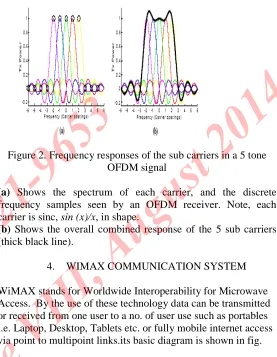
The spectrum analyzed the Orthogonality property of OFDM signals. As shown in fig.2 each sub carrier has a sinc, sin(x)/x, frequency response in frequency domain. This is a result of the symbol time by inversing of the carrier spacing. As far as the receiver is afraid each OFDM symbol transmitted for a fixed time (TFFT) with no tapering at the ends of the symbol. This symbol time corresponds to the inverse of the sub carrier spacing of 1/TFFT Hz 1.The rectangular shape in time domain results in sinc in frequency domain. The sinc has pictorial view with a narrow main lobe and having many side-lobes with slowly decaying with the magnitude of the frequency difference away from the center. Each carrier has a peak at the center frequency and nulls evenly spaced with a frequency gap equal to the carrier spacing.
[image:3.612.315.592.103.460.2]The orthogonal nature of the transmission is a result of the peak of each sub carrier corresponding to the nulls of all other sub carriers. When this signal is detected using a Discrete Fourier Transform (DFT) the spectrum is not continuous as shown in Figure 2 a), but has discrete samples. The sampled spectrum is shown as ‘o’s in the figure. If the DFT is time synchronized, the frequency samples of the DFT correspond to just the peaks of the sub carriers, thus the overlapping frequency region between sub carriers does not affect the receiver. The measured peaks correspond to the nulls for all other sub carriers, resulting in orthogonality between the sub carriers [7].
Figure 2. Frequency responses of the sub carriers in a 5 tone OFDM signal
(a) Shows the spectrum of each carrier, and the discrete frequency samples seen by an OFDM receiver. Note, each carrier is sinc, sin (x)/x, in shape.
(b) Shows the overall combined response of the 5 sub carriers (thick black line).
4. WIMAX COMMUNICATION SYSTEM
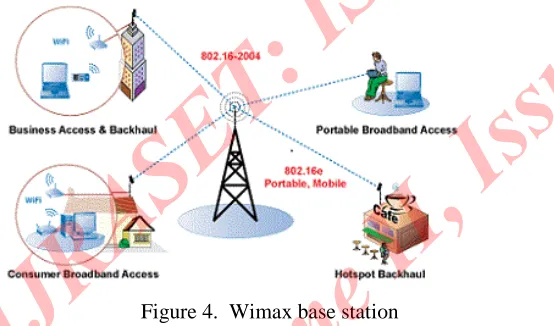
WiMAX stands for Worldwide Interoperability for Microwave Access. By the use of these technology data can be transmitted or received from one user to a no. of user use such as portables i.e. Laptop, Desktop, Tablets etc. or fully mobile internet access via point to multipoint links.its basic diagram is shown in fig.
[image:3.612.310.570.457.600.2]5. MECHNASIUM OF WIMAX
In WiMax for high speed internet connection point to point connectivity is required which is linked by fiber optic cable or microwave but in Point to multipoint connectivity is mesh technology is used but basically point to point antennas is used to connect different base stations and data can be transmitted over a long distance. Base station can serve the customer premise equipment using a point to multipoint connectivity which could be either line of sight (LOS) or non line of sight (NLOS). This figure 1.5 shows the point to multipoint non line of sight connectivity between base station and businesses residential subscriber.
6. DESIGNING OF WIMAX
WiMAX is designed to support high speed broadband services. Usually it has
Two parts:
1. WiMax base station 2. WiMax receiver
1. WiMax base station
[image:4.612.25.302.437.600.2]WiMax base station is similar to a cellular network base station which consists of a WiMax tower and indoor electronics. Base station performs the MAC and PHY features.
Figure 4. Wimax base station
It also handles the signaling and user scheduling. It is also responsible for uplink and downlink bandwidth management on a real time basis and frequency reuse. Following figure 4 and 5
WiMax receiver could be a WiMax enabled computer, PCMCIA card, WiMax modem, mobile internet devices or a standalone box. It works like a Wi-Fi network but in a broader coverage area.
Figure 5. WiMAX Receiver
7. LITERATURE SURVEY
In year 2011, Amir R. Forouzan, Member, IEEE, LeeM. Garth, has proposed “Novel Orthogonal Codes for Spectrally-Encoded OFDM Systems in Fading Channels. In this paper, a novel orthogonal spreading code has been proposed for spectrally-encoded (SE) OFDM, a.k.a., spread-time (ST) OFDM with arbitrary pulse shape. It has been shown that it is possible to retain the orthogonally of the code in the presence of tail truncation by time windowing and in a general multipath fading channel in which users experience different frequency selectivity just by modifying the user code words. Simulation results show that the proposed codes can achieve single user performance when the code length is twice the number of users[1].
conducted. The author of [5] discusses that WiMAX system simulation model is achieved by Simulink first, and then proposes a new frame synchronization algorithm based on IEEE802.16d downlink frame structure. The author of [6] discusses various modulation techniques to improve the data speed of WiMAX.
8. PROBLEM DEFINED
WiMAX is one of the rising wireless data transmission technologies that’s provides a very high speed data transmission over the network. WiMAX networks have an advantages over the other network is security & efficiency. But in wimax technology when data is transmitted by mesh topology where the different nodes are connected in a tree network, a parent node has to perform the multiple inputs and the multiple outputs. This situation is called the bottleneck problem. This bottleneck problem results in network congestion and packet loss. To resolve this problem OFDM data transmission methodology is used.The OFDM gives a dynamic frequency based utilization of the bandwidth. The proposed work will result better efficiency, lower packet loss over the WiMAX network and will improve the Quality Of Service (QOS) by sharing and utilizing the bandwidth efficiently.
9. SIGNIFICANCE OF WORK
As we know a distributed network is required to share the information as well as the resources. Because of this as the number of nodes in the network increases the communication or the load over the network increases. This load increases the congestion that results delayed transmission, packet loss etc. In short we can say as the network traffic increases the QOS decreases. In some topologies this degradation in the QOS is heavy. Such as in tree based topology a centralized node can have heavy traffic over the network. The proposed work will resolve this problem; improve the Quality of Service (QOS) by sharing and utilizing the bandwidth efficiently.
REFERENCES
1. In year 2011, Amir R. Forouzan, Member, IEEE, LeeM. Garth, has proposed “Novel Orthogonal Codes for Spectrally-Encoded OFDM Systems in Fading Channels.
2. Chin-Liang Wang, Yu-Chih Huang and Po-Chung Shen (May 2006). “An Intercarrier Interference suppression Technique using Time Domain windowing for OFDM System”. Vehicular Technology Conference, 2006. VTC 2006-Spring. IEEE 63rd. 5, pp. 2518-2522
3. Eric Phillip Lawrey, “Adaptive Techniques for
multiuser OFDM” Phd Thesis.[Online]
http://www.skydsp.com/resources/OFDM_thesis_lawre y.PDF
4. Marabissi, D.; Tarchi, D.; Fantacci, R.; Balleri, F.Communications, (2008). “Efficient Adaptive Modulation and Coding Techniquesfor WiMAX Systems “IEEE International Conference, pp: 3383 – 3387.
5. Melki, M.; Hamouda, S.; Mohamed, S.O.; Tabbane, S. (2009), "WiMAX sub channelization modes: Performance analysis and spectrum efficiency enhancement”, Communications Magazine, IEEE Volume: 43, pp: 1 –5.
6. Olariu, I.; Obreja, S.; Baraev, A. (June, 2012). “Performance evaluation of a WiMAX mobile network using smart antennas in a simulated environment” in IEEE International Conference on Communications (COMM). pp. 271-274
7. In Year 2004, Ki-Young Han performed a work,” Channel Estimation for OFDM with Fast Fading Channels by Modified Kalman Filter”.