www.ijraset.com Volume 3 Issue IX, September 2015 IC Value: 13.98 ISSN: 2321-9653
International Journal for Research in Applied Science & Engineering
Technology (IJRASET)
©IJRASET 2015: All Rights are Reserved
224
Performance Evaluation of Procedural Cognitive
Complexity Metric on Imperative Programming
Languages
Isola Esther O.1, Sotonwa Kehinde A2
1,2
Computer Science and Engineering Dept., Ladoke Akintola University Of Technology Ogbomoso Oyo State.
Abstract: Software metrics is an acceptable measure of software quality. An improved complexity metric named procedural cognitive complexity metric (PCCM) that consider factors affecting the complexity of a procedural programming languages is applied to a set of sorting algorithms written in different codes. Our intentions are to study which code (C, FORTRAN, BASIC) has less complexity measures for each of the sorting algorithms. The results explicitly revealed that codes that has less cognitive complexity are easier to understand, test and maintain than codes with high cognitive complexity.
Keywords: Software complexity metrics, procedural programming languages, sorting algorithms, variables and Basic control structures.
I. INTRODUCTION
Software system is a set of programs developed with an engineering discipline under consideration of quality with an aim to accomplish many tasks properly. The main distinguishing factor is quality [1]. Thereby, quality is the indispensable fact of a software system. Due to the fact that software systems are complex, life cycle models tend to enable developers to cope with software complexity. Life cycle models expose the software development activities and their dependencies in order to make them more visible and manageable [2]. An acceptable measure of software quality must quantify software complexity. Software metrics attempt to uncover difficult or complex components of a software system. The hypothesis is that complex components are more difficult to understand, hence they are hard to maintain and more prone to error. The ability to quantify the complexity of designs and software is a necessary conditions for the creation of acceptable quality standard and refinement of estimating techniques. Metrics are indicators of complexity, they expose several weaknesses of a complex software system[5]. Therefore, by the means of software metrics quality can be estimated. Hence,the available metric for procedural programming language called procedural cognitive complexity metric ( PCCM) that consider the cognitive characteristics in calculating the complexity of a code is considered. This paper attempts to evaluate the performance of the metric with some sorting algorithms code written in three (3) different procedural languages (C, FORTRAN, BASIC).
II. PROCEDURAL COMPLEXITY
Procedural complexity is associated with the complexity of the logical structure of a program. This approach to complexity measurement assumes that the length of the program (number of logical construction, sequences, decisions or loops) that a program contains determines the complexity of the progam.
A. Procedural Program
Procedural programming is by far the most common form of programming. A progam is a series of instructions which operate on variables it is also known as imperative programming. Procedural programming bears a close relations to the Von Neuman form of computer architecture and early procedural languages were little more complex than assemblers [3]. Examples of procedural programming languages include FORTRAN, C, Pascal, BASIC, Ada. Despite their differences they all share the common characteristics of procedural programming. As a method of design, procedural programming attempts to encapsulate the human problem solving method of carrying out a sequence of operations.
Technology (IJRASET)
The total complexity of a procedural languages is given by the formula:
= ((4∗ + ) + )∗
Where, ANV = Arbitrarily Named Variable MNV= Meaningfully Named Variables
CWU= Cognitive weight of basic control structure
Here, the complexity measure of procedural code (PCCM) is defined as the sum of complexity of its n modules (if exists) and module l consists of mi lines of code. In the context of formula above I, the concept of cognitive weights is used as an integer multiplier, therefore the unit of the PCCM is CWU (Cognitive Weight Unit) which is always a positive integer number.
III. MATERIALS AND METHODS
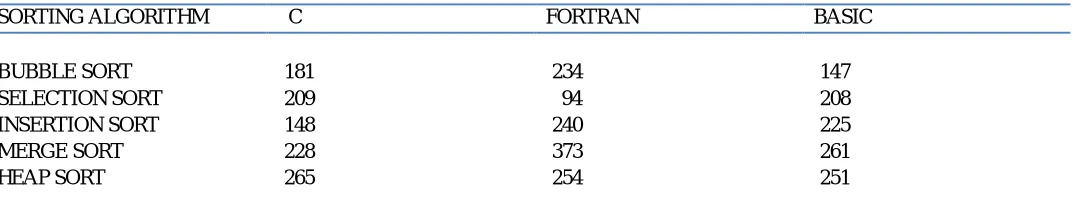
The metric is applied on some sorting algorithms code which are written in C, FORTRAN and BASIC languages, five (5) different types of sorting algorithms codes were considered. These programs were different from each other in their architecture, the calculations of PCCM on C, FORTRAN and BASIC code for these sorting algorithms are given in Table 1.
IV. RESULTS AND DISCUSSIONS
For empirical validation of the PCCM metric, five sorting algorithms code written in C, FORTRAN and BASIC were analyzed. Table 1 contains the statistics that are collected after analyzing the C, FORTRAN and BASIC codes to evaluate the PCCM measure.
SORTING ALGORITHM C FORTRAN BASIC
BUBBLE SORT 181 234 147
SELECTION SORT 209 94 208
INSERTION SORT 148 240 225
MERGE SORT 228 373 261
[image:3.612.42.578.377.487.2]HEAP SORT 265 254 251
TABLE 1: COMPARISON OF THE C, FORTRAN AND BASIC
www.ijraset.com Volume 3 Issue IX, September 2015 IC Value: 13.98 ISSN: 2321-9653
International Journal for Research in Applied Science & Engineering
Technology (IJRASET)
©IJRASET 2015: All Rights are Reserved
[image:4.612.158.459.79.252.2]226
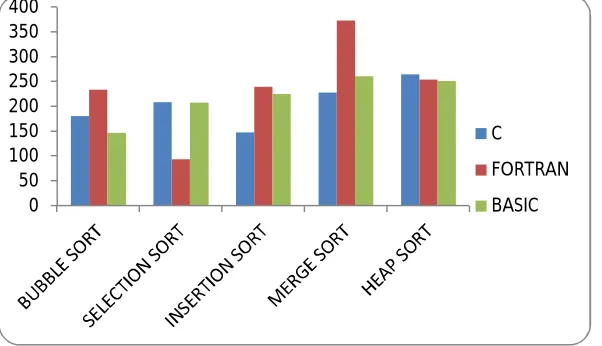
Figure 1: Comparison of C, FORTRAN and BASIC code.V. CONCLUSION
In this study, performance comparison of C, BASIC and FORTRAN code based on complexity metric was carried out using five (5) sorting algorithms. The comparative inspection of the implementation of PCCM has shown that codes that has less cognitive complexity are easier to understand, test and maintain than codes with high cognitive complexity.
VI. ACKNOWLEDGEMENT
We acknowledge God the father, the Son and the Holy Spirit for making this work possible. To God be thy Glory. Our sincere appreciation also goes to the entire staff of the Department of Computer Science and Engineering, LAUTECH, for their encouragements and supports.
REFERENCES
[1] Misra, S. and Akman, I. (2008) : A model for measuring cognitive complexity of software, springerverlag Berlin Heidelberg. [2] Sommerville, I. (2004) : software Engineering, 7th Edition, Addison Wesley.
[3] Aaby and Anthony (2004)
[4] E.O.Isola (2012),’’ An improved software complexity metric for procedural programming languages ‘’, M.Tech thesis Department of Computer Science , LAUTECH, Ogbomoso Nigeria.