Technology (IJRASET)
A Survey on Multiple-Input Multiple-Output Free
Space Optical System
Harmeet Singh1, Amandeep Singh Sappal2
1,2
Department of Electronics and Communication Engineering, Punjabi University, Patiala, India
Abstract— Free space optical communication refers to unguided propagation of information through the use of optical carrier signals such as visible, infrared and ultraviolet bands. This paper presents a survey on an emerging area in the field of free space optical communication i.e. Multiple-Input Multiple-Output Free Space Optical (MIMO-FSO) system. A detailed study has been done on this topic and the work done by various scientists in this area has been presented in this paper. Apart from this, a table presenting the strength and weaknesses of the work done has been added to this paper.
Keywords—Multiple-Input Multiple-Output FSO, repetition coding, space time coding, orthogonal space time block codes, channel state information, intensity-modulation direct detection.
I. INTRODUCTION
The need for communication through distances, to pass information from one place to another, became necessary and the invention of telegraphy brought the world into the electrical communication. The major revolution that affected the world, however, was the invention of the telephone in 1876 [1]. This event has drastically transformed the development of communication technology. Today’s long distance communication has the ability to transmit and receive a large amount of information in a short period of time using optical fiber communication systems.
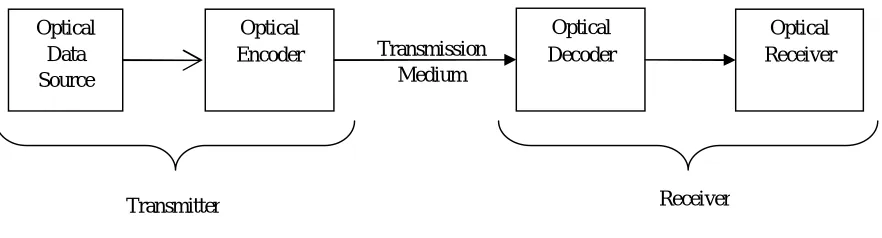
[image:2.612.62.503.449.568.2]Optical communication is a branch of telecommunication in which light is used as signal. Traditionally, the signals through the circuits used to be electrical signals. The need of faster data transfer and large bandwidth became the mother of invention of optical communication, which provides efficient transmission of data over long distances. The basic optical communication system includes optical data source, optical encoder, transmission medium, optical decoder and optical receiver.
Fig.1 Optical Communication system
Fiber optic communication also has some disadvantages. First of all, fiber optic communication requires large amount of revenue. The additional components such as electrical to optical converters and vice versa, add to the system cost. Moreover, installing fiber over large network is a tedious job and requires municipal and government approval to lay the fiber underground by digging along road side and across the road where ever required. It may cause damage to the road. Optical fibers are very delicate, so have to be handled with care. A little more stress may cause damage to the fiber which results in loss of data. The repair of the damaged sectors is very difficult as it would require digging up the location of that sector again.
This led to the invention of Free Space Optics (FSO) which is wireless optical communication system. Along with the solution to a number of above said issues, this technology introduced a number of more advantages and applications. The capital investment for the installation of FSO system is less than a fifth as compared to ground based fiber optic technology. So, it is affordable easily. Moreover, they can be installed much more quickly. Some common applications are metro network extensions, last-mile access,
Optical Data Source
Optical Encoder
Optical Decoder
Optical Receiver
Transmitter Receiver
Simple FSO systems suffer from induced atmospheric turbulence effects which degrade the performance of the system and results in poor received optical power at the receiver. MIMO FSO systems are known to mitigate turbulence-induced fading and significantly improve the performance of the system. This paper focuses on the work done by various researchers in the field of MIMO-FSO and the results are summarized in tabular form.
The rest of the paper is organized as follows: Section II gives the brief introduction of MIMO-FSO system, section III presents the work done by researchers, section IV concludes the paper followed by references.
II. MIMO-FSO SYSTEM
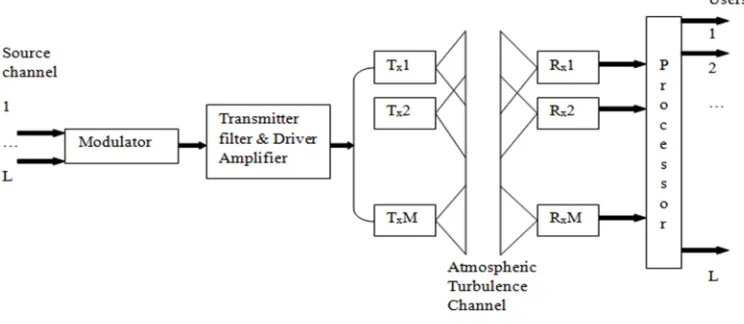
[image:3.612.131.503.274.436.2]Multiple-input multiple-output (MIMO) is a method to multiply the capacity of a communication link using multiple transmit and receive antennas by exploiting multipath propagation. In FSO system, apart from increasing the capacity, the effect of fading can be substantially reduced using MIMO system integrated into FSO with multiple lasers at the transmitter and multiple photo-detectors at the receiver. MIMO FSO system is shown in fig 2.
Fig 2. MIMO FSO System
The incoming signal is modulated using one of the modulation techniques and then passed through filter and amplifier. The final signal is transmitted by multiple transmitters through atmosphere where it faces fading due to turbulence effects caused by scintillation, scattering etc. Finally, the signal is received at receiver by multiple photo-detectors. The received signal is then processed and ultimately used by the user.
III. REVIEW ON MIMO FSO SYSTEM
A number of researchers have worked in the area of MIMO-FSO system. Their work is reviewed and briefed as under:
Technology (IJRASET)
signaling [11]. Garcia-Zambrana (2007) used the modified Alamouti scheme on OOK modulation with any pulse shape [13]. Safari (2008) explained that DC biasing degrades the system performance when using OSTBC scheme as compared to low-complexity RC scheme [14]. He further explained that the difference in their performance increases with increased number of transmitter beams. Khalighi et al (2014) explained non-orthogonal schemes as designed to optimize diversity and coding gain. But at the receiver, optimal detection has high computational complexity. He further added that the information bearing signals can be multiplexed at the transmitter to attain maximum transmission rate at the expense of reduced diversity gain. This phenomenon is called spatial multiplexing. For signal detection at the receiver, optimal maximum-likelihood detection scheme can be used. The drawback of this scheme is the high complexity. Arar et al (2006) gave another method for signal detection using Alamouti code and QR decomposition [15]. Mesleh et al (2011) proposed another non-orthogonal ST scheme, named Optical Spatial Modulation (OSM), in which only one “on” slot is transmitted from multiple beams at a given channel-use, in order to avoid inter-channel interference. The rate of OSM is log2M symbols/channel-use, where M is the transmitting beam [16]. Abou-Rjeily et al (2007) proposed a MIMO transceiver for time-hopping ultra-wideband communication. He used ST coding for binary PPM when the number of transmitter beams is a power of two. In 2008, he extended his work to obtain general PPM modulation for any number of beams used. He also gave orthogonal ST codes that preserve the phase in binary PPM. In 2009, he proposed an ST code for binary PPM that gives minimum-delay, in which data is sent through time delays of the signals transmitted from different beams. In this way, full transmit diversity is achieved ([17]-[20]). Park et al (2011) considered Alamouti ST coding for Subcarrier Intensity Modulation (SIM) with BPSK modulation and gave power series expression for average bit-error rate. He further declared that Alamouti scheme could achieve a high signal-to-noise ratio (SNR) gain of 37 dB in a strong turbulence regime and a high SNR gain of 27 dB in moderate turbulence regime at a BER of 10-6 [21]. Cronie (2010) explained low-density parity-check codes (LDPC) with bit-interleaved coded modulation (BICM) and Multi-level coding which was earlier explained by Djordjevic (2006) [22]. Niu et al (2013) worked on design and performance investigation of MIMO FSO system using BPSK modulation scheme [23]. Kashani et al (2015) provided BER performance based on numerical calculations of integral expressions with improved system performance [24].
The work done by the above researchers has some strength and weaknesses which are explained in tubular form as under:
S.N. Year Author Work Weakness Strength
1 1998 Tarokh et
al
Space-time codes for high data rate wireless communication: performance
analysis and code construction
Decoding complexity comparable to codes used in practice on Gaussian channels.
Low complexity and low error probability at the transmitter.
2 1998 Alamouti
A simple transmit diversity technique for wireless
communications
Computational complexity same as maximal-ratio receiver
combining.
Provide new scheme with two transmit antennas and M receive antennas to
provide diversity order of 2M.
3 1999 Tarokh et
al
Space-time block codes from orthogonal
designs
Only theoretical work done. Lacks experimental work.
Developed codes having a very simple maximum-likelihood decoding algorithm which is only based on linear processing.
4 2005 Wilson et
al
Optical repetition MIMO transmission with multipulse
PPM
Electronic noise such as shot noise of photodetector not
considered.
An optical MIMO system employing multipulse PPM across laser sources, together with ideal photon counting reception from multiple small apertures is
analysed and beneficial effects are obtained.
5 2005 Simon et al
Alamouti-Type Space–Time Coding for Free-Space Optical Communication With
A number of other modifications can be
done.
6 2006 Djordjevic et al
space optical MIMO transmission with Q-ary PPM
over the atmospheric turbulence channel
Optimization can be further done using this
technique.
Q-ary PPM proved to be one of the best modulation techniques in MIMO FSO
7 2006 Arar et al
Efficient Detection Algorithm for
2Nx2N MIMO Systems using Alamouti Code and QR
Decomposition
Investigation done only with bit-error-rate
parameters.
Proposed detection algorithm shows Signal-to-noise ratio increased by 2-6 dB at BER of 10^-4 than MMSE V-BLAST.
Complexity is also less.
8 2007
Garcia-Zambrana
Error rate performance for STBC in free-space optical communications through strong atmospheric turbulence
Results carried out only for OOK scheme.
Reduced duty cycle, increase of the peak-to-average optical power ratio (PAOPR) and improvement in error rate
performance.
9 2007
Abou-Rjeily
A space-time coded MIMO TH-UWB transceiver with
binary pulse position modulation
Investigations with techniques other than
PPM can be carried out.
The proposed encoding scheme can achieve a full transmit diversity order.
10 2008 Cvijetic et
al
Performance bounds for free-space optical MIMO systems
with APD receivers in atmospheric turbulence
Only error probability parameter used.
Used repetition coding to show that multiple transceivers have better performance that single transceivers.
11 2008 Safari et al
Do we really need OSTBCs for free-space optical communication with direct
detection?
Investigation done only with bit-error-rate
parameters.
Investigated that repetition codes outperform OSTBCs.
12 2008
Abou-Rjeily
Space-Time Codes for MIMO Ultra-Wideband Communications and MIMO
Free-Space Optical Communications with PPM
Proposed scheme more complicated.
Proposed scheme having lowcost carrier-less Multiple-Input-Multiple-Output (MIMO) Time-Hopping
Ultra-WideBand (TH-UWB) systems and absence of phase rotation.
13 2009 Bayaki et
al
Performance Analysis of MIMO Free–Space Optical Systems in Gamma–Gamma
Fading
Few parameters discussed.
Provided simple closed–form expressions for the diversity gain and the combining gain of MIMO FSO with repetition coding
across lasers at the transmitter and equal gain combining or maximal ratio
combining at the receiver.
14 2009 Riediger et
al
Fast Multiple-Symbol Detection for Free-Space Optical
Communications
Uses increased number of receivers and hence
higher cost.
Provided an attractive low–complexity mechanism for performing noncoherent
multiple-symbol detection in FSO systems.
15 2009
Abou-Rjeily
Achieving Full Transmit Diversity for PPM Constellations with any Number of Antennas via Double Position and Symbol
Permutations
Few parameters discussed.
Achieved a full transmit diversity order while maintaining unipolar
Technology (IJRASET)
16 2011 Mesleh et
al Optical Spatial Modulation
Complexity more than previous techniques.
Proposed a power and bandwidth efficient pulsed modulation technique for optical
wireless (OW) communication called optical spatial modulation (OSM).
17 2011 Park et al
Average Bit-Error Rate of the Alamouti Scheme in Gamma-Gamma Fading
Channels
Few parameters discussed.
Achieved a high SNR gain of 37 dB in strong turbulence and 27 dB in moderate
turbulence regime.
18 2013 Niu et al
MIMO Architecture for Coherent Optical Wireless
Communication: System Design and Performance
Other modulation techniques can be
invested.
Worked on design and performance investigation of MIMO FSO system using
BPSK modulation scheme.
19 2015 Kashani et
al
On the Performance of MIMO FSO
Communications over Double Generalized Gamma
Fading Channels
Simulative results not provided.
Presented BER performance based on numerical calculations of the integral
expressions. Improved system performance.
IV. CONCLUSION
\In this paper, we have presented a review on multiple-input multiple-output free space optical system. The work done by various researchers and scientists has been presented along with the strengths and shortcomings in their research work. We have tried to present the work since the starting tenure till date in this field which can be useful for developing new research ideas in the field of MIMO FSO. Weaknesses and strengths are presented in tabular form.
REFERENCES
[1] G.P. Agrawal, Fiber-Optic Communication Systems, 4th ed. New York: Wiley-Interscience, 2010.
[2] H. Willebrand and B.S. Ghumman, Free Space Optics: Enabling Optical Connectivity in Today's Network, SAMS Publishing, 2001.
[3] S.G Wilson, M. Brandt-Pearce, Q.L. Cao and M.Baedke, Optical repetition MIMO transmission with multipulse PPM, IEEE Journal on selected areas in communication, Vol 23, pp. 1901-1910, September 2005.
[4] N.Cvijetic, S.G.Wilson and M.Brandt-Pearce, Performanve bounds for free-space optical MIMO systems with APD receivers in atmospheric turbulence, IEEE on selected areas in communications, Vol 26, pp. 3-12, March 2008.
[5] E.Bayaki, R.Schober and R.Mallik, Performance analysis of MIMO free-space optical systems in Gamma-Gamma fading, IEEE transactions on communications, Vol 57, pp. 3415-3424, November 2009.
[6] M.L.B.Riediger, R.Schober and L.Lampe, Multiple-symbol detection for photon-counting MIMO free-space optical communications, IEEE Transactions on wireless communications, Vol 7, pp. 5369-5379, December 2008.
[7] M.L.B.Riediger, R.Schober and L.Lampe, Fast multiple-symbol detection for free-space optical communications, IEEE Transactions on communications,
Vol 57, pp. 1119-1128, April 2009.
[8] B.Vucetic, and J.Yuan, Space-time coding, John Willey & Sons, Inc.,Chichester, England, 2003.
[9] V.Tarokh, N.Seshadri, and A.K.Calderbank, Space-time codes for high data rate wireless communication: performance analysis and code construction,
IEEE transactions on information theory,Vol 44, pp. 744-765, February 1998.
[10] V.Tarokh, H.J.Jafarkhani and A.R.Calderbank, Space-time block codes from orthogonal designs, IEEE Transactions on information theory, Vol 45, pp. 1456-1467, May 1999.
[11] M.K.Simon and V.A.Vilnrotter, Alamouti-type space -time coding for free-space optical communication with direct detection, IEEE transactions on wireless communications,Vol 4, pp. 35-39, January 2005.
[12] S.M.Alamouti, A simple transmit diversity technique for wireless communications, IEEE Journal on selected areas in communications,Vol 16, pp. 1451-1458, August 1998.
[13] A. Garc'ia-Zambrana, Error performance for STBC in free-space optical communications through strong atmospheric turbulence, IEEE communications letters, Vol 11, pp. 390-392, May 2007.
[14] M.Safari and M.Uysal, Do we really need OSTBCs for free-space optical communication with direct detection?, IEEE transactions on wireless communications, Vol 7, pp. 4445-4448, November 2008.
[15] M.Arar and A.Yongacoglu, Efficient detection algorithm for 2nx2n MIMO systems using alamouti code and QR decomposition, IEEE Communications Letters,Vol 10, pp. 819-821, December 20006.
[18] C.Abou-Rjeily, and W.Fawaz, Space-time codes for MIMO ultrawideband communications and MIMO free-space optical communications with PPM, IEEE Journal on Selected Areas in Communications, Vol 26, pp. 938–947, June 2008.
[19] C.Abou-Rjeily, Orthogonal space-time block codes for binary pulse position modulation, IEEE Transactions on Communications, Vol 57, pp. 602–605, March 2009.
[20] C.Abou-Rjeily, Z.Baba, Achieving full transmit diversity for PPM constellations with any number of antennas via double position and symbol permutations, IEEE Transactions on Communications, Vol 57, pp. 3235–3238, November 2009.
[21] J.Park, E.Lee and G.Yoon, Average bit error rate of the Alamouti scheme in Gamma-Gamma fading channels, IEEE Photonics Technology Letters, Vol 23(4), pp. 269–271, April 2011.
[22] I.B.Djordjevic, B.Vasic and M.A.Neifeld, Multilevel coding in free-space optical MIMO transmission with Q-ary PPM over the atmospheric turbulence channel,IEEE Photonics Technology Letters,Vol 18, pp. 1491–1493, 2006.
[23] M.Niu, J.Cheng and J.F.Holzman, MIMO architecture for coherent optical wireless communication: System design and performance, Optical Society of America, Vol 5, pp. 411-420, May 2013.