Technology (IJRASET)
Study of Process Parameters Used in
Wire-electric Discharge Machining
Smita P. Bhise1 Minakshi Y. Shinde2
1Post Graduate student in Mechanical Engineering Department
2Professor in Mechanical Engineering Department, Karmaveer Bhaurao Patil College of Engineering Satara, India
Abstract— Wire electric discharge machining (Wire-EDM) is one of the widely accepted advanced machining processes used to machine components with intricate shapes and profiles.The wire is slowly fed through the material and the electrical discharges actually cut the work piece. Wire electrode usually made of thin copper, brass, molybdenum or tungsten of which transforms electrical energy to thermal energy, is used for cutting materials. Wire Electric Discharge Machine (WEDM) seems a good option for machining the complicated shapes for the harden materials. Determination of process parameters is essential for effective utilization of these parameters and it is also involved with many response parameters. This paper deals with the study of a various process parameters and from various literatures in the field of electrical discharge machining. Optimization of machining parameters plays an important role to achieve a best quality product at a reasonable price.
Index Terms— WEDM, process parameters, Review
I. INTRODUCTION
Wire EDM manufacturers and users always want to achieve higher machining productivity with a desired accuracy and surface finish. Performance of the wire-EDM process, however, is affected by many factors such as peak current, pulse on time, pulse off time, wire tension, water pressure, etc. and a single parameter change will influence the process in a complex way. Because of many variables and the complex and stochastic nature of the process, achieving the optimal performance, even for a highly skilled operator with a state-of-the-art wire-EDM machine is rarely possible. Various investigators have proposed optimization techniques, both traditional like Taguchi method, response surface method, grey relational analysis and non-traditional like genetic algorithm, simulated annealing and artificial bee colony for optimization of wire-EDM process parameters.
Modernization of mechanical industry has lead to the increase in demand which specializes in cutting complex shapes and geometries of conductive metals of any hardness that are difficult or impossible to cut with traditional machining method. Wire cut electro discharge machining (WEDM), a form of EDM, is a non-traditional machining method which is employed in machining of conductive or hard metals. Non-traditional machining processes like Electro discharge machining (EDM) and wire electro discharge machining (WEDM) plays important role in precision manufacturing industries like automobile, aerospace and sheet metal industries. Especially for the manufacturing of punch, dies, jigs and fixtures. The non-contact machining technique has been continuously evolving from a mere tool and dies making process to a micro-scale application machining alternative attracting a significant amount of research interests.WEDM has been defined as the process of material removal of electrically conductive materials by the thermo-electric source of energy. Wire Electric Discharge Machine (WEDM) seems a good option for machining the complicated shapes for the harden materials. The effects of various process parameters of WEDM such as pulse on time (Ton)
,pulse off time (Toff),Wire feed rate (WF) and current (I) on the material removal rate (MRR), surface roughness(Ra) and the
overcut or Kerf width (Kf).
II. WORKINGPRINCIPLEOFWEDMPROCESS
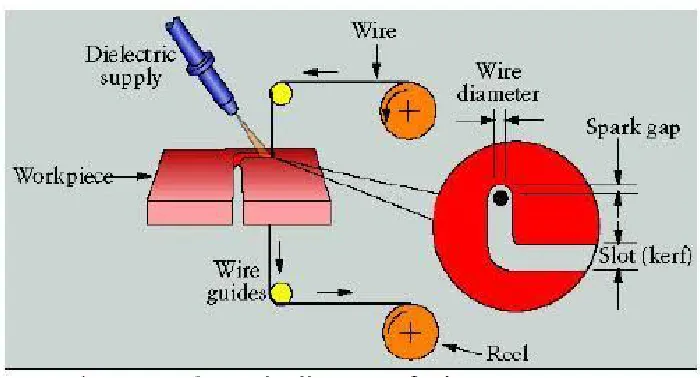
The Principle used in ‘wire Cut EDM’ is same as that of EDM i.e Thermal energy of the spark is used to remove material of the
workpiece. WEDM process involves the complex erosion effect by rapid repetitive and discrete spark discharges between the wire
Technology (IJRASET)
[image:3.612.131.481.101.290.2]times per second, with discharge sparks lasting in the range of 1/1,000,000 of a second or less. The volume of metal removed during this short period of spark discharge depends on the desired cutting speed and the surface finish required.
Fig. 1 Basic Working Diagram of WEDM
III. LITERATURE SURVEY
Nihat Tosun et al. investigated on the optimization and the effect of machining parameters on the kerf and the MRR in WEDM operations. CuZn37 Master brass wire was used in the experiments. The level of importance of the machining parameters on the kerf and the MRR is determined by using ANOVA. The effect of various machining parameter such as open circuit voltage and pulse duration wire speed and dielectric flushing pressure was been studied though machining on AISI 4140 steel.The highly effective parameters on both the kerf and the MRR were found as open circuit voltage and pulse duration than other. [1]
J.R.Mevada carried out for two responses, MRR and Surface roughness using three different wires namely, molybdenum, plain brass and zinc coated brass wire.This investigation is carried out to find best optimal level for higher material removal rate at lower surface rough-ness for Inconel 600 material and to check best suitable wire among the three wires. The experiments were conducted under varying pulse on time, pulse off time and peak current The experiments were conducted under various parameters setting. L
27 Orthogonal Array designed. Minitab 16 software was used for analyze the experimental data. The optimal search for
machining parameters for objective of maxi-mum material removal rate with lower surface roughness is performed by comparing the optimal level obtained by grey relational analysis with the established mathematical model. [2]
Farnaz Nourbakhsha et al. studied influence of zinc-coated brass wire on the performance of WEDM is compared with high-speed brass. Also, the effect of process parameters on the process performance was determined by performing experiments under different machining conditions. Based on the experimental results and analysis, the following conclusions can be drawn Experiments results of WEDM of titanium indicate peak current and pulse width have significant effect on cutting speed and surface roughness. Pulse width and peak current have direct relation with cutting speed but there is an inverse relation between surface roughness and them. A Taguchi L18 design of experiment (DOE) has been applied. The Analysis of Variance (ANOVA) also indicated that voltage, injection pressure, wire feed rate and wire tension have non-significant effect on the cutting speed. As a result of surface roughness Increases with pulse width & decreases with pulse interval. [3]
Pragya Shandilya et al. studied effects of voltage, pulse-on time, pulse-off time and wire feed rate on kerf separately in WEDM of SiCp/6061 Al MMC. A diffused brass wire was used as the cutting tool.Input process parameters have been found to play a significant role in the minimization of kerf. ANOVA results show that voltage and wire feed rate are highly significant parameters and pulse-off time is less significant. Pulse-on time has insignificant effect on kerf. [4]
Technology (IJRASET)
improved. The validity of the developed optimization tool was tested and provided a consistent result. Present analysis it is evident that the optimal parametric combination will be very beneficial to the manufacturing communities who are working in the WEDM process. Researcher might attempt to consider the other performance criteria, such as surface waviness, form accuracy, and surface flatness as output parameters in their studies. [5]
Yu Huang et al. studied effect of cutting parameters on surface roughness, material removal rate and average gap voltage in the WEDM of high hardness tool steel YG15,which are experimentally investigated for both rough cutting and finish cutting. Regression models and signal-to-noise ratio were used to obtain the optimum cutting parameter combination. On rough cutting, pulse-on time had the extremely important effect on Ra, and the effects of pulse-on time, pulse-off time, and cutting feed rate were more important than wire tension, wire speed, and water pressure on MRR. On finish cutting, power and cutting feed rate had the extremely important effect on Ra; and pulse-on time, cutting feed rate, and water pressure were more important than other factors on MRR. The ANOVA for regression analysis indicated that the estimated model for MRR on rough cutting and for Ra on finish cutting were significant. Confirmation experiments showed that it was possible to increase the MRR and decrease the Ra significantly by using the proposed statistical technique. The MRR was increased by 2.23 times and Ra was decreased by 1.41 times. [6]
Thella Babu Rao et al. investigated compliance of an integrated approach, principal component analysis coupled with Taguchi’s robust theory for simultaneous optimization of correlated multiple responses of wire electrical discharge machining process for machining SiCP reinforced ZC63 metal matrix composites. WEDM experiments were conducted by varying the particulate size, volume fraction, pulse-on time, pulse-off time and wire tension. For the view of quality cut, the most important performance indicators of WEDM are surface roughness, metal removal rate, wire wear ratio, kerf and white layer thickness were measured as responses. PCA was used as multi-response optimization technique to derive the composite principal component which acts as the overall quality index in the process. Taguchi’s S/N ratio analysis was applied to optimize the CPC. The derived optimal process responses were confirmed by the experimental validation tests results. The analysis of variance was conducted to find the effects of choosing process variables on the overall quality of the machined component. These methodology could be also applied for different machining process on different materials in different machining conditions so as to automate the machining process based on the chosen optimal values. [7]
Tzeng and Chen analyzed a hybrid method including a back-propagation neural network (BPNN), a genetic algorithm (GA) and response surface methodology (RSM) to determine optimal parameter settings of the EDM process. Material removal rate, electrode wear ratio and work-piece surface finish on process parameters during the manufacture of SKD61 by electrical discharge machining (EDM). [8]
Tzeng et al. had proposed an effective process parameter optimization approach that integrates Taguchi’s parameter design method, response surface methodology (RSM), a back-propagation neural network (BPNN), and a genetic algorithm (GA) on engineering optimization concepts to determine optimal parameter settings of the WEDM process under consideration of multiple responses. Material removal rate and work-piece surface finish on process parameters during the manufacture of pure tungsten profiles by wire electrical discharge machining (WEDM). [9]
M. Durairaja et al. investigated on wire electrical discharge machining of Stainless Steel (SS304) has been done using brass wire used as a tool and distilled water is used as a dielectric fluid.for experimentation Taguchis L16, orthogonal array has been used. The input parameters selected for optimization are gap voltage, wire feed, pulse on time, and pulse off time. Dielectric fluid pressure, wire speed, wire tension, resistance and cutting length are taken as fixed parameters. Additionally, the analysis of variance (ANOVA) is too useful to identify the most important factor. The Analysis of Variance resulted that the pulse on time has major influence on the surface roughness (μm) and kerf width (mm) in both the Taguchi optimization method and Grey relational analysis. [10].
Technology (IJRASET)
K. Kumar et al. They did optimization the parameters of (WEDM) process by considering the effect of input parameters viz. Time On, Time Off, Wire Speed & Wire Feed. In this project, the Al-sic(20%) plate is the work piece. The molybdenum wire as tool electrode. Experiments have been conducted with these parameters in three different levels data related to process responses viz. Metal removal rate, surface roughness (Ra) have been measured for each of the experimental run.. Taguchi techniques have been used for optimization of minimizing the surface roughness. The optimal value has been verified to the predicted value. Factors like speed, feed, Time on and Time off have been found to play a significant role for MRR and surface roughness. Taguchi’s method is used to obtain optimum parameters combination for maximization of surface roughness. The conformation experiments were conducted to evaluate the result predicted from Taguchi Optimization. [12]
U.K. Vates1 and N.K. Singh2 investigate Response Surface Methodology (RSM) is use to investigate the effect of five independent input parameter namely gap voltage (Vg), Pulse on time (Ton), pulse off time (Toff), wire feed (Wf) and flush rate (Fr) over CLA value of surface roughness (Ra).A fractional factorial Design of Experiment of two level were employed to conducted the experiment on EN-31 die steel with chromium coated copper alloy wire data. The significance coefficients were observed by performing analysis of variance (ANOVA) at 95% confidence level. Performance of WEDM largely depend not only upon the combination of material of workpiece and wire electrode but also the optimal combination of the independent control process parameter[13].
Goutam Kumar Bose1, Pritam Pain2 studied WEDM is a complex machining process controlled by a large number of process parameters such as Pulse on Time (Ton), Pulse off Time (Toff), Wire Tension (W/Ten), Wire Feed Rate (W/Feed) etc. for various cutting operations. In this experimental investigation several responses such as material removal rate, surface roughness and overcut have been considered. Experimentation is planned as per Taguchi’s L27 Orthogonal array (OA). Copper Wire and Oil Hardened Naturally Shrinking (OHNS) are used as tool and work materials respectively. The machining parameters are optimized with the multi response characteristics applying response surface methodology. The experimental based result showed that increasing the pulse on time, wire feed and wire tension values leads to an increase in the amount of Material Removal Rate. [14] vedansh chaturvedi, anil kumar Sharma studied oil harden non- shrinking (OHNS) steel is used as a work piece, brass wire used as a tool and distilled water is used as a dielectric fluid. For experimentation Taguchi’s L27 orthogonal array has been used. The input parameters selected for optimization are wire tension, wire feed rate, flushing pressure, servo feed rate. by using parametric optimization technique, MOORA method, best parametric combination is found. Experimental investigation on CNC wire electrical discharge machining of OHNS Tool steel has been done.the analysis of moora method following conclusions are made. the optimized input parameter combination to get best result at1900 (grm) wire tension, 8.5 mtr/min. wire feed rate, 1.5 kg/cm2 flushing pressure,0.5mm/min servo feed [15]
IV. DISCUSSION
The experimental based result showed that increasing the pulse on time, wire feed values leads to an increase in the amount of Material Removal Rate.. Ra showed that increasing the pulse on time,wire feed values leads to a decreasing the amount of Ra. also the Ra increase gradually with the increasing Wire feed, and Overcut(kerf) showed that increasing the wire feed, Toff values leads to a decreasing the amount of Overcut. The present work is carried out with a view to optimize MRR , Ra, Overcut/kerf
Surface roughness decreases when there is a decrease in peak current as well as a pulse on time. For surface roughness peak current and duty cycle are primarily important to maintain it in desired levels. As compared to pulse off time current has the largest effect on the surface roughness. A Less rough surface can be obtained by setting small pulse duration period along with relatively high enough discharge current. Highest current improves material removal rate, but surface roughness also increases.With the increase in the pulse off time, the spark contact time within the workpiece decreases and it will decrease the material removal rate. Material removal rate steadily increases with increase in discharge current and duty cycle.
V. CONCLUSION
The Present paper gives a study on optimization of various machining Parameters on WEDM. Based on the above literature references concluded that, The modelling and analysis of the wire EDM process is done by using pulse on , pulse off and wire feed rate as a main parameters and response surface method as a methodology in the composite material The various cutting process parameters such as current, pulse on , pulse off and wire feed rate affects the material removal rate and surface roughness, Overcut(Kerf).
Technology (IJRASET)
used in production sectors to get at the best manufacturing conditions, which is an need for industries towards manufacturing of quality products at lowest cost. Limited work has been done on OHNS materials. OHNS (Oil harden non Shrinkage) steel are gradually becoming very important materials for their scope of uses in manufacturing industries. It is also revealed from the literature that very few efforts have been made to achieve the optimum parameter setting in wire-EDM process for OHNS. Wire Electric Discharge Machine (WEDM) seems a good option for machining the complicated shapes for the harden materials. In this propose work, the effects of various process parameters of WEDM such as pulse on time (Ton) ,pulse off time (Toff),Wire feed rate
(WF) and current (I) on the material removal rate (MRR), surface roughness(Ra) and the overcut or Kerf width (Kf).
REFERENCES
[1] Nihat Tosun a,∗, Can Cogunb, Gul Tosun a(2004) ,“A study on kerf and material removal rate in wire electrical discharge machining based on Taguchi method” Journal of Materials Processing Technology 152 (2004) pp.316–322
[2] J.R.Mevada,“ A Comparative Experimental Investigation on Process Parameters Using Molybdenum,Brass and Zinc-Coated Wires in Wire cut EDM” International Journal of Scientific & Engineering Research, Volume 4, Issue 7, July-2013 pp.1398-1407
[3] Farnaz Nourbakhsha, K. P. Rajurkarb,*, A. P. Malshec, Jian Caod, “Wire electro- discharge machining of titanium alloy,” Procedia CIRP 5 ( 2013 ) pp. 13 – 18 [4] Pragya Shandilyaa*, P.K.Jainb, N.K. Jainc ,“Parametric optimization during wire Electrical discharge machining using response surface methodology”Procedia
Engineering 38 ( 2012 ) pp.2371 – 2377
[5] R.Ramakrishnan, L.Karunamoorthy,“Multi response optimization of wire EDM operations using robust design of experiments” International Journal of
Manufacturing Technology, Vol.29, 2006, pp.105-112
[6] Yu Huang, Wuyi Ming, Jianwen Guo, Zhen Zhang, Guangdou Liu, Mingzhen Li, Guojun Zhang,“Optimization of cutting conditions of YG15 on rough and finish cutting in WEDM based on statistical analyses” International Journal of Advanced Manufacturing Technology, Vol.69, 2013, pp.993-1008
[7] Thella Babu Rao, A.Gopala Krishna,“Simultaneous optimization of multiple performance characteristics in WEDM for machining ZC63/SiCp MMC” Advances in Manufacturing, Vol.1, 2013, pp.265-275
[8] Tzeng C.J. and Chen R.Y, “Optimization of electric discharge machining process using the response surface methodology and genetic algorithm approach” International Journal of Precision Engineering and Manufacturing, 14 (2013): pp.709-717.
[9] Tzeng C.J., Yang Y.K., Hsieh M.H. and Jeng M.C., “Optimization of wire electrical discharge machining of pure tungsten using neural network and response surface methodology” Proceedings of the Institution of Mechanical Engineers, Part B: Journal of Engineering Manufacture, 225(2011): pp. 841-852
[10] M. Durairaja, D. Sudharsunb,*, N. Swamynathanb “Analysis of Process Parameters in Wire EDM with Stainless Steel using Single Objective Taguchi Method and Multi Objective Grey Relational “Grade Procedia Engineering 64 ( 2013 ) 868 – 877
[11] S.Boopathi1, K.Sivakumar2, R.Kalidas3 “Parametric Study of Dry WEDM Using Taguchi Method” Volume 2, Issue 4 (July 2012), PP. 63-68 [12] K. Kumara, R. Ravikumarb,“Modeling and Optimization of Wire EDM Process” Vol.3, Issue. 3, May.-June. 2013 pp-1645-1648
[13] U.K.Vates1 and N.K. Singh2, “Optimization of Surface Roughness Proces Parameters of Electrical Discharge Machining of EN-31 by Response Surface Methodoloy”Volume 6, Number 6 (2013), pp. 835-840
[14] Goutam Kumar Bose1, Pritam Pain2, “Parametric Optimizationof WEDM Process on OHNS Tool Steel Using Statistical Techniques”Volume 5, Issue 12, December 2015
[15] Chaturvedi, V. and Sharma, A. K. 2013, “ Parametric Optimization of CNC Wire Cut EDM for OHNS Steel Using Moora Methodology”‖ 10th IRF
International Conference, 04th October-2014, Bengaluru, India.