5
IV
April 2017
Technology (IJRASET)
©IJRASET: All Rights are Reserved
706
QOS Improved Load Balancing Framework for
Wireless Networks
Mr. Abhijit A. Rajguru1, Mrs. Dr. S. S. Apte2
1
Research Scholar, Walchand Institute of Technology, Solapur Maharashtra, INDIA.413305 2
Walchand Institute of Technology, Solapur Maharashtra, INDIA.413305
Abstract: Quality-of-service (QoS) is very important issues in load balancing and task scheduling process in distributed network system. The non-efficient load balancing and task scheduling algorithm decreases Quality-of-service (QoS) parameters like schedule delay, energy consumption, throughput etc. In this research paper, we proposed QoS improved load balancing frameworks for wireless networks (WNs). We improve QoS of distributed frameworks by using particle swarm optimization and cuckoo search method. The proposed technique improves QoS, such as energy consumption, latency, throughput, network life time.
Keywords: wireless networks (WNs), load balancing, task scheduling, particle swarm optimization (PSO), cuckoo search (CS)
I. INTRODUCTION
A Distributed Network System can be viewed as a collection of computing and communication resources shared by active users [2-3]. The distributed network system can be classified into cloud computing, cluster computing, P2P system, grid computing etc. In distributed network systems the management of resources and applications is a very difficult task [1]. Resource sharing is the most important features of distributed system. The applications of distributed networks are internet, telecommunication networks and computer networks etc.
When the demand for computing power increases, the load balancing and task scheduling problems becomes very important. The load balancing and task scheduling in distributed network system are most challenging research area in computer science and engineering. Load balancing and task scheduling in distributed network system has an important role in overall quality of service (QoS). Task scheduling in distributed system can be defined as allocating processes to processor so that total execution time will be minimized, utilization of processors will be optimized. Load balancing is the process of improving the performance of system through a redistribution of load among processor. In this research paper, we proposed QoS improved load balancing frameworks for wireless networks (WNs). We improve QoS of distributed frameworks by using particle swarm optimization and cuckoo search method. The proposed technique improves QoS, such as energy consumption, latency, throughput, network life time.
II. RELATED WORKS
Wenzhong Guo [4], propose a soft real-time fault-tolerant task allocation algorithm (FTAOA) for WSNs in using primary/backup (P/B) technique to support fault tolerance mechanism. In the proposed algorithm, the construction process of discrete particle swarm optimization (DPSO) is achieved through adopting a binary matrix encoding form, minimizing tasks execution time, saving node energy cost, balancing network load, and defining a fitness function for improving scheduling effectiveness and system reliability. Jin et al. [5] proposed an adaptive intelligent task mapping together with a scheduling scheme based on a genetic algorithm (ITAS). They employed a hybrid fitness function in the algorithm to extend the overall network lifetime via workload balancing among collaborative nodes. Zeng et al. [6] developed an energy balanced directed acyclic graph (DAG) task scheduling algorithm and gave a genetic algorithm (GA) integrating
Technology (IJRASET)
©IJRASET: All Rights are Reserved
707
task deadlines and limited battery life of robots. Such constraints are relevant in many applications including parts movement by robots in manufacturing, delivery of goods by unmanned vehicles, and search and rescue operations. Our solution is applicable to a group of heterogeneous robots with different suitability (i.e., payoffs) for different tasks.
III. SYSTEM MODEL
[image:3.612.117.520.138.436.2]A. System Model
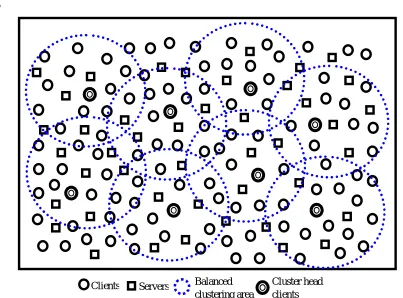
Fig. 1 System model of proposed work
The system model of proposed work is shown in figure.1. Consider the clients and servers represented by round nodes and square nodes respectively forms a cluster using PSO technique. A cluster coordinator will be selected among the client’s members in the cluster which has high energy, computation power, and buffer capacity. The cluster coordinator schedule tasks to available server in same cluster or in neighboring cluster. The neighboring cluster is selected based on GSA (Gravitational Search Algorithm). The cuckoo search algorithm is used to select best neighboring cluster.
IV. PROPOSED DISTRIBUTED FRAMEWORKS
The proposed distributed framework consists of two phase system, such as load balancing phase and task scheduling phase and the theoretical and mathematical models are briefly described in the following sub sections.
A. Cluster Formation
Particle swarm optimization (PSO) is a population based stochastic optimization technique developed by Kennedy and Eberhart (1995) inspired by social behavior of bird flocking or fish schooling. They developed a concept for the optimization of non-linear functions using particle swarm intelligence. PSO has its roots in artificial and Social Psychology, as well as in Engineering and Computer Science. In addition, PSO uses the swarm intelligence concept, which is the property of a system, where the collective behaviors of unsophisticated agents that are interacting locally with their environment create coherent global functional patterns. PSO is a population based search algorithm and is initialized with a population of random solutions called particles. Each particle in PSO is associated with a velocity. Particles fly through the search space with velocities which are dynamically adjusted according to their historical behaviors. PSO has attracted a lot of attention from the researchers all around the world. PSO is based on two fundamental disciplines, namely, Social Science and Computer Science. The system is initialized with a population of random solutions and searches for optima by updating generations. In PSO, the potential solutions, called particles, fly through the problem
Clients Servers Balanced
clustering area
Technology (IJRASET)
©IJRASET: All Rights are Reserved
708
space by following the current optimum particles.
B. PSO Algorithm
The basic operation of PSO is given by,
Step 1: Initialize the swarm from the solution space Step 2: Evaluate the fitness of individual particles Step 3: Modify the Gbest, Pbest and velocity Step 4: Move each particle to a new position
Step 5: Goto step 2, and repeat until convergence or the stopping condition
is satisfied The basic idea of the PSO is the mathematical modelling and simulation of the food searching activities of a swarm of birds (particles).In the multi-dimensional space where the optimal solution is sought, each particle in the swarm is moved towards the optimal point by adding a velocity with its position. The velocity of a particle is influenced by three components, namely, inertial momentum, cognitive, and social. The inertial component simulates the inertial behaviour of the bird to fly in the previous direction. The cognitive component models the memory of the bird about its previous best position, and the social component models the memory of the bird about the best position among the particles. The velocity and position updating equation is given by,
Vi = w * Vi + C1 * r1 * (Pbesti - Si) + C2 * r2* (Gbesti - Si) where,
Vi : velocity of particle i,
Si : current position of the particle, w: inertia weight,
C1 : cognition acceleration coefficient, C2: social acceleration coefficient, P : own best position of particle i,
besti G : global best position among the group of particles,
r1, r2 : uniformly distributed random numbers in the range [0 to 1].
After formation of cluster, cluster coordinator will be selected based on buffer capacity, processing power, energy etc.
V. EXPERIMENTAL RESULTS
The simulation of proposed algorithm is carried out by using most popular simulator NS2. Following parameters are analyzed throughput, scheduling delay and energy consumption. The QoS performance of our technique is compared with the existing FTAOA framework.
A. Load Balancing Analysis
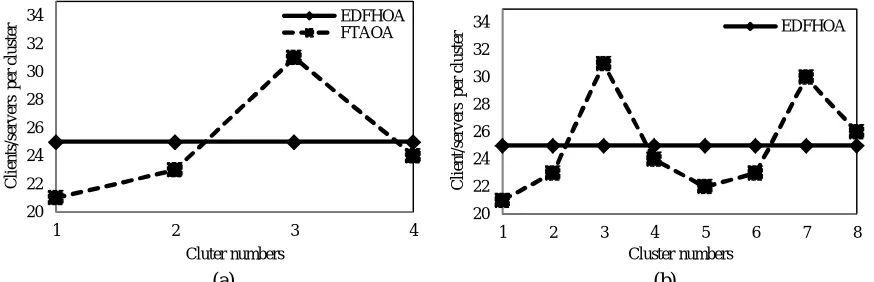
In this load balancing analyzed in cluster formation process with the changeable number of clients/servers from 100 to 500. The load balancing in cluster formation is defined by the number of clients/servers per cluster.
[image:4.612.93.530.555.696.2](a) (b)
Fig. 2 Load balancing analysis (a) for 100 clients/servers with 4 clusters (b) for 200 clients/servers with 8 clusters 20 22 24 26 28 30 32 34
1 2 3 4
Cl ie n ts /s erv er s p er cl u st er Cluter numbers EDFHOA FTAOA 20 22 24 26 28 30 32 34
1 2 3 4 5 6 7 8
Technology (IJRASET)
©IJRASET: All Rights are Reserved
709
The graph clearly says the proposed distributed framework balance the clusters. The existing FTAOA frameworks are not maintain the balanced clusters in both 100, 200 clients/servers.
B. Node Varying Analysis
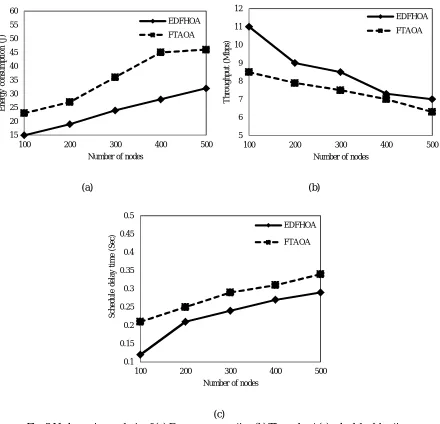
In this, QoS are analyzed by varying number of clients/servers from 100-500. We set fixed 100 tasks and 100 deadlines.
(a) (b)
[image:5.612.87.527.152.576.2](c)
Fig. 3 Node varying analysis of (a) Energy consumption (b) Throughput (c) schedule delay time
The graph plot shows the energy consumption and scheduling delay of our technique is less than FTAOA. The throughput of our technique is high as compared to FTAOA.
VI. CONCLUSION
An efficient load balancing and task scheduling technique is vital for system performance, to maximize throughput, to maintain system stability and fault tolerant. In this research paper QoS improved load balancing and task scheduling frameworks for wireless networks is proposed. By using this technique we improve QoS of distributed network system like throughput, network lifetime energy consumption. We improve QoS of distributed frameworks by using particle swarm optimization (PSO) technique and cuckoo search. In future we will present new load balancing and task scheduling algorithm using fuzzy and neuro-fuzzy system.
15 20 25 30 35 40 45 50 55 60
100 200 300 400 500
E n erg y c o n su m p ti o n (J )
Number of nodes
EDFHOA FTAOA 5 6 7 8 9 10 11 12
100 200 300 400 500
T h ro u g h p u t (M b p s)
Number of nodes
EDFHOA FTAOA 0.1 0.15 0.2 0.25 0.3 0.35 0.4 0.45 0.5
100 200 300 400 500
S ch ed u le d el a y t im e (S ec )
Number of nodes
EDFHOA
Technology (IJRASET)
©IJRASET: All Rights are Reserved
710
REFERENCES
[1] M. Marsan, A. Bianco, L. Ciminiera, R. Sisto and A. Valenzano, "A LOTOS extension for the performance analysis of distributed systems", IEEE/ACM Transactions on Networking, vol. 2, no. 2, pp. 151-165, 1994
[2] J. Perkins, C. Humes and P. Kumar, "Distributed scheduling of flexible manufacturing systems: stability and performance", IEEE Transactions on Robotics and Automation, vol. 10, no. 2, pp. 133-141, 1994.
[3] Xinxin Zhang and D. Seret, "Supporting network management through distributed directory service", IEEE Journal on Selected Areas in Communications, vol. 12, no. 6, pp. 1000-1010, 1994.
[4] Wenzhong Guo, Jie Li, “A PSO-optimized Real-time Fault-tolerant Task Allocation Algorithm in Wireless Sensor Networks”, IEEE Transactions on Parallel and Distributed Systems, DOI 10.1109/TPDS.2014.2386343,
[5] Y. C. Jin, J. Jin, A. Gluhak, et al, ”An Intelligent Task Allocation Scheme for Multihop Wireless Networks,” IEEE Trans.Parallel and Distributed Systems , vol. 23, no.3, pp. 444-451, 2012.
[6] Z. W. Zeng, A. F. Liu, D. Li, et al, ”A highly efficient DAG task scheduling algorithm for wireless sensor networks,” in Proc. of the 9th International Conference for Young Computer Scientists, Hunan, China, pp.570-575, 2008
[7] Penmatasa, “Game-theoretic static load balancing for distributed systems”, J. Parallel Distrib. Comput. 71 (2011) 537–555