Analysis of Use of Taguchi Method with Design of
Experiment (DOE) and Analysis of
Variance(ANOVA) in Plastic Injection Molding for
Quality Improvement by Optimization
Vinitkumar K.Modi
Lecturer B. & B. Institute of Technology Vallabhvidyanagar, Anand, Gujarat, India
Abstract:
Injection molding is very important forming processes for thermoplastic polymers. For controlling quality of various
cast products setting of the injection molding parameter such as injection pressure, injection speed, cooling time and packing
pressure etc shows a very important role in manufacturing of various products by injection molding process. Taguchi approach
is a widely used technique for optimizing the molding process parameters This paper presents use of taguchi method with Design
of Experiment and Analysis of variance (ANOVA) etc.in plastic injection Molding Process by various researchers by
optimization for quality improvement. The paper applies Taguchi’s parametric design and analysis of variance (ANOVA)
technique to study the effect of process settings of plastic injection molding on part quality. Experimental data are used to
identify the relationship between the injections molding process parameters and product quality.
Key words: Taguchi method, Design of Experiment(DOE), Analysis of Variance (ANOVA), Molding
I.
INTRODUCTION
Nowadays, the plastics industry is a multi-billion cash business, and it is still rising at a rate faster than most other industries in the
world. Plastics are now largely used in every major market including construction, packaging, automobiles and boats, electrical and
electronics, pipe and fittings, and consumer goods, toys etc.
As way of life change, plastics will become more valuable and popular to tomorrow's advanced new concepts in advance building
construction, architecture, aerospace, communications, transportation, even to medicine, computer and manufacturing of computer
and printer parts.
In injection molding, very complicated parts can be manufactured and sizes may range from very small to very large. Injection
Molding is a cyclic process for producing duplicate articles from a mold, and is the most widely used for polymer processing. The
main advantage of this process is the capacity of repetitively fabricating parts having complex shapes and geometries at high
production rates with minimum cost. Maximum polymers may be injection molded, like thermo plastics, fiber reinforced thermo
plastics, thermosetting plastics, and elastomers.( M. V. Kavade et al. 2012).
The injection molding process starts with the feeding of a polymer in granular form through hopper to barrel then it is heated with
the enough temperature to make it flow. The molten plastic which was melted is then injected under high pressure into the mold,
injection pressure is applied to both platens of the injection molding machine (moving and fixed platens) in order to hold the mold
tool together. Then the product is set to cool which helps it in the solidification process. When the product gets its desired shape the
two platens will move away from each other in order to separate the mold tool known as mold opening. Finally the molded product
is ejected or removed from the mold. (Abohashima HS et al. 2015 and Teklehaimanot S (2011)).
will produce defects in the plastic parts. Many researchers investigate defects in plastic injection molding , such as warpage,
shrinkage, sink marks, short shot and so on {( J. J. Mostafa et.al 2011), (H. Oktem et. al 2011),( D. Kusi etal. 2013).( X. Wang et.al.
2013)}.
Chang et al [1] explain the relationship between input process parameters for injection molded part and outputs as weld line width
and tensile impact using Taguchi method. The author taken seven various input parameters such as melt and mold temperatures,
injection and hold pressures, cooling and holding times, and back pressure and found that the melt and mold temperature, injection
pressure, and holding time are the most effective, while hold pressure, holding time and back pressure are least important parameter.
II.
TAGUCHI METHOD, DESIGN OF EXPERIMENT AND ANALYSIS OF VARIANCE
The quality engineering method suggested by Taguchi is commonly known as the Taguchi method or Taguchi approach. His
approach provides a new experimental strategy in which a modified and standardized form of design of experiment (DOE) is used.
So that, the Taguchi approach is a form of DOE with special application principles. This technique helps to study effect of many
factors (variables) on the desired quality characteristic most economically. By studying the effect of individual factors on the results,
the best factor combination can be determined ( Roy R.K. 2001). Taguchi designs experiments using specially constructed tables
known as “orthogonal array” (OA). The selection of an appropriate orthogonal array (OA) depends on the total degrees of freedom
of the parameters. Degrees of freedom are defined as the number of comparisons between process parameters that essential to be
made to define which level is better and specifically how much better it is. ( S. Kamaruddin, Zahid et. al.).
The use of these tables makes the design of experiments very easy and consistent (Roy R.K. 1990) and it requires relatively lesser
number of experimental trials to study the entire parameters. As a result saving of , time, cost, and labor can be achieved.
successfully. The experimental results are then transformed into a signal-to-noise (S/N) ratio. Usually, there are three categories of
quality characteristic in the analysis of the S/N ratio, i.e. the-lower-the-better, the-higher-the-better, and the nominal-the-better. The
S/N ratio for each level of process parameters is calculated based on the S/N analysis. Moreover, a statistical analysis of variance
(ANOVA) is performed to understand which process parameters are statistically significant. With the help of S/N ratio and
ANOVA analyses, the optimal combination of the process parameters can be anticipated. Lastly, a confirmation experiment is
conducted to verify the optimal process parameters achieved from the parameter design.Taguchi method stresses the importance of
studying the response variation using the signal–to–noise (S/N) ratio, resulting in minimization of quality characteristic variation
due to uncontrollable parameter. (Amruta Wavare et, al, 2016 & S. Kamaruddin, Zahid e,t a,l 2010). The selection of an appropriate
orthogonal array (OA) is done afterwards.
III.
RESEARCH METHODOLOGY
In this paper total different case study of Plastic Injection molding Company is studied for critical examination. All the case
studies of which are selected in this paper are from popular publications to show the real research The main aim of this study is to
find out the benefits which Taguchi methods with design of experiments and ANOVA in plastic injection molding for quality
improvement by reducing defects.
I have taken 15
case studies from plastic injection molding industries for review and critical analyis. The time period of various
case studies are from 2004 to 2016. These all case studies are then compared from different perspective and presented into following
sequence:
A.
Overview of Case Studies and Publication
[image:3.612.57.565.647.740.2]TABLE -1 shows overview of various Research paper/Case study showing Title of paper, publication journal authors etc. The
referred name on the left most column indicates the name by which the publication has been referred in the rest of the review paper.
TABLE:-1General Overview of Case Industries (Plastic Injection Company)
Refereed No Title Journal and Year Author/Authors Case Study/Product
PI-1 Application of Taguchi Method in
the Optimization of Injection Moulding Parameters
for Manufacturing Products from Plastic Blend
IACSIT International Journal of Engineering and Technology, Vol.2, No.6, December 2010
S. Kamaruddin, Zahid A. Khan and S. H. Foong
This paper presents a study in which an attempt has been made to improve the quality characteristic (shrinkage) of an injection molding product (plastic tray)
Molding of Polypropylene by using Taguchi Methodology
Mechanical and Civil Engineering (IOSR-JMCE)
Volume 4, Issue 4 (Nov. - Dec. 2012), PP 49-58
Kadam molding process parameters will be
carried out using polypropylene (PP) as the molding material
PI-3 Practical application of Taguchi method for optimization of process parameters in Injection Molding Machine for PP material
International Research Journal of Engineering and Technology (IRJETVolume: 02 Issue: 04 | July-2015
Anand Kr Dwiwedi, Sunil Kumar, Nasihun Noor Rahbar, Dharmendra Kumar
In this paper injection molding process parameter optimization for polypropylene material has been done using the Taguchi methodology
PI-4 Optimization Of Plastic Injection
Molding Process Parameters Using Taguchi Method For Warpage Defect
National Innovation and Invention Competition Through Exhibition (iCompEx 17
Riduwan Bin Zakaria, Mohd Hairol Mizzam Bin Haris, Zulkifli Bin Hamzah
In this study, polypropylene was injected in honey cup shape product under various processing parameters
PI-5 The Use Of The Taguchi Method In
Determining
The Optimum Plastic Injection Moulding
Parameters For The Production Of A Consumer
Product
Journal Mekanikal Disember 2004, Bil.18 , 98 – 110
S. Kamaruddin Zahid A. Khan K. S. Wan
In this study, the Taguchi method is used to find the optimal process parameters for an injection
moulding machine that was used to produce a consumer product (plastic tray) from polypropylene (PP) plastic material
PI-6 Minimization of Defects Percentage
in Injection Molding Process using Design of Experiment and Taguchi Approach
Industrial Engineering & Management Ind Eng Manage 2015, 4:5
Abohashima HS, Aly MF, Mohib A and Attia HA
This study was conducted in Plastics Injection Plant called
International Engineering Union Company in the Six of October City, Giza, Egypt
PI-7 Taguchi analysis of shrinkage and
warpage of injection-moulded polypropylene/multiwall carbon nanotubes nanocomposites
eXPRESS Polymer Letters Vol.3, No.10 (2009) 630–638
K. Prashantha J. Soulestin, M. F. Lacrampe, E. Lafranche, P. Krawczak, G. Dupin M. Claes
This paper focuses on the effect of
multi-walled carbon nanotube (MWNT)
addition on shrinkage and warpage properties of polypropylene (PP) injection moldings before and after annealing.
PI-8 An Optimization of Shrinkage in
Injection
Molding Parts by Using Taguchi Method
Journal of Advanced Research in Applied MechanicsVol. 10, No. 1. Pages 1-8, 2015
H. Radhwan, M. T. Mustaffa, A. F. Annuar , H. Azmi, M. Z. Zakaria and A. N. M. Khalilf
This research paper is about an optimization of shrinkage in injection molding part by using the Taguchi Method. The part chosen was from a company which had a critical issue of shrinkage
PI-9 Optimization of Injection Molding
Process
Parameter for Reducing Shrinkage by Using High
Density Polyethylene (HDPE) Material
International Journal of Science and Research (IJSR) Volume 4 Issue 5, May 2015
Harshal P. Kale, Dr. Umesh V. Hambire
Case study in Injection molding process for polymer processing operation in the plastic industry
PI-10 Effect of Injection Moulding
Process Parameter on
Tensile Strength Using Taguchi Method
International Journal of Mechanical, Aerospace, Industrial, Mechatronic
and Manufacturing
Engineering Vol:9,
No:10, 2015
Gurjeet Singh, M. K. Pradhan, Ajay Verma
In this paper the effect of the parameters selection on injection molding process has been described. I
PI-11
Investigation And Analysis Of The Active Factors To
Address The Defect In Plastic Injection
Molding Process
Proceedings of 7th IRF International Conference, 27th April-2014, Pune, India
kalpesh S.Kamble,
baliram Jadhav, ramjan Kalmadi
In this paper work, the effects of different molding parameters . on plastic injection molding process are considered.
Pi-12
Optimization Of Injection Molding Parameters For Led Lampshade
Transactions of the Canadian Society for Mechanical Engineering, Vol. 37, No. 3, 2013
Kingsun Lee and Jui-Chang Lin
Case study of the unibody of LED (light-emitting diodes) lampshades is fabricated by injection mold.
PI-13 Study of Injection Molding
Warpage Using Analytic Hierarchy Process and Taguchi Method
Advances in Technology Innovation, vol. 1, no. 2, 2016, pp. 46 - 49
Dyi-Cheng Chen, Chen-Kun Huang
warpage.
PI-14 Investigation On Warpage And Sink
Mark For Injection Molded Parts Using Taguchi Method
SPE ANTEC™
Indianapolis 2016
Omar Ahmed Mohamed, Syed Hasan Masood, Abul Saifullah, Jahar Lal Bhowmik
The paper applies Taguchi’s parametric design and analysis of variance ANOVA) technique to study the effect of process settings of plastic injection molding on part quality.
PI-15 The use of Taguchi method in the design of plastic injection
mould for reducing warpage
Journal of Materials Processing Technology 182 (2007) 418–426
S.H. Tang, Y.J. Tan,
S.M. Sapuan, S.
Sulaiman, N. Ismail, R. Samin
This project is going to fabricate a mould that produced a thin plate with dimension 120mm×50mm×1 mm. The thin plate will be used for warpage testing
B.
Methodology Adopted & Objectives By Plastic Injection Molding Company
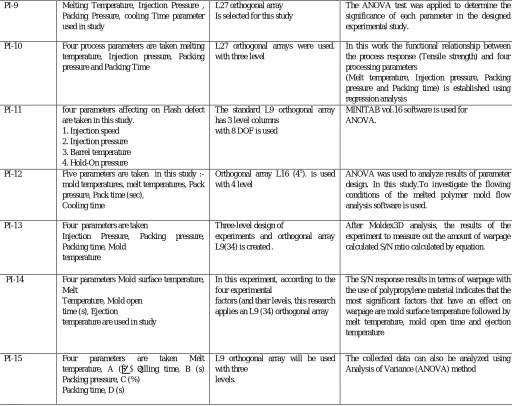
Table-2 shows the tools/Techniques used by various plastic injection molding company and case study as shown in table 1 and its
main objectives
TABLE:-2 Table 2 Used and Main Objectives
Referred No Tools/Techniques used Main objective
PI-1 Taguchi method. analysis of variance (ANOVA
Design of Experiments(DOE)
To improve the quality characteristic (shrinkage)
of an injection molding product (plastic tray) made from blends plastic (75% polypropylene (PP) and 25% low density polyethylene (LDPE)) by optimizing the injection molding
parameters using the Taguchi method. PI-2 Injection Molding Optimization, Taguchi methodology, Design of
Experiment ANOVA
In this process, polymer is injected into a mold cavity, and solidifies to the shape of the mold. Optimizing the
parameters of the injection molding process is critical to enhance productivity.
PI-3 orthogonal array, Taguchi’s Concept, S/N Ratio This article aims to analyze the recent research in
determining optimal process parameters of injection molding machine
PI-4 Moldflow, Taguchi, orthogonal array with parameters, S/N ratio, The Minitab 15 software
The main aim is use of orthogonal Arrays of Taguchi and signal to noise ratio utilized to find the optimal levels and to indicate the impacts of the process parameters on warpage PI-5 Taguchi method; Optimization , signal-to-noise ratio (S/N) analyses,
Design of Experiments (DOE)
The main objective of this study, not only can the optimal process parameters for injection molding process be obtained, but also the main process parameters that affect the bending performance of the tray can be found
PI-6 Taguchi approach, ANOVA This main objective of this paper to study the
influence of injection molding parameters on defects percentage. Using Design of experiments and Taguchi approach
PI-7 Taguchi analysis, DOE Main objective is to implement Taguchi design of
experiments for Highlighting the influence and optimize processing conditions such as injection flow rate, holding pressure, back pressure and screw speed.
PI-8 Taguchi method, Minitab software, analysis of variance (ANOVA), S/N ratio, Moldflow Plastic Insight (MPI) software
The approach of Taguchi method is applied for the optimization of selected process parameters such as the mold temperature, melt temperature, packing pressure, packing time, and cooling time.
PI-9 DOE, Taguchi optimization, ANOVA The main objective of this paper is to find optimal injection
molding condition for minimum shrinkage were determined by the DOE technique of Taguchi methods. The various observation has been taken for material namely HDPE.
PI-10 Taguchi method, Signal-to-Noise Ratio (S/N Ratio The main objective is optimization of processing parameter
of injection molding process ,
P-11 Taguchi Approach, ANOVA technique The main objective is to reduce various defects & to
produce a plastic part with good quality with less rejection percentage with the help of Taguchi’s Approach. in this project.
injection parameters
and their levels on shrinkage size, and the subsequent design of experiments were accomplished using the
Taguchi method.
PI-13 Analytic Hierarchy Process (AHP), taguchi method Use of Taguchi quality engineering method to decide
injection molding optimized combination factors.
PI-14 Taguchi’s parametric design. analysis of variance (ANOVA) Main objective is to use Experimental data to identify the relationship between the injection molding process parameters and product quality.
PI-15 Taguchi methods; Experimental design, Analysis
of Variance (ANOVA) method.
The main objective product is testing on the effective factors in warpage problem by applying the experimental design of Taguchi method
C.
Tools and Techniques used and Details of Taguchi Method, Design of Experiment
Table-3 Shows Tools and Techniques used. Various parameter taken for optimization method used for deciding significate
parameters, No of experiments and Level
TABLE-3 Tools and Techniques used and Taguchi method, DOE Details
Refereed No Various parameters taken Details of Design
Of Experiment
Other details
PI-1 Here 6 parameters Injection Speed, melting temperature, injection pressure, holding pressure, holding time and cooling time. are taken
L18 (21 × 37) orthogonal array with eight columns and eighteen rows was appropriate and used in this study.
The contributions of parameters were injection pressure (10.49%), holding time (71.45%) and cooling time (9.77%).
Based on the S/N ratio and ANOVA analyses,
PI-2 Here 5 parameters are taken
1)Barrel Temperature, °C - 2) Injection pressure , MPa 3) Injection speed, % - 4) Coolant flow rate, l/m -] 5) Holding pressure, MPa - 6) Holding time, second - [F] 7) Cooling time, second
The design of experiment (D.O.E.) chosen for the Injection Molding of Polypropylene is Taguchi L18 orthogonal array
The combining of column effects to get better estimate error variance is referred to as pooling. Pooling-up will tend to maximize the number of columns judged to be significant, and it will be used by us to lead us to the verification experiment
PI-3 Processing Temperature,
Injection pressure Cooling time Injection speed
L9 orthogonal array has been selected with three level.
The values of process parameters are taken by the proper discussion with the industry and CIPET personal.
PI-4 The default parameters are melt
temperature; o C, mold temperature; C, injection pressure; 1Mpa and cooling time second.
Tests were organized using the Taguchi’s L9 (34) orthogonal array
Moldflow software simulated the injection process to study the effect of process parameters on warpage deflection of the honey cup.
PI-5 Melting temperature, Injection speed,
Cooling time, Holding pressure, Total 4 parameters
The experimental layout for the injection
molding parameters using the L9 OA and three level
The contribution of melting temperature, injection speed, cooling time,
and holding pressure to the quality characteristic (bending strength) is
3.55%, 6.95%, 10.93%, and 76.49% respectively PI-6 Four parameters Injection pressure(bar )
Injection Speed (CCm/Sec) Cavity Temperature (°C)
Packing Pressure (bar) are taken into consideration
In this array L16 (24) orthogonal array is used with two levels of four factor are conducted
It is it is observed that, Injection Speed is the significant factor affecting on the inverted label defect and finding the optimum value of Injection Speed will minimize this defect
PI-7 Injection speed [cm3/s]: Q, Holding
pressure [bar]: hP, Back pressure [bar]: bP,
Screw rotational speed [rpm]: Ω These
parameters are taken.
L16 orthogonal array is used . Each studied parameter was set up at two levels (low and high) according to the experimental matrix and during the injection moulding experiments, each
process condition was allowed to stabilize for at least half an hour.
PI-8 Parameters decided to be studied on the part are the melt temperature (A), mold temperature
(B), packing pressure(C), packing time (D) and cooling time (E).
L27 with five factors that with three experimental levels is used in this study
Moldflow Plastic Insight (MPI) software was used to design the gating system of the part. A statically analysis of variance
PI-9 Melting Temperature, Injection Pressure , Packing Pressure, cooling Time parameter used in study
L27 orthogonal array Is selected for this study
The ANOVA test was applied to determine the significance of each parameter in the designed experimental study.
PI-10 Four process parameters are taken melting temperature, Injection pressure, Packing pressure and Packing Time
L27 orthogonal arrays were used. with three level
In this work the functional relationship between the process response (Tensile strength) and four processing parameters
(Melt temperature, Injection pressure, Packing pressure and Packing time) is established using regression analysis
PI-11 four parameters affecting on Flash defect are taken in this study.
1. Injection speed 2. Injection pressure 3. Barrel temperature 4. Hold-On pressure
The standard L9 orthogonal array has 3 level columns
with 8 DOF is used
MINITAB vol.16 software is used for ANOVA.
PI-12 Five parameters are taken in this study :-mold temperatures, melt temperatures, Pack pressure, Pack time (sec),
Cooling time
Orthogonal array L16 (45). is used
with 4 level
ANOVA was used to analyze results of parameter design. In this study.To investigate the flowing conditions of the melted polymer mold flow analysis software is used.
PI-13 Four parameters are taken
Injection Pressure, Packing pressure, Packing time, Mold
temperature
Three-level design of
experiments and orthogonal array L9(34) is created .
After Moldex3D analysis, the results of the experiment to measure out the amount of warpage calculated S/N ratio calculated by equation.
PI-14 Four parameters Mold surface temperature, Melt
Temperature, Mold open time (s), Ejection
temperature are used in study
In this experiment, according to the four experimental
factors (and their levels, this research applies an L9 (34) orthogonal array
The S/N response results in terms of warpage with the use of polypropylene material indicates that the most significant factors that have an effect on warpage are mold surface temperature followed by melt temperature, mold open time and ejection temperature
PI-15 Four parameters are taken Melt
temperature, A (◦C) Filling time, B (s) Packing pressure, C (%)
Packing time, D (s)
L9 orthogonal array will be used with three
levels.
The collected data can also be analyzed using Analysis of Variance (ANOVA) method
D.
Benefits Gained By Case Industries
Table 4 shows the benefits gain by different plastic injection molding company with the use of taguchi method, Design of
Experiment ,and Analysis of variance(ANOVA
)
TABLE 4 Benefits achieved
Refereed No
Benefits achieved
PI-1
The analysis of the results shows that the optimal combination for low shrinkage are low melting temperature,
high injection pressure, low holding pressure, long holding time and long cooling time. The optimum total
shrinkage is 0.1645 cm
PI-2
Cycle Time was reduced by 4 second as against the cycle time prior to experimentation recorded was 32.4
second. The percent saving in production was 12.5%, we can reasonably comment that productivity was
enhanced by 12.5 %.
PI-3
This methodology provides the optimum value of process parameter with the help of orthogonal array by
conducting only few experiments. Authors used Processing temperature, Injection pressure, Cooling time and
Injection speed as a process parameter and optimized the process parameters by considering Tensile strength
as a resulting factor.
PI-4
The default parameters are melt temperature; 220
oC, mold temperature; 50
oC, injection pressure; 180 Mpa
[image:7.612.49.561.85.491.2]PI-5
The experimental value of bending deflection is very close to the Estimated value. This verifies that the
experimental result is strongly correlated with the estimated result, as the error is only 0.81 %
PI-6
The injection speed of 300 CCm/Sec and the injection pressure of 2000 bar, these results would enhance the
quality level for the company Which in turn increases customer satisfaction. Moreover, material utilization
and energy consumption are improved, which in turn reduce the production cost for the company and increase
profit.
PI-7
The addition of 2 wt% of carbon nanotubes into PP significantly reduces the shrinkage and warpage of
injection-moulded parts as compared to the neat
PP, both before and after annealing. Skrinkage reduction up to 48% (resp. 33%) were noticed in the flow
direction before (resp. after) annealing,
whereas warpage reduction was found to exceed 55%.
PI-8
The recommended parameter setting reduced the shrinkage defects on the part in this study The confirmation
test shows the best combination of process parameters using the Taguchi approach to minimize the shrinkage
on the part
PI-9
Optimal injection molding condition for minimum shrinkage can be determined by the DOE technique of
Taguchi methods. The various observation has been taken for material namely HDPE
PI-10
By using Taguchi technique with the help of MiniTab-14 software the best value of injection pressure, melt
temperature, packing pressure and packing time is obtained. The author found that process parameter packing
pressure contribute more in production of good tensile plastic product
PI-11
The main benefits are improvement in productivity and profitability of the industry by reducing the major
flash defect problem for corporate chair round back.
PI-12
The optimal combination of injection parameters was confirmed through confirmation experiments. The
results indicate that the error between confirmation tests and predicted values was within 3.82%.
PI-13
The entire injection molding mold temperature have a significant impact, accounting for 62.1% of the overall
experiment; and the optimum amount of warpage results about 0.0549 mm.
PI-14
For polypropylene parts, and the results for warpage and sink mark depth analyses indicate that they were
improved to 1.137 mm and 0.0583 mm respectively. Thus they are shortened by 1.56 % in terms of warpage
and by 3.16 % in terms of sink mark depth as compared to the initial warpage and sink mark.
PI-15
The optimum parameters that can minimize the warpage defect are: melt temperature (240
◦C), filling time
(0.5 s), packing pressure (90%) and packing time (0.6 s). Among these factors, the melt temperature is the
most effective factor
IV.
LESSON LEARNED/OUTCOMES OF THIS REVIEW PAPER
Injection Molding is widely used to produce plastic products and components, which finds application in many industries as well as
beneficial household products.
In quest of an optimal parameter combination, (favorable process environment) capable of producing anticipated quality of the
product in a comparatively lesser time (enhancement in productivity), the Taguchi methodology has been characteristically
successful.
A.
Taguchi Approach Divided into 3 Different Stages to Optimize this Process as
1)
To decrease the number of experiments (runs) carried out by selecting appropriate orthogonal Array (O.A.).
2)
Finding out most optimal parameters which effects on process.
3)
Then appluning ANOVA technique, finding out how much percentage of each parameter affects on process for that particular
part. In any project work one of the major defects which are producing the maximum of defect & rejection is to be considered
for a particular plastic part.
The study suggests an associated optimization approach using Taguchi
‟s robust design of optimization .The Methodology could
help in minimizing the cost to customer by enhancing quality and production features.
There are some researches that have studied the effects of injection molding process parameters on the shrinkage of moldings. There
are many process parameters affect the shrinkage. the parameter optimization and experimental design are needed to produce high
quality products (Phadke MS. 1989).
In Taguchi method, S/N ratios were used for determining the optimal set of process parameters. ANOVA method gave the
significance degree of the each process parameter in plastic injection molding.
From the widespread literature review of various paper, Taguchi method is a robust experimental design that finds to get a best
combination set of factors/levels with minimum cost to achieve the product quality requirements. It involves some functional
elements that can provide the essential contribution required to enhance the optimization implementation. However, there are two
noticeable shortcomings in performing the Taguchi method single-handedly. First, from the explanations in the reviewed works, the
selection of processing parameters to be optimized is totally created on the experience or literature review, which is very ineffective
and not reliable. Second, when more than one quality characteristics considered in the optimization, an engineering judgement is
essential to define a weight for each quality characteristic due to this there is increase uncertainty during the decision-making
process. Due to this problems the integration of Taguchi method and other approaches looks to be a requirement to overcome the
limitations of the Taguchi method and to complete the requirements of optimization effectively.(Ng Chin Fei et al 2013).
V.
CONCLUSION
From various papers it is concluded that taguchi method is one of the methods that can be used for optimization, in which
orthogonal array is generated based on experimental design.
The most common defects in injection molding include blisters, burn marks, flash, sink marks, short shot, weld line and warping.
Injection molding is one of the common processes involved in plastic industry. However, injection molding is a complex process
due to many adjustments required, such as the part design, mold design, machine performance and process parameter setting. These
adjustments are necessary to produce good quality plastic part. It is well known that process parameter setting is the first interactive
corrective actions that should be performed to reach quality requirements.
Failure to set the appropriate parameters will result in an increased cost and reduced quality and productivity of injection molding
products. Determining the process parameter settings for plastic injection molding greatly affects the quality of the plastic injection
molded product
(Lin, Y.H et al 2008).
In plastic injection molding various defect cannot be completely removed by any method but by using optimization techniques one
can search for the optimal settings for injection molding process parameters so that this defect can be minimized up to desired level.
An orthogonal array (OA), signal-to-noise (S/N) ratio and analysis of variance (ANOVA) are employed to analyze the effect of
injection molding parameters on the various defects of the product of plastic injection molding.
Using Taguchi method for design of experiment (DOE), other significant effects such as interaction among injection molding
parameters are also investigated.
Taguchi method is widely used for about 50 years in the optimization of parameters of manufacturing processes like injection
molding process also. But, a review of the literature has discovered that there, successful industrial applications of Taguchi-based
optimization approaches in determining the optimal settings of process variables for injection molding due to its practicality and
robust in designing and optimizing the experiment. The Distinctive features of Taguchi method in simplifying the experiment
which gives the accurate results. Taguchi method is not only applicable as a standalone method but it is viable to be integrated with
other approaches.
REFERENCES
[1] Abohashima HS, Aly MF, Mohib A and Attia HA(2015) “Minimization of Defects Percentage in Injection Molding Process using Design of Experiment and Taguchi Approach” Industrial Engineering & Management Ind Eng Manage 2015, 4:5.
[2] Amruta Wavare, Shahadev Ubale (2016) “Parametric Investigation for PP Homopolymer (1110MAS) in Plastic Injection Molding Process using Taguchi Method” international Journal of Engineering Research and General Science Volume 4, Issue 2.
[3] Anand Kr Dwiwedi, Sunil Kumar, Nasihun Noor Rahbar, Dharmendra Kumar(2015) “Practical application of Taguchi method for optimization of process parameters in Injection Molding Machine for PP material” International Research Journal of Engineering and Technology (IRJET)Volume: 02 Issue: 04. [4] D. Kusi, T. Kek, J. M. Slabe, R. Svečko, and J. Grum(2013), “The impact of process parameters on test specimen deviations and their correlation with AE
signals captured during the injection molding cycle,” Polymer Testing, vol. 32, pp. 583-593.
[6] Gurjeet Singh, M. K. Pradhan, Ajay Verma (2015) “Effect of Injection Moulding Process Parameter on Tensile Strength Using Taguchi Method” International Journal of Mechanical, Aerospace, Industrial, Mechatronic and Manufacturing Engineering Vol:9, No:10.
[7] H. Oktem(2011) “Optimum process conditions on shrinkage of an injected-molded part of DVD-ROM cover using Taguchi robust method,” International Journal of Advanced Manufacturing Technology, vol. 61, no. 5-8, pp. 519-528.
[8] H. Radhwan, M. T. Mustaffa, A. F. Annuar , H. Azmi, M. Z. Zakaria and A. N. M. Khalilf(2015) “An Optimization of Shrinkage in Injection Molding Parts by Using Taguchi Method” Journal of Advanced Research in Applied MechanicsVol. 10, No. 1. Pages 1-8.
[9] Harshal P. Kale, Dr. Umesh V. Hambire(2015) “Optimization of Injection Molding Process Parameter for Reducing Shrinkage by Using High Density Polyethylene (HDPE) Material” International Journal of Science and Research (IJSR) Volume 4 Issue 5.
[10] J. J. Mostafa, M. A. Mohammad, and M. Ehsan(2011), “A hybrid response surface methodology and simulated annealing algorithm: A case study on the optimization of shrinkage and warpage of a fuel filter,” in Proc. International Conf. on Computer Communication and Management,Singapore, vol. 13, no. 10, pp. 2156-2163.
[11] K. Prashantha J. Soulestin, M. F. Lacrampe, E. Lafranche, P. Krawczak, G. Dupin M. Claes(2009) “Taguchi analysis of shrinkage and warpage of injection-moulded polypropylene/multiwall carbon nanotubes Nano composites” eXPRESS Polymer Letters Vol.3, No.10 (2009) 630–638.
[12] kalpesh S.Kamble, baliram Jadhav, ramjan Kalmadi(2014)” Investigation And Analysis Of The Active Factors To Address The Defect In Plastic Injection Molding Process” Proceedings of 7th IRF International Conference, 27th April-2014, Pune, India.
[13] Kingsun Lee and Jui-Chang Lin(2013) “Optimization Of Injection Molding Parameters For Led Lampshade” Transactions of the Canadian Society for Mechanical Engineering, Vol. 37, No. 3,
[14] Lin, Y.H., Deng, W.J., Huang, C.H., Yang, Y.K. (2008). Optimization of injection molding process for tensile and wear properties of polypropylene components via Taguchi and design of experiments method. Polymer-Plastics Technology and Engineering;47(1):96-105
[15] M. V. Kavade, S. D. Kadam(2012) “Parameter Optimization of Injection Molding of Polypropylene by using Taguchi Methodology” IOSR Journal of Mechanical and Civil Engineering (IOSR-JMCE) Volume 4, Issue 4 PP 49-58.
[16] Mathivanan D, Vidhya R, Ghazaly NM (2010) Minimization of sink mark defects in injection molding process Taguchi approach. International Journal of Engineering Science and Technology 2: 13-22.
[17] Ng Chin Fei, NikMizamzulMehat, and Shahrul Kamaruddin (2013) “Practical Applications of aguchi Method for Optimization of Processing Parameters for Plastic Injection Moulding: A Retrospective Review” Hindawi Publishing Corporation ISRN Industrial Engineering Volume 2013.
[18] Omar Ahmed Mohamed, Syed Hasan Masood, Abul Saifullah, Jahar Lal Bhowmik(2016) “Investigation On Warpage And Sink Mark For Injection Molded Parts Using Taguchi Method”SPE ANTEC™ Indianapolis.
[19] Phadke MS.(1989).Quality engineering using robust design. Englewood cliffs, NJ: Prentice- Hall
[20] Riduwan Bin Zakaria, Mohd Hairol Mizzam Bin Haris, Zulkifli Bin Hamzah “Optimization Of Plastic Injection Molding Process Parameters Using Taguchi Method For Warpage Defect” National Innovation and Invention Competition Through Exhibition (iCompEx 17)
[21] Roy, R.K(1990), "Competitive Manufacturing Series, Van Nostrand Reinhold, New York, (1990)
[22] Roy, R.K.,( 2001)“Design of Experiments using The Taguchi Approach: Steps to Product and Process Improvement”. John Wiley & Sons, Inc.
[23] S. Kamaruddin Zahid A. Khan K. S. Wan(2004) “The Use Of The Taguchi Method In Determining The Optimum Plastic Injection Moulding Parameters For The Production Of A Consumer Product” Journal Mekanikal Disember 2004, Bil.18 , 98 – 110.
[24] S. Kamaruddin, Zahid A. Khan and S. H. Foong(2010) “Application of Taguchi Method in the Optimization of Injection Moulding Parameters for Manufacturing Products from Plastic Blend” IACSIT International Journal of Engineering and Technology, Vol.2, No.6.
[25] S.H. Tang, Y.J. Tan, S.M. Sapuan, S. Sulaiman, N. Ismail, R. Samin(2007)” The use of Taguchi method in the design of plastic injection mould for reducing warpage” Journal of Materials Processing Technology 182 (2007) 418–426.
[26] Tao C. Chang and Ernest Faison(1999), Optimization of Weld Line Quality in Injection Molding Using an Experimental Design Approach” Journal of Injection Moulding Technology.Vol. 3, No. 2 PP 61-66.
[27] Teklehaimanot S (2011) Simulation and Design of a plastic injection Mold thesis.