5
VIII
August 2017
The Investigation of Lateral Extrusion Process
Using Finite Element Simulation
Dr. Payman Abhari
Ph.D., Associate Professor of Metal Forming Department, Donbass State Engineering Academy, Ukraine
Abstract: In this paper, the cold lateral extrusion process of branch form is considered. A numerical simulation method such as the rigid-plastic finite element method (FEM) in two different schemes of lateral extrusion process, viz, single-ended and double-ended has been used. The die geometry parameters, billet dimensions and power mode parameters were used for investigating the material flow, stress-strain state and variation of punch load. Based on FE simulation using three-dimensional DEFORM software, forming characteristics such as deformation patterns (gridlines distortion), distributions of effective strain and stress, the variation of punch load with punch stroke and comparisons of load–stroke curve in single-ended and double-ended lateral extrusion processes by using various relationships have been investigated.
Keywords: Deformation patterns, Finite element method, Forming load, Lateral extrusion, Material flow, Stress-strain state
I. INTRODUCTION
Forging process that is one of the main metal forming processes has been used to produce various industrial parts especially precision and flashless parts in cold, warm and hot forming. It can be described as an operation to change the shape and characteristics of a billet through plastic deformation without any removal of material during the process. Computer aided design, manufacturing and engineering techniques have been gradually applied to design and analysis of forging processes. On the other hand computer aided simulation techniques in forging processes reduce the cost and time of process design. In recent years there has been a greater need for cold forging process to provide precision parts with various shapes. Due to high production rates, the material savings achieved through precision shapes and excellent surface finish, cold forging process is an economical process and one of the best options for producing different parts in large quantities. Extrusion process with room temperature is type of cold forging process. By this process can be produced axisymmetric and non-axisymmetric parts. There are principal types of extrusion process such as forward, backward, radial, lateral and combined. The lateral extrusion is an important branch of the extrusion process to create non-axisymmetric parts. A billet is placed in a container and pressed by one or two opposite simple punches causing the radial material flow through a fixed die cavity [1-10].
II. METHODOFANALYSIS
Numerical method such as finite element method (FEM) is one of the most powerful tools of computer aided engineering (CAE) to solve various problems in design, manufacturing and also to reduce development time and cost. In this paper, a rigid plastic finite element program as DEFORM 3D has been used to investigate lateral extrusion process.
III. PURPOSEOFINVESTIGATION
In this study, deformation patterns (gridlines distortion), distributions of effective strain and stress in two different schemes of lateral extrusion process, viz, single-ended and double-ended by numerical simulation method as finite element during the forming process are investigated. The variation of punch load with punch stroke in single-ended process and comparisons of load–stroke curve between single-ended and double-ended processes by using various relationships as determined from the numerical simulations are shown.
IV. LATERALEXTRUSIONPROCESS
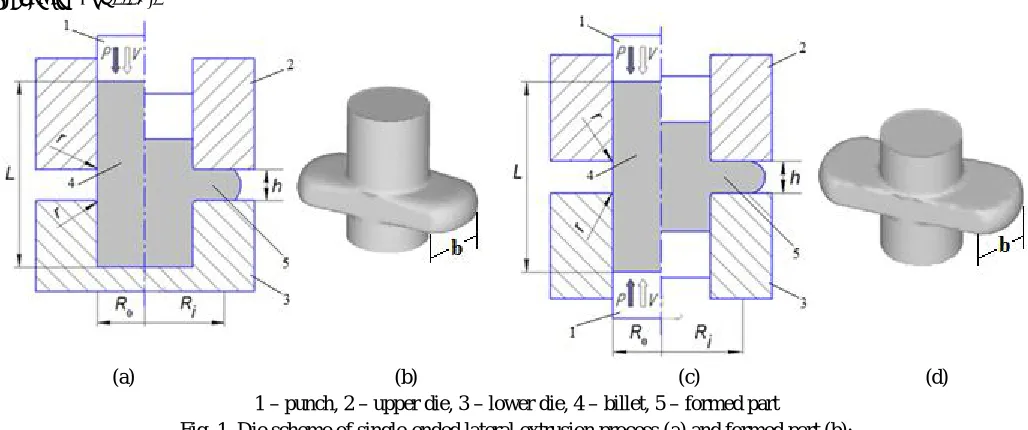
radius (r=1mm), V – punch velocity (V=1mm/s), P – punch load, , The friction factors between the billet and tools are constant
(Zibel's law, μ=0.08).
[image:3.612.48.562.98.313.2](a) (b) (c) (d) 1 – punch, 2 – upper die, 3 – lower die, 4 – billet, 5 – formed part
Fig. 1. Die scheme of single-ended lateral extrusion process (a) and formed part (b); die scheme of double-ended lateral extrusion process (c) and formed part (d)
V. MATERIALPROPERTY
In this study, the material used for the simulation is AA 6060 aluminum alloy. The relationship between flow stress and effective strain for AA 6060 aluminum alloy can be approximated by:
0.202
191.55 (MPa)
(1)
VI. ANALYSISOFLATERALEXTRUSIONPROCESS
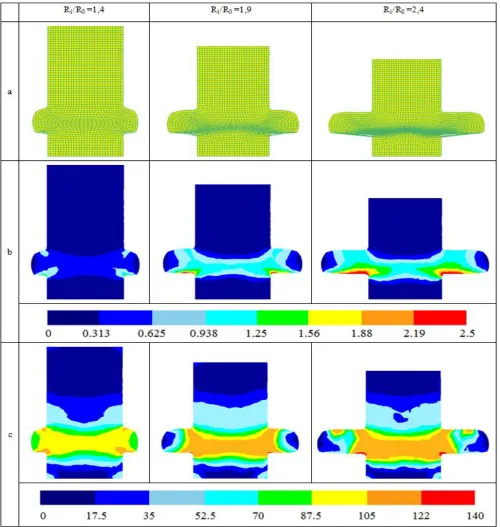
In the lateral extrusion process with branch, some tool parts such as upper, lower dies and movable punches have been used to design and simulate based on finite element software as DEFORM 3D. During the process simulations, it is seemed that the billet is rigid-plastic and upper, lower dies and punches are all rigid. The analysis is carried out in two stages. In the first stage, the simulation results such as finite element analysis illustrations are determined. In the second stage, after simulations, the influences of various parameters on the punch load during the forming processes are investigated. Deformation patterns (gridlines distortion), distributions of effective strain and stress in single-ended (Fig. 2) and double-ended (Fig. 3) lateral extrusion processes with relationship h/R0=0.75 are shown. It is observed in these figures that the maximum amounts will be in a relationship Ri/R0=2.4. The maximum deformation patterns are occurred in central area of the forming processes. In fig. 2 and 3, it can be seen that the effective strain and stress of the workpiece were symmetrical distributed in the processes. The maximum effective strain and stress are
calculated as follows: εmax =2.5, σmax =140MPa in single-ended (Fig. 2) and εmax =1.5,
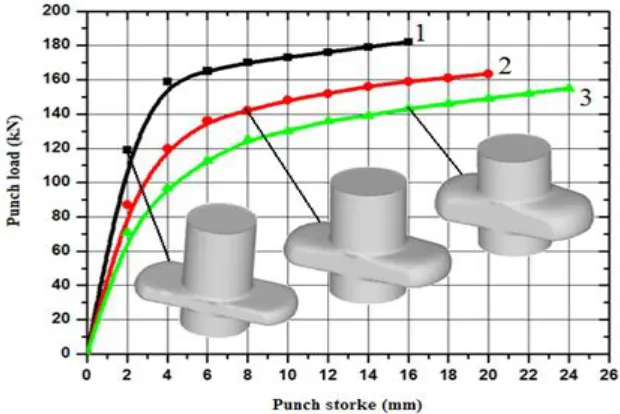
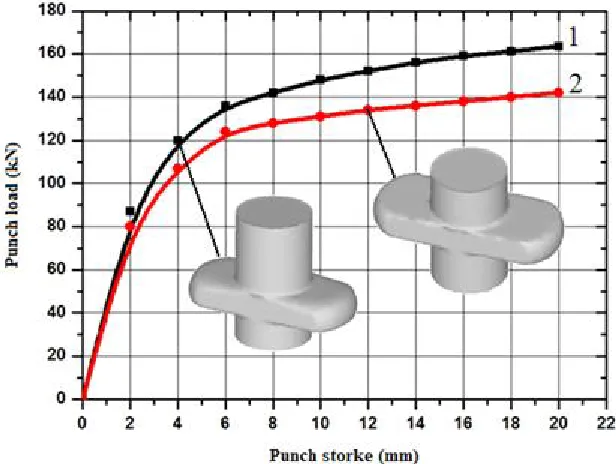
σmax =135MPa in double-ended (Fig. 3) processes. The variation of punch load with punch displacement (stroke) in single-ended process by using various relationships h/R0= 0.5, 0.75, 1.0 (Fig. 4) and comparisons of load–stroke curve between single-ended and double-ended processes with relationship h/R0=0.75 (Fig. 5) have been determined by finite element simulation. As shown in theses figures stiff rising of forming loads were commonly observed according to increase of the punch stroke. The predicted maximum forming loads of the punch are the following (Fig. 4): Pmax=182kN (h/R0= 0.5), Pmax=165kN (h/R0= 0.75), and Pmax=155kN (h/R0= 1.0). In fig. 5 it is observed that the maximum loads single-ended and double-ended processes were 165 and 142kN respectively. Thus it was construed that formability of the double-ended forming is better than that of the single-ended forming in terms of strain-stress distributions and forming load.
VII. CONCLUSIONS
for investigating the material flow, stress-strain state and variation of punch load. Deformation patterns (gridlines distortion), distributions of effective strain and stress in single-ended and double-ended lateral extrusion processes are shown. The variation of punch load with punch stroke in single-ended process and comparisons of load–stroke curve between single-ended and double-ended processes by using various relationships have been determined. Based on simulation results, the formability of the double-ended forming is better than that of the single-ended forming in terms of strain-stress distributions and forming load.
Fig. 3. Deformation patterns or gridlines distortion (a); distributions of effective strain (b); distributions of effective stress, MPa (c) with various stages Ri/R0 in double-ended lateral extrusion process
[image:5.612.150.460.491.698.2]Fig. 5. The punch load vs. the punch stroke in single-ended (1) and double-ended (2) lateral extrusion process with relationship h/R0=0.75
REFERENCES
[1] YS. Lee. S.K. Hwang. Y.S. Chang. B.B. Hwang. The forming characteristics of radial forward extrusion. J. Mater. Process. Technol. 103 (2001) 136-140. [2] Du Ko.B, D. Kim, S. Hyung, B.B. Hwang, The influence of die geometry on the radial extrusion processes. Journal of Materials Processing Technology, 113
(2001) 109-114
[3] H. Yang, M. Zhan, Y. L. Liu, F. J. Xian, Z. C. Sun, Y. Lin, X. G. Zhang, Some advanced plastic processing technologies and their numerical simulation [J]. Journal of Materials Processing Technology, 2004, 151:63-69.
[4] Altinbalik, T. and Y. can. An experimental study of lateral extrusion of splines. J. Mat. Des 2006..27:727-734
[5] Giuliano G., Process design of the cold extrusion of a billet using finite element method. Mater. Des. 28, 726-729, 2007.
[6] D. Y. Yang and K. J. Kim, Design of processes and products through simulation of three-dimensional extrusion, Journal of Materials Processing Technology, vol. 191, pp. 2-6,2007.
[7] Fu M. W., Yong M. S., Tong K. K., Danno A., Design solution evaluation for metal forming product development. Int. J. Adv. Manuf. Technol. 38, 249-257, 2008.
[8] L. N. Patra and S. K. Sahoo, 3D analysis of extrusion-forging process: Pentagonal head with round shaft. International Journal of Applied Engineering, vol 1, PP. 2-8, 2011.
[9] U. C. Paltasingh, S. K. Sahoo, P.R. Dash, K.C. Nayak. S. Potnuru, Lateral Extrusion for Round to-Triangular Head: Experimental Studies and Three Dimensional Analyses. International Journal of Research in Aeronautical and Mechanical Engineering, vol. 1(2), pp. 1-8, 2013.