Isolation, Partial Purification and Characterization
of Protease Enzyme from Proteolytic Bacteria from
Dairy Soil
Prakash Bhuyar1
1
Universiti Malaysia Pahang
I. INTRODUCTION A. Enzymes
Enzymes are very important and essential in all over the world because they have a wide range of physiological and industrial applications, mainly from microorganisms, because of their broad biochemical diversity, feasibility of mass culture and case of genetic manipulation. More than 300 enzymes have been identified and among them, protease and lipase have important role in industries. All the industrially important enzymes, proteases and lipases have a wide range of applications. (D.J. Mukesh Kumar, et al Mar 2012)Enzymes are very delicate protein molecules necessary for life. Proteases are essential constituents of all forms of life on earth including prokaryotes, fungi, plants and animals. Proteases are the most important group of the enzymes produced commercially and industrial purpose. This project was subjected to evaluate the presence of Protease bacteria in dairy soil.
B. Protease
As proteases are very important for living organisms, they are ubiquitous, found in a wide diversity of sources such as plants, animals and microorganisms. Proteases are photolytic enzymes which catalyze the hydrolysis of proteins based upon their structures or properties of the active site. (Gupta et al.,2002). A protease (also termed peptidase) is any enzyme that conducts proteolysis, which begins protein catabolism by hydrolysis of the peptide bonds that link amino acids together in the polypeptide chain to form the protein.(Amrita Raj, Nancy Khess, et. al 20 November 2012)
C. Classification
They are classified into various groups such as
1) Alkaline protease
2) Serine protease
3) Cystein protease
4) Aspartic protease and
5) Metallo protease. (V. Duraipandiyan Apr 2012)
D. Classification based on their acid-base behavior
1) Acid protease: Acid proteases perform best at pH range of 2.0-5.0 and are mostly produced by fungi.
2) Neutral protease: Proteases having pH optima in the range of 7.0 or around are called neutral proteases. Neutral proteases are mainly of plant origin.
3) Alkaline proteases: While proteases having optimum activity at pH range of 8 and above are classified as alkaline proteases. (Gupta et al., 2002).
E. Applications
They have extensive applications in a range of industrial products and processes including laundry detergents, brewing, food, pharmaceuticals and leather processing.
F. Proteolytic Bacteria
The genus “Bacillus”is an important source of industrial alkaline proteases (Ferrari et al., 1993; Kocher and Mishra, 2009). They are
widely distributed in soil and water. Bacteria are the most important alkaline protease producers with the genus Bacillus being the
most prominent source, because of their ability to produce large number of alkaline proteases having significant proteolytic activity and stability at high pH and temperature (Venugopal and Saramma, 2007).
The production of proteases by microorganisms is greatly influenced by media components, especially carbon and nitrogen sources, and by physical factors such as temperature, pH, incubation time, agitation and inoculums density. (C. Balachandran Apr 2012). Although protease production is an inherent property of all organisms, only those microbes that produce extracellular protease have been isolated commercially. Microbial enzyme production on an industrial scale was started by Takamine, in 1890, and started the
production of Takadiastase enzyme preparation which was mainly α-amylase preparation, but it contained a substantial amount of
protease (Aunstrup, 1980). Since the initiation of microbial enzyme production, many protease preparations took part in the market.
Although, verity of microorganisms were used to produce protease, the genus Bacillus have being so far the most important group
of enzymes produced commercially (Ferrero et al., 1996).
With respect to the factors affecting productivity and properties of the proteases, it was considered of interest to isolate new sources of protease, purify proteases and investigate the factors affecting their activity. In this paper my aim is to isolate newer source of protease producing bacteria from the dairy soil sample and partially purify protease and to study the factors affecting the activity to present potential application of the proteases for industrial applications.
II. REVIEW OF LITERATURE
In Bangalore soil samples were collected from various different places for isolation and Screening of protease producing strains of bacteria. The isolates show positive result on skim milk agar and selected as protease producing strain. The organisms were tested for various biochemical tests, for their identification as Bacillus subtilis producing protease enzyme. These Bacillus subtilisare grouped in two 40ºC and pH range 6-9 with optimal growth temperature and pH at 37ºC and 8.0 respectively. Enzyme production was carried in 1 litre of optimized media in the fermenter and fermented at 37ºC for 48 hours at pH 8.0. Finally the enzyme was purified by column chromatography. The protein was classified using SDS-PAGE. This result showed that Bacillus subtilisunder study is a good producer of extra cellular protease, which can be beneficial for industries. (Gitishree Das and M.P. Prasad 2010) In this study enzymatic characteristics of strain of Pseudomonas aeruginosa ATCC 27853 were determined. According to SDS-PAGE, and gel filtration, it was estimated that the molecular mass of the purified enzyme was about 15 kDa. Other enzymatic properties were found to be: pH optimum 7.1, pH stability between 6.5 and 10; temperature optimum around 60 °C while the enzyme was stable at 60 °C for 30 min. Inhibition of the enzyme was observed with metal chelators, such as EDTA and 1,10-phenanthroline, suggesting that the protease is a metallo enzyme. Furthermore, the enzyme contains one mole of zinc ion per mole of enzyme. The protease was stable in the presence of different organic solvents, which enables its potential Use for the synthesis of peptides. (LidijaIzrael, et al. Jan – Apr 2010)
Soil samples collected from different habitats such as tanneries, soap industries, garden soil and soil compost were screened for the presence of alkalophilic Bacillus isolates capable of producing alkaline protease in large quantities. One hundred and eighteen isolates were found having proteolytic activity on skim milk agar plates. Isolates forming larger zones, as a result of casein hydrolysis were further studied for quantitative production of extracellular alkaline protease activity in the shake flask studies. Isolate CEMB10370 gave maximum activity. Time course studies indicated that strain CEMB10370 had the highest protease activity (380 APU/ml) after 48 h of fermentation. The wild type enzyme was biochemically characterized. The enzyme exhibits optimal activity at 50°C and pH 11.5.The enzyme was purified by ion-exchange chromatography using CMSepharose column as a ~29 Kilo Dalton (kDa) protein. (Mohsin Ahmad Khan, Nadeem Ahmad,et al. 6 July 2011)
In this project 50 microbial strains were isolated from the soil samples from different regions of Andhra Pradesh. Among the isolates hyper producing strain namely, Bacillus Clausiiwas selected for alkaline protease production. The protease production efficiency of the organisms was measured with different environmental and nutritional parameters. The optimum fermentation conditions of production were temperature 400C, pH 8 and time 32H. Fructose, peptone and Copper sulphate helps very much for producing higher yields of the enzyme. (SwapnaVadlamani, Sreenivasa Rao Parcha, Sept17, 2011)
About forty six strains of action mycetes were isolated from the soil collected from Northern Himalayas, India to study their culture characterization, protease production and cytotoxic effects on cancer cell line (A549). Isolation of actinomycetes was performed by serial dilution plate technique. Forty six isolated actinomycetes cultures were grown in ISP 2 medium to study the morphology and biochemical characteristics. Isolated strains were studied for protease enzyme production in skim milk agar medium with solubilising capacity. Seven isolates were studied for melanin pigmentation and different NaCl concentration. Effects of environmental conditions on protease enzyme production of seven isolated strains were also studied at different pH, temperature and
metal ions (mercaptoethanol, MgSO4, CaCl2and EDTA). Seven isolates were also studied for lytic enzyme activity using different
bacteria and yeast such as Pseudomonas aeruginosa, Enterococcus feacalis, Escherishia coli, Candida albicans, Bacillus subtilis, Klebsiella pneumonia and Staphylococcus aureus. Conclusions are that Actinomycete being a protease producing bacteria has the potential for use in industrial purpose, pharmaceuticals, cytotoxic agent and its proteolytic activity. (C. Balachandran, V. Duraipandiyan, S. Ignacimuthu, Jan - Apr 2012)
This project is carried out in field nearer to Ravulapalem village, East Godavari district, Andhra Pradesh, India for isolation of about 25 types from different soil samples. On the basis of colony size, texture, and microscopic characteristics, the soil isolate were classified into ten types. In these, five isolates shows good proteolysis activity, three isolates showed moderate activity, two isolates showed poor activity, and eight isolates exhibited very poor activity. Structural, staining and biochemical activity results have results that four of five active enzyme producing bacteria are Bacillus spp, and one is Staphylococcus spp. One Bacterium has shown high Enzyme producing activity than the other. Estimation of enzyme producing activity of bacteria isolate was studied by Spectrophotometer. Based on the amount tyrosine released the protease activity was expressed in microgram of tyrosine released by 1 ml of enzyme in 30 minutes at 300C on tyrosine equivalent. (D.Narendra et al, July.2012)
Maharani Science College, Bangalore campus soil was collected, isolated the Bacillusspp. which producing protease enzyme. The optimum conditions required for cell growth and protease production were 37 °C in 24 h, agitation speed of 200 rpm and medium pH 7.0. The specific activity of protease obtained from ammonium sulphate precipitation is found to be 10 to 32 and the fractionation is 1.32 fold purified from the crude enzyme preparation producing 75.75% from the crude protein. The optimum temperature and pH required for the partially purified protease from Bacillusspp. is 40 °C and pH 7.0 resp. (Soundra Josephine1, Ramya V, et al, 2012)
Soil was collected and allowed for serial dilution using sterile distilled water. Totally 5 bacterial colonies are isolated, all the 5 shows clear zone in protease plate , particularly the strain SM3 exhibited clear zone around the colony on skim agar plates. Considering the macroscopic, microscopic, biochemical and physiological characteristics the strain was identified as Bacillus clausii SM3. It was seen that protease produced by Bacillus clausii SM3 had high capability of removing the blood stain, which indicates its potential in detergent industries. From this study it was came to be know that the study organism isolated from soil can be used as an effective source for the production of protease enzyme. (Hema. T. A and Shiny, July-August 2012)
Extra cellular alkaline protease producing species is an isolate from soil which was characterized and identified as Streptomyces pulvereceus MTCC 8374. Studies on submerged fermentation revealed that maximum level of enzyme production was during early stationary phase. Optimum pH, inoculum and temperature were 9.0, 3 percent and 33 C respectively. Among carbon sources 0.3 percent starch gave a maximum production followed by maltose, xylose and fructose. High yield of protease production was reported with 1.0 percent casein followed by soybean meal, yeast extract and malt extract. Further, it was optimized with 0.5 percent, 1.0 percentand 1.5 percent of NaCl among which 1 percent NaCl resulted in maximum level of protease. The protease profile of the isolate shows its potential as a good source for industrial application. (D.Jayasree, T.D. Sandhya Kumari, P.B. Kavi Kishor, et al.)
Indian soils are best for alkaline protease producing bacteria that resulted in isolation of 21 alkaline protease producing alkaliphilic bacterial strains. In this study screening was done from soil samples collected from black cotton soil, groundnut field, milk processing unit, Kotappakonda hill area in Guntur Dist, and Tirumala in Chittur District, A.P. Isolate was identified as Bacillus licheniformisby Microbial Type Culture Collection center (MTCC) and gene bank, Institute of Microbial Technology (IMTECH), Chandigarh, India. This strain was used to examine the changes in alkaline protease production following UV irradiation. Alkaline protease activity assay under submerged culture conditions was more accurate than the relative growth production method because there is no correlation between zone diameter and the ability to produce the enzyme in submerged cultures. High level of productivity increased with Bl8 mutant of B. licheniformis, indicating that the enzyme is to be thermo-alkaliphilic protease.
III. AIMS & OBJECTIVES A. Aim
Isolation, partial purification and characterization of protease enzyme from proteolytic bacteria from dairy soil.
B. Objectives
1) Collection of dairy soil.
2) Serial dilution of soil sample.
3) Screening of proteolytic bacteria on milk agar plate.
4) Identification of proteolytic bacteria.
5) Isolatio of protease.
6) Partial purification.
7) Characterization of protease.
IV. MATERIALS AND METHODOLOGY A. Soil Sample collection from dairy soil for isolation of Proease enzyme from Microbial sources –
The middle layer of dairy soil was collected from a Govt. Dairy, Miraj in sterilized sampling bags. The samples were brought in laboratory and processed for analysis on the same day.
B. Serial dilution of soil.
After soil collection soil is allowed for dilution. Serial dilution is carried out in test tubes. 5 gm of each soil samples was diluted with distilled water (50ml), serially diluted in order to reduce the initial number of microorganisms. These dilutions were then inoculated into alkaline agar media containing casein as substrate.
C. Screening of proteolytic bacteria on milk agar plate.
Protease production was optimized for the isolated bacteria. Optimization of organisms was carried out by varying concentrations of substrate casein (0.5-1.0 %) in the media with incubation period range of 12-72 hrs. The agitation speeds tested were at 60 and 140 rpm and the effect of temperature on protease production was studied by growing each organism in fermentation media set at
different temperatures (300, 400, 500 and 55ºC).
D. Identification of proteolytic bacteria.
All incubations were done at 37ºC and incubated in controlled-environment. The isolated colonies were transferred to alkaline broth. Different dilutions of above broth were streaked on Skim milk agar plates for testing the caseinolytic activity of the organisms. Bacteria were inoculated onto plates and incubated at 37ºC for 24 h. Strains that produced clearing zones in this medium were selected. Formation of halo zone around the colonies, resulting from casein hydrolysis, was taken as evidence of proteolytic activity. The colonies producing clearing zones by hydrolysis of skim milk were used as indication of an alkaline protease producer. The organism screened with casein agar plates were subcultured by continuously growing the bacterium in basal broth medium at 37ºC and subsequently streaking on basal agar medium
(2% agar-agar, 2 days at 37ºC).
Eventually, after several weeks of repeated selection and subculturing a pure culture of the bacterium was obtained. The resulting isolated colonies were sub cultured onto nutrient agar slants, grown at 37ºC for 24 h, maintained at 4ºC and sub cultured at an interval of four-weeks. The bacterial isolate with prominent zones of clearance was processed for the determination of morphology, gram characteristics, motility, citrate utilization, methyl red test, VP and indol tests, acid production from dextrose, lactose and sucrose, hydrogen sulphide test.
V. IDENTIFICATION
According to Burgeys Mannual, testes were carried out for identification of bacteria up to genus level. It was found that isolated strain will may be belongs to Genus Bacillus spp.
A) Study of culture, morphology and biochemical characteristics of proteolytic isolates
2) Motility: Motility was observed by Hanging drop method.
B) Biochemical Test
1) Hydrogen sulphide production: An inoculum from apure culture is transferred aseptically to a sterile triple sugar iron agar slant.
The inoculated tube is incubated as 35-37 0 C for 24 hrs. and the results are determined. Present in TSIA is an iron compound.
The iron ions (Fe2+ ) have a high affinity for sulfide ions. The result is that H2S combines with the iron to make FeS, as blank compound. In tubes of TSIA containing bacteria producing hydrogen sulfide, the agar turns black from the FeS.
2) Indole Test: To detect the ability of an organism to breakdown tryptophan to indole. Method – The culture was inoculated in sterile peptone water and incubated for 24 hours. After incubation the breakdown of tryptophan was analyzed by adding Kovac’s reagent.
3) Methyl Red Test: To test the ability of an organism to produce and maintain stable acid end products from glucose fermentation. Method – To MR - VP broth a loopful of culture was inoculated containing MR indicator and incubated for 24 hours.
4) Voges Prosakeurtest: To detect the production of acetylmethylcarbinol, a natural product formed from pyruvic acid in the course of glucose fermentation. Method – To MR - VP broth a loopful of culture was inoculated containing Barritt’s reagent and incubated for 24 hours.
5) Citrate utilization test: To determine if an organism is capable of utilizing citrate as sole carbon source for metabolism with resulting alkalinity. Method - Streak a Simmons’s Citrate agar plate with the organism and incubate at 37°C for 48 hours.
6) Gelatinaseliquefaction test : For this gelatin agar media was produced and bacterial suspension of isolated srain was spot
inoculated in the centre of medium plate and incubated at 370 C for 24 hrs. for the growth development. After incubation, HgCl2
is added and results in clear zone which indicated that this test is positive.
C. Isolation and production of protease.
1) Inoculum Preparation: The selected bacterial colony after it’s identification and characterization inoculated into the milk agar
medium. An incubated on shaker incubator at 350C for 7 days.
D. Production of enzyme
Milk brot was prepared for small scale production of Protease. For that following procedure was followed.
1) 100 ml sterile milk broth in flask was inoculated with bacterial culture.
2) Flask was kept on shaker incubator at 370 C for 6 days.
3) After that this broth was centrifuged at 10000rpm for 15 min at 40C.
4) Supernatant was collected and pellet was discarded.
5) The supernatant containing crude protease enzyme was taken and stored at 40C and used for further processes as required.
E. Partial purification.
1) Salting out technique: Purification of enzyme was carried out at lower temperature and the microorganisms were grown at 35ºC
for 2-4 days. The culture was centrifuged at 10000 g for 10 min at 4ºC and the supernatant was retained as the source of
extracellular enzyme. Ammonium sulphate saturation was carried out, to the cell free supernatant, solid ammonium sulphate (80% saturation) was added and centrifuged at 20000g for 20 mins at 4ºC.
2) Dialysis :Principle- Dialysis is a separation technique that facilitates the removal of small, unwanted compounds from macromolecules in solution by selective and passive diffusion through a semi-permeable membrane. A sample and buffer solution is placed on opposite sides of the membrane. Sample molecules that are then the membrane-pores are retained on the sample of the membrane, but small molecules and buffer salt pass freely through the membrane, reducing the concentration of those molecules in the sample. Changing the dialysis buffer removes the small molecules that are no longer in the sample and allows more contaminants to diffuse into the dialysate. In this way, the concentration of small contaminants within the sample can be decreased to acceptable or negligible levels. Method- After resuspension of precipitated phase in phosphate buffer, it was dialyzed for 24 h at 4ºC against the same buffer. The concentrated enzyme activity, protein content and specific activity was calculated.
copper sulphate was added in it and incubated for 30 min. The protein concentration of enzyme was determined by plotting graph of O.D vs concentration in µg.
4) Protease assay :The protease activity was determined with casein as a substrate following the procedure of Abidi et al (2008). The reaction mixture contained 50 microlitre of Tris-HCl buffer (pH 8.5), 2 mg/mL of casein, and 50 microlitre of enzyme
solution. The mixture was incubated at 30 0 C for 25 min and the reaction was stopped by the addition of an equal volume of
10% trichloroacetic acid. After centrifugation, absorbance of supernatant was read at 280 nm. One unit of proteolyticactivity was defined as the amount of enzyme which liberates digestion product not precipitated by trichloroacetic acid equivalent to 1
5) Ion exchange chromatography : Ion exchange chromatography involves two primary steps, first the binding of a protein to a charged resin and second the elution or displacement of the protein from the charges of the resin. Critical to the former are the pH of the buffer used to equilibrate and load the proteins onto the column. Factors that control the elution are pH or ionic strength. Common ion exchangers include the positively charged anion exchanger - DEAE (diethylaminoethyl) and the negatively charged cation exchanger - CM (carboxymethyl).
6) Procedure :10 ml column using the glass column was prepared, the pump and adaptor attached and allowed a 1-2 ml/min flow rate. Regenerated with a 25 ml wash High Salt Buffer (50 mM buffer at pH 7.5 plus 0.1M NaCl). Column equilibrated with the 50 – 100 ml of Equilibration Buffer (50 mM buffer at pH 7.5) Checked to the sample has more than 50 mMNaCl or KCl. If it does, it must be dialyzed overnight before using. If starting from lysates, no further preparation of the sample is necessary 36hrs. Save a sample of the lysates for later analysis. Freeze in a microfuge tube. Sample is loaded and 1-2 ml / min flow rate is maintained. Washed with 3 column volumes of Equilibration Buffer. Elute protein using either an isocratic (40 ml) or gradient elution (100 ml total). 5 ml fractions throughout this step was collected. Follow up with a High Salt buffer wash to remove any tightly bound proteins and regenerate your resin for the next use. 5 ml fractions throughout this step were collected. Each tube of or th protein for total protein concentration was analyzed.
The protein concentration was determined by
Protein conc. = O.D × Sample dilution
Extension coefficient × Pathlength O.D - Optical density at 280 nm
Extention coefficient - extinction coefficient of 1, so 1 OD = 1 mg/ml protein. Pathlength - When using a 1 cm cuvette, the pathlength is 1
Sample dilution – Dilution of sample done by 1 ml
Calculated Extinction Coefficients for proteins measured in a 1cm cuvette
Molecule Calculated Extinction Coefficient (mg/ml) cm-1
BSA .66 0.66
F. Reference
1) Maniatis T, Fritsch EF, Sambrook J. Molecular cloning a laboratory manual. Cold Spring Harbor Laboratory, Cold Spring
Harbor NY (1982).
2) Fasman G. Ed. Practical handbook of biochemistry and molecular biology. CRC press, Boston (1992
3) Gill, SC and von Hippel, PH. Calculation of protein extinction coefficients from amino acid sequence data. (1989) Anal.
Biochem 182:319-26.
G. Characterization of protease.
1) Effect of pH on Enzyme Activity: Effect of pH on the purified enzyme activity was measured at various pH ranges (4 – 10). The pH was adjusted using the following buffers- acetate (50mM) (pH 2.0- 4.0), phosphate (50mM) (pH 5.0-7.0), Tris-Cl (50mM) (pH 8.0) and glycine-NaOH (50mM) (pH 9.0-12.0) and the activity of the enzyme was measured at pH 4, 5, 6, 7, 8, 9, 10.
Temperatures ranging from 4, 10, 28, 37, 50 and 50°C were studied. The activity of the enzyme was measured as described previously.
VI. RESULT AND DISCUSSION
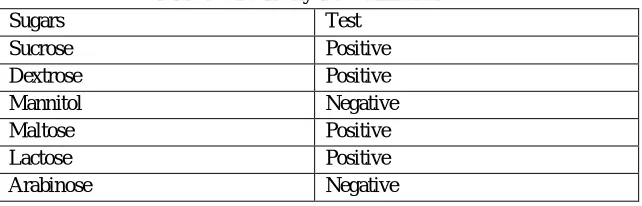
Protein degrading bacteria or proteolytic bacterial culture was isolated from dairy soil sample collected from dairy field area and selection of proteolytic bacteria from mixed culture was done by crowded plate technique on the basis of zone of Clarence. In this selection culture is purified and stock culture was maintained on nutrient agar slants. Isolation and Screening for protease producing organisms Isolates were initially screened based on zone of clearance on milk agar plates. The colony characteristics, Gram nature and motility of the proteolytic culture were studied. It is Gram positive rods in chain, motile in nature and colony characteristics and morphology was shown in table no. 1.The biochemical testes of proteolytic culture were also studied and there results were shown
in table no. 2 and 3. The enzyme production was observed between temperature 40 - 500C and pH 4.0-10.0 The highest enzyme
activity was observed at 370C, decrease in enzyme activity is observed with increase in temperature above 40 0C. The highest
[image:8.612.65.552.388.549.2]enzyme activity was obtained at pH 8. However, further increase in pH was not favorable on enzyme production. It was reported that proteases secreted by Bacillus sp. presented activity at a wide range of pH (7.0 to 9.0) and temperature (30°C to 40°C). Soil sample collected from dairy area. On the basis of colony size, texture, and microscopic characteristics, the isolates were categorized into 10types. Isolated bacterial strains were screened for protease producing ability on skim milk agar. The zone formation around the bacterial colony indicated the protease positive strain which may be due to hydrolysis of casein. Hence the strains were identified as a protease producer and it was taken for further experimental studies and biochemical test. The pictures of zone forming isolates are given below. Structural, staining and biochemical activity results have revealed that active enzyme producing bacteria are Bacillus spp.
Table No.1: Morphological characterization of proteolytic bacteria
Colony characteristics of well isolated colony, isolated on nutrient agar containing proteolytic bacteria incubated at room temperature for 24 hrs.
Sr. No Characters Culture
1 Size 2mm
2 Shape Circular
3 Color Pale yellow
4 Margin Regular
5 Elevation Flat
6 Opacity Opaque
7 Consistency Moist
8 Gram nature Gram positive rods in chain
9 Motility Motile
According to Burgeys Mannual , testes were carried out for identification of bacteria upto genus level.It was found that isolated strain will may be belongs to Genus Bacillus spp.
Table No.2Carbohydrate utilization test -
Sugars Test
Sucrose Positive
Dextrose Positive
Mannitol Negative
Maltose Positive
Lactose Positive
[image:8.612.147.468.617.720.2]Table No.3 Biochemical Tests
Hydrogen sulphide production Positive
Indole production Negative
Methyl red test Positive
VogesProskauer test Negative
Citrate utilization Positive
[image:9.612.51.558.197.412.2]Gelatinase test Negative
Table No.4Estimation of protein concentration by Lowery method.
Test tube
No.
BSA
(ml)
D/W
(ml)
Reagent C
(ml)
Keep in RT for 10 min.
Reagent D (ml)
Keep RT for 30 min.
O.D at
660nm
1 0.0 1 5 0.5 0.000
2 0.2 0.8 5 0.5 0.002
3 0.4 0.6 5 0.5 0.009
4 0.6 0.4 5 0.5 0.020
5 0.8 0.2 5 0.5 0.043
6 1.0 0.0 5 0.5 0.048
7(Unknown) 1 0.0 5 0.5 0.037
[image:9.612.155.460.459.729.2]Unknown – Dialyzed Sample
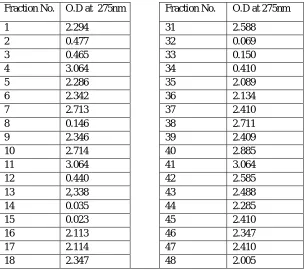
Table No.5 Ion Exchange Chromatography
Fraction No. O.D at 275nm Fraction No. O.D at 275nm
1 2.294 31 2.588
2 0.477 32 0.069
3 0.465 33 0.150
4 3.064 34 0.410
5 2.286 35 2.089
6 2.342 36 2.134
7 2.713 37 2.410
8 0.146 38 2.711
9 2.346 39 2.409
10 2.714 40 2.885
11 3.064 41 3.064
12 0.440 42 2.585
13 2,338 43 2.488
14 0.035 44 2.285
15 0.023 45 2.410
16 2.113 46 2.347
17 2.114 47 2.410
19 2.347 49 2.486
20 2.289 50 2.047
21 2.346 51 3.019
22 2.005 52 3.064
23 2.413 53 3.064
24 2.288 54 3.064
25 2.585 55 3.064
26 3.064 56 0.071
27 2.712 57 0.069
28 2.490 58 0.070
29 2.491 59 0.064
30 2.889 60 0.048
[image:10.612.207.403.279.727.2]The fraction number 35 to 55 Showed maximum value of O.D. Therefore they were pooled and stored further study.
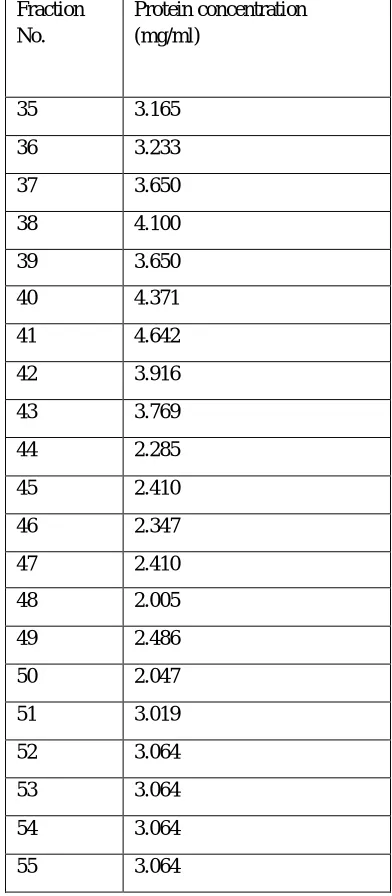
Table No.6 Estimation of protein concentration of IEC fraction Fraction
No.
Protein concentration (mg/ml)
35 3.165
36 3.233
37 3.650
38 4.100
39 3.650
40 4.371
41 4.642
42 3.916
43 3.769
44 2.285
45 2.410
46 2.347
47 2.410
48 2.005
49 2.486
50 2.047
51 3.019
52 3.064
53 3.064
54 3.064
Table No.7Determination of enzyme activity of IEC Fractions:-
Fraction No. Substrate
(ml)
50mM Buffer (ml)
Enzyme (µl)
Incubated For 10 min at Room temperature.
Enzyme activity at 275nm
35 0.5 0.5 20 0.004
36 0.5 0.5 20 0.017
37 0.5 0.5 20 0.024
38 0.5 0.5 20 0.037
39 0.5 0.5 20 0.034
40 0.5 0.5 20 0.021
41 0.5 0.5 20 0.016
42 0.5 0.5 20 0.010
43 0.5 0.5 20 0.021
44 0.5 0.5 20 0.010
45 0.5 0.5 20 0.024
46 0.5 0.5 20 0.016
47 0.5 0.5 20 0.023
48 0.5 0.5 20 0.031
49 0.5 0.5 20 0.034
50 0.5 0.5 20 0.037
51 0.5 0.5 20 0.058
52 0.5 0.5 20 0.054
53 0.5 0.5 20 0.052
54 0.5 0.5 20 0.061
55 0.5 0.5 20 0.063
Table No.8Effect of pH Test
tube
Substrate ( ml)
Buffer (ml)
pH Enzyme
(µl)
Incubating At RT For 10 min.
O.D at 275nm
1 0.9 1.5 4.0 100 0.070
2 0.9 1.5 5.0 100 0.100
3 0.9 1.5 6.0 100 0.100
4 0.9 1.5 7.0 100 0.040
5 0.9 1.5 8.0 100 0.180
6 0.9 1.5 9.0 100 0.020
The enzyme activity is maximum at pH 8.0 therefore we can interpret that the optimum pH for this enzyme is 8.0 at RT.
Table No.9 Effect of temperature Test tube Substrate ( ml) Buffer (ml) Temperature (0C)
Enzyme (µl)
Incubating At RT For 10 min.
O.D at 275nm
1 0.9 1.5 4.0 100 0.020
2 0.9 1.5 10.0 100 0.000
3 0.9 1.5 28.0 100 0.070
4 0.9 1.5 37.0 100 0.140
5 0.9 1.5 50.0 100 0.020
This experiment was performed at pH optima of enzyme determined earlier. According to observation table, the maximum activity
of enzyme was observed at 370C. Therefore 370C is the optimum temperature for protease.
Table No. 10 Determination of enzyme activity
Test tube Substrate
(ml) Buffer (ml) Enzyme (ml) Incubate for 10 min at RT TCA (ml) Incubate for 20 min at RT
OD at 275 nm
Enzyme Blank
1.0 1.5 - 0.2 0.000
Substrate Blank
- 2.0 0.5 0.2 0.000
Crude Sample
1.0 1.0 0.5 0.2 0.015
Dilaysed sample
1.0 1.0 0.5 0.2 0.037
IEC sample 1.0 1.0 0.5 0.2 0.063
As we purify the enzyme, the enzyme activity goes on increasing from crude enzyme sample to ion-exchange chromatography sample.
VII. CONCLUSION
Various bacterial isolates from soil were studied for protease producing activity. Proteolytic activity was measured for high enzyme producing strain. Structural, staining and biochemical activity results have revealed it is Bacillus spp. The isolate having higher protease activity was selected for biochemical characterization and identification. The organism was identified as Bacillus spp. Further, authentic identification in laboratory reveled that organism belongs to Bacillus spp. This is the report on alkaline protease production by Bacillus spp. The optimized conditions of the fermentation media can be implemented in large scale for production of alkaline proteases.
REFERENCES
[1] Anustrup, K. 1980. Proteinases. In: Rose, A.H. (Ed.), Economic Microbiology.Microbial Enzymes and Bioconvesions,Academic Press, New York., PP: 50– 114.
[2] Barrett A.J., Rawlings ND, Woessner JF. The Handbook of Proteolytic Enzymes, 2nd ed. Academic Press, 2003.ISBN 0-12-079610-4.
[3] Beg KB, Sahai V, Gupta R (2003). Statistical media optimization and alkaline protease production from Bacillus mojavensisin a bioreactor.Process Biochem.2003-2009.
[image:12.612.66.554.333.486.2][5] Duraipandiyan V, Sasi AH, Islam VIH, Valanarasu M, Ignacimuthu S. Antimicrobial properties of actinomycetes from the soil of Himalaya. J de MycologieMédicale 2010; 213: 6.
[6] Ferrari E, Jarnagin AS, Schmidt BF (1993).Commercial production of extracellular enzymes. In: Bacillus subtilisand other Grampositivebacteria.,American Society for Microbiology Washington D.C. 917-938.
[7] Frankena J, Koningstein GM, Verseveld HW, Stouthamer AH (1986)
[8] Effect of different limitation in chemostat culture on growth and production of extra cellular protease by Bacillus licheniformis.Applied Microbiol.Biotechnol.106-112.
[9] Godfrey, R. and West, M. 1996. Industrialenzymology, Mac Millan Publishers Inc,New York., PP:3–10.Gupta, R., Beg, Q.K. and Lorenz, P.2002.Bacterial alkaline proteases:molecularapproaches and industrial applications.Appl.Microbiol.Biotechnol.,59: 15-20.
[10] Jaouadi B, Abdelmalek B, Fodil D, Ferradji FZ, Rekik H, Zaraî N, et al. Purification and characterization of a thermostablekeratinolytic serine alkaline proteinase from Streptomyces sp. strain AB1 with high stability in organic solvents. BioresourceTechnol 2010; 101: 8361-8369.
[11] Pastor MD, Lorda GS, BalattiA(2001). Protease obtention using Bacillus subtilis3411 and amaranth seed meal medium at different aeration rates. Braz. J. Microbiol. 32: 1-8.
[12] Rao BM, Tanksale MA, Ghatge SM, DeshpandeVV(1998). Molecular and Biotechnological Aspects of Microbial Proteases.Microbiol.and Mol. Biol. Rev. 62 (3): 597-635.
[13] Singh, J., Vohra, R.M. and Sahoo,D.K.2004. Enhanced production ofalkaline protease by Bacillus sphaericususing fed-batch culture.ProcessBiochemistry.,39: 1093–1101.
[14] Tunga R, Banarjee R., and Bhattacharya, B.C.1998.Optimizing some factor saffecting protease production undersolid state fermentation.Biopro Eng.,19:87– 190.
[15] Yeng JK, Shih IL, Tzeng YM, Wang SL (2000). Production and purification protease from a Bacillus subtilis that can deproteinize crustacean wastes. Enzyme and Microbial. Technol. 26: 287-301
[16] Uyar F, Porsuk I, Kizil G, Yilmaz EI. Optimal conditions for production of extracellular protease from newly isolated Bacillus cereus strain CA15. Eur Asia J Bio Sci 2011; 5: 1-9.
Appendix
A. Composition of nutrient agar medium –
Peptone – 1 gm Beef extract – 0.3 gm NaCl – 0.5 gm Agar-agar – 2.5 gm D/W – 100 ml pH – 7.2
B. Composition of milk agar medium –
Peptone – 1.0 gm Meat extract – 0.3 gm NaCl – 0.5 gm Agar – 2.5 gm D/W – 95 ml pH – 7.2 Milk – 5 ml
C. Composition of peptone water broth –
Peptone – 1 gm NaCl – 0.5 gm D/W – 100 ml pH – 7.5
D. Reagent preparation –
(a) TCA – 110 mM
Commercial 0.9 gm TCA dissolved in 500 ml D/W.
(b) Folin’s reagent – 0.5 N
2.5 ml 2.0 N Folin’s reagent dissolved in 10 ml D/W
(c) Std. BSA solution – 1gm/1ml