2016 International Conference on Manufacturing Science and Information Engineering (ICMSIE 2016) ISBN: 978-1-60595-325-0
A Reliability Analysis of In-service Reinforced
Concrete Residential Structures
YUYING WANG, QIANG GAO and GUOPING ZHANG
ABSTRACT
Floor load and resistance of residential buildings, two important parameters for reliability analysis, pose direct influences upon the structural reliability. Based on the survey of floor live load of typical reinforced concrete residential buildings, strength of member materials, geometric parameters of reinforced concrete members and other resistance parameters, the reliability level of residential buildings is systematically studied, the standard value for floor live load and influences of the construction quality upon the reliability of residential buildings are analyzed, and primary causes of reduced reliability of reinforced concrete flexural members of residential buildings are obtained.
INTRODUCTION
Structure reliability can be defined as the probability that structures reach desired functions in the specified time and under specific conditions[1]. It’s being a dominant tendency for study and development of residential buildings in our country to research the structure reliability, improve the durability and practically guarantee the security of residential buildings. As important parameters for analyzing structure reliability, structural load and resistance are two direct influence factors. Through the investigation and statistic analysis of the floor live load of 100 households and 400 rooms in typical residential buildings in Chang Chun City, this paper studies its statistic parameters and probability distribution and, based on actual measurement and statistical analysis of material strength of newly-built residential buildings and geometric parameters of structural members, the variability of performances and geometric parameters of structural member
__________________________
Yuying Wang , Guoping Zhang, Civil College, Changchun Institute of Technology, Changchun, 130012, Jilin, China.
materials. On this basis, statistic parameters and reliability of the resistance of structural members as well as influences of the standard value for the floor live load upon the reliability of residential buildings are analyzed.
1 STATISTIC PARAMETERS OF STRUCTURAL MEMBER RESISTANCE OF RESIDENTIAL BUILDINGS
l.1 Indeterminateness of Structural Member Resistance
Resistance of structural members is not only the ability to resist effects of actions, including bearing capacity, rigidity and crack resistance etc. but also the bearing capacity in the reliability analysis of its ultimate state. Indeterminateness of resistance contains indeterminateness of material performances, indeterminateness of geometric parameters and indeterminateness of calculation mode. Generally, the resistance of structural members is a function of multiple random variables, so it is difficult to obtain statistical information of resistance directly and confirm the distribution pattern of statistical parameters and probability. Thus, statistical features and probability distribution of basic resistance parameters are confirmed through the statistic analysis of primary causes, and then statistical parameters of resistance and probability distribution mode are figured out using the functional relationship between resistance and influence factors.
Indeterminateness of the calculation mode of structural members refers to indeterminateness caused by the similarity basically assumed in the calculation of resistance and the uncertainty of the calculation formula, which is also called the error of the calculation mode. The indeterminateness of the calculation mode of structural members is expressed using random variable KP, namely[2]:
j z
P R /R
K (1)
Where, Rz is the actual resistance value of structural member, generally, it’s the experimental measured value or the accurate calculated value, and Rjis the value of the structure resistance which is figured out using a normal formula with the actual value of material performance and geometric dimensioning.
Statistical parameters of random variable KP for indeterminateness in the
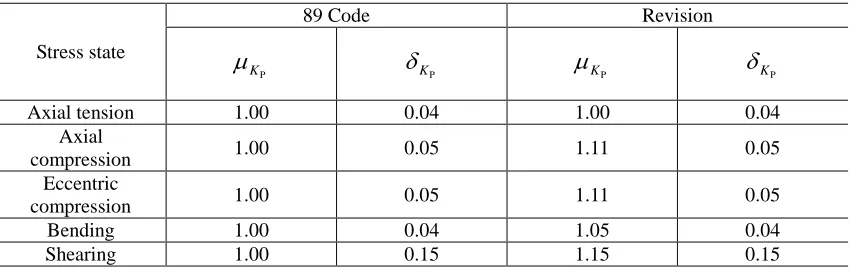
calculation mode are provided in Code for Concrete Structure Design[3]. Through the contrastive analysis of the old code and the new, statistical parameters of random variable KPfor calculating the indeterminateness of reinforced concrete
TABLE I. STATISTICAL PARAMETERS OF RANDOM VARIABLE KPOF REINFORCED CONCRETE STRUCTURAL MEMBERS.
Stress state
89 Code Revision
P
K
P
K
P
K
P
K
Axial tension 1.00 0.04 1.00 0.04
Axial
compression 1.00 0.05 1.11 0.05
Eccentric
compression 1.00 0.05 1.11 0.05
Bending 1.00 0.04 1.05 0.04
Shearing 1.00 0.15 1.15 0.15
l.2 Statistical Parameters Of Resistance Of Structural Members
Considering the indeterminateness of the calculation mode, the resistance of structural members is figured out using Equation (2):
) ( )
(t KPRP t
R (2)
Where, R(t) is the random process of resistance; KP is the random variable
of indeterminateness of the calculation mode; Rp(t) is the calculated resistance of
structural members. Obviously, the key of establishing the random process model of structure resistance is to determine the mean function and the standard deviation function of resistance. The standard deviation of resistance is figured out using the error propagation formula:
2
2 2
μ P
i
X
i i
R
X
R
(3)
Where, Xiis the random variable of RP, and R/Xiμis the value of the
partial derivative from the mean value.
According to the above method, Table II shows statistical parameters KR and
R
TABLE II. STATISTICAL PARAMETERS OF RESISTANCE ROF REINFORCED CONCRETE STRUCTURAL MEMBERS.
Stress state
89 Code Analysis result of measured
data
R
K R KR R
Axial tension 1.10 0.10 1.20 0.10
Axial compression 1.33 0.17 1.13 0.18
Micro-excentral compression (short
column)
1.30 0.15 1.15 0.17
Macro-excentral compression (short
column)
1.16 0.13 1.11 0.14
Bending 1.13 0.10 1.09 0.06
Shearing 1.24 0.19 1.68 0.22
2 STATISTICAL PARAMETERS OF LOAD OF RESIDENTIAL BUILDINGS
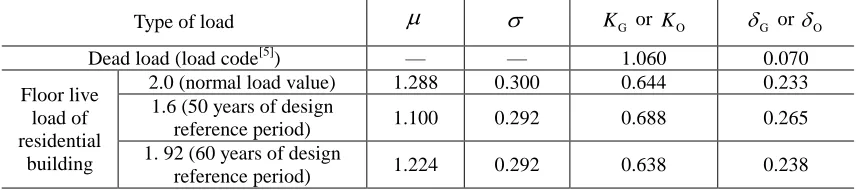
[4] shows the proposed value of the standard floor live load value of a design reference period of 50 years (1.6 kN/m2) and 100 years (1.92kN/m2). Table III shows major statistical parameters of residential structure load, K is the ratio between the average load value and the standard value.
Table III. STATISTICAL PARAMETERS OF LOAD OF RESIDENTIAL BUILDINGS.
Type of load KG or KO G or O
Dead load (load code[5]) — — 1.060 0.070
Floor live load of residential
building
2.0 (normal load value) 1.288 0.300 0.644 0.233
1.6 (50 years of design
reference period) 1.100 0.292 0.688 0.265
1. 92 (60 years of design
reference period) 1.224 0.292 0.638 0.238
3 INFLUENCES OF THE VALUE OF FLOOR LIVE LOAD UPON THE RELIABILITY OF RESIDENTIAL STRUCTURE
[image:4.612.93.523.462.557.2]The structural design is expressed using Equation[5]
G Q
R0 k k /
SG SQ Rk (4)
Where, 0 is structural importance factor, G is the dead load partial factor, SGkis
the standard value effect of dead load, Qis the partial factor of floor live load, k
Q
S
is the standard value effect of floor live load, Rk is the standard value of
structure resistance, and R is the partial factor of resistance.
When the ratio SQk /SGkbetween the standard value effect of the variable
load and that of the dead load changes, the value of reliability indexchanges. If is fixed, the absolute value of the load effect does not affect . Therefore, the specific design value is not required in the analysis of , various stress states in practical projects can be summarized with the ratio of the load effect as the variable parameter.
As per the standard value of the floor live load of residential buildings 1.60 kN/m2 and l.92kN/m2 respectively in a design reference period of 50 years and 100 years given in [l], and that in existing load codes 2.0kN/m2, corresponding to of 14 basic members and all load values is calculated, the mean value is the reliability index of each member. The computed results show that the mean value of of ductile failure members is higher than the target reliability index of ductility, while that of brittle failure members is higher than the target reliability index of brittleness; the standard value of the floor live load directly affects the reliability level of structure. As for the floor live load in a design reference period of 50 years, the proposed value 1.60kN/m2 can meet the requirements of the target reliability index, and the reliability index obtained is much higher than the target value.
4 RELIABILITY ANALYSIS OF REINFORCED CONCRETE BENDING MEMBERS
Bending members are major stressed members in concrete structure, damages will result in serious consequences. The reliability of residential structures is analyzed below with reinforced concrete bending member as an example.
[l] shows a random model of the resistance of reinforced concrete bending members, it’s visible that attenuation laws of resistance increase shortly and then decreases.
1 4 . 1 2 . 1 2 / 1 0 0 s y P PPR K f Ah
K
R (5)
As per the normative design structure, the reliability is independent of specific load value. According to the relation among the design value, the standard value and the mean value, the design can be translated into the mean value using Equation[7]:
y y 1 1.625
y s f f f
(6)
In case that 1/2 is fixed, the mean value and variable coefficient of resistance are figured out using Equation (7) and (8)
1 645 . 1 1 4 . 1 2 . 1 2 1 y 0 p 0 s y p 0 s R f h K h A fK (7)
2 2 2 2 2
R KP fy As h0
(8)
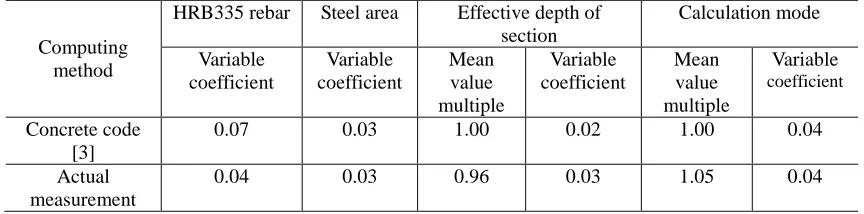
[image:6.612.91.523.499.606.2]The reliability of reinforced concrete bending members is calculated according to calculating parameters of resistance and statistical parameters given in Table IV, the results are shown in Table V.
TABLE IV. CALCULATING PARAMETERS OF REINFORCED CONCRETE BENDING MEMBERS.
Computing method
HRB335 rebar Steel area Effective depth of section Calculation mode Variable coefficient Variable coefficient Mean value multiple Variable coefficient Mean value multiple Variable coefficient Concrete code [3]
0.07 0.03 1.00 0.02 1.00 0.04
Actual measurement
TABLE V. COMPUTED RESULTS OF RELIABILITY OF BENDING MEMBERS.
Computing method
Mean
value of reliability
index
0.10 0.25 0.50 1.00 2.00
Concrete code [3]
3.611 4.167 4.323 4.152 3.972 4.045
Actual measurement
1.372 1.652 1.987 2.358 2.620 1.998
Table V shows that the reliability of bending member which is calculated according to the resistance obtained from investigation and statistics is obviously lower than that of normative design members due to differences between construction quality and design, as a result, the actual reliability of residential structures fail to reach the designed value.
5 CONCLUSIONS
(1) Different values of floor live load of residential buildings pose great influences upon the structure reliability analysis; the higher the value is, the higher the reliability index and the structure reliability level are.
(2) The structure resistance is lower than the design resistance as a result of construction quality, and the reliability level of reinforced concrete bending members is far lower than the target value. Thus, improving the construction quality is an important measure to guarantee the design reliability and safety of structure.
REFERENCES
1. Zhao Guofan and Jin Weiliang. 2000. “Structure Reliability Theory,” Beijing: China Building Industry Press, 65-75.
2. Li Jihua, Lin Zhongmin and Li Mingshun etc. 1990. “Design of Probability Limit State of Building Structure,” Beijing: China Building Industry Press.
3. Code for Concrete Structure Design (C;BJI0-89). 1990. Beijing: China Building Industry Press.
4. Niu Jiangang. 2004. “Investigation and Statistical Analysis of Floor Live Load of Typical Residential Buildings”. Xi'an University of Architecture and Technology.
5. Unified Standard For Reliability Design of Building Structure (GB50068 -2001). 2001. Beijing: China Building Industry Press.
6. Code for Concrete Structure Design (GB500102002), 2002. Beijing: China Building Industry Press.