A VALIDATED RP
*1,2
Pavan Kumar, D.,
1Naga Jhansi
1
Dr. Reddy’s Laboratories Ltd., Hyderabad 500 072, A.P., India
2GITAM Institute of Science, Gitam University,
ARTICLE INFO ABSTRACT
The objective of
chromatographic method for the quantitative determination of related substances of Abacavir sulfate. Reverse phase method was developed and optimized with chromatographic conditi
YMC Pack Pro C18, 150 mm x 4.6 mm, 3µ particle size, 0.05% Phosphoric acid in water as mobile phase A and 100% Acetonitrile as mobile phase Column flow fixed as 1.0mL/min in gradient mode. The column temperature was maintained at 45°C. Det
injection volume was 10 µL. Water and Acetonitrile in the ratio 90:10(v/v) was used as a diluent. The developed RP
LOQ values for
and 0.023 µg/mL to 0.076 µg/mL respectively.
from 92 to 112 % w/w. The test solution and mobile phase were observed to
preparation. The validated method produced good results of precision, linearity, accuracy, robustness and ruggedness. The proposed method was found to be suitable precise, sensitive and accurate for the quantitative determination
Copyright © 2018, Pavan Kumar et al. This is an open distribution, and reproduction in any medium, provided
INTRODUCTION
Abacavir sulfate is chemically known as ((1S, 4R) Amino-6-(Cyclopropylamine)-9H-purin-9-yl) cyclopent enyl) methanol Hemi sulfate, is a nucleoside reverse transcriptase inhibitor (NRTIs). It is used as either a 600 once-daily or 300-mg twice-daily regimen exclusively in the treatment of human immunodeficiency virus (HIV) infection (Ravitch, 2001). Mainly helps to halt the inroads of the human immunodeficiency virus (HIV). Without treatment, HIV gradually undermines the body's immune system by encouraging other infections to take hold until the body succumbs to full-blown acquired immune deficiency syndrome (AIDS). Initially, abacavir is phosphorylated to its corresponding monophosphate as intracellular reaction. Cytosolic enzymes convert Abacavir m
carbovir monophosphate (CBV-MP), which is finally phosphorylated to the biologically active moiety, carbovir triphosphate (CBV-TP). CBV-TP inhibits HIV reverse transcriptase by competing with the endogenous substrate dGTP and by chain termination subsequent to incorporation into the growing polynucleotide strand (Anil Yadav Nodagala 2013).
ISSN: 0975-833X
Vol. 10, Issue,
Article History:
Received 14th September, 2018
Received in revised form
26th October, 2018
Accepted 17th November, 2018
Published online 29th December, 2018
Citation: Pavan Kumar, D., Naga Jhansi, T., Srinivasa Rao, G. and Kirti Kumar Jain
International Journal of Current Research, 10, (12), 76072
Key Words:
Abacavir sulphate, Impurities, HPLC, UV Detector and Validation (3).
RESEARCH ARTICLE
A VALIDATED RP-HPLC METHOD FOR ABACAVIR SULPHATE
Naga Jhansi, T.,
2Srinivasa Rao, G. and
1Kirti Kumar Jain
Dr. Reddy’s Laboratories Ltd., Hyderabad 500 072, A.P., India
GITAM Institute of Science, Gitam University,
Beach Rd, Rushi Konda, Visakhapatnam, 530045
ABSTRACT
The objective of this study was to develop a robust, rapid and validated reverse phase liquid chromatographic method for the quantitative determination of related substances of Abacavir sulfate. Reverse phase method was developed and optimized with chromatographic conditi
YMC Pack Pro C18, 150 mm x 4.6 mm, 3µ particle size, 0.05% Phosphoric acid in water as mobile phase A and 100% Acetonitrile as mobile phase Column flow fixed as 1.0mL/min in gradient mode. The column temperature was maintained at 45°C. Detection wavelength was set at 220 nm and the injection volume was 10 µL. Water and Acetonitrile in the ratio 90:10(v/v) was used as a diluent. The developed RP-HPLC method was validated according to ICH guidelines. In this method the LOD and LOQ values for abacavir and all its related impurities were ranged from 0.004µg/mL to 0.013µg/mL and 0.023 µg/mL to 0.076 µg/mL respectively.The percentage recovery for all impurities was ranged from 92 to 112 % w/w. The test solution and mobile phase were observed to
preparation. The validated method produced good results of precision, linearity, accuracy, robustness and ruggedness. The proposed method was found to be suitable precise, sensitive and accurate for the quantitative determination of related impurities in the bulk samples of abacavir sulfate API
access article distributed under the Creative Commons Attribution the original work is properly cited.
Abacavir sulfate is chemically known as ((1S, 4R)-4-(2-yl) cyclopent-2-enyl) methanol Hemi sulfate, is a nucleoside reverse transcriptase inhibitor (NRTIs). It is used as either a 600-mg y regimen exclusively in the treatment of human immunodeficiency virus (HIV) infection Mainly helps to halt the inroads of the human immunodeficiency virus (HIV). Without treatment, HIV gradually undermines the body's immune system by uraging other infections to take hold until the body blown acquired immune deficiency syndrome (AIDS). Initially, abacavir is phosphorylated to its corresponding monophosphate as intracellular reaction. Cytosolic enzymes convert Abacavir monophosphate to MP), which is finally phosphorylated to the biologically active moiety, carbovir TP inhibits HIV reverse transcriptase by competing with the endogenous substrate nation subsequent to incorporation Anil Yadav Nodagala,
Side effects of this drug may cause
diarrhea, fatigue, fever or chills, generally ill feeling, headache/migraine, joint pain, mouth ulcers, muscle aches or weakness, nausea, rash, severe blisters in the mouth and eyes, severe peeling skin, shortness of breath, skin tin
burning, sleep disorders, sore throat, swelling, tiredness, vomiting (Ravitcph,, 2001 and
MATERIALS AND METHODS
Samples and reagents
The development samples of
impurities (FADCP, Descyclo propyl abacavir, Carbovir impurity, CABS1, Dihydro abacavir impurity, Side chain dimer impurity, Ethoxy impurity, O
Acetyl impurity and CABS2) were obtained from synthetic R&D laboratory of Dr. Reddy’s Laboratories Ltd., CTO and Srikakulam, India. Reagents used for analysis, i.e., phosphoric Acid (AR grade)
were obtained from Merck (India) Limited. Milli water was prepared with the Milli
system used (Huff, 1999 and
impurities were>95%. Details of purity are as foll International Journal of Current Research
Vol. 10, Issue, 12, pp.76072-76076, December, 2018
DOI: https://doi.org/10.24941/ijcr.33378.12.2018
Naga Jhansi, T., Srinivasa Rao, G. and Kirti Kumar Jain. 2018. “A validated rp-76072-76076.
Available online at http://www.journalcra.com
z
HPLC METHOD FOR ABACAVIR SULPHATE
Kirti Kumar Jain
Dr. Reddy’s Laboratories Ltd., Hyderabad 500 072, A.P., India
Beach Rd, Rushi Konda, Visakhapatnam, 530045
, A.P., India
this study was to develop a robust, rapid and validated reverse phase liquid chromatographic method for the quantitative determination of related substances of Abacavir sulfate. Reverse phase method was developed and optimized with chromatographic conditions as column of YMC Pack Pro C18, 150 mm x 4.6 mm, 3µ particle size, 0.05% Phosphoric acid in water as mobile phase A and 100% Acetonitrile as mobile phase Column flow fixed as 1.0mL/min in gradient mode. ection wavelength was set at 220 nm and the injection volume was 10 µL. Water and Acetonitrile in the ratio 90:10(v/v) was used as a diluent. The HPLC method was validated according to ICH guidelines. In this method the LOD and abacavir and all its related impurities were ranged from 0.004µg/mL to 0.013µg/mL The percentage recovery for all impurities was ranged from 92 to 112 % w/w. The test solution and mobile phase were observed to be stable up to 48 h after preparation. The validated method produced good results of precision, linearity, accuracy, robustness and ruggedness. The proposed method was found to be suitable precise, sensitive and accurate for the
of related impurities in the bulk samples of abacavir sulfate API (1)(2).
ribution License, which permits unrestricted use,
Side effects of this drug may cause abdominal pain, cough, diarrhea, fatigue, fever or chills, generally ill feeling, headache/migraine, joint pain, mouth ulcers, muscle aches or weakness, nausea, rash, severe blisters in the mouth and eyes, severe peeling skin, shortness of breath, skin tingling or burning, sleep disorders, sore throat, swelling, tiredness,
, 2001 and Nageswara Rao, 2011).
MATERIALS AND METHODS
The development samples of abacavir sulphate and all impurities (FADCP, Descyclo propyl abacavir, Carbovir impurity, CABS1, Dihydro abacavir impurity, Side chain dimer impurity, Ethoxy impurity, Pyrimidinyl impurity, O-Acetyl impurity and CABS2) were obtained from synthetic
of Dr. Reddy’s Laboratories Ltd., CTO-VI, and Srikakulam, India. Reagents used for analysis, i.e., Ortho and acetonitrile (HPLC grade) were obtained from Merck (India) Limited. Milli-Q grade water was prepared with the Milli-Q Plus water purification , 1999 and Salut, 2004). The purity of all
Details of purity are as follows,
INTERNATIONAL JOURNAL OF CURRENT RESEARCH
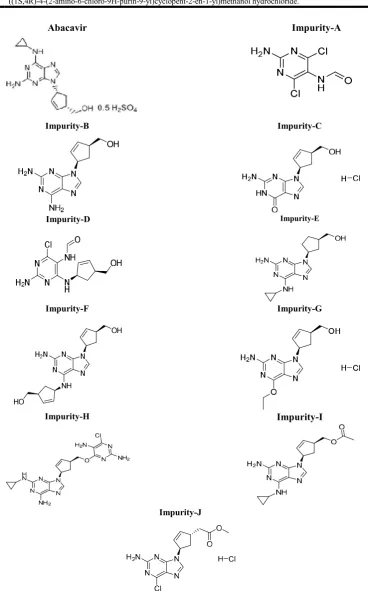
Table 1. Impurity chemical names
Name of the impurity Chemical name of the impurity
Impurity-A N-(2-Amino -4,6-dichloropyrimidin-5-yl)formamide
Impurity-B (1S,4R)-4-(2,6-Diamino-9H-purin-9-yl)-2-cyclopenten-1-methanol
Impurity-C 2-amino-9-((1R,4S)-4-(hydroxymethyl)cyclopent-2-en-1-yl)1H-purin-6(9H)-one hydrochloride
Impurity-D N-(2-Amino-4-chloro6(((1R,4S)-4-(hydroxymethyl))cyclopent-2-en-1-yl-) amino)pyrimidin-5-yl)formamide
Abacavir ((1S,4R)-4-(2-amino-6-(cyclopropylamino)-9H-purin-9-yl)cyclopent-2-en-1-yl) methanol. Hemisulphate
Impurity-E ((1S,4R)-4-(2-amino-6-(cyclopropylamino) -9H-purin-9-yl)cyclopentane-1-methanol
Impurity-F (1S,4R)-4-(2-amino-6-((1R,4S)-4-(hydroxymethyl)cyclopent-2-en-1-yl-) amino)-9H-purin-9-yl)cyclopent-2-en-1-yl)methanol
Impurity-G ((1S,4R)-4-(2-amino-6-ethoxy-9H-purin-9-yl)cyclopent-2-en-1-yl)methanol hydrochloride
Impurity-H N-6-cyclopropyl-9-((1R,4S)-4-((2,5-diamino-6-chloropyrimidin-4-yloxy)methyl) cyclopent-2-enyl) -9H-purine-2, 6-diamine
Impurity-I ((1S,4R)-4-(2-amino-6-(cyclopropylamino)-9H-purin-9-yl)cyclopent-2-en-1-yl)methyl acetate.
Impurity-J ((1S,4R)-4-(2-amino-6-chloro-9H-purin-9-yl)cyclopent-2-en-1-yl)methanol hydrochloride.
Abacavir Impurity-A
Impurity-B Impurity-C
Impurity-D Impurity-E
Impurity-F Impurity-G
Impurity-H Impurity-I
Impurity-J
Instruments
A Waters Model Alliance 2695-separation module (Waters corporation, Milford, MA, USA) equipped with a waters 2998-photo diode array UV detector was used. Data was processed through empower-3 software.
Chromatographic Conditions
The analysis was carried out on YMC Pack Pro C18, 150 mm x 4.6 mm, 3µ particle size (Advanced Chromatography Technologies., Scotland) with a mobile phase consisting of 0.05% Phosphoric acid in water as mobile phase A and 100% Acetonitrile as mobile phase B . The column temperature was maintained at 45°C. Flow rate was kept at 1.0 mL/min and the column eluent was monitored at 220 nm for 45 minutes. Water and Acetonitrile in the ratio of 90: 10 (v/v) is used as diluent (ICH Q1A, 2000).
Standard and Sample Preparation
Related substance by HPLC was performed with 0.25 mg/mL test concentration. Resolution in related substance, all the ten impurities are spiked 0.10% with respect to 0.25 mg/mL test concentration.
RESULTS AND DISCUSSION
Analytical method validation
Analytical method validation for the estimation related substance by HPLC of abacavir API was performed according to ICH guidelines on Validation of Procedures (Ravitch, 2001).
System Suitability Evaluation
Resolution between abacavir and impurity-D should not be less than 2.0.
Precision
Precision is a term used to describe data from an experiment that has been repeated several times. The precision of an analytical procedure expresses the closeness of agreement (degree of scatter) between a series of measurements obtained from multiple sampling of the homogeneous sample under the prescribed conditions.
Precision for Related Substance
The repeatability of the related substance method was checked by six-fold analysis by spiking all the ten impurities at LOQ
level as well 0.10% level in abacavir test sample. Study was also performed on different day with different analyst for the evaluation of inter day and intra-day variation and analyst. The % RSD of all individual impurity areas in each six preparations were found well within the set acceptance limit, which conforms that the method is precise. The results are tabulated in Table-4.
Limit of Detection and Limit of Quantification
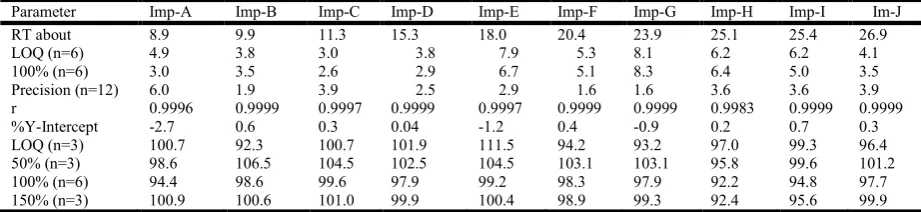
The quantitation limit (LOQ) of impurities and drug substance was determined by diluting known concentrations of each related substance and abacavir until the average responses were approximately ten times the SD of the responses. Table 2. System Suitability Results
Parameter Resolution Between Abacavir and impurity-D
System Suitability 2.39
Robustness
Flow Variation (0.8 mL/min) 1.8
Flow Variation (1.2 mL/min) 4.0
Column Temperature Variation (40º C) 3.5
[image:3.595.86.515.274.626.2]Column Temperature Variation (50º C) 2.5
Table 3. LOD and LOQ results
Name of the impurity LOD (µg/mL) LOQ (µg/mL)
Impurity-A 0.0227 0.0757
Impurity-B 0.0038 0.0127
Impurity-C 0.0118 0.0392
Impurity-D 0.0112 0.0374
CABS4 0.0039 0.0130
Impurity-E 0.0077 0.0255
Impurity-F 0.0054 0.0180
Impurity-G 0.0077 0.0255
Impurity-H 0.0075 0.0251
Impurity-I 0.0031 0.0255
[image:3.595.65.526.514.620.2]Impurity-J 0.00616 0.0205
Table 4. Validation Data
Parameter Imp-A Imp-B Imp-C Imp-D Imp-E Imp-F Imp-G Imp-H Imp-I Im-J
RT about 8.9 9.9 11.3 15.3 18.0 20.4 23.9 25.1 25.4 26.9
LOQ (n=6) 4.9 3.8 3.0 3.8 7.9 5.3 8.1 6.2 6.2 4.1
100% (n=6) 3.0 3.5 2.6 2.9 6.7 5.1 8.3 6.4 5.0 3.5
Precision (n=12) 6.0 1.9 3.9 2.5 2.9 1.6 1.6 3.6 3.6 3.9
r 0.9996 0.9999 0.9997 0.9999 0.9997 0.9999 0.9999 0.9983 0.9999 0.9999
%Y-Intercept -2.7 0.6 0.3 0.04 -1.2 0.4 -0.9 0.2 0.7 0.3
LOQ (n=3) 100.7 92.3 100.7 101.9 111.5 94.2 93.2 97.0 99.3 96.4
50% (n=3) 98.6 106.5 104.5 102.5 104.5 103.1 103.1 95.8 99.6 101.2
100% (n=6) 94.4 98.6 99.6 97.9 99.2 98.3 97.9 92.2 94.8 97.7
150% (n=3) 100.9 100.6 101.0 99.9 100.4 98.9 99.3 92.4 95.6 99.9
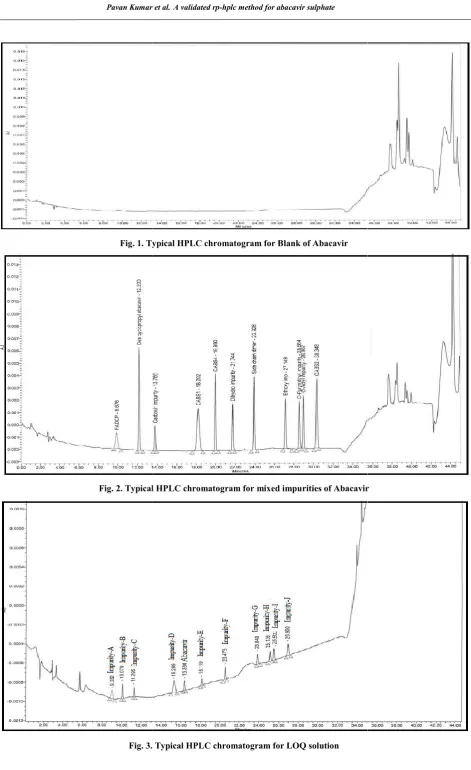
Fig. 1. Typical HPLC chromatogram for Blank of Abacavir
Fig. 2. Typical HPLC chromatogram for mixed impurities
Fig. 3.
Typical HPLC chromatogram for Blank of Abacavir
Fig. 2. Typical HPLC chromatogram for mixed impurities of Abacavir
The detection limit (LOD) of impurities and drug substance was determined by diluting known concentrations of each related substance and abacavir until the average responses were approximately three times the SD of the responses. The LOQ values were conformed by performing precision and accuracy at LOQ level verification. The LOD and LOQ values of impurities are as tabulated below. The % RSD of percent area of all the impurities in six preparations at LOQ concentration were found within the acceptance limit, which conforms that the method is precise at LOQ Concentration. The results are tabulated in Table-3. The percentage recovery of each impurity ranged from 90 to 105, those values are listed in the Table-4. Recovery all the impurities are well within the acceptance limit, which confirms that method is accurate at LOQ level.
Linearity
Linearity of the response for all the impurities was carried out from limit of quantification (LOQ) to 150% concentration of the analyte concentration 0.25mg/mL. Peak responses for all impurities were recorded and plotted the calibration curve for each impurity concentration verses response, the correlation coefficient obtained for each impurity was greater than 0.999 and results are listed in Table-4.
Accuracy
Known amount of each impurity is added in abacavir test sample and recovery experiments were conducted to determine the accuracy of the method for the quantification of all impurities. The study was carried out in triplicate at LOQ, 0.05%, 0.1% and 0.15% of the analyte concentration (0.25 mg/mL) and calculated the percentage recovery of all the ten impurities. The percentage recovery of each impurity was with in the acceptance limit, which confirms that proposed method was accurate. Values are listed in the Table-4.
Robustness
To determine the robustness of the method, chromatographic parameters are modified and the evaluated the change of resolution between abacavir and impurity-D. Experiments are conducted by varying the flow by ± 10% and column temperature by ±5ºC. Resolution between abacavir and impurity-D is established the robustness of the method. Data is evaluated in the Table-2.
Solution Stability
The solution Stability of abacavir and its impurities in related substance method was carried out by spiking impurities at 0.1% level. All solutions which are prepared in volumetric flask were tightly capped and kept at room temperature for 48 hours. Content of all the impurities were determined initially, after 24hours and after 48hours. Results were indicated the sample solution is stable up to 48hours. Mobile Phase solution stability was also established for abacavir related impurities with fresh sample solutions and holding the mobile phased for 48 hours. Freshly prepared sample solutions were analyzed initially, after 24 hours and after 48 hours with initially prepared mobile phase. Results were indicated the mobile phase solution is stable up to 48hours.
Conclusion
The LC method developed for quantitative and related substance determination of abacavir sulphate is precise, accurate, linear and specific. The method was fully validated, and the data found to be satisfactory for all the method validated parameters tested. The developed method can be conveniently used to determine the related substance and the assay of regular abacavir commercial samples.
Acknowledgements
The authors wish to thank the management of Dr. Reddy’s Laboratories Ltd., for permitting this work to be published. Cooperation extended by all the colleagues of Analytical R&D, CTO-VI QC, and Process R&D division, is gratefully acknowledged.
REFERENCES
Anil Yadav Nodagala, Mangamma, K., Mani Kumar, G., Venkata Rao, D.; Analytical method development and validation by RPHPLC for the simultaneous estimation of Abacavir Sulphate and Lamivudine in tablet dosage forms;
International Journal of Pharmaceutical, Chemical and
Biological Sciences. 2013, 3(3): 538-545.
Aymard, G., Legrand, M., Trichereau, N., Diquet, B.; Determination of twelve antiretroviral agents in human plasma sample using reversed phase high performance liquid chromatography; Journal of Chromatography B.
2000, 744: 227 – 240.
Huff, J. R.; New drugs- Reports of new drugs recently approved by the FDA; Bioorganic & Medicinal Chemistry.
1999, 7: 2667- 2669.
ICH Q1A (R2), Stability Testing of New Drug Substances and Products, 2000.
Nageswara Rao, R., Mastan Vali, R., Ramchandra Bondigalla, Satyanarayana Raju, S.; Separation and characterization of forced degradation products of abacavir sulphate by LC-MS/MS; Journal of Pharmaceutical and Biomedical
Analysis. 2011, 54: 279-285.
Ravitch, J.R., Moseley, C.G.; High performance liquid chromatographic assay for abacavir and its two major metabolites in human urine and cerebrospinal fluid;
Journal of Chromatography B. 2001, 762: 165 – 173.
Ravitch, J.R., Moseley, C.G.; High performance liquid chromatographic assay for abacavir and its two major metabolites in human urine and cerebrospinal fluid;
Journal of Chromatography B. 2001, 762: 165 – 173.
Ravitch, J.R., Moseley, C.G.; High performance liquid chromatographic assay for abacavir and its two major metabolites in human urine and cerebrospinal fluid;
Journal of Chromatography B. 2001, 762: 165 – 173.
Salut, M. F., Pilar, M., Cecilia, F. L., Eduardo, L. M.; Determination of abacavir in human plasma by high-performance liquid chromatography with ultraviolet detection and the analytical error function; Biomedical
Chromatography. 2004, 18: 862 – 865.
Sudha, T., Ravikumar, V. R., Hemalatha, P.V.; RP-HPLC method for the simultaneous estimation of Lamivudine and Abacavir Sulphate in Tablet Dosage form; International Journal of Pharmaceutical and Biomedical Research.
2010, 1(14): 108-113.