Abstract
Association of Oral and Systemic diseases has gained importance because the high occurrence of oral dis-eases is an extremely common source of infection. Epidemiological Studies have presented periodontal eases as a risk factor for development of cardiovascular dis-eases. A chronic oral infection such as periodontitis is a constant potential source of infection and has now been con-sidered as a separate risk factor for cardiovascular diseases, cerebrovascular diseases, peripheral arterial disease and res-piratory diseases as well as delivery of low-birth-weight infants.
The possible pathways linking oral infections to sys-temic diseases are metastatic infections, bacterial endotox-ins, and systemic vascular injury. People with a history of periodontal disease and/or tooth loss were found at higher risk for Peripheral arterial disease (PAD) as compared to those without periodontal disease and/or tooth loss.
All studies on the relationship of periodontal dis-eases to cardiovascular disdis-eases are inconclusive and most of the data is based on epidemiological studies.
Introduction
Epidemiological Studies have presented periodon-tal diseases as a risk factor for development of cardiovas-cular diseases. The association between oral infection and systemic diseases is not a new one. Chronic oral infec-tions such as periodontal diseases are a constant potential source of infection. The oral cavity and oropharynx have been described as an "open mouth system" for bacteria and other organisms to adhere to both shedding (soft tis-sues) and non-shedding (teeth, restorations, dentures) sur-faces.1The mouth serves as a mirror of health or disease,
as an essential or early warning system, as an accessible model for the study of other tissues and organs and as a potential source of pathology affecting other system and organs.2 The most common diseases of oral cavity are
dental caries and periodontal diseases and are taken as measures of oral health status. Periodontitis, periapical lesions, pericoronitis, and abscesses are the possible sources of infection in the oral cavity. Many systemic dis-eases, such as diabetes mellitus, cardiovascular disdis-eases,
respiratory diseases and low-birth-weight infants are related to oral infections. More recently epidemiological studies have presented periodontal diseases as a risk fac-tor for the development of Cardiovascular (CHD), cere-brovascular diseases (Stroke), and Peripheral arterial dis-ease (PAD) and this relationship has been reviewed here. Association of Oral Infection to Systemic diseases Herzberg quoted the Assyrians who proposed the effect of oral health on the rest of the body as early as the seventh century B.C.3 "Focal infection theory" was published in
1891 suggesting that microorganisms or their waste prod-ucts gain entrance to parts of the body adjacent to or remote from the point of entry.4Other proponents of this
theory blamed oral foci of infection for a number of regional and systemic diseases, ranging from tonsillitis and middle ear infections to pneumonia, tuberculosis, syphilis, osteomyelitis, endocarditis, meningitis, and sep-ticemia.4The "Focal infection theory" was not given any
attention until recent progress in identification and char-acterization of periodontal pathogens, as well as elucida-tion of potential systemic mechanisms of acelucida-tion of bacte-rial products and inflammatory cytokines. This has opened the way for a more realistic assessment of the sys-temic importance of periodontal disease. Studies have lent credence to the concept that periodontal disease may be a separate risk factor for cardiovascular disease, cere-brovascular disease and respiratory disease, as well as delivery of low-birth-weight infants.5-8 However the
important issue is that oral infections often are only one of the many confounding factors that can influence sys-temic diseases.4
Periodontal diseases
Periodontal diseases have been prevalent throughout human history, although without the obvious secular variations.9
Research and clinical evidence indicated that the damage caused to the supporting structures of the teeth by periodon-tal disease in early adult life is irreparable, whilst in the middle adult life it destroys a large part of the natural denti-tion and deprives many people of all their teeth long before old age. The effects of periodontal disease on the
Review Article
The Relationship of Periodontal Disease to Cardiovascular
diseases - Review of Literature
S.Akhtar Hussain Bokhari1, Ayyaz A. Khan2
general health of the population are un-assessable.10
Inflammatory periodontal diseases constitute probably the most common infections in the world. Gingivitis is present in the great majority of adults throughout the world but is most pronounced in developing countries. Moderate odontitis affects approximately 30% and advanced peri-odontitis approximately 10% of the adult populations of USA. Deep pockets are present in 2-18% of adults in west-ern countries and at higher prevalence in developing coun-tries.11
Periodontal diseases are currently thought to progress in periodic, relatively short episodes of rapid tissue destruc-tion. Some people have frequent episodes of active disease at many sites in their mouth, while others experience far less active disease with signs of gingivitis and may be some pockets but no loss of attachment over long periods. Its ini-tiation and progression is influenced by a wide variety of determinants and factors, including subject characteristics, social and behavioral factors, systemic factors, genetic fac-tors, tooth -level facfac-tors, microbial composition of dental plaque and other emerging factors.12Because periodontal
disease is common in the populations, it may account for a significant portion of the proposed infection-associated risk of CVD. Interestingly periodontal diseases share a number of characteristics; old age, smoking, low education status, diabetes and stress, all common with cardiovascular dis-eases.13
Cardiovascular Diseases (CVD)
Cardiovascular Diseases (CVD) make up the most prevalent category of systemic diseases in developed as well develop-ing countries and are increasdevelop-ing with age.14
World Health Organization statistics in 1995 indicated that CVD were responsible for 20% of deaths worldwide and in some developing countries accounted for 50% of deaths.15
CVD has contributed to a third of global deaths. The low and middle-income countries were responsible for 78% of CVD deaths in 1999. By 2010 CVD is estimated to be the leading cause of death in developing countries.
1. Periodontal disease and Cerebrovascular Disease-Stroke
The relationship of periodontal disease to ischemic stroke has been evaluated in a number of studies. The outcome is different across the reported studies, ranging from total stroke to fatal stroke, nonfatal stroke and ischemic stroke.5,6,16 The study of Beck and colleagues compared
men who had any type of stroke with men who did not develop CVD during the follow up. They found a signifi-cant association between periodontal disease and total stroke: relative risk (RR) of 2.80.5Wu and colleagues found
a possible association between periodontal disease and
ischemic stroke (RR=2.11); the risk was even higher when limited to fatal stroke.16 Although studies have shown an
association between tooth loss or periodontal disease and stroke, no two studies are consistent in defining the outcome and exposure. Hence, no association has been truly replicat-ed. It is difficult to rule out residual confounding variables, as there are several common risk factors.17
2. Periodontal disease and Coronary Heart Disease (CHD)
Periodontal disease is a chronic infection and may be asso-ciated with inflammatory systemic conditions. A number of studies provided a significant data and statistics to suggest and support the relationship of periodontal disease to car-diovascular diseases. Most of the risk factors for cardiovas-cular disease are also regarded as risk factors for periodon-tal disease.18
Mattila et al suggested a statistical association between severity of coronary stenosis and dental tions. Data are compatible with hypothesis that oral infec-tions might play a role in the development of adverse car-diovascular outcomes. Studies conducted by Beck et al and Arbes et al also provided some support to the hypothesis that periodontal disease and tooth loss might play a role in the development of CHD.18,19However likelihood of
con-siderable residual confounding remains there in all these studies.
Hujoel et al presented a negative association between periodontal disease and subsequent CHD in first National Health And Nutrition Examination Surveys (NHANES-I) longitudinal study with a 21 years follow-up.20
Periodontal disease and Peripheral Arterial Disease (PAD)
PAD shares a common underlying pathological change, ath-erosclerosis, with coronary heart diseases and stroke. Very few studies have been reported on the relationship of peri-odontal disease to PAD.
In a cohort study of 51529 health professionals aged 40-75 including 29683 dentists conducted between 1986-1998, tooth loss and periodontal disease experience was recorded through self reported biennial questionnaires.21A
periodontal diseases or any tooth loss during follow-up had a significantly higher risk of PAD than men without any periodontitis or without any tooth loss. Incident tooth loss was significantly associated with PAD, especially among men with periodontal diseases. In a follow up study on 1030 subjects of 25-30 years, Mendez et al reported that subjects with clinically significant periodontal disease at baseline had a relative risk of 2.27 of having PAD.22
Mechanism for the proposed Periodontal infection and CHD / Stroke association
Infection has been recognized as a risk factor for atheroge-nesis and thromboembolic events.22Gram-negative bacteria
or the associated lipopolysacchride (endotoxin), when pre-sented as a systemic challenge in animal models, can induce inflammatory cell infiltration into major blood vessels, vas-cular smooth muscle proliferation, vasvas-cular fatty degenera-tion and intravascular coaguladegenera-tion. The remarkable
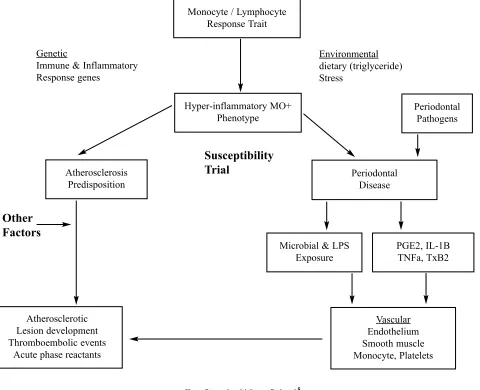
similar-ities of bacterially induced vascular pathology, natural his-tory of atherogenesis has led certain investigators to suggest that, in addition to genetic, lifestyle and dietary influences, infections of unknown origin may contribute to the observed cardiovascular pathology. The chronic inflamma-tory burden of periodontal infection and the host response provide the bases for our hypothetical model of the observed associations between periodontal disease and ath-erosclerosis, coronary heart disease and stroke. The concep-tual model is explained through Figure1.5 This model
emphasizes that among certain individuals there may be an underlying hyperinflammatory trait in response to stimuli that is manifest by an excessive production of pro-inflam-matory cytokine and lipid mediators by monocytes and other cell types.23
[image:3.612.64.544.37.427.2]Four potential mechanisms by which periodontal infections might contribute to the pathogenesis of CHD and
Figure. Proposed model. Source: Beck et al.5
LPS: Lipopolysacchride; PGE2: Prostaglandin E2; IL-1ß: inter-leukin 1ß; TNFa: Tumor Necrosis factor a; TxB2 : thromboxane B2 Monocyte / Lymphocyte
Response Trait
Hyper-inflammatory MO+ Phenotype Genetic
Immune & Inflammatory Response genes
Environmental dietary (triglyceride) Stress
Periodontal Pathogens
Periodontal Disease Atherosclerosis
Predisposition
Microbial & LPS Exposure
PGE2, IL-1B TNFa, TxB2
Atherosclerotic Lesion development Thromboembolic events
Acute phase reactants
Vascular Endothelium Smooth muscle Monocyte, Platelets
Other
Factors
stroke have gained importance. 1) Effects of Endotoxins in the circulation, 2) Role of heat shock proteins, 3) Infection-induced perturbations in lipid profiles, and 4) Formation of acute-phase reactants.
1. Effects of endotoxins in the circulation
The microflora associated with periodontal infections is a rich source of endotoxins, which are lipopolysacchride (LPS) components of the cell walls of all gram-negative bacteria. Entry of endotoxins into the circulation can occur from many sources including respiratory infections (C. Pneumonae), gastric ulcers (H.Pylori), and periodontitis (P. gingivalis, A. actinomycetemcomitans, B. forsythus, etc). Once endotoxins enter the circulation they present a consid-erable threat to the well-being of the host. They can direct-ly injure endothelial cells24, promote adhesion of monocytes
to endothelium21, induce macrophage foam cell
forma-tion25, and cause general endothelial dysfunction.26All of
these effects play a significant role in the initiation and development of atherosclerosis.27One of the primary
fea-tures of acute occlusion of vessels in CHD and Stroke is the disruption of existing atherosclerotic plaques by macrophage-mediated inflammation.28
2. Role of heat shock proteins
Heat shock proteins (Hsp) are produced by a wide variety of bacteria and human cells under a variety of stressful or harsh conditions such as high temperature, infection, inflammation, and mechanical stress.29It is well established
that endothelial cells produce Hsp under stressful conditions such as exposure to endotoxins.30
3. Infection-induced perturbations in lipid profiles It known from some studies that hyperlipidemia frequently accompanies many bacterial infections.27 Low doses of
endotoxins cause a rapid rise in serum triglycerides due to an increase in triglyceride-rich very-low-density lipoprotein (VLDL).31Hyperlipidemia may have negative effects such
as promoting the release of proinflammatory cytokines from neutrophils. It is interesting to note that hyperlipidemia occurs during periodontal infections.32Cytokines like IL-I ,
IL-6, and TNF- have been implicated as risk factors for CHD and prolonged hyperlipidemia is likely to have delete-rious clinical effects.33
4. Formation of acute-phase reactants
Acute phase reactants appear in the circulation in response to infections and tissue injury. C-reactive protein (CRP) is of particular interest since at "high -normal" levels it has been shown to be an important risk factor for CHD and is also elevated in patients with extensive periodontal dis-ease.34It remains to be determined if CRP elevations
occur-ring duoccur-ring periodontal infections play a role in atheroscle-rosis.
Conclusion and Recommendations
The findings of epidemiologic studies conducted on the relationship of periodontal disease to cardiovascular dis-ease are inconsistent and lead to conservative conclusion. Studies do not prove a causal relationship rather present periodontal disease in weak association as one of the founding factors. The studies show a lack of control of con-founding factors, residual confounders, and over-control of cofounders. Although both periodontal and cardiovascular diseases share common potential biological risk factors (Diabetes) and behavioural risk factors (diet, smoking etc.), the link between periodontal and cardiovascular diseases is weak and it is a challenging task to prove the role of peri-odontal disease in the etiology of cardiovascular diseases. Intervention studies are needed to understand the role of periodontal disease in the initiation and progression of car-diovascular diseases. Longitudinal and Case-control studies are also required to track down the association of both dis-eases with well controlled confounding factors and outcome measures for periodontal diseases.
References
1. Quirynen M. Desoete M, Dierickx K, Van Steenbarghe D. The intra-oral translocation of periodontal pathogens jeopardizes the outcome of periodon-tal therapy. A review of literature. J Clin Periodontol 2001;28:499-507. 2. Oral health in America; a report of the surgeon general: Executive summary.
Rockville, MD: National Institute of Dental and Craniofacial Research 2000. 3. Herzberg MC, Meyer MW. Effects of oral flora on platelets: possible
conse-quences in cardiovascular diseases. J Periodontol 1996;67:1138-42. 4. Slavkin HC. Does the mouth put the heart at risk? JADA 1999;130:109-113. 5. Beck J, Garcia R, Heiss G, Vokonas PS, Offenbacher S. Periodontal disease
and cardiovascular disease. J Periodontol 1996;67:1123-37.
6. Mattila KJ, Nieminen MS, Valtonen VV, Rasi VP, Kesanieni YA, Syrjala SL etal. Association between dental health and acute myocardial infarction. BMJ 1989;298:779-81.
7. Rehman MM, Salama RI, Association between periodontal diseases and car-diovascular diseases. Pak J Med Sci 2004;20:151-6.
8. Paquette DW. The concept of "Risk" and the emerging discipline of periodon-tal medicine. J Contemp Dent Pract 1999;1:1-18.
9. World Health Organization. Periodontal disease. Tech report series No207. Geneva: WHO, 1961.
10. Brian A Burt, Stephen A Eklund. Dentistry, Dental Practice, and the Community; 5th Ed W.B. Saunders 1999; p. 237.
11. Slots J. Update on general health risk of periodontal diseases. Int Dent J 2003;53: (Suppl) 3:2000-7.
12. Nunn ME. Understanding the etiology of periodontitis: an overview of peri-odontal risk Factors. Periodontol 2003;32:11-23.
13. Joshipura KJ, Hung H-C, Rimm EB, Willet WC, Ascherio A. Periodontal dis-ease, Tooth loss, and incidence of Ischemic Stroke. Stroke2003;34:47-52. 14. World Health Organization. The World Health Report 1995:bridging the gaps.
Geneva: World Health Organization;1995;16:77-85.
15. World Health Organization. Strategic Priorities of the Cardiovascular Disease p r o g r a m 2 0 0 3 . h t t p : / / w w w . w h o . i n t / c a r d i o v a s c u l a r -diseases/priorities/en/print.html 8/3/03.
16. Wu T, Trevisan M, Genco RJ, Dorn JP, Falkner KL, Sempos CT. Periodontal disease and risk of Cerebrovascular disease: the first National Health and Nutrition Examination Survey and its follow-up study. Arch Intern Med 2000;160:2749-55.
and peripheral vascular disease. JADA 2002;133;23S-30S.
18. Beck J, Offenbacher S, Williams R, Gibbs P, Garcia R. Periodontitis: A risk factor for coronary heart disease? Am Periodontol 1998;3:127-41. 19. Arbes SJ Jr, Slade GD, Beck GD. Association between extent of periodontal
attachment loss and self reported history of heart attack: an analysis of NHANES III data. J Dent Res1999;78:1777-82.
20. Hujoel PP, Drangsholt M, Spiekerman C, DeRouen TA. Periodontal disease and coronary heart disease risk. JAMA 2000;284:1406-10.
21. Hung HC, Willett W, Merchant A, Rosner BA, Ascherio A, Joshipura KJ. Oral health and Peripheral arterial disease. Circulation 2003;107:1152-57. 22. Mendez MV, Scott T, LaMorte W, Vokonas P, Menzoian JO, Garcia R. An
association between periodontal disease and peripheral vascular disease. Am J Surg 1998;176:153-7.
23. Beck JD, Slade GD, Offenbacher S. Oral disease, cardiovascular disease and systemic inflammation. Periodontol 2000;23:110-20.
24. Armitage GC. Periodontal infections and cardiovascular diseases-how strong is the association. Oral Dis 2000;6:335-50.
25. Kalayoglu MV, Byrne GI. A Chlamydia pneumoniae component that induces macrophage foam cell formation is chlamydial lipopolysaccharides. Infect Immun 1998;66:5067-72.
26. Bhagat K, Moss R, Collier J, Vallance P. Endothelial "stunning" following a brief exposure to endotoxins: a mechanism to link infection and infarction? Cardivasc Res 1996;32:822-9.
27. Liao W. Endotoxin: possible roles in initiation and development of
atheroscle-rosis. J Lab Clin Med 1996;128:452-60.
28. Fuster V, Badimon L, Badimon JJ, Chesebro JH . The pathogenesis of coro-nary artery disease and the acute corocoro-nary syndromes N Eng J Med 1992;326:310-18.
29. Benjamin IJ, McMillan DR. Stress (heat shock) proteins: molecular chaper-ones in cardiovascular biology and disease. Circulation Res 1998;83:117-32. 30. Cabana VG, Siegel JN, Sabesin SM. Effects of the acute phase response on the concentration and density distribution of plasma lipids and a polipopro-teins. J Lipid Res1989;30:39-49.
31. Read TE, Grunfeld C, Kumwenda ZL, Calhoun MC, Kane JP, Feingold KR, et al. Triglyceride-rich lipoproteins prevent septic death in rats. J Exp Med 1995;182:267-272.
32. Cutler CW, Shinedling EA, Nunn M, Jotwani R, kim BO, Nares S etal. Association between periodontitis and hyperlipidemia: Cause or effect? J Periodontol 1999;70:1429-34.
33. Mendall MA, Patel P, Asante M, Ballam L, Morris J, Strachan DP, etal. Relation of serum cytokine concentrations to cardiovascular risk and associa-tion with coronary heart disease. Heart 1997;78:273-7.