2017 2nd International Conference on Artificial Intelligence and Engineering Applications (AIEA 2017)
ISBN: 978-1-60595-485-1
Sphere Decoding for Space-time Multiuser Detection
in STBC-DS-CDMA System
LV SHI, MIAO HE and XIAOLAN MEI
ABSTRACT
In this paper, a new uplink DS-CDMA system based on Alamouti STBC is proposed in order to restrain the multiple access interference (MAI) in DS-CDMA system. In the new system, data is modulated by BPSK and encoded by sing Alamouti space time block codes before transmitting. And we apply sphere decoding algorithm in the space-time multiuser detection process. The equivalent MIMO structure of received signals is also analyzed. Simulation result shows superiority of combining the new uplink system with space-time multiuser detection using sphere decoding.
KEYWORDS
Sphere decoding, DS-CDMA, MIMO, Alamouti STBC, Space-time multi-user detection.
INTRODUCTION
Space-time processing for MIMO communications and multiuser detection technology in CDMA system are always the foci in wireless communication research. Using multiple antennas for sending and receiving, MIMO communications can combine space-time coding method so as to increase the capacity of system and improve the transmission rate without increasing transmission power or channel bandwidth [1]. As a decoding approach based on the maximum-likelihood (ML) criterion, Sphere decoding has also become a popular implementation of MIMO decoding in recent years [2]. For CDMA system, multiuser detection is usually used to restrain multiple access interference (MAI) in the system [3].
ALAMOUTI STBC BASED UPLINK DS-CDMA SYSTEM
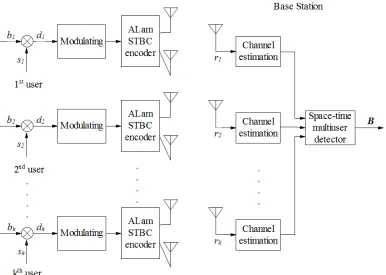
The configuration of our uplink DS-CDMA system is shown in Fig. 1 where signals from K users, each with two antennas, are received by the base station with nR antennas.
We let T
1 2
[ , ,...,b b bK]
b denotes the data vector where each element represents the bit to be transmitted in a given symbol interval from a single user. bk takes the value of either +1 or -1. The signals are spread by using each user’s spreading matrix
T
[ (1),..., ( )] ( 1) k sk s Nk N
s . The signals after spreading can be represented in vector form as [ (1), (2),..., ( )] (T 1)
k dk dk d Nk N
d where N is the spreading factor. Each
chip data in dk is modulated by BPSK and then encoded by using Alamouti space time block codes described in [4] before being transmitted through two antennas.
[image:2.612.108.494.353.628.2]At base station, nR receiving antennas receive signals in diversity mode. The channel links between users’ and receivers’ antennas are assumed to be independent slow flat Rayleigh fading channels, such that the complex fading coefficients of these transmission channels remain unchanged in one bit duration which is divided to N chip durations.
Each signal received by the ith antenna in one bit duration can be represented separately as
1 1, 2,
1
*
2 1, 2,
1
1 1, 2,
1
*
2 1, 2,
1
(1) [ (1) (2)] (1)
(1) [ (2) (1)] (2)
( 1) [ ( 1) ( )] ( 1)
( ) [ ( ) ( 1)] ( )
K
k k
i k i k i
k K
k k
i k i k i
k K
k k
i k i k i
k K
k k
i k i k i
k
r h d h d n
r h d h d n
r N h d N h d N n N
r N h d N h d N n N
(1)where 1,k i
h and h2,ki are the complex fading coefficients of the transmission channels from two antennas of the kth user to the ith antenna of receiver, and
(1), (2),..., ( )
i i i
n n n N are zero-mean white Gaussian noises with a variance of 2. In order to facilitate the detecting process of received signals, we define the signal vector received by the ith antenna as
* * T
[ (1), (2),..., ( 1), ( )] ( 1). i ri ri r Ni r Ni N
r (2)
All received signal vectors are merged at base station. The bit data sent from a single user, which is denoted as B, can be obtained through space-time multiuser detection [3].
STRUCTURE ANALYSIS OF RECEIVED SIGNAL
The receivers are assumed to know the CSI of each user. We separately define the matrixes of chip channel and symbol channel from the kth user to the ith receiver antenna as: 1, 2, /2 * * 2, 1, , ( ) ( ) k i k k i i
k k k
i k k i N i
i i k
i N N
h h h h h
h H Ι h
h
(3)
where ΙN/2 is a N/2 order unit matrix and represents kronecker product. So the received signal vector ri from (2) can be denoted as:
* * T
1 1
[ (1), (2),..., ( 1), ( )] K k K k
i i i i i i k i i k k i
k k
r r r N r N b
r H d n H s n
1 2
1 2,...,
[ , K ] .
i i i i K N K C H s H s H s
(5)
The bit data sent simultaneously from each user forms the user bit data matrix
T
1 2
[ , ,...,b b bK] (N 1).
B (6)
Therefore, the received signal vector ri at the ith antenna can be written as a complex N-vector
. i i i
r C B n (7)
From the above analysis, we can find that the space-time spreading channel matrix
i
C can be seen as a channel matrix with K sender antennas and N receiver antennas. And each element in user bit data B can be seen as a NPSK modulation symbol with the value of either +1 or -1. Therefore, the received signal at each antenna can be thought of as a received signal of MIMO system with K sender antennas and N receiver antennas under BPSK modulation.
On the receiving side, we use CSI and spreading code of each user to generate space-time spreading channel matrix Ci . Then we can use the sphere decoding algorithm of MIMO system as space-time multiuser detection scheme to solve out user’s bit data B.
CONCLUSION
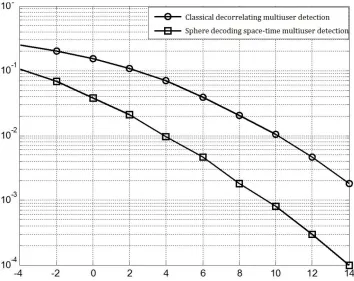
In this paper we have proposed a new uplink DS-CDMA system. The Simulations of sphere decoding space-time multiuser detection algorithm in our system and classical decorrelating multiuser detection algorithm in one-antenna system are showed in Fig. 2 where abscissa denotes Eb/N0 and ordinate is the bit error rate of 1st user.
These two algorithms both take 16 as spreading factors and use 16 dimensional Walsh sequences for spreading. Both systems have 10 users and use BPSK modulation.
Figure 2. Sphere decoding STMUD versus decorrelating MUD performance for user #1.
ACKNOWLEDGEMENTS
This work was supported by Research Foundation of Nanjing College of Information Technology (No. YK20150401).
REFERENCES
1. X. Chen, J. Hu. Design and Matlab Simulation of Downlink in Multi-user MIMO-CDMA System. Mobile Communications. Vol. 32 (2008) No. 11, p. 37-40.
2. L. Gao. An Improved Method of Sphere Decoder. Journal of Nanjing University of Posts and Telecommunications (Natural Science). Vol. 26 (2006) No. 1, p. 62-65.
3. V. Sergio. Multiuser Detection. Cambridge University Press, New York, 1998.