2017 International Conference on Computer, Electronics and Communication Engineering (CECE 2017) ISBN: 978-1-60595-476-9
Based on Premium Channels Package Optimum Combination of 0-1
Programming Model Design
Yun-peng CHEN
1, Jing-jing HAN
2,*, Ye-zi DENG
2and Yan WANG
21Chinese Standardization Research Institute, Haidian, Beijing, China, 100191.
2Communication University of China, Chaoyang, Beijing, China, 100024.
*Corresponding author
Keywords: Pay channels package, RFML, 0-1 planning, Greedy algorithm, Optimal solution.
Abstract. According to the statistical analysis of the user viewing pay channels behavior based on
RFML Model and Pay-TV channel promotion strategy research, build an optimization model. First of all, use the results of RFML model about user viewing behavior and build 0-1 programming model. Secondly, solve the problem by the greedy dynamic programming algorithm while comparing the results to determine the optimal solution for each channel premium channels users. Finally, clustering analysis, the optimal solution for all users to cluster, given the optimal combination of design program results. The results showed that: RFML model results to calculate a single and comprehensive index, and further shows the current users of the program package with premium channel slower satisfaction with the status 0-1 programming model for solving dynamic programming algorithm results show that high clustering results indicate 42 premium channels clustered into four groups show package ideal; CCTVFY type of program can be packaged separately; fishing and sports programs as class program package appropriate; photography, travel, painting Finance, for a small minority of users.
Introduction
Analysis Results of RFML Model
RFML Model Introduction
RFM analysis method is a widely used method in the market of product response and value analysis. Its analysis mainly based on three important indicators, which refers to the ‘the last time of products purchasing’ R, ‘product purchasing number/frequency’ F and ‘the total amount of the product consumption’ M [3]. Because TV users’ behavior and common goods customer behavior is not exactly the same, it is necessary to consider the viewing time L based on the RFM customer analysis mode.
Introduction of the four important indicators:
R: the user who buys products more lately has more possibility to buy again than those who buy long before.
F: Over a period of time, the user who buys more (frequency) has more possibility to buy again than those who buy fewer.
M: The user who spends more on purchasing has more possibility to buy again than those who spend less.
L: The length that user viewing the channel. It is a watching duration index.
Total index RFML can reflect not only the TV viewing behavior characteristic, but also the value of each user to each paid channel.
Based on RFML model data and SAS, the scoring results of the viewing index could be worked out.
Pay-TV Channels’ Situation of Viewing
(1) Output datetime format data in best12 format to calculate RFML value. There are 42 Independent RFML value data sets for each program.
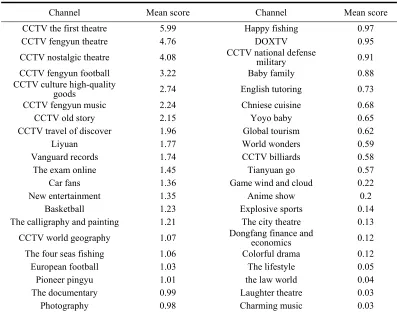
(2) Calculate to get RFML scoring table, with 27966 samples and 42 variables. RFML main index = 2R+F+M+2L
[image:2.612.107.504.437.749.2]RFML main index weighted by the importance of R, F, M and L, which shows the TV users viewing behavior.
Table 1. RFML mean scores of each channels.
Channel Mean score Channel Mean score
CCTV the first theatre 5.99 Happy fishing 0.97
CCTV fengyun theatre 4.76 DOXTV 0.95
CCTV nostalgic theatre 4.08 CCTV national defense military 0.91
CCTV fengyun football 3.22 Baby family 0.88
CCTV culture high-quality
goods 2.74 English tutoring 0.73
CCTV fengyun music 2.24 Chniese cuisine 0.68
CCTV old story 2.15 Yoyo baby 0.65
CCTV travel of discover 1.96 Global tourism 0.62
Liyuan 1.77 World wonders 0.59
Vanguard records 1.74 CCTV billiards 0.58
The exam online 1.45 Tianyuan go 0.57
Car fans 1.36 Game wind and cloud 0.22
New entertainment 1.35 Anime show 0.2
Basketball 1.23 Explosive sports 0.14
The calligraphy and painting 1.21 The city theatre 0.13
CCTV world geography 1.07 Dongfang finance and economics 0.12
The four seas fishing 1.06 Colorful drama 0.12
European football 1.03 The lifestyle 0.05
Pioneer pingyu 1.01 the law world 0.04
The documentary 0.99 Laughter theatre 0.03
Promotion Strategy
Building the Optimization Model
It has been known that based on each user corresponding to each channel TV RFML evaluation index, the claim of getting the optimal combination plan of paid channels, makes the sales promotion profit maximum and the promotion cost minimum, and conform to the TV user preferences (the most customer satisfaction).
A mathematical model based on the theory of the knapsack problem [4][5]:
Objective function: TV user RFML gross score corresponding to the paid channel promotion combination is the largest
Restrictions: the combination of promotional total budgetary constraints in the paid channel pay TV channel
1
max I i i
i
F rx
(1)s.t.
1 I
i i
i
c x C
(2)}
1
,
0
{
i
x
(3)Description of the model’s symbol significance: The subscript:
i is the number of paid channel, i {1,2,…,I}, I=42; Decision variables:
xi is the 0-1 decision variables, a1×42 one-dimensional vector represents weather a user puts a paid channel i into the sales promotion combination program package, when xi equals to 0, it won’t be put in; when xi equals to 1, it will be added in.
Constant:
i
r is a 1 * 42 one-dimensional vector, represents the total RFML evaluation index of TV users to the paid channel;
i
c is a 1 * 42 one-dimensional vector, represents the promotion cost when the paid channel i joins into the program package;
C represents the total funding of paid channel combination promotion.
This mathematical model is applied to each individual user’s data, can obtain the optimal solution of each user, that is the most suitable plan for each user’s paid channel sales promotion combination. It will eventually get all users’ optimal solutions into a summary form, in order to get the overall packaging solutions. Choose some appropriate paid channels to join the combination packages, make a model to get the user’s satisfaction and the response degree maximized [6] [7].
The main parameter of the model ri has been solved in the preceding part of this paper, the parameter total spending limit C in the promotion cost limit function, and the promotion cost of single channel ci, use simulated data, as follows.
C=40;
i
c =[7 5 2 6 4 3 4 8 5 7 6 3 6 5 4 2 15 3 3 3 3 7 4 3 13 6 3 3 5 7 5 6 6 4 4 4 17 10 8 5 8 9];
Cluster Analysis
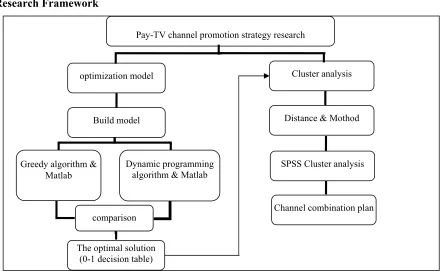
part, then use index cluster analysis to analyse it., with TV users as the sample and pay-TV channels as the indicator. Finally, the research will get pay-TV channel promotion combinatorial optimization programs for all TV. Using the index system cluster method can implemented the cluster analysis[8].
[image:4.612.85.527.117.388.2]Research Framework
Figure 1. The research framework.
Algorithm Design and Implementation
The Idea of Greedy Algorithm
We should guided by the idea of greedy algorithm and make every option based on current decisions while solving problems.
It starts with the original state of the problem and reach the optimal solution via multiple decisions or steps. Whereas, greedy algorithm is merely based on the current state instead of the overall state, thus the decision made by greedy algorithm is merely the optimal solution for the partial [9]. It’s encouraged to get the ultimate optimal solution by decisions and options made for multiple times.
The Idea of Dynamic Programming Algorithm
A problem can be de divided into many solutions or steps by dynamic programming algorithm. It’s only needed to refer to the former step instead of all decisions made before. i.e. to estimate and calculate the current status parameter by that of former step [10]. During problem-solving process, each solution is derived by recurrence relation from the initial to the last. And it is terminated with a decision sequence via several stages to the optimal solution.
In this study, f ci( ) represents the attainable optimal result from the program package whose sales promotion expenses are C, selected from the first i channels. Thus the state transition equation is
( )
i
f c =max{ fi1( )c , fi1(c c i)ri}, i.e. The ultimate optimal result is the better one between the former one and the one which new channels are added in.
Pay-TV channel promotion strategy research
optimization model Cluster analysis
Build model Distance & Mothod
Greedy algorithm & Matlab
SPSS Cluster analysis
Channel combination plan comparison
The optimal solution (0-1 decision table)
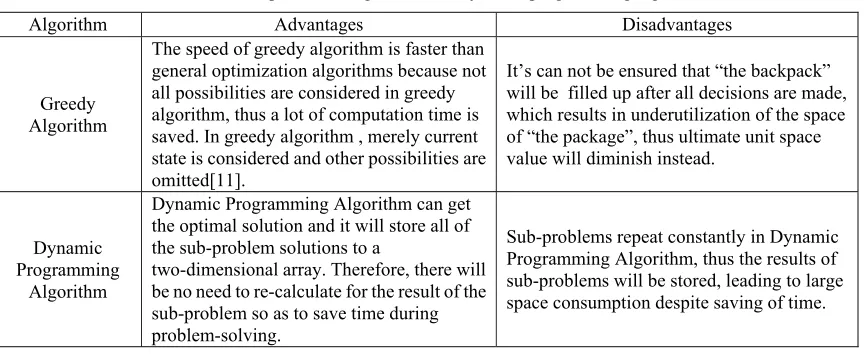
The Comparison of Algorithm and Dynamic Programming Algorithm on Respective Advantages and Disadvantages
Table 2. The comparison of algorithm and dynamic programming algorithm.
Algorithm Advantages Disadvantages
Greedy Algorithm
The speed of greedy algorithm is faster than general optimization algorithms because not all possibilities are considered in greedy algorithm, thus a lot of computation time is saved. In greedy algorithm , merely current state is considered and other possibilities are omitted[11].
It’s can not be ensured that “the backpack” will be filled up after all decisions are made, which results in underutilization of the space of “the package”, thus ultimate unit space value will diminish instead.
Dynamic Programming
Algorithm
Dynamic Programming Algorithm can get the optimal solution and it will store all of the sub-problem solutions to a
two-dimensional array. Therefore, there will be no need to re-calculate for the result of the sub-problem so as to save time during problem-solving.
Sub-problems repeat constantly in Dynamic Programming Algorithm, thus the results of sub-problems will be stored, leading to large space consumption despite saving of time.
Algorithm Implementation
(1) Greedy algorithm
Construct [a1, b1] sort1 = (n, a, b), this function is : using the bubble sort method, the two arrays a and b’s data is sorted according to the new array of a/b from big to small order, and output the sorted array a1, b1;
function [a1,b1]=sort1(n,a,b) [m,n]=size(a); d=zeros(m,n); for k=1:n
d(k)=a(k)/b(k); end
for h=1:n-1 for j=1:n-h if d(j)<d(j+1)
t1=a(j);a(j)=a(j+1);a(j+1)=t1; t2=b(j);b(j)=b(j+1);b(j+1)=t2; t3=d(j);d(j)=d(j+1);d(j+1)=t3; end
end end
a1=a;b1=b; end
(2) Construct (p, x, r, c) = goodknapsack (n, limitc, r, c), this function is: add the channel into the combination package according to the size of the ri/ci order, until the amount of sales promotion of the channel in the combination package reaches the marketing restrictions. Record the rank, the combination package channel number p, and the reordered ri, ci;
function [p,x,r,c]=goodknapsack(n,limitc,r,c) cl=limitc; p=0;
[m,z]=size(r); x=zeros(m,z); [v,t]=sort1(n,r,c);
r=v;c=t; for i=1:n
else x(i)=1; cl=cl-c(i); p=p+1; end end end
(3) Construct function y = knapsack (n, limitc, c, r), this function is: get the solution of the joining combination package, compare with the original unsorted array. If ri and ci all match, add the channel into the combination package. Then get the final solution of 0-1 decision variables y;
function y=knapsack(n,limitc,c,r) [m,n]=size(c); x=zeros(m,n); t=c; k=r; y=x;
[p,x,r,c]=goodknapsack(n,limitc,r,c); for j=1:p
for i=1:n
if (c(j)==t(i))&&(r(j)==k(i)) y(i)=1;
end end end y end
(4) Construct function B=goodknapsack (c,r,C) to solve the model.[10]
(5) Construct a two-dimensional array A of zeros, using circular comparison and recurrence, assign the elements of A, make the A (j + 1, Y + 1) equal to "when the total promotion budgetary constraint is Y, determine whether to join channel j, get the current optimal combination packages, get the corresponding creating profit index value sum ri ", the A (j + 1, Y + 1) is the dynamic clock of this problem. This is a dynamic planning process, the main formula for the dynamic programming is recurrence formula:
A(j+1,Y+1)=max(A(j,Y+1),r(j)+A(j,Y-c(j)+1)) (3-6) A=zeros(length(c)+1,C+1);
for j=1:length(c) for Y=1:C if c(j)>Y
A(j+1,Y+1)=A(j,Y+1); else
A(j+1,Y+1)=max(A(j,Y+1),r(j)+A(j,Y-c(j)+1)); end
end end
best=A(end,end);
(6) Construct an array amount of zeros, start from the end of the array A(that is, the last state), cycle to determine whether a program j has been added into the combination package, get the constituent elements of the most of sub set by recalling the calculation process of table cell A. If so, then the amount (j) = 1, until a value (that is, the corresponding creating profit index value sum ri) is reduced to less than 0, get a 0-1 decision variable array amount (j).
amount=zeros(length(c),1); a=best;
Y=C; while a>0
while A(j+1,Y+1) == a j=j-1;
end j=j+1; amount(j)=1; Y=Y-c(j); j=j-1;
a=A(j+1,Y+1); end
Results and Discussion
The Solve to Optimization Model
(1) Extract a TV user sample to analyze, using the two kinds of algorithm above: TV user sample ID: 3890898010
This user’s evaluation index to 42 RFML of paid TV channel :
[0 0 0 7 15 8 10 14 0 12 0 0 7 0 9 0 0 0 0 0 0 0 0 0 14 17 7 11 0 0 0 0 0 8 0 15 0 10 0 0 0 0]. The promotion total budgetary constraints C=40.
Paid channel i sales promotion costs :
[7 5 2 6 4 3 4 8 5 7 6 3 6 5 4 2 15 3 3 3 3 7 4 3 13 6 3 3 5 7 5 6 6 4 4 4 17 10 8 5 8 9]. 1) The solution by using to the Greedy algorithm:
[0 0 0 0 1 1 1 0 0 0 0 0 0 0 1 0 0 0 0 0 0 0 0 0 0 1 1 1 0 0 0 0 0 1 0 1 0 0 0 0 0 0]. This combination package contains paid channels i=5, 6, 7, 15, 26, 27, 28, 34, 36. 2) The solution by using the dynamic programming algorithm:
[0 0 0 0 1 1 1 1 0 0 0 0 0 0 1 0 0 0 0 0 0 0 0 0 0 1 0 1 0 0 0 0 0 1 0 1 0 0 0 0 0 0]. This combination package contains paid channels i=5, 6, 7, 8, 15, 26, 28, 34, 36.
(2) The result comparison:
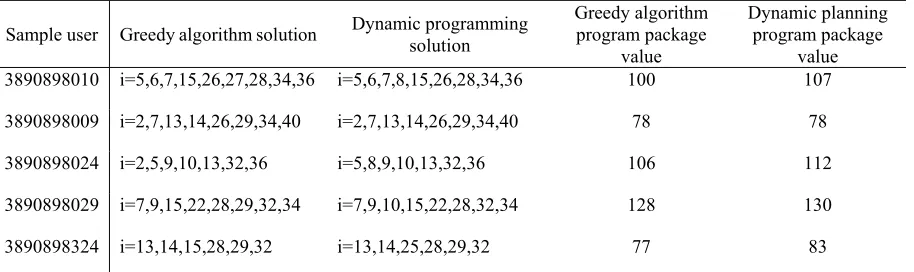
Using the dynamic programming algorithm to get the combination of the total package is 40, the sum is 107; using the knapsack algorithm to get the combination of the total package is 35, the sum is 100. This suggests that the dynamic programming algorithm can make full use of the total promotional funds, and can obtain a higher sum , which is proved to be a better algorithm. The Greedy algorithm cannot get the optimal solution, only the approximate solution of the optimal solution.
[image:7.612.81.538.570.706.2](3) The comparison of multiple sample data:
Table 3. The result of comparative sample data.
Sample user Greedy algorithm solution Dynamic programming solution
Greedy algorithm program package
value
Dynamic planning program package
value
3890898010 i=5,6,7,15,26,27,28,34,36 i=5,6,7,8,15,26,28,34,36 100 107
3890898009 i=2,7,13,14,26,29,34,40 i=2,7,13,14,26,29,34,40 78 78
3890898024 i=2,5,9,10,13,32,36 i=5,8,9,10,13,32,36 106 112
3890898029 i=7,9,15,22,28,29,32,34 i=7,9,10,15,22,28,32,34 128 130
3890898324 i=13,14,15,28,29,32 i=13,14,25,28,29,32 77 83
Program Package Clustering Results
Table 4. Premium channel sales promotion combination results.
Program
package Program name included Potential users
Type 1 CCTV Channel Music, CCTV Channel Teleplay, CCTV Channel Football, CCTV Channel Culture goods, CCTV Channel Nostalgic teleplay, CCTV Channel Old story, CCTV Channel Film and television play, CCTV Channel Outlook, Channel Liyuan opera channel, Channel Exam online, Channel Car fans, Channel Vanguard records, Channel Documentary
4474
Type 2 Channel Photography, Channel Global travel, Channel Calligraphy and
painting, Channel World wonders, Channel New entertainment 2345
Type 3 Channel Happy fishing, Channel Table tennis, Channel Basketball, Channel
European soccer, Channel Baby, Channel English tutoring, Channel Fishing 2566 Type 4 Channel Oriental finance and economics, Channel Animation, Channel Rule of
law, Channel Happy TV play, Channel Colorful TV play, Channel Lifestyle, Channel City TV play, Channel Gamefy, Channel Glamour music, CCTV Channel World geography, Channel Sports, CCTV Channel National defense and military, Channel Chinese cuisine, Channel Game of Go, DOXTV, CCTV Channel Billiards
1298
Acknowledgement
This paper is supported by the Data Acquisition of Brand Evaluation, Relevant National Standards Research Application Technology Applicability (252016z-4623-01) and Outstanding Young Teacher Training Project of Communication University of China (YXJS201527).
References
[1] Zhao Fei. 2003-2010 The development of Chinese digital pay TV channel research [D]. Shan Dong: Shandong University, 2011.
[2] Sun Liang, Guan Na. Premium channel packaging and marketing strategy research [N]. Radio and Television Information, 2007, (10).
[3] Zhao Xiaoyu, Huang Xiaoyuan, Sun Fuquan..Promotion mix strategy based on RFM analysis optimization model. Chinese Management Science, 2005.
[4] Wang Xiaoyin, Zhou Baoping. Mathematical modeling and mathematical experiment. Beijing: Science Press, 2010.
[5] Peter.0-1Knapsack. MATLAB Central.
http://www.mathworks.cn/matlabcentral/fileexchange/22783-0-1-knapsack
[6] Zhang Jingcheng, Dai Guangming. Algorithm research based on the 0/1 knapsack problem. Computer knowledge and technology (academic), 2007, (11).
[7] Huixin Ke, Hao Shen. 2005. Statistical Analysis Method in the Investigation. Communication University of China Press, pp. 193-220.
[8] Deng Hongtao, Zhu Xun. 0/1 knapsack problem greedy optimization method.The computer and digital engineering, 2006, (3): 34.
[9] Huang Bo, Cai Zhihua. 0/1 knapsack problem and its solution method. Computer Knowledge and Technology (academic), 2007, (7).