2017 International Conference on Computer Science and Application Engineering (CSAE 2017) ISBN: 978-1-60595-505-6
Research and Comparison of SQL Optimization
Techniques based on MapReduce
Qin Liu, Haijie Hong, Hongming Zhu* and Hongfei Fan
School of Software Engineering, Tongji University, Cao’an, Highway, Shanghai, China
ABSTRACT
MapReduce [1] is a software framework for distributed computing. It has been widely used in data processing and analysis. SQL-like queries are also playing important roles in data analysis. In this paper, we study different approaches to optimize SQL-like queries in MapReduce and evaluate them on benchmark dataset in a Hadoop cluster. The result shows that these optimizations including adjust join order, push down predicates and merge different MapReduce tasks can significantly speed up analytical queries.
INTRODUCTION
Data on the Internet is increasing every day, such as social network and online transaction data. Traditional RDBMS cannot handle such much data. We need a quick and convenient way to analyze huge amounts of data. MapReduce is a popular framework when processing large data. MapReduce is a core module of Hadoop, which lower the difficulty of distributed computing. The performance of MapReduce-based SQL execution is not always good. When the input query is complex, we need to translate it to multi-stage MapReduce. A MapReduce-based solution even performs worse than traditional RDBMS when the input data is small. MapReduce has to store intermediate results to HDFS [2] and bottleneck of MapReduce is often Disk I/O.
LITERATURE REVIEW
Apache Hive [3] is a data warehouse system. It can analyze large datasets using HiveQL. HiveQL execution consists of two parts: compiler and optimizer. Compiler contains parser, semantic analyser, logical plan generator and query plan generator. Hive will parse the input HiveQL [4] to syntax tree, do type-checking, type conversion, verify column names and generate internal query representation. Logical plan and MapReduce tasks would be generated and serialized to a file. Hive has integrated many optimization, such as column pruning, predicate pushdown, cost-based optimization and correlation optimizer.
dominated by I/O operations. They proposed MultiSplitJobs algorithm, which introducing even 20% saving in the execution time.
YSmart [6] is a correlation aware SQL-to-MapReduce translator. They demonstrate that one-operation-to-one-join translator is not efficient for analysis task. YSmart uses a minimal number of MapReduce jobs to execute queries. The experiment shows that YSmart can significantly reduce redundant computations and I/O operations. They proposed three types of correlation: input correlation, transit correlation and job flow correlation. If there exist a correlation between two nodes, YSmart will merge these two node to improve efficiency. They evaluate it on Amazon EC2 clusters and select four TPC-H [7] queries. It shows that YSmart outperforms Hive in all cases.
Stubby [8] is a transformation-based optimizer for MapReduce workflows. They define five transformations: intra-job vertical packing transformation, inter-job vertical packing transformation, horizontal packing transformation, partition function transformation and configuration transformation. They enumerate all of the valid transformation and use Starfish’s What-if Engine [9] to estimate the cost of each execution plan. They evaluate it in 51 Amazon EC2 nodes using various datasets, including Information Retrieval, Social Network Analysis, Log Analysis, etc. Stubby outperforms Starfish, YSmart and MRShare.
MAPREDUCE CODE GENARATION AND OPTIMIZATION
There are three steps in MapReduce-based SQL execution. Step 1 is parsing SQL. We use ANTLR (ANother Tool for Language Recognition) to parse the query string and generate a syntax tree. We support a subset of SQL-92, including order by, group by, where and arithmetic expression etc. After that, we analyze the syntax tree and verify the schema and table name. Step 2, we convert syntax tree to DAG (Directed Acyclic Graph) and optimize it. Step3, java code file is generated from DAG.
In common scenario, we want to minimize the execution time using limited computing resources, so a cost model can be introduced to SQL execution. For example, running time of MapReduce job is determined by size of input file, resources of cluster, configuration of MapReduce job, etc. Hardware resources of cluster can affect I/O and CPU efficiency. I/O efficiency includes local disk read/write speed, HDFS read/write speed and network transfer speed. I/O is the common bottleneck. We can pre-set parameters based on experience, such as I/O speed of local disk is 80MB/s, network speed is 125MB/s, etc.
from Score, Student, Grade where
Score.student_id = Student.student_id and Grade.student_id = Student.student_id and Grade.grade = 3;
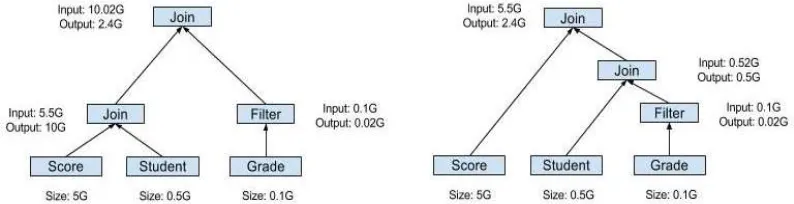
[image:3.612.114.487.174.283.2]Predicate “Grade.grade = 3” can be executed firstly, then join two tables. If there are complex nested queries, the predicate should be pushed down into subqueries.
Figure 1. The execution plan before and after predicate pushdown.
Figure 1 shows the execution plan before and after predicate pushdown. Assume the size of the three tables were 5G, 0.5G, 0.1G, a Student corresponding to 10 Score and a Grade. Average size of each line is 1K in Score table and Student table. Average size of each line is 2K in Grade table. We can roughly estimate the amount of IO before and after the transformation. The total I/O for the first execution plan is 52G and the total I/O of the second execution plan is 28.04G. It’s obvious that the predicate pushdown greatly reduces the total amount of IO required for the execution of the SQL.
Multiple joins are common in SQL statements, and multi-way join can be decomposed to multiple 2-way joins. MapReduce must write the results to disk after the program is executed. We can reduce the size of the intermediate results by adjusting the join order and improve the efficiency.
[image:3.612.98.495.578.680.2]For the above SQL statement, we can first join the Score table and the Student table, and then join the result to the Grade table. Or join the Grade table and the Student table first, and then join the result and the Score table. Figure 2 shows the execution plan before and after adjusting join order. The former will produce unrelated students’ scores, which is useless intermediate results, while the latter will not. Therefore, the latter query is more efficient. Likewise, we can see that the total amount of I/O before and after adjustment is 28.04G and 9.04G.
When executing SQL under MapReduce, a SQL statement usually needs to be broken down into multiple MapReduce jobs. We can combine different MapReduce jobs into one job, and add a tag before each line of output file. If different MapReduce tasks share the same input file, then the disk read can be reduced. This optimization is not always effective because you need to add a column of data to the output file, which introduces additional I / O.
EVALUATION
We build a Hadoop cluster which contains 4 nodes, and each node have 4 GB memory. After that, we generate 10G TPC-H data using TPC-H tools. We use TPC-H Q10 to evaluate the performance of our system.
TPC-H is a data set commonly used in data analysis. The main purpose of TPC-H is evaluating the ability of data analysis and processing.
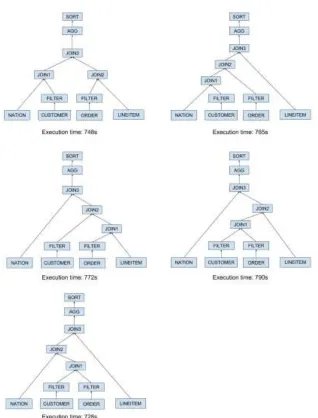
Adjust Join Order
Figure 3. The execution time when using different join order.
PushdownPredicates
[image:5.612.115.475.532.688.2]Figure 4 shows two equivalent query plans and they do filtering operation in different phrases. The second query plan pushes the predicate before the join phrase. Predicate pushdown improves efficiency greatly. Since it is only necessary to return data which is in three months, a large number of data in the table are trimmed in first step.
[image:6.612.113.480.162.310.2]Merge MapReduce Jobs
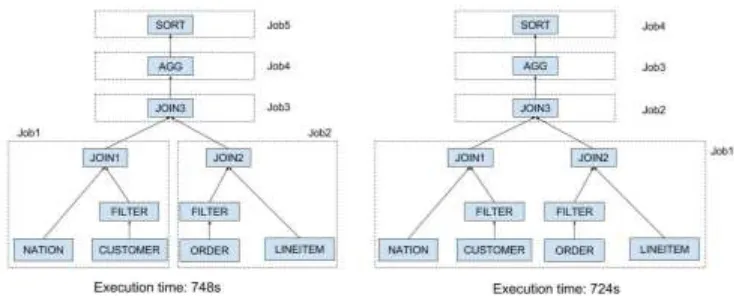
Figure 5. The execution time before and after merging join operator.
Figure 5 shows the query plan before and after merging different jobs. The original query plan starts 5 MapReduce jobs. The second query plan merges job 1 and job 2 so that the number of jobs is reduced from 5 to 4. This optimization slightly reduces the execution time, and the efficiency of the operation is not greatly improved, since the two MapReduce tasks do not share the same input file. If two different MapReduce share the same input file, merging them can reduce the size of the disk read.
CONCLUSIONS
In this paper, we describe some commonly used optimizations when executing SQL on MapReduce. We compare the I/O size when apply these optimization, which is a very import factor of execution time. Through analysis and experimental comparison in TPC-H dataset, we found: 1) changing join order can change the size of intermediate file so that the efficiency is also affected. 2) Predicate pushdown can greatly affect the execution time since they can reduce the I/O size. 3) Merging different MapReduce jobs can’t obviously reduce execution time unless the jobs share the same input or output file. These optimization techniques can improve the efficiency more or less, and when the optimization should be applied is also a worthy of further research.
ACKNOWLEDGEMENT
REFERENCES
1. Dean, J., and Ghemawat, S. 2008. “MapReduce: simplified data processing on large clusters,” Communications of the ACM, 51(1): 107-113.
2. Shvachko, K., Kuang, H., Radia, S., and Chansler, R. 2010. “The hadoop distributed file system,” in 2010 IEEE 26th symposium on mass storage systems and technologies (MSST), pp. 1-10. IEEE. 3. Thusoo, A., Sarma, J. S., Jain, N., Shao, Z., Chakka, P., Anthony, S., and Murthy, R. 2009. “Hive: a
warehousing solution over a map-reduce framework,” Proceedings of the VLDB Endowment, 2(2): 1626-1629.
4. Apache Software Foundation. 2012. HiveQL Language Manual. Published at https://cwiki.apache. org/confluence/display/Hive/LanguageManual.
5. Nykiel, T., Potamias, M., Mishra, C., Kollios, G., and Koudas, N. 2010. “MRShare: sharing across multiple queries in MapReduce,” Proceedings of the VLDB Endowment, 3(1-2):494-505.
6. Lee, R., Luo, T., Huai, Y., Wang, F., He, Y., and Zhang, X. 2011, “June. Ysmart: Yet another sql-to-mapreduce translator,” In Distributed Computing Systems (ICDCS), 2011 31st International Conference, pp. 25-36. IEEE.
7. Council, T. P. P. 2008. “TPC-H benchmark specification,” Published at http://www. tcp. org/hspec. html.
8. Lim, H., Herodotou, H., and Babu, S. 2012. “Stubby: A transformation-based optimizer for mapreduce workflows,” Proceedings of the VLDB Endowment, 5(11): 1196-1207.