2017 2nd International Conference on Information Technology and Management Engineering (ITME 2017) ISBN: 978-1-60595-415-8
Research on the Mode and Mechanism of Cloud Sharing of Information
Education Resources in Universities
Feng-ling WANG, Bo ZHANG* and Hong-jun ZHANG
Hezhou University, Hezhou, Guangxi 542899, China
*Corresponding author
Keywords: Cloud computing, Information education resources, Sharing model, Sharing mechanism.
Abstract. The application of cloud computing in higher education has become a research hotspot. On the basis of introducing the concept and characteristics of cloud computing and combining with the current situation and problems of education resources sharing in universities in Guangxi province, this paper puts forward the advantage of cloud computing to the sharing of higher education resources in Guangxi Province, creatively constructs the information resources Cloud sharing mode, and put forward the sharing mechanism of information resources in colleges and universities under the cloud computing environment to ensure the effective implementation of sharing and solve the problems encountered in sharing.
Introduction
With the development of cloud computing technology, the level of higher education information gradually improved, with its powerful features gradually infiltrated into the field of education, cloud computing applications will education and teaching resources construction, education management and resource sharing And so have a profound impact, and promote the development of education and teaching. How to apply cloud computing in education is becoming a hotspot of research. Under this background, it is of theoretical and practical significance to integrate cloud computing into education and to study the mode and mechanism of information sharing.
Overview and Features of Cloud Computing
An Overview of Cloud Computing
The concept of cloud computing is proposed by Google, is an emerging shared infrastructure approach. It is an Internet-centric, service-based and open standards-based approach that provides secure, convenient, reliable and fast data storage and network computing services through mass storage and processing capabilities of large-scale server clusters of service providers, Users need only through the client browser can access these applications anytime, anywhere.
Cloud Computing Features
Secure, Reliable Data Storage Center. Through a strict rights management strategy can help you safely with the specified person to share data resources. At the same time, users can store data in the cloud, in the "cloud" where the most professional team to manage information, do not have to worry about computer viruses and data loss problems. In this way, you can enjoy the most secure, the best service.
Fast and Convenient Cloud Services. Users only need to have a computer and Internet access to the browser, you can access cloud services anytime, anywhere. Numerous services and software placed in the cloud, the dynamic upgrade, do not need to download, easy to use, fast.
To Meet The Needs Of Users Of Services. Cloud computing can be based on user requirements to provide users with different personalized service, and in accordance with the provision of services, the increasing number of users and the integration of resources will be easier access and more humane.
Economic Benefits. No matter from the software and hardware can achieve the maximum benefit, enterprises and schools do not have to buy expensive hardware devices, just rent the cloud of equipment can easily build their own information education platform.
Advantages of Cloud Computing in the Sharing of Information Education Resources in Colleges and Universities of Guangxi Province
The sharing of information resources in colleges and universities refers to the common use of the informationized educational resources through some means, including the digital resources of the library, the resources of the network courses, the resources of the library, Subject resources (such as teaching courseware, case, question bank, etc.), multimedia resources, software resources and teaching management information resources. The purpose of educational resource sharing is to promote the information management of education, optimize the allocation of educational information resources, improve the utilization rate of information education resources [1]. At present, the province in the information sharing of educational resources mainly exist the following questions:
Information Resource Construction Regional Imbalance
The literature information resources, for example, each school professional settings, discipline construction, funding sources and other differences, leading to the literature information resources purchasing power, literature information resources collection system exists between the regional imbalance, the literature information resources quality and quantity gap . In addition, from the traditional literature to digital literature conversion technology capacity, the gap between regions is relatively large. In the collection of literature, some colleges and universities emphasize "self-sufficiency", resulting in the duplication of literature collection, a lot of waste of funds; lack of collaboration with other institutions and libraries, the concept of resource sharing is weak.
Lack of Inter-School Information Sharing between Educational Resources Platform
At present, the survey data of colleges and universities within the province of Guangxi, the use of campus network for teaching, research, administrative office of the university to reach 100%, some institutions have taken the lead in upgrading to 10 Gigabit campus network, most colleges and universities provide multimedia classroom Campus network access environment, 90% of the college students will host the campus network. Therefore, the hardware and technical conditions of information technology education is no longer a major obstacle to the sharing of resources. However, due to the lack of overall planning, the construction of information resources in colleges and universities in the province are mostly self-contained, fragmentation, lack of open sharing, interconnection, the building of the resource platform for the use of the school, the role is very limited. So far, there is no real sense of the inter-school information sharing between educational resources platform.
Insufficient Capital Investment
Information Security Issues
Open information network, computer viruses, network hackers, electronic deception makes information security issues become increasingly prominent. These factors in the resource-sharing environment, the loss is undoubtedly enormous, therefore, to achieve information sharing of educational resources, the need for strong technical capacity to support, to maximize the protection of information security [3].
Educational Authorities Is not Enough
Guangxi Province, the basic colleges and universities are provincial colleges and universities, therefore, the sharing of information resources to guide the construction and coordination should be the provincial government and the Provincial Department of Education to complete. However, at present, the departments concerned are less concerned with the sharing and sharing of resources. As a result, the resources are duplicated, the information sharing is small, the participating units are few and the service capacity is limited [4].
Advantages of Cloud Computing in the Sharing of Information Education Resources in Colleges and Universities of Guangxi Province
The advantage of cloud computing is the use of distributed storage systems and virtualization technology to break through the regional barriers and hardware bottlenecks, to achieve a simple and unified management model, effectively improve the utilization of infrastructure and information resources, so scattered and incomplete information technology education resources Optimize integration, and widely shared among different educational institutions.
At present, colleges and universities have been building or are building a large number of more information-based education resources. The application of cloud computing to education and teaching, to promote the sharing of information technology education in colleges and universities the advantages of resources is obvious, from the cloud computing service model and characteristics of analysis, mainly reflected in:
Promoting the Cost - Saving Construction of Information Sharing Education in Colleges and Universities
If the construction of university information-based education resource sharing is based on the service and cloud computing, large-scale hardware investment is not needed to manage and store the informationized education resources, heavy server equipment and sharing platform construction. Work to the cloud service provider. In addition, as long as a browser and the Internet terminal equipment, terminal equipment will be connected to the Internet can achieve anything you want to do. Cloud computing on the client device requirements are relatively low, the client terminal almost does not require any upgrade. In the construction of information-based education resources sharing in universities, the cost mainly comes from the initial network access, the renewal of servers and terminals, daily system maintenance and operation, and the purchase of equipment. Customer terminal diversification and low investment, so that cloud computing is easy access to institutions of higher learning. School teachers and students can make full use of smart phones, low-cost Internet access and the original old computer access to cloud services, information sharing on the construction of university information sharing costs significantly reduced [5].
Strengthen the Goal of Resource Sharing and Promote the Integration of Information Education Resources in Colleges and Universities
on the construction of services and cloud computing on the basis of the organization of personnel through the construction of information resources in colleges and universities to focus on the construction of information resources to solve the problem of sharing, Duplication and other issues, through the sharing of educational resources to build the cloud library, information exchange between universities, collaboration has become more closely, to achieve complementary resources to promote academic exchanges and create an academic atmosphere[6].
Promote Cross System, Cross Regional Strong Security Common Resource Sharing Platform Formation
Cloud computing system is an efficient autonomous system, the system hardware, software, storage can be automatically configured and upgraded. "Cloud" data resources can be efficiently stored, analyzed, retrieved and managed, and users can request deployment of resources and computing power to construct a variety of high availability and reliability of the application. On the current form of view, through independent development or purchase of the establishment of an independent, localized information sharing platform for information technology education in colleges and universities, as a result of closed, fragmented construction, colleges and universities invest a lot of money, lack of mutual sharing platform Connectivity and openness. In addition, the colleges and universities of the localization of information resources sharing platform are solely responsible for the larger security and operation and maintenance and other aspects of the problem and a certain amount of pressure. If the construction of university information-based education resource-sharing is based on the service and cloud computing, providing information-based educational resource sharing service for the students and teachers within the limited sharing platform, the existing resource sharing construction Platform operation and maintenance and security, hardware and software resources such as duplication of investment issues will be solved.
Analysis of Cloud Sharing Model of Information Education Resources in Universities of Guangxi Province
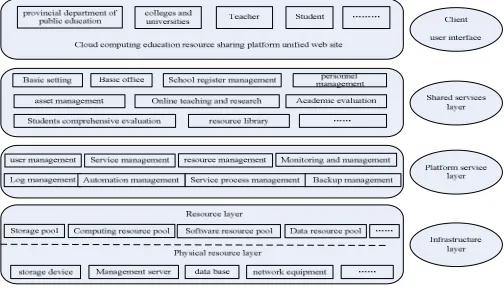
[image:4.612.181.433.499.644.2]The information sharing model based on cloud computing can provide the theoretical scheme and reference for the sharing of informationization education resources of colleges and universities in Guangxi under the cloud computing mode. In the author's opinion, the cloud shared framework model can be divided into three layers: shared application service layer, platform service layer and infrastructure layer, as shown in Figure 1.
Figure 1. University information education resource sharing framework model based on Cloud Computing.
Shared Application Service Layer (Shared Service Layer)
to provide different application services. The shared application service layer is the function embodiment layer of the university's informationized educational resource cloud sharing model, and provides the terminal service to the outside. This layer expresses the main business logic of educational resource sharing, including information sharing platform for educational resources, online applications (online office, chat program, streaming media player, e-mail, collaborative office, etc.), management procedures, middleware programs. Cloud sharing platform users can quickly through the development of middleware system for individuals to share space, and share resources with others.
Platform Service Layer (Management Middleware Layer)
The platform service layer is the core layer of the information sharing cloud model, and it is also an indispensable part of the sharing. This layer is mainly responsible for the deployment of a large number of application tasks and scheduling, and the unified management of cloud computing resources, so that it can be efficient, safe and reliable operation. Platform service layer consists of resource management, task management, security management, user management modules, these modules can be flexibly deployed according to user needs, at any time customize the function or the corresponding expansion, the free combination of trade-offs. If some of the school's resources for off-campus users need to share the pay, you can design the use of monitoring statistics and billing module.
Infrastructure Layer (Resource Layer)
The infrastructure layer is located at the bottom of the cloud-sharing architecture. It includes physical infrastructure resources and virtual infrastructure resources. It supports the cloud sharing system and is the material basis for cloud sharing. The physical resource layer can be built on the basis of the existing facilities, the existing various types of servers, databases, storage facilities, network equipment, etc .; virtual pool is the use of virtualization technology to build the physical resources of the integration layer, it Virtualization of a large number of different types of physical resources and management of these highly virtualized resources to form a large pool of resources, such as computing resource pool, storage resource pool, software resource pool. This can be heterogeneous information resources of different colleges and universities to integrate educational resources, hidden background scattered hardware resources, to create a collaborative work foundation, to provide a unified service.
Mechanism of Information Resource Sharing in Colleges and Universities under Cloud Environment
Organization and Coordination Mechanism
In the cloud-based information technology education resources sharing level through the resource sharing cloud management committee to establish a coordination mechanism. Resource Sharing Cloud Management Committee is a coordinating body of resource sharing of colleges and universities, the main function is to coordinate the interests of colleges and universities and the relationship between, to ensure the realization of resource sharing. Such as who will bear the part of the information sharing of educational resources, construction tasks, the distribution of benefits and how to share resources, such as charges.
Integration and Unification Mechanism
Security Guarantee Mechanism
By ensuring the effective transmission of educational resources on the Internet to the information resources to encrypt, through the cloud of resources in the database to save sensitive data and data encryption to effectively ensure data security, the establishment of SSL security tunnel, the use of VPN-related Technology and other means to ensure that information technology education resources on the Internet and reliable transmission. To ensure the provision of reliable services to users, through the SLA service level agreement to achieve. At the same time SLA can cloud service providers to carry out certain constraints, improve service quality, to increase user confidence in the cloud services. Cloud sharing platform to create and rent third-party cloud security solutions.
Continuous Incentive Mechanism
In the principle of mutual benefit, the contribution of the more enjoyment of the right to share the greater. Through the incentive mechanism to mobilize the enthusiasm of the sharing of rights and obligations and resources to match. The "points pooling system" to encourage and mobilize the broad participation of users, "the offenders punish points, sitting to enjoy their spending points, contributors get points" principle. In the model of resource pool system, each user can freely switch between the dual roles of consumers and builders by exchanging partial commercialization of resources and rewards and punishments of socialization mechanism, and can convert the points into cash The actual income, you can also use the cash recharge and various forms of incentives to get points. So that it can also play a role in the protection of intellectual property rights, but also to ensure the quality and efficiency of the construction of resources to enhance the library.
Conclusions
Cloud computing is the commanding heights of technology in the Internet age. Its characteristics and advantages make it not only widely used in commercial field, but also in education field. The application of cloud computing to the construction of information sharing of educational resources is also a useful new attempt. Although cloud computing technology is still in the growth stage, there are still many difficulties and blind spots in the study of cloud computing, many theoretical and practical problems still to be solved. In-depth exploration and research.
Acknowledgement
The author thanks to the support from Hezhou University 2016 Professor of scientific research start fund project under Grant No. HZUJS201608.
References
[1]Ning Ning. Study on the mode and mechanism of information resources sharing in university information education [D]. Zhejiang Normal University. 2011.
[2]Li Duanming, Cao Taifeng. Study on the application of cloud computing in the information construction of colleges and universities [J]. modern information, 2010, 30 (8):167-170.
[3]L. Walras. Elements of pure Economics[M].London: Allen and Unwin Press, 1954. 420-428.
[4]Jane Cho. An Evaluation Plan for Korean University Libraries to Revitalize Academic Resource-Sharing[J].The Journal of Academic librarianship. 2007, (4). 515-518.
[5]Volmer A. Geronimo, Claudia Aragon. Resource Sharing in Universit libraries: A tool for information interchange[J].Library Collections, Acquisitions and Technical Services. 2005, (4). 425-432.