International Research Journal of Natural and Applied Sciences Vol. 4, Issue 5, May 2017 Impact Factor- 5.46 ISSN: (2349-4077)
© Associated Asia Research Foundation (AARF)
Website: www.aarf.asiaEmail : [email protected] , [email protected]
GROWTH, HERBAGE YIELD AND NUTRIENT UPTAKES OF
INDIGENOUS JUTE MALLOW (CORCHORUS OLITORIUS) AS
INFLUENCED BY DIFFERENT FERTILIZER SOURCES UNDER DRY
SEASON ALFISOLS CONDITIONS
1Babajide, Peter A.; 1Ajibola, Adijat T.; 2Oyeleye, A. David; 1Gbadamosi, Tunde S. and
3Olla, Noah O.
1Department of Crop Production and Soil Science, Ladoke Akintola University of Technology,
PMB 4000, Ogbomoso, Nigeria.
2 Department of Agricultural Technology, Federal College of Agriculture, PMB 7008, Ishiagu,
Ebonyi State, Nigeria.
3 Department of Agricultural Technology, Oyo State College of Agriculture and Technology,
PMB 10, Igboora, Oyo State, Nigeria.
ABSTRACT
Although soil moisture is a major limiting factor to sustainable crop production in the
tropics, particularly during dry season, artificial moisture application if properly supported by
application of suitable fertilizer materials, a desirable fertilizer use efficiency and enhanced crop
performance, may be achieved. Field experiment was carried out during the late or dry season of
the year 2014, at the Arable Crop Experimental Unit of Teaching and Research Farms, Ladoke
Akintola University of Technology, Ogbomoso, to evaluate the response of Corchorus olitorius to
different fertilizer types (of dissimilar origins or sources). Five (5) fertilizer treatments (N. P. K.
15-15-15, Urea, Poultry manure, Organo-mineral, Composted Tithonia biomass), and the
Control (which received no fertilizer application), were investigated. All fertilizers were applied
at the recommended N-rate of 60 kg Nha-1. The treatments were laid out in Randomized
Complete Block Design (RCBD), replicated three times. Data collected on growth and yield
parameters were analyzed following the procedures of analysis of variance (ANOVA) and means
were separated using Duncan’s Multiple Range Test (DMRT) at 5% probability level.
Application of different fertilizers of dissimilar origins significantly improved Corchorus
uptakes of Corchorus olitorius significantly increased with improved soil nutrition via the
applied organic and inorganic fertilizers. The organic-based and organo-mineral fertilizers
effectively competed with the N-rich chemical fertilizers (NPK and Urea) tested. Hence,
application of either organic fertilizer or organo-mineral fertilizer may be more suitable than
any of the chemical fertilizers tested. This will reduce chemical inputs and their residual effects
on soil and considerably encourage maximum and lasting utilization of soil nutrients by
crop-plants.
Keywords: Fertilizer sources, Indigenous Jute mallow, Alfisols, Dry Season, Herbage Yield and Nutrient uptakes.
I. INTRODUCTION
Jute mallow (Corchorus olitorius), which is also known as wild / bush okro or Egyptian spinach, is a flowering annual leaf vegetable, which belongs to the family Malvaceae and the genus corchorus. Although the plant is now grown all over the World, South China is believed to be its centre of origin, from where it was introduced to India and Pakistan. Farmers often grow it in association with other vegetables or food crops such as okra, tomato, watermelon, groundnut or yam (Nwangburuka et al., 2012). It grows more easily in rural subsistence farming system, when compared to exotic vegetables like Brassica oleraceae and Spinacea oleraceas. Corchorus
basic (alkaline) soils. It prefers sandy loam soils which is very rich in organic matter. Jute mallow is susceptible to drought at different stages of growth, even during the flowering period (Nwangburuka et al., 2012). It is usually propagated by seed, which may be broadcast or drilled. Seeds of C. olitorius undergo dormant period which makes germination to be considerably poor. It can be overcome by pre-planting soaking of seeds in hot water (parboiling). The seeds could be tied in a piece of cotton cloth and immersed in almost-boiling water, for five seconds (Akoroda, 1985; Tindall, 1986).
2.0. MATERIALS AND METHODS
2.1.Experimental Location and Description
Field experiment was carried out during the dry season (January and March) of the year 2015, at the Teaching and Research Farms, Ladoke Akintola University of Technology, Ogbomoso. Ladoke Akintola University of Technology (LAUTECH), Ogbomoso falls between latitude 80 10’ N and longitude 40 10’ E, which also falls under southern guinea savanna vegetation zone of Nigeria, located in the south-western region. This experimental location is distinctively characterized by bimodal rainfall distribution, with the annual mean rainfall of between 1150 mm and 1250 mm. The early rains start in late March /early April and end in late July / early August, which is usually followed by a short dry spell in August. Also, the late rainy season spans between August and November.
2.2. Land Clearing, Soil Sampling and Analysis
Land clearing and preparation were carried out manually, following farmers’
conventional practice, using hoe, cutlass, mattock, rake etc. Each plot size was 2.0 x 2.0 m2. During land preparation, soil samples were collected from the soil depths of between 0-15 cm, for pre-cropping physico-chemical analyses, according to IITA, (1982). The soil samples were Alfisols, belonging to Olorunda soil series (Smyth and Montgomery, 1962).
2.3.Treatments and Experimental Design
Five (5) fertilizer treatments (N. P. K. 15-15-15, Urea, Poultry manure, Organo-mineral, Composted Tithonia biomass), and the Control (which received no fertilizer application), were tested. All fertilizers were applied at the recommended N-rate of 60 kg Nha-1. The treatments were laid out in Randomized Complete Block Design (RCBD), replicated three times.
2.4. Propagation and Agronomic Practices
Poultry unit of Teaching and Research Farms, Ladoke Akintola University of Technology, Ogbomoso. All fertilizers were applied at the recommended N-rate of 60 kg N ha-1 (Akanbi,
2002). A water tank (400 litres capacity) regularly filled up from a drilled bore-hole available in the Faculty of Agriculture, was the perennial water source used throughout the experiment. The watering was maintained regularly twice on daily basis (early in the morning and late in the evening) with the aid of watering can filled with water from the opened tap when ever required. Thinning was done at two weeks after sowing (2WAS). Weeding was manually done using hoe on weekly basis.
2.5. Data Collection, Plant Sampling and Statistical Analysis
Data collection on growth parameters (number of leaves, plant height, number of branches and stem girth) commenced at three weeks after sowing. Plant height was determined by using measuring tape placed at the base of the main stem of the plant to the tip. Harvesting was done at 6 WAS. Plant samples were oven dried at 80oC for 48 hours (AOAC, 2005). Electronic weighing balance model citizen Mp600H was used to determine the fresh and dry weights of the shoot and root, followed by determination of nutrient concentrations in plant samples and nutrient uptakes (Ombo, 1994: Gungula, 1999). All data collected were subjected to analysis of variance (ANOVA). The means were separated using Duncan’s Multiple Range Test (DMRT) at 5% probability level (SAS, 2013).
3.0. RESULTS AND DISCUSSION
3.1. Soil physicochemical properties
The results of soil physico-chemical analyses revealed that; the soil used for this experiment was mildly-acidic (pH 6.2) and texturally sandy-loam: (Sand; 85.4%, Silt; 11.4% and Clay; 3.2%). Also, the soil was grossly low in essential nutrients: (Total N; 0.04%, Available P; 4.78 mg kg-1 and exchangeable bases (in cmol kg-1), K; 0.62, Ca; 1.31 and Mg; 0.38), and organic Carbon; 1.78%. These results agreed with Olabode et al. (2007) and Babajide et al.
(2012), who reported that the soils at the study area was slightly acidic in nature and generally low in essential nutrient concentrations, hence, marginally supportive for vegetative and reproductive stages of the commonly grown arable crops.
3.2 Growth and herbage production of Corchorus olitorius as influenced by Fertilizer types
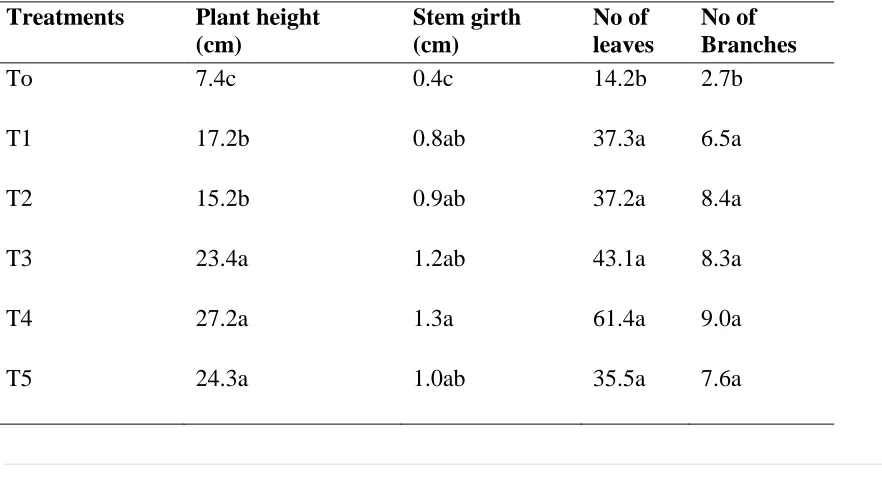
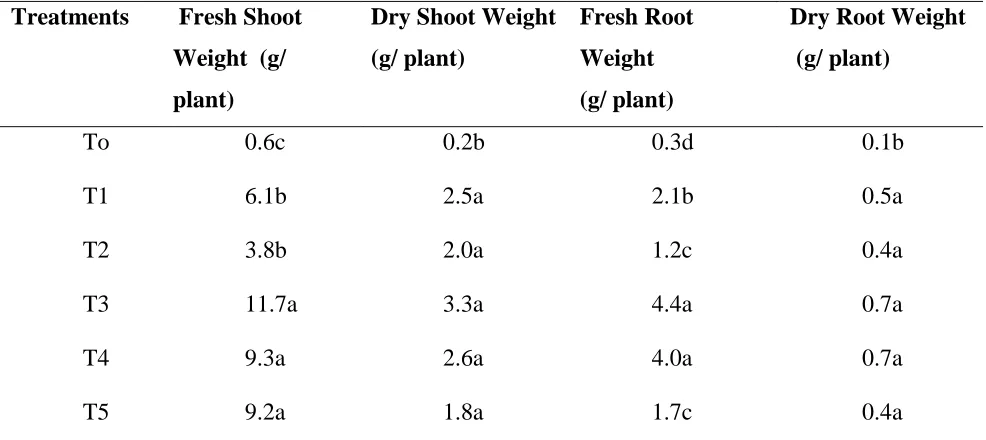
(Table 1). Application of organomineral significantly improved plant height of Corchorus olitorius but the value was not significantly different from those obtained from applications of poultry manure (T3) and Tithonia compost (T5). Poultry manure significantly increased stem girth size but the value was not statistically different from all other fertilizer treatments applied while the control had the least value (Table1). Application of organic and inorganic fertilizers significantly improved number of branches and number of leaves of Corchorus olitorius while the control had least values (Table 1). All these results agreed with the findings of Akanbi, (2002); Olabode et al., (2007) and Babajide and Oyeleke, (2014), who reported significant growth parameters of arable crops as resulted from improved soil nutrition via organic and inorganic fertilizer applications. Application of organic fertilizers (T3, T4, and T5), significantly enhanced fresh shoot weight of Corchorus olitorius (Table 2). Application of inorganic fertilizers (T1, and T2) produced significantly lower fresh shoot weights but significantly higher than the control (Table 2). Applications of fertilizer significantly improve shoot dry weight compared to the control (Table 2). Fresh root and dry root weights were significantly enhanced by application of fertilizers (Table 2). Poultry manure application significantly improved fresh and dry root weights of Corchorus olitorius, while the control had the least values (Table 2). All these results corroborated with the findings of Ojeniyi and Akanni, (2005); Seran et al.,
[image:6.612.69.510.470.716.2](2010) and Babajide and Olayiwola, (2014), who reported significant yield parameters of arable crops as resulted from organic and (or) inorganic fertilizer applications.
TABLE 1:Fertilizers application on growth parameters of Corchorus olitorius
Treatments Plant height
(cm)
Stem girth (cm)
No of leaves
No of Branches
To 7.4c 0.4c 14.2b 2.7b
T1 17.2b 0.8ab 37.3a 6.5a
T2 15.2b 0.9ab 37.2a 8.4a
T3 23.4a 1.2ab 43.1a 8.3a
T4 27.2a 1.3a 61.4a 9.0a
Means followed by the same letter are not significantly different using Duncan multiple Range test (DMRT). To = Zero application of fertilizer, T1=NPK fertilizer,T2=Urea,T3=poultry manure,T4 organo mineral, T5 Tithonia compost.
TABLE 2: Fertilizers application on yield parameters of Corchorus olitorius
Treatments Fresh Shoot
Weight (g/
plant)
Dry Shoot Weight
(g/ plant)
Fresh Root
Weight
(g/ plant)
Dry Root Weight
(g/ plant)
To 0.6c 0.2b 0.3d 0.1b
T1 6.1b 2.5a 2.1b 0.5a
T2 3.8b 2.0a 1.2c 0.4a
T3 11.7a 3.3a 4.4a 0.7a
T4 9.3a 2.6a 4.0a 0.7a
T5 9.2a 1.8a 1.7c 0.4a
Means followed by the same letter are not significantly different using Duncan multiple Range test (DMRT). To = Zero application of fertilizer, T1=NPK fertilizer,T2=Urea,T3=poultry manure,T4 Organo mineral, T5 Tithonia compost.
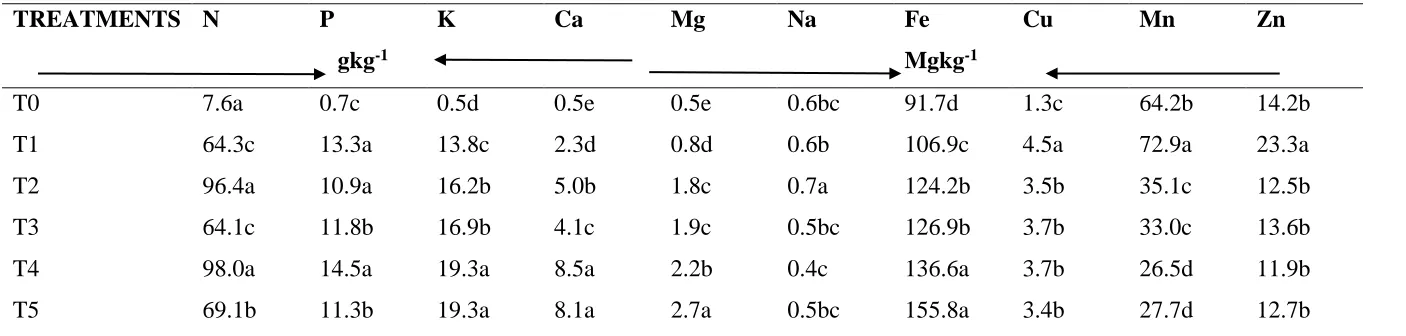
Application of fertilizer on nutrient uptake of Corchorus olitorius
Table 3: Organic and inorganic Fertilizers application on nutrient uptake of Corchorus olitorius
TREATMENTS N P
gkg-1
K Ca Mg Na Fe
Mgkg-1
Cu Mn Zn
T0 7.6a 0.7c 0.5d 0.5e 0.5e 0.6bc 91.7d 1.3c 64.2b 14.2b
T1 64.3c 13.3a 13.8c 2.3d 0.8d 0.6b 106.9c 4.5a 72.9a 23.3a
T2 96.4a 10.9a 16.2b 5.0b 1.8c 0.7a 124.2b 3.5b 35.1c 12.5b
T3 64.1c 11.8b 16.9b 4.1c 1.9c 0.5bc 126.9b 3.7b 33.0c 13.6b
T4 98.0a 14.5a 19.3a 8.5a 2.2b 0.4c 136.6a 3.7b 26.5d 11.9b
T5 69.1b 11.3b 19.3a 8.1a 2.7a 0.5bc 155.8a 3.4b 27.7d 12.7b
4.0. CONCLUSION
Application of fertilizers (irrespective of the sources), significantly improved the growth and yield parameters measured, compared to the control. Although, application of organic fertilizers and organomineral had significantly higher values of most of the parameters measured, the values were not significantly different from those obtained from the tested inorganic fertilizers (i,e urea and NPK). The organic-based and organo-mineral fertilizers effectively competed with the N-rich chemical fertilizers (NPK and Urea) tested. Hence, application of either organic fertilizer or organo-mineral fertilizer may be more suitable than any of the chemical fertilizers tested. This will reduce chemical inputs and their residual effects on soil and health-threats. Adoption of such low-input technology may favour maximum and lasting utilization of soil nutrients by crop-plants. Also, use of organomineral fertilizers may promote environment friendliness, particularly both in the areas of reducing chemical fertilizer load on soils and conscious efforts towards turning of harmful phyto-residues, as well as industrial and domestic wastes into effective fertilizer materials under tropical environment when most farmlands could be regarded as marginal.
REFERENCES
1. Akanbi, W. B. (2002). Growth, Nutrient uptake and yield of maize and okra as influenced by compost and nitrogen fertilizer under different cropping systems. Ph. D. Thesis, Department of Crop Protection and Environmental Biology, University of Ibadan, Ibadan, Nigeria pp. 232.
2. Akoroda, M.O. (1985). Morphotype diversity in Nigerian and races of C. olitorius. Journal of Horticultural sciences 6(4); 557-62.
3. AOAC (2005). Official methods of analysis of the Association of Official Analytical Chemists (17th Ed.). Arlington, Virginia pp. 96-105.
4. Babajide, P. A. (2010). Response of Sesame (Sesamum indicum Linn.) to Integrated Nutrient Management Approach in an Alfisol, in Oyo State, Nigeria (Ph.D. Thesis),
University of Ibadan, Ibadan, Nigeria. 173 pp.
south-western Nigeria. Journal of Animal and Plant sciences: Biosciences:Vol.15 (2): 2135-2146.
6. Babajide, P.A. and Olayiwola, A.O. (2014). Influence of composted phyto-residues and harvesting frequency on growth and forage potentials of grain amaranth (Amaranthus cruentus) under oxic paleutult soil conditions. Journal of Natural Science Research. ISSN online 2224-0921. Vol. 4 (17): 115-121.
7. Babajide, P.A. and Oyeleke, O.R. (2014). Evaluation of Sesame (Sesamum indicum Linn.) for Optimum Nitrogen Requirement Under Usual Farmers’ Practice of Basal Organic Manuring in the Savanna Ecoregion of Nigeria. Journal of Natural Science Research. ISSNonline 2224-0921 Vol. 4 (17): 122 - 132.
8. Chukwuka, K. S. and Omotayo, O. E. (2009). Soil fertility restoration potentials of Tithonia green manure and water hyacinth compost on a nutrient depleted soil in south west Nigeria. Research Journal of Soil Biology 1(1); 20-30.
9. Gungula D.T. 1999: Growth and nitrogen use efficiency in Mays (Zea may L.) . In the Southern Guinea Savanna of Nigeira, Ph.D. Thesis University of Ibadan Nigeria 181pp. 10.International Institute of Tropical Agriculture, (1982). Selected Methods for Soil and
Plant Analysis. International Institute of Tropical Agriculture, Ibadan Nigeria. IITA Manual Series, No. 7.
11.Nwangburuka, C.C., Olawuyi, O.J., Oyekale, K.,Ogunwemimo,K.O., Denton, O.A. and Nwanko, E. (2012). Growth and yield response of Corchorus olitorius in the treatment of Arbuscular mycorrhizae (AM), Poultry manure (PM), Combination of AM-PM and Inorganic Fertilizer (NPK). Advances in Applied Science Research Vol.3 (3):1466-1471.
a. Ojeniyi, S.O. and Akanni, D.I. (2008). Effect of Animal manure on soil properties, leaf nutrient composition, growth and yield of pepper (Capsicum annum). Journal of Research in Agric. 5(4): 86-90.
12.Olabode, O.S; Ogunyemi Sola, Akanbi, W.B; Adesina, G.O and P.A. Babajide (2007). Evaluation of Tithonia diversifolia (Hems.l) A Gray for Soil Improvement. World Journal of Agricultural Sciences 3 (4); 503-507.
14.Seran T.H., Srikrishnah S. and Ahamed M.M.Z. (2010). Effect of different levels of Inorganic fertilizers and compost as basal application on the growth and yield of some food crops. The Journal of Agric, Sci, 5(2): 64-70.
15.Schipper, R.R. (2000). African indigenous vegetables An overview of the cultivated species.
16.Smyth, A. J. and Montgometry, R. F. (1962). Soils and land use in Central Western Nigeria. Govt. of Western Nig. Press, Ibadan pp. 265.
17.SAS (2013). Sas Institute Inc., Cary Nc., U.S.A. (Software Statistical Programme). 2013 18.Sobulo, R. A. 2000. Fertilizer use and soil testing in Nigeria. In: Agronomy in Nigeria
2000 Edition, pp. 195-201.
19.Tindall, H. D. (1986). Vegetables in the Tropics A textbook.. H. D. Tindall (Ed), pp: 328. 20.Vorster, A.J., Janser VanResburg W.S., Venter S.I. and VanZiji J.B. (2002): Germplasm
management of African leafy vegetables for the nutritional and food security Needs of vulnerable Groups. South Africa progress report ARC-VOPI VOPI Pretoria, South Africa 130pp.