14th International Conference on Wireless Communications, Networking and Mobile Computing (WiCOM 2018) ISBN: 978-1-60595-578-0
Local-Interference-Exchange Based Maximum Weighted Independent
Set Algorithm for D2D Communication in Cellular Network
Mingxin Wang1, Tao Peng1 and Zhiqiang Qi
ABSTRACT
Device-to-device communications bring potential benefits for improving network performance but also lead to interference problems in D2D, D2C (device-to-CUE), C2D (device-to-CUE) of cellular network. Effects of recent studies on these issues are constrained by high signaling overhead, fairness and global information exchange. To overcome such problems, a Local-Interference-Exchange based Maximum Weighted Independent Set (LIE-MWIS) Algorithm is proposed. We first design a reasonable weight for each D2D link and find out the optimal independent set that can communicate simultaneously, which significantly reduces the interference between D2D links. Furthermore, a Time Slot Round Robin (TSRR) scheduling scheme is proposed to improve system coverage and fairness. To find a suitable solution of interference of C2D and D2C, we modify the weight design by charging D2D links for its interference to BS and adding influence of CUE interference on D2D links. System-level simulation results are provided to validate that the proposed scheme not only makes improvement in spectral efficiency and fairness, but also reduces signaling overhead compared with other interference control algorithms, especially in dense-deployed scenario.
1. INTRODUCTION
D2D communications can be implemented over licensed spectrum. D2D communications over licensed spectrum effectively provide a controlled interference environment [1] and the safety of communication is guaranteed. However, the problem of severe interference and high control overhead in underlay scenario becomes of vital importance. Various interference control methods are explored in distributed resource scheduling. In [2], the authors propose a distributed CSMA algorithm based on Ideal CSMA Network (ICN) for throughput and total utility maximization. The authors in [3] extends the ICN model. A Stackelberg Game is used to address the resource allocation among D2D links. Although D2D links can meet their own needs through self-updating, such methods based on CSMA network have to face the issue of multiple iterations and high latency.
Other resource allocation schemes focus on selecting a feasible subset of D2D links. In [4], fictional pricing mechanism is considered where the base station(BS) optimizes and transmits to D2D users, who then play a best response to this control signal. The authors in [5] come up with a distributed scheduling scheme called FlashLinQ which demonstrates considerable improvement over pure CSMA/CA, but FlashLinQ scheduling suffers from cascade yielding problem [6]. I-Map(On-off interference map) scheduling method [7] is then proposed to deal with cascade
1
yielding problem. However, D2D links in I-Map scheduling require global information to build the I-Map which leads to high signaling overhead especially when the network changes frequently.
To overcome the shortcomings in above algorithms, a Local-Interference-Exchange based Maximum Weighted Independent Set algorithm is proposed in this paper which can be abbreviated as LIE-MWIS algorithm. Different from the algorithm in [8], the weight of each D2D link is determined by interference situation and only obtained by local information exchange which brings analysis of D2D interference into resource allocation algorithm. By limited iterations, the near-optimal independent set is presented and each D2D link knows whether it is able to access the network in fully distributed mode which significantly reduces the signaling overhead. Furthermore, we repeat the LIE-MWIS algorithm in the remaining D2D set in different time slot which gives the non-access D2D links opportunities to access the network. In underlay mode, to avoid strong interference from D2D to the BS, a pricing-based [9] weight design is proposed that the BS charges D2D links for their interference to the BS. Meanwhile, interference power from CUE to D2D links is considered which limits the accessibility of D2D closer to the base station. Numerical results show that our algorithms have low signaling overhead ,achieve a significant throughput gain and make more users access the network.
The remaining part of this paper is organized as follow. In Section II, the system model and problems of this paper are described. In Section III, LIE-MWIS and Time Slot Round Robin(TSRR) scheduling scheme is introduced. The solution to interference of C2D and D2C is proposed in section IV. The simulation results are presented in section V. Finally, section VI concludes this paper.
2. SYSTEM MODEL AND PROBLEM FORMULATION
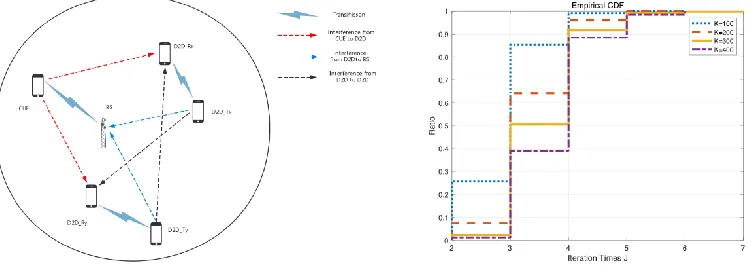
As shown in Figure 1, we consider a two-tier cellular network with K D2D links and one CUE. Each D2D link consists of a transmitter Tx and a receiverRx, in which each Tx aims at communicating to its correspondingRx. We assume that the distance between each Tx and Rx of a D2D link is the same.
Orthogonal frequency division multiplexing (OFDM)-based system is considered for signaling and data transmission. A single carrier by one OFDM symbol, the basic unit of OFDM resource is called a "resource element", over which a single quadrature-modulated symbol such as a quadrature phase-shift keying symbol is transmitted [7]. The communication between Tx and Rx is based on TDD operation with synchronized time slots. We assume that each time slot has two stages: contention stage and transmission stage. The contention stage has several intervals, and each interval is further divided into serveral mini-slots. The control signaling spectrum is divided into K blocks and each D2D link transmits its control signal in its own assigned block. We determine a feasible schedule during the contention stage, and with the computed schedule, D2D links transmit actual data during the transmission stage [8]. When more than one D2D link transmits messages simultaneously, the signal-to-interference-plus-noise ratio (SINR) at each receiver, i is given as
,
D i ii
i D C
j ii ci
j S j i
P h
P h P h N
where D i
P is transmit power of D D2 i , hij is the channel gain between transmitter of
2 i
D D and receiver ofD D2 j, C
P is the power of CUE, hci is the channel gain between
CUE and D2D receiver, and N is the noise power. The set S represents a collection of D2D links that can communicate simultaneously.
Similar to i, SINR at the BS, is given as
C cb D j jb j S
P g
P g N
(2)where gib denotes the channel gain between transmitter of D D2 j and the BS, gcb
denotes the channel gain between CUE and the BS.
In dense-deployed scenario, strong interference among D2D links is produced when D2D links in proximity transmit messages simultineously. LIE-MWIS algorithm proposed in section III aims at selecting one of D2D links in proximity to access the network that can effectively avoid strong interference and improve SINR of D2D links. Meanwhile, to give D2D links eliminated by LIE-MWIS algorithm the opportunities to access the network which improves the fairness of the network, we propose Time Slot Round Robin scheduling scheme in section IV.
[image:3.612.107.484.411.547.2]In heterogenous network, CUEs always have higher access priority than D2D links. Thus, the received signal intensity of the BS from CUE should be kept beyond an acceptable level when D2D links transmit messages simultineously. To ensure the communication quality of the CUE, a algorithm based on LIE-MWIS algorithm called LIE-MWIS_BS in section V is proposed.
Figure 1. Architecture of heterogeneous D2D network. Figure 2. CDF of iteration time J.
3. LIE-MWIS ALGORITHM NOT CONSIDERING CUES
Weight Design
We start with some definations. The distance between each D2D transmitter and receiver is fixed,
0
R . Since two closely spaced D2D links may cause servere
interference, we define interference radius called Ri to avoid strong interference. Two D2D links are neighbours, if the distance between any Tx and Ry is more thanRI. We
define a conflict graph G( , )V E constructed from the interference radiusRI. Each vertex represents a D2D link. If vertex x is a neighbor of vertex v, they are connected by an edge in the conflict graph [8]. Let I v( ) denote the set of neighbors of vertex v including v and I A( ) denote the set of neighbors of vertices in A where A is a set of D2D links. Let w v i( , ) denote the weight associated with vertex vi, i.e.
2
( , ) 1
( ) log (1 )
D i ii
i D
j ji TP i j
P h w v
P h N
(3)where TP i j( , )1 represents D D2 i is neighbor ofD D2 j. Here, we define the weight of
a D2D link as the sum of the interference from its neighbors. In dense-deployed D2D network, D2D links with strong interference to or from each other may not transmit at the same time. Accessing the D2D link with more neighbors means that more D2D links will be discarded. Therefore, a D2D independent set that provides better throughput tends to access those D2Ds with better interference environment. (3) can be a good choice for those D2D links who are more suitable for accessing the network.
Description of LIE-MWIS algorithm
In the contention stage, we define Vi as alternative D2D links in the
th
i turn. We
also define B as the final result D2D set, Bi is the partial independent set result selected for each time interval i. B set is the result of Bi set union, i.e. B iBi. We start with the set V0 as V and an empty setB0. An iterative algorithm is shown in
Algorithm 1.
Algorithm 1 LIE-MWIS Algorithm
1: Initialization: V0V B, 0 ,W0 . 2: for i=1 to J do
3: ViVi1\ (I Bi1)
4: Each D D2 i pdates its weight according to (2)
5: for j=1 to Vi do
6: ( ) max ( )
j j
j x v I v x
w v w
7: if w v( )j w v( )j then
8: BiBi { }vj
First, each D2D Tx transmits a signal in its assigned resource element with a given power in a mini-slot. The signal with given power can only be successfully received by D2D Rx within Tx's RI. Due to the asymmetry of interference of D2D links, each
x
R transmits a similar signal in the next mini-slot and each Tx within Rx'sRI can receive the signal. Then each D2D link calculates its own weight with its neighbors’ channel information. In the next slot, each D2D link broadcasts its own weight to its neighbors. In the ith turn, each user decides whether to access the network, based on
whether it is the one with the highest weight in I v( ). All selected D2D links make up
i
B and D2D links in Bi broadcast a message to its neighbors to inform them not to access the network at that moment. Therefore, the set of alternative vertices Vi is updated by excluding I B( i1) fromVi1. In the next turn, D2D links in Vi recalculate its weight based on Vi. The same procedure repeats J times until Vi is empty.
We tried 1000 times in each selection of D2D link to test the number of iterations needed to cover all D2D links. As shown in Figure 2, only 6 or 7 times of iteration are enough to cover all D2D links no matter how large the number of alternative D2D links is. The reason is that the total area which each iteration can cover is about the same.
Thus, a constant iteration time is enough to cover all D2D links in one LIE-MWIS time slot.
Analysis of signaling resource overhead
In this section, control signaling resource of LIE-MWIS algorithm is considered and compared to [5] [7]. Let's define Nslot as the total number of traffic time slots allowed for D2D communications, and Nup be the updating period in the number of
time slots. In [7], average number of resource elements per traffic time slot is,
*( 1) / /
IMAP slot up slot
N K K N N N (4)
In LIE-MWIS algorithm, considering that the selected set is reused Nup times,
average number of resource elements per traffic time slot is,
[(2 2 ) * ] /
LIE MWIS up
N K K J N (5)
Figure 3. LIE-MWIS time slot resource scheduling diagram.
Time Slot Round Robin Scheduling
The D2D links selected by LIE-MWIS algorithm which can communicate simultaneously provide high throughput compared to [5] [7]. However, there are also some D2D links that can not access the network because of their poor locations. In this paper, we propose a scheduling scheme called Time Slot Round Robin Scheduling to improve fairness of D2D links. The scheme is described in detail as follow.
Algorithm 2 Implementation of Time Slot Round Robin Scheduling
1: Initialization: V0V H, ,H0
2: for i=1 to T do 3: Vi Vi1\ (I Hi1)
4: ( i)
i
H LIEMWIS V
5: HH Hi
6: end for
The Time Slot Round Robin scheduling selects different D2D sets from different time slots which provides possibilities for more users to access the network. Since the execution of LIE-MWIS algorithm in each round is independent, it is ensured that D2D links selected from each round have a relatively good density distribution under above interference radius which can also provide quite large throughput.
4. LIE-MWIS ALGORITHM CONSIDERING INTERFERENCE AT THE BS(LIE-MWIS_BS)
In this section, we try to solve the cross-tier interference problem in a two-tier cellular network by modifying the LIE-MWIS algorithm. An extending algorithm called LIE-MWIS_BS algorithm is proposed.
Problem Formulation
[4]. We define D i
R as achievable rate of D D2 i. Therefore, the goal of the BS is to improve the total throughput of D2D network as much as possible while ensuring that the interference of D2D links to the BS is below the threshold Q, i.e.
max D . . D
i i ib
i BR s t i SP g Q
(6)where D
i
P is transmit power of each D2D link, S is the D2D set selected by LIE-MWIS, Qis a predefined threshold which denotes the maximum interference that the BS can tolerate.
Weight Design with Interference at the BS
Since the sum of the interference power of the selected D2D set to the BS is likely to be greater than the threshold Q, the above LIE-MWIS algorithm can not be directly applied in this scenario. Thus, we design a new weight scheme to solve the D2D interference to the BS, i.e.
2( ) [ ]
( )
C
D D
i i i ib D
i ib
R
w v R P g
P g
(7)
where D
i
R is denoted as,
2
( , ) 1
log (1 )
D
D i ii
i D C
j ji ci
TP i j
P h R
P h P h N
(8) CR is denoted as,
2
log (1 )
C C cb D i ib P g R
P g N
(9)
[ ]amax[ ,0]a . D i
R indicates the estimated reachable rate per unit bandwidth of the D2D link in the coexistence with the cellular user. C
ci
P h is the extra part for the D2D interference. Different from the distribution of pure D2D networks, interference items of cellular users to D2D users are considered. RC/ ( PiDgib) is the negative gradient
of the signal power of cellular user’s rate to the interference power of D2D links, which indicates the decrease of unit D2D interference power to cellular user rate. We define as the price charged by the BS for the interference from D2D links.
( / ( ))
D C D
i ib i ib
P g R P g
indicates that the result of the BS charging for decrement of cellular user rate due to the access of D2D links, which is considered as a reduction of D2D weights. is considered as the estimate interference of the BS from D2D links, which can be obtained by D2D links through the BS's broadcasting. The whole above design provides a good solution to the D2C interference problem.
weight of D2D link is less than 0, it will be barred from accessing the network which may cause serious interference.
Algorithm 2 Procedure of LIE-MWIS_BS Algorithm 1: Initialization: 0,
2: while Qdo
3: BLIE MWIS V ( )
4: iD ib
i BP g
5: if Q then
6: 0 7: else
8: break 9: end if 10:end while
Description of LIE-MWIS\_BS algorithm
To ensure the quality of CUE's transmission, the BS will reduce the interference of the D2D links to the BS by adjusting the price . The total interference the BS received from D2D links is denoted as . The detail process is presented as follow.
The price is initialized as0. According to the calculation of new weights,
LIE-MWIS_BS algorithm is implemented to obtain the D2D set. Then, the BS monitors and calculates the interference power of the selected D2D links and determines whether it exceeds the threshold Q . If total interference power is below Q , the algorithm is over and the current set B is the result D2D set. If not, the BS increases the price and repeats the same process until the total interference at the BS is below the threshold.
[image:8.612.174.423.507.651.2]Simulation Results
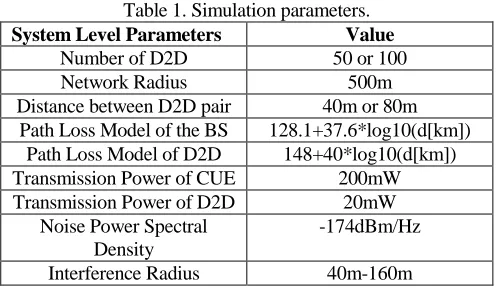
Table 1. Simulation parameters.
System Level Parameters Value
Number of D2D 50 or 100
Network Radius 500m
Distance between D2D pair 40m or 80m Path Loss Model of the BS 128.1+37.6*log10(d[km])
Path Loss Model of D2D 148+40*log10(d[km])
Transmission Power of CUE 200mW
Transmission Power of D2D 20mW
Noise Power Spectral Density
-174dBm/Hz
Interference Radius 40m-160m
two improved distributed scheduling schemes Priority-based MAP and SIR-based I-MAP and two proposed LIE-MWIS algorithms with different polling cycles. Furthermore, we also evaluated six scheduling schemes considering CUE in D2D network: IO algorithm, two Guard Zone scheduling in and Power Control algorithm in [4] and two proposed LIE-MWIS_BS algorithm with different polling cycles. The detail simulation parameters are illustrated in Table 1.
We consider a circular area with a radius of 500 meters centered on the BS.
D2D transmitters are uniformly distributed in that circular area with its corresponding receivers located on a circle centered on it with a radius of 40m or 80m. It is assumed that all D2D links and CUEs are transmitting in their maximum power.
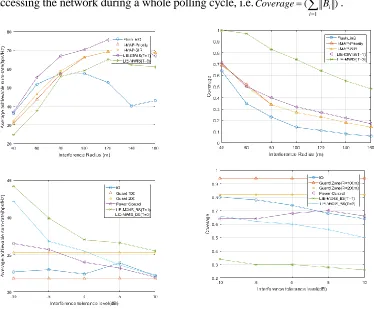
As shown in Figure 4 and Figure 5, different interference control algorithms are compared in terms of coverage and average achievable sum-rate(AASR). In this paper, AASR is defined as the average spectrum efficiency of D2D network in one time slot during a whole polling cycle, i.e.
1
( ) /
l T
D i i B i
AASR R T
and coverage is defined as the total ratio of D2D linksaccessing the network during a whole polling cycle, i.e.
1
( )
T
i i
Coverage B
[image:9.612.100.474.286.595.2]
.Figure 4. Performance of different algorithm in spectrum efficiency without Macro Users. Figure 5. Performance of different algorithm in Coverage without Macro Users. Figure 6. Performance of different algorithm in spectrum efficiency with Macro Users.
Figure 7. Performance of different algorithm in Coverage with Macro Users.
compared with other algorithms. We can see that the Time Slot Round Robin scheduling scheme is a trade-off between rate and coverage which also improves the fairness according to Figure 4.
Figure 6 and Figure 7 show the performances of LIE-MWIS_BS algorithm compared with other algorithms. The LIE-MWIS_BS(T=1) and LIE-MWIS_BS(T=3) both perform well in low interference tolerance threshold in Figure 6. But in high interference tolerance case, LIE-MWISS_BS(T=3) drops quickly for the fact that the weight of many D2D links are down to 0 according to the weight calculation method. Nevertheless, the average achievable sum rate of LIE-MWIS_BS algorithms are 20% larger than other algorithms. It is worth mentioning that although the coverage of LIE-MWIS_BS algorithms performs worse than other comparing algorithms where all D2D links tend to access the network, it still gets a good coverage if the polling cycle is raised.
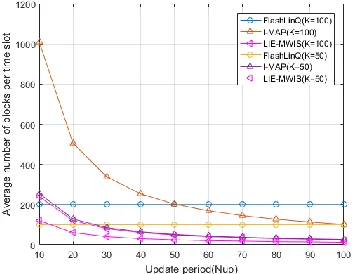
[image:10.612.208.384.313.450.2]In addition to signaling resources elements, LIE-MWIS algorithm performs well both in low and high update period compared with I-MAPs [7] and FlashLinQ [5] as shown in Figure 8. Furthermore, LIE-MWIS algorithm uses local information instead of global information exchanges in I-MAP which significantly reduces the delay.
Figure 8. Performance of Signal element overhead comparing with other algorithm.
5. CONCLUSION
In this paper, resource allocation in D2D network considering interference to the BS and not considering interference to the BS are modeled. Based on such models, LIE-MWIS and LIE-MWIS_BS are presented to solve the interference problem of D2D, C2D and D2C whileTime Slot Round Robin scheduling scheme is proposed. In addition, the proposed algorithm greatly reduces the signaling resource elements which is of great importance for dense-deployed D2D scenario. In the future research, power control and RI adaptation will be considered to improve the spectrum efficiency.
REFERENCES
2. Jiang L, Walrand J. A Distributed CSMA Algorithm for Throughput and Utility Maximization in Wireless Networks[J]. Networking IEEE/ACM Transactions on, 2010, 18(3):960-972.
3. J. Lyu, H. C. Yong, and W. C. Wong, “A stackelberg game model for overlay d2d transmission with heterogeneous rate requirements,” IEEE Transactions on Vehicular Technology, vol. 65, no. 10, pp. 8461–8475, 2015.
4. Q. Ye, M. Al-Shalash, C. Caramanis, and J. G. Andrews, “Distributed resource allocation in device-to-device enhanced cellular networks,” Communications IEEE Transactions on, vol. 63, no. 2, pp. 441–454, 2014.
5. Wu X, Tavildar S, Shakkottai S, et al. FlashLinQ: A synchronous distributed scheduler for peer-to-peer ad hoc networks[C]//Communication, Control, and Computing. IEEE, 2010:514-521.
6. Cho C K, Jin W K, Kim S H. Multi-level thresholding for reducing cascade yielding of FlahLinQ link scheduling[C]//International Conference on Ubiquitous Information Management and Communication. ACM, 2013:113.
7. Kang J W, Hussain A, Kim S H. Link scheduling schemes with on-off interference map for device-to-device communications[J]. Communications Iet, 2015, 9(3):359-366.
8. Joo C, Lin X, Ryu J, et al. Distributed greedy approximation to maximum weighted independent set for scheduling with fading channels[C]// Fourteenth ACM International Symposium on Mobile Ad Hoc Networking and Computing. ACM, 2013:89-98.