2018 International Conference on Computer, Communication and Network Technology (CCNT 2018) ISBN: 978-1-60595-561-2
Construction of Identity Code for Power Grid Asset
Based on "Internet of Things +"
Rong BU, Heng ZHANG and Wen-biao LIANG
*215 Shanghai Road, Gulou District, Nanjing City, Jiangsu Province, China *
Corresponding author
Keywords: Power grid asset, Internet of things, MIS, Tags, Identity code.
Abstract. In order to improve the efficiency of asset management and the benefit of enterprise business, we introduced the identity code into the asset management of Jiangsu Electric Power Co., Ltd. First, we formulated the technical specification and the management system of the identity code. Then, we developed the tags and reformed the management information systems. Finally, we applied the identity code in the typical scenes of the asset management. This series of work promotes the business collaboration, the information transfixion and the intelligent transformation of asset management. The application of identity code plays an important role in the lean management of power grid assets.
Construction Background
With the development of China's economy into a new normal and the acceleration of the green transformation of energy, the development of State Grid Corporation of China (SGCC) has entered a
new stage. The rapid development of Industry 4.0 and the maturing of new technologies such as big
data, cloud computing, Internet of things (IoT) and mobile Internet make it is possible that all kinds of equipment be intelligent identified, positioned, tracked, monitored and managed.
The construction of identity code for power grid asset based on "Internet of things +" is a major and basic project that innovative uses the theory results and key technologies of life cycle asset management (LCAM), integrates the resources of management information systems (MIS), and promotes the standardization and information sharing of the company's assets data.
It is an Important Basic GUARANTEE to adapt to the Reformation of Electric Power System and Realize the Value Preservation and Appreciation of State-owned Assets
The new round of electricity transmission and distribution price reform has broken the power grid enterprise's revenue model of acquiring revenue from the differential between purchase and sale
prices, and changed it to the accounting model of "cost plus profit". The revenue model of power grid
enterprises will face a huge change. At the same time, the State-owned Assets Supervision and Administration Commission (SASAC) has improved the assess criteria of the value preservation and appreciation of enterprise assets, and clearly put forward that the gross wages should not be increased, or should be decreased moderately if the enterprise fails to realize the value preservation and
appreciation of its state-owned assets. Therefore, it is urgent for enterprises to "make good use of both
existing and additional resources", quickly and accurately grasp the asset status, and strengthen the
precise investment of assets.
It is an Important Basic Guarantee to Adapt to the Reformation of Electric Power System and Realize the Value Preservation and Appreciation of State-owned Assets
At present, great changes have taken place in economic and social ecology at home and abroad.
Industry 4.0 and intelligent manufacturing are listed as national strategies. The National Energy
Administration has put forward the energy strategy of "four revolutions and one cooperation".
should apply the new technology of IoT, connect the energy production and consumption, strengthen the multi-dimensional information interconnection and cross-domain energy interconnection, and promote the transformation of the enterprises to intelligence.
It is an Important Means to Meet the Requirement of Power Grid Development and Improve the Ability to Make Decisions on Assets
Power grid enterprises have large volume of assets which is growing rapidly, and lack of coordination between departments leads to difficulties in the integration of MIS. The information chain of assets in program planning, procurement, construction, operation and maintenance is not smooth. It is imperative for the power grid enterprises to strengthen the management of asset information and navigate the information flow in all aspects of the life cycle of assets.
The application of new technologies such as big data, cloud computing, IoT and mobile Internet to realize the quantitative analysis of the investment and efficiency of the power grid assets provides a more complete and accurate decision for precise investment, cost control and efficiency improvement of enterprises.
Construction Connotation and Main Practice
Jiangsu Electric Power Co., Ltd.(hereinafter referred to as the company), which is one of the provincial power grid companies in SGCC, deeply practices the concept of LCAM and uses the identity code to promote the optimization of business processes and the reformation of MIS and realize multi-code linkage of project code, WBS (Work Breakdown Structure), material code, equipment code, asset code and other codes in the life cycle of assets, to promote the business collaboration and information transfixion, and to promote accurate decision-making on its assets, improvement of power grid security, cost reducing and efficiency increasing of management.
The main practice is as follows:
Develop the IoT Tags and Formulate Technical Specification of Identity Code for Power Grid Assets
Fully comparing the usual international code and the internal business code, considering trans-department collaborative demand, the company conducts research on IoT tag technology and determines the coding rules and management positioning which can be replicated and popularized in the company and the power industry.
Develop the IoT Tags for Power grid Equipment
Research on the Technology Roadmap. Combined with the IoT industrial park, scientific research institutes and manufacturers, the company conducts research on IoT tag technology such as the bar code tag, two-dimensional code tag and RFID (Radio Frequency Identification) tag. The company learns from the application and experience of the IoT technology in the logistics, aviation, energy, municipal transportation and other industries, considers the power grid assets which have large scale, long life cycle and strict operation requirements, conducts the feasibility analysis of the application of IoT tags in power grid asset management from physical performance, reading distance, cost, etc. By theoretical research and field verification, it is determined that the QR code (Quick Response code) tags and RFID tags can be used as the carriers of the identity codes (Figure 1).
Formulate the Installation Specifications. According to the different operating environment and different appearance characteristics of the equipment that is indoor, outdoor, high or ground, the company carried out field installation of PET (Polyethylene Terephthalate), metal and RFID tags for all voltage grade transmission lines and substations equipment. At the same time, the company carried out investigation for data plate installation information of more than 200 major suppliers, formulated the installation specifications of the tags which standardizes the style, appearance, size, installation mode and installation position for the newly purchased equipment and the running equipment, and ensures that the tags attached to the equipment to meet the on-site operation requirements of the equipment.
Figure 1. The tag drawing.
Formulate Technical Specification of Identity Code for Power Grid Assets. On the basis of meeting the requirements of future asset management, covering all types of power grid assets and achieving information transfixion between all departments, the company has learned from the coding rules of EPC (E-commerce platform of SGCC), fixed assets and identity cards, formulated a set of coding rules and management positioning of the identity code using 24 bit organization signature codes. The technical specification of identity code for power grid assets has been published.
The technical specification clearly defines that the identity code should be generated in procurement stage or maintenance stage to meet the common requirements of the assets management of the newly purchased equipment and the running equipment. The identity code runs through the life cycle of the assets, and does not conflict with or replace the business codes (project code, WBS, material code, equipment code, asset code, etc.) being used.
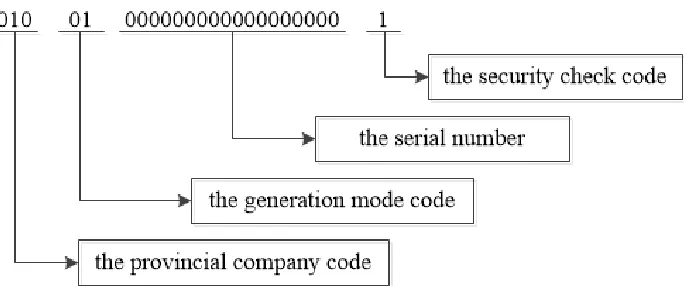
The identity code is applicable, universal, and unique. The first 3 bits of the identity code are the provincial company code, the 4-5 bits are the generation mode code, the 6-23 bits are the serial number of equipment, and the 24 bit is the security check code (Fig. 2). The object encoded by the identity code has the characteristics of traceability, location, independent and permanent.
[image:3.612.138.480.560.703.2]Implement the Concept of Business Collaboration and Formulate the Management System of the Identity Code
The company establishes trans-department collaborative mechanism, fully analyzes the impact of the identity code on existing business, reengineers the business processes and formulates management system, and provides a solid management support to maximize the role of the identity code.
Improve the Responsibility System. The company’s Committee of LCAM has unified leadership in the construction and application of the identity code, and has comprehensively formulated the division of responsibilities for each department. The security supervision and quality department is responsible for the overall organization and coordination of the construction of the identity code for power grid asset, and the department of science and technology and information communications is responsible for the transformation and management of relevant MIS related to the construction. At the same time, 23 specific responsibilities of the management departments of procurement, construction, operation and maintenance, finance, power dispatch and control, power sales and others are clearly defined.
Reengineer the Business Processes. The company analyzes and compares the difference between the identity code management and existing business management, and conducts research on business process reengineering and management adjustment. Twenty-seven management changes for twelve process nodes in nine departments involved in asset management are proposed. Mainly include:
Stage of program planning. The decision-making for post project evaluation and the improvement of the WBS in basis of the identity code are proposed.
Stage of procurement. The procurement departments should clarify the requirements for the tags producing and installing in the supplementary provisions of the contract in which the requirements for technical parameters filling should also be clarified. After organizing the manufacturers to produce the tags and install them on the equipment, the procurement departments should scan the tags for inventory management of the equipment and finally connect the identity codes in the tags with the project information.
Stage of construction. The construction departments should put the identity code into the equipment acceptance list and ensure that the identity code corresponds to the physical location of the equipment, and coordinate with the operation and maintenance departments and finance departments to ensure the accuracy of the equipment acceptance list. The construction departments should check the consistency of the identity codes in the technical specification, outgoing insepction report, data plate and tags. Then, the operation and maintenance departments count and inspect the on-site equipment according to the acceptance list and the identity codes, and automatically create the equipment ledgers by scanning the tags.
Stage of operation and maintenance. The operation and maintenance departments organize to produce and install the tags of running equipment. They carry out the operation and maintenance work with the tags, and replace the damaged, missing or unidentified tags in time.
Stage of retirement and disposal. The operation and maintenance departments rely on all the information associated by the identity code to carry out decision-making analysis of equipment retirement, scrapping and reusing.
Research on the Application Scenes of all Business. The solutions to the six typical scenes, such as "one-to-many”, “many-to-one" between material group and asset classification, have been worked out.
Scene 1: one-to-one, that is, one material forms one asset. Each material will generate one identity code when the procurement contract is signed. The manufacturers produce and install the tags during the stage of the contract performance.
Scene 3: many-to-one, that is, many materials are combined to form one asset. One identity code is generated for the asset when the procurement contract is signed. The manufacturers produce and install the tag on the material that gives play to the main function of the asset.
Scene 4: many-to-many, that is, many materials form many assets, such as transmission lines. The identity codes are generated during the project acceptance. The construction departments organize to produce and install the tags and associate the information of project, WBS and procurement with the codes.
Scene 5: the donated assets. They are managed according to the identity code management specification of running equipment.
Scene 6: assets formed by service procurement, such as houses, fire extinguisher systems and drainage systems. The identity codes are not generated for these types of assets because the tags can not be accurately fixed on the corresponding assets.
Reform the Systems and Achieve the Information Transfixion of the Equipment Data
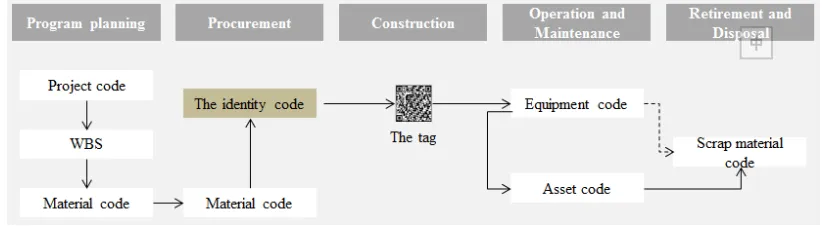
[image:5.612.99.511.312.425.2]The company has put forward the ideas of "serving the LCAM as a guide, based on the current MIS, laying equal stress on the local reformation of the systems and the data governance", and has reformed the MIS of the four stages of project planning, procurement and construction, operation and maintenance, retirement and disposal to achieve the information transfixion and traceability (Fig. 3).
Figure 3. Schematic of the information transfixion.
Design the Architecture. The company summarizes and refines the requirements for the construction of the identity code for power grid asset, and carries out architecture design from business, application, data and security.
Business architecture design. The company combs the business process of LCAM, analyzes the last level processes in the core business such as financial management, procurement management, construction management, operation and maintenance management to design the business architecture as a whole.
Application architecture design. Considering the current functions of ERP (Enterprise Resource Planning), PMS (Production Management System) and other MIS, the company has made plans of system integration, function improvement and micro application development.
Data architecture design. The company complied with the data architecture of SGCC and integrated the identity code into data architecture design.
Security architecture design. According to the security protection requirements of SGCC, the company has taken full account of the host security, application security, network security, data security and other factors, and has carried out the security architecture design.
Improve the System Functions. According to the needs of departments and end users, 101 functions of ERP, PMS and other MIS have been improved or developed.
Stage of procurement. The functions of ERP are improved to generate the identity codes during the procurement stage. Another micro application has been developed for manufactures to download the identity codes from the Internet. After producing and installing the tags, the manufactures can fill in the technical parameters of the equipment by the micro application. The procurement departments can scan the tags for inventory management.
Stage of construction. According to the bills of materials for equipment, the construction departments check the integrity and standardization of the tags, and check the consistency of the information in tags and MIS. The function has been developed to input the data of the on-site equipment handover testing by scanning the tags. The function for transferring the project equipment to assets has been improved which can automatically generate equipment ledger and asset card by the identity code.
Stage of operation and maintenance. A function has been developed in PMS that enables the automatic generation of the identity codes for running equipment of main network and distribution network. By the integration of PMS and ERP, the technical parameters of equipment ledger can be automatically quoted. The financial module of ERP has been reformed, the corresponding relation between the identity code and asset code is established, and asset checking, transferring and scrapping based on the tags are supported.
Stage of retirement and disposal. When the assets are decommissioned, they are identified according to the identity codes, and the information of the assets is read. The process of the assets disposal can be tracked with the identity code.
Apply the Identity Code and Verify the Top-level Design
A set of practical operation procedures is selected to ensure that the top-level design can be fully applied in the practical business.
Normalize the Application of the Identity Code in the Newly Purchased Equipment. The procurement department of the company clarifies the requirements for the tags producing and installing in the bidding announcement, and clarifies the requirements for technical parameters filling in supplementary provisions of the contract.
The manufacturers, the procurement departments, the construction departments and the operation and maintenance departments have practiced and verified four processes which are producing and installing the tags, scanning the tags for inventory management, creating the equipment acceptance list and scanning the tags for equipment delivery and equipment ledger creation.
On June 16, 2017, the 220kV Binnan substation expansion project of Jiangsu Province was successfully put into operation as the first pilot project to apply the identity code.
Formalize the Application of the Identity Code in the Running Equipment. The company carries out the tags producing and installing for running equipment of main network and distribution network, the feasibility, validity and durability of the tags producing and installation standards such as the tag material, size, installation position and fixed mode under different equipment types and different operating conditions.
The rationality of the process changes in the operation and maintenance, retirement and disposal are verified by the tags producing and installing for running equipment.
As of December 2017, the company has completed the identity codes encoding and tags installing for 36,453 equipment, of which 12,669 were newly purchased equipment and 23,784 were running equipment.
Apply the Identity code in Typical scenes and Promote the Transformation of Business
Typical scenes such as digital supply chain, accurate transfer and intelligent operation and maintenance have been selected to apply the identity codes, and LCAM has become more intelligent.
Develop the Material Supply Chain Management System. Relying on the technologies of mobile Internet and Internet of things, the new generation of mobile terminal has comprehensive advantages in mobile communication, scanning and identifying, image acquisition, automatic positioning, rapid entry of information, large screen display, real-time message reminding, etc.
The supply chain management system and mobile application for procurement departments, construction departments and manufactures, which contain the functions of coding management, codes distributing, on-site operation, business reminding communication and interaction and so on, have been developed.
Ensure the Accuracy of the Transfer of Equipment to Assets. With "precision and automation" as the goal, the equipment will be accurately transferred to assets based on the identity codes. The business processes of project approval, project construction, project acceptance, project settlement and final accounts have been dovetailed from offline to online. The information of project, material, equipment and assets can be accurately recorded in the system and transferred to the financial department timely and accurately, all the information can be traced and querying, which meets the asset management requirements of “real-time displaying of data, real-time controlling of process and real-time supervising of result". The capital management and cost control of the project construction have been enhanced, and the completion acceptance cycle has also been effectively shortened.
Explore Intelligent Operation and Maintenance. Optimize equipment ledger management model. By the introduction of the identity code, the technical parameters of the equipment are filled by the manufacturers, and the information of project, material can be automatically quoted when the equipment ledgers are generated, which greatly reduces the workload of the operators and improves the accuracy of the equipment ledger.
Carry out intelligent mobile maintenance. With the application the technologies such as Internet of things and mobile Internet, the maintainer scan the tags and fill the maintenance information in real time by the identity codes. The problem of difficulty in obtaining on-site information data under the previous maintenance mode was solved, and the control of equipment status and the scientificity of maintenance management were improved.
Carry out intelligent inventory. With the application of intelligent inventory technology, the operation and maintenance departments and financial departments can detect changes in asset operation in time. Carry out the inventory in combination with the routing inspection at any time, which can keep the correct correspondence between the equipment, equipment ledgers and asset cards.
Construction Effect
By carrying out the construction of the identity code for power grid assets based on "Internet of things +", information transfixion, value integration and business innovation of the power grid assets have been realized. The improvement of management makes the management benefits, economic benefits and social benefits of the company significantly improved.
Mainly reflected in the following aspects:
The Quality of Basic Data has been Improved and the Information Sharing of Asset Life Cycle has been Achieved
With the identity code as a link, the difficult problem of the complete correspondence between the ledger and the equipment has been solved and the quality of basic data has been improved. The key information of the assets is clean, transparent, uniform and effective, and is input for a life time sharing.
The Business Collaboration has been Promoted and the Efficiency of Asset Management has been Improved
The construction of identity code for power grid asset has promoted the transformation of enterprise management mode from the separate management by function to the collaborative management by business processes. The management objectives of departments have been coordinated and unified, and the information of departments has been fully shared. The company has achieved collective management in basis of the vertical integration and horizontal coordination.
At the same time, the management requirements of departments have been refined and standardized to make the LCAM more scientific and efficient.
The New Technologies for Asset Management has been Introduced and the Modernization of the Company has been Pushed to a New Level
The operation efficiency of the frontline staff has been improved by the application of the identify code, tags and mobile terminals in the field.
First, the efficiency of equipment ledger creation has been improved. The ledger creation mode has been reformed by automatically integrating the equipment technical parameters entered by the manufactures. The workload of ledger creation in PMS is greatly reduced. The average time of equipment ledger creation for 220kV and below substations has been saved by 50%, while 70% has been saved for 500kV and above substations.
Second, the accuracy rate of transferring equipment to asset has been improved. The essential information has been standardized by application of the identity code, and the accuracy rate of pilot projects has reached 100%.
Third, the inventory efficiency of equipment has been greatly improved. Through the intelligent inventory, the inspection time of equipment in 220kV and below substations has been shortened from 2 days to 6 hours, while 2.5 days to 8 hours for equipment in 500kV and above substations.
The Reliability of Power Grid Equipment has been Enhanced and the Benefit of Enterprise Business has been Increased
By the application of the identity code, the status of the assets can be grasped at any time, which enhances the reliability of the equipment operation. The situation of shortening the running time of the equipment due to one-sided pursuit of operation security, reliability and reduction of the maintenance workload has been overturned. The decommissioning and crapping of the equipment that is still available can be avoided, which effectively prolongs the service life of the equipment and increases the benefit of enterprise business.
Compared with 2016, the reliability rate of power supply of the company's urban distribution network and rural power grid have reached 99.956% and 99.852% respectively, the average failure time per year per household in urban and rural has been reduced by 4.65 and 20.77 hours respectively, and the average service life of assets is increased by 1.1 years.
References
[1]The State Council, Several opinions on further deepening the reform of electric power system.
2015-3-15.
[2]The State Council, Opinion on reforming the wage determination mechanism of state-owned
[3]General Office of the State Council, Guideline on financial support for economic restructuring and transformation and upgrading. 2013-7-1.
[4]Jin-ping Xi, Keynote speech at the 6th meeting of the central finance and economy leading group.
2014-6-13.
[5]State Grid Corporation of China, Technical specification of identity code for power grid assets.
2018-4-12.
[6]State Grid Corporation of China, Regulation of the identity code for power grid assets. 2018-3-1.
[7]Rong Bu, Xing-hui Zhang, The company's first pilot project of identity code for power grid assets