t h e Lo n d o n Sc h o o l o f E C O N O M IC S a n c Po l i t ic a l Sc ie n c e ■
A Systems Theoretical approach for Anti-Money
Laundering informed by a Case Study in a Greek
Financial Institution:
Self-reference, AML, its systemic constitution and technological
consequences
Dissertation submitted in fulfilment of the requirements for the award of
the degree of Doctor of Philosophy
Dionysios S. Demetis
http://www.demetis.com
Department of Management
Information Systems and Innovation Group
London School of Economics and Political Science
UMI Number: U615520
All rights reserved
INFORMATION TO ALL USERS
The quality of this reproduction is dependent upon the quality of the copy submitted. In the unlikely event that the author did not send a complete manuscript and there are missing pages, these will be noted. Also, if material had to be removed,
a note will indicate the deletion.
Dissertation Publishing
UMI U615520
Published by ProQuest LLC 2014. Copyright in the Dissertation held by the Author. Microform Edition © ProQuest LLC.
All rights reserved. This work is protected against unauthorized copying under Title 17, United States Code.
ProQuest LLC
789 East Eisenhower Parkway P.O. Box 1346
TMS5SS
F <5 S 2 - tLibra'y
BttShUx-ary1 *o*w>Abstract
(Red rose o f the w in d an d o f the fate, You have fingered in my memories, fihe a heavy rhythm (Rpse o f the night, you have passed, tempest o f a redveif
Table of Contents
Abstract... 2
Table of Contents... 5
List of Tables & Figures... 7
Acknowledgements... 8
Prologue...10
Chapter I: Introduction... 11
Chapter II: Literature Review... 15
Chapter Structure... 15
Section I: Deconstructing Money-Laundering... 16
What is Money-Laundering?... 16
The nature of the laundered money ... 16
The laundering process...21
Section II: The myths of ML estimation...23
Estimating the money laundering market...23
Section III: Legislation on ML...27
The International Fight against M L ...27
Section IV: Chapter Epilogue - Overview...41
An overview of some ‘global’ AML features...41
Chapter III: Research Methodology...47
Chapter Structure... 47
Introduction... 47
Methodology... 50
A broader structure for methodology...i... 54
Stage 1: Determining the philosophical presuppositions that guide the research ...56
Stage 2: Determining Research Design and Collecting Data... 58
Stage 3: Coding the Data, Applying the Theory and Reaching Conclusions 60 Applying Stage 1: Determining the philosophical presuppositions that guide the research... 60
Applying Stage 2: Determining Research Design and Collecting D ata... 62
Applying Stage 3: Coding the Data, Applying the Theory, and Reaching Conclusions... 67
Chapter IV: On Systems Theory... 71
Chapter Structure... 71
Introduction... 71
Difference & Distinction... 76
The System... 79
The Boundary, the Environment et a l...83
Complexity... 87
Self-Reference... 91
Chapter V: Empirical Findings - The Case Study...102
Chapter Structure... 102
The Greek AML system... 103
Access to the Bank... 106
Drosia Bank... 109
AML within the Bank... 114
Examining Scenario 2 ... ... ...118
The POSEIDON Information System... 121
The extent and form of asymmetry in STRs... 126
The CHIMERA System - New Automated Solutions for AM L...134
The Electronic Updates System...144
Broader comments... 145
Chapter VI: Analysis & Discussion...147
Chapter Structure... 147
Introduction... 147
The System of A M L... 148
The functional differentiation of society & the role of A M L...155
Coding... 163
The code of the AML system... 166
The role of technology in the AML system... 171
AML - ‘islands of reduced complexity’ ... ;... 182
The technological construction of AML-reality...187
From Bureaucracy to ‘Electreaucracy’ ... 193
Theoretical and Practical Contributions... 195
Epilogue... 199
Appendix I: ... 201
A treatise of the Risk-Based Approach with practical considerations:... 201
An informal account o f the self-reference in the risk-based approach and an application to a financial institution in the UK....201
References... 217
List of Tables & Figures
Fig u r e 2.1: t o w a r d sf ia tm o n e y... 18
Fig u r e 2.2: A r e a l A T M c a r df o rw it h d r a w in gv ir t u a lm o n e y...20
Ta b l e 2a: Su m m a r yo fm a jo rl e g is l a t iv ein it ia t iv e s...40
Fig u r e 2.3: A (M L ? ) n e t w o r k s...41
Ta b l e 3 a: Th e Ma t r ixo f Bu r r e l l & Mo r g a n... 49
Fig u r e 3.1: Th e Py t h a g o r e a n Th e o r e m...52
Fig u r e 3.2: A b r o a d e rs t r u c t u r ef o rm e t h o d o l o g y ... 55
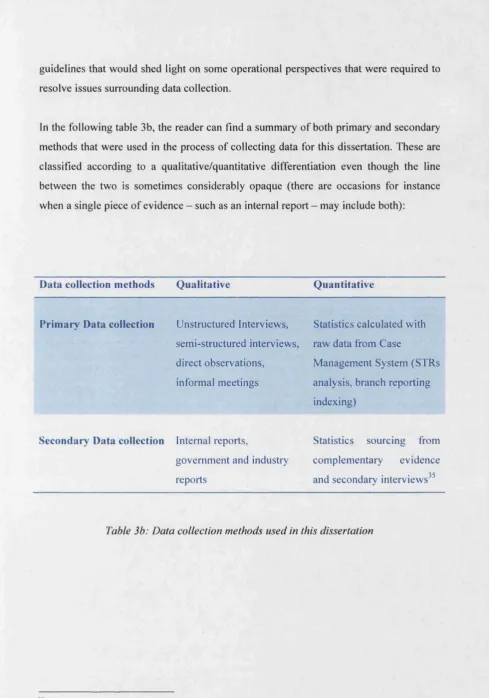
Ta b l e 3b: Da t ac o l l e c t io nm e t h o d su s e dint h isd is s e r t a t io n... 66
Fig u r e 3.3: Co d in gs t a g e s... 68
Fig u r e 4.1: Th e Kl e in Bo t t l e... 92
Fig u r e 4 .2: Pa t t e r n Ma t c h in g, Vis u a l Re p r e s e n t a t io na n d Sc a t t e r in g... 96
Fig u r e 4.3 . Sc a t t e r in go f 2sa c c o r d in gt op r o b a b il it ie s...97
Fig u r e 4 .4: Th isc a no n l yb ea na b s t r a c t io n... 98
Fig u r e 5.1: In c r e a s ein S T Rs... 111
Fig u r e 5.2: Lin e a rf ito f S T R -p r o j e c t io n... 112
Fig u r e 5.3: Re v e r s io no fr e p o r t in g... 113
Fig u r e 5.4: S T R -s u b m is s io na s y m m e t r yint h eb r a n c hn e t w o r k... 128
Fig u r e 5.5: As y m m e t r icd is t r ib u t io no f S T Rsina g g r e g a t e dc a t e g o r i e s...130
Fig u r e 5.6: De c r e a s in g S T R -p r o d u c t io ng r a p h...131
Fig u r e 5.7. To p 10 m o s ta c t iv eb r a n c h e sinr e p o r t in g... 133
Fig u r e 6 .1 , Th e St a n d a r d Mo d e lo ft h e 3 -t ie rh ie r a r c h y... 150
Fig u r e 6 .2: Th ef u n c t io n a ld if f e r e n t ia t io no f A M L ...159
Fig u r e 6 .3 . Co d e sa n d Sy s t e m s: Fu n d a m e n t a lu n it ie so fd is t in c t io n...164
Fig u r e 6.4. In t e r p e n e t r a t io nb e t w e e nt h es y s t e m so f A M L a n dt e c h n o l o g y... 179
Fig u r e. 6.5 C H IM E R A in f l u e n c e s...180
Fig u r e 6.6.: S T R in c r e a s ein Dr o s ia Ba n k...181
Fig u r e. 6 .7 - Dis c l o s u r e s/Pr o s e c u t io n sf o rt h e Gr e e k A M L s y s t e m...183
Fig u r e A 1 . Fe e d b a c kl o o pb e t w e e nm a n u a lg e n e r a t io no f S T Rsa n da u t o m a t e dr u l e sf o r ESTABLISHING SUSPICION...206
Acknowledgements
The reader may skip this (hopefully enjoyable) section as I intend to make no
exceptions in thanking wholeheartedly the good number of people that I have met at the
London School of Economics and elsewhere, and who have supported me throughout
my research in one way or another. I would like to thank (in no particular order):
Anna Palamidi, for always being there for me, and for continuing to do so,
Christoforos Moutafis, for making me laugh while being severely injured in Cambridge during the French festival, for accepting to perform as the best ‘koumparomaterial’ ever,
and for not going to these pretentious formal balls,
Sarah Emery, for being the best boss and friend one could ever have,
Ashutosh Khanna, for our unique strolls up and down Tower I, and the discussions,
James Backhouse, for Spotlight and for trusting me with the classes of his Security course within our IS integrity group,
Bernard Dyer, for the stories, the ants, and our endless collaboration,
Antonio Cordelia, for the Stella-Shandy, his Italian accent, and Sapori,
Chrysanthi Avgerou, for our interesting conversations and for sending me to MCIS,
Cheryl Edwardes, for her giggle and always sharp-commentary,
Magda Hercheui, for her energy, particularly on the dance-floor,
Katerina Voutsina, for being one of my best friends despite her Kefallonia-origin,
Jonathan Ezer, for discussing, discussing, and ... eventually publishing together,
Joanna Chini, for staying alive after choosing the dangerous sport of kayaking on the Thames,
Avgousta Kyriakidou, for remaining calm on an unprecedented number of occasions,
Daniel Osei-Joehene, for his early advice about making money that I failed to follow, and so I believe did he, in light of too many philosophical interests,
Dominique Lazanski, for the help and the music,
Federico Iannacci, for our interesting discussions on national-corruption and more,
Prodromos Tsiavos, for keeping my Eric Cartman quote and the Naples tragic ornament,
Spiro Samonas, for our common photographic interests at the Student Support Desk,
Shirin Madon, for I would prefer no one else to give me the good news of my PhD upgrade in the sweetest possible way, (& she plays the piano!),
Jannis Kallinikos, for Greek poetry on Kalvos, for introducing me to Luhmann, our chapter in his book, and the ‘what is reality’ quote,
Frank Land, for accepting my invitation three times in a row to give a fantastic set of lectures to our students,
Carsten Sorensen, for without him I would have forgotten what it would be like to be a computer geek, for the music, and for the crucial advice in life-changing moments,
Steve Smithson, for trusting me with the dissertation classes, letting me organise the weekly seminars at the LSE for our MSc students, and our occasional cigarette down
Tower I,
Maha Shaikh, for one only knows what trust really means with Maha as a friend,
Everyone who is not on this list, for memory is often week and space limited,
My Students at LSE, for reviving my brain cells in every single class,
Jose-Carlos Mariategui, for the satanic laughter and for founding Nepheli Ltd,
My Parents, for without them my ontological question would not exist,
My PhD supervisor, Professor Ian Oakley Angell,
for accepting me as his PhD student,
for putting yellow marks all over my written documents,
marks that gradually turned purple,
for the right-o quote, (after the kettle has been set for tea)
for teaching me how to balance the Force,
for our always heated discussions and debates,
for not allowing me to win over one single argument, and for saying to
me: “All in good time, balance the Force, learn you shall”.
And for everything else that spacetime and words cannot encapsulate.
Prologue
As any dissertation contains and confronts an antithesis, this one cannot but wholeheartedly embrace its own. The antithesis I speak o f has been the challenge to combine, confront and reflect on somewhat different levels: that o f philosophical abstraction represented by theory, and that o f specificity represented by the somewhat more pragmatic domain o f Anti-Money Laundering (AML). In dealing with deep philosophical issues and confronting theoretical challenges I have found tremendous pleasure in choosing Systems Theory as the theory that would guide this research, and unavoidably, a theory that has for myself constituted an entire paradigm o f thinking about any problem. At the same time, I have found a great deal o f pleasure in dealing with the domain o f AML as a pragmatic problem affecting financial institutions worldwide.
In dealing with AML, I have come to witness its evolution throughout a number of years and under a number o f capacities. First as a young researcher into the problem domain by examining a few financial institutions, then as a PhD student in dealing with a single institution for a long period o f time, then as an associate and author for two European Commission funded projects on AML (Spotlight1 and Gate2) and various other publications, and most recently as an independent AML-expert giving consultation seminars in a number o f financial institutions and organisations in Europe and the Middle East. Many things have changed over these years, even though global evidence that the AML domain is becoming more effective in dealing with the problem domain is consistently missing. One thing is certain, for those observing the problem itself: its complexity increases and so is the complexity o f AML.
In discovering Systems Theory during my Masters degree in Information Systems at the London School o f Economics when Professor Ian Angell - later on to become my PhD supervisor - outlined the fundamental constructs o f the theory, I have come to realise that there is something terribly appealing in that theory. It was much later that I discovered how my first Degree in Physics would conceptually help me tackle systems theoretical concepts in dealing with systems o f greater complexity and/or descriptive variation. Within the multitude o f theoretical constructs in existence, I cannot think of one that could surpass the theoretical richness and depth o f examination that Systems Theory can offer.
This dissertation has been the product o f a long intellectual journey that now strangely seems to have ended, or rather has reached a new beginning (one always keeps the prologue for the end). I hope that the reader finds this pleasure on both fronts, those of theory and practice, but more importantly in their combination.
Chapter
/;
Introduction
Anti-Money Laundering has become an important contemporary phenomenon that has
generated a great deal of attention, predominantly in the past two decades. While the net
of stakeholders involved in AML has expanded due to regulatory initiatives, financial
institutions remain at the forefront of the fight against money-laundering. Consequently,
the study of how financial institutions deal with this important problem domain remains
crucial. Financial institutions, however, do not exist in a void. They are part of a
complex socio-political and economic arena that is advancing in particularly structured
ways, but with unstructured consequences.
Whatever modernity may come to mean in this regard, modem society may be
characterised by a number of attributes, although it is evident that technology has come
to occupy a central role in this self-proclaimed modernity. Technology as broadly
understood has of course little to do with both the wider study of information systems
and the very concept of systems as will be developed and analysed in this dissertation. Still, our dependence on technology has increased considerably, and it is becoming
evident that a technology that fails to function no longer comes to a halt, but triggers
unanticipated effects of possibly catastrophic dimensions. Such catastrophic dimensions
not only permeate problem domains like AML, but also, and even worse, they often go
unnoticed or they become masked as an operative success by the systems that employ
the technological function and all that this implies. Hence, in a large number of fields,
society has come to rely on technology functioning, and develops its own structures
more and more on the basis of this precondition of reliance.
This technological precondition is not an exception merely within AML. Financial
Institutions have always been technologically astute, and have expanded their own
‘closed’ organisational structures to include technological developments that were
viewed as beneficial within their own structures.
The current conditions in the broader AML domain appear therefore to have acquired a
highly unstructured complexity - a complexity partly due to the regulatory initiatives
that have spawned a myriad of reactions, and partly due to the technological
Such complexity is also reinforced by an unrestrained opportunism shown by the
software industry that for a number o f years has exploited the fact that technology was
deemed by regulators as a necessary tool in the development o f the fight against ML.
Consequently software has found a vulnerable ground that has resulted in considerable
automation with adverse effects for Financial Intelligence Units. Last but not least, the
risk-based approach and its introduction with the 3rd Directive has created a multitude of
additional ambiguities. Even though the European Union (EU) has rightly taken the step
o f introducing a more flexible approach in the fight against ML, a series o f difficulties
and uncertainties have been introduced in how such a risk-based approach should be
implemented, and furthermore, how individual institutions and Financial Intelligence
Units are to make sense of this newly-born complexity that comes with the very elusive
nature o f risk. Typical stances within these new difficulties sourcing from the risk-based
approach can be found not only in financial institutions but also in the regulators. In the
UK for example, the Financial Services Authority has scrapped the detailed AML guide
and introduced high-level principles in line with the risk-based approach. At the same
time, however, checking compliance becomes compromised. How will risk-based
supervision be put into practice when the internal document that is the basis o f checks
by the FSA is labyrinthine? Even the Chairman o f the FSA accepts this to be a problem,
noting: ‘The policy question is the balance between the two, and in particular the extent
we can rebalance between the present very large (8500 pages and growing) rule book on
the one hand and principles on the other... this rebalancing will not be easy’3.
To put it simply, no one knows how to go about introducing, supervising and managing
a risk-based approach for AML as the underlying infrastructure for doing so is simply
non-existent. Such a strong assertion is not carried out here with the purpose of
overemphasizing the problems. This section merely remains a preface to the academic
discussion that follows. The reality however also remains, that feedback between FIUs
and financial institutions is at a primordial state, interoperability issues are barely
considered, while stakeholder fragmentation as well as the sharing o f intelligence -
even at an anonymized form that would not jeopardise data protection and privacy
issues - is left unattended.
Within this dynamic, between regulatory initiatives and technological development
(even though development here should not be taken to imply improvement in any
regard), the domain of AML is considerably reconstructed.
Much like a biological organism that encodes its own survival and evolution within a
double-helix of genetic code, the Anti-Money Laundering System becomes structurally
coupled with the system of technology with which it co-evolves. Examination of such
an interplay implies two things to be considered together: how is AML a system? And
also, how is technology a system? Beyond the realm of technology, as commonly
perceived, this dissertation seeks to offer an insight (through the empirical data gathered
and the analysis put forward) into the broader effects that various information systems
have within a financial institution in relation to Anti-Money Laundering. This implies
that the commonly perceived technological structures that currently affect ML, those of
profiling technologies that attempt to simulate money-laundering behaviour and hence
capture suspicious transactions, remain but a single instance of a broader structure of
various information systems that have similar (if not more powerful and propagating)
effects on AML.
This dissertation seeks to give an answer to the following research questions:
i. What theoretical description can be developed in order to describe the domain of
Anti-Money Laundering through the lens of Systems Theory?
ii. What is the role that various information systems come to occupy within
financial institutions, which in their own turn try to tackle the problem of
ML, and how do the complex interactions between various information
systems employed affect AML?
In seeking to outline the path for answering the aforementioned research questions, a
general literature review is provided that deconstructs the problem of money-
laundering, while reviewing the issue of defining ML, estimating the ML market,
reviewing some key legislative initiatives, and outlining global AML characteristics.
Chapter III, the methodology chapter, outlines both the basic research principles that
guide the research process throughout its stages, and the methodological choices being
made, while also seeking to contribute to the broader construction of a methodological
process.
Chapter IV presents the key theoretical principles of Systems Theory that constitute the foundational basis for developing a further theoretical treatise and for relating systems
principles to AML.
Chapter V describes the empirical findings that have sourced from a longitudinal case
study carried out in a major financial institution in Greece, and relates the various
information systems instances in order to ponder the second research question outlined
above.
Chapter VI, the final chapter, analyses and discusses a number of systemically
theoretical instances that lead to a description of AML as a system (in the systems theoretical sense of the second-order cybernetics tradition). There is an attempt to
synthesize, in systemic terms, both the domain of AML and the domain of technology,
all the while examining their interplay. This is followed by an endeavour to extrapolate
these observations in order to provide both theoretical and practical contributions.
The dissertation concludes with some final remarks and offers some suggestions for
Chapter II: Literature Review
Chapter Structure
This chapter reviews the literature on anti-money-laundering in four different
sections. In this prologue, a brief description of each section follows:
i) Section I tries to deconstruct the problem of defining money-laundering. The
problem of definition (besides being a semantic issue) is one of crucial
importance. Using Searle’s social construction of reality, an effort is made to
articulate a description of what money-laundering is, through the very nature
of money per se. The focus lies partly on the functionalities that money serves.
ii) Section II describes the plethora of problems that come into existence when
we try to estimate the scale of the money-laundering market. There are
reasons to suggest that the market has increased, despite the attempts to
estimate it proving highly problematic.
iii) Section III presents the major international initiatives against Money
Laundering. As the initiatives are many, and their contents often
complicated, an effort is made to present these in a clear chronological order.
A brief description follows of the most important initiatives, ending with an
attempt to categorize the major contributions.
iv) Section IV describes some features of the global anti-money-laundering
arena, which will hopefully provide the reader with a broader perspective of
Section I: Deconstructing Money-Laundering
What is Money-Laundering?
In order to formulate a definition on what money-laundering (ML hereinafter) is, we
must take into consideration the fact that ML is first and foremost a process that is dynamic and can therefore change considerably. Furthermore, we must also ponder the
question of what the nature of the money being laundered actually is. I will commence by examining the latter.
The nature of the laundered money
The way money is used, and perceived of today, has nothing to do with the early years
of banking, which preceded the discovery of coinage. The first use of ‘money’ as a
medium of exchange was based in commodities like ivory, leather, gold, etc. Banking these commodities meant storing them in warehouses and keeping track of the
exchanges. The diversity in the physical properties of the medium of exchange in
ancient times meant that the value being exchanged was inherent in the medium itself. It
would therefore be pointless to define money here by connecting it to the physical properties of the medium of exchange (Davies 2002). A better understanding comes
from acknowledging the functions that money serves as a medium of exchange, as a means of payment, and store of value.
These functions that are ascribed to money are the dominant characteristics of its
constitution. If we strip money from its functionality, or cease to believe that something
functions as money, then money has no meaning and therefore no functionality. Money
is an institutional fact (as is marriage), sourcing from the collective intentionality that
assigns - to money - the agentive functions that define its purpose (Searle 1995). In his
book ‘The Social Construction of Reality’, Searle (1995) gives a compelling account of
Critical in the process of creating institutional facts is the collective intentionality4,
which cannot be reduced to an individual’s intentionality. As Searle frames it (p.41):
“The central span on the bridge from physics to society is collective intentionality and the decisive movement on that bridge in the creation of social reality is the collective intentional imposition of function on entities that cannot perform those functions without th at imposition.” (Emphasis added) - (ibid)
Applied to money, this brings us to the realization that without the collective intentional
imposition of function on money, money would not be able to function as such.
Impositions of functionality on money are typically done by institutions that express the
aforementioned collective intentionality. These institutions have a status that is not
easily contested, disputed or refuted. For instance, central banks can be seen as the
primary institutions that engage in such impositions by issuing money, and at the same
time as entities with a commonly shared status. Such impositions however do not only
occur within the legally defined scope of function-based utilisation of money. Such
impositions are also carried out in systems like Hawala, whereby a token functions as
money, because the agentive functions that are ascribed to the token are recognized as
such. Hence, the token that encompasses these collectively imposed functions (even if
that happens ‘underground’), is as good as money5.
Most academic-related material that examines the nature of money usually distinguishes
three common forms [i.e. (Davies 2002)]:
Commodity money: Gold6 or other materials.
Contract money: Pieces of paper that promise to pay the bearer in gold.
4 According to Searle (1995, p.46) collective intentionality ‘assigns a new status to some phenomenon, where that status has an accompanying function that cannot be performed solely in virtue o f the intrinsic physical features of the phenomenon in question. This assignment creates a new fact, an institutional fact, a new fact created by human agreement.’
5 Money here refers to the commonly shared institutional fact that we recognize as legitimate. Underground tokens have the same functionality in their respective institutional reality, but are not recognized as legitimate by governments.
Fiat money: Not attached to gold. They are just certificates that have resulted from a
collective intentionality, and that has ascribed to them the agentive function o f
‘functioning as money’.
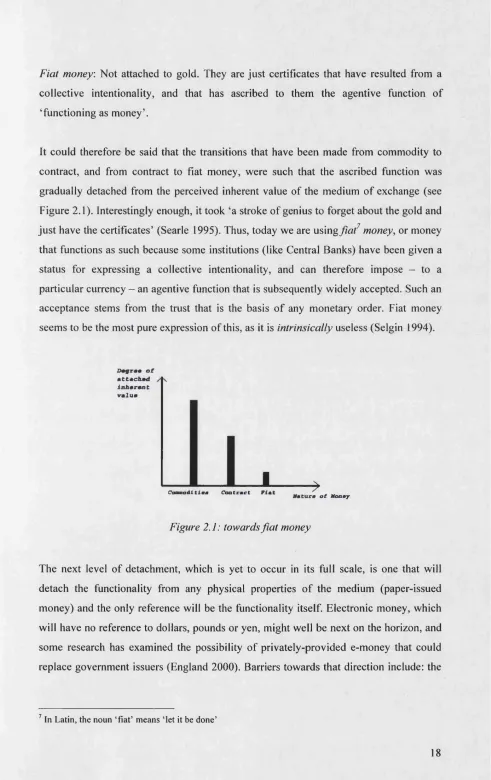
It could therefore be said that the transitions that have been made from commodity to
contract, and from contract to fiat money, were such that the ascribed function was
gradually detached from the perceived inherent value o f the medium o f exchange (see
Figure 2.1). Interestingly enough, it took ‘a stroke o f genius to forget about the gold and
just have the certificates’ (Searle 1995). Thus, today we are using fia t7 money, or money
that functions as such because some institutions (like Central Banks) have been given a
status for expressing a collective intentionality, and can therefore impose - to a
particular currency - an agentive function that is subsequently widely accepted. Such an
acceptance stems from the trust that is the basis o f any monetary order. Fiat money
seems to be the most pure expression o f this, as it is intrinsically useless (Selgin 1994).
D * g r » » o f
mttmehmd
i n h m r n t
vmlum
Figure 2.1: towards fia t money
The next level o f detachment, which is yet to occur in its full scale, is one that will
detach the functionality from any physical properties o f the medium (paper-issued
money) and the only reference will be the functionality itself. Electronic money, which
will have no reference to dollars, pounds or yen, might well be next on the horizon, and
some research has examined the possibility o f privately-provided e-money that could
replace government issuers (England 2000). Barriers towards that direction include: the
7 In Latin, the noun ‘fiat’ means ‘let it be done’
- I »
C o m m o d i t i e s C o n t r a c t F l a t „
[image:20.595.26.517.28.808.2]o pre-established base of government issuers that will be hard to compete against; that
different e-money issuers will not be easily identifiable; the place of government in
regulating these new monies. This transition will hard because the control-oriented and
will-to-power-driven governments will not easily let go. Electronic money will create a
mobility that will diminish their control-abilities (Greenberg and Goodman 1996).
Furthermore, electronic money at that level of functional-detachment may considerably
exacerbate ML.
With electronic money under consideration, and in connection to the ascribed
functionalities of money, it could be said that:
Money is an institutional fact that may or may not take on a physical form (i.e. cash, e-
cash), and has a variety of collectively ascribed agentive functions that allow it to serve
as a medium of exchange, a unit of account, or a store of value. Subsequently, any
definition on money laundering must also encompass the nature of the money being
laundered, with reference to the functionality that it serves.
Money-laundering then becomes the process of trying to disguise illicit-profits in order
to enjoy the use of all ascribed legitimate, standardised and commonly shared agentive
functions of money while the criminal origins of the entity incorporating these functions
{money) are hidden.
By focusing on the agentive functions that money performs, the above definition distances ML from the physical (paper-money) or electronic (bits of information)
properties of money. In short, whatever it may be that governments impose an agency o f functioning as money upon, this can be laundered or made to succumb to fraudulent activities. Even though it is difficult to perceive such a differentiation, the first examples
are already here and considerably test our understanding of how money functions, how
it is to be regulated, or how can it open new avenues for money-laundering. Online
games for example, which have introduced virtual online economies with fictional
currencies, have broadened the scope of the interactivity between real and virtual cash.
In only one such game-example entitled ‘Project Entropia’9, more than half-a-million
participants interact online. This virtual game platform belongs to a broader category o f
games categorised as MMORPGs (Massive Multiplayer Online Role Playing Games)
and profits from a turnover o f more than 1.5Billion PED, with PED being the virtual
currency in the online space (standing for Project Entropia Dollars). A virtual exchange
rate has been introduced for the purpose o f converting money back and forth into USD,
with the virtual exchange rate being 10/1 (that is lOPEDs are worth $1). One can
transfer money into the virtual space, make virtual investments, potentially engage in
fraudulent activities online, and even claim more than one identity (virtual!) for
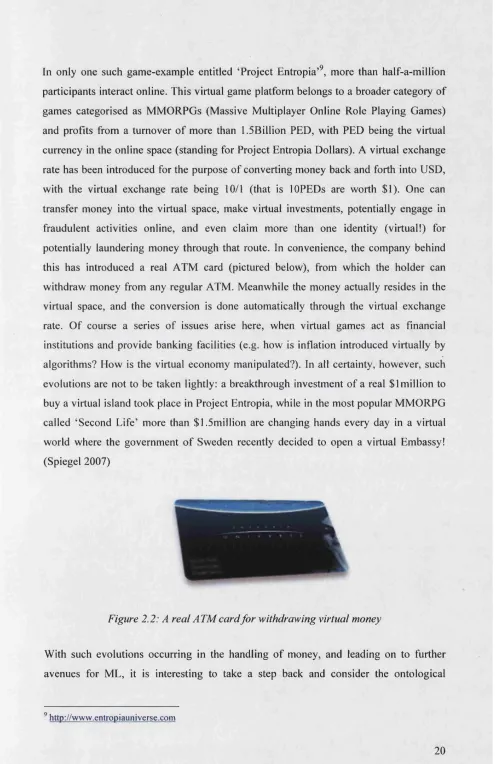
potentially laundering money through that route. In convenience, the company behind
this has introduced a real ATM card (pictured below), from which the holder can
withdraw money from any regular ATM. Meanwhile the money actually resides in the
virtual space, and the conversion is done automatically through the virtual exchange
rate. O f course a series o f issues arise here, when virtual games act as financial
institutions and provide banking facilities (e.g. how is inflation introduced virtually by
algorithms? How is the virtual economy manipulated?). In all certainty, however, such
evolutions are not to be taken lightly: a breakthrough investment o f a real $1 million to
buy a virtual island took place in Project Entropia, while in the most popular MMORPG
called ‘Second Life’ more than $1.5million are changing hands every day in a virtual
world where the government o f Sweden recently decided to open a virtual Embassy!
[image:22.595.24.519.30.794.2](Spiegel 2007)
Figure 2.2: A real ATM cardfor withdrawing virtual money
With such evolutions occurring in the handling o f money, and leading on to further
avenues for ML, it is interesting to take a step back and consider the ontological
constructs of criminality, or else to examine what are those offences that are considered
as criminal and can be associated with the laundering of money they acquire illegally.
Even though it is beyond the purposes of this dissertation to delve into such an issue, its
importance cannot be over-emphasized. Because of the differences between nation
states in their definitions of what criminal offences are, launderers are given an
advantage. A clear example is in the application of Directive 91/308/EEC in different member states of the EU. As the directive gave flexibility on its application to national
laws, it was inevitable that discrepancies and differences would follow. Launderers
were thus given the opportunity to shop around for a member state with more lenient
laws on detection and punishment (Mohamed 2002). Take into account the possibilities
opened up virtually, and the difficulties become insurmountable. Where has the crime
taken place? In the user’s home computer, in the server hosting the virtual service, or in
the myriad different routers that participate in the trafficking of internet protocols, thus
perplexing the bit-trail?
In any event, once successful, ML gives the opportunity to criminals, besides distancing
themselves from the crime and the profits, to enjoy their benefits or reinvest them in
order to conduct legitimate business or fund another criminal activity (McDonell 1998).
Thus, money-laundering attempts the transformation of the 'assets' into a more usable
and legitimate form, by trying to store the gained value from the criminal activities,
which quite often produce large sums of money that must be manipulated10 (Tanzi
1996).
The laundering
process
A fundamental distinction that has to be made while attempting to define money-
laundering is that between methods and processes. Viewing ML as a set of methods creates a variety of inconsistencies due to the ever-increasing ways that are used to
launder money. Methods of laundering money are also known as typologies. The
Financial Action Task Force (FATF), the world’s only group targeting solely ML, regularly publishes listings of such typologies.
Another way of defining ML is by portraying it as a process. The consensus surrounding such a definition is somewhat better, and ML is portrayed through the
typical three-stage model:
i) The Placement Stage where the proceeds from the criminal activity enter the financial system.
ii)The Layering Stage where the money launderer creates the complex set of financial transactions aimed at separating the illicit proceeds from the source,
and blurring the audit trail.
iii) The Integration Stage where the laundered proceeds can re-enter the financial system, appearing to be from a legitimate source and the result of normal
business activities (CS 2001).
Even though the above stages are adequate for describing the processes of ‘traditional’
money-laundering, cyber-laundering11 has altered even these, and has given them a new
perspective, worthy of brief mention and analysis. Electronic money, and the
phenomenon of disintermediation, make it much easier for the criminal to go through
the placement stage, hitherto the stage where he was most likely to be detected (Gilmore
1993). Through the use of the Internet, it is possible to create an extremely complex
audit trail in a very short period o f time, which in a multi-jurisdictional financial environment can render the possibility of detection minimal (Philippsohn 2001). That,
along with the fact that Money Laundering on the Internet has cut out one of the two
methods for detection (suspicious transaction reporting through face-to-face interaction
- with the other method being monitoring transactions that exceed a certain threshold),
it is no wonder that cyber-laundering has created a 'market' of around $50 billion per
year12. Money launderers have therefore recently moved into Internet gambling, online
casinos, and credit card e-transactions. The potential for illegally utilizing these new
possibilities has increased considerably (Hugel and Kelly 2002).
11 Nothing more than the application o f ML in the information age, by the use o f ‘tools’ like the Internet, mobile technologies, etc...
Section II: The myths of ML estimation
Estimating the money laundering market
One of the most difficult tasks of analysis is the estimation of the money laundering
market. There have been several attempts, but before we proceed in describing the
proxies that have been used for estimation, it is useful first to acknowledge once again
that what constitutes ML is constantly changing. For instance, when ML was connected
to drug-trafficking, estimations on the ML market were based upon the drug market.
Once the norm-producing institutions like the LIN expanded the scope of criminality of
ML, then it became evident that estimations would increase as more proxies claimed
their share in contributing to ML. In this section, it will be argued that it is beyond our
capacity to formulate a clear understanding of how much money is actually being
laundered, but at the same time, there are several reasons to suggest that money-
laundering has increased.
It has been claimed that money-laundering is the world’s third largest market (Robinson
1998), after the US domestic bond market, and the Eurobond market (Scholte 1997).
The International Monetary Fund (IMF) estimates the ML market to be 2-5% of the
world’s Gross Domestic Product, something that brings the estimate up to $600billion ~
$1.5 trillion (Lilley 2000). Similar estimates reaching $1.5 trillion come from an Ernst
& Young report (Price 2002). Using crime and economic statistics from various sources
like the United Nations Crime and Justice database, Walker develops a model for
estimating the total global ML to around $2.85 trillion (Walker 1998)13. If we include
cyber-laundering14, then we can add an additional $50 billion to the total estimates
(Philippsohn 2001).
13 That being the case, the author wonders why the suspicious transaction reports count for only a tiny fragment of the total volume o f ML. Moreover, another issue that is posed is not the amount o f dirty money at a national level but the relevant proportions o f clean versus dirty money being transmitted through the financial centres, something that is particularly higher offshore.
The deviations in the estimates of the ML market become more evident when we look at
how many different methodologies exist for this purpose. Furthermore, and as we have
previously discussed, the dynamics of the definition of ML evident from the evolution
of legislation151, clearly poses another serious problem in estimation. The issue of
defining the underground economy is still unsettled, and besides being a semantic issue,
it remains of fundamental importance (Tanzi 1999). An example that clearly
demonstrates the aforementioned problematic nature of estimating the ML market is
that of Australia", where estimates range from 1.4% to 47.1% of the GDP. This wide
range demonstrates clearly that progress in estimating the size of the underground
economy has been modest to say the least (ibid).
The above differences, and the fact that the special working team appointed from the
FATF with the task of estimating the money-laundering ‘market’, could not reach a
conclusion and was dismantled one year later, shows how little confidence we should
place in ML estimations. As the former chairman of the working group on statistics and
methods concluded:
“There is not at present any economic dens ex machina that will allow the accurate measurement of money laundering world-wide, or even within most large nations. The basis for such estimations simply does not exist” (Walker 1998)
There are good reasons behind our incapacity to estimate ML. The dubious but obvious
connection between the underground and the legitimate economies is such that little
room is left for separating one from the other. Since ML distorts several economic
statistical indices (Quirk 1996), it is simply pointless to try and uncover the figure
behind the underground economy. This is because the instruments used for the
estimations are already distorted and entangled with the underground economy.
Substantial sums of money from the underground economy have been used for
‘legitimate businesses’, ranging from the re-election of several US presidents, to the
constitution of Stanford University (Duyne 1998). It is therefore time to stop seeing
money laundering and anti-money-laundering as separate entities that are in conflict.
They are structurally coupled, and formulate an industry that is beyond good and evil111.
It is therefore a fallacy to consider any estimations of the underground economy as real.
Rather they are only indicative of scale. The most we can probably do is speculate on
whether there has been an increase or decrease in the ML market, and there are at least
two good reasons to suggest that ML has indeed increased. The first is the transition to
the information age, and the second has to do with the economic aspect of globalization.
► ML in the information age: it might as well be termed cyber-laundering, but it is
money-laundering nevertheless. Cyber-Laundering (CL hereinafter), concerns the
passage of ML into the cyber-domain via information technologies and the Internet.
Moreover, the ongoing evolution o f computer systems creates security issues that may
make these systems prone to exploitation by launderers (Granville 2003). One such
example comes from China where two hackers were given the death penalty for hacking
into a bank remotely, stealing ¥720,000, and then trying to transfer the money to sixteen
accounts they had createdlv (HKVoD 1998). Bothering with offshore financial centres
could therefore prove pointless, once the PC has become the best washing machine, not
forgetting that e-mail routing, encryption and anonymizer software can also be used by
criminals (Lilley 2000). E-banking and e-payment systems are also a fabric of the CL
that can be exploited by the launderers, something that ultimately renders Know Your
Customer (KYC) policies, harder to apply (ibid).
CL magnifies the problem because of two interconnected reasons: the first is that the
laundering phasesv may be carried out more easily, and the second is because
dematerialized e-cash and its subsequent liquidity provide the opportunity for
disintermediation, bringing the buyer and the seller in a direct relationship. However, it
is difficult to say whether such transactions are 'black' or not, and what exactly their
connection to the underground economy is (Angell 2000). As long as taking middle
men out of the equation proves more profitable (and it usually is) then there will be an
inherent systemic trend towards the profitability of disintermediation.
► The Economic Aspect of Globalization: The second element that could be considered
as a reason for suggesting an increase in the ML-market. According to a research report
the relationship between the Trade Openness of a country and its Real Per Capita Income, it becomes evident that there was a strong positive correlation between the two (ibid) in the majority of countries examined. Two particular examples are China and
Mexico.
There is strong evidence to support the fact that a country's openness to international
trade is a very important factor for its growth. This makes a clear point that countries
entering the globalization game (from its economic standpoint), liberalizing their
markets, will find major economic benefits. Contrariwise, marginalized countries have
had little or no growth, resulting in increasing poverty and inequality (WorldBank
2001). In addition to that, the transition from the ‘welfare state’ to the ‘competition
state’, followed by an intensification of capitalism, meant that state sovereignty was
compromised and supra-territoriality of capital was unavoidable (Scholte 1997). This
gave rise to a supra-state-govemance concerning capital matters, including ways to
combat ML through the FATF’s constitution.
The economic dimension of globalization cannot therefore be ignored, and it is safe to
assume that it will continue to expand with more countries willing to participate in the
new global economy. This will subsequently result in a continuously increasing capital
flow, which in its turn will make it much easier for money-launderers to conceal their
transactions and carry out successful ML. The bigger the volume and number of
transactions on a global scale, the easier it will be to launder money under that very
beneficial globalized economy, as the money stream there is of such astronomical
magnitude that with a little caution, miscreants won't attract much attention.
Integration and globalization of markets also bring underground markets closer
together. An example is shell banks that have no physical presence in the country they
are incorporated and licensed, and are usually a particular feature of some offshore
Section III: Legislation on ML
The International Fight against ML
There have been several initiatives targeting the problem of ML, but it is beyond the
scope of this dissertation to analyse fully each and every one. Furthermore, an in-depth
examination of the documents would require a comparative legal analysis, which would
overshadow the purpose of this section, that being the identification of those initiatives
that have made a significant contribution at a truly international level.
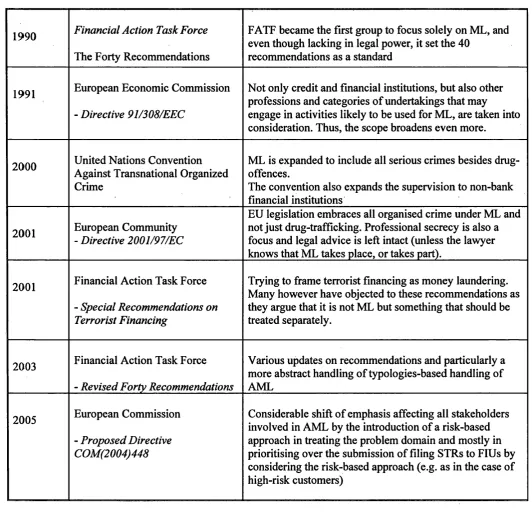
The purpose of this section is to review the initiatives in a chronological order,
demonstrating how the definition and scope of ML has expanded, and bringing out the
instruments that are being used for the prevention of ML, thus constituting the Anti-
Money-Laundering domain (AML).
The major initiatives regarding AML are presented below in chronological order (where
specific dates could be retrieved for the initiatives, they are presented):
1) 27 June 1980 - The Council of Europe, Committee of Ministers - “Measures
Against the transfer and safeguarding of funds of criminal origin -
Recommendation No.R (80)10 adopted by the Committee of Ministers and the
Council of Europe”.
2) December 1988 - The Basel Committee on Banking Supervision - “Statement
on Prevention of Criminal Use of the Banking System for the Purpose of
Money-Laundering”.
3) 19 December 1988 - United Nations - “United Nations Convention Against
Illicit Traffic in Narcotic Drugs and Psychotropic Substances16”.
4) June 1990 - The Caribbean Financial Action Task Force (CFATF) - The 19
Aruba Recommendations.
5) 8 November 1990 - Council of Europe Convention on laundering, tracing,
seizure and confiscation of proceeds of crime (The Strasbourg Convention).
6) 1991 - The European Economic Commission - “Council Directive on
Prevention of the use of the financial system for the purpose of money-
laundering” Directive 91/308/EEC.
7) 5-6 November 1992 - The Kingston Declaration on Money-Laundering.
8) 18-20 June 1994 - “International Conference on Preventing and Controlling
Money-Laundering and the use of the proceeds of Crime: A global approach”.
9) 21-23 November 1994 - United Nations - “Naples Declaration and Global
Action Plan against Organized Transnational Crime, adopted at the World
Ministerial Conference on OTC at Naples from the United Nations General
Assembly” Resolution GA/49/159.
10) 1996 - Financial Action Task Force - “The Forty Recommendations”.
11)14 November 1996 - “The Riga Declaration on the fight against money-
laundering”.
12)10 June 1998 - United Nations - “United Nations on attacking the profits of
crime: Drugs, money and laundering”. A panel Discussion at the Twentieth
Special Session of the General Assembly.
13)1999 - United Nations - “International Convention for the Suppression of the
financing of Terrorism”.
14)30-31 March 2000 - United Nations - “The United Nations Offshore Forum”
Cayman Islands.
15)15 November 2000 - United Nations - “The United Nations Convention
Against Transnational Organized Crime”.
16) October 2001 - The Basel Committee on Banking Supervision - “Customer
Due Diligence for Banks”.
17)31 October 2001 - FATF - “The Financial Action Task Force Special
Recommendations on Terrorist Financing”.
18)4 December 2001 - European Community - “Directive 2001/97/EC of the
European Parliament and of the Council on 4 December 2001, amending
Council Directive 91/308/EEC on prevention of the use of the financial system
for the purpose of money-laundering”.
20)26 October 2005 - European Commission - ‘Directive of the European
Parliament and of the Council on the prevention of the use of the financial
system for the purpose of money laundering, including terrorist financing’
2005/60/EC.
From all of the above initiatives, it would be useful to analyse briefly those that have
made a considerable impact on the Anti-Money-Laundering arena. These are chosen in
terms of their scope, and therefore their attempt to encompass several areas of the problem domain at a truly international level. Even though there has been attempts from
the early 80s to address the problem (e.g. Council of Europe), it must be recognized that
the first truly international initiative was that of the United Nations in the Convention
titled “United Nations Convention Against Illicit Traffic in Narcotic Drugs and
Psychotropic Substances”. This convention is also known as the Vienna Convention, and it is this term that will be used henceforth in this dissertation.
► The Vienna Convention: The major contribution, and something that was done for
the very first time at this UN gathering was the requirement that all States should establish money laundering as a criminal offence. Even though the convention was focused on the proceeds of drug17 trafficking crimes (thus money-laundering didn’t
include reference to other types of crime), there was participation from many states
including major drug producers who faced the problem at a greater scale (Gilmore
1999). ML became an extraditable offence, and the confiscation of the proceeds was
also addressedvl. The convention’s breakthrough in criminalizing money laundering is
clearly stated in Article 3:
“Each party shall adopt such measures as may be necessary to establish as criminal offences under its domestic law, when committed intentionally: ... conversion or transfer of property knowing that such property is derived from any [drug trafficking] offence, or from an act of participation in such offence ... the concealment or disguise of the true nature, source, location, disposition, movement, rights with respect to, or ownership of property, knowing that such property is derived from an offence or offences established in accordance with subparagraph (a)...” (UN 1988) -Article 3.
Focusing on drug trafficking, the Vienna convention recognizes that such activities pose
a serious threat to the welfare of human beings. Moreover, drug trafficking and
laundering the proceeds of crime can also ‘adversely affect the economicv" cultural, and political foundations o f society
According to the Vienna convention, each party should adopt measures that would
enable its competent authorities to identify, trace, and freeze or seize proceeds. Bilateral
and multilateral treaties were also encouraged to increase effectiveness. Banking
secrecy was also addressed, in order to ensure that it would not prevent any
investigations. Further, provisions were made in the convention to confiscate the
proceeds of crime, even if their form has been altered or commingled with other
property.
Article 7 provided for mutual legal and other assistance between countries as obtaining
evidence from abroad is critical for any ML investigation. Bilateral or multilateral
agreements between countries could enhance that cooperation.
The UNDCP (Drug Control Programme) added an additional step, providing help in
legislation and drafting a Model Law in ML, in 1993. Law enforcement agencies, which played a major role in that initiative, included the ICPO/Interpol. Even though Interpol
does not have an operational policing mandate, its infrastructure helps the overall effort.
Interpol connects the National Central Bureau (NCB) of the participating countries
through an Automated Message Switching System. Nearly 50% of the messages being
exchanged through that system are drug-related and of immediate interest for the fight
against money-laundering (Gilmore 1999).
► The Financial Action Task Force is a single group that targets the ML domain. The
group was constituted by the G7 in July 1989, and produced the famous 40
recommendations, which have received broad recognition as the world’s standard for
countering ML.
Three important landmarks in the work of the FATF are:
b) The Revised Forty Recommendations in 2003.
c) Eight special recommendations on Terrorist Financing in 2001.
Even though the FATF cannot pass laws, it only makes recommendations, however,
these are received with widespread trust and so the FATF has been recognized as the
major contributor in the global fight against ML. Interestingly enough, the first version
of the forty recommendations in 1990 called countries to ratify the UN Vienna
Convention amongst other recommendations, and embarrassingly claimed that “Each
country should, without further delay, take steps to fully implement the Vienna
Convention, and proceed to ratify it” (FATF 1990). Following that initiative, the UN
asserted that the FATF recommendations should be recognized as the international 1 ft
standard against ML . The support of the United Nations to the FATF was re-affirmed
in the Political Declaration and Action Plan against Money Laundering, which was adopted at the Twentieth Special Session of the UN General Assembly. Most notably:
“ ... the Commission noted that the forty recommendations of the Financial Action Task Force established by the heads of State or Government of the seven major industrialized countries and the President of the European Commission remained the standard by which the measures against money-laundering adopted by concerned States should be judged ...” (UN 1998) - emphasis added.
The Financial Action Task Force appraises its members annually. Recommendations 21
and 22 of the FATF, give the option to FATF-member countries to impose financial
sanctions and adopt countermeasures against those that do not have sound AML
policies. The group also produces a list of non-cooperative countries, a process termed
as ‘black-listing’. Typically, the countries that do not have sound AML policies are
those that are black-listed. No G7 country has ever been blacklisted, for whatever
reason, despite the fact that a large amount of laundered money goes through the US
and the UK. Despite its attempts to combat ML, the United Kingdom has failed to
provide a satisfactory answer to why there are not stringent measures on its
protectorates. The thorny issue of why the UK has not promptly dismantled the legal
and banking havens of the Crown Dependencies remains unsettled. One might say that
political will is inversely related to the amount of money surrounding the country. The
fact remains that this connection between the UK and its protectorates has crowned
London as one of the major ML capitals of the world (Mohamed 2002). A case of ML
in the Cayman Islands shows how contradictory forces work within the same systems.
Four people charged for money-laundering offences in the Cayman Islands were cleared
due to lack of evidence. The investigation uncovered the fact that the Director of the
Financial Intelligence Unit of the Cayman Islands (CAYFIN), Mr. Brian Gibbs, had
destroyed critical financial evidence on the case. For a long period of time he acted as a
paid informer of the MI6, and was desperately trying to keep his role secret (Rider
2003).
Nauru19 may be a country that is a long way away from the Paris-based FATF, but it is
still under considerable pressure from the threat of financial countermeasures (Johnson
2003; Roule and Salak 2003), and so the country has attempted to take significant steps
towards inclusion. These countermeasures applied by FATF members create a
substantial financial burden on the business transactions of a country, which
subsequently presents economic and credibility problems. Under such circumstances,
most countries find it ‘appropriate’ to comply.
There is a general consensus among observers that the FATF is US-dominated, and that
US interests support the expansion of the group’s sphere of influence. This comes as no
surprise. Naylor (1994) gives a compelling account of US-domination of the financial
world post-World-War II, including the role of the IMF, the capital flight problem (from
developing countries to the US), and so-called ‘Pentagon Capitalism’ (Naylor 1994).
The evolution of FATF’s working agenda speaks for itself.
The reality is that the FATF has expanded, and it has become extremely powerful. This
is due, in no small part, to the fact that the FATF has made a big difference in
combating ML, in that many countries have been influenced to improve and strengthen
their AML efforts (Johnson and Lim 2002). Non-compliance now means financial
sanctions as well as severe difficulties when transacting with the world’s biggest
markets, which would suggest that the pressure imposed by the ‘blame-and-shame’
approach actually works. In fact, most of the countries black-listed initially responded
negatively, but soon recognized that improving their procedures would get them
accepted. Subsequently the vast majority wholeheartedly joined in with the international
AML effort (Johnson 2001).
However, after the terrorist attacks on US soil on September 11 2001, it was inevitable
that changes in policy would rapidly follow. Expansion of the working agenda of the
FATF to cover terrorist financing was something that has caused considerable problems
in several ways. The original problem of defining ML was, and still is a nebulous issue
(Tanzi 1999), with the Financial Action Task Force claiming that ML was the
processing of criminal proceeds in order to disguise their illegal origin (FATF 2003). However, with terrorist financing, even that problematic definition of money laundering
was twisted and distorted in a most profound way. The problems are many. Firstly,
terrorist activities are often funded by legal money. Secondly, banks now face
considerable amounts of stress, pressure and compliance fear because they have to
check (besides the origin of money) the purpose of the transaction, and its use by the
end customer. Thirdly, Know Your Customer (KYC) principles can be seen as
expanding to KYEC principles (Know Your End Customer), something that raises
serious questions about civil liberties (Mohamed 2002). This all points to the
problematic nature of terrorist financing and its link to money laundering. Banks are
being forced into policing legitimate transactions that could potentially be used for
terrorist purposes (ibid). Furthermore, it is evident that the hopeful pre-emptive strike
against ML and terrorist financing may cause more problems than it actually solves. Let
us not forget that as the totality of the global financial system is being affected by these
changes, only a very tiny fraction of the money being exchanged will be used for
terrorist financing.
► The Political Declaration in 1998 by the UN General Assembly at the Twentieth
Special Session, upgraded and updated the Vienna Convention through the ‘Countering
Money Laundering’ Plan of Action.
In this UN General Assembly, members reinstated their determination to combat the
narcotics problem. They also encouraged all nations to adopt national ML legislation by
Among the several aspects that were examined in this UN Assembly, particular
emphasis was given to the issue of globalisation and how international cooperation must
be fostered and strengthened in order to deal with the phenomenon in a globalized
world. As the Executive Director of the Office fo r Drug Control and Crime Prevention,
Professor Arlacchi, stated20:
“Globalisation has turned the international financial system into a money
launderer’s dream, and this criminal process siphons away billions of
dollars per year from economic growth at a time when the financial
health of every country affects the stability of the global marketplace”
(UN 1998).
Several ways were discussed in this UN Assembly on how international cooperation
could be enhanced for combating the problem of ML more effectively in a globalized
world. Multilateral information networks were brought up as networks of vital
importance, and a specific example is that of the Egmont Group linking different
Financial Intelligence Units. There was also an expansion in offence of laundering
money, which is termed ‘money derived from serious crimes’.
► The UN Convention Against Transnational Organized Crime in 200021. Once
again, the scope of this convention was very important as it was under the auspices of
the United Nations. The major contribution of the convention was the adoption of a
broader definition of money laundering, which would include not only drugs but also a
wide range of other criminal activity.
The intention therefore of Article 6 of this convention was to expand the definition of
money laundering by including all serious crimes on top of the pre-existing drug offences.
20 A Panel Discussion held at the United Nations, New York, on 10 June 1998, titled: “Attacking the Profits o f Crime: Drugs, Money and Laundering”. The title o f Professor Arlacchi’s speech was “The Need for a Global Attack on Money Laundering”.
Article 6, the ‘Criminalisation of the laundering of proceeds of crime’, mentions that the
application of laws must be done ‘to the widest range of predicate offences’ for ‘serious
crime’. This is clearly defined in Article 2(b) as follows: ‘Serious crime shall mean
conduct constituting an offence punishable by a maximum deprivation of liberty of at
least four years or a more serious penalty’ (UN 2000).
Moreover, Article 7 of the convention expanded the supervisory regime to non-bank financial institutions. This was another major contribution of the convention as it
recognized there are many avenues for money-laundering that go beyond the traditional
route through the banking institutions. According to Article 7:
“Each State Party shall ‘institute a comprehensive domestic regulatory and
supervisory regime for banks and non-bank financial institutions and, where appropriate, other bodies particularly susceptible to money-laundering...
customer identification, record-keeping and the reporting of suspicious
transactions are emphasized.” Article 7 (UN 2000) - emphasis added.
► The Basel Committee on Banking Supervision Initiatives.
As the Basel Committee is responsible for the supervision of the banking sector, it has
contributed to the AML domain through a series of initiatives.
The Basel Committee became involved in AML as early as 1988 when it issued a
statement on ‘Prevention of Crimina