Token Bus Based MAC protocol for Wireless Sensor
Networks
P.Udayakumar
Department of CSCCEM
Raipur, Chattisgarh, India
Ranjana Vyas
School of IT MATS University Raipur, Chattisgarh, IndiaO.P Vyas
Prof. In-charge (Ph.D. Section)IIIT-A Allahabad, India
ABSTRACT
In this paper, we propose TBB-MAC, an enhancement for medium access control (MAC) protocol based on the token bus in wireless sensor networks (WSNs). In this type of networks, sensors are spatially correlated and they often sense and collect the information and send it to the sink. In this paper, we design an innovative contention-based MAC protocol to provide long network lifetime. Our ideas help wireless nodes at sleep mode as much as possible to avoid major energy waste causes, such as idle listening, collision and overhearing. We want to show that, TBB-MAC can be an efficient method to reduce redundant transmissions in sensor networks, thus diminishing energy consumption and transmission delay. Hence, the network lifetime can last longer and the sink receives events within shorter delays. We propose to apply our technique in S-MAC and T-MAC, the contention based protocols for WSN. By simulation and experimentation, we prove that TBB-MAC overpasses S-MAC and T-MAC in terms of energy consumption and transmission delay.
Key words
S-MAC, T-MAC, TBB-MAC, OMNET++, TRAMA
1. INTRODUCTION
A wireless sensor network is a network composed of hundreds to thousands of communicating sensors and deployed in an area to collect environment events. In a sensor network, each node is a small sensor with a low processing, storage and energy capacity. Sensors are often battery powered and we expect a lifetime of several months to several years. Hence, the major difference between the sensor network and the traditional wireless network is that sensors are very sensitive to energy consumption. In the future, when sensor manufacture becomes massive, sensor price will be much lower and it is preferable to change sensors rather than batteries after use.
Wireless sensor networks have wide range of potential applications [1] such as environmental monitoring, medical systems, agriculture, robotic exploration, traffic surveillance, military, earth quake monitoring, space research, disaster relief etc. Medium access control (MAC) protocols play a major role in energy consumption, because sensor nodes are battery powered. The battery has limited capacity and generally impractical to be replaced or recharged, due to environmental or cost constraints. MAC protocols typically trade off classical performance parameters such as throughput, latency and fairness for reduction in energy consumption.
In general, a sensor radio has 4 operating modes: transmission, reception, idle listening and sleep. In MICA [2] the energy consumption in transmission/reception/idle/sleep mode is 80/30/30/0.003 mW respectively. Normally, the energy consumption in listening mode and idle mode is approximately equal and half of the energy used in transmission mode and the
energy consumption in sleep mode is much lower. Therefore, we should put the radio in sleep mode as much as possible.
In this paper we discuss the design of new MAC protocol, TBB-MAC, for wireless sensor networks, which mainly avoids overhearing, collisions, and frequent communication between sleep and active modes. Our protocol uses two separate phases during the communication process. In the first phase, nodes compete for time slots reservation for their transmissions and in the next phase, each node transmits or receives data from corresponding sender. When a node is aware of its time slot, it will be active otherwise it goes back to sleep mode during the remaining time of the transmission period. In this paper we have studied the performance of TBB-MAC protocol and compared with the existing S-MAC and T-MAC protocols. Depending on the traffic load, our protocol improves the energy consumption significantly when compared to S-MAC and T-MAC.
This paper is organized in such a way that it starts with an introduction about the existing related MAC protocols, and our protocol (TBB MAC) is described in detail in the third section. In the fourth section, energy efficiency performance and comparison with the existing protocols is analyzed. Finally the results are compared into a comprehensive conclusion.
2. THE RELATED WORK
In recent years, many energy-efficient MAC protocols have been proposed in literature which is classified into two main categories, contention-based and TDMA-based protocols. It has been widely recognized that contention based MAC protocols [3] [4] [5] are the most suitable for wireless sensor networks due to their self-organizing nature. On the other hand, TDMA based MAC protocols [6][7][8] provide excellent trade-offs between energy savings and throughput performance. In these protocols, where nodes are assumed to be synchronized and accesses the communication channel by scheduling and reservation of time slots. Such protocols by nature preserve energy as they have duty cycle built-in and an inherent collision-free medium access. Their major problem consists in their high complexity due to non-trivial problem of synchronization in WSNs. Managing inter-cluster communication and interference is not an easy task, and the scalability is also not good when compared to contention based protocols.
periodic synchronization among neighbors to agree sleep or active schedules, but the use of fixed radio cycles can waste considerable amounts of energy. S-MAC suffers another problem that during the period of high activity, the radio must be turned on long enough to handle the traffic, and when the load decreases the radio remain essentially idle.
T-MAC [9] is another well-known contention based protocol, addresses this problem by adaptive sleep/active duty cycle for the radio operation. T-MAC protocol reduces idle listening by periodically transmitting all messages in bursts of variable length, and also sleeping between bursts. When no activation event is heard after a time out, its active period ends up. T-MAC protocol also suffers the high-latency and large buffer size problem like S-MAC. Another problem in T-MAC is the synchronization is hard to reach and the clock drift may lead to unstable coordination. L-MAC [5] is suited for data collection applications in which sensors have to report to sink nodes through multiple nodes.
The protocol is mainly used to decrease the message multi-hop latency, while reducing energy consumption. TRAMA[10] is a scheduled-based protocol that provides energy efficient conflict-free channel, is able to achieve good energy savings at the expense of delay. It has complex mechanism and does not support the inclusion of new nodes or topology changes. Z-MAC [11] is a combination of TDMA and CSMA principles, uses the concept of self-owned slot. Collisions are reduced and better energy savings is possible. It introduces a new flexible time-frame rule and it needs global clock synchronization once at the setup time.
3. TBB-MAC DESIGN
In this section, we describe our proposal TBB-MAC to improve MAC layer in wireless sensor networks. TBB-MAC is like OBMAC [12] can be applied in any existing MAC protocols for WSNs. We propose an election algorithm which guarantees low cost communication and low congestion in the network. We suppose several hypotheses for the context of sensor networks. Initially, the wireless sensor network is deployed randomly and densely in an area to detect events related to the environment, especially, the change of temperature, moisture, pressure, vibration etc. Second, when an event occurs, all or many sensors with in the subnet detect the same information and transmit it to the access point. Hence, sensors waste energy to transmit the same messages. Based on these hypotheses, we present token bus based algorithm to better adapt MAC protocol to wireless sensor networks. TBB-MAC reduces energy waste by minimizing the amount of redundant communications and guarantees shorter communication delays. As there are many MAC protocols for WSNs, we propose to apply TBB-MAC in well-known S-MAC and T-MAC protocols in WSNs.
We organize our paper as follows: we first give a brief introduction of S-MAC and T-MAC, next we show how TBB-MAC can be applied in S-TBB-MAC and T-TBB-MAC in order to reduce energy consumption and network congestion.
3.1 S-MAC Protocol Design
S-MAC consists of three major components namely periodic listen and sleep, collision and overhearing avoidance, and message passing.
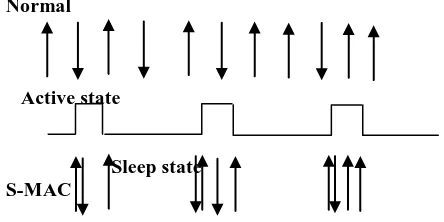
Normal
Active state
[image:2.595.310.532.75.186.2]Sleep state S-MAC
Fig 1: S-MAC protocol design
3.1.1 Periodic Listen and Sleep
In many sensor network applications, if no sensing event occurs, then nodes remain idle for a long time as shown in figure 1. The data rate during this period is very low. Compared to TDMA schemes with very short time slots, S-MAC requires much looser synchronization among neighboring nodes, which are free to choose their own listen/sleep schedules. The drawback of the scheme is that latency is increased due to periodic sleep of each node.
3.1.2 Collision and Overhearing Avoidance
[image:2.595.303.517.398.454.2]S-MAC protocol follows both virtual and physical carrier sense and RTS/CTS exchange. All senders perform carrier sense before initiating a transmission. Unicast packets follow the sequence of RTS/CTS/DATA/ACK between the sender and receiver.
Fig 2: Transmission on multi-hop network
As shown in Figure 2, nodes A, B, C, D, E, and F forms a multi-hop network [13] where each node can only hear the transmissions from its immediate neighbors. Collisions happen at receiver. Suppose node B is currently transmitting a data packet to A. In the figure 2 it is shown that C should go to sleep since its transmission interferes with A’s reception. Node E and F do not need to go to sleep. D is two-hop away from A, and its transmission does not interfere with A’s reception, so it is free to transmit to its other neighbors like F. however, D is unable to get any reply from F, e.g., CTS or data, because F’s transmission collides with B’s transmission at node D. So D’s transmission is simply waste of energy. That means all immediate neighbors should sleep after they hear the RTS or CTS packet until the current transmissions is over.
3.1.3 Message Passing
One of the approaches is to fragment the long message into many small fragments, and transmit them in burst. In this case only one RTS and one CTS packet is used. Each time a data fragment is transmitted, the sender waits for an ACK from the receiver. If the neighboring node hears a RTS or CTS packet, it will go to sleep for the time that is needed to transmit all the fragments and each data fragment and ACK packet also has the duration field.
3.2 T-MAC Protocol Design
T-MAC (Timeout MAC) [9] is a contention-based, adaptive energy efficient MAC protocol for wireless sensor networks. T-MAC reduces energy consumption by introducing an active/sleep duty cycle. TDMA-based protocols are naturally energy
preserving, because they have a duty cycle built-in, and do not suffer from collisions [13].
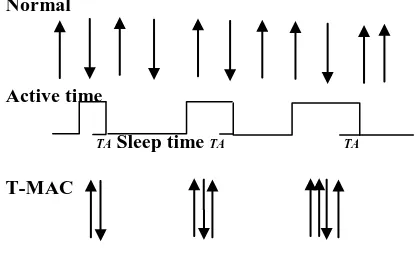
Normal
Active time
TA Sleep time TA TA
T-MAC
Fig 3: T-MAC Protocol Design
Every node in T-MAC periodically wakes up to communicate with its neighbors using a Request-To-Send (RTS), Clear-To-Send (CTS), Data, Acknowledgement (ACK) scheme, that provides both collision avoidance and reliable transmission, and then goes to sleep again until the next frame. See figure 3 for illustration. In the meantime new messages are queued. In the active period, a node will keep listening and potentially transmitting the messages. When no activation event has occurred then active period ends for a time TA.
Every node in T-MAC transmits its queued messages in a burst at the start of the frame. During this burst, the medium is saturated and the messages are transmitted at maximum rate. A node may expect to be in the medium every time it sends an RTS. The RTS transmission starts by waiting and listening for a random time within a fixed contention interval and this interval is adjusted for maximum load.
T-MAC uses much less energy than either S-MAC especially when the message frequency during events increases. But T-MAC suffers from the early sleeping problem, because we have relatively many edge nodes.
3.3
TBB-MAC Design
In this section, we describe our proposal TBB-MAC to improve MAC layer in wireless sensor networks. TBB-MAC can be applied in any existing MAC protocols for WSNs. It guarantees low cost communication and low congestion in the network. We suppose several theories for the context of wireless sensor networks. As shown in figure 4, initially, the wireless sensor network is deployed randomly and densely in an area to detect events related to the environment, like the change of temperature, moisture, pressure, vibration etc. Second, when an event occurs, many sensors collect the same information and transmit it to the access point. Hence, sensors waste energy to transmit redundant messages. Based on these theories, we present TBB-MAC to maximize the performance of MAC protocol in wireless sensor networks. TBB-MAC reduces energy waste by minimizing the amount of redundant communications and guarantees shorter communication delays. As there are many MAC protocols for WSNs, we propose to apply TBB-MAC in well-known S-MAC and T-MAC protocols.
[image:3.595.307.526.83.230.2]
Fig 4: TBB-MAC protocol design
TBB-MAC uses token bus algorithm. Initially, the wireless sensor network is deployed densely in an area. From the figure it shows that one node is elected as base station (sink) using an election algorithm [14], meanwhile other nodes within the radius go to sleep for a random amount of time. The base station is the token holder can sense or detect events related to environment, like change of temperature, pressure etc. After time out, the token is passed to another node selected randomly and goes to sleep. This process continues and repeated. The main advantage of this algorithm is that only one node is active within the radius in time.
3.3.1 Token Bus Algorithm
A station has a token holding timer to limit the time it can hold the token. This value is set at the system initialization time by the network management process.
At the end of transmission, the token is passed to the next station.
Once received the token, the station either starts to transmit or passes the token to the next station within one response window.
Token holder has the responsibility of periodically (an inter-solicit-count timer) granting an opportunity for new stations to enter the logical ring before it passes the token.
The station wishes to be deleted may wait until it receives the token, then sends a Set-Successor frame to its predecessor
4. PERFORMANCE RESULTS
In this section, we will present the results of performance evaluation to prove the effectiveness of TBB-MAC. We use the OMNet++ simulator [15] to validate TBB-MAC. OMNet++ is a public-source, component-based, modular and open-architecture simulation environment. To simulate a wireless sensor network, we use mobility framework (MF) [16], a framework of OMNet++ which supports simulations of wireless and mobile networks. We use the battery module [17] to simulate battery drain.
Table 1: Simulation parameters
Deployment zone 500 x 500
Number of nodes 5 – 20
Influential range -60 to -90 dBm Battery Energizer Lithium AA 2900 mAh Processor (active/sleep) 8mA/15 µA RF transceiver(TX/RX/Sleep) 27mA/10mA/1µA
RF power 3mW
Receive Sensitivity -98dBm Active/Sleep period .1/9.9s Data transfer frequency 1pkt/10s
Simulation time 500s
Event
Node
[image:3.595.62.270.107.240.2]Table 1 describes the simulation parameters used in our test. These simulation parameters correspond to MICA2 sensors [2]. The network is deployed randomly in a square of 500 x 500. The coordinator is placed in the center of the deployment zone. Nodes periodically send data to the coordinator.
4.1 Delay Time:
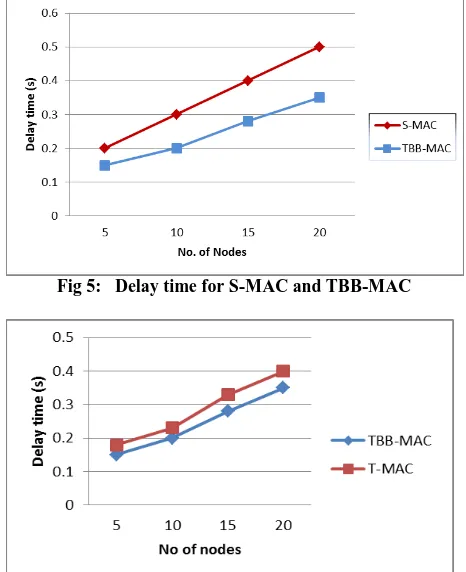
[image:4.595.312.534.81.208.2]For simulation we use number of nodes from 5 to 20. Other simulation parameters are given in table 1. We implement our algorithm with both S-MAC and T-MAC protocols. The horizontal axis shows the number of nodes and the vertical axis illustrates the total delay time of all transmissions.
Fig 5: Delay time for S-MAC and TBB-MAC
Fig 6: Delay time for T-MAC and TBB-MAC
We compare the delay time between S-MAC, T-MAC and TBB-MAC. From the figure 5 and figure 6, we can see that TBB-MAC has shorter delay that S-MAC and T-MAC. In general, the more nodes there are in the network, the delay also increases. By reducing redundant transmissions in TBB-MAC, nodes avoid transmitting useless packets and reduce transmission delays for each event. Therefore as the number nodes increase in TBB-MAC the delay time slightly increases.
4.2 Energy Consumption:
[image:4.595.62.295.190.476.2]In figure 7, the vertical axis illustrates the average energy consumption of all nodes in the network and horizontal axis shows the number of nodes from 5 to 20. We also implement our algorithm with S-MAC and T-MAC.
Fig 7: Energy consumption for S-MAC and TBB-MAC
[image:4.595.64.296.192.322.2]
Fig 8: Energy consumption for T-MAC and TBB-MAC
As S-MAC and T-MAC use sleep mode periodically, their energy consumption is very high when compare to TBB-MAC as shown in figure 7 and figure 8. As the number of nodes increase, due to congestion in the network, S-MAC and T-MAC consume more energy. In TBB-MAC, as the number of nodes increase, there will be more nodes in the influential range and they will not transmit their packets since those packets are redundant packets.
5. CONCLUSION AND FUTURE WORK
In this paper we have analyzed TBB-MAC and apply it to well-known S-MAC and T-MAC protocols for wireless sensor networks. The performance results show that TBB-MAC over passes the performances of S-MAC and T-MAC in terms of transmission delay and energy consumption. As we increase the number of nodes, S-MAC and T-MAC were affected badly due to increase in congestion in the network but TBB-MAC was not affected due to redundant packets. Hence TBB-MAC can be applied to any existing MAC protocol for WSN.6. REFERENCES
[1] I.F. Akyildiz, W. Su, Y. Sankarasubramaniam, E. Cayirci, “Wireless sensor networks: a survey”, Computer Networks 38 (2002), pp. 393–422, Atlanta, USA.
[2] MICA2 OEM Edition, http://www.xbow.com/ Products/Product_pdf_files/Wireless_pdf/MICA2_OEM_E dition_Datasheet.pdf OB-MAC.pdf.
[3] Wei Ye, John Heidemann, Deborah Estrin “An Energy-Efficient MAC Protocol for Wireless Sensor Networks”, In 21st Conference of the IEEE Computer and Communications Societies (INFOCOM), vol. 3, pp. 1567-1576, June 2002.
[4] Boopendra Kumar, Rakesh Kumar, Rama Krishna Challa “Comprehensive Performance Analysis of MAC Protocols for Wireless Sensor Networks”, International conference on Computer & Communication Technology, pp. 342-347, 2010.
[5] Lening Wang, Kai Liu “An Adaptive Energy-Efficient and Low-Latency MAC Protocol for Wireless Sensor Networks”, 3rd
International Conference of IEEE Wireless Communications Networking and Mobile Computing (WiCom), pp. 2440-2443, September 2007.
[6] Ana Liu, Honyi Yu, Lin Li “an Energy-efficiency and Collision-free MAC Protocol for Wireless Sensor Networks”, Vehicular Technology Conference VTC 2005-Spring of IEEE in May 2005, vol. 2, pp. 1317-1322.
[image:4.595.64.284.649.747.2][8] W. R. Heinzelman, A. Chandrakasan, and H.Balakrishnan, “Energy efficient communication protocols for wireless microsensor networks”, Proc. Hawaii Int. Conf. Systems Sciences, Jan. 2000, pp. 3005–3014.
[9] Tijs Van Dam, Koen Langendoen, “An Adaptive Energy Efficient MAC Protocol for Wireless Sensor Networks”, Proceedings of 1st International Conference on embedded networked sensor systems, pp.171-180 SenSys03, ACM, New York 2003.
[10] Venkatesh Rajendran, Katia Obraczka, J. J Garcia – Luna – Aceves “Energy-Efficient, Collision-Free Medium Access Control for Wireless Sensor Networks”, ACM/Sensys 03, November 2003, pp. 181-192.
[11] Injong Rhee, Ajit Warrier, Mahesh Aia and Jeongki Min, “ZMAC: A hybrid MAC for wireless sensor networks,” in IEEE/ACM transactions June 2008, vol. 16, pp. 511-524.
[12] Hung-Cuong LE, Herve Guyennet and Violeta Felea, “OBMAC: an Overhearing Based MAC Protocol for Wireless Sensor Networks”, SENSORCOMM’07,
International conference on Sensor Technologies and Applications, Valencia, Spain, pp. 547-553, October 2007.
[13] P. Havinga and G. Smit, “Energy effcient TDMA medium access control protocol scheduling”, Proc. of Asian International Mobile Computing Conference (AMOC 2000), pp. 1-9, November 2000.
[14] Weaver, A.C, “The IEEE token bus-A performance bound on GM MAP”, Industrial Electronics, IEEE Transactions, Feb. 1998, Vol. 35, pp.13-17.
[15] OMNet++ Community Site. [Online] Available http://www.omnetpp.org/.
[16] Mobility Framework for OMNet++. [Online] Available http://mobility-fw.sourceforge.net/.