
Lifetime Maximization of Wireless Sensor Networks
using Improved Genetic Algorithm based Approach
Vinay Kumar Singh
Vidushi Sharma
Department of Computer Sc. & Engg and IT Anand Engineering College,
Agra, India
School of Information & Communication Technology, Gautam Buddha University,
Greater Noida, India
ABSTRACT
In Wireless Sensor Networks the nodes have limited energy and are seriously constrained by the battery life. To increase the lifetime of the network is a critical and challenging issue and thus it is the routing in WSNs, which is the primary focus of design for researchers. In this paper the Elitist genetic algorithm and simulated annealing algorithms are combined to find an optimal energy efficient route for the sensor nodes towards the sink node to prolong the network lifetime. The objective function of the proposed method considers not only the distance of the nodes form the sink but also the lifetime of the network as a function of the maximum energy dissipated by a node in the route. It is evident from the simulation results that the performance of the new scheme is improved further over the existing routing protocols.
Keywords
wireless sensor network; network lifetime; energy efficient; genetic algorithm, simulated annealing
1.
INTRODUCTION
A Wireless sensor network consists of randomly/manually deployed sensors that sense the physical or environmental events and send the collected data to the base station. A large number of inexpensive, small and autonomous sensors are generally deployed in an ad hoc manner at remote areas. Sensor nodes in a WSN are constrained in storage capacity, computation power, bandwidth and power supply[1-4]. The routing protocols in WSN aim at reducing the energy consumption and thus prolong the network lifetime. The development of multifunctional low cost and power, sensors is the need of today. Sensor nodes are smaller in size and capable of sensing the events, collecting data and processing it. They also communicate with other sensors in the network, via radio frequency (RF) channel. The application areas of WSNs are in the field of civil, health, military and environment[4]. Rest of the paper is organized as follows: Section II describes the work done so far in the area, Section III describes the GASA algorithm, Section IV talks about the proposed model and methodology, Section V is about simulation and analysis and section VI is the conclusion.
2.
LITERATURE REVIEW
Energy Efficient Routing in Wireless sensor networks has gained a lot of attraction from the researchers in the recent years. In [5, 6] summary of recent research results on energy efficient data routing in sensor networks is discussed. To increase the network lifetime, the design of efficient routing protocol for communication is very important. A data centric approach using the existing routing schemes and performance analysis of these schemes is done in [7]. Evolutionary Algorithms can be used effectively to find the energy efficient path in wireless sensor networks [8]. A simple approach to
minimize the average path length is proposed in [9] where they considered the wireless network of sensor nodes having known spatial distribution using a GA approach. Each of the nodes consists of a relatively simple transceiver (antennas, a receiver and a transmitter). The goal of the optimization is to minimize the average path length from source to destination to minimize the transmitted power. Further, a method proposed in [10] has used a multipath routing protocol for WSNs to improve the reliability. The technique uses many paths and sends through them the same subpackets. This increases the network traffic (not energy aware), but the reliability of the network is increased but this may reduce the lifetime of the sensor network. The energy awareness in multi path routing is done in [11-14] with consideration of maximizing the lifetime of the network. This protocol uses the idea of routing the packets through path where the nodes have the maximum residual energy. The path is changed whenever a better path is found. By using this approach, the nodes in the primary path will not get their energy exhausted by the continuously using the same path, thus longer lifetime is achieved.
Each the request is forwarded only to the neighbors closer to the source that itself and farther from the destination node to find the optimal path[15]. Ant colony optimization is also used by researchers to check if a node has lower energy, then its probability of being chosen in the route is low[16]. Choosing the lowest energy path is not always best for long term health of the network, because the energy of the optimal path shall quickly deplete [17]. Elitist GA is used in [18] that have inherent advantage whereby it keeps the elite solutions in the next generation so as to quickly converge towards the global optima. Considering the distance between the transmitter and receiver and the remaining energy of the nodes to find the energy efficient route is a better approach[19].
3.
GENETIC
ALGORITHM
AND
SIMULATED ANNEALING
Genetic algorithm (GA)[20] is an optimization technique which is based on process of natural selection. GA can obtain satisfactory results for NP hard search problems. GA does well at global search; it does not get trapped in local minima when following in a rapid descending direction. It can compute the result fast as it is a parallel search, but poor at local search.
Genetic Algorithm Simulated Annealing (GASA) is a combination of the two optimization algorithms. A special feature of GASA is the integration of SA with GA which improves the solution quality, consistency and speed of convergence of GA. Such combination of methods[22, 23] have been shown to exploit the solution search space using the convergence properties of SA at the same time maintains the recombinative power of GA. Such a strategy helps the technique to seek out the global optimum without getting stuck in any local optimum. In this paper, based on GASA, a routing protocol is introduced which prevents the low-energy nodes to exist in the data gathering route and the energy load balancing of the network can be achieved. The proposed model ensures that if the energy of a particular node in the routing reaches below a predefined level, the node is replaced in the routing chain based on some probability. This is done to distribute the energy consumption on the nodes in routing so that the overall lifetime of the network is prolonged. Figure 1 describes the GASA Algorithm.
4.
THE PROPOSED MODEL
The model considered in this paper realizes a powerful Base Station which has adequate energy supply source and it is located away from the sink. The sensor nodes in the network have limited energy. All the nodes are initialized with a same level of initial energy. In this paper, the radio energy model described by equations (1) and (2) is used[24]. Two channel models, free space(fs) and the multipath(mp) fading are used. The choice of the either model depends upon the distance between the transmitter and receivers. When the distance between the two nodes is less than a threshold d0, the free space model is used. The system prefers to transmit via the link (i,j) if the distance is less than d0, otherwise, the multipath model is used. Thus, for transmitting a k-bit packet for a distance d, the energy expended by it is
And for receiving a k-bit message, the energy expended by the radio is:
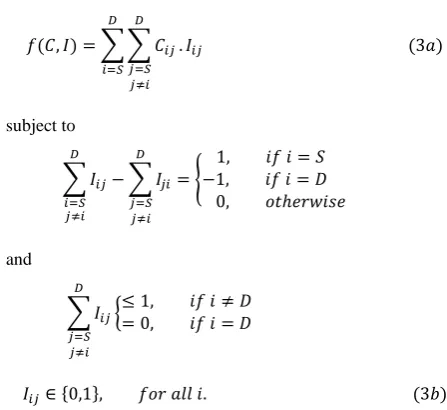
The network topology is analogues to a directed graph G=(N,A), where the set of nodes (vertices) is called N, and the set of its links (edges) is called A, which are in the transmission range of each other (i.e. A is the set of all nodes having distance less than distance threshold, d0). Each link (i,j) has a cost associated with it. The cost matrix C=[Cij] specifies the costs, where Cij denotes the cost of packet transmission from node i to node j. S and D denote the source and destination nodes respectively. Link connection indicator Iij provides the information, whether the link (i,j) is included in the path or not.
It is noted that elements in the diagonal of Iij are zero. The problem of finding the optimal routing is formulated as a combinatorial optimization problem that minimizes the objective function (3a) as follows:
minimize
subject to
and
The constraint (3b) is used to ensure that the result obtained is a path (without loops) between S and D.
The model discussed above is implemented using GASA algorithm. The procedure is as follows:
(i) Encoding
The individual/chromosome is represented as a string
1. Initialize final temperature Tf;
2. Initialize maximum number of iterations MaxIt; 3. Choose initial population;
4. Evaluate each individual's fitness; 5. Repeat {
6. Select individuals to reproduce;
7. Apply crossover operator to produce offsprings; 8. Repair the individual;
9. Select the best child as the parent for the next generation;
10. For each family, accept the best child as the parent for next generation if
11. E0 OR exp((E)/t)
Where Yc is the objective value of the best child Y1 is the objective value of Parent1
Y2 is the objective value of Parent2 t is the temperature coefficient
is a random number uniformly distributed between 0 and 1.
E
is as described in eqn (6)
12. Store the produced offspring for the next generation; 13. Mark the best offspring in the generation as Cfit 14. Increment generation number by i=i+1
15. Decrement the temperature t according to cooling schedule
16. Calculating the individual fitness and store the best offspring in Cbest
17. } While t ≤ Tf or i < MaxIt
[image:2.595.309.533.129.334.2]18. Output the required route is represented by Cbest Figure 1: Steps of GASA Algorithm
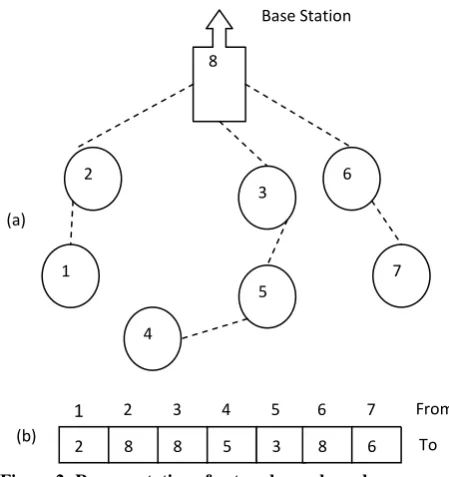
containing node numbers as genes. The length of each chromosome is equal to the number of sensor nodes. The routing scheme with a base station and 6 nodes, is shown in figure 2(a) and the corresponding individual is shown in figure 2(b). In this example, the value of the gene in position 1 is 2, indicating that node 1 transmits to node 2. Similarly, the gene value at position 3 is 8, which means that the node 3 transmits to node 8 (base station).
Each chromosome represents a valid route. The routing thus developed is based on the respective positions of the nodes in the network. The base station creates a list, Ni,1≤ i ≤ n, that contains all the nearest one-hop neighbors j, of i, such that the link i→j, j Ni can be used to route data from i towards the base station through j. For example, node 1, from figure 2, will have Ni (where i=1) ={2, 4} which are one hop neighbor of node 1. These are the nodes (referred as j) who leads i towards the destination. Here node 1 can reach to node 8 (destination) through node 2 or 4 only. Based on this information, the greedy approach is used to generate the routes for the initial population, by randomly picking up the neighboring node j Ni for each source node i. The problem’s search space is enormous. If each node has d valid neighbors (which are one-hop away), then the number of paths/routes for a network with n nodes is O(dn). In order to select an optimal energy efficient route, from a large number of possible valid solutions, within a optimum amount of time, a non-conventional search technique, such as GA, is needed[25]. The fitness in terms of energy consumption of each individual needs to be evaluated. Fitness value is calculated as the network lifetime, which is given by the total number of rounds, until the first node depletes all its battery power. As in [26], the Energy value of the fitness function for an individual is computed as
where Lnet is the lifetime of the network in terms of rounds and Einitial is the initial energy configuration of a node. Einitial is same for all relay nodes in the bigening. Emax is the maximum energy dissipated by any node in the individual in one round of data collection.
It is assumed that Einitial is known initially and will remain same. But Emaxis the maximum power dissipated by any node of the chromosome. E.g. in figure 2(b), maximum energy dissipated from node 1 to 2, form node 2 to 8, from node 3 to 8,
from node 4 to 5, from node 5 to 3, from node 6 to 8 and from node 7 to 6 is considered as Emax.
i.e. Emax = Max Energy Dissipated from node (1→2, 2→8, 3→8, 4→5, 5→3, 6→8, 7→6)
Such fitness calculation is done for each individual of the population
(ii) Fitness Function
Designing the fitness function for evaluation is critical for GA. It should be able solve the problem considering all the parameters of the problem that affect the fitness of an individual. In this paper the distance of the nodes from the sink and lifetime of the network as a function of the maximum energy dissipated by a relay node in the route, are taken into account for designing the fitness function.
Where f(C, I) is the optimal route as in equation (3a) and Lnet is the network lifetime as in equation (4). Lnet has been made negative to make it a minimization function. α and β are the weighted coefficients of the optimal route and the expected lifetime of the network respectively, and α + β = 1.
(iii) Selection
The selection retains the chromosome that have high fitness value to the next generation, thus improving the average fitness of the population.. In this paper, elitist selection and tournament selection are used together. In elitist section the best individuals are not changed and retained for the next generation. Whereas, in tournament selection two individuals are randomly selected and the one having better fitness is included in the mating pool.
When Parent1 and Parent2, produces a new offspring: ΔE = [ Yc – (Y2 + Y1)] * 0.5 (6)
Equation (6) represents the energy difference between the two generations. Y1, Y2, Yc are the objective values of Parent1, Parent2 and Offspring respectively. A negative ΔE means the offspring is better. Whereas a negative ΔE does not always mean that it will be accepted, this eliminates the algorithm to get stuck in local optima. The simulated annealing ensures that an individual with negative ΔE is accepted with a Table 2: Total Energy Consumption (Joules) during the
network lifetime for different number of nodes
Techniques Number of Nodes
50 100 150 200 250 300
Broadcastin g
12 3
510 2
1878 2
3675 4
4526 2
6321 4 Clustering 11
9 497 3
8732 1764 0
2677 5
4281 5
DD 10
5 451 9
5854 1142 8
2231 7
3787 3
GASA 10
3 423 2
5237 1098 7
1987 6
[image:3.595.336.561.79.318.2]3567 2 Table 1:Avg energy consumption (Joules) for number of
nodes
Techniques Number of Nodes
50 100 150 200 250
Broadcasting 0.0120 0.0146 0.0160 0.0168 0.0168 Clustering 0.
0058 0. 0065
0.0070 0.0076 0.0080
DD 0.0045 0.0058 0.0059 0.0059 0.0059 GASA 0.0040 0.0047 0.0050 0.0050 0.0050
2
7 6
4
5 3
1
8
Base Station
1
2
3 4
2 5 6 7
2
8 5
8 3 8 6
(a)
(b)
Figure 2: Representation of network graph as chromosome From
[image:3.595.48.291.429.672.2]probability of an acceptance.
(iv) Crossover
Crossover is used to improve the combinations in chromosomes. A two-point method is used here, in which exchanges of genes occur at any position on the chromosome. For example, consider two parents 4 2 3 1 5 and 5 1 3 2 4, an exchange of gene values takes place at position 2 and 4, then the two offspring produced have the values 4 1 3 2 5 and 5 2 3 1 4. Duplicate genes are deleted. The crossover
takes place with a crossover probability Pc (0<Pc<1).
(v) Mutation
Mutation is to maintain the diversity in the population and avoid trapping into a local optimum. Here, mutation operation changes a gene value with a random number between 1 to N, with a small probability Pm.
5.
SIMULATION AND ANALYSIS
To evaluate the proposed scheme the simulations are performed by writing customized code under MATLAB 7.0 environment The sensor fieleds of 200m x 200m meters is considered ranging from 50 to 250 nodes in the increments of 50. Each sensor has a transmitting range of d0=40m. the base station is located in the centre of the sensor field.
The average energy consumption (Ea) of the network is the average of the difference between the initial level of energy
and the final level of energy remaining in each node in a network lifetime. Network lifetime here use the definition of reference [15], it is the time till the first node runs out of energy. Ei and E f are the initial and final energy levels of a node respectively and n is number of nodes in the
network. Ea can be expressed by equation (7).
For the simulations described in this paper, the communication energy parameters are set as: Eelec =50nJ/bit,
=10pJ/bit/m2, =0.0013pJ/bit/m4. Each sensor has an
initial energy of 1J. Each sensor node generates a packet of fixed size having 1000 bits in each round.
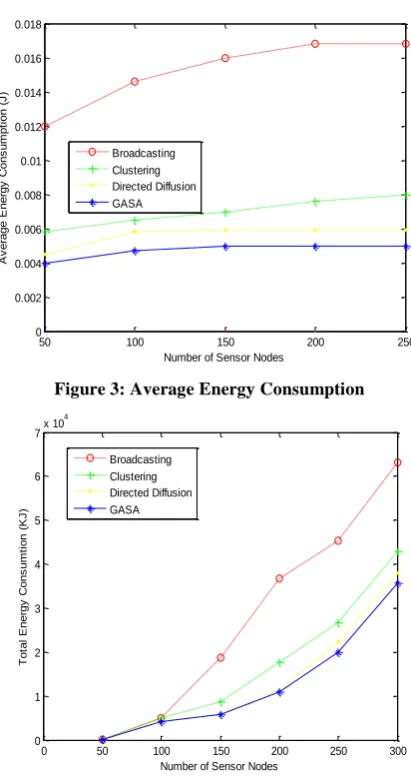
The performance analysis of the existing and proposed schemes is shown in table 1. The proposed scheme (GASA) distributes the energy load balancing among different nodes in the network as a result, comparatively less energy is consumed and thus an improvement in the overall lifetime of the sensor network. The average energy consumption of GASA routing is comparable and less to that of clustering and directed diffusion as shown in figure 3. Table 2 and figure 4, show that Broadcasting performs the worst. When the number of nodes are less the clustering and directed diffusion have nearly the same power consumption as GASA routing. GASA routing delivers a better performance as the number of nodes is increased. Increasing the number of nodes provides more neighbors per node on average. Therefore GASA routing will have more candidate nodes to choose from to determine a desirable routing path and hence less overall energy consumption.
6.
CONCLUSION
In this paper, the basic Genetic algorithm is improved by combining it with Simulated annealing Algorithm. The GASA which is synergistic combination of the two algorithms that takes the merits of both the algorithms. The idea of the proposed scheme is not to use the lowest energy and shorter distance path always, for the long term health of the network, because the nodes in the route it will quickly deplete energy. Thus the GASA algorithm establishes a balanced energy routing. The scheme not only considers the distance between the nodes but also the energy consumtion of the path to achieve a dynamic and adaptive routing.
7.
REFERENCES
[1] Goldberg, D. E. 1989, Genetic Algorithms in Search. Optimization, and Machine Learning. Reading. MA: Addison-Wesley.
[2] Akyildiz, I. F., Su, W., Sankarasubramaniam, Y., and Cayirci E. 2002 A Survey On Sensor Networks. IEEE Communications Magazine, Vol. 40, Issue 8.
[3] Raghavendra, V. K., Förster, A. , and Venayagamoorthy, G. K. 2011 Computational Intelligence in Wireless Sensor Networks: A Survey. IEEE Communications Surveys & Tutorials, Vol. 13, No. 1, 68-96.
[4] Heikalabad, S. R., Ghaffari, A., Hadian, A., and Rasouli, H. 2011 DPCC: Dynamic Predictive Congestion Control in Wireless Sensor Networks. IJCSI International Journal of Computer Science Issues, Vol. 8, Issue 1, 472-477.
[image:4.595.62.268.185.575.2][5] Min, R., Bhardwaj, M., and Cho S. H. 2001 Low Power Wireless Sensor Networks. Proceedings for International. Conference on VLSI Design, Bangalore, India, 221-226. Figure 3: Average Energy Consumption
Figure 4: Total Energy Consumption of the Network
50 100 150 200 250
0 0.002 0.004 0.006 0.008 0.01 0.012 0.014 0.016 0.018
Number of Sensor Nodes
A
v
e
ra
g
e
E
n
e
rg
y
C
o
n
s
u
m
p
ti
o
n
(
J
)
Broadcasting Clustering Directed Diffusion GASA
0 50 100 150 200 250 300 0
1 2 3 4 5 6 7x 10
4
Number of Sensor Nodes
To
ta
l
E
n
e
rg
y
C
o
n
s
u
m
ti
o
n
(
K
J
)
[6] Akkaya, K., and Younis, M. A Survey on Routing Protocols for Wireless Sensor Networks. Elsevier Ad Hoc Networks, Vol. 3, Issue 3, 325–349.
[7] Azni, A. H., Saudi, M. M., Azman, A., and Johari, A. S. 2009 Performance Analysis of Routing Protocol for WSN using Data Centric Approach. World Academy of Science, Engineering and Technology, Issue 53.
[8] Singh, Vinay. K., and Sharma, Vidushi. 2011 On the Hybridization of Evolutionary Algorithms and Optimization Techniques. Conference on Advancements in Communication, Computing & Signal Processing (COMMUNE CACCS 2011).
[9] Johnson, J. M., and Samii, Y. R. 1995 Genetic Algorithm Optimization of Wireless Communication Networks. Proceedings for Antennas and Propagation Society International Symposium, AP-S. Digest.
[10] Li, Q., Aslam, J., and Rus, D. 2011 Hierarchical Power-Aware Routing in Sensor Networks. Proceedings of DIMACS Workshop on Pervasive Networking.
[11] Murthy, S., and Garcia-Luna-Aceves, J. J. 1996 An Efficient Routing Protocol for Wireless Networks. ACM Mobile Networks Applications, Vol. 1, Issue 2, 183-197.
[12] Singh, S., Woo, M., and Mghavendra, C.S. 1998 Power-Aware Routing in Mobile Ad Hoc Networks,” ACM SIGMOBILE Mobile Computing and Communications Review,181-190.
[13] Heinzelman, W. R., Chandrakasan, A., and Balakrishnan, H. 2000 Energy-Efficient Communication Protocol for Wireless Microsensor Networks,” Proceedings for the Hawaii International Conference on System Sciences, (IEEE), January 4-7, 876–882.
[14] Chang, J.H., and Tassiulas, L. 2004 Maximum Lifetime Routing in Wireless Sensor Networks. Journal IEEE/ACM Transactions on Networking (TON), Vol. 12 Issue 4.
[15] Shah, R. C. and Rabaey, J. 2002 Energy Aware Routing for Low Energy Ad-Hoc Sensor Networks. Proceedings of IEEE WirelessCommunications and Networking Conference (WCNC), Vol. 1, Orlando, FL, 350.355.
[16] Selcuk, Okdem and Dervis Karaboga. 2006 Routing in Wireless Sensor Networks Using Ant Colony Optimization. Proceedings of the First NASA/ESA Conference on Adaptive Hardware and Systems (AHS'06).
[17] Manjeshwar, A., and Agrawal, D.P. 2001 TEEN: A Protocol for Enhanced Efficiency in Wireless SensorNetworks. 1st International Workshop on Parallel and Distributed Computing Issues in Wireless Networks and Mobile Computing.
[18] Singh Vinay. K., and Sharma Vidushi. 2012 Elitist Genetic Algorithm Based Energy Efficient Routing Scheme For Wireless Sensor Networks. International Journal of Advanced Smart Sensor Network Systems (IJASSN),Volume 2,Number 2.
[19] Singh Vinay. K., and Sharma Vidushi. 2012 Extending Wireless Sensor Network Lifetime Through Effective Genetic Algorithm Based Approach. COMMUNE Conference on Advancements in Communication, Computing & Signal Processing.
[20] Holland J. 1975 Adaptation in Natural and Artificial Systems,” University of Michigan Press, Ann Arbor.
[21] Eglese, R. W. 1990 Simulated annealing: A tool for operation research,” Euro. J. Operation Res, 271-281.
[22] Srinivas, K. Patvardhan, C., and Bhagwan Das, D. 2000 A Hybrid Stochastic Search Technique for optimization of Difficult Functions, Journal of the Institution of Engineers (India), Computer Engineering Division, Vol. 81, 45-49.
[23] Bhagwan Das, D. and Patvardhan, C. 1999 Solutions of Economic Load Dispatch using real coded Hybrid Stochastic Search. Electrical Power and Energy Systems. Vol. 21, No. 3, 165-170.
[24] Hui, X., Zhi-gang, Z., and Feng, N. 2010 A Novel Routing Protocol in Wireless Sensor Networks based on Ant Colony Optimization International Journal of Intelligent Information Technology Application, Vol. 3 Issue (1), 1-5.
[25] Bari A., Wazed , S., Jaekel , A., and Bandyopadhyay S. 2009 A genetic algorithm based approach for energy efficient routing in two-tiered sensor networks”, Ad Hoc Networks, Volume 7, Issue 4, 665–676.
[26] Rana, K. M., and Zaveri, M. A. 2011 Techniques for Efficient Routing in Wireless Sensor Network. International Conference on Intelligent Systems and Data Processing (ICISD)- Special Issue published by International Journal of Computer Applications® (IJCA).
AUTHORS PROFILE
Vinay Kumar Singh received his B.E. in Computer Engineering degree from University of Pune, India in 1994 and M. Tech. degree from Dayalbagh Educational Institute, Agra, India in 2002. He is a research scholar at Gautam Buddha University, Greater Noida, India, and is presently working as Assistant Professor in Department of Computer Science & Engineering and Information Technology at Anand Engineering College, Agra, India. His research interests are Evolutionary Algorithms, Optimization and Energy Efficient Routing in Wireless Sensor Networks.
![[(1R) 3 Benzoyl 1,7,7 trimethylbicyclo[2 2 1]heptan 2 onato κ2O,O′]chlorido(η6 p cymene)ruthenium(II)](data:image/gif;base64,R0lGODlhAQABAIAAAP///wAAACH5BAEAAAAALAAAAAABAAEAAAICRAEAOw==)