Performance Analysis of Proactive, Reactive and Hybrid
MANET Routing Protocols on IEEE 802.11 Standard
Anjali
Dept. of Computer Science Punjabi University, Patiala
Maninder Singh
Dept. Of Computer SciencePunjabi University, Patiala
ABSTRACT
MANET consists of mobile nodes which exchange information dynamically among them over wireless links. The most important element of MANET is Routing Protocols which are needed to handle dynamic communication and also find route so as to deliver data packets to the correct destination. Performance of routing protocols is an important issue because of dynamic nature of MANET. In this paper performance of AODV, OLSR and GRP routing protocols is evaluated for FTP based application traffic on IEEE 802.11 WLAN Standard and 48 Mbps data rate. The network performance is evaluated by using OPNET simulator based on various quantitative metrics- Network Load, Throughput, Retransmission Attempts and Media Access Delay by varying physical characteristics and number of nodes. A comparative performance analysis of these protocols have been carried out in this paper and in the last conclusion will be presented which demonstrate that performance of routing protocols differs by varying the network and selection of accurate routing protocol according to the network ultimately influences the efficiency of the network in a magnificent way.
Keywords
AODV, GRP, IEEE 802.11, MANET, OLSR, OPNET, Routing protocols
1.
INTRODUCTION
Mobile Ad hoc Network (MANET) is a group of mobile nodes which communicate with each other without any centralized support and are connected by wireless links. Each node in MANET acts as a router or an end system for all other nodes in the network. Mobile ad hoc network supports competent operation by integrating routing in nodes of mobile ad hoc wireless networks.
During data communications, performance of MANET routing protocols is a significant issue. Therefore, effective and accurate routing protocols are required so as to handle mobility of nodes and to give superior utilization in MANET technology. An ad hoc routing protocol is a standard that handles how nodes determine which way to forward packets between devices in a mobile ad-hoc network. In this paper we have evaluated performance of AODV, OLSR AND GRP routing protocols by considering FTP application type and IEEE 802.11a/g WLAN Standard.
IEEE 802.11 is a WLAN Standard with data rates up to 2 Mbps which is developed in 1997.After that, various task groups have been developed to extend this standard like 802.11a, 802.11b and 802.11g.
The 802.11a task group created a standard for WLAN operation in the 5 GHz band, with data rates up to 54 Mbps. The 802.11b task group produced a standard for WLAN operations in 2.4 GHz band, with data rates up to 11 Mbps and backward compatibility. It published in 1999.802.11g is working to develop a higher speed extension to the 802.11b. The IEEE 802.11standard defines two operational modes for WLANs: infrastructure-based and infrastructure-less or ad hoc. Network interface cards can be set to work in either of these modes but not in both simultaneously [1]
2.
RELATED WORK
Razan Al-Ani [2] simulated and evaluated the AODV, OLSR, GRP, TORA and DSR routing protocols to analysis the performance on basis of Throughput, Delay, and Network load. They created a network which consists of mobile nodes, one fixed WLAN server running GRP and RX group config node to speed up simulation time. All nodes are configured to work with 5.5 Mbps data rate and FTP application type was chosen for all nodes with multiple FTP sessions. They ran four scenarios for each type of routing protocol. Each scenario was run for 30 min. According to their results OLSR routing protocol performs better than others in both delay and throughput.
Xiaoyan Hong [3]surveys the routing protocols that address scalability. The routing protocols they intend to include in the survey fall into three categories: flat routing protocols, hierarchical routing approaches, and GPS augmented geographical routing schemes. In this paper, descriptions of the protocols have been provided and the differences among them have been discussed, highlighting particular important features impacting scalability. No protocol emerges as the winner for all the scenarios. They concluded that protocols have different, competitive and complementary advantages and are thus appropriate for different applications.
Ravinder Ahuja [4] evaluated performance of three types of routing protocols (AODV, OLSR and ZRP) based on random waypoint mobility model. In this paper they analyze and compare the performance of protocols using Qualnet 4.5 from scalable network .These routing protocols were compared in terms of Packet delivery ratio, Average end-to end delay and Throughput when subjected to change in no. of nodes and pause time. Simulation results show that Reactive protocols better in terms of packet delivery ratio and throughput
their simulation result OLSR presented the best performance and GRP presented low to OLSR and high to DSR or finally DSR presented the low performance (DSR<GRP<OLSR) is analyzed.
3.
MOBILE Ad hoc NETWORK
ROUTING PROTOCOLS
A number of routing protocols have been created and implemented for MANET which are categorized into three different types according to their functionality: Proactive, Reactive and Hybrid.
3.1
Proactive Protocols
Proactive methods are also called Table-driven methods which keep routes to all other nodes in the network also considering those nodes to which packets are not sent. Thus, the route is already available when a path to a particular destination is needed at a node and there is no extra delay due to route discovery. OLSR is an example of Proactive Protocol
3.1.1 Optimized Link State Routing Protocol
(OLSR) Routing Protocol:
OLSR is a table driven or Proactive, link-state routing protocol. Link-state routing algorithms choose best route by determining various characteristics like link load, delay, bandwidth etc. Link-state routes are more stable, accurate and reliable in calculating best route. Conceptually, OLSR contain three generic elements: a mechanism for neighbour sensing, a mechanism for efficient flooding of control traffic, and a specification of how to select and diffuse sufficient topological information in the network in order to prove optimal routes [6][ 7].
3.2 Reactive Protocols
Reactive methods (On-demand methods) are bandwidth efficient. Routes between nodes are determined whenever a path is required by a node to forward packets. Therefore, routing overhead is decreased because search for the route is not required on which packet is not sent. AODV is an example of Reactive Protocol.
3.2.1 Ad hoc On-Demand Distance Vector
(AODV) Routing Protocol:
AODV [8] algorithm enables dynamic, self-starting, multi hop routing between participating mobile nodes wishing to establish and maintain an ad hoc network. AODV allows mobile nodes to obtain routes quickly for new destinations, and does not require nodes to maintain routes to destinations that are not in active communication. Route Requests (RREQs), Route Replies (RREPs) and Route Errors (RERRs) are message types defined by AODV [8].
3.3
Hybrid Protocols
It combine characteristics of both pro-active and re-active routing in order to find effective and reliable routes, without large control overhead, by locally using pro-active routing and inter-locally using re-active routing. In this method communication in MANET is possible when nodes are near to each other and the supposition that changes in topology are only important if they happen in the vicinity of a node. This method decides its strategies of routing according to characteristics of network and thus provides a good method
for routing in MANETs. GRP is an example of Hybrid Protocol.
3.3.1 Gathering-based Routing Protocol (GRP):
Gathering-based Routing Protocol (GRP) gathers network information rapidly at a source node without spending a large amount of overheads. It offers an efficient framework that can simultaneously draw on the strengths of Proactive routing protocol (PRP) and reactive routing protocol (RRP) collects network information at a source node at an expense of a small amount of control overheads. The source node can equip promising routes on the basis of the collected information, thereby continuously transmitting data packets even if the current route is disconnected, its results in achieving fast (packet) transfer delay without unduly compromising on (control) overhead performance[9]
4.
EXPERIMENTAL SET-UP
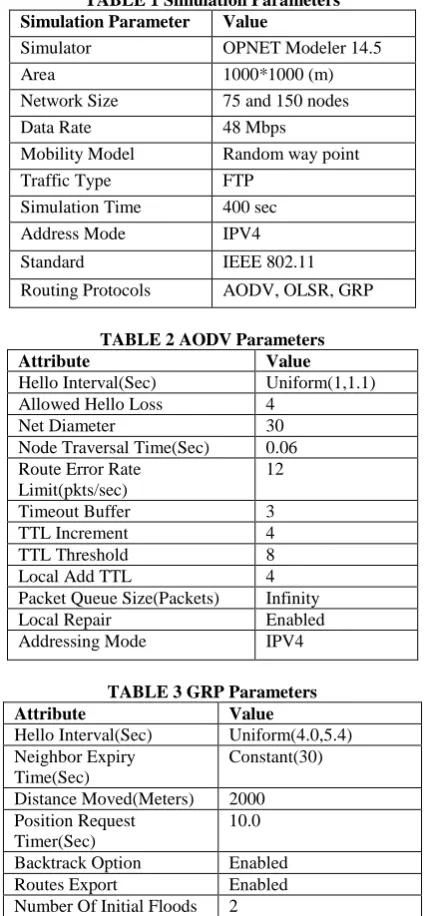
[image:2.595.322.535.310.769.2]In this paper the simulation tool used for analysis is OPNET. The simulation parameters are summarized in following tables.
TABLE 1 Simulation Parameters Simulation Parameter Value
Simulator OPNET Modeler 14.5
Area 1000*1000 (m)
Network Size 75 and 150 nodes
Data Rate 48 Mbps
Mobility Model Random way point
Traffic Type FTP
Simulation Time 400 sec
Address Mode IPV4
Standard IEEE 802.11
Routing Protocols AODV, OLSR, GRP
TABLE 2 AODV Parameters
Attribute Value
Hello Interval(Sec) Uniform(1,1.1) Allowed Hello Loss 4
Net Diameter 30
Node Traversal Time(Sec) 0.06 Route Error Rate
Limit(pkts/sec)
12
Timeout Buffer 3
TTL Increment 4
TTL Threshold 8
Local Add TTL 4
Packet Queue Size(Packets) Infinity
Local Repair Enabled
Addressing Mode IPV4
TABLE 3 GRP Parameters
Attribute Value
Hello Interval(Sec) Uniform(4.0,5.4) Neighbor Expiry
Time(Sec)
Constant(30) Distance Moved(Meters) 2000 Position Request
Timer(Sec)
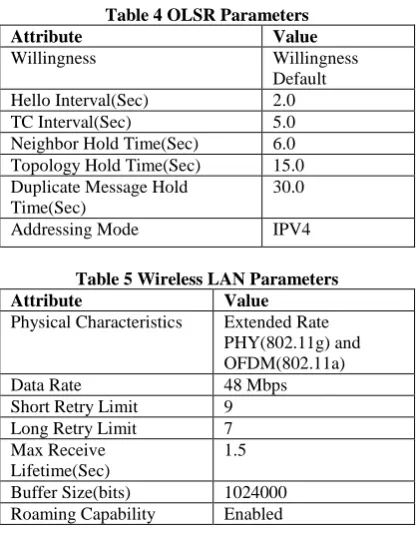
Table 4 OLSR Parameters
Attribute Value
Willingness Willingness
Default Hello Interval(Sec) 2.0
TC Interval(Sec) 5.0
Neighbor Hold Time(Sec) 6.0 Topology Hold Time(Sec) 15.0 Duplicate Message Hold
Time(Sec)
30.0
Addressing Mode IPV4
Table 5 Wireless LAN Parameters
Attribute Value
Physical Characteristics Extended Rate PHY(802.11g) and OFDM(802.11a)
Data Rate 48 Mbps
Short Retry Limit 9 Long Retry Limit 7 Max Receive
Lifetime(Sec)
1.5 Buffer Size(bits) 1024000 Roaming Capability Enabled
Fig. 1 shows the simulation environment of one scenario containing 75 WLAN mobile nodes, one fixed WLAN Server, Application definition, Profile definition and Mobility Config. We configure the nodes in the scenario to work with 48 Mbps. The network size is 1000* 1000 meters. After that IPV4 addressing is assigned to all nodes. The “Application Config” node is used to specify applications using available application types. FTP application type was chosen to all nodes in the network with multiple FTP sessions, and the FTP was selected as high traffic load. We configured the profile with FTP application. Random waypoint mobility model was used in this simulation. Mobile nodes move at a constant speed of 10 m/s, and when reaches the destination, the pause time is 120 sec and after that it choose a new random destination. We ran four scenarios for each type of routing protocol (AODV, OLSR, and GRP). Two scenarios ran for IEEE 802.11a WLAN Standard, one for 75 nodes and other for 150 nodes and similarly two scenarios for IEEE 802.11g WLAN Standard. Each scenario was run for 400 seconds. After successful completion of the simulations, results are selected according to the problem solution. Results are collected in the form of graphs, with overlaid data displaying multiple values.
Fig 1: Network Model (75 Nodes)
5.
PERFORMANCE MERICS
5.1 Network Load
It represents the total load (in bits/sec) submitted to wireless LAN layers by all higher layers in all WLAN nodes of the network.
5.2 Throughput
It represents the total number of bits (in bits/sec) forwarded from wireless LAN layers to higher layers in all WLAN nodes of the network.
5.3 Retransmission Attempts
It is the total number of retransmission attempts by all WLAN MACs in the network until either packet is successfully transmitted or it is discarded as a result of reaching short or long retry limit.
5.4 Media Access Delay
[image:3.595.63.272.70.337.2]6.
SIMULATION RESULTS AND
ANALYSIS
6.1
AODV, OLSR and GRP in 75 nodes for
802.11a and 802.11g WLAN Standard
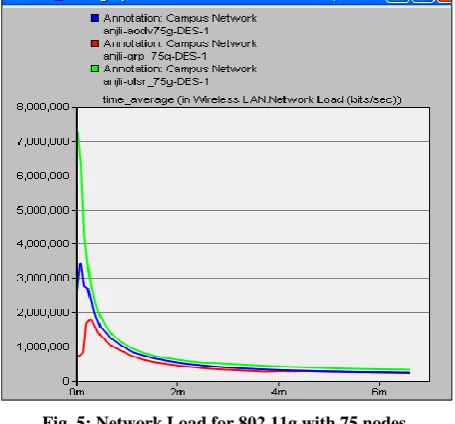
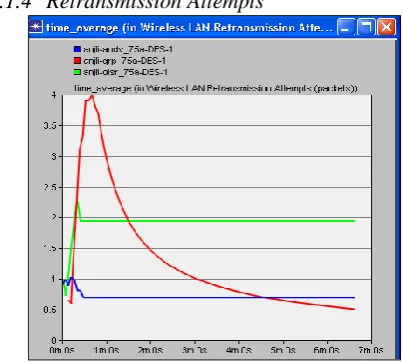
Figure (2 - 9) below show media access delay, network load, retransmission attempts and throughput in 75 mobile nodes scenario for 802.11a and g standard at 48 Mbps data rate with AODV, GRP and OLSR respectively. The color scheme is showing the protocols behavior in different graphs which gives the average values. Blue line gave the results for AODV protocol, red line is for GRP and green line provide the result for OLSR routing protocol. From these average values we will conclude the behavior of all these routing protocols.
6.1.1
Media Access Delay
Fig 2: Media Access Delay for 802.11a with 75 nodes
According to simulation, as we can see in Fig. 2, media access delay in GRP is highest and the minimum value of media access delay belongs to OLSR.
The Fig. 3 show media access delay present while using 802.11g. According to this, the GRP has highest and OLSR has the minimum media access delay.
[image:4.595.315.535.120.333.2]6.1.2
Network Load
Fig. 4: Network Load for 802.11a with 75 nodes
[image:4.595.59.274.251.460.2]In Fig. 4, we see that AODV has highest network load than GRP and OLSR at the start of simulation. After 3 min network load of all protocols is almost same.
Fig. 5: Network Load for 802.11g with 75 nodes
[image:4.595.316.544.439.651.2] [image:4.595.65.272.534.742.2]6.1.3
Throughput
Fig. 6: Throughput for 802.11a with 75 nodes
Fig. 6 shows that throughput in OLSR is the highest and in GRP, we have the minimum throughput
Fig. 7: Throughput for 802.11g with 75 nodes
From Fig. 7 we find out that the throughput of OLSR is highest and in GRP we have the minimum throughput.
[image:5.595.333.525.123.291.2]6.1.4
Retransmission Attempts
Fig. 8: Retransmission Attempts for 802.11a with 75 nodes
In Fig. 8, we see that GRP has more retransmission attempts than other two protocols in the starting. After 4.5 min we can conclude that retransmission attempts in OLSR are the highest and in GRP we have the minimum retransmission attempts.
Fig. 9: Retransmission Attempts for 802.11g with 75 nodes
According to simulation result in Fig. 9, we can see that OLSR has the maximum and AODV has minimum retransmission attempts.
We conclude from the above discussion that for 802.11a WLAN Standard with 75 nodes OLSR protocol is better than AODV and GRP in terms of media access delay and throughput. But retransmission attempts of GRP are less than other than other two protocols and network load of all the three protocols is almost same and for 802.11g WLAN Standard with 75 nodes it can be concluded that OLSR protocol is better than AODV and GRP in terms of media access delay and throughput. But retransmission attempts of AODV are less than other than other two protocols and network load of all the three protocols is almost same for 802.11g WLAN Standard with 75 nodes.
6.2
AODV, OLSR and GRP in 150 nodes
for 802.11a and g WLAN Standard
The below figures (10 - 17) showing media access delay, network load, retransmission attempts and throughput in 150 mobile nodes scenario for 802.11a and g standard at 48 Mbps data rate with AODV, GRP and OLSR respectively.
[image:5.595.73.261.323.503.2]6.2.1 Media Access Delay
[image:5.595.60.262.567.748.2] [image:5.595.319.519.572.748.2]Fig 10 depicts that media access delay of GRP is maximum and in OLSR we have minimum value of media access delay.
Fig 11: Media Access Delay for 802.11g with 150 nodes
In Fig. 11 we find out that that media access delay in GRP is the highest and in OLSR we have the minimum media access delay.
[image:6.595.81.255.103.265.2]6.2.2 Network Load
Fig. 12: Network Load for 802.11a with 150 nodes
According to simulation result in Fig. 12, we can see that OLSR has the maximum network load. We can order the network load respectively: OLSR >AODV > GRP.
According to simulation result in Fig. 13, we can see that OLSR has the maximum and GRP has minimum Network Load. We can order the network load respectively: OLSR >AODV>GRP.
[image:6.595.316.515.133.310.2]6.2.3 Throughput
Fig. 14: Throughput for 802.11a with 150 nodes
Fig. 14 shows that throughput in OLSR is the highest and in GRP, we have the minimum throughput.
Fig. 15: Throughput for 802.11g with 150 nodes
[image:6.595.64.258.339.521.2]From Fig. 15 we can see that throughput in OLSR is the highest and in GRP, we have the minimum throughput.
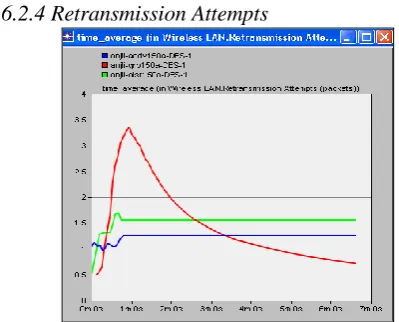
6.2.4 Retransmission Attempts
[image:6.595.315.506.370.533.2] [image:6.595.315.515.586.747.2] [image:6.595.84.253.595.746.2]In Fig. 16, we can conclude that retransmission attempts in OLSR are highest and in GRP we have the minimum retransmission attempts.
Fig. 17: Retransmission Attempts for 802.11g with 150 nodes
Fig. 17 shows that retransmission attempts in OLSR are highest and in AODV, we have the minimum retransmission attempts.
We conclude from the above discussion that media access delay of OLSR is lesser and throughput of OLSR is higher than other two protocols. But retransmission attempts and network load of GRP are less than other two protocols. So we can conclude that OLSR protocol is better than other two protocols in terms of media access delay and throughput, but in terms of network load and retransmission attempts GRP is showing better results than AODV and OLSR protocol for 802.11a WLAN Standard with 150 nodes and for 802.11g WLAN Standard with 150 nodes it can be concluded that OLSR protocol is better than AODV and GRP in terms of media access delay and throughput. But network load of GRP protocol is minimum and in terms of retransmission attempts AODV protocol is showing better results than OLSR and GRP.
7.
CONCLUSION
In this paper performance of Reactive (AODV), Hybrid (GRP) and Proactive protocol (OLSR) is evaluated for metrics like Media Access Delay, Network Load, Throughput and Retransmission Attempts by varying number of nodes and version of IEEE 802.11 WLAN Standard. From the above discussion we find out that OLSR performs best in each case in terms of media access delay and throughput. In terms of
retransmission attempts GRP is showing better results than AODV and OLSR for 75 and 150 nodes with 802.11a technology but for 802.11g technology AODV outperforms the two OLSR and GRP. In 75 mobile nodes network load of all the three protocols is almost same for both the technologies.GRP offer good results in offering low load on the network than OLSR and GRP respectively in case of 150 nodes for both technologies i.e. 802.11a and g. We summarized the results in table 6 and 7.
TABLE 6 Resultant Values for 802.11a WLAN Standard
Nodes Performance Metrics
AODV OLSR GRP
75 Media Access Delay
Medium Low High
75 Network Load High Medium Low
75 Throughput Medium High Low
75 Retransmission Attempts
Medium High Low
150 Media Access Delay
Medium Low High
150 Network Load Medium High Low 150 Throughput Medium High Low 150 Retransmission
Attempts
[image:7.595.64.272.114.289.2]Medium High Low
TABLE 7 Resultant Values for 802.11g WLAN Standard
Nodes Performance Metrics
AODV OLSR GRP
75 Media Access Delay
Medium Low High
75 Network Load Same Same Same 75 Throughput Medium High Low
Nodes Performance Metrics
AODV OLSR GRP
75 Retransmission Attempts
Low High Medium
150 Media Access Delay
Medium Low High
150 Network Load Medium High Low 150 Throughput Medium High Low 150 Retransmission
Attempts
[image:7.595.314.550.399.698.2]Therefore, we can conclude that under different environments, every protocol behaves differently because there are many parameters which differ under varied situations. From the above discussions we find out that OLSR outperforms the other two protocols in each scenario in terms of media access delay and throughput. So we can say that OLSR is better in MANET according to our simulation results but it is not necessary that OLSR always perform better in all the networks, its performance may vary by varying the network. At the end we came to the point from our simulation and analytical study that the performance of routing protocols vary with network and selection of accurate routing protocols according to the network, ultimately influence the efficiency of that network in magnificent way.
8. ACKNOWLEDGEMENT
Special thanks to PUNJABI UNIVERSITY, PATIALA and my supervisor Dr. Maninder Singh for providing continuous support throughout this work.
9.
REFERNCES
[1] Pravin GhoseKar, Girish Katkar and Dr. Pradip Ghorpade, “Mobile Ad Hoc Networking: Imperatives and Challenges”,IJCA, pp. 153-158, 2010.
[2] Razan Al-Ani, “Simulation and Performance Analysis Evaluation for Variant MANET Routing Protocols”, International Journal of Advancements in Computing Technology, Volume 3, Number 1, Feb. 2011.
[3] Xiaoyan Hong, Kaixin Xu and Mario Gerla, “Scalable Routing Protocols for Mobile Ad Hoc Networks”, IEEE Network, vol. 16, issue 4, pp 11-21, Aug.2002.
[4] Ravinder Ahuja, “Simulation based Performance Evaluation and Comparison of Reactive, Proactive and Hybrid Routing Protocols based on Random Waypoint Mobility Model”, International Journal of Computer Applications, Vol. 7, No.11, pp. 20-24, Oct. 2010.
[5] Kuldeep Vats, Monika Sachdeva and Dr. Krishan Saluja, “ Simulation and performance Analysis of OLSR, GRP, DSR Routing Protocol using OPNET”, International Journal of Emerging trends in Engineering and Development, Vol.2 ,Issue 2, pp 390-404, March-2012. [6] T.H. Clausen, ”The optimized link state routing protocol
evaluating through experiments and simulation” mind pass centre for distributed system,Aalborg university ,Denmark.
[7] Kuldeep Vats, “Simulation and performance analysis of OLSR routing protocol using OPNET” IJARCSSE ,Vol. 2, Issue 2, Feb. 2012 .
[8] Mobile Ad Hoc Networking Working Group – AODV, http://www.ietf.org/rfc/rfc3561.txt.
[9] Naveen Bilandi, Harsh K Verma and Suryakant, “ Comparative Analysis of GRP and TORA MANET Routing Protocols using OPNET”, Vol. 2, Issue 4, April 2012.
[10] C. Liu, J. Kaiser, “ A Survey of Mobile Ad Hoc network Routing Protocols”, Network IEEE, Vol. 6, 2009, pp. 1-36.
[11] N. Surayati, M. Usop, A. Abdullah,”Performance Evaluation of AODV, DSDV & DSR Routing Protocol in Grid Environment”, IJCSNS International Journal of Computer Science and Network Security, vol. 9, No.7, Jul. 2009, pp. 191-196.
[12] Z. Ghaleb, A. Mekhlafi and R. Hassan,“ Evaluation Study on Routing Information on Protocol and Dynamic Source Routing in Ad-Hoc Network”, International IT in Asia Conference, 2011.