EUROPEAN COMMISSION
Reference Document on
Best Available Techniques in the
Ceramic Manufacturing Industry
August 2007
This document is one of a series of foreseen documents as below (at the time of writing, not all documents have been finalised):
Reference Document on Best Available Techniques . . . Code
Large Combustion Plants LCP
Mineral Oil and Gas Refineries REF
Production of Iron and Steel I&S
Ferrous Metals Processing Industry FMP
Non Ferrous Metals Industries NFM
Smitheries and Foundries Industry SF
Surface Treatment of Metals and Plastics STM
Cement and Lime Manufacturing Industries CL
Glass Manufacturing Industry GLS
Ceramic Manufacturing Industry CER
Large Volume Organic Chemical Industry LVOC
Manufacture of Organic Fine Chemicals OFC
Production of Polymers POL
Chlor – Alkali Manufacturing Industry CAK
Large Volume Inorganic Chemicals - Ammonia, Acids and Fertilisers Industries LVIC-AAF
Large Volume Inorganic Chemicals - Solid and Others industry LVIC-S
Production of Speciality Inorganic Chemicals SIC
Common Waste Water and Waste Gas Treatment/Management Systems in the Chemical Sector CWW
Waste Treatments Industries WT
Waste Incineration WI
Management of Tailings and Waste-Rock in Mining Activities MTWR
Pulp and Paper Industry PP
Textiles Industry TXT
Tanning of Hides and Skins TAN
Slaughterhouses and Animals By-products Industries SA
Food, Drink and Milk Industries FDM
Intensive Rearing of Poultry and Pigs ILF
Surface Treatment Using Organic Solvents STS
Industrial Cooling Systems CV
Emissions from Storage ESB
Reference Document . . .
General Principles of Monitoring MON
Economics and Cross-Media Effects ECM
Energy Efficiency Techniques ENE
Electronic versions of draft and finalised documents are publically available and can be downloaded from http://eippcb.jrc.es
EXECUTIVE SUMMARY
The BAT (Best Available Techniques) Reference Document (BREF) entitled ‘Ceramic Manufacturing (CER)’ reflects an information exchange carried out under Article 16(2) of Council Directive 96/61/EC (IPPC Directive). This executive summary describes the main findings, a summary of the principal BAT conclusions and the associated consumption and emission levels. It should be read in conjunction with the preface, which explains this document’s objectives; how it is intended to be used and legal terms. It can be read and understood as a standalone document but, as a summary, it does not present all the complexities of this full document. It is therefore not intended as a substitute for this full document as a tool in BAT decision making and it has to be stressed again that this summary cannot correctly be interpreted unless it is read in conjunction with Chapters 4 and 5.
SCOPE OF THIS DOCUMENT
This document addresses the industrial activities specified in Section 3.5 of Annex I to Directive 96/61/EC, namely:
‘3.5. Installations for the manufacture of ceramic products by firing, in particular roofing tiles, bricks, refractory bricks, tiles, stoneware or porcelain, with a production capacity exceeding 75 tonnes per day, and/or with a kiln capacity exceeding 4 m³ and with a setting density per kiln exceeding 300 kg/m³’.
For the purposes of this document the industrial activities falling within this description will be referred to as the ‘ceramic industry’. The major sectors which are based on the ceramic products (ceramics) manufactured are as follows:
• wall and floor tiles • bricks and roof tiles
• table- and ornamentalware (household ceramics) • refractory products
• sanitaryware • technical ceramics • vitrified clay pipes • expanded clay aggregates • inorganic bonded abrasives.
In addition to the basic manufacturing activities, this document covers the directly associated activities which could have an effect on emissions or pollution. Thus, this document includes activities from the preparation of raw materials to the dispatch of finished products. Certain activities, such as the quarrying of raw materials, are not covered because they are not considered to be directly associated with the primary activity.
THE CERAMIC INDUSTRY
Generally the term ‘ceramics’ (ceramic products) is used for inorganic materials (with possibly some organic content), made up of non-metallic compounds and made permanent by a firing process. In addition to clay based materials, today ceramics include a multitude of products with a small fraction of clay or none at all. Ceramics can be glazed or unglazed, porous or vitrified. Firing of ceramic bodies induces time-temperature transformation of the constituent minerals, usually into a mixture of new minerals and glassy phases. Characteristic properties of ceramic products include high strength, wear resistance, long service life, chemical inertness and non-toxicity, resistance to heat and fire, (usually) electrical resistance and sometimes also a specific porosity.
Clay raw materials are widely distributed throughout Europe, so ceramic products like bricks which are relatively inexpensive (but which incur high transport costs due to their weight) are manufactured in virtually all Member States. Building traditions and heritage considerations result in different unit sizes from country to country. More specialised products which command higher prices tend to be mainly produced in a few countries, which have the necessary special raw materials and – equally important – traditions of skill and expertise.
KEY ENVIRONMENTAL ISSUES
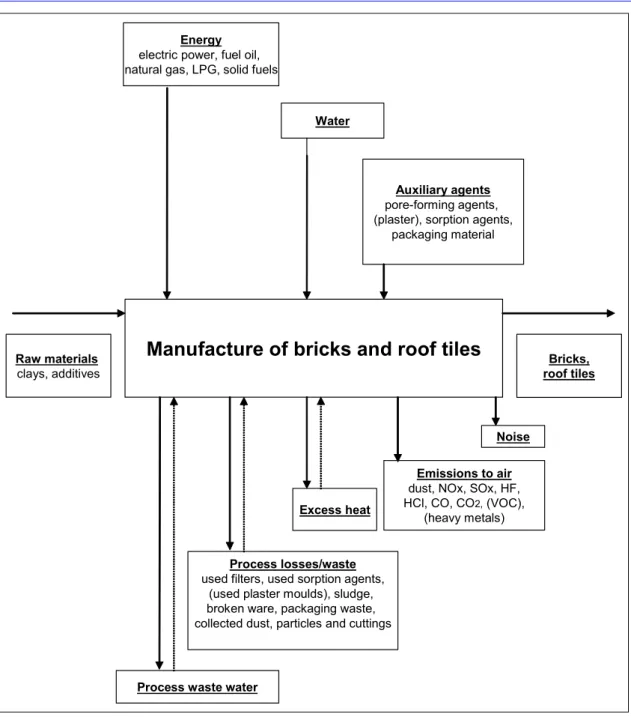
Depending on the specific production processes, plants manufacturing ceramic products cause emissions to be released into air, water and land (waste). Additionally, the environment can be affected by noise and unpleasant smells. The type and quantity of air pollution, wastes and waste water depend on different parameters. These parameters are, e.g. the raw materials used, the auxiliary agents employed, the fuels used and the production methods:
• emissions to air: particulate matter/dust, soot, gaseous emissions (carbon oxides, nitrogen oxides, sulphur oxides, inorganic fluorine and chlorine compounds, organic compounds and heavy metals) can arise from the manufacture of ceramic products
• emissions to water: process waste water mainly contains mineral components (insoluble particulate matter) and also further inorganic materials, small quantities of numerous organic materials as well as some heavy metals
• process losses/waste: process losses originating from the manufacture of ceramic products, mainly consist of different kinds of sludge, broken ware, used plaster moulds, used sorption agents, solid residues (dust, ashes) and packaging waste
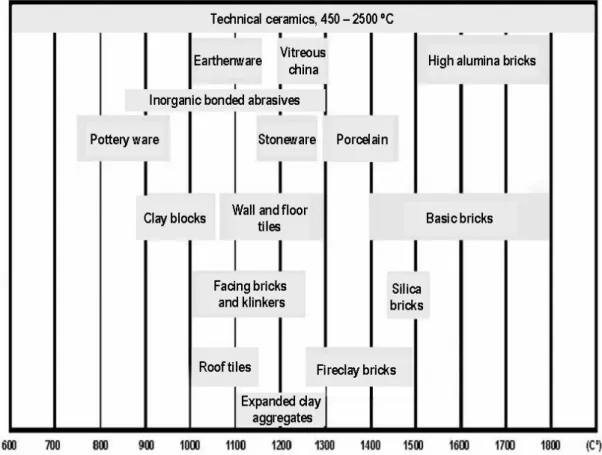
• energy consumption/CO2 emissions: all sectors of the ceramic industry are energy
intensive, as a key part of the process involves drying followed by firing to temperatures of between 800 and 2000 ºC. Today natural gas, liquefied petroleum gas (propane and butane) and fuel oil EL are mainly used for firing, while heavy fuel oil, liquefied natural gas (LNG), biogas/biomass, electricity and solid fuels (e.g. coal, petroleum coke) can also play a role as energy sources for burners.
APPLIED PROCESSES AND TECHNIQUES
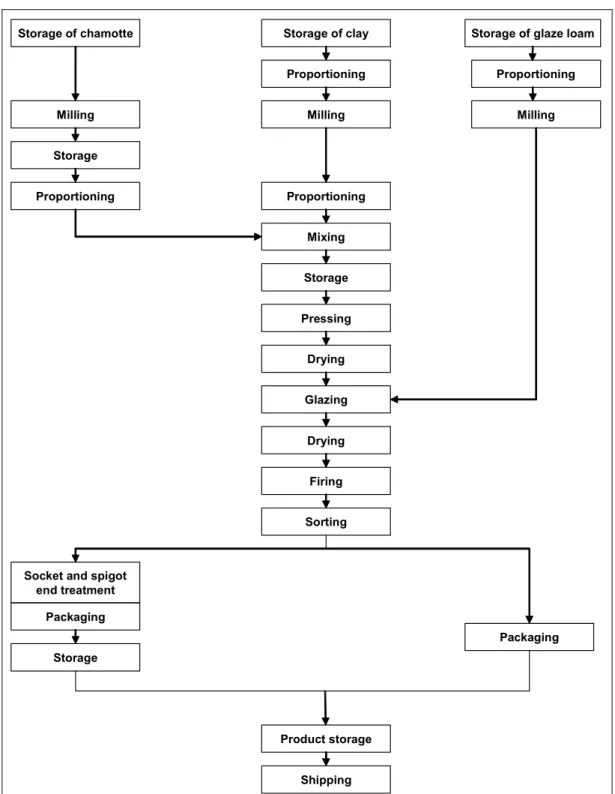
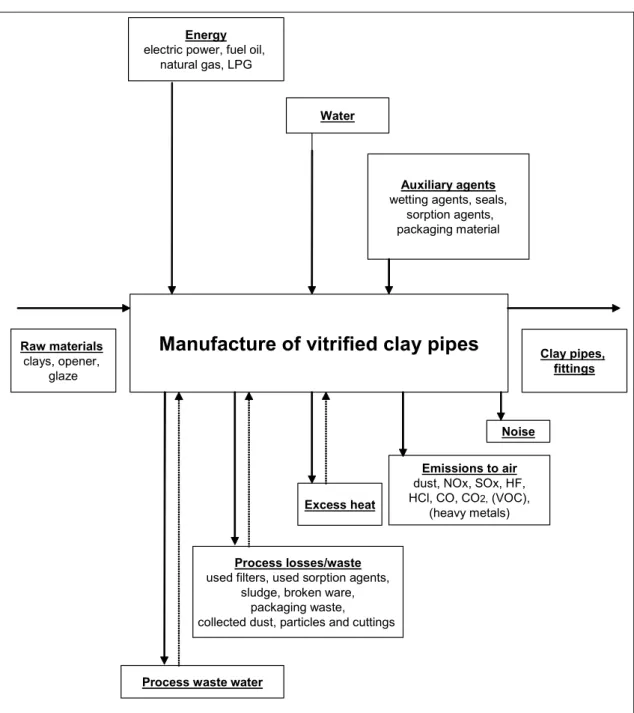
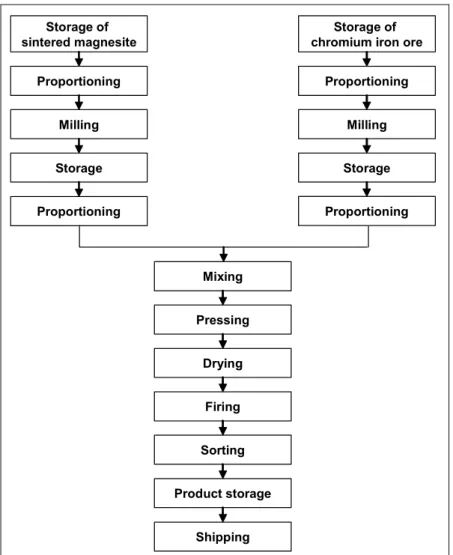
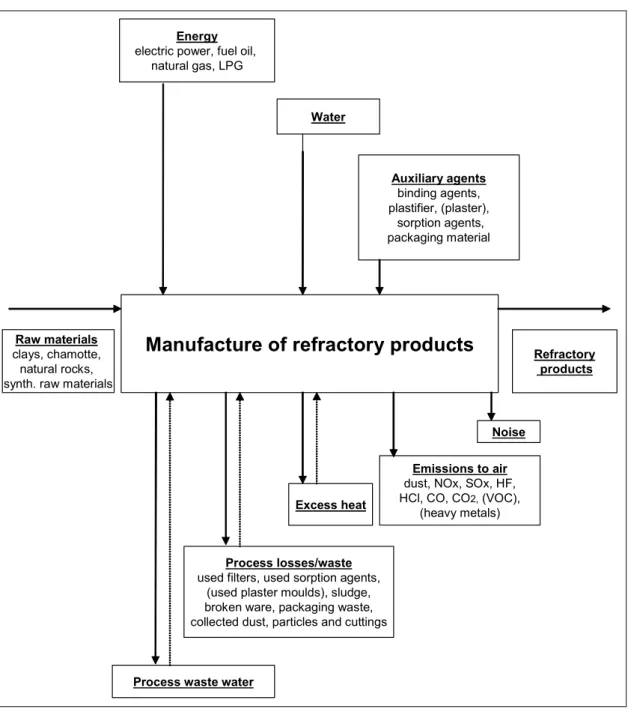
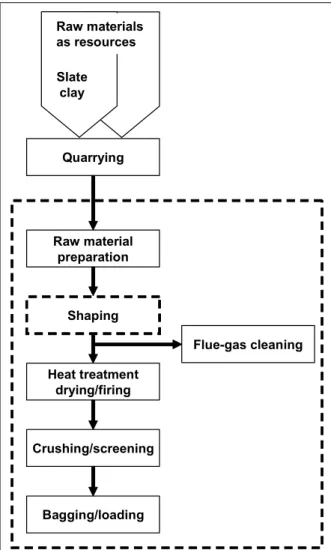
The manufacture of ceramic products takes place in different types of kilns, with a wide range of raw materials and in numerous shapes, sizes and colours. The general process of manufacturing ceramic products, however, is rather uniform, besides the fact that for the manufacture of wall and floor tiles, household ceramics, sanitaryware and technical ceramics often a multiple stage firing process is used.
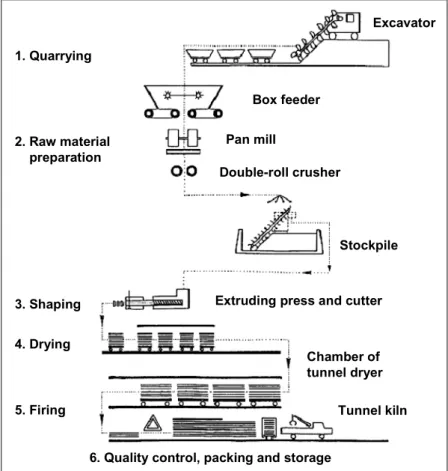
In general, raw materials are mixed and cast, pressed or extruded into shape. Water is regularly used for a thorough mixing and shaping. This water is evaporated in dryers and the products are either placed by hand in the kiln – especially in the case of periodically operated shuttle kilns – or placed onto carriages that are transferred through continuously operated tunnel or roller hearth kilns. For the manufacture of expanded clay aggregates, rotary kilns are used.
During firing a very accurate temperature gradient is necessary to ensure that the products obtain the right treatment. Afterwards controlled cooling is necessary, so that the products release their heat gradually and preserve their ceramic structure. Then the products are packaged and stored for delivery.
EMISSIONS AND CONSUMPTIONS Emissions
The processing of clays and other ceramic raw materials inevitably leads to dust formation – especially in the case of dry materials. Drying, (including spray drying), comminution (grinding, milling), screening, mixing and conveying can all result in a release of fine dust. Some dust also forms during the decorating and firing of the ware, and during the machining or finishing operations on the fired ware. Dust emissions are not only derived from the raw materials as described above, but also the fuels contribute to these emissions to air.
The gaseous compounds released during drying and firing are mainly derived from the raw materials, but fuels also contribute gaseous pollutants. In particular these are SOX, NOX, HF,
HCl, VOC and heavy metals.
Process waste water is generated mainly when clay materials are flushed out and suspended in flowing water during the manufacturing process and equipment cleaning, but emissions to water also occur during the operation of wet off-gas scrubbers. The water added directly to ceramic body mixes is subsequently evaporated into the air during the drying and firing stages.
Process losses can often be recycled and re-used within the plant due to product specifications or process requirements. Materials, which cannot be recycled internally, leave the plant to be used in other industries or to be supplied to external waste recycling or waste disposal facilities. Consumptions
The primary energy use in ceramic manufacturing is for kiln firing and, in many processes, drying of intermediates or shaped ware is also energy intensive.
Water is used in virtually all ceramic processes and good quality water is essential for the preparation of clays and glaze slips, clay bodies for extrusion, ‘muds’ for moulding, preparation of spray dried powders, wet grinding/milling and washing or cleaning operations.
A vast range of raw materials is consumed by the ceramic industry. These include the main body forming materials, involving high tonnages, and various additives, binders and decorative surface-applied materials which are used on a lesser scale.
TECHNIQUES TO CONSIDER IN THE DETERMINATION OF BAT
Important issues for the implementation of IPPC in the ceramic industry are reduction of emissions to air and water, efficient energy, raw material and water usage, minimisation, recovery and recycling of process losses/waste and process waste water, as well as effective management systems.
The issues above are addressed by a variety of process-integrated and end-of-pipe techniques, taking into account the applicability in the nine individual ceramic sectors. In this context, approximately 50 techniques for pollution prevention and control are presented in this document, under the following seven thematic headings:
Reduction of energy consumption (energy efficiency)
The choices of energy source, firing technique and heat recovery method are central to the design of the kiln and are also some of the most important factors affecting the environmental performance and energy efficiency of the manufacturing process.
The main techniques for reducing energy usage, which can be applied individually or in combination, are listed below and are discussed in detail in this document:
• improved design of kilns and dryers • recovery of excess heat from kilns
• cogeneration/combined heat and power plants
• substitution of heavy fuel oil and solid fuels by low emission fuels • modification of ceramic bodies.
Emissions of dust (particulate matter)
To prevent diffuse and channelled dust emissions, techniques and measures are described, which can be applied individually or in combination. These are:
• measures for dusty operations • measures for bulk storage areas • separation/filter systems. Gaseous compounds
To prevent emissions of gaseous air pollutants (in particular SOXx, NOXx, HF, HCl, VOC),
primary and secondary measures/techniques are described, which can be applied individually or in combination. These are:
• reduction of pollutant precursor input • addition of calcium rich additives • process optimisation
• sorption plants (adsorbers, absorbers) • afterburning.
Process waste water
Objectives and solutions for the reduction of process waste water (emissions and consumption) are presented in the form of process optimisation measures and process waste water treatment systems. For the reduction of process waste water emissions and lower water consumption, combinations of these measures are usually applied.
Process losses/waste
Objectives and solutions for the reduction of process losses/waste are presented regarding sludge arising in the manufacture of ceramic products and solid process losses/solid waste in the form of process optimisation, recycling and re-use measures/techniques. For the reduction of process losses/waste, combinations of these measures/techniques are usually applied.
General considerations concerning noise
Possibilities for the reduction of noise occurring in the several steps during the manufacturing processes of ceramic products are demonstrated. A general summary and overview for the reduction of noise is presented.
Environmental management tools/environmental management systems (EMS)
EMS are essential for minimising the environmental impact of industrial activities in general, with some measures that are specifically important to ceramics. Therefore EMS are presented in this document as tools that operators can use to address these design, construction, maintenance, operation and decommissioning issues in a systematic, demonstrable way.
BAT FOR CERAMIC MANUFACTURING
The BAT chapter (Chapter 5) identifies those techniques that are considered to be BAT in a general sense, based mainly on the information in Chapter 4, taking into account the Article 2(11) definition of best available techniques and the considerations listed in Annex IV to the Directive. As described more fully in the Preface, the BAT chapter does not set or propose emission limit values but suggests consumption and emission values that are associated with the use of BAT as well as a selection of BAT. The determination of appropriate permit conditions will involve taking account of local, site-specific factors such as the technical characteristics of the installation concerned, its geographical location and the local environmental conditions. In the case of existing installations, the economic and technical viability of upgrading them also needs to be taken into account.
The following paragraphs summarise the key BAT conclusions for the ceramic manufacturing industry relating to the most relevant environmental issues. The BAT conclusions are set out on two levels. Section 5.1 presents generic BAT conclusions, i.e. those that are generally applicable to the whole ceramic industry. Section 5.2 contains more specific BAT conclusions, i.e. those for the nine major ceramic sectors under the scope. ‘Best Available Techniques’ for a specific installation will usually be the use of one individual or a combination of the techniques and measures listed in the relevant chapter under the generic and sector specific sections. It has to be noted, that in this Executive Summary, the BAT conclusions of this document are summarised as short versions. To read the relevant full BAT conclusions, see the corresponding sections in Chapter 5 of this document.
Generic BAT
The generic BAT section contains general BAT conclusions regarding all nine sectors explained and described in detail in this document.
It has to be noted, that in this Executive Summary, the BAT conclusions of this document are summarised as short versions. It has to be stressed again that this BAT summary as well as the associated BAT AEL ranges mentioned in the summary, cannot correctly be interpreted unless it is read in conjunction with Chapter 4 and the relevant full BAT conclusions in Chapter 5 of this document.
Environmental management:
Implement and adhere to an Environmental Management System (EMS) that incorporates, as appropriate to individual circumstances, the features listed in Section 5.1.1 of this document. Energy consumption:
Reduce energy consumption by applying a combination of several techniques, which are listed in Section 5.1.2.a of this document and can be summarised as:
• improved design of kilns and dryers
• recovery of excess heat from kilns, especially from their cooling zone
• applying a fuel switch in the kiln firing process (substitution of heavy fuel oil and solid fuels by low emission fuels)
• modification of ceramic bodies.
Reduce primary energy consumption by applying cogeneration/combined heat and power plants on the basis of useful heat demand, within energy regulatory schemes which are economically viable.
Diffuse dust emissions:
Reduce diffuse dust emissions by applying a combination of several techniques, which are listed in Section 5.1.3.1 of this document and can be summarised as measures for dusty operations and bulk storage area measures.
Channelled dust emissions from dusty operations other than from drying, spray drying or firing:
Reduce channelled dust emissions from dusty operations to 1 – 10 mg/m3, as the half hourly
average value, by applying bag filters. The range may be higher depending on specific operating conditions.
Dust emissions from drying processes:
Keep dust emissions from drying processes in the range 1 – 20 mg/m3as the daily average value
by cleaning the dryer, by avoiding the accumulation of dust residues in the dryer and by adopting adequate maintenance protocols.
Dust emissions from kiln firing processes:
Reduce dust emissions from the flue-gases of kiln firing processes to 1 – 20 mg/m3as the daily average value by applying a combination of several techniques, which are listed in Section 5.1.3.4 of this document. These techniques can be summarised as utilisation of low ash fuels and minimisation of dust formation caused by the charging of the ware to be fired in the kiln.
By applying dry flue-gas cleaning with a filter, a dust emission level of less than 20 mg/m3 in the cleaned flue-gas is BAT and by applying cascade-type packed bed adsorbers, a dust emission level of less than 50 mg/m3 in the cleaned flue-gas is BAT (for expanded clay
aggregates, see the sector specific BAT).
Gaseous compounds, primary measures/techniques:
Reduce the emissions of gaseous compounds (i.e. HF, HCl, SOX, VOC, heavy metals) from flue-gases of kiln firing processes by applying one or a combination of several techniques, which are listed in Section 5.1.4.1 of this document. These techniques can be summarised as reducing the input of pollutant precursors and heating curve optimisation.
Keep the emissions of NOXfrom flue-gases of kiln firing processes below 250 mg/m3, as the
daily average value stated as NO2, for kiln gas temperatures below 1300 ºC, or below
500 mg/m3, as the daily average value stated as NO
2, for kiln gas temperatures of 1300 ºC and
higher, by applying a combination of primary measures/techniques as listed in Sections 4.3.1 and 4.3.3 of the document (for expanded clay aggregates, see the sector specific BAT).
Keep the emissions of NOXfrom off-gases of cogeneration engines below 500 mg/m3, as the
daily average value stated as NO2, by applying process optimisation measures.
Gaseous compounds, secondary measures/techniques and in combination with primary measures/techniques:
Reduce the emissions of gaseous inorganic compounds from flue-gases of kiln firing processes by applying one of several techniques which are listed in Section 5.1.4.2 of this document and can be summarised as cascade-type packed bed adsorbers and dry flue-gas cleaning with a filter.
The following table from Section 5.1.4.2 shows BAT emission levels for gaseous inorganic compounds from flue-gases of kiln firing processes by applying a combination of primary measures/techniques as stated in Section 5.1.4.1.a and/or secondary measures/techniques as stated in Section 5.1.4.2 of this document.
Parameter Unit, as a daily average value BAT AEL1)
Fluoride stated as HF mg/m3 1 – 102)
Chloride stated as HCl mg/m3 1 – 303)
SOXstated as SO2
Sulphur content in raw material J0.25 % mg/m
3 <500
SOXstated as SO2
Sulphur content in raw material >0.25 % mg/m
3 500 – 20004)
1) The ranges depend on the content of the pollutant (precursor) in the raw materials, i.e. for firing processes of ceramic products with a low content of the pollutant (precursor) in the raw materials, lower levels within the range are BAT and for firing processes of ceramic products with a high content of the pollutant (precursor) in the raw materials, higher levels within the range are BAT AELs.
2) The higher BAT level can be lower depending on the characteristics of the raw material.
3) The higher BAT level can be lower depending on the characteristics of the raw material. Also, the higher BAT AEL should not prevent the re-use of waste water.
4) The higher BAT level only applies to raw material with an extremely high sulphur content. Process waste water (emissions and consumption):
Reduce water consumption by applying several process optimisation measures as listed in Section 4.4.5.1 of this document, which can be applied individually or in combination.
Clean process waste water by applying several process waste water treatment systems as listed in Section 4.4.5.2 of this document, which can be applied individually or in combination to ensure that the water is adequately cleaned to be re-used in the manufacturing process or to be discharged directly into watercourses or indirectly into a municipal waste water sewerage system.
The following table from Section 5.1.5 shows BAT associated emission levels of pollutants in waste water discharges:
Parameter Unit BAT AEL
(2 hours composite sample)
Suspended solids mg/l 50.0
AOX mg/l 0.1
Lead (Pb) mg/l 0.3
Zinc (Zn) mg/l 2.0
Cadmium (Cd) mg/l 0.07
If more than 50 % of the process water is re-used in the manufacturing processes, higher concentrations of these pollutants may still be BAT AELs, as long as the specific pollutant load per production amount (kg of processed raw material) is not higher than the pollutant load resulting from a water recycling rate of less than 50 %.
Sludge:
Recycle/re-use sludge by applying sludge recycling systems and/or sludge re-use in other products.
Solid process losses/solid waste:
Reduce solid process losses/solid waste by applying a combination of several techniques, which are listed in Section 5.1.7 of this document and can be summarised as:
• feedback of unmixed raw materials
• feedback of broken ware into the manufacturing process • use of solid process losses in other industries
• electronic controlling of firing • applying optimised setting. Noise:
Reduce noise by applying a combination of several techniques, which are listed in Section 5.1.8 of this document and can be summarised as:
• enclosure of units
• vibration insulation of units
• using silencers and slow rotating fans
• situating windows, gates and noisy units away from neighbours • sound insulation of windows and walls
• closing windows and gates
• carrying out noisy (outdoor) activities only during the day • good maintenance of the plant.
Sector specific BAT
The sector specific BAT section contains specific BAT conclusions regarding each of the nine sectors explained and described in this document. It has to be stressed again that this BAT summary as well as the associated BAT AEL ranges mentioned in the summary, cannot correctly be interpreted unless it is read in conjunction with Chapter 4 and the relevant full BAT conclusions in Chapter 5 of this document.
Channelled dust emissions:
Wall and floor tiles, household ceramics, sanitaryware, technical ceramics, vitrified clay pipes: Reduce channelled dust emissions from spray glazing processes to 1 – 10 mg/m3, as the half
hourly average value, by applying bag filters or sintered lamellar filters. Wall and floor tiles, household ceramics, technical ceramics:
Reduce channelled dust emissions from spray drying processes to 1 – 30 mg/m3, as the half
hourly average value, by applying bag filters, or to 1 – 50 mg/m3 by applying cyclones in
combination with wet dust separators for existing installations, if the rinsing water can be re-used.
Expanded clay aggregates:
Reduce channelled dust emissions from hot off-gases to 5 – 50 mg/m3, as the daily average
value, by applying electrostatic precipitators or wet dust separators. Dust emissions from kiln firing processes:
Wall and floor tiles:
Reduce dust emissions from flue-gases of kiln firing processes to 1 – 5 mg/m3, as the daily
Gaseous compounds/primary measures/techniques: Bricks and roof tiles:
Reduce the emissions of gaseous compounds (i.e. HF, HCl, SOX,) from the flue-gases of kiln
firing processes by the addition of calcium rich additives. Expanded clay aggregates:
Keep the emissions of NOX from the flue-gases of rotary kiln firing processes below
500 mg/m3, as the daily average value stated as NO
2, by applying a combination of primary
measures/techniques.
Gaseous compounds/secondary measures/techniques:
Wall and floor tiles, household ceramics, sanitaryware, technical ceramics:
Reduce the emissions of gaseous inorganic compounds from the flue-gases of kiln firing processes by applying module adsorbers, especially for lower flue-gas flowrates (below 18000 m3/h) and when raw gas concentrations of inorganic compounds other than HF
(SO2, SO3, HCl) and of dust are low.
Wall and floor tiles:
Reduce the emissions of HF from the flue-gases of kiln firing processes to 1 – 5 mg/m3, as the
daily average value, by applying, e.g. dry flue-gas cleaning with a bag filter. Volatile organic compounds:
Bricks and roof tiles, refractory products, technical ceramics, inorganic bonded abrasives:
Reduce the emissions of volatile organic compounds from the flue-gases of firing processes – with raw gas concentrations of more than 100 to 150 mg/m3, depending on the raw gas
characteristics, e.g. composition, temperature – to 5 – 20 mg/m3, as the daily average value
stated as total C, by applying thermal afterburning either in a one or a three chamber thermoreactor.
Refractory products treated with organic compounds:
Reduce the emissions of volatile organic compounds in low off-gas volumes from the treatment with organic compounds by applying activated carbon filters. For high off-gas volumes, BAT is to reduce the emissions of volatile organic compounds from the treatment with organic compounds by applying thermal afterburning to 5 – 20 mg/m3.
Re-use of process waste water:
Wall and floor tiles, household ceramics, sanitaryware:
Re-use process waste water in the manufacturing process with process waste water recycling ratios of 50 – 100 % (for wall and floor tiles, depending on the type of tile to be manufactured), or of 30 – 50 % (for household ceramics and sanitaryware), by applying a combination of process optimisation measures and process waste water treatment systems.
Re-use of sludge: Wall and floor tiles:
Re-use the sludge arising from process waste water treatment in the ceramic body preparation process in a ratio of 0.4 – 1.5 % per weight of added dry sludge to the ceramic body, by applying a sludge recycling system, when applicable.
Solid process losses/solid waste:
Household ceramics, sanitaryware, technical ceramics, refractory products:
Reduce the amount of solid process losses/solid waste in the form of used plaster moulds from the shaping by applying one individual or a combination of the following measures:
• replacing plaster moulds by polymer moulds • replacing plaster moulds by metal moulds • use of vacuum plaster mixers
• re-use of used plaster moulds in other industries. EMERGING TECHNIQUES
Some new techniques for the minimisation of environmental impacts are under development or in limited use and are considered emerging techniques. Five of these are discussed in Chapter 6: • radiant-tube burners
• microwave assisted firing and microwave dryers • a new type of drying system for refractory products
• advanced process waste water management with integrated glaze recovery • lead-free glazing of high quality table porcelain.
CONCLUDING REMARKS
The Concluding Remarks Chapter contains information on the milestones in developing this document, the degree of consensus reached on the BAT proposals for the ceramic industry and the information gaps that still exist, in particular regarding data which were not provided within the time period of the information exchange and, therefore, could not be taken in consideration. Recommendations for further research and information gathering are given and, finally, recommendations for updating the BREF on ceramic manufacturing.
The EC is launching and supporting, through its RTD programmes, a series of projects dealing with clean technologies, emerging effluent treatment and recycling technologies and management strategies. Potentially these projects could provide a useful contribution to future BREF reviews. Readers are therefore invited to inform the EIPPCB of any research results which are relevant to the scope of this document (see also the preface of this document).
PREFACE
1. Status of this document
Unless otherwise stated, references to “the Directive” in this document means the Council Directive 96/61/EC on integrated pollution prevention and control. As the Directive applies without prejudice to Community provisions on health and safety at the workplace, so does this document.
This document forms part of a series presenting the results of an exchange of information between EU Member States and industries concerned on best available technique (BAT), associated monitoring, and developments in them. It is published by the European Commission pursuant to Article 16(2) of the Directive, and must therefore be taken into account in accordance with Annex IV of the Directive when determining “best available techniques”. 2. Relevant legal obligations of the IPPC Directive and the definition of BAT
In order to help the reader understand the legal context in which this document has been drafted, some of the most relevant provisions of the IPPC Directive, including the definition of the term “best available techniques”, are described in this preface. This description is inevitably incomplete and is given for information only. It has no legal value and does not in any way alter or prejudice the actual provisions of the Directive.
The purpose of the Directive is to achieve integrated prevention and control of pollution arising from the activities listed in its Annex I, leading to a high level of protection of the environment as a whole. The legal basis of the Directive relates to environmental protection. Its implementation should also take account of other Community objectives such as the competitiveness of the Community’s industry thereby contributing to sustainable development. More specifically, it provides for a permitting system for certain categories of industrial installations requiring both operators and regulators to take an integrated, overall look at the polluting and consuming potential of the installation. The overall aim of such an integrated approach must be to improve the management and control of industrial processes so as to ensure a high level of protection for the environment as a whole. Central to this approach is the general principle given in Article 3 that operators should take all appropriate preventative measures against pollution, in particular through the application of best available techniques enabling them to improve their environmental performance.
The term “best available techniques” is defined in Article 2(11) of the Directive as “the most effective and advanced stage in the development of activities and their methods of operation which indicate the practical suitability of particular techniques for providing in principle the basis for emission limit values designed to prevent and, where that is not practicable, generally to reduce emissions and the impact on the environment as a whole.” Article 2(11) goes on to clarify further this definition as follows:
“techniques” includes both the technology used and the way in which the installation is designed, built, maintained, operated and decommissioned;
“available” techniques are those developed on a scale which allows implementation in the relevant industrial sector, under economically and technically viable conditions, taking into consideration the costs and advantages, whether or not the techniques are used or produced inside the Member State in question, as long as they are reasonably accessible to the operator; “best” means most effective in achieving a high general level of protection of the environment as a whole.
Furthermore, Annex IV of the Directive contains a list of “considerations to be taken into account generally or in specific cases when determining best available techniques... bearing in mind the likely costs and benefits of a measure and the principles of precaution and prevention”. These considerations include the information published by the Commission pursuant to Article 16(2).
Competent authorities responsible for issuing permits are required to take account of the general principles set out in Article 3 when determining the conditions of the permit. These conditions must include emission limit values, supplemented or replaced where appropriate by equivalent parameters or technical measures. According to Article 9(4) of the Directive, these emission limit values, equivalent parameters and technical measures must, without prejudice to compliance with environmental quality standards, be based on the best available techniques, without prescribing the use of any technique or specific technology, but taking into account the technical characteristics of the installation concerned, its geographical location and the local environmental conditions. In all circumstances, the conditions of the permit must include provisions on the minimisation of long-distance or transboundary pollution and must ensure a high level of protection for the environment as a whole.
Member States have the obligation, according to Article 11 of the Directive, to ensure that competent authorities follow or are informed of developments in best available techniques. 3. Objective of this Document
Article 16(2) of the Directive requires the Commission to organise “an exchange of information between Member States and the industries concerned on best available techniques, associated monitoring and developments in them”, and to publish the results of the exchange.
The purpose of the information exchange is given in recital 25 of the Directive, which states that “the development and exchange of information at Community level about best available techniques will help to redress the technological imbalances in the Community, will promote the worldwide dissemination of limit values and techniques used in the Community and will help the Member States in the efficient implementation of this Directive.”
The Commission (Environment DG) established an information exchange forum (IEF) to assist the work under Article 16(2) and a number of technical working groups have been established under the umbrella of the IEF. Both IEF and the technical working groups include representation from Member States and industry as required in Article 16(2).
The aim of this series of documents is to reflect accurately the exchange of information which has taken place as required by Article 16(2) and to provide reference information for the permitting authority to take into account when determining permit conditions. By providing relevant information concerning best available techniques, these documents should act as valuable tools to drive environmental performance.
4. Information Sources
This document represents a summary of information collected from a number of sources, including in particular the expertise of the groups established to assist the Commission in its work, and verified by the Commission services. All contributions are gratefully acknowledged. 5. How to understand and use this document
The information provided in this document is intended to be used as an input to the determination of BAT in specific cases. When determining BAT and setting BAT-based permit conditions, account should always be taken of the overall goal to achieve a high level of protection for the environment as a whole.
The rest of this section describes the type of information that is provided in each section of this document.
Chapters 1 and 2 provide general information on the ceramic manufacturing industry and on the industrial processes used within this industry. Chapter 3 provides data and information concerning current emission and consumption levels reflecting the situation in existing installations at the time of writing.
Chapter 4 describes in more detail the emission reduction and other techniques that are considered to be most relevant for determining BAT and BAT-based permit conditions. This information includes the consumption and emission levels considered achievable by using the technique, some idea of the costs and the cross-media issues associated with the technique, and the extent to which the technique is applicable to the range of installations requiring IPPC permits, for example new, existing, large or small installations. Also the applicability of a technique in the different sectors of the ceramic industry is taken into consideration. Techniques that are generally seen as obsolete are not included.
Chapter 5 presents the techniques and the emission and consumption levels that are considered to be compatible with BAT in a general sense. The purpose is thus to provide general indications regarding the emission and consumption levels that can be considered as an appropriate reference point to assist in the determination of BAT-based permit conditions or for the establishment of general binding rules under Article 9(8). It should be stressed, however, that this document does not propose emission limit values. The determination of appropriate permit conditions will involve taking account of local, site-specific factors such as the technical characteristics of the installation concerned, its geographical location and the local environmental conditions. In the case of existing installations, the economic and technical viability of upgrading them also needs to be taken into account. Even the single objective of ensuring a high level of protection for the environment as a whole will often involve making trade-off judgements between different types of environmental impact, and these judgements will often be influenced by local considerations.
Although an attempt is made to address some of these issues, it is not possible for them to be considered fully in this document. The techniques and levels presented in Chapter 5 will therefore not necessarily be appropriate for all installations. On the other hand, the obligation to ensure a high level of environmental protection including the minimisation of long-distance or transboundary pollution implies that permit conditions cannot be set on the basis of purely local considerations. It is therefore of the utmost importance that the information contained in this document is fully taken into account by permitting authorities.
Since the best available techniques change over time, this document will be reviewed and updated as appropriate. All comments and suggestions should be made to the European IPPC Bureau at the Institute for Prospective Technological Studies at the following address:
Edificio Expo, c/ Inca Garcilaso, s/n, E-41092 Sevilla, Spain Telephone: +34 95 4488 284
Fax: +34 95 4488 426
e-mail: [email protected] Internet: http://eippcb.jrc.es
Best Available Techniques Reference Document on
Ceramic Manufacturing
EXECUTIVE SUMMARY...I PREFACE...XI SCOPE ... XXV
1 GENERAL INFORMATION ON CERAMIC MANUFACTURING ... 1
1.1 Historical origins... 1
1.2 Characteristics of ceramics... 1
1.3 Geographical distribution and general economic considerations ... 3
1.4 Key environmental issues... 4
1.5 Ceramics sectors... 5
1.5.1 Bricks and roof tiles ... 6
1.5.2 Vitrified clay pipes... 7
1.5.3 Refractory products... 8
1.5.4 Expanded clay aggregates ... 9
1.5.5 Wall and floor tiles... 9
1.5.6 Table- and ornamentalware (household ceramics)... 11
1.5.7 Sanitaryware ... 11
1.5.8 Technical ceramics... 12
1.5.9 Inorganic bonded abrasives... 12
2 APPLIED PROCESSES AND TECHNIQUES IN CERAMIC MANUFACTURING ... 13
2.1 Raw materials... 13
2.2 General production process description ... 14
2.2.1 Storage and transport of raw materials... 15
2.2.2 Preparation of raw materials ... 15
2.2.2.1 Pre-drying... 15
2.2.2.2 Pre-blending ... 15
2.2.2.3 Weathering/souring ... 15
2.2.2.4 Primary and secondary crushing, grinding and screening... 16
2.2.2.5 Dry or wet milling (grinding)... 16
2.2.2.6 Dry screening/air classification... 16
2.2.2.7 Spray drying... 17
2.2.2.8 Calcining ... 17
2.2.2.9 Synthetic base materials ... 17
2.2.2.10 Frits and glazes, glaze preparation ... 17
2.2.3 Component mixing... 18 2.2.3.1 General ... 18 2.2.3.2 Continuous mixers ... 18 2.2.3.3 Batch mixers ... 18 2.2.4 Shaping/forming of ware ... 19 2.2.4.1 General ... 19 2.2.4.2 Pressing ... 19 2.2.4.2.1 Mechanical pressing ... 19 2.2.4.2.2 Hydraulic pressing... 19 2.2.4.2.3 Impact pressing ... 19 2.2.4.2.4 Friction pressing... 19 2.2.4.2.5 Isostatic pressing ... 20 2.2.4.3 Extrusion ... 20 2.2.4.4 Moulding... 20 2.2.4.5 Slip casting... 20 2.2.4.6 Fusion casting ... 21
2.2.5 Drying of ceramic products... 21
2.2.5.1 General ... 21
2.2.5.2 Hot floor dryers ... 21
2.2.5.3 Chamber dryers (intermittent) ... 21
2.2.5.4 Tunnel dryers (continuous) ... 22
2.2.5.5 Vertical ‘basket’ dryers ... 22
2.2.5.7 Dehumidifying dryers...22
2.2.5.8 Infrared and microwave dryers ...23
2.2.6 Surface treatment and decoration of ceramic products...23
2.2.6.1 Texturing of clay products...23
2.2.6.2 Applied facings...23
2.2.6.3 Glazing, engobing and other decorating techniques ...23
2.2.7 Firing ...24
2.2.7.1 Aims of firing ...24
2.2.7.2 Physico-chemical changes during firing...24
2.2.7.3 Intermittent (periodic) kilns ...25
2.2.7.4 Continuous kilns ...26
2.2.7.4.1 Chamber (Hoffmann) kilns ...26
2.2.7.4.2 Tunnel kilns ...26
2.2.7.4.3 Roller hearth kilns...27
2.2.7.4.4 Sliding bat kilns ...28
2.2.7.5 Clamp firing...28
2.2.7.6 Rotary kilns...28
2.2.7.7 Fluidised beds ...29
2.2.7.8 Cooling stage heat recovery...29
2.2.8 Subsequent treatment (product finishing)...29
2.2.8.1 Machining (grinding, drilling, sawing)...29
2.2.8.1.1 Wet grinding ...29
2.2.8.1.2 Dry grinding...29
2.2.8.1.3 Drilling...29
2.2.8.1.4 Sawing ...30
2.2.8.2 Polishing ...30
2.2.8.3 Carbon enrichment (refractory products)...30
2.2.8.4 Tumbling of facing bricks ...30
2.2.9 Addition of auxiliary materials...31
2.2.9.1 Jointing materials (pipes)...31
2.2.9.2 Silicones/water repellents ...31
2.2.9.3 Insulation materials...31
2.2.9.4 Carding and plating (refractory bricks)...31
2.2.9.5 Adhesives...31
2.2.9.6 Final assembly ...31
2.2.10 Sorting, packaging and storage...31
2.2.11 Supply and disposal (off-gas treatment and process waste water treatment) facilities ...32
2.2.12 Recycling in the ceramic industry ...32
2.2.13 General process flow diagram showing different processing paths...33
2.3 Description of techniques for the manufacture of ceramic products sector by sector...34
2.3.1 Bricks and roof tiles...34
2.3.1.1 Raw materials ...35
2.3.1.2 Preparation of raw materials ...39
2.3.1.3 Shaping ...40
2.3.1.4 Drying, glazing and engobing...41
2.3.1.5 Firing ...41
2.3.1.6 Subsequent treatment...43
2.3.1.7 Input and output flows in the manufacture of bricks and roof tiles ...43
2.3.2 Vitrified clay pipes ...44
2.3.2.1 Raw materials ...45
2.3.2.2 Preparation of raw materials ...47
2.3.2.3 Shaping ...47
2.3.2.4 Drying and glazing ...47
2.3.2.5 Firing ...47
2.3.2.6 Subsequent treatment...48
2.3.2.7 Input and output flows in the manufacture of vitrified clay pipes ...48
2.3.3 Refractory products ...49
2.3.3.1 Raw materials ...50
2.3.3.2 Preparation of raw materials ...51
2.3.3.3 Shaping ...51
2.3.3.4 Drying...52
2.3.3.5 Firing ...52
2.3.3.7 Special procedures ... 53
2.3.3.8 Input and output flows in the manufacture of refractory products ... 54
2.3.4 Expanded clay aggregates ... 54
2.3.4.1 Raw materials, additives and auxiliary agents ... 56
2.3.4.2 General system and process technology... 57
2.3.4.2.1 Shaping... 57
2.3.4.2.2 Thermal process technology... 57
2.3.4.2.3 Chemical reaction during expansion ... 58
2.3.4.2.4 Subsequent sieving and crushing... 58
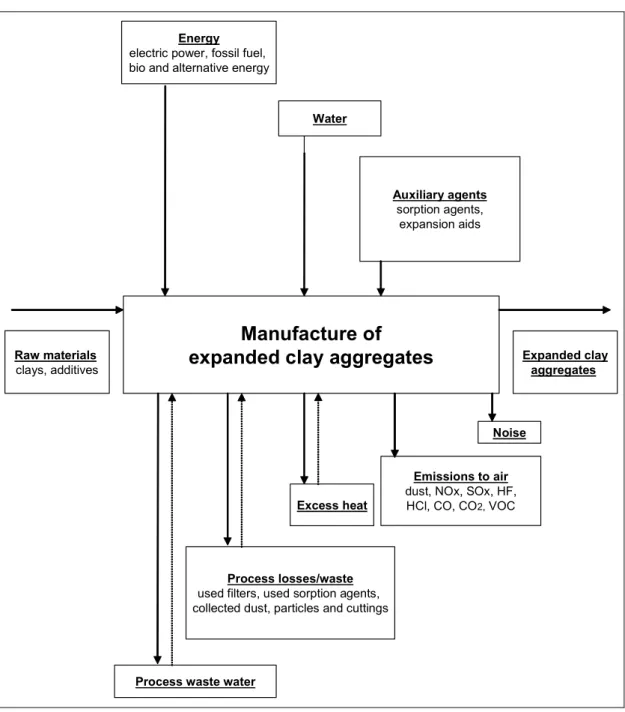
2.3.4.3 Input and output flows in the manufacture of expanded clay aggregates... 58
2.3.5 Wall and floor tiles... 59
2.3.5.1 Raw materials... 60
2.3.5.2 Preparation of raw materials ... 61
2.3.5.3 Shaping... 61
2.3.5.4 Drying ... 62
2.3.5.5 Firing and glazing ... 62
2.3.5.6 Subsequent treatment ... 63
2.3.5.7 Input and output flows in the manufacture of wall and floor tiles... 63
2.3.6 Table- and ornamentalware (household ceramics)... 64
2.3.6.1 Raw materials... 65
2.3.6.2 Preparation of raw materials ... 65
2.3.6.3 Shaping... 66
2.3.6.4 Drying ... 67
2.3.6.5 Firing, glazing and decoration... 67
2.3.6.6 Subsequent treatment ... 70
2.3.6.7 Input and output flows in the manufacture of household ceramics ... 70
2.3.7 Sanitaryware ... 71
2.3.7.1 Raw materials... 71
2.3.7.2 Preparation of raw materials ... 72
2.3.7.3 Shaping... 72
2.3.7.4 Drying and glazing... 72
2.3.7.5 Firing... 73
2.3.7.6 Subsequent treatment ... 74
2.3.7.7 Input and output flows in the manufacture of sanitaryware ... 74
2.3.8 Technical ceramics... 75
2.3.8.1 Raw materials... 77
2.3.8.2 Preparation of raw materials ... 78
2.3.8.3 Shaping... 79
2.3.8.4 Machining ... 80
2.3.8.5 Glazing, engobing and metallisation ... 81
2.3.8.6 Drying, burning out and pre-firing ... 82
2.3.8.7 Firing/sintering... 83
2.3.8.8 Subsequent treatment ... 84
2.3.8.9 Input and output flows in the manufacture of technical ceramics ... 84
2.3.9 Inorganic bonded abrasives... 85
2.3.9.1 Raw materials... 85
2.3.9.2 Preparation of raw materials ... 85
2.3.9.3 Shaping... 86
2.3.9.4 Drying ... 86
2.3.9.5 Firing... 86
2.3.9.6 Subsequent treatment ... 86
2.3.9.7 Input and output flows in the manufacture of inorganic bonded abrasives ... 86
3 CURRENT EMISSION AND CONSUMPTION LEVELS ... 89
3.1 Emissions – general considerations... 89
3.1.1 Emissions to air... 89
3.1.1.1 Dust (particulate matter)... 89
3.1.1.2 Gaseous emissions ... 89
3.1.1.2.1 Sulphur dioxide and other sulphur compounds ... 89
3.1.1.2.2 Oxides of nitrogen and other nitrogen compounds... 89
3.1.1.2.3 Carbon monoxide (and carbon dioxide) ... 90
3.1.1.2.4 Volatile organic compounds (VOCs) ... 90
3.1.1.2.6 Chlorine and its compounds...90
3.1.1.2.7 Fluorine and its compounds ...91
3.1.2 Emissions to water...91
3.1.3 Process losses/waste ...92
3.1.4 Emissions of noise...92
3.1.5 Possible emission sources and emission paths ...93
3.2 Consumption – general considerations ...94
3.2.1 Energy consumption ...94
3.2.2 Water consumption...94
3.2.3 Raw materials consumption...94
3.3 Presentation of emission and consumption data ...95
3.3.1 Bricks and roof tiles...95
3.3.1.1 Emission data...95
3.3.1.2 Consumption data ...104
3.3.2 Vitrified clay pipes ...106
3.3.2.1 Emission data...106
3.3.2.2 Consumption data ...108
3.3.3 Refractory products ...109
3.3.3.1 Emission data...109
3.3.3.2 Consumption data ...111
3.3.4 Expanded clay aggregates ...113
3.3.4.1 Emission data...113
3.3.4.2 Consumption data ...115
3.3.5 Wall and floor tiles ...116
3.3.5.1 Emission data...116
3.3.5.2 Consumption data ...120
3.3.6 Table- and ornamentalware (household ceramics) ...121
3.3.6.1 Emission data...121 3.3.6.2 Consumption data ...125 3.3.7 Sanitaryware ...126 3.3.7.1 Emission data...126 3.3.7.2 Consumption data ...129 3.3.8 Technical ceramics ...130 3.3.8.1 Emission data...130 3.3.8.2 Consumption data ...133
3.3.9 Inorganic bonded abrasives ...134
3.3.9.1 Emission data...134
3.3.9.2 Consumption data ...136
4 TECHNIQUES TO CONSIDER IN THE DETERMINATION OF BAT FOR CERAMIC MANUFACTURING ...137
4.1 Reduction of energy consumption (energy efficiency)...138
4.1.1 Improved design of kilns and dryers ...138
4.1.2 Recovery of excess heat from kilns ...140
4.1.3 Cogeneration/combined heat and power plants ...141
4.1.4 Substitution of heavy fuel oil and solid fuels by low emission fuels...143
4.1.5 Modification of ceramic bodies ...144
4.2 Emissions of dust (particulate matter) ...146
4.2.1 Measures for dusty operations ...146
4.2.2 Measures for bulk storage areas ...147
4.2.3 Separation/filter systems...148
4.2.3.1 Centrifugal separators...148
4.2.3.2 Bag filters ...148
4.2.3.3 Sintered lamellar filters...151
4.2.3.4 Wet dust separators...152
4.2.3.5 Electrostatic precipitators (ESP)...153
4.3 Gaseous compounds ...155
4.3.1 Reducing the input of pollutant precursors...155
4.3.2 Addition of calcium rich additives ...157
4.3.3 Process optimisation ...159
4.3.3.1 Optimising the heating curve...159
4.3.3.2 Reduction of water vapour levels in the kiln gases...160
4.3.3.4 Low-NOXburners ... 162
4.3.4 Sorption plants (adsorbers, absorbers) ... 163
4.3.4.1 Cascade-type packed bed adsorbers ... 163
4.3.4.2 Module adsorber systems ... 167
4.3.4.3 Dry flue-gas cleaning with a filter (bag filter or electrostatic precipitator)... 168
4.3.4.4 Wet flue-gas cleaning... 171
4.3.4.5 Activated carbon filters ... 173
4.3.4.6 Biological scrubbers... 173
4.3.5 Afterburning... 174
4.3.5.1 Thermal afterburning ... 174
4.3.5.2 Catalytic afterburning... 176
4.3.6 Examples of operational data, efficiencies, consumption and cost data for different flue-gas cleaning techniques... 178
4.4 Process waste water... 182
4.4.1 Water used as a raw material ... 182
4.4.2 Water used as a heat exchange vehicle ... 182
4.4.3 Water used as a scrubbing agent ... 182
4.4.4 Water used as a cleaning agent ... 182
4.4.5 Objectives and solutions for the reduction of process waste water (emissions and consumption)... 182
4.4.5.1 Process optimisation... 183
4.4.5.2 Systems of process waste water treatment ... 184
4.5 Process losses/waste... 186
4.5.1 Sludge arising in the manufacture of ceramic products ... 186
4.5.1.1 Sludge recycling systems ... 186
4.5.1.2 Sludge re-use in other products... 188
4.5.2 Solid process losses/solid waste... 189
4.5.2.1 General considerations concerning re-use of solid process losses as raw materials ... 189
4.5.2.2 General considerations on plaster moulds, firing auxiliaries and broken ware – avoidance/replacement/reduction... 190
4.6 General considerations concerning noise ... 191
4.7 Environmental management tools... 192
5 BEST AVAILABLE TECHNIQUES FOR CERAMIC MANUFACTURING... 201
5.1 Generic Best Available Techniques ... 203
5.1.1 Environmental management... 203
5.1.2 Energy consumption ... 204
5.1.3 Dust emissions ... 205
5.1.3.1 Diffuse dust emissions ... 205
5.1.3.2 Channelled dust emissions from dusty operations ... 205
5.1.3.3 Dust emissions from drying processes ... 205
5.1.3.4 Dust emissions from kiln firing processes ... 205
5.1.4 Gaseous compounds... 206
5.1.4.1 Primary measures/techniques... 206
5.1.4.2 Secondary measures/techniques and in combination with primary measures/techniques... 206
5.1.5 Process waste water (emissions and consumption) ... 207
5.1.6 Sludge ... 208
5.1.7 Solid process losses/solid waste... 208
5.1.8 Noise ... 208
5.2 Sector specific Best Available Techniques ... 209
5.2.1 Bricks and roof tiles ... 209
5.2.1.1 Gaseous compounds/primary measures/techniques ... 209
5.2.1.2 Volatile organic compounds... 209
5.2.2 Vitrified clay pipes... 209
5.2.2.1 Channelled dust emissions ... 209
5.2.3 Refractory products... 209
5.2.3.1 Volatile organic compounds... 209
5.2.3.2 Solid process losses/solid waste ... 210
5.2.4 Expanded clay aggregates ... 210
5.2.4.1 Channelled dust emissions ... 210
5.2.5 Wall and floor tiles ...210 5.2.5.1 Channelled dust emissions...210 5.2.5.2 Dust emissions from kiln firing processes ...210 5.2.5.3 Gaseous compounds/secondary measures/techniques ...211 5.2.5.4 Re-use of process waste water ...211 5.2.5.5 Re-use of sludge ...211 5.2.6 Table- and ornamental ware (household ceramics) ...211 5.2.6.1 Channelled dust emissions...211 5.2.6.2 Gaseous compounds/secondary measures/techniques ...211 5.2.6.3 Re-use of process waste water ...211 5.2.6.4 Solid process losses/solid waste ...212 5.2.7 Sanitaryware ...212 5.2.7.1 Channelled dust emissions...212 5.2.7.2 Gaseous compounds/secondary measures/techniques ...212 5.2.7.3 Re-use of process waste water ...212 5.2.7.4 Solid process losses/solid waste ...212 5.2.8 Technical ceramics ...212 5.2.8.1 Channelled dust emissions...212 5.2.8.2 Gaseous compounds/secondary measures/techniques ...213 5.2.8.3 Volatile organic compounds ...213 5.2.8.4 Solid process losses/solid waste ...213 5.2.9 Inorganic bonded abrasives ...213 5.2.9.1 Volatile organic compounds ...213
6 EMERGING TECHNIQUES FOR CERAMIC MANUFACTURING...215
6.1 Radiant tube burners ...215 6.2 Microwave assisted firing and microwave dryers...215 6.3 New type of drying system for refractory products ...216 6.4 Advanced process waste water management with integrated glaze recovery...218 6.5 Lead-free glazing of high quality table porcelain ...219
7 CONCLUDING REMARKS...221 8 REFERENCES ...225 9 GLOSSARY...227
List of figures
Figure 1.1: Stages in the manufacture of ceramic products... 2 Figure 2.1: Ranges of industrial maturing temperatures for different product groups ... 25 Figure 2.2: Cross-section of a shuttle kiln... 26 Figure 2.3: Schematic view of a tunnel kiln... 27 Figure 2.4: Cross-section of a tunnel kiln with a tunnel kiln car... 27 Figure 2.5: Cross-section of a roller hearth kiln... 28 Figure 2.6: General process flow diagram showing different processing paths ... 33 Figure 2.7: Schematic view of pressed roof tile manufacture ... 34 Figure 2.8: Schematic view of preparation of extruded bricks in masonry brick manufacture... 35 Figure 2.9: Distribution of fluoride content in Italian clays ... 37 Figure 2.10: Distribution of chlorine content in Italian clays... 38 Figure 2.11: Distribution of sulphur content in Italian clays... 38 Figure 2.12: Sulphur content in clays... 39 Figure 2.13: Input and output flows in the manufacture of bricks and roof tiles ... 44 Figure 2.14: Schematic view of the manufacture of vitrified clay pipes... 45 Figure 2.15: Input and output flows in the manufacture of vitrified clay pipes ... 49 Figure 2.16: Schematic view of the manufacture of basic bricks containing chromium ore... 50 Figure 2.17: Input and output flows in the manufacture of refractory products... 54 Figure 2.18: Schematic view of the manufacture of expanded clay aggregates... 55 Figure 2.19: Input and output flows in the manufacture of expanded clay aggregates ... 59 Figure 2.20: Schematic view of wall and floor tile manufacturing ... 60 Figure 2.21: Input and output flows in the manufacture of wall and floor tiles ... 63 Figure 2.22: Schematic view of the manufacture of table porcelain ... 64 Figure 2.23: Input and output flows in the manufacture of household ceramics... 70 Figure 2.24: Schematic view of the manufacture of sanitaryware ... 71 Figure 2.25: Input and output flows in the manufacture of sanitaryware... 74 Figure 2.26: Schematic view of an electrical insulator manufacturing process ... 76 Figure 2.27: Schematic view of a ceramic catalyst manufacturing process ... 77 Figure 2.28: Green, white and hard machining in the manufacture of technical ceramics... 81 Figure 2.29: Input and output flows in the manufacture of technical ceramics... 84 Figure 2.30: Input and output flows in the manufacture of inorganic bonded abrasives... 87 Figure 3.1: Distribution of released fluoride in the Italian brick and roof tile industry... 97 Figure 3.2: Distribution of released chloride in the Italian brick and roof tile industry ... 97 Figure 3.3: SOXemissions in Germany, United Kingdom and Belgium... 98
Figure 3.4: Mass flow example for the manufacture of masonry bricks ... 106 Figure 3.5: Mass flow example for the manufacture of vitrified clay pipes... 109 Figure 3.6: Mass flow example for the manufacture of periclase chromite bricks... 112 Figure 3.7: Mass flow example for the manufacture of tableware ... 126 Figure 3.8: Mass flow example for the manufacture of sanitaryware ... 130 Figure 4.1: Schematic view of an example of a combined heat recycling system ... 140 Figure 4.2: Schematic view of hot air generation using a cogeneration gas engine ... 142 Figure 4.3: Schematic view of a bag filter with pressure pulse regeneration ... 149 Figure 4.4: Investment cost examples as part of annual costs for filter plants excluding installation and
filter bags ... 150 Figure 4.5: Schematic view of a rigid sintered lamellar filter ... 151 Figure 4.6: Temperature ranges of a temperature curve example for the release of pollutants during the
firing of bricks ... 159 Figure 4.7: Schematic view of internal carbonisation gas combustion ... 161 Figure 4.8: Illustration of a crossflow cascade adsorber ... 164 Figure 4.9: Process diagram of a cascade-type packed bed adsorber with peeling drum... 165 Figure 4.10: Schematic view of a honeycomb module adsorber system... 167 Figure 4.11: Schematic view of dry flue-gas cleaning with a bag filter... 168 Figure 4.12: Schematic view of dry flue-gas cleaning with an electrostatic precipitator... 169 Figure 4.13: Illustration of a wet flue-gas cleaning unit... 171 Figure 4.14: Schematic view of a thermal afterburning system in a thermoreactor (three-chamber system)
... 175 Figure 4.15: Flue-gas conduction in an external thermal afterburning system ... 175 Figure 4.16: Flow diagram of a process waste water purification plant... 185 Figure 4.17: Schematic view of a sludge recycling installation ... 187
List of tables
Table 1.1: Ceramics output, sales and employment figures...3 Table 1.2: Specific energy consumption in the ceramics industry in Europe ...4 Table 1.3: Share of used fuels in Germany per sector in 1998 ...5 Table 1.4: The vitrified clay pipes industry in Europe...7 Table 1.5: EU-15 manufacture of refractory products in 2001/2002...8 Table 1.6: Simplified classification of ceramic tiles...10 Table 1.7: Energy consumption per Member State (specific energy consumption in TJ per 1000 tonnes
produced) ...10 Table 1.8: Output of table- and ornamentalware ...11 Table 2.1: Ranges of chemical and mineralogical compositions of clay raw materials applied in the brick
and roof tile industry in different European countries...36 Table 2.2: Operating data of tunnel kilns...42 Table 2.3: Comparison of classic tunnel kilns and fast firing methods (roof tiles)...42 Table 2.4: Operating data of fast firing tunnel kilns ...42 Table 2.5: Mineralogical composition of clay in the manufacture of vitrified clay pipes ...46 Table 2.6: Chemical composition of clay in the manufacture of vitrified clay pipes ...46 Table 2.7: Ranges of operating data of tunnel kilns ...48 Table 2.8: Most used oxides in melting/casting operations ...51 Table 2.9: Operating data of periodically operated dryers (chamber dryers)...52 Table 2.10: Operating data of two tunnel dryers and a climate controlled dryer...52 Table 2.11: Operating data of tunnel kilns used in the refractory industry...53 Table 2.12: Operating data of shuttle kilns ...53 Table 2.13: Examples of expansion promoting additives and auxiliary agents ...56 Table 2.14: Operating data of tunnel kilns and roller hearth kilns...62 Table 2.15: Typical ranges of the mineralogical composition of raw materials for the manufacture of
household ceramics ...65 Table 2.16: Typical ranges of the chemical composition of raw materials for the manufacture of
household ceramics ...65 Table 2.17: Operating data of a shuttle kiln...68 Table 2.18: Operating data of tunnel kilns...68 Table 2.19: On-glaze decoration operating data ...69 Table 2.20: In-glaze and under-glaze decoration operating data ...69 Table 2.21: Operating data of periodically operated dryers (chamber dryers)...73 Table 2.22: Operating data of tunnel kilns...73 Table 2.23: Operating data of shuttle kilns ...73 Table 2.24: Sintering temperatures for technical ceramic materials...83 Table 3.1: Overview on possible emission sources and emission paths in the ceramic industry...93 Table 3.2: Emission ranges of raw flue-gases from the firing process of brick and roof tiles manufacturing ...96 Table 3.3: Operating data of raw gas with various fuels...98 Table 3.4: Raw gas values with various pore-forming agents ...99 Table 3.5: Average clean gas concentrations (porous clay blocks) and corresponding product related
emission factors...99 Table 3.6: Clean gas concentrations of masonry brick plants...100 Table 3.7: Clean gas concentrations of clinker brick plants and roof tile plants...101 Table 3.8: Raw gas and clean gas emission values in clay block manufacturing ...102 Table 3.9: Raw gas and clean gas emission values in facing brick manufacturing...103 Table 3.10: Energy consumption data per tonne of product from installations for the manufacture of
bricks and roof tiles ...104 Table 3.11: Specific energy consumption in the brick and roof tile industry ...105 Table 3.12: Maximum concentration of clean gas in the manufacture of vitrified clay pipes ...107 Table 3.13: Specific energy consumption in the manufacture of vitrified clay pipes...108 Table 3.14: Raw gas values of different refractory products ...110 Table 3.15: Emissions from kilns for non-basic refractory products...110 Table 3.16: Raw gas values for special procedures ...110 Table 3.17: Energy consumption data for the manufacture of magnesia refractory bricks, regarding kg of
product ...111 Table 3.18: Ranges of dust emission values from primary crushing downstream of a fabric filter...113 Table 3.19: Ranges of actual emission values from dry grinding downstream of the respective filter
system...113 Table 3.20: Ranges of dust emission values from granulation downstream of a fabric filter ...114
... 114 Table 3.22: Dust emission values of screening units... 114 Table 3.23: Effluent values of wet scrubbers ... 115 Table 3.24: Raw material mix in the production of expanded clay aggregates... 115 Table 3.25: Operating data and raw gas values of spray drying units ... 116 Table 3.26: Operating data and raw gas values of dryers... 117 Table 3.27: Operating data and raw gas values in firing ... 117 Table 3.28: Gaseous emissions from the various phases of wall and floor tile manufacturing processes.
Pollutant emission factors for uncontrolled (UC) and controlled (C) emissions ... 118 Table 3.29: Chemical analysis of untreated process waste water... 119 Table 3.30: Ranges of the main chemical components of sludge (manufacture of wall and floor tiles) .. 119 Table 3.31: Examples of specific energy requirements of different kilns ... 120 Table 3.32: Comparison of the specific consumption of thermal energy and electrical energy per process
step... 120 Table 3.33: Operating data and clean gas dust emission values of a spray dryer... 121 Table 3.34: Raw gas values and operating data in household ceramics firing ... 122 Table 3.35: Raw and clean gas values of a one time firing process of household ceramics ... 122 Table 3.36: Ceramic pigment systems used for decoration colours ... 123 Table 3.37: Concentrations of heavy metals in the raw gas of decoration firing ... 123 Table 3.38: Process waste water analysis of a porcelain tableware manufacturer ... 124 Table 3.39: Process waste water analysis of a household ceramics plant ... 124 Table 3.40: Thermal and electrical energy consumption data of a porcelain tableware manufacturer .... 125 Table 3.41: Example of raw and clean gas compositions from one tunnel kiln ... 127 Table 3.42: Raw gas concentrations of tunnel and shuttle kilns... 127 Table 3.43: Examples of clean gas concentrations of two sanitaryware plants... 128 Table 3.44: Pollutant concentrations in cleaned process waste water ... 128 Table 3.45: Operating data and throughput of different kilns ... 129 Table 3.46: Energy consumption data... 129 Table 3.47: Raw gas concentrations in the firing of electrical insulators... 131 Table 3.48: Flue-gas concentrations from a shuttle kiln during the firing of electrical insulators ... 131 Table 3.49: Concentrations in cleaned process waste water from an electrical insulator manufacturer... 132 Table 3.50: Concentrations in process waste water from an electric insulator manufacturer after
flocculation ... 132 Table 3.51: Concentrations in cleaned process waste water from a manufacturer of piezoceramic products
... 133 Table 3.52: Energy consumption data from two electroporcelain plants ... 133 Table 3.53: Raw material compositions for the manufacture of electroporcelain... 134 Table 3.54: Examples of flue-gas values from three plants in which inorganic bonded abrasives are
manufactured ... 135 Table 3.55: Overall energy consumption data from three inorganic bonded abrasives manufacturers .... 136 Table 3.56: Raw material consumption data from three inorganic bonded abrasives manufacturers ... 136 Table 4.1: Information breakdown for each technique described in this chapter... 137 Table 4.2 Examples of temperature resistance and the price of filter bags ... 150 Table 4.3: Examples of operating data for dust removal with fabric filters ... 150 Table 4.4: Operating and cost data for electrostatic precipitators ... 154 Table 4.5: Technical parameters, efficiencies, consumption and cost data for flue-gas cleaning techniques
... 178 Table 4.6: Reduction efficiencies regarding the dependency of the sulphur content in the raw material 179 Table 4.7: Costs regarding the abatement of dust, inorganic gaseous compounds and organic gaseous
compounds by using different abatement techniques ... 181 Table 4.8: Achievable process waste water recycling ratios in different sectors of the ceramic industry 183 Table 5.1: BAT associated emission levels for gaseous inorganic compounds from flue-gases of kiln
firing processes ... 207 Table 5.2: BAT associated emission levels of pollutants in waste water discharges ... 207 Table 7.1: Timing of the work process on the BREF on Ceramic Manufacturing... 221
SCOPE
This document addresses the industrial activities specified in Section 3.5 of Annex I of Directive 96/61/EC, namely:
‘3.5. Installations for the manufacture of ceramic products by firing, in particular roofing tiles, bricks, refractory bricks, tiles, stoneware or porcelain, with a production capacity exceeding 75 tonnes per day, and/or with a kiln capacity exceeding 4 m³ and with a setting density per kiln exceeding 300 kg/m³’.
For the purposes of this document the industrial activities falling within this description will be referred to as the ceramic industry.
The various sectors of the ceramic industry encompass a wide range of raw materials and manufacturing techniques, but all involve the selection of clays or other mainly inorganic materials which are processed then dried and fired. The major sectors which are based on the ceramic products (ceramics) manufactured are as follows:
• wall and floor tiles • bricks and roof tiles
• table- and ornamentalware (household ceramics) • refractory products
• sanitaryware • technical ceramics • vitrified clay pipes • expanded clay aggregates • inorganic bonded abrasives.
In addition to the basic manufacturing activities, this document covers the directly associated activities which could have an effect on emissions or pollution. Thus, this document includes activities from the preparation of raw materials to the dispatch of finished products. Certain activities are not covered, because they are not considered to be directly associated with the primary activity. For example, the quarrying of raw materials is not covered. The activities that are covered include:
• selection and preparation of raw materials – mainly based on clays and/or other inorganic minerals
• shaping of ware – usually from raw materials which are in the plastic state • drying of the ware and possibly coating
• kiln firing to achieve vitrification • subsequent treatment and packaging.
1 GENERAL INFORMATION ON CERAMIC MANUFACTURING
1.1 Historical
origins
The term ‘ceramics’ is derived from the Greek ‘keramos’ meaning ‘burned earth’ and is used to describe materials of the pottery industry. Recent research shows that the processing of clay started around 19000 BC. The oldest findings of pottery in southern Japan are dated between 8000 BC and 9000 BC. As early as 4000 BC fired bricks were used for the construction of temple towers, palaces and fortifications. More than 2000 years ago the Romans spread the technique of brick making into large parts of Europe. In Egypt, glazed ceramic plates were used as wall decorations for the pyramids in 2600 BC and in China, the art of china porcelain making has been known since 1000 BC.
1.2 Characteristics
of
ceramics
Generally the term ‘ceramics’ (ceramic products) is used for inorganic materials (with possibly some organic content), made up of non-metallic compounds and made permanent by a firing process. In addition to clay based materials, today ceramics include a multitude of products with a small fraction of clay or none at all. Ceramics can be glazed or unglazed, porous or vitrified. Firing of ceramic bodies induces time-temperature transformation of the constituent minerals, usually into a mixture of new minerals and glassy phases. Characteristic properties of ceramic products include high strength, wear resistance, long service life, chemical inertness and non-toxicity, resistance to heat and fire, (usually) electrical resistance and sometimes also a specific porosity.
The main steps in the manufacture of ceramic products are largely independent of the materials used and the final product. The following figure schematically shows the typical process and possible or necessary supply and disposal facilities. The process is made up of the steps: mining/quarrying of raw materials and transport to the ceramic plant (neither of these two steps is covered in this document), storage of raw materials, preparation of raw materials, shaping, drying, surface treatment, firing and subsequent treatment [23, TWG Ceramics, 2005].