Original
Contributions
MANAGING EMERGENCY DEPARTMENT PATIENTS WITH RECENT-ONSET
ATRIAL FIBRILLATION
David R. Vinson,MD,*Ted Hoehn,MD,*David J. Graber,MD,*and Terry M. Williams,MD†
*The Permanente Medical Group, Kaiser Permanente Roseville Medical Center, Roseville, California; and Kaiser Permanente Sacramento Medical Center, Sacramento, California, and †The Permanente Medical Group, Kaiser Permanente South Sacramento Medical Center,
Sacramento, California
Reprint Address: David R. Vinson,MD, Department of Emergency Medicine, Kaiser Permanente Sacramento Medical Center, 2025 Morse Ave., Sacramento, CA 95825
,Abstract—Background: The management of emergency department (ED) patients with presumed recent-onset atrial fibrillation or flutter#48 h in duration varies widely. Objective and Method: We conducted a prospective study across three affiliated community EDs within a large inte-grated health care delivery system to describe the manage-ment of patients with recent-onset atrial fibrillation or flutter, to determine the safety and effectiveness of ED cardio-version, and to measure the incidence of thromboembolism 30 days after discharge. Results: We enrolled 206 patients with convenience sampling between June 2005 and November 2007. Mean age was 64.0 ± 14.4 years (range 21–96 years). Patients were grouped for analysis into four categories based on whether cardioversion was 1) spontaneous in the ED (59; 28.6%); 2) attempted with electrical or pharmacological means (115; 56.3%), with success in 110 (95.7%); 3) hoped for during a short stint of home observation (16; 7.8%, 11 of which spontaneously converted to sinus rhythm within 24 h); or 4) contraindicated (16; 7.8%). Of the entire group, 183 (88.8%) patients were discharged home. Adverse events requiring ED interventions were reported in 6 (2.9%; 95% confidence interval [CI] 1.1–6.2%) patients, all of whom recovered. Two (1.0%; 95% CI 0.1–3.5%) patients were found to have an embolic event on 30-day follow-up. Conclusions: Our approach to ED patients with presumed
recent-onset atrial fibrillation or flutter seems to be safe and effective, with a high rate of cardioversion and discharge to home coupled with a low ED adverse event and 30-day thromboembolic event rate. Ó2012 Elsevier Inc.
,Keywords—atrial fibrillation; cardioversion; thrombo-embolism; procedural sedation; emergency medicine
INTRODUCTION
Atrial fibrillation is the most common sustained cardiac rhythm disturbance in adults. As a potent risk factor for is-chemic stroke and a cause of worsening heart failure and bothersome symptoms, atrial fibrillation is a major public health problem(1,2). The societal and economic burden associated with atrial fibrillation is compounded by its increasing prevalence among our aging population. As a consequence, emergency department (ED) visit rates for symptomatic atrial fibrillation are on the rise and can be expected to increase(3).
Conventionally, most ED patients with presumed recent-onset atrial fibrillation (#48 h) have been admit-ted to the hospital to evaluate for more serious conditions (e.g., myocardial infarction, pulmonary embolism) as well as to monitor for possible acute complications. More recently, there has been a trend in several countries to attempt elective cardioversion without anticoagulation in a sub-population of stable ED patients with presumed
Financial support was received from a Community Benefit Grant, Kaiser Permanente Northern California, and the Depart-ment of Emergency Medicine, The Permanente Medical Group, Sacramento and Roseville.
RECEIVED: 4 August 2009; FINAL SUBMISSION RECEIVED: 21 February 2010;
ACCEPTED: 14 May 2010
139
Printed in the USA. All rights reserved 0736-4679/$ - see front matter
recent-onset atrial fibrillation. This more aggressive ap-proach has been associated with a high rate of cardiover-sion to sinus rhythm and a low rate of hospitalization and complications, factors that support its safety and effec-tiveness(4–10). However, no consensus yet exists about whether an initial aggressive approach is better than conventional ED management, and, if so, in which subset of patients it might best be applied.
We undertook this prospective study of a convenience sample of community ED patients with presumed recent-onset atrial fibrillation or flutter to describe our practice patterns and to determine the rate of adverse events in the ED and the incidence of thromboembolic events within 30 days of index presentation.
METHODS Study Design and Setting
A prospective cohort study was performed with conve-nience sampling among three neighboring suburban community-based hospitals within Kaiser Permanente Northern California, a large integrated health care delivery system that provides comprehensive care for more than 3.2 million members. Two facilities are affiliated with a univer-sity emergency medicine residency training program. Combined, these three EDs at the time of the study were staffed by 75 emergency medicine residency-trained and board-certified (or eligible) physicians. Participant enroll-ment was conducted between June 1, 2005 and November 30, 2007.
The genesis of this study was our observation that we were managing patients with recent-onset atrial fibrilla-tion and flutter in a variety of ways that could be organized according to whether cardioversion was spontaneous, at-tempted, hoped for, or contraindicated. The question whether cardioversion should be done, delayed, or denied was not regulated by any departmental policies. Manage-ment strategies were left entirely to the discretion of the treating physician in dialogue with their patient, and sometimes with phone consultation to a cardiologist or the patient’s primary care provider.
This study was undertaken to describe our practice patterns and to ascertain their safety and effectiveness. The study was approved by Kaiser Permanente Northern California’s Institutional Review Board. Informed con-sent was obtained from participating patients or their sur-rogates at the time of telephone contact for the follow-up arm of the study.
Selection of Participants
Emergency patients with suspected recent-onset atrial fi-brillation or flutter were identified by the triage nurse or
the treating physician. Enrollment by the treating physi-cian required the presence of atrial fibrillation or flutter on the initial electrocardiographic tracing in the ED and the well-defined onset of rhythm-related symptoms within 48 h of emergency physician evaluation. For the study, electrocardiographic (ECG) manifestations of atrial fibrillation included absence of P waves, rapid os-cillations of fibrillatory waves that vary in amplitude, fre-quency, and shape, and an irregular ventricular response. ECG manifestations of atrial flutter required an atrial tachycardia characterized by atrial complexes of constant morphology, polarity, and cycle length, with a rate typi-cally at 300 (range 240–340) beats/min appearing in a sawtooth pattern. Patients were excluded if their atrial fibrillation or flutter could not be confirmed by ECG, if the timing of symptom onset was imprecise, or if uncer-tainty existed about whether presenting symptoms were rhythm related.
Data Elements
Baseline patient characteristics. We collected demo-graphic features (age, gender), primary atrial dysrhythmia (atrial fibrillation or flutter), chief complaint (palpitations, chest pain, shortness of breath, dizziness, syncope, or other), use of warfarin and rate-reduction agents, and per-tinent past medical history.
ED management variables.Treating physicians prospec-tively collected the following information: administration of intravenous (IV) medication for rate reduction and the success of attempted rate control in bringing the ventricu-lar rate below 100 beats/min for a sustained period of time (the duration of which varied per treating physician); administration of agents for pharmacological cardiover-sion and the success of restoring sinus rhythm that persisted throughout the patient’s ED course; administra-tion of agents for procedural sedaadministra-tion; energy level and number of shocks employed; the success of attempted electrical cardioversion; and the administration of antico-agulant therapy. Physicians were also asked to note the reasons why they attempted cardioversion or why they did not. For the purposes of this study, IV rate-reduction medications included beta-blockers and calcium-channel blockers. IV digoxin was not considered a rapid rate-reduction medication and its use was not recorded.
Participant subcategories.Management of patients with recent-onset atrial fibrillation and flutter was not standard-ized, but was left to the discretion of the treating physi-cian. Our taxonomy of management approaches is based on whether cardioversion was spontaneous, attempted, hoped for, or contraindicated. The four groups were as follows:
1) Patients who spontaneously cardioverted to sinus rhythm in the ED after their initial diagnostic ECG. 2) Patients who underwent attempted
pharmacologi-cal or electripharmacologi-cal cardioversion.
3) Patients who were not cardioverted, but were dis-charged in atrial fibrillation or flutter with short-term home observation in hopes of spontaneous cardioversion. They were scheduled to return within 48 h of symptom onset, at which time a repeat ECG would guide further management. 4) Patients who did not spontaneously convert and
were deemed ineligible for attempted ED cardio-version.
ED management is presented collectively for the en-tire cohort and, for some variables, is stratified according to the four management groups.
Adverse events in the ED.Potential intervention-requiring adverse events in the ED included bradycardia, hypoten-sion, atrioventricular blockade, ventricular tachycardia, ventricular fibrillation, asystole, torsades de pointes, bag-valve mask ventilation, endotracheal tube intubation, and vomiting (11). Discharge variables included disposition (admit, home) and discharge rate-reduction, antidysrhyth-mic, and anticoagulation medications. Of note, variables not documented by the treating physician were noted as ‘‘not reported.’’
Follow-up and clinical outcomes.Follow-up information on the short-term home observation group was collected retrospectively by the investigators. The following vari-ables were abstracted from the medical records: if patients returned for the recommended urgent reassessment; num-ber of hours from symptom onset to return for medical care; and the documented rhythm at the second visit.
The presence or absence of any arterial embolic diagno-ses within 30 days of discharge from the ED visit was determined for the entire cohort using two methods under-taken at least 45 days after the index ED visit. First, the electronic medical records of all study subjects were reviewed by the investigators. Second, at least three at-tempts were made to contact each patient or their surrogate by telephone to ask whether a thromboembolic event had occurred. If a thromboembolic event was reported, medi-cal records were examined in detail to confirm the nature of that event. The investigators had access to electronic records from all 18 hospitals of the Health Plan in Northern California. Embolic events included the following diagno-ses: transient ischemic attack (including amaurosis fugax); ischemic cerebrovascular accident; mesenteric ischemia; splenic, renal, or hepatic infarct; and arterial embolism to limb. A 30-day follow-up period was chosen to capture short-term embolic events(12). Short-term recurrence or
persistence of atrial fibrillation/flutter was not recorded. Patients were not given home rhythm monitoring in the form of Holter or event monitors, nor were all patients brought back for follow-up 12-lead ECGs.
Statistical Analysis
Continuous variables are presented as means with SD or in-terquartiles. Categorical data are presented as frequencies and proportions. Descriptive statistics were performed with standard software (Microsoft Excel, 2007; Microsoft Corporation, Redmond, WA). Ap value of < 0.05 was considered statistically significant. Exact confidence intervals (CIs) were calculated with binomial distributions.
RESULTS
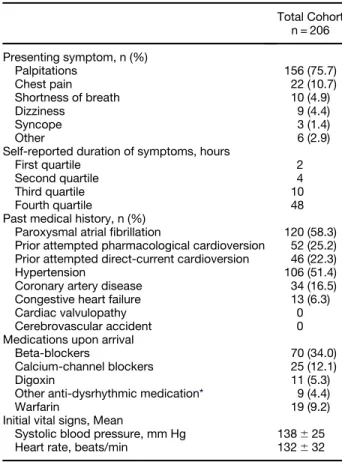
During the study period, 206 patients with presumed recent-onset atrial fibrillation (191; 92.7%) or atrial flutter (15; 7.3%) who met specific inclusion criteria were en-rolled in the study. Mean age of the total cohort was 64.06 14.4 years (range 21–96 years), and 83 (40.3%) patients were women. The most common presenting symptom was palpitations (156; 75.7%). Three-fourths of the cohort presented within 10 h of symptom onset. A history of prior episodes of paroxysmal atrial fibrillation was common (120; 58.3%) and a history of congestive heart failure was uncommon (13; 6.3%). Baseline charac-teristics and presenting symptoms are described inTable 1.
ED MANAGEMENT
Ventricular Rate Reduction Therapy Use and Success
Rate-reduction medications were administered to 129 (62.6%) patients at the discretion of the treating physi-cian. Of these, 20 patients did not have information docu-mented in their medical record about the degree of success of attempted rate reduction. Of the remaining 109 patients, 79 (72.4%) were judged to have successful ventricular rate reduction below 100 beats/min for a sus-tained period of time (the duration of which varied per treating physician and was not recorded). The medica-tions and their respective success rates are noted in Table 2.Table 3 reports the administration of IV rate-reduction medications stratified by management sub-group.
Spontaneous Cardioversion
Fifty-nine (28.6%) patients spontaneously converted to normal sinus rhythm during their ED stay, after their initial diagnostic ECG. Time from ED arrival to
spontaneous cardioversion was not measured, and in many cases may not have been measurable.
Attempted Cardioversion
Attempted cardioversion was undertaken for the unstable patients as well as a large portion of stable patients. No structured protocol was in place for determining which stable patients were candidates for attempted cardiover-sion in general or for determining which therapeutic ap-proach in particular was preferred (pharmacological or
direct-current electrical cardioversion). If one method failed, the other approach was frequently attempted in a sequential, two-step fashion.
One hundred fifteen (56.3%) patients underwent at-tempted cardioversion using direct-current, pharmaco-logic agents, or both (Figure 1). Reasons for attempting cardioversion in the ED included (more than one could be listed): infrequent symptomatic episodes of paroxys-mal atrial fibrillation (68; 59.1%), prior successful cardi-oversion (29; 25.2%), absence of relevant comorbidities (26; 22.6%), and clinical instability (6; 5.2%). Of this subpopulation, 110 (95.7%) participants were success-fully converted to normal sinus rhythm.
A total of 52 patients underwent attempted pharmaco-logical cardioversion. In 51 patients it was the initial cardio-version method employed. The pharmacologic agents and initial success rate included ibutilide (12/25 [48%]), pro-cainamide (16/23 [70%]), and amiodarone (3/4 [75%]).
Overall, 83 patients underwent attempted direct-current cardioversion with biphasic shock waveform, all with the aid of procedural sedation. For 65 patients, direct current was the initial cardioversion method employed, and for 18 patients, direct current was applied only after failed chemical cardioversion (Figure 1). Among these 83 patients, 80 (96%) experienced successful electrical car-dioversion. Synchronized direct-current cardioversion was attempted with only one shock in 65 (78%) patients, two shocks in 11 (13%) patients, three shocks in 2 (2%) patients, and four shocks in 5 (6%) patients. The sedation agents were as follows: propofol (46; 55%), etomidate (32; 39%), methohexital (4; 5%), and midazolam (1; 1%).
Hoped-for Cardioversion: Short-term Home Observation with Urgent Follow-up
Sixteen (7.8%) patients were managed with a short trial of home observation with an urgent follow-up for rhythm re-assessment. These patients generally had presented early after symptom onset but had not spontaneously cardio-verted. Issues of rate control were addressed if needed. As noted inTable 3, 11 of 16 patients received parenteral rate reduction medication in the ED. These same patients
Table 1. Clinical Characteristic of Emergency Department Patients with Recent-onset Atrial Fibrillation or Flutter Total Cohort n = 206 Presenting symptom, n (%) Palpitations 156 (75.7) Chest pain 22 (10.7) Shortness of breath 10 (4.9) Dizziness 9 (4.4) Syncope 3 (1.4) Other 6 (2.9)
Self-reported duration of symptoms, hours
First quartile 2
Second quartile 4
Third quartile 10
Fourth quartile 48
Past medical history, n (%)
Paroxysmal atrial fibrillation 120 (58.3) Prior attempted pharmacological cardioversion 52 (25.2) Prior attempted direct-current cardioversion 46 (22.3)
Hypertension 106 (51.4)
Coronary artery disease 34 (16.5) Congestive heart failure 13 (6.3)
Cardiac valvulopathy 0
Cerebrovascular accident 0
Medications upon arrival
Beta-blockers 70 (34.0)
Calcium-channel blockers 25 (12.1)
Digoxin 11 (5.3)
Other anti-dysrhythmic medication* 9 (4.4)
Warfarin 19 (9.2)
Initial vital signs, Mean
Systolic blood pressure, mm Hg 138625
Heart rate, beats/min 132632
* Includes amiodarone (n = 5), propafenone (n = 2), flecanide (n = 1), and quinidine (n = 1).
Table 2. Ventricular Rate-reduction Medications and their Success in Emergency Department Patients with Presumed Recent-onset Atrial Fibrillation/Flutter
Rate-reduction Medication Patients Receiving IV Rate-reduction Therapy n = 129 Degree of Success Documented in Chart n = 109 Successful Rate Reduction (Sustained Ventricular Reduction < 100 Beats/min) n = 79 n (%)
Calcium-channel blockade only 86 79 56 (71)
Beta-blockade only 28 19 15 (79)
Both agents 15 11 8 (73)
went home with a new or continued prescription for either calcium-channel blockers or beta-blockers. The aim of home observation was to allow more time for spontaneous conversion to occur. However, the maximal duration of home observation fell within 48 h from symptom onset, which is thought to be the time during which cardiover-sion may be attempted without the need for prolonged pre-conversion anticoagulation, as suggested by consensus-based guidelines (13). Generally, these pa-tients were scheduled for a return visit the very next day. This would allow sufficient time for attempted cardiover-sion within the 48-h window for those who might fail to spontaneously convert.
Eleven of these home observation patients were instructed to return directly to the ED, and 5 were arranged urgent follow-up in the clinic (3 in the Cardiology Clinic and 2 with their primary care provider)(14). All 16 pa-tients returned as directed and 11 (68.8%) were found to have spontaneously converted. The 5 patients who re-mained in atrial fibrillation were treated as follows: electrical direct-current cardioversion in the ED (n = 1; with success); admission to hospital for rate and symptom control (n = 1); initiation of outpatient warfarin therapy with rate control medications (n = 3).
When those managed with short-term home observa-tion were compared with the rest of the cohort, we noted that those managed with home observation had presented to the ED earlier in their symptom course (mean 3.0 h vs. 7.8 h; difference between means: 4.8 h; 95% CI 0.5–9.0;
p= 0.03).
Contraindicated Cardioversion: Participants Deemed Ineligible for Attempted ED Cardioversion
A total of 15 patients failed to spontaneously cardiovert in the ED and were deemed ineligible by the treating physi-cian for attempted ED cardioversion. The reasons listed by the treating physician for not attempting cardioversion (more than one reason could be noted) included frequent recurrences of atrial dysrhythmia (n = 14; 93.3%), rele-vant comorbidities or sedation risk (n = 9; 60.0%), and
prior failed cardioversion attempt (n = 2; 13.3%). The majority of these patients received IV rate reduction med-ication in the ED (Table 3) and was discharged home (Table 4) on rate-control medications and anticoagulation with arranged timely follow-up with their primary care provider or cardiologist(14). Because this group of pa-tients was thought to be ineligible for cardioversion, they were not advised to return to the ED within 48 h of symptom onset as in the ‘‘short-term home observation’’ group.
Unstable Patients
Overall, 8 (3.9%) patients with recent-onset atrial fibrilla-tion or flutter were considered clinically unstable, a desig-nation made at the discretion of the treating physician. All were cardioverted to sinus rhythm, 2 spontaneously and 6 in response to intervention. Five of the 8 were admitted and 3 were discharged home.
Use of Anticoagulation and Other Discharge Medications
Nineteen patients (9.2% of the overall cohort) were receiving warfarin therapy at presentation (Table 1),
Table 3. Ventricular Rate-reduction Medications Stratified by Treatment Groups of ED Patients with Recent-onset Atrial Fibrillation/Flutter
Patient Category Total n = 206
Administration of ED IV Rate-reduction Medications n (%) 129 (63) Spontaneous cardioversion 59 40 (68) Attempted cardioversion 115 66 (57) Home observation 16 13 (81)
Patients deemed ineligible for cardioversion
16 10 (63)
ED = emergency department; IV = intravenous.
Pharmacological Cardioversion as First Method 50/115 (43.4%) Direct-current Cardioversion as Second Method 18/20 (90.0%) Successful 30/50 (60.0%) Unsuccessful 20/50 (40.0%) Successful 16/18 (88.9%) Unsuccessful 2/18 (41.2%) Persistent Atrial Fibrillation (n = 2) Direct-current Cardioversion as First Method 65/115 (56.2%) Successful 63/65 (96.9%) Unsuccessful 2/65 (3.1%) Pharmacological Cardioversion as Second Method 1/2 (50.0%) Successful 1/1 (100.0%) Persistent Atrial Fibrillation (n = 1) Persistent Atrial Fibrillation (n = 2)
Figure 1. Methods and outcomes of cardioversion attempts in ED patients with recent-onset atrial fibrillation or flutter.
and an additional 15 (7.3%) were initiated on warfarin therapy in the ED. Overall, 34 (16.5%) patients were discharged from the ED with anticoagulation.
Other discharge medications included new prescrip-tions for beta-blockers (n = 16), calcium-channel blockers (n = 9), amiodarone (n = 4), propafenone (n = 2), and digoxin (n = 1).
Disposition
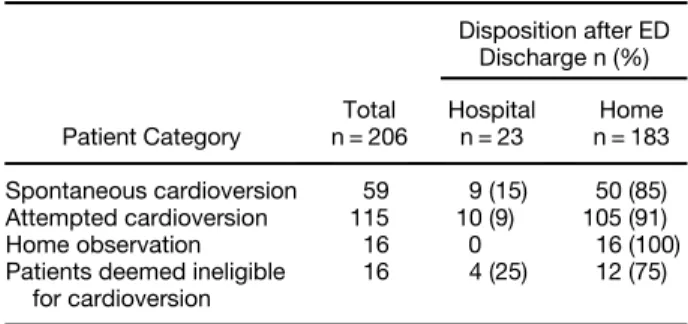
Overall, 183 (88.8% of the cohort) patients were dis-charged from the ED to home, and the distribution of disposition status varied by participant subgroup (Table 4). Admitting diagnoses were not recorded.
Emergency Department Adverse Events
Adverse events in the ED requiring interventions were re-ported in 6 (2.9%; 95% CI 1.1–6.2%) patients: vomiting (n = 1; secondary to procainamide), hypotension (n = 2; secondary to diltiazem), ventricular tachycardia (n = 2; secondary to cardioversion attempts), and hypoventilation (n = 1; secondary to procedural sedation). Four of these events occurred secondary to attempted cardioversion with procedural sedation (4/115; 2.6%). All six adverse events resolved in the ED without sequelae. Four patients with adverse events were discharged home after treatment and 2 were admitted for observation. No patients died in the ED or developed atrioventricular block, ventricular fibrillation, asystole, or torsades de pointes.
Thromboembolic Events within 30 Days
For the 30-day follow-up, the investigators undertook a structured review of the medical records (both hard-copy charts and electronic data) and attempted to contact all 206 patients. Two hundred four (99.0%) patients or their surrogates were contacted by phone at least 45 days after the index ED visit and were asked to participate in the follow-up arm of the study. Among these, 204 (100%) gave their informed consent at the time of the
telephone interview. The 2 patients whom we were not able to contact for follow-up, however, continued receiv-ing routine and episodic care with multiple documented visits within the Health Plan for at least 3 months beyond the 30-day endpoint. In neither case was a thromboem-bolic event noted to have occurred during the 30-day follow-up period. None of the 206 patients died during the 30-day follow-up period.
A thromboembolic event within 30 days of ED presen-tation was diagnosed in 2 (1.0%; 95% CI 0.1–3.5%) patients. Both cases involved cerebrovascular accidents with expressive aphasia that developed within 48 h of their index ED visit. Both patients had a prior history of atrial fibrillation and were not receiving anticoagulation at the time of the thromboembolic event, one due to prior hemorrhagic complications and the other due to persistent patient refusal. One patient was on flecanide and aspirin and requested electrical cardioversion in the ED, which was successful. She was discharged home in normal sinus rhythm and, at the recommendation of her cardiologist, was advised to increase her flecanide dose. She again was offered warfarin, but declined. The other patient pre-sented on a calcium-channel blocker, but as directed was not taking any kind of anti-thrombotic or anti-platelet medication. In the ED he was deemed a non-candidate for cardioversion. He underwent IV rate reduction and was discharged home in atrial fibrillation on his usual medications. An urgent follow-up appointment had been arranged with his primary care provider. Interestingly, after their strokes, both patients began warfarin therapy.
DISCUSSION
The optimal management of ED patients with symptom-atic atrial fibrillation that is of presumed recent onset (i.e.,#48 h) remains controversial. Issues of clinical sta-bility, symptom severity, perceived likelihood of sponta-neous conversion, reliability of timely follow-up after discharge, availability of cardioversion interventions, experience level of the treating physician, and patient preference can influence the clinical decision-making process. The management of ED patients with recent-onset atrial fibrillation and flutter varies widely, but can generally be organized into two broad approaches. The less aggressive and more conventional approach priori-tizes rate reduction over rhythm control. Clinically stable ED patients receive only rate reduction medication as in-dicated, whereas attempted cardioversion is frequently re-served for clinically unstable patients. A more aggressive approach expands the indications for attempted ED cardioversion to include hemodynamically stable eligible patients with recent-onset atrial fibrillation, especially those who are younger without structural heart disease (4,13,15,16). The arguments for pursuing aggressive
Table 4. Disposition upon ED Discharge of Patients with Recent-onset Atrial Fibrillation or Flutter
Disposition after ED Discharge n (%) Patient Category Total n = 206 Hospital n = 23 Home n = 183 Spontaneous cardioversion 59 9 (15) 50 (85) Attempted cardioversion 115 10 (9) 105 (91) Home observation 16 0 16 (100)
Patients deemed ineligible for cardioversion
16 4 (25) 12 (75)
cardioversion attempts to restore normal sinus rhythm include ventricular rate control without the need for long-term rate control agents, removing rhythm-related symptoms, improved hemodynamic measures and exer-cise capacity, and obviating the inconvenience, cost, and risk associated with long-term anticoagulation therapy. Moreover, the presence of atrial fibrillation itself can cause changes in atrial tissue electrophysiology that may promote the persistence of atrial fibrillation(17,18). Our study provides a contemporary assessment of a di-verse sample of patients with recent-onset atrial fibrilla-tion and flutter who presented at three community-based EDs within a large integrated health care delivery system and who received a variety of management strategies. In our practices, patients fell naturally into four mutually ex-clusive subgroups based on whether cardioversion was spontaneous, attempted, hoped for, or contraindicated.
The short-term home observation management ap-proach for atrial fibrillation/flutter patients who present early in their symptomatic course has been mentioned in the literature (sometimes called the ‘‘wait and watch’’ method), but it has not been well described(4). In our sam-ple, 11 of 16 patients (69%) managed with this approach spontaneously cardioverted to normal sinus rhythm within 48 h of symptom onset. Our findings are consistent with previous studies, which have reported that up to two-thirds of selected patients with presumed recent-onset atrial fibrillation spontaneously convert to normal sinus rhythm within 2–3 days (19,20). Whereas we allowed our patients to undergo their observation at home, others have admitted these patients into an observation unit within the hospital(21). Interestingly, 75% (154/206) of our total study population presented to the ED within 10 h of symptom onset. This might suggest that more of our patients may have been candidates for short-term home observation. One advantage of maximizing a pa-tient’s opportunity for spontaneous cardioversion is that it obviates the risks associated with labor- and time-intensive attempts at cardioversion.
A large proportion of our cohort underwent attempted cardioversion. Options for cardioversion include pharma-cological therapy, direct-current electrical therapy, or both (i.e., ‘‘two-step’’ sequence) (13,17). Although direct-current cardioversion has a higher immediate success rate than pharmacological interventions (97% vs. 60% for first attempts in our sample), it requires procedural sedation and analgesia, with its attendant risks, and increased personnel requirements and medical costs. The higher immediate effectiveness of direct-current cardio-version compared with pharmacological cardiocardio-version prompts some emergency physicians to start with electri-cal intervention in patients who are good candidates for procedural sedation(21). Others prefer to initiate pharma-cological therapy first and reserve electrical intervention
for patients who fail this initial approach. A sequential two-step model has become the standard approach for certain EDs (4,9,10,16,22). Using both approaches to cardioversion either individually or in sequence, we observed a 96% successful conversion rate overall.
Less than 3% of patients who underwent attempted car-dioversion had an adverse event in the ED that required in-tervention. The adverse events all readily resolved without sequelae during the patients’ stay in the ED. This low adverse event rate supports the safety of this approach.
Some have questioned the utility of rhythm control in patients with atrial fibrillation. Several large randomized clinical trials of older patients with persistent or paroxysmal atrial fibrillation have demonstrated that all-cause mortality and quality-of-life outcomes were not significantly different with long-term rate control com-pared with aggressive rhythm control using pharmacolog-ical and electrpharmacolog-ical cardioversion (23–29). Many older patients who present with recurrent or persistent minimally symptomatic atrial fibrillation often have significant cardiovascular comorbidities (e.g., congestive heart failure) and are successfully managed with long-term rate control and anticoagulation. In contrast, our study patients were younger, had relatively few serious co-morbid conditions, and presented with moderately to highly symptomatic atrial fibrillation or flutter. The 2006 American College of Cardiology (ACC) guidelines state that ‘‘restoration of sinus rhythm by cardioversion [with] antidysrhythmic drugs or non-pharmacological interven-tions still must be considered a useful therapeutic ap-proach,’’ especially for the ‘‘younger, symptomatic patients with little underlying heart disease.’’ These ACC guidelines stress the importance of not overlooking ‘‘a window of opportunity to maintain sinus rhythm.early
in the course of management of a patient with AF [atrial fi-brillation]’’ (13). As sensible as these recommendations are, it should be noted that they are primarily consensus-based rather than evidence-consensus-based guidelines.
One concern about undertaking elective ED cardiover-sion without anticoagulation is the potential for associated thromboembolic complications. This risk for thromboem-bolism is thought to influence management decisions of ED patients with symptomatic recent-onset atrial fibrilla-tion. We sought to quantify that risk. Although we found a very low incidence (1.0%) of embolic events within 30 days of ED management, our estimates are imprecise. However, our observed incidence of 30-day embolic events is consistent with other published studies. Weigner et al. measured the embolic incidence at 30 days among a group of 357 inpatients cardioverted within 48 h of atrial fibrillation onset without prior anticoagulation(30). Three patients (0.8%; 95% CI 0.2–2.4%) had a clinical thrombo-embolic event, each of whom had converted spontaneously
after receiving intravenous medications for ventricular rate control. None of these 3 patients had a history of atrial fibrillation or thromboembolism, and all had normal left ventricular systolic function. Similar findings have been reported in studies of ED patients undergoing attempted cardioversion for recent-onset atrial fibrillation, including those with 1-week follow-up and those with longer periods of post-cardioversion observation: 30 days in one study, 3 months in another, and a mean of 19 weeks in a third (4,5,7,8,10,31).
Recent consensus guidelines state that it is a safe option to forego prolonged anticoagulation before cardioversion attempts in patients with presumed atrial fibrillation < 48 h (32). One major caveat here is the presumptive nature of the clinical estimation of the duration of atrial fibrillation— without home monitoring, there must remain some element of uncertainty whether the dysrhythmia has really been present for < 48 h.
We did not obtain patient consent at the time of our pro-spective data collection. We contacted patients 45 days or more after their index ED visit to obtain their informed con-sent for the study and inquire about embolic complications. We were able to speak with the vast majority of the cohort (204 of 206). None of those we contacted failed to consent to the telephone interview. We found that ED patients do not object to receiving a telephone follow-up survey for an observational study to which they had not previously consented in person. This finding accords with other emer-gency medicine research on the topic(33–35).
Limitations
This study had several limitations. Patient enrollment employed convenience sampling, which may lead to potential selection bias. The number of patients with recent-onset atrial fibrillation or flutter who were not included in the study is not known. The outpatient medi-cation data capture was incomplete, as we did not record use of aspirin and clopidogrel. Even though we used two complementary approaches to identify thromboembolic events, we cannot exclude the possibility of missed events, although we believe the likelihood was very low. Our estimate of 30-day embolic rates lacks precision, given our modest sample size. Given that the participating EDs function within a single integrated health care deliv-ery system in Northern California, data about practice patterns may not be generalizable to other settings and patient populations.
CONCLUSIONS
In sum, we provide an assessment of patient characteris-tics, management, and relevant clinical outcomes among a cohort of adults presenting to three community EDs
with symptomatic, presumed recent-onset atrial fibrilla-tion or flutter. Our management taxonomy is based on whether cardioversion was spontaneous, attempted, hoped for, or contraindicated. Our success rate of attempted car-dioversion was quite high. Rates of adverse events in the ED and hospitalizations were low, and observed thrombo-embolic events within 30 days were uncommon. Overall, our approach to ED patients with presumed recent-onset atrial fibrillation or flutter seems to be safe and effective.
Acknowledgments—The authors thank Dr. John Burton, Albany Medical Center, and Dr. Alan Go, The Permanente Medical Group, for their constructive review of the manuscript. We also extend our appreciation to the busy emergency physicians of the participating Kaiser Permanente EDs, who assisted with patient enrollment and data collection.
REFERENCES
1. Khoo CW, Lip GY. Burden of atrial fibrillation. Curr Med Res Opin 2009;25:1261–3.
2. Go AS. The epidemiology of atrial fibrillation in elderly persons: the tip of the iceberg. Am J Geriatr Cardiol 2005;14:56–61. 3. McDonald AJ, Pelletier AJ, Ellinor PT, Camargo CA Jr. Increasing
US emergency department visit rates and subsequent hospital ad-missions for atrial fibrillation from 1993 to 2004. Ann Emerg Med 2008;51:58–65.
4. Stiell IG, Clement CM, Symington C, Perry JJ, Vaillancourt C, Wells GA. Emergency department use of intravenous procainamide for patients with acute atrial fibrillation or flutter. Acad Emerg Med 2007;14:1158–64.
5. Lo GK, Fatovich DM, Haig AD. Biphasic cardioversion of acute atrial fibrillation in the emergency department. Emerg Med J 2006; 23:51–3.
6. del Arco C, Martı´n A, Laguna P, Gargantilla P. Analysis of current management of atrial fibrillation in the acute setting: GEFAUR-1 study. Ann Emerg Med 2005;46:424–30.
7. Jacoby JL, Cesta M, Heller MB, Salen P, Reed J. Synchronized emergency department cardioversion of atrial dysrhythmias saves time, money and resources. J Emerg Med 2005;28:27–30. 8. Burton JH, Vinson DR, Drummond K, Strout TD, Thode HC,
McInturff JJ. Direct-current cardioversion of emergency depart-ment patients with atrial fibrillation. Ann Emerg Med 2004;44: 20–30.
9. Domanovits H, Schillinger M, Thoennissen J, et al. Termination of recent-onset atrial fibrillation/flutter in the emergency department: a sequential approach with intravenous ibutilide and external direct-current cardioversion. Resuscitation 2000;45:181–7. 10. Michael JA, Stiell IG, Agarwal S, et al. Cardioversion of
paroxys-mal atrial fibrillation in the emergency department. Ann Emerg Med 1999;33:379–87.
11. Bhatt M, Kennedy RM, Osmond MH, et al. Consensus Panel on Sedation Research of Pediatric Emergency Research Canada (PERC) and the Pediatric Emergency Care Applied Research Network (PECARN). Consensus-based recommendations for stan-dardizing terminology and reporting adverse events for emergency department procedural sedation and analgesia in children. Ann Emerg Med 2009;53:426–35:e4.
12. Berger M, Schweitzer P. Timing of thromboembolic events after direct-current cardioversion of atrial fibrillation or flutter: a retro-spective analysis. Am J Cardiol 1998;82:1545–7.
13. Fuster V, Ryde´n LE, Cannom DS, et al. ACC/AHA/ESC 2006 guidelines for the management of patients with atrial fibrillation: a report of the American College of Cardiology/American Heart As-sociation Task Force on Practice Guidelines and the European So-ciety of Cardiology Committee for Practice Guidelines (Writing
Committee to Revise the 2001 Guidelines for the Management of Patients With Atrial Fibrillation). Circulation 2006;114:e257–354. 14. Vinson DR, Patel PB. Facilitating follow-up after emergency care using an appointment assignment system. J Healthc Qual 2009; 31:18–24.
15. Khoo CW, Lip GY. Acute management of atrial fibrillation. Chest 2009;135:849–59.
16. Stiell IG, Clement CM, Perry JJ, et al. Association of the Ottawa Aggressive Protocol with rapid discharge of emergency department patients with recent-onset atrial fibrillation or flutter. CJEM 2010; 12:181–91.
17. Lip GY, Tse HF. Management of atrial fibrillation. Lancet 2007; 370:604–18.
18. Wijffels MC, Kirchhof CJ, Dorland R, Allessie MA. Atrial fibrilla-tion begets atrial fibrillafibrilla-tion. A study in awake chronically instru-mented goats. Circulation 1995;92:1954–68.
19. Cotter G, Blatt A, Kaluski E, et al. Conversion of recent onset par-oxysmal atrial fibrillation to normal sinus rhythm: the effect of no treatment and high-dose amiodarone. A randomized, placebo-controlled study. Eur Heart J 1999;20:1833–42.
20. Danias PG, Caulfield TA, Weigner MJ, Silverman DI, Manning WJ. Likelihood of spontaneous conversion of atrial fibrillation to sinus rhythm. J Am Coll Cardiol 1998;31:588–92.
21. Decker WW, Smars PA, Vaidyanathan L, et al. A prospective, randomized trial of an emergency department observation unit for acute onset atrial fibrillation. Ann Emerg Med 2008;52: 322–8.
22. Koenig BO, Ross MA, Jackson RE. An emergency department ob-servation unit protocol for acute-onset atrial fibrillation is feasible. Ann Emerg Med 2002;39:374–81.
23. Roy D, Talajic M, Nattel S, et al. Atrial Fibrillation and Congestive Heart Failure Investigators. Rhythm control versus rate control for atrial fibrillation and heart failure. N Engl J Med 2008;358: 2667–77.
24. Opolski G, Torbicki A, Kosior D, et al. Rhythm control versus rate control in patients with persistent atrial fibrillation. Results of the HOT CAFE Polish Study. Kardiol Pol 2003;59:1–16.
25. Carlsson J, Miketic S, Windeler J, et al. Randomized trial of rate-control versus rhythm-rate-control in persistent atrial fibrillation: the
Strategies of Treatment of Atrial Fibrillation (STAF) study. J Am Coll Cardiol 2003;41:1690–6.
26. Wyse DG, Waldo AL, DiMarco JP, et al. A comparison of rate con-trol and rhythm concon-trol in patients with atrial fibrillation. N Engl J Med 2002;347:1825–33.
27. Van Gelder IC, Hagens VE, Bosker HA, et al. A comparison of rate control and rhythm control in patients with recurrent persistent atrial fibrillation. N Engl J Med 2002;347:1834–40.
28. Hohnloser SH, Kuck KH. Randomized trial of rhythm or rate con-trol in atrial fibrillation: the Pharmacological Intervention in Atrial Fibrillation Trial (PIAF). Eur Heart J 2001;22:801–2.
29. Gro¨nefeld GC, Lilienthal J, Kuck KH, Hohnloser SH. Pharmacolog-ical Intervention in Atrial Fibrillation (PIAF) Study investigators. Impact of rate versus rhythm control on quality of life in patients with persistent atrial fibrillation. Results from a prospective ran-domized study. Eur Heart J 2003;24:1430–6.
30. Weigner MJ, Caulfield TA, Danias PG, et al. Risk for clinical throm-boembolism associated with conversion to sinus rhythm in patients with atrial fibrillation lasting less than 48 hours. Ann Intern Med 1997;126:615–20.
31. Xavier Scheuermeyer F, Grafstein E, Stenstrom R, Innes G, Poureslami I, Sighary M. Thirty-day outcomes of emergency department patients undergoing electrical cardioversion for atrial fibrillation or flutter. Acad Emerg Med 2010;17:408–15. 32. Singer DE, Albers GW, Dalen JE, et al. American College of Chest
Physicians. Antithrombotic therapy in atrial fibrillation: American College of Chest Physicians Evidence-Based Clinical Practice Guidelines (8th Edition). Chest 2008;133(6 Suppl):546S–92S. 33. Vinson DR, Bradbury DR. Etomidate for procedural sedation in
emergency medicine. Ann Emerg Med 2002;39:592–8.
34. Campbell SG, McCarvill EM, Magee KD, Cajee I, Crawford M. The consent and prescription compliance (COPRECO) study: does obtaining consent in the emergency department affect study results in a telephone follow-up study of medication compliance? Acad Emerg Med 2008;15:932–8.
35. Offerman SR, Nishijima D, Ballard D, Chettipally U, Vinson DR, Holmes JF Jr. The use of delayed telephone informed consent for observational emergency medicine research is ethical and effective. Acad Emer Med 2010;17:S139–40, abstract 407.
ARTICLE SUMMARY
1. Why is this topic important?
Recent-onset atrial fibrillation is common in emergency medicine practice, yet the therapeutic approaches and patient disposition are not standardized and vary widely. For the subset of patients who un-dergo elective cardioversion in the emergency department (ED), there still exists some concern over the near-term risk of thromboembolic events.
2. What does this study attempt to show?
This study prospectively examined how a group of community EDs manages patients with recent-onset atrial fibrillation. The inves-tigators also determined the adverse event rate in the ED as well as the 30-day incidence of thromboembolic events.
3. What are the key findings?
Attempted electrical or pharmacological cardioversion in the ED was performed with a high rate of success. The great majority of the remaining patients either converted spontaneously in the ED or within the next day without intervention. The complication rate in the ED and within 30 days of discharge was very low.
4. How is patient care impacted?
Clinicians may be able to tailor their therapy for recent-onset atrial fibrillation to the individual patient, taking into account their particu-lar circumstances and preferences. Although attempted cardioversion is a highly successful strategy, a brief period of home observation may also be reasonable. All approaches seem to be associated with a low incidence of short-term thromboembolic events.