Efficient Security Mechanisms for Routing Protocols
Yih-Chun Hu
Carnegie Mellon University
[email protected]
Adrian Perrig
Carnegie Mellon University
[email protected]
David B. Johnson
Rice University
[email protected]
Abstract
As our economy and critical infrastructure increasingly rely on the Internet, securing routing protocols becomes of critical impor-tance. In this paper, we present four new mechanisms as tools for securing distance vector and path vector routing protocols. For securing distance vector protocols, our hash tree chain mecha-nism forces a router to increase the distance (metric) when for-warding a routing table entry. To provide authentication of a re-ceived routing update in bounded time, we present a new mecha-nism, similar to hash chains, that we calltree-authenticated one-way chains. For cases in which the maximum metric is large, we presentskiplists, which provides more efficient initial computa-tion cost and more efficient element verificacomputa-tion; this mechanism is based on a new cryptographic mechanism, called MW-chains, which we also present. For securing path vector protocols, our cu-mulative authenticationmechanism authenticates the list of routers on the path in a routing update, preventing removal or reordering of the router addresses in the list; the mechanism uses only a sin-gle authenticator in the routing update rather than one per router address. We also present a simple mechanism to securely switch one-way chains, by authenticating the next one-way chain using the previous one. These mechanisms are all based on efficient symmetriccryptographic techniques and can be used as building blocks for securing routing protocols.
1. Introduction
Routing protocols are difficult to efficiently secure. An attacker may, for example, attempt to inject forged routing messages into the system, or may attempt to modify legit-imate routing messages sent by other nodes. An attacker may also attempt to exploit mechanisms in the routing pro-tocol, such as those intended to quickly spread new routing information, to instead consume large amounts of network and router resources. Even the addition of cryptographic mechanisms to a routing protocol may make the protocol This work was supported in part by NSF under grant CCR-0209204, by NASA under grant NAG3-2534, and by gifts from Schlumberger and Bosch. The views and conclusions contained here are those of the au-thors and should not be interpreted as necessarily representing the offi-cial policies or endorsements, either express or implied, of NSF, NASA, Schlumberger, Bosch, Rice University, Carnegie Mellon University, or the U.S. Government or any of its agencies.
vulnerable to such attacks, since traditional security mech-anisms are generally expensive in terms of CPU time; an attacker may be able to cripple several routers simply by flooding each router with large numbers of randomly gen-erated, forged routing messages, which then must be au-thenticated and rejected by the router, leading to a denial of service by consuming all router CPU time.
Current routing protocols in use in the Internet today, such as the Border Gateway Protocol (BGP) [36] or the Routing Information Protocol (RIP) [23], were originally designed to operate in a trusted environment, assuming no malicious nodes. However, with the growing importance and usage of the Internet, an increasing number of corpo-rations and public services are becoming dependent on the correct functioning of the Internet, and routing protocol se-curity has become a significant issue. The command and control of critical infrastructures (such as the control of the power grid) and the emerging use of the Internet to carry voice traffic are two examples of this trend. The importance of securing Internet routing has also been illustrated by re-cent BGP misconfigurations [22], in which non-malicious BGP speakers have been able to disrupt Internet routing as a result of incorrect configuration.
Several researchers have proposed secure network rout-ing protocols, but most have used standard digital signatures to authenticate routing update messages [18, 19, 20, 32, 38, 39, 40]. Similarly, in the area of secure multihop wireless
ad hoc networkrouting, most researchers use standard dig-ital signatures to authenticate routing messages [5, 41, 43]. Unfortunately, generation and verification of digital signa-tures is relatively inefficient, and it is thus challenging to design a scalable, efficient, and viable secure routing proto-col based on suchasymmetriccryptography.
Symmetriccryptographic primitives are much more ef-ficient than asymmetric primitives, but so far, few security mechanisms based on symmetric cryptography have been designed for the requirements of routing protocols. We now discuss the exceptions of which we are aware.
Three mechanisms based on symmetric cryptography have been proposed to secure link state routing updates. Cheung [2] presents an efficient time-based authentication protocol to authenticate link state routing updates. The
proposed authentication is optimistic, though, and routers use the routing update before it is authenticated. Hauser, Przygienda, and Tsudik [10] propose to use efficient one-way hash chains to authenticate link state routing up-dates. Zhang [42] subsequently improves their mechanism and presents a chained Merkle-Winternitz one-time signa-ture [27, 26], similar to our basic MW chains scheme that we present in Section 4.6, although our technique is more space-efficient.
Heffernan [12] assumes that neighboring routers share secret keys, and routers use MD5 to authenticate each other’s messages. This approach allows BGP to protect itself against the introduction of spoofed TCP segments into the connection stream (TCP resets are of particular concern).
Basagni et al. [1] present a protocol with a network-wide shared key for use in routing, purely based on symmet-ric cryptography. However, their approach assumes secure hardware to protect the key.
We have previously developed two efficient secure rout-ing protocols based on symmetric cryptography. Our SEAD protocol [13] introduces a new efficient mechanism, based on one-way hash chains, to secure distance vector routing updates. Our Ariadne routing protocol [14] is a secure on-demand ad hoc network routing protocol using source routing.
In this paper, we present four new security mechanisms based on efficientsymmetriccryptographic techniques, that can be applied to strengthen current distance vector and path vector routing protocols or can be incorporated into the de-sign of new secure routing protocols. For securing distance vector protocols, ourhash tree chainmechanism forces a router to increase the distance (metric) when forwarding a routing table entry. To provide authentication of a received routing update in bounded time, we present a new mecha-nism, similar to hash chains, that we calltree-authenticated one-way chains. For cases in which the maximum metric is large, we presentskiplists, which provides more efficient initial computation cost and more efficient element verifi-cation; this mechanism is based on a new cryptographic mechanism, called MW-chains, which we also present. For securing path vector protocols, ourcumulative authentica-tionmechanism authenticates the list of routers on the path in a routing update, preventing removal or reordering of the router addresses in the list; the mechanism uses only a sin-gle authenticator in the routing update rather than one per router address. We also present a simple mechanism to se-curely switch one-way chains, by authenticating the next one-way chain using the previous one.
In Section 2 of this paper, we discuss the assumptions underlying our secure mechanisms. Section 3 describes the basic cryptographic mechanisms that we use. Section 4 describes our new mechanisms for improving security in
distance vector protocols, and Section 5 presents our new mechanisms for building efficient and secure path vector routing protocols. Finally, we present our conclusions in Section 6.
2. Assumptions
In designing our mechanisms to build secure routing proto-cols, we make the following assumptions on node capability and key setup.
2.1. Node Assumptions
The computational resources of network nodes vary greatly, from a high-end Internet backbone router to a tiny ad hoc network node. To make our results as general as possi-ble, we design our mechanisms to be extremely lightweight and efficient. This allows our mechanisms to be used on resource-constrained ad hoc network nodes and enables large Internet routers to scale to high bandwidth links. In particular, we design our mechanisms from purely symmet-riccryptographic functions, such as message authentication codes (MACs) or cryptographic hash functions. In contrast, mechanisms based on asymmetric cryptography are often 3 to 4 orders of magnitude slower than hash functions.
Most previous work on secure Internet and ad hoc network routing relies on asymmetric cryptography [18, 20, 32, 38, 39, 40]. However, computing such signatures on resource-constrained nodes is expensive, and such high overhead computations may hinder the routing protocol’s scalability to large networks.
We do not assume trusted hardware such as tamperproof modules. Secure routing with trusted hardware is much simpler, since node compromise is assumed to be impos-sible.
2.2. Security Assumptions and Key Setup
We assume a mechanism that enables the secure and authen-tic distribution of keying material. Most of our mechanisms require the distribution of authentic public values to enable authentication of subsequent values. However, the cumula-tive authentication mechanism assumes pairwise shared se-cret keys, or authentic public keys of other nodes if a broad-cast authentication system such as TESLA [34, 35] is used. Digital signatures and a public-key infrastructure may be used to set up the authenticated public values, as well as to establish pairwise shared secret keys if used in conjunction with a key agreement protocol such as Diffie-Hellman [6].
We assume protection against the immediate replay of routing packets. In a wired network or a static wireless network, each router can be configured with a list of possi-ble neighbors; a router that receives an update from a node not on this list can silently discard that update. In mobile
PSfrag replacements
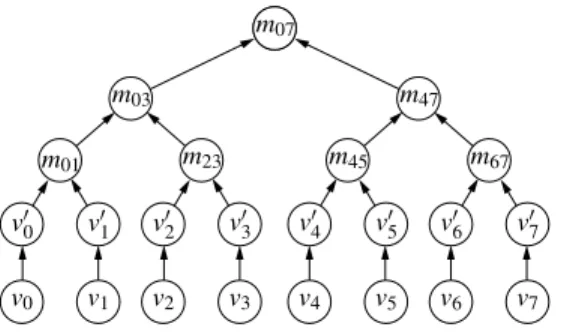
v0 v1 v2 v3 v4 v5 v6 v7 v0 0 v01 v02 v03 v04 v05 v06 v07 m01 m23 m03 m45 m67 m47 m07Figure 1: Tree authenticated values
wireless networks, such as ad hoc networks, we have de-veloped packet leasheswhich restrict such immediate re-play [15]. In this paper, we assume that one of these mech-anisms is used.
3. Cryptographic Mechanisms
In this section, we review the basic cryptographic mech-anisms that we use in this work. We first review tree-authenticated values, also known as Merkle hash trees [25]. We also review one-way hash chains, a frequently used cryptographic primitive.
3.1. Tree-Authenticated Values
The mechanism of tree-authenticated values is an effi-cient hash tree authentication mechanism, first presented by Merkle and also known as Merkle hash trees [25]. To au-thenticate valuesv0,v1, . . . ,vw−1, we place these values at
the leaf nodes of a binary tree. (For simplicity we assume a balanced binary tree, sow is a power of two.) We first blind all thevi values with a one-way hash functionH to prevent disclosing neighboring values in the authentication information (as we describe below), sov0
i=H[vi]. We then use the Merkle hash tree construction to commit to the val-uesv0
0, . . . ,v0w−1. Each internal node of the binary tree is
derived from its two child nodes. Consider the derivation of some parent nodempfrom its left and right child nodesml andmr:mp=H[ml ||mr], where||denotes concatenation. We compute the levels of the tree recursively from the leaf nodes to the root node. Figure 1 shows this construction over the eight valuesv0,v1, . . . ,v7, e.g.,m01=H(v00||v01), m03=H[m01||m23].
The root value of the tree is used to commit to the en-tire tree, and in conjunction with additional information, it can be used to authenticate any leaf value. To authenticate a valuevithe sender disclosesi,vi, and all the sibling nodes of the nodes on the path fromvito the root node. The receiver can then use these nodes to verify the path up to the root, which authenticates the valuevi. For example, if a sender wants to authenticate keyv2in Figure 1, it includes the
val-uesv0
3,m01,m47in the packet. A receiver with an authentic
root valuem07can then verify that H
H
m01||HH[v2]||v03||m47
equals the stored root valuem07. If the verification is
suc-cessful, the receiver knows thatv2is authentic.
The extrav0
0,v01, . . . ,v07in Figure 1 are added to the tree
to avoid disclosing (in this example) the valuev3 for the
authentication ofv2.
3.2. One-Way Hash Chains
One-way hash chains, or simplyone-way chains, are a fre-quently used cryptographic primitive in the design of secure protocols. We create a one-way chain by selecting the final value at random, and repeatedly apply a one-way hash func-tionH. (In our description, we discuss the one-way chain from the viewpoint of usage, so the first value of the chain is the last value generated, and the initially randomly chosen value is the last value of the chain used.) One-way chains have two main properties (assumingH is a cryptographi-cally secure one-way hash function):
• Anybody can authenticate that a value vj really be-longs to the one-way chain, by using an earlier value
viof the chain and checking thatHj−i(vj)equalsvi.
• Given the latest released valueviof a one-way chain, an adversary cannot find a later value vj such that Hj−i(vj)equalsv
i. Even when valuevi+1is released,
asecond pre-image collision resistant hash function
prevents an adversary from findingv0
i+1different from vi+1such thatH[vi+1]equalsvi.
These two properties result in authentication of one-way chain values: if the current valuevibelongs to the one-way chain, and we see another valuevj with the property that Hj−i(vj) equalsvi, thenvj also originates from the same chain and was released by the creator of the chain.
Jakobsson [16] and Coppersmith and Jakobsson [3] pro-pose a storage-efficient mechanism for one-way chains, such that a one-way chain withN elements requires only
O(log(N))storage andO(log(N))computation to access an element.
4. Mechanisms for Securing
Distance Vector Protocols
In this section, we first review distance vector routing pro-tocols, and then discuss attacks, previous work on securing distance vector routing, and the remaining research chal-lenges. We then present new mechanisms to address these challenges.
The utility of the mechanisms we present is not limited to routing protocols. In particular, theskiplistsmechanism
we present in Section 4.7 allows highly efficient genera-tion and verificagenera-tion of elements in long hash chains, giving a constant factor speedup in both generation and verifica-tion. Skiplists are thus particularly useful for protocols that use long one-way hash chains, such as TESLA [34, 35] or BiBa [33].
4.1. Overview of Distance Vector Routing
Adistance vectorrouting protocol finds shortest paths be-tween nodes in the network through a distributed implemen-tation of the classical Bellman-Ford algorithm. Distance vector protocols are easy to implement and are efficient in terms of memory and CPU processing capacity required at each node. A popular example of a distance vector rout-ing protocol is RIP [11, 23], which is widely used in IP networks of moderate size. Distance vector routing can also be used for routing within a multihop wireless ad hoc network by having each node in the network act as a router and participate in the routing protocol [17, 30, 31].
In distance vector routing, each router maintains a rout-ing table listrout-ing all possible destinations within the network. Each entry in a node’s routing table contains the address (identity) of some destination, this node’s shortest known distance (usually in number of hops) to that destination, and the address of this node’s neighbor router that is the first hop on this shortest route to that destination; the distance to the destination is known as themetricin that table entry. When routing a packet to some destination, the node transmits the packet to the indicated neighbor router for that destination, and each router in turn uses its own routing table to forward the packet along its next hop toward the destination.
To maintain the routing tables, each node periodically transmits a routing update to to each of its neighbor routers, containing the information from its own routing table. Each node uses this information advertised by its neighbors to up-date its own table, so that its route for each destination uses as a next hop the neighbor that claimed the shortest distance to that destination; the node sets the metric in its table entry for that destination to 1 (hop) more than the metric in that neighbor’s update.
4.2. Attacks to Distance Vector Routing
Without security mechanisms, a distance vector routing pro-tocol may be vulnerable to a number of attacks from mali-cious routers. For example, a malimali-cious router could per-form the following types of attacks [8, 14, 18, 20, 21, 28, 38, 40]:
• Try to attract as much traffic as possible by adver-tising short distances to all destinations. This attack is sometimes referred to as a blackhole attack [14]. The blackhole attack is quite powerful, because the malicious router can control any communication that passes through it. The router can eavesdrop on data,
selectively drop or alter packets, or inject packets. Otherwise eavesdropping on a specific target may be challenging in in today’s Internet, as one would need to access the network link to the target, but by claim-ing a short distance to the target, a malicious router can attract the target’s traffic.
• Try to claim longer distances. This attack results in
less traffic flowing across the attacking router, poten-tially allowing the attacker to obtain network services without (for example, in the case of a multihop wire-less ad hoc network) using its own network band-width and battery power to forward packets from other nodes. We do not attempt to prevent this attack, since it is weaker than a malicious router arbitrarily discard-ing, delaydiscard-ing, or reordering packets sent to it for for-warding.
• Inject routing loops. This is a powerful attack if the
resulting routing loop does not go through the mali-cious router, since a single packet sent along that loop can cause the packet to be forwarded a large number of times. However, if the routing loop goes through a malicious router, this attack is equivalent to a data flooding attack: for example, if an attacker forms a loop from itself through routersn1,n2, . . . ,nxand back to itself, then each time it forwards the packet around the loop, it is equivalent to sending a packet traversing
xrouters.
• Inject a large number of route updates, to consume network bandwidth and router processing time. Most of these attacks are forms of denial-of-service attacks, either consuming network resources or preventing packet delivery. Of these attacks, the most powerful attacks are the blackhole attack and the routing loop attack (when the attacker is not in the loop). As a result, we aim to pre-vent a malicious router from claiming a shorter distance to a target than it actually has, and to prevent a loop from form-ing such that an attacker is not in the loop.
4.3. Overview of Previous Work on Securing Distance Vector Routing and the Remaining Challenges
We briefly reviewed previous work on secure routing in Section 1. SEAD is a recent secure distance vector routing protocol we designed, that is particularly efficient because it uses one-way hash chains and no asymmetric cryptogra-phy. We briefly overview SEAD and discuss the remaining research challenges.
SEAD, the Secure Efficient Ad hoc Distance vector rout-ing protocol [13], is based on based on DSDV [30], and we secure SEAD using hash chains. As in other distance vec-tor protocols such as RIP [11, 23], SEAD requires some limit on hop count (metric), denoted as k−1. A
dis-tance vector update originated from a node in SEAD con-tains a sequence number and a metric for each
destina-PSfrag replacements
v15 v14 v13 v12 v11
v10 v9 v8 v7 v6
v5 v4 v3 v2 v1 v0
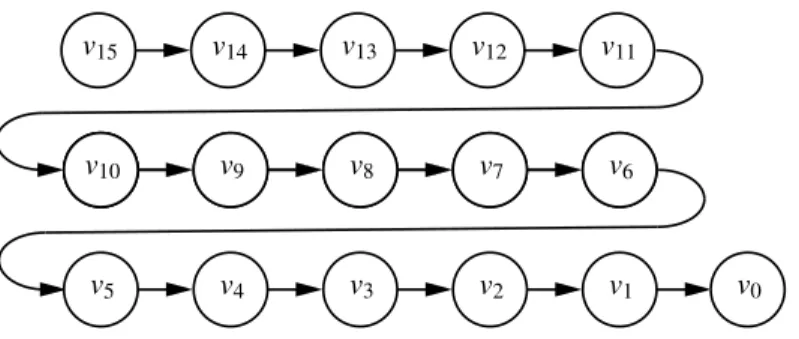
Figure 2: An example of a SEAD hash chain, withk=5andn=3. Arrows show the direction of hash chain generation; hash chain usage proceeds in the opposite direction.
tion. The sequence number is used to indicate the fresh-ness of each route update. The metric is the distance, measured in number of hops, from the originating node to the destination. When a node receives a route update, for each entry in the route update, it accepts the entry if the entry has a higher sequence number, or if the entry has equal sequence number and a lower metric than the route entry currently in the node’s route table for that des-tination. In order to prevent attacks on the route updates, the sequence number and metric must both be authenti-cated.
SEAD authenticates the sequence numbers and met-rics in route updates using one-way hash chains. As out-lined in Section 4.2, we are mainly concerned about the authenticity of a route update, and that a node cannot make a route shorter (in order to prevent the blackhole attack). To initialize, each nodeN forms a one-way hash chainvkn,vkn−1, . . . ,v0, withvi−1=H[vi], as we describe in
Section 3.2, wherek−1 is the maximum hop count, andn
is the maximum sequence number this hash chain allows. These values are used to authenticate routing update entries that specify this nodeNas a destination. To allow values
vkn,vkn−1, . . . ,v1to be authenticated, an authenticv0is
pub-lished as an authenticated seed value for the node N, for example by a Certificate Authority. The value vki+j will be used to authenticate a route update entry with sequence numberiand metrick−jfor the nodeN as a destination when 1≤j≤k.
For example, a hash chain for a nodeN is depicted in Figure 2, wherek=5 andn=3. To initialize, v0is
pub-lished as an authenticated seed value for nodeN. To start the first route update for entries withNas the destination, the nodeN first sendsv5as an authenticator for sequence
number 0 and metric 0. A recipient would first authenticate
v5using the public authenticated valuev0, and then compute v4fromv5; the node would then advertise sequence number
0 and metric 1 using authenticatorv4. Similarly, recipients
of that update would advertise sequence number 0 metric 2 using authenticatorv3, and so forth. The next time the node Nstarts route updates for entries withNas the destination,
it would disclosev10to authenticate sequence number 1 and
metric 0.
Because of the properties of a one-way hash chain, a node cannot forge a routing update with higher sequence number, nor can it forge a routing update with an equal sequence number and lower metric. Larger sequence numbers take precedence over smaller ones, so nodes would simply drop updates with smaller sequence numbers, even if the metric is lower.
Since a node selects the next-hop router towards a des-tination to be the source address of the routing update with the shortest distance it receives, the source address of each routing update must be authenticated. This authentication can be achieved with a signature, broadcast authentication, or pairwise shared keys. SEAD specifies the use of pair-wise shared keys, which exploits the periodic nature of the protocol. When two nodesAandBmove within range, one of the two nodes (for example,A) will hear an update sent by the other (B). That nodeAcan begin including in each of its updates symmetric authentication to the new neigh-borB. Conversely, whenBhears one ofA’s updates, it will respond by including inB’s updates symmetric authentica-tion to its new neighborA. When the two nodes move away from each other such that they are no longer neighbors, their routing tables will reflect that. For example, whenAandB
move apart,A’s routing table will show thatBis no longer a neighbor, as an update with a fresh sequence number will override an older update received directly fromB. Acan then stop including in its routing updates symmetric authen-tication to nodeB.
Although SEAD does prevent a number of attacks, some attacks and shortcomings remain:
• SEAD does not prevent same-distance fraud: that
is, a node receiving an advertisement for sequence numbersand distance (metric)dcan re-advertise the same sequence numbersand distanced. Section 4.4 presents an approach that prevents this same-distance fraud.
• Another drawback of SEAD is that an attacker can
O(ks), wherekis the maximum number of hops and
sis the maximum number of sequence numbers rep-resented by a hash chain. Section 4.5 describes the tree-authenticated one-way chains mechanism, which bounds this effort byO(k+lgs). The same scheme prevents the sequence number rushing attack, which we present in Section 4.5.
• The overhead to verify authentication values can be large if a node has missed several routing updates. An attacker can exploit this overhead to perform a denial-of-service attack by sending bogus routing up-dates, forcing a node to spend considerable effort ver-ifying the authenticity. In Section 4.6, we introduce a novel authentication scheme that is a hybrid between a one-way chain and a one-time signature which we call an MW-chain. Based on the MW-chain, we intro-duce in Section 4.7 a one-way chain that is very effi-cient to verify in case of missed routing updates. In a network with maximum diameterk, this approach re-duces the verification overhead toO(c√ck+lgs)for ar-bitrary positive integersc. Finally, we reduce the over-head of setting up a single hash chain fromO(ks)to
O(s).
We now discuss mechanisms that can solve these remain-ing challenges. Our mechanisms can be generalized to se-cure many other distance vector protocols.
4.4. Hash Tree Chains for Preventing Same-Distance Fraud
We present an alternative calledhash tree chainsto one-way hash chains for authenticating the distance metric in dis-tance vector protocols, to prevent the same-disdis-tance fraud attack introduced above. Our new mechanism forces a node to increase the distance to the destination when sending a routing update. As noted in Section 2, we use packet leashes [15] to prevent an adversary from replaying a rout-ing update in wireless networks, so that the adversary would be a “stealth node” on that route. The packet leash also pro-vides hop-by-hop authentication, preventing an adversary from impersonating another node.
To prevent same-distance fraud, we need to prevent an attacker from replaying the same hash value (thus without increasing the metric) but replacing the node id with the attacker’s node id. We construct a special one-way chain, which we call a hash tree chain, where each element of the chain encodes the node id, thus forcing a node to increase the distance metric if it wants to encode its own id. Each step in this one-way chain contains a collection of values, one or more of which are used to authenticate any partic-ular node. These values are authenticated using a Merkle tree, and the root of that Merkle tree is used to generate the collection of values in the next step.
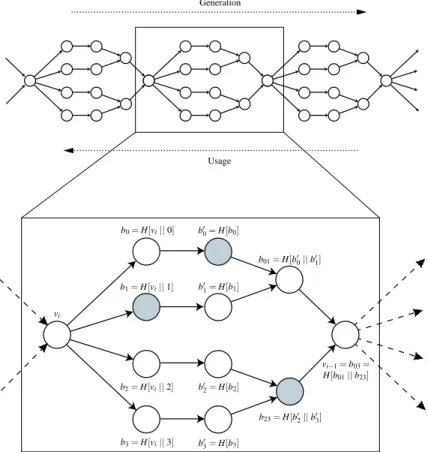
A hash tree chain is a hybrid between a hash tree and a one-way chain. The one-way chain property is used in the same way as in SEAD (to enforce that nodes cannot decrease the distance metric), and the hash tree property is used to authenticate the node id. We construct the hash tree between each pairvi−1,vi of one-way chain values as fol-lows. From the valuevi, we derive a set of valuesb0, . . . ,bn, using a one-way hash functionHasbj=H[vi|| j], for each j. We then build a hash tree above those values as described in Section 3.1. The root of the tree becomes the previous value of the one-way chainvi−1=b0n. Figure 3 shows an example. The node with the id 1 forwards the shaded val-ues b0
0, b1, and b23 to the neighboring nodes, which can
compute the one-way hash tree chain forward to verify the authenticity of valuesb0
0,b1, andb23, and use the valueb03
to sign their own id when forwarding the route update, thus automatically increasing the distance metric.
We now present two examples of how the hash tree chain can be used: when a single value corresponds to a node, and when a γ-tuple of values corresponds to a node. For notational and analytic convenience, we describe hash tree chains for which the number of values between each hash chain value is a power of two.
In a small network, each valuebj can correspond to a single node; since no two nodes share a single value, an attacker has no way to derive its value from the advertise-ments of neighboring nodes, and hence it must follow the hash tree chain to the next step in order to provide a valid authenticator.
In larger networks, withnnodes, theO(n)overhead of generating each step of the chain may be too great; as a result, we authenticate each node with a γ-tuple of val-ues. Although two nodes share the sameγ-tuple of val-ues, an attacker could learn each of its γvalues from dif-ferent neighbors that advertise the same metric, and could then forge an advertisement without increasing the metric. We show that an attacker’s probability of success may be sufficiently small. We also change the encoding of a node id for each update, so that an attacker in a static network cannot continue to forge updates once it finds an appropri-ate set of values from its neighbors. Consider a hash tree chain with 2m values in each step (and thus a hash tree of heightm+1). For example, if each node has a unique node id between 0 and 2γm
−1, then theγ-tuple encodes x= (node id+H[sequence number]) mod 2γm
, such that theγ-tuple changes for each sequence number.
We now analyze the security of hash tree chains as the probability that a malicious node can forge an advertisement based on the advertisements from its neighbors. Clearly, if each value corresponds to a single node id, no forgery is possible. We now consider the case in which a pair of values (i.e., γ=2) represents each node. For our analy-sis, we consider a hash tree chain with 2m values at each
PSfrag replacements vi b0=H[vi||0] b1=H[vi||1] b2=H[vi||2] b3=H[vi||3] b0 0=H[b0] b0 1=H[b1] b0 2=H[b2] b0 3=H[b3] b01=H[b0 0||b01] b23=H[b0 2||b03] vi−1=b03= H[b01||b23] Generation Usage
Figure 3: Authenticating one distance metric within a sequence of a hash tree chain. In this example, each element bistands for one router, so this hash tree chain supports 4 routers.
step, used in a network withn= 22mnodes. We compute
the probability that an attacker can claim the same metric after it has heard the same metric advertised fromqother nodes. For each of the two values the attacker must produce, there are 2m−2 other nodes that have that particular value. It follows that the attacker has (n−1)−(2m−2)
q
= n−2qm+1
ways of failing to get a predetermined one of the two val-ues. We now compute the probability that the attacker is unable to obtain either value. Since the set of nodes from which an attacker can receive either value are disjoint, there are 2(2m−2)nodes that have one of those two values. As a result, the attacker has (n−1)−2(2m−2)
q
= n−2mq+1+3
ways of failing to get either of the two values. Applying the inclusion-exclusion principle, we now compute the number of ways the attacker can fail to obtain both values it needs: 2 n−2m+1
q − n−2 m+1+3
q , of n−q1 possible distributions. The probability of successful defense, then, is
2 n−2m+1 q − n−2mq+1+3 n−1 q .
For example, when m=8, then n=32640, and an attacker that hears q=3 advertisements has a 0.000361
(3.61×10⁻⁴, or 1.49×2−12) probability of forging a valid
authenticator from the three advertisements, without in-creasing the distance to the destination. In other words, an attacker can decrease its advertised metric by 0.00036
in expectation, or on average once every 2752 rounds. To improve security and reduce route oscillations, we can also require that a node advertise a particular metric for several consecutive sequence numbers before we choose that route. For example, if we require a route to be advertised three consecutive times before we accept it, and if routing up-dates are sent (and accepted if valid) once per second, then the attacker can successfully send a forged routing update on average only once in over 660 years, given the parame-ters ofn,m, andqabove.
To generalize our analysis, we consider the security of the hash tree chain scheme, where a node corresponds to a set ofβ values. First, we consider the number of ways that an attacker can fail to obtain a specific set ofγdifferent values. There are 2m−γ
β nodes that do not help the attacker,
so there are a total of (2mβ−γ)
q
ways to pickqnodes that do not help the attacker.
LetAi be the set of combinations of nodes that do not include valuebineeded by the attacker. The attacker, then,
PSfrag replacements
A B C E D
F G
S N
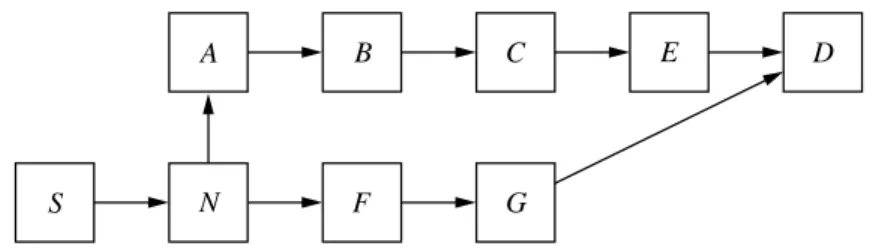
Figure 4: Sample network to demonstrate the sequence number rushing attack.
has | ∪γi=1Ai| ways to fail. We now apply the inclusion-exclusion principle: γ ∪ i=1Ai =
∑
i |Ai| −i∑
1,i2 |Ai1∩Ai2|+···+ (−1)γ+1 γ ∩ i=1Ai = γ∑
i=1 (−1)i+1 γ i 2m−i γ qThen the probability of a successful defense is
γ ∑ i=1(−1) i+1 γ i (2mγ−i) q (2γm)−1 q
We can now use this to analyze variants of the scheme described earlier. In particular, we look forn>32000.
When m=6, γ=3. (This represents a four-fold re-duction in computation, in exchange for a 17% increase in overhead). Using q=3 as before, an attacker has a 1.675×10⁻³ probability of success; when three
consecu-tive advertisements are required for the same metric before a routing change is made, the attacker succeeds once every 6.74 years.
Whenm=5, γ=4. (This represents a eight-fold re-duction in computation, in exchange for a 33% increase in overhead). Using q=3 as before, an attacker has a 8.023×10⁻³ probability of success; when four
consecu-tive advertisements are required for the same metric before a routing change is made, the attacker succeeds once every 7.65 years.
4.5. Tree-Authenticated One-Way Chains for
Preventing the Sequence Number Rushing Attack
In protocols such as SEAD, a node that has missed a number of sequence numbers may need to perform a large number of hash operations to bring its chain up-to-date. This creates a potential denial-of-service vulnerability: if an attacker knows that a victim missed several recent updates for a destination, the attacker can flood the victim with updates containing recent sequence numbers but bogus authentica-tors; the victim must then perform many hash operations
for each update received in an attempt to verify each up-date. Alternatively, the attacker can fabricate an update with sequence numbers far in the future, thus requiring each node receiving such an update to perform a large number of hash operations to determine that the update is bogus, although this attack can be somewhat mitigated using loose time syn-chronization, and rate limiting the use of new sequence numbers.
Another attack is thesequence number rushing attack. We explain this attack with an example. Consider the case in which a malicious nodeAtries to attract traffic flowing from a source Sto a destination D throughS’s neighbor
N. Figure 4 shows the network setup. Let the attackerA
be 4 hops fromD, andN be 3 hops fromD. If Ahears new routing updates fromD before they reach N, A can rush the routing update to N. If we use the policy that a node always uses the routing update with the most recent sequence number,Nwill forward traffic fromStoDthrough
Auntil it hears the routing update with the new sequence number fromF which contains a shorter route. To rem-edy this rushing attack, we adapt adelayed route update adoption policy: always use the shortest route from the pre-vious sequence number. For example, when nodeNhears the first routing update with sequence numberifor destina-tionD, it will use the shortest update of sequence number
i−1. Unfortunately, this approach is still vulnerable to an
attack in whichAsends two routing updates to N after it hears the update for sequencei: it forges an update with distance 0 of sequence numberi−1, followed by an update
of distance 3 for sequence numberi. The tree-authenticated one-way chain mechanism we present in this section pre-ventsAfrom forging low distance metrics for previous route updates. Together with the delayed route update adoption policy, we can prevent the sequence number rushing attack. We describe here our efficient tree-authenticated one-way chain mechanism, which has two properties in addition to those of the hash chain in SEAD: first, it bounds the ef-fort to verify an update; and second, it prevents a node with fresh sequence number information from fabricating lower metric authenticators for old sequence numbers.
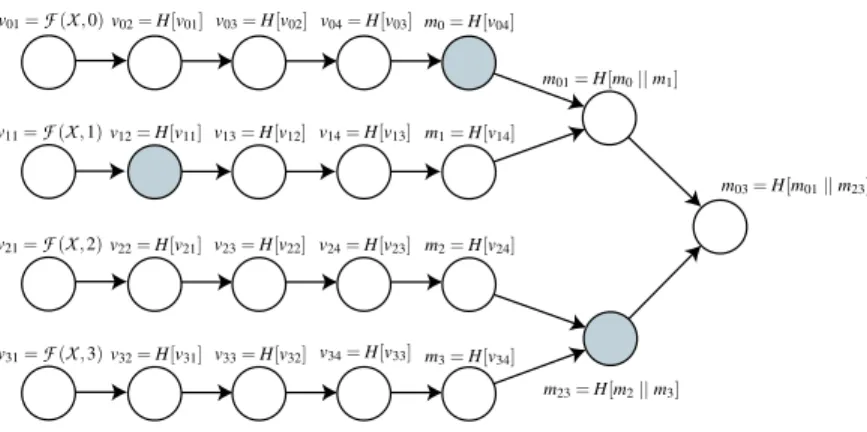
In our new scheme, we use a new hash chain for each sequence number. A node using this scheme generates a random hash chain rooth0,s for each sequence numbers,
PSfrag replacements v01=F(X,0) v11=F(X,1) v21=F(X,2) v31=F(X,3) v02=H[v01]v03=H[v02] v04=H[v03] m0=H[v04] v12=H[v11] v13=H[v12] v14=H[v13] m1=H[v14] v22=H[v21] v23=H[v22] v24=H[v23] m2=H[v24] v32=H[v31] v33=H[v32] v34=H[v33] m3=H[v34] m01=H[m0||m1] m23=H[m2||m3] m03=H[m01||m23]
Figure 5: Example tree-authenticated one-way chain construction for authenticating a sequence of one-way chains. The instance in this figure allows4sequence numbers to be authenticated, and metrics up to3. The shaded values represent sequence number1metric1.
for example by using a PRF
F
and a secret master keyX
to deriveh0,s=
F
(X
,s). Given the authentic anchor of this hash chainhk,s=Hk[h0,s](wherekis the maximum metric),any node can authenticatehm,s, which is the authenticator
for sequence numbersand metricm.
To allow nodes to authenticate these anchorshk,s, each
node builds a hash tree, using the hash chain anchors as leaves (Section 3.1). When a node sends an update with a new sequence numbers, it includes the root of the hash chainh0,s, the anchor of the hash chainhk,s, and the path
to the root of the hash tree. To authenticate any update, the node verifies the anchor by following the path to the root of the hash tree. It then verifies the hash valuehm,s by verify-ing thathk,s=Hk−m[hm,s]. Since the maximum hash chain length isk and the anchor verification requiresO(log(s)) effort, wheres is the number of sequence numbers repre-sented by any root, the computation required to verify any update is bounded byk+log(s).
4.6. The MW-Chains Mechanism
In this section, we present a new cryptographic mechanism, which we use in the next section to improve the efficiency of secure network routing and to prevent a class of denial-of-service attacks. This mechanism is an extension to the Merkle-Winternitz one-time signature construction [26]. That construction was subsequently used and extended by Even, Goldreich, and Micali [7], and by Rohatgi [37]. Our extension to this signature construction, which we call a one-way Merkle-Winternitz chain, or MW-chain, provides instant authentication and low storage overhead. This one-way chain contains a list of values, calledheads, and be-tween any two heads are a set ofsignature branchesand a set ofchecksum branches. To achieve low storage over-head, we derive these branches from a single head using a one-way hash functionH.
The most basic way to construct an MW-chain is with one signature branch and one checksum branch between each head. Assuming we want one set of branches to sign up toNvalues, we choose the length of the signature branch and the checksum branch to beN; that is, we choose
`1=`01=N. A random value that isρbits long is chosen as the first head valuevn. Next, the signature and checksum branches are computed using
s1,`1 = H[vi||“s”||1] s1,x−1 = H[s1,x]
c1,`01 = H[vi||“c”||1] c1,x−1 = H[c1,x]
for 2 ≤ x ≤ `1. Finally, the next head value is vn−1=H[s1,1 || c1,1]. The signature of a value n using
this MW-chain is the ordered set{s1,n,c1,N−n}. An attacker can produces1,j, for j<n, but then cannot producec1,N−j. Similarly, an attacker can producec1,N−jforj>n, but then cannot produces1,j.
More generally, an MW-chain can have m signature branches andm0checksum branches. We call the lengths of
the signature branches`1, `2, . . . , `m and the lengths of the
checksum branches`01, `02, . . . , `0m0. The signature for some
valuenis the ordered set
{s1,n1,s2,n2, . . . ,sm,nm,c1,n0 1,c2,n02, . . . ,cm0,n0m0} where ni= n ∏i j=1`j mod`i +1, and n0i= ∑m j=1`j−nj−1 ∏i j=1`0j mod`0i +1.
For example, Figure 6 shows an example MW-chain being used to sign the value 58. In this example, there are 3 signature chains, each of length 4, and 2 checksum chains, also each of length 4. To sign the value 58 in this case,
PSfrag replacements s1,4=H[vi||“s”||1] s1,3=H[s1,4] s1,2=H[s1,3] s1,1=H[s1,2] s2,4=H[vi||“s”||2] s2,3=H[s2,4] s2,2=H[s2,3] s2,1=H[s2,2] s3,4=H[vi||“s”||3] s3,3=H[s3,4] s3,2=H[s3,3] s3,1=H[s3,2] c1,4=H[vi||“c”||1] c1,3=H[c1,4] c1,2=H[c1,3] c1,1=H[c1,2] c2,4=H[vi||“c”||2] c2,3=H[c2,4] c2,2=H[c2,3] c2,1=H[c2,2] Headvi Headvi−1= H[s∗,1||c∗,1] Branches Generation Verification
Figure 6: An example MW-chain being used to sign the value 58
n1 = (58 mod 4) +1=3, n2 = 584 mod 4+1=3, and n3 = 5816 mod 4 + 1 = 4, so n0 1 = ((12−(2+2+3)) mod 4) + 1 = 2 and n0 2 = j12 −(2+2+3) 4 k
mod 4+1 = 2. The signature is thus the ordered set{s1,3,s2,3,s3,4,c1,2,c2,2}.
Every signature chainican sign log2(`i)bits. All signa-ture chains together can signb= ∑m
i=1log2(`i)bits. To sign
a messageMofbbits, the signer splits the message intom
chunksM1, . . . ,Mm, each of size log2(`)bits. The signer
adds the valuessi,Mi+1to the signature. Note that the first
value of a signature chain signs the number 0, the second value a 1, and so on.
To prevent an attacker from forging a messageM0, where
Mi≥M0i,1≤i≤m(because anybody can compute the one-way chain into that direction to know the previous values) the sender uses a checksum chain that moves in the op-posite direction of the signature chains. Consequently, an attacker that tries to signM0as described above would need
to invert the checksum chain, which is computationally in-feasible. The checksum chains need to be long enough to sign the maximum sum that might occur in the signature chains: ∏m0 i=1` 0 i≥1+ m ∑ i=1(`i−1).
The signer computes the checksum of the signature chains by summing all the values that it signed with the
sig-nature chains: s= ∑m
i=1Mi. The signer splits the checksum
into m0 checksum chunks. The checksum chunks are
en-coded in reverse in the checksum chains, compared to how the message chunks are encoded n the signature chains. For checksum chunksi, the signer adds the valueci,`0−sito the
signature.
Rohatgi [37] proposes a concrete instantiation to sign an 80-bit message: 20 signature chains of length 16, and 3 checksum chains of length 16. Zhang [42] presents a sim-ilar mechanism, except that he does not bring the multiple hash chains together into heads. As a result, MW-chains have an advantage in reduced storage overhead.
In retrospect, it may seem that the development of hash tree chains was unnecessary: a node could use an MW-chain to sign its node identifier, thus preventing a node from directly replaying its authenticator. Unfortunately, using MW-chains in this context is not secure, since an attacker receiving several advertisements of equal metric can recover many values of the signature and checksum chains. For example, we performed a Monte Carlo simula-tion for a scenario in whichn=32640 nodes are represented using 5 signature chains of length 8, and 2 checksum chains of length 4, and each attacker hears 3 advertisements. In this case, an attacker was able to forge a valid signature with a probability of 0.196, in contrast to the hash tree chain,
PSfrag replacements vi vi−1 h0,i=H[vi] h1,i=H[h0,i] h2,i=H[h1,i] h3,i=H[h2,i] h4,i=H[h3,i] S(h4,i) Generation Usage
Figure 7: One step in a skiplist withk=4 4.7. Skiplists for Preventing Denial-of-Service Attacks
and for Faster Hash Chain Authentication
In Section 4.5, we described a mechanism that allows each node to verify a hash chain without needing to perform a large number of hash functions. However, the amount of effort required to verify an element isO(k+lgs), wherek
is the length of the hash chain andsis the number of hash chains. The network overhead isO(lgs), and initial com-putation cost isO(ks). If the maximum metric is large, this approach may be prohibitively expensive, either in terms of initial computation cost or for element verification.
In this section, we describe an approach which, when combined with the Merkle tree authentication described in Section 4.5, hasO(c√ck+lgs)verification cost andO(s√ck) generation cost, at the cost ofO(c+lgs)overhead, wherec is any positive integer. We achieve this by creating askiplist, which is a chain that, when followed for one step, skips over many steps in a virtual hash chain. In the most basic version, a skiplist is√klong, and each step in a skiplist represents
√
ksteps in a hash chain, which representsc=2. In general, skiplists can be embedded inside skiplists, allowing values ofc>2. Skiplists can also be used in protocols such as
TESLA [34, 35] and BiBa [33], to improve the efficiency of following long hash chains.
Each skiplist is represented by an MW-chain capable of signing enough bits to ensure security (for example, 80 bits). Each step in this MW-chain representsmsteps in a
virtual hash chain. To generate the hash chain (or skiplist) associated with this step, a new head is chosen by hash-ing the head of this step. The anchor of this hash chain (or skiplist) is computed, and that step in the MW-chain is used to sign this new anchor. For example, if the head of one step in a skiplist isvi, a node formsh0,i=H[vi], computes the
corresponding anchor (for examplehm,i=Hm(h0,i), if this
is the last level of skiplists). It signs this anchor usingvi, as described in Section 4.6.
More concretely, we consider the case in which there is one level of skiplist, and each step in the skiplist corre-sponds tomsteps in the virtual hash chain. If the MW-chain is n steps long, then the virtual hash chain is mn steps long. The leftmost element in this virtual hash chain is
vn, from which all chain elements can be derived. An al-ternative representation is the pair(h0,n,Svn(hm,n)), where Svn(hm,n) representshm,n signed using vn. The next ele-ment is the pair(h1,n,Svn(hm,n)). The element at position
(m+1) from the left is (h1,n−1,Svn−1(hm,n−1)). In
gen-eral, thexth element from the left is represented by the pair (hx modn,y,Svy(hm,y)), wherey=n− bmxc.
To verify a hash element, a node follows the hash chain to the anchor, and verifies the signature of the anchor. If there are multiple levels of skiplists (that is, ifc>2), the
signature is verified recursively: that is, the verification of the signature requires the verification of a signature in a higher level chain. For example, if there are two levels of skiplists (c=3), then the hash chain is followed to its
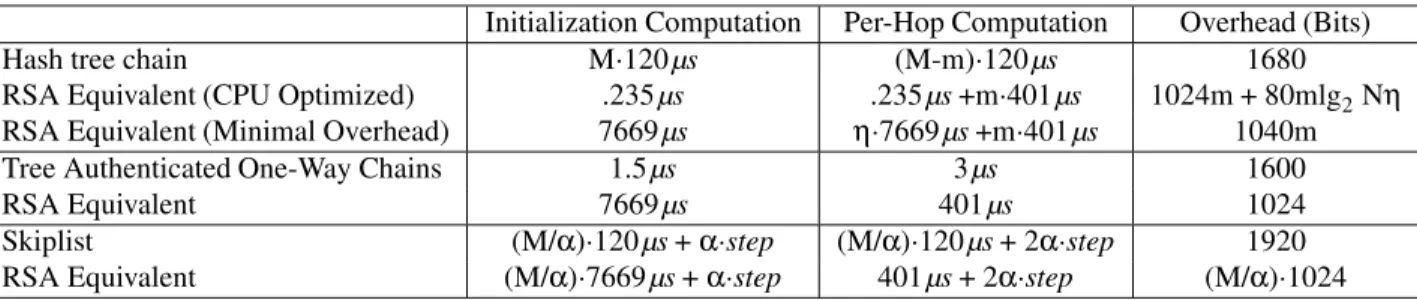
Table 1: Our mechanisms compared with public key equivalents
Initialization Computation Per-Hop Computation Overhead (Bits)
Hash tree chain M·120µs (M-m)·120µs 1680
RSA Equivalent (CPU Optimized) .235µs .235µs+m·401µs 1024m + 80mlg2Nη
RSA Equivalent (Minimal Overhead) 7669µs η·7669µs+m·401µs 1040m
Tree Authenticated One-Way Chains 1.5µs 3µs 1600
RSA Equivalent 7669µs 401µs 1024
Skiplist (M/α)·120µs+α·step (M/α)·120µs+ 2α·step 1920
RSA Equivalent (M/α)·7669µs+α·step 401µs+ 2α·step (M/α)·1024
Notation: M is the maximum metric, m is the metric at a hop, n is the total network size,ηis the average number of neighbors,αis the number of hops covered by one skiplist hop, andstepis the cost of one hash chain step. RSA timings were performed with 1024-bit keys, using OpenSSL [29]. Hash tree chain performance is based on a network of size 32640, roughly the number of ASes in the Internet, and uses hash tree of size 26, with 3 values corresponding to each node. CPU optimized RSA equivalent combines all routing table elements using a Merkle tree, amortizing signature costs across all routing table elements. Tree-authenticated one-way chain is of size 220, and the calculation of initialization cost is amortized over all elements.
anchor, the second level skiplist signature is checked by following that skiplist to its anchor, and the anchor of that skiplist is verified by verifying the signature in the top-level skiplist.
Skiplists can be generalized to allow skipping over any type of one-way chain that is formed from a single arbitrary head and can be verified using a single anchor. For example, hash tree chains can be used in conjunction with skiplists. This generalized skiplist is generated in the same way as skiplists over hash chains: at the lowest level of skiplist, the head of one step is used to seed the head of the one-way chain, and the anchor of that one-way chain is signed by that step in the skiplist.
Another possible application of such skiplists is to choose the top-level skiplist to representksteps, wherekis the maximum diameter of the network. This would reduce the initial cost of setting up a Merkle tree (as described in Section 4.5) fromO(s√ck)toO(s), wheresis the number of
sequence numbers covered by the tree. This increases over-head and computation cost byO(1)for each update sent and verified, respectively.
4.8. Efficiency Evaluation
To evaluate the efficiency of our mechanisms, we imple-mented generation and verification procedures for the three mechanisms described in this section. For efficiency, our hash function is based on the Rijndael block cipher [4] in the Matyas, Meyer, and Oseas construction [24], with a 128-bit key and a 128- or 192-bit block size, depending on the number of bits to be hashed. With a single block to be hashed, the hash output is the following (with an initializa-tion vector (IV) as the initial keyK): H(x) =EK(x)⊕x. We built our implementation on top of Gladman’s imple-mentation [9]. We implemented hash tree chains with 64 leaves, which represents a 64-node network with a single element per node, or a 2016-node network, when using two
elements per node. Our skiplist was based on Rohatgi’s construction [37] of 20 signature chains of length 16 and 3 checksum chains of length 16.
We ran our tests on a laptop with a Mobile Pentium 4 CPU running at 1.6GHz. Verifying a node in a tree-authenticated one-way chain took 3.08µson average, com-puting one step in a hash tree chain took 120µson aver-age, and computing one step of an MW-chain took 145µs
on average. As a result, in a network with maximum metric 16 using skiplists of length 4, theworst case verification takes just over one millisecond. Another advantage of our approach is that most of the computation needed for verifi-cation can be used for generation; in particular, the worst case authentication plus verification operation takes just 480µsmore than verification alone.
To compare these results to the efficiency of public-key cryptography, we analyzed the functionality provided by each mechanism. A summary of our analysis is shown in Table 1. The tree-authenticated one-way chain essentially provides a signature: given a public key (the root value), private values can be authenticated. Tree-authenticated one-way chains are significantly more efficient than existing ap-proaches [41] that authenticate each anchor using RSA.
A hash tree chain uses cryptographic mechanisms to en-sure that only nodes authorized to advertise a particular metric can advertise that metric. In particular, only nodes that hear an advertisement with metricm(or lower) can ad-vertise metricm+1. A public-key approach to this prob-lem can be adapted from the solution proposed by Kent et al. [18]: each node signs the list of nodes that are al-lowed to advertise a particular metric. Each routing table element includes a signature chain, with a length equal to the metric, which shows the delegation of authority for ad-vertising particular metrics. A node verifying this chain would need to verify a number of signatures equal to the distance to the destination. In addition, each node needs to
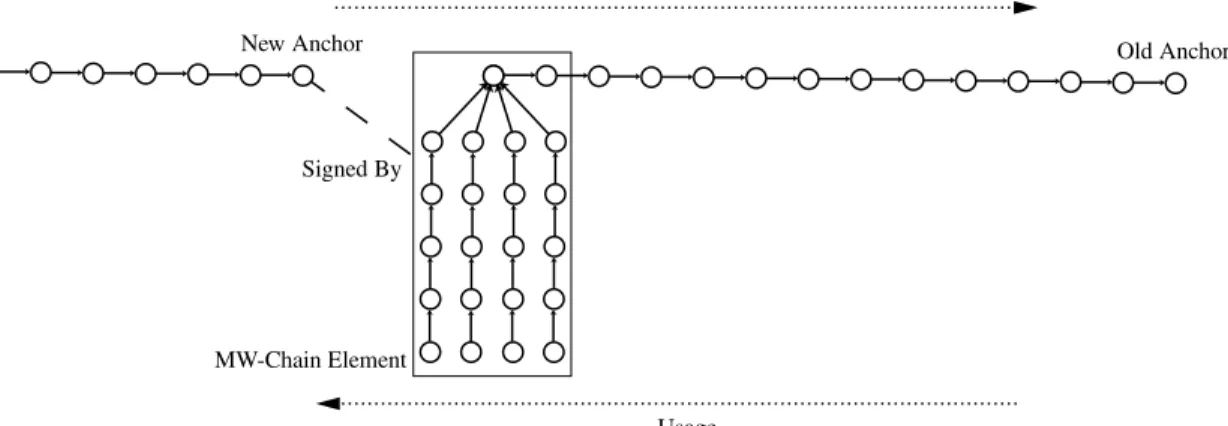
PSfrag replacements Old Anchor New Anchor MW-Chain Element Signed By Generation Usage
Figure 8: Bootstrapping a new hash chain. The new anchor is signed using the MW-chain element at the far left side of the old chain.
PSfrag replacements Old Tree
New Root
MW-Chain Element
Signs
Figure 9: Bootstrapping a new tree-authenticated one-way chain. The new root is signed using the MW-chain element embedded in the old tree.
run a secure neighbor discovery protocol in order to know which neighbors to authorize. Though such a protocol may be easy to design in a wired network or a fixed wireless network, where a list of potential neighbors is easily gener-ated, it could be prohibitively expensive in a mobile wireless environment such as an ad hoc network.
Finally, an alternative to skiplists is signatures. For ex-ample, in a network with maximum metric 16 and one step in a skiplist is used to skip over 4 elements, a sender can sign not only the anchor (metric 16 authenticator), it can also sign metric 4, 8, and 12 authenticators. Naturally, when a node sends an advertisement with metric 5, it will not include the signature of the metric 4 authenticator, and in general, a node advertising metric n will not in-clude signatures on any metricmauthenticators form<n.
Although skiplists may be slower than public key mecha-nisms on general-purpose processors, they have four advan-tages: first, they may require less network overhead for long
chains; second, signature generation overhead is reduced, especially at the sender; third, they are easier to implement in hardware; and fourth, verification is easily parallelizable.
4.9. Bootstrapping New Chains and Trees
As time progresses, the elements of one-way hash chains or hash trees eventually run out and the node needs to securely distribute the anchor of a new chain or the root of a new tree. Recall that the security of our schemes relies on the secure distribution of these initial values, as they are used to authenticate all subsequent values. One solution to this problem is to compute a chain that is long enough to out-last the network; unfortunately, such a computation may be relatively expensive.
An alternative solution is to use the old chain or tree to authenticate the new anchor or root. To achieve this, we place a single MW-chain element at on the left-hand side of each hash chain or hash tree chain, or as the last element of
Figure 10: The Big Picture. Each leaf (except the bottom leaf) of the hash tree is identical to the top leaf, but the structure is omitted for clarity.
a tree-authenticated one-way chain (as used in Section 4.5). When a node comes close to running out of its current chain, it generates a new chain, and uses the MW-chain element from its old chain to form a one-time signature on the an-chor of the newly generated chain. It then distributes this new anchor by piggybacking it on several updates around the time the old chain expires. Figure 8 shows the use of a skiplist element in a hash chain for authenticating a new hash chain anchor, and Figure 9 shows the use of a skiplist element in a tree-authenticated one-way chain for authenti-cating a new tree-authenticated one-way chain root.
This approach can be extended in several ways: each chain could contain several MW-chain elements to allow nodes to more easily reenter the network should they miss an entire chain of another node. Furthermore, a node may choose to piggyback a newly authenticated anchor often, when it first switches to the new chain, and progressively less often as the node consumes that chain. For example, the node may distribute the authentication information when-ever the chain element used is a power of 2 from the anchor; this approach reduces overhead while still allowing nodes to rejoin the network after an extended time away.
4.10. Combining Our Primitives
Two of our primitives (hash tree chains described in Section 4.4 and tree-authenticated one-way chains in Section 4.5) protect against specific attacks (namely, same-metric fraud and the rushing attack); in addition, we provide skiplists (Section 4.6) for more efficient traversal of long hash chains. In order to prevent both of the above attacks, we can combine our approaches as shown in Figure 10. At the highest level, shown on the right side of the figure, we use a tree-authenticated one-way chain, which is a Merkle tree. The root of this Merkle tree is bootstrapped on each node. Each leaf in the Merkle tree is the anchor of an-other chain, with each leaf representing a single sequence number. In this case, the chains are skiplists built on top of hash tree chains; the chains could also be implemented as hash tree chains, or, if same-metric fraud is not a concern,
as hash chains. Finally, at the bottom of the figure is an MW-chain element, which is later used for authenticating the root of the next tree-authenticated one-way chain.
5. A Mechanism for Securing
Path Vector Protocols
5.1. Overview of Path Vector Routing
Path vector protocols are similar to distance vector proto-cols, except that in place of the metric, each routing update includes a list of routers (or, in the case of BGP, a list of Autonomous Systems) on the route. By default, a path vec-tor protocol will choose a route with the shortest recorded path; policies may also specify specific routers to prefer or to avoid. As a result, a node may wish to authenticate each hop that the routing update has traversed as recorded in the path, and to assure that no hops were removed from that recorded path.
A traditional way to perform this authentication is to have each node insert an authenticator in the packet, and to have the recipient individually verify each authentica-tor when the packet is received. This approach requires the network overhead of carrying a message authentication code (MAC) for each node in the path. In this section, we present acumulative authenticationmechanism that has the property that the message can be authenticated with only a single MAC, together with an ordered list of nodes traversed by the packet.
5.2. Cumulative Authentication
First, we describe the cumulative authentication mechanism in the case in which private keys are shared between the authenticating node and each node on the path. Each packet authenticated in this way maintains apath authenticatorand anaddress list. When the packet traverses a node, the node appends its address to the address list. It authenticates its position in the list by replacing the path authenticator with a MAC computed over the received path authenticator and the packet’s immutable fields.
PSfrag replacements A B C D E T ha=MACTA(0||p) hb=MACT B(ha||p) hc=MACTC(hb||p) hd=MACT D(hc||p) he=MACT E(hd||p)
Figure 11: Cumulative authentication of packetpto a targetT
When the packet reaches the receiver, if the path authen-ticator was originally initialized to a well known value (such as 0), then the receiver can reconstruct an expected final path authenticator value, given the address list. If the recon-structed value matches the received value, then the packet is deemed to be authentic and to have in fact traversed each node in the address list.
Figure 11 shows an example of cumulative authentica-tion for a packetp. In addition to updating the path authenti-cator, each node also appends its own address to address list in the packet. If each node authenticates the packet using a shared MAC withT, thenT can verify the path the packet traversed by verifying the received path authenticatorheby checking that
he=MACT E(MACT D(MACTC(MACT B(MACTA(0||p)
||p)||p)||p)||p).
Cumulative authentication also resists the removal of previous nodes from the address list. For example, in Figure 11, if an attacker C wishes to remove B from the address list, it must obtain ha to derive a valid hc=MACTC(ha||p). Since invertingB’s MAC is infeasible, an attacker generally must have the cooperation of the node immediately before the node to be removed. This mecha-nism does not prevent the second node from removing the first node, but since the first node is the source node, this is equivalent to the second node dropping the original packet and originating a packet of the same type to the destination. Instead of using private, shared keys for authentication, it is also possible to use our cumulative authentication mech-anism in the case in which the TESLA broadcast authenti-cation protocol [34, 35] is used for authentiauthenti-cation; the au-thentication can be performed either by the sender of the packet to be authenticated or by each recipient. To perform the authentication at each recipient, as may be desirable with a proactive routing protocol, such as BGP, each node along the path verifies the TESLA “security condition” (that the TESLA keys have not yet been released) and updates a address list and path authenticator as described above using its current TESLA key. The node then buffers the packet for verification. Later, the sender transmits the key, required for the verification of its authentication, to each node to which the sender transmitted the original routing packet. Each node receiving such an authentication packet verifies the authentication information. After the node performs that authentication, it appends its previous TESLA key to the
authentication packet and transmits the new authentication packet to each neighbor to which it sent the original routing packet.
In an on-demand protocol, such as Ariadne [14], an ini-tiator floods a route request packet when it needs a route to a destination; the initiator may then wish to perform the au-thentication. In this case, each node along the path updates a address list and path authenticator as described above. When the packet reaches the destination, the destination verifies the TESLA security condition. Alternatively, the destination can include a timestamp, and allow the source to verify the security condition. The destination then adds an authenticator to the path authenticator and address list (and possibly the timestamp), and sends the packet along the reverse of the route along which it came. Each node receiving such a packet includes in the packet a key that al-lows the original authenticator to be reconstructed. If the end-to-end authentication is also performed using TESLA, the TESLA key used by the destination for authenticating the path authenticator, address list, and timestamp must be sent to the original sender.
5.3. Performance Evaluation
To evaluate the performance of cumulative authentication, we examined the overhead reduction resulting from using cumulative authentication together with Ariadne [14]. We performed 140 simulations, each running over 900 simu-lated seconds, and examined the number of bytes of over-head transmitted within control packets. When Ariadne was run without cumulative authentication, thetotal over-head across 50 nodes and 126000 simulated seconds was 1997 megabytes, whereas with cumulative authentication the same total overhead was 1491 megabytes. This result represents a 25% reduction in routing overhead.
6. Conclusion
In this paper, we have presented four new mechanisms as building blocks for creating secure distance vector and path vector routing protocols. These mechanisms not only pro-tect the routing protocol against standard routing attacks, they are based on highly efficientsymmetriccryptographic techniques; our mechanisms thus also help to protect the routing protocol against denial of service attacks based for example on simply by flooding large numbers of randomly