Abstract Code
Manual
MISSOURI CANCER REGISTRY
AND RESEARCH CENTER
University of Missouri – Columbia
2013
Revised
Missouri Cancer Registry and Research Center Abstract Code Manual
13th Edition 2013
This project was supported in part by a cooperative agreement between the Centers for Disease Control and Prevention (CDC) and the Missouri Department of Health and Senior Services (DHSS) (#U58/DP003924-01) and a Surveillance
Table of Contents
Preface: ABOUT THIS MANUAL ... i
Changes for 2013 ... ii
Introduction: MISSOURI CANCER REPORTING REQUIREMENTS ... iii
Role of Hospitals ... iii
Role of Missouri Cancer Registry and Research Center ... iv
Confidentiality ... iv
Edits ... iv
Audits ... v
Chapter 1: GENERAL INSTRUCTIONS ... 1
Important Items for Reporting ... 1
Changing Information ... 2
Data Transmissions ... 2
Proper Mailing Procedures ... 3
Chapter 2: DETERMINING REPORTABILITY ... 4
Casefinding Techniques ... 4
Reportable List for Casefinding ... 4
Cases That Must Be Reported ... 4
Cases Not Required To Be Reported ... 6
Ambiguous Terms at Diagnosis ... 6
Chapter 3: DETERMINING PRIMARY TUMORS ... 8
Multiple Primaries for Solid Tumors ... 8
General Information ... 8
How to Use the Multiple Primary Rules ... 9
Multiple Primary Rules for Hematopoietic Cases ... 10
Chapter 4: FIRST COURSE OF THERAPY ... 11
Definitions ... 11
All Malignancies Except Leukemias ... 11
Leukemias ... 11
Time Periods for First Course of Treatment (FCT) ... 11
Rx Summ—Treatment Status ... 12
Surgical Diagnostic and Staging Procedures (Non-Cancer Directed Surgery) ... 13
Palliative Procedure ... 13
Chapter 5: INITIAL ABSTRACT ... 14
Identification Information ... 14
Reporting Hospital/Facility Number (Reporting Facility) ... 14
NPI-Reporting Facility ... 14
Accession Number + Sequence Number ... 14
Sequence Number(s) ... 15
Personal History (1 & 2) (MO Personal Hx 1, 2) ... 16
Year 1 & 2 (MO Year 1, 2) ... 16
Name—Last ... 16
Name—First ... 16
Name—Middle ... 17
Name—Maiden ... 17
Address at Diagnosis - Number and Street ... 17
Address at Diagnosis – Supplemental ... 17
Address at Diagnosis – City/Town ... 18
State at Diagnosis ... 18
Postal Code at Diagnosis ... 18
County at Diagnosis ... 19
Address Current ... 19
Patient Address Current—(Number and Street) ... 19
City/Town Current ... 19
State—Current ... 19
Postal Code—Current (Zip Code) ... 19
County-Current ... 19
Medical Record Number ... 19
Name of Spouse / Parent / Contact Person ... 19
Abstracted By ... 20
Social Security Number ... 20
Telephone Number... 20
MO Alcohol History ... 20
MO Tobacco History ... 20
Years of Tobacco Use ... 21
Toxic Exposure ... 21
Marital Status at Diagnosis ... 21
Sex ... 21
Race 1 – 5 ... 22
Spanish/Hispanic Origin ... 23
Date of Birth (Birth Date) ... 23
Date of Birth Flag ... 24
Birthplace—State, Country ... 24
Age at Diagnosis ... 24
Lifetime Occupation ... 24
Type of Industry ... 25
Date of 1st Contact ... 25
Date of First Contact Flag (Date of 1st Contact Flag) ... 26
Institution Referred To ... 26
Institution Referred From ... 26
Primary Payer at Diagnosis ... 26
Class of Case ... 27
Type of Reporting Source ... 29
Chapter 6: TEXT FIELDS ... 30
Text—Dx Procedure—Physical Exam (Text—Dx Proc—PE) ... 30
Text—Dx Procedure—X-rays/Scans (Text—Dx Proc—X-ray/scan) ... 31
Text—Dx Procedure—Scopes (Text—DX Proc—Scopes) ... 31
Text—Lab Tests (Text—Dx Proc—Lab Tests) ... 32
Rx Text—Surgery (Rx Text—Surgery) ... 32
Text—OP (Text—Dx Procedure—OP) ... 32
Text—Dx Procedure—Pathology (Text—Dx Proc—Path) ... 33
Text—Staging ... 33
Text—Remarks ... 34
Text—Place of Diagnosis ... 34
Rx Text—Radiation (Beam) and Rx Text—Radiation Other ... 34
Rx Text—Chemo, Rx Text—Hormone, Rx Text—BRM, and Rx Text—Other ... 34
Primary Site Title (Text—Primary Site Title) ... 35
Histology Title (Text –Histology Title) ... 35
Chapter 7: CANCER IDENTIFICATION ... 36
Primary Site ... 36
Primary Site Coding—Lymphomas ... 37
Histologic Type ... 37
Information About the 2007 Histology Coding Rules ... 38
How to Use the Rules... 39
Priority Order for using Documents to Code Histology ... 39
Ambiguous Terms Used to Code Histology ... 40
General Instructions Histology Coding Rules ... 40
ICD-O-3 Conversion Flag ... 41
Behavior Code ... 41
Grade or Differentiation ... 43
Grade Path Value ... 46
Grade Path System ... 46
Date of Diagnosis ... 47
Date of Diagnosis Flag ... 48
Diagnostic Confirmation ... 49
Laterality ... 51
Chapter 8: STAGING SCHEMES ... 53
Collaborative Stage ... 53
Lymph-Vascular Invasion ... 53
CS Tumor Size ... 54
CS Extension ... 54
CS Tumor Size/Ext Eval ... 54
CS Lymph Nodes ... 55
CS Regional Nodes Evaluation (CS Lymph Nodes Eval) ... 55
CS Mets at Diagnosis ... 55 CS Mets at DX—Bone ... 55 CS Mets at DX—Brain ... 55 CS Mets at DX—Liver ... 55 CS Mets at DX—Lung ... 55 CS Mets Evaluation ... 56 CS Version Original ... 56 CS Version Derived ... 56
CS Version Input Current ... 57
Regional Nodes Positive ... 57
Regional Nodes Examined ... 58
CS Site-Specific Factors ... 58
General Summary State at Diagnosis ... 58
AJCC Stage ... 59
Surgical Diagnostic and Staging Procedure (RX Summ-DX/Stg Proc) ... 59
Date of Surgical, Diagnostic and Staging Procedure (Rx Date—Dx/Stg/Proc) ... 60
Rx Date—Dx/Stg Proc Flag ... 60
Chapter 9: TUMOR-DIRECTED TREATMENT ... 61
Date of 1st Course of Treatment (Date of 1st Crs Rx-CoC) ... 61
Date of 1st Course RX Flag ... 61
Rx Summ—Treatment Status ... 62
Surgery of Primary Site (Rx Summ—Surg Prim Site) ... 63
Date of First Surgical Procedure (Rx Date—Surgery) ... 64
Rx Date—Surgery Flag ... 64
Reason for No Surgery of Primary Site (Reason for No Surgery) ... 64
Systemic/Surgery Sequence (Rx Summ-System/Sur Seq) ... 67
Scope of Regional Lymph Node Surgery (Rx Summ—Scope Reg LN Surg) ... 67
Surgical Procedure/Other Site (Rx Summ—Surg Oth Reg/Dis) ... 69
Date Radiation Started (Rx Date—Radiation) ... 70
Rx Date—Radiation Flag ... 70
Regional Treatment Modality (Rad—Regional Rx Modality) ... 70
Reason for No Radiation ... 72
Radiation/Surgery Sequence (Rx Summ—Surg/Rad Sequence) ... 73
Chemotherapy (Rx Summ—Chemo) ... 74
Date Chemotherapy Started (Rx Date—Chemo) ... 76
Rx Date—Chemo Flag ... 76
Hormone (Hormone/Steroid) Therapy (Rx Summ – Hormone) ... 77
Date Hormone Therapy Started (RX Date—Hormone) ... 78
Rx Date—Hormone Flag ... 79
Immunotherapy (BRM) (Rx Summ—BRM) ... 79
Date Immunotherapy Started (Rx Date—BRM) ... 80
Rx Date—BRM Flag ... 81
Hematologic Transplant and Endocrine Procedures (Rx Summ—Transplnt/Endocr) ... 81
Other Treatment (Rx Summ—Other)... 83
Date Other Treatment Started (Rx Date—Other) ... 84
Rx Date—Other Flag ... 84
Palliative Procedure (Rx Summ—Palliative Proc) ... 84
Chapter 10: OUTCOME INFORMATION ... 86
Date of Last Contact or Death (Date of Last Contact) ... 86
Date of Last Contact Flag. ... 86
Vital Status ... 87
Cancer Status ... 87
Underlying Cause of Death (Cause of Death) ... 88
ICD Revision Number ... 88
Place of Death—State and Country ... 88
Follow-up Source ... 88
Appendix A: SUPPLEMENTAL INSTRUCTIONS FOR CASES DIAGNOSED PRIOR TO 2010 ... 1
Primary Site for Solid Tumors Diagnosed Prior to 2007 ... 1
Site Differences ... 1
Subsites that Represent Unique Primaries ... 2
Primary Based on Grouped Sites ... 3
Laterality Differences ... 3
Histology Differences ... 4
Timing Differences ... 5
Primary Site for Lymphomas Diagnosed Prior to 2010 ... 5
Histologic Type ... 6
SEER Summary Stage 2000 ... 7
SEER Summary Stage 1977 ... 7
Citations ... 8
Acknowledgements
The Missouri Cancer Registry and Research Center would like to thank the American College of Surgeons-Commission on Cancer for permission to include some Facility Oncology Registry Data Standards (FORDS) in this manual. Such sections in-clude the sub-heading “Instructions for Coding” or the term “per FORDS”.
ABOUT THIS MANUAL
Public Law 102-515 and the Missouri Cancer
Registry and Research Center
The primary purpose of the Abstract Code Manual is to assist hospital-based cancer
registrars in reporting cancer cases to the Missouri Cancer Registry and Research Center (MCR-ARC). This revision introduces changes in coding structures and requirements for cases diagnosed on or after January 1, 2011 established by the National Program of Cancer Registries (NPCR), the North American Association of Central Cancer Registries (NAACCR)and the Commission on Cancer (CoC). The 2011 updates are fully documented in Facility Oncology Registry Data Standards (FORDS)and SEER Program Coding and Staging Manual 2011.
Since the passage of Public Law 102-515, entitled the Cancer Registries Amendment Act, by the 102nd Congress in October 1992, there has been a tremendous effort by all agencies collecting cancer data to unify and standardize data sets. With the establishment of the National Program of Cancer Registries in 1994, all central registries funded by the Centers for Disease Control and Prevention (CDC) through NPCR are required to follow stringent data management procedures; provide training for state personnel and hospital registry staff; publish an annual report; and conduct case-finding and re-abstracting audits at selected facilities.
Although MCR-ARC began receiving CDC/NPCR funding in 1995, our index (reference) year is 1996. MCR-ARC collects data that: 1) are compliant with required NPCR data elements; 2) meet standard requirements designated by NAACCR for incidence reporting and endorsed by CDC; and 3) assist in determining data quality. MCR-ARC also uses the data to provide useful feedback to submitting facilities that can be used for quality assurance activities and administrative purposes. Data is submitted annually to NAACCR for Registry Certification and publication in Cancer in North America (CINA). Registries whose data meet established criteria, including criteria for timeliness, accuracy and completeness, are recognized annually as NAACCR Certified Registries. MCR-ARC data has been certified since 2001 (for 1998 data) and has received ‘gold’ status since 2003 (for 2000 data).
In 1999, the Department of Health and Senior Services (DHSS) entered into a cooperative agreement with the University of Missouri, Columbia (UMC) allowing UMC to be the recipient of data submitted by reporting facilities. This agreement is carried out under the auspices of the Health Management and Informatics Department of UMC. Usage of the data is regulated by DHSS policies.
In early 2011, the Missouri Cancer Registry became the Missouri Cancer Registry and Research Center (MCR-ARC). The change was made to better reflect our activities in research and data usage.
Changes for 2013
Explanations added to MCR Abstract Manual entries for 2013, are shown in blue font for your convenience.
Clarifications were added per updates to the FORDS manual. Guidance on estimating dates has been added to Date of Diagnosis.
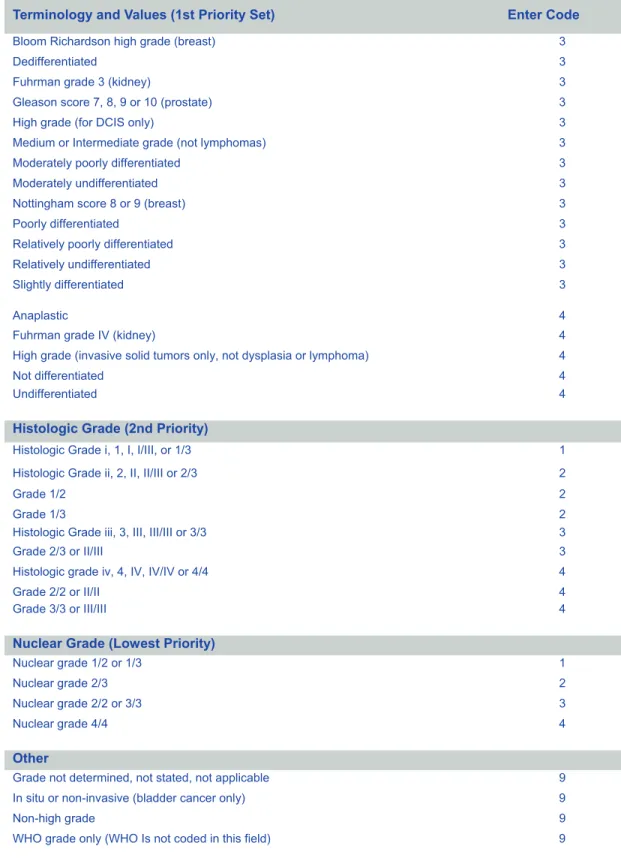
Instructions for coding Grade have been simplified to include one table for assigning a code.
MISSOURI CANCER REPORTING
REQUIREMENTS
Role of Reporting Facilities, Missouri Cancer
Registry and Research Center, Confidentiality and
Audits
Missouri statutes, NPCR and NAACCR requirements, data quality and projected
needs of the citizens of this state govern reporting requirements. In 1999, in an effort to establish a true population-based central cancer registry in Missouri, statues governing cancer reportability were expanded to include patients diagnosed and/or treated as hospital outpatients and in non-hospital facilities (e.g., pathology laboratories, ambulatory surgery centers, freestanding treatment centers, physician offices and long-term care facilities). This manual is intended for use in hospital-based registries.
In determining case reportability, MCR-ARC follows the rules of the Surveillance, Epidemiology and End Results (SEER) program of the National Cancer Institute. SEER guidelines are specified in GENERAL INSTRUCTIONS. Data items are based on fields required and/or recommended by NPCR for central registries collecting incidence data. Additional requirements include fields necessary for quality assurance purposes and ten Missouri-specific fields. A complete list of required data items is posted on the MCR-ARC
website:
Role of Hospitals
The primary source for obtaining epidemiological information is the hospital cancer
registry. A registry is responsible for providing a listing of cancer patients and pertinent information regarding their diagnoses. A registry may be small or large, and the extent of information submitted varies, depending on hospital size and the reporting methods for each facility. Some hospitals have had their own registries for years in accordance with the American College of Surgeons-Commission on Cancer (ACoS-CoC) requirements, while others have limited registries and collect or provide only the state mandated reporting requirements.
Role of MCR-ARC
MCR-ARC’s role is to gather information from hospitals and other sources to monitor the
incidence of cancer in the state for epidemiological research that may be used to develop and evaluate cancer prevention and control activities in Missouri. The data is received electronically from hospitals that have on-site or contract registrars. Facilities without a registrar having an annual caseload of 75 or fewer cases are called low-volume facilities. Information from these facilities is accepted in paper chart form, and MCR-ARC staff complete the abstracts. The data collected is invaluable in targeting risk factors in certain populations, studying the impact of environmental factors, identifying ethnic and social variations and evaluating the effectiveness of state cancer control programs.
The MCR-ARC staff is available to answer registry-related questions and to provide workshops, educational presentations and one-on-one training. Please refer to the MCR-ARC website at for complete information.
Confidentiality
Per Missouri statute (192.655, RSMo 1999), the “department of health shall protect the
identity of the patient, physician, health care provider, hospital, pathology laboratory, ambulatory surgical center, residential care facilities I or II, intermediate care facilities or skilled nursing facilities, and free-standing cancer clinic or treatment center… and that such identity shall not be revealed except…only upon written consent…” This confidentiality provision is necessary to assure all reporting entities that neither their identity nor the confidential data they submit will be subject to unauthorized release.
In addition, MCR-ARC employees are required to sign confidentiality agreements and follow confidentiality procedures set forth in the MCR-ARC Policy and Procedure Manual. These regulations include the use of locked cabinets for confidential data, employing secure work station practices, adhering to procedures for handling requests for data, etc. MCR-ARC employees also recognize the importance of compliance with ARRA HITECH provisions. Note: The Health Insurance Portability and Accountability Act known as HIPAA allows for the reporting of identifiable cancer data to public health entities. Because the MCR-ARC falls under the definition of a public health authority, HIPAA allows your facility to continue reporting cancer incidence data in compliance with state statutes (192.650-192.657 RSMo) and regulations (19 CSR 70-21). Written informed consent from each cancer patient reported to public health entities is not required under HIPAA nor is a Business Associate Agreement required; rather, hospitals must simply document that reporting has occurred.
Edits
A Missouri-specific edit set was first developed in 2008. The MCR-ARC edit set
was updated in accordance with the NAACCR v13 data layout and made available to all registry software vendors. MCR-ARC recommends that you run these edits at the time of abstracting.
These edits are applied to all files submitted to MCR-ARC via Web Plus and errors exceeding a set threshold may be cause for rejection of the file. Questions regarding edits should be directed to MCR-ARC Quality Assurance staff at 1-800-392-2829.
Audits
MCR-ARC periodically conducts case completeness and data quality audits as
required by the NPCR. The intent of the audits is to assist hospitals with casefinding and abstracting issues to ensure complete, high quality data is submitted to MCR-ARC. Each Missouri hospital is audited every five years. All electronic reporting hospitals are subject to case completeness and data quality audits, including some low volume facilities, while only case completeness audits are performed at other low volume hospitals that do not perform abstracting. Standard audits include casefinding and re-abstraction of data for a specific year. Alternatively, audits other than the standard method may also be performed periodically such as case completeness review based on hospital accession register matches with MCR-ARC’s database, data quality re-coding audits to evaluate data quality and text, and other site specific or tumor specific data quality reviews. After completion of the audits, detailed summary reports are prepared and shared with the hospital registrar and other related hospital staff. Per NPCR guidelines, the acceptable accuracy rate for all audits is 95 – 100%.
Standard Casefinding Inpatient/Outpatient hospital disease indices, pathology
reports and other pertinent casefinding documents are reviewed and matched to the MCR-ARC database. Any non-matched cases are returned to the registrar or hospital contact person for resolution. During routine casefinding, registrars can assist themselves and MCR-ARC by maintaining a non-reportable list (patient name, date of birth or social security number, ICD-9-CM code of the non-reportable malignancy, date seen and reason not reported). Another method is to note the reason a case is non-reportable on the registrar’s casefinding source, such as the Medical Records Disease Index (MRDI). The listing or notations will help registrars avoid duplication of efforts related to casefinding and identification of non-reportable cases in the audit process.
Standard Abstraction The re-abstracting audit consists of review and re-abstraction
of specific MCR-ARC required fields from the original hospital record with comparison to the original abstracted data. During resolution, registrars are given the opportunity to provide any additional information not available to the auditor that may justify the original coding. Discrepancies are discussed with the hospital registrar. Abstracting and coding guidelines are reviewed and reinforced. Further training may be recommended and, if warranted, MCR-ARC can provide assistance to individual registrars through conferencing and/or site visits.
NPCR Audits Case Completeness and data quality audits are periodically conducted by
NPCR on the Missouri Cancer Registry and Research Center. While a few hospitals are requested to provide the data, the audits are conducted on MCR-ARC, not on the individual facilities.
GENERAL INSTRUCTIONS
Basic Reporting Rules for State Reporting
Important Items for Reporting
All reportable cancer cases diagnosed and/or treated in your facility after August 28, 1984, must be abstracted and reported to the MCR-ARC
Completed cases should be submitted to the MCR-ARC within six months of date of initial contact for that facility
Electronic reporting is required for all facilities with an annual caseload greater than 75 cases. MCR-ARC no longer accepts paper abstracts. MCR-ARC will provide free software (Abstract Plus) to facilities that have 76-150 cases annually. If your facility accessions 76-150 cases annually, please contact us at 1-800-392-2829 to inquire about Abstract Plus.
Occasionally hospitals require special data reports from the central registry. Requests for studies, reports or information may be submitted to MCR-ARC staff by calling 1-800-392-2829 .
Solid tumors diagnosed on or after January 1, 2007 MUST be abstracted according to reportability and coding instructions set forth in The Multiple Primary and Histology Coding Rules
Manual whichcan be downl
The ICD-O-3 coding scheme must be used for site and histology of cases diagnosed on or after January 1, 2001. The ICD-0-2 coding scheme must be used for cases diagnosed prior to January 1, 2001 and may not be used for cases diagnosed on or after that date
Note: Hematopoietic malignancies are coded according to the Hematopoietic and Lymphoid Neoplasm Case Reportability and Coding Manual and the Hematopoietic Database for cases diagnosed on or after January 1, 2010.
Changing Information
It is possible that after a cancer case has been abstracted and submitted to MCR-ARC,
additional information was added to the patient's chart, which may lead to significant changes in specific data items submitted on the initial abstract. Justification/explanation should accompany the change.
Example: The patient is originally diagnosed with an unknown primary cancer and after further investigation it is determined that the cancer is a primary of the lung. It is correct to electronically submit a Change Of Information form(COI) to MCR-ARC and change the primary site code .
Hint: Changing the primary site will require review of site-specific fields (e.g., surgery codes, staging, laterality, etc.) to identify additional coding changes needed.
Note: COI forms can be found on the MCR-ARC website.
Please note that all COI’s must be reported electronically via WebPlus. Use the non-NAACCR format as you do for transmittal forms. For assistance or to discuss a changed case directly, please contact MCR-ACR staff at 1-800-392-2829.
Data Transmissions
Security of Data Transmissions — Electronic data are to be transmitted using the Web
Plus upload. Instructions for the use of Web Plus can be found on the MCR-ARC website. If your facility has other required methods of data transmission, please contact ARC staff. The MCR-ARC requires that all data be submitted via a secure electronic method. Diskettes and CDs are no longer accepted.
Protected Health Information (PHI) and other confidential data MUST NOT be included in e-mails to MCR-ARC. Do not include information either in the text of the e-mail or as an attachment. If this happens, MCR-ARC staff will alert the registrar, so that the information can be deleted from all e-mail.
Confidential information on individual cases may be uploaded using Web Plus non-NAACCR layout function, or it may be transmitted via fax. The MCR-ARC fax machine is in a locked office, accessible only to MCR-ARC personnel. The office is secure 24 hours a day.
Data Transmission Procedures — A completed transmittal form must accompany
each data submission. In addition, a completed transmittal form should be sent to MCR-ARC even if no data is submitted for the designated reporting period. Required schedules for data submissions are as follows:
Annual caseload >500 Monthly
Annual caseload 300-500 Monthly or quarterly Annual caseload <300 Quarterly
Proper Mailing Procedures
In the unlikely event that needed information absolutely cannot be sent electronically,
documents containing confidential patient information must be double-wrapped, using tear resis-tant packaging as the outer layer, regardless of carrier. MCR-ARC is not responsible for torn or lost packages containing patient information. We recommend you contact the addressee at MCR-ARC so that he/she knows to be on the alert for a letter or package. Be sure to track the package to ensure that it has reached its destination. We also encourage you to keep a listing of patient names included in the mailing, in the event there is a problem.
U.S. Postal Service
You must use MCR’-ARCs post office box address for items sent via the U.S. Postal Service. You may want to explore the added security of certified and registered mail options.
Missouri Cancer Registry and Research Center PO BOX 718
Columbia, MO 65205
Courier Service
For Federal Express, UPS, Airborne Express or other secure courier services, MCR-ARC’s street address must be used. You may also want to explore the e-mail tracking and notification features that the courier of choice offers.
Missouri Cancer Registry and Research Center University of Missouri
401 Clark Hall Columbia, MO 65211
DETERMINING REPORTABILITY
Casefinding Techniques
Reportable Cases may be identified from a variety of sources.. The hospital pathology
laboratory can provide cases diagnosed by histology, cytology, hematology, bone marrow or autopsy. Other resources include daily discharges and daily coding logs, disease indices, inpatient and outpatient surgery logs, radiotherapy consults, treatment reports and logs, and oncology clinic treatment reports and logs. Never rely solely on the pathology department to provide reportable cases. Doing so could exclude cases for which the hospital has no diagnostic tissue reports. Cases diagnosed elsewhere but treated at your facility and those diagnosed radio-graphically or clinically only, without tissue confirmation would be missed during casefinding unless additional resources are employed. It is essential to include review of the Medical Record Disease Index (usually provided by Health Information Management) and other tracking tools such as medical and radiation oncology clinic logs to ensure that all reportable cases are identified. You should form an alliance with staff from the aforementioned departments to establish and develop a systematic method to routinely receive necessary information from them.
Reportable List for Casefinding
A link to the SEER table listing reportable diagnoses for casefinding is posted on the
MCR-ARC web site (). Diagnoses are
listed by ICD-9-CM and ICD-10-CM codes which can be used by facilities to identify which cases to include on their MRDI casefinding lists. The list is updated annually to ensure that any new applicable codes are added.
Cases That Must Be Reported
Refer to the “MCR Reportable List for Casefinding” noted above when conducting casefinding activities. Depending on how casefinding is conducted, not all ICD-9-CM codes will be used by all facilities
Malignancies with a behavior code (fifth digit of the morphology code) of 2 or 3 in ICD-O-2 (cases diagnosed prior to January 1, 2001) or ICD-O-3 (cases diagnosed on or after January 1, 2001) or the Hematopoietic Database Appendix D, except as otherwise noted in this manual
Beginning with cases diagnosed on or after January 1, 2004, non-malignant primary intracranial and central nervous system tumors are required to be reported. See below for applicable site codes
Beginning with cases diagnosed on or after January 1, 2002, the following squamous intraepithelial neoplasia, grade III (8077/2) are reportable (NPCR requirement)
o AIN III (C21.1) o VIN III (C51. *) o VAIN III (C52. *)
Analytic cases. Patients whose initial diagnosis was made at your facility and/or any part of the first course of treatment was delivered or prescribed at your facility. (Class of Case 00, 10, 11, 12, 13, 14, 20, 21, 22, 35, and 37)
Patients diagnosed at a staff physician’s office and receiving any or their entire first course of treatment in your facility (Class of Case 12)
Nonanalytic cases. Patients diagnosed elsewhere who had all first course treatment elsewhere who were seen at your facility for diagnosis of recurrent disease or for treatment of relapsed, persistent or progressive disease; cases diagnosed prior to the facility’s Reference Date and diagnosis or treatment was given by the reporting facility; diagnosis was established by autopsy at reporting facility and was unsuspected prior to death (Class of Case 32, 35, 37 and 38).Record all available information regarding the original diagnosis and treatment
Malignant tumors of the skin such as adnexal carcinoma/adenocarcinoma (8390/3-8420/3), lymphoma, melanoma, sarcoma, and Merkel cell carcinoma must be reported. Any carcinoma arising in a hemorrhoid is reportable, since hemorrhoids arise in mucosa, not in the skin
Adenocarcinoma in situ of the cervix is reportable
Pilocytic/juvenile astrocytoma (9421) will continue to be collected as a /3 even though the behavior code changed to /1 in the ICD-O-3
Gastrointestinal stromal tumors (GIST) & thymomas are frequently non-malignant. However, they must be abstracted and assigned a behavior code 3 if they are noted to have multiple foci, metastasis or positive lymph nodes.
Codes Description
C70.0 – C70.9 Meninges C71.0 – C71.9 Brain C72.0 – C71.1 Spinal cord C72.3—C72.5 Cranial nerves
Topography Codes for Intracranial and Central Nervous System Tumors
C72.8-C72.9 Overlapping brain and CNS; CNS, nos C75.1 Pituitary gland
C75.2 Craniopharyngeal duct
Cases Not Required To Be Reported
Skin cancers (site = C44._ and histology = 8000-8110) as of January 1, 2001
Patients who have a history of cancer but diagnosis or treatment were not performed at your facility. (Class of case 33)
Patients who receive transient care to avoid interruption of therapy started elsewhere. (Class of case 31)
Patients seen only in consultation to confirm a diagnosis. (Class of case 30)
Pathology cases that are consultative readings of slides submitted from outside facilities. (Class of case 43)
Class of Case 40, 41, 42, 49 or 99
Patients with squamous cell carcinoma in situ or carcinoma in situ, nos of the cervix (as of 1/1/2003), cervical intraepithelial neoplasia (CIN) or prostatic intraepithelial neoplasia (PIN)
Patients with a pre-cancerous condition or benign tumor (other than CNS sites stated above)
Patients admitted to a hospice unit or home health care service
Patients above who are not reportable for your facility, but who die at your facility with active cancer, although not required may be reported to MCR. Cases not reported at the time of death may appear later on a Death Certificate Only listing (list of patients who died at your facility with cancer but not listed in the MCR database), which requires additional follow-back by MCR and research by the registrar. A minimal abstract prepared with documentation of any available information regarding date of diagnosis, primary site, histology or treatment is very useful
Note: Your cancer committee may decide to require additional benign or borderline cases. Please do not submit these reportable-by-agreement cases to MCR.
Ambiguous Terms at Diagnosis
Reportable cases are usually based on unequivocal statements made by recognized
medical practitioners that the patient has a reportable diagnosis. However, physicians sometimes use vague or ambiguous terms to describe a tumor when its behavior is uncertain. In instances where pathology or cytology findings cannot definitively confirm a cancer diagnosis or when imaging studies show inconclusive results, physicians often state the diagnosis in ambiguous terms. Reportability of such a diagnosis depends on the verbiage used. For a cancer case to be reportable, the ambiguous term must always include a reference to the reportable diagnosis being described, eg., favors carcinoma or suspicious for malignancy. When the diagnosis is stated in only ambiguous terms, use the following guidelines to determine whether a particular case should be reported. Note: Synonyms of these terms do not constitute diagnosis.
**unless supplemented by additional information
Example: Barium enema (BE) reveals a sigmoid mass suspicious for neoplasm. Colonoscopy reveals a sigmoid mass, “possible malignant neoplasm.” The patient is referred for biopsy and colon resection at another facility revealing carcinoma. The case
is NOT reportable for your facility because mass and neoplasm are not
associated with a reportable malignant term, whereas if it had been stated “suspicious sigmoid mass, probable malignant neoplasm,” it would be reportable.
Ambiguous terms that constitute a diagnosis
Apparent(ly) Most likely
Appears Presumed
Comparable with Probable
Compatible with Suspect (ed)
Consistent with tumor* (beginning with 2004 diagnosis and only for C70.0-C72.9, C75.1 - C75.3)
Suspicious (for)
Favors Typical of
Malignant appearing
Neoplasm* or Tumor (beginning with 2004 diagnosis and only for C70.0-C72.9, C75.1-C75.3)
* additional terms for nonmalignant primary intracranial and central nervous system tumors only
Exception: If cytology is reported only using an ambiguous term (such as suspicious), do not interpret it as a diagnosis of cancer. Abstract the case only if a positive biopsy or a physician’s clinical impression of cancer supports the cytology findings.
Example: Discharge summary and X-ray results report “CT of the chest compatible with
carcinoma of left lung.” Although there may be no further work-up or treatment, the case is radiographically diagnosed and is reportable.
Example: The only documentation says “likely” carcinoma. Because it does not say “most likely,” it is not reportable.
Cannot be ruled out
Equivocal Rule out
Possible Suggests Potentially malignant Worrisome
Terms that DO NOT constitute a diagnosis** Questionable
DETERMINING PRIMARY TUMORS
When potential cases are identified through the casefinding process, it is important to
determine whether they represent new reportable primaries, or whether they are actually pointing to cases previously accessioned into the cancer registry database. The Multiple Primaries and Histology Coding Manual contains all rules for determining multiple primaries for solid tumors. These rules MUST be applied to all cases (except hematopoietic primaries) diagnosed on or after January 1, 2007. For cases diagnosed prior to 2007, multiple primaries are determined according to instructions which are included in Appendix A of this manual. For determining multiple primaries of hematopoietic origin diagnosed on or after January 1, 2010, refer to the Hematopoietic and Lymphoid Neoplasm Case Reportability and Coding Manual and the Hematopoietic Database which can be found at
.
Multiple Primaries for Solid Tumors
Multiple Primaries for Solid Tumors are determined according to the rules
detailed in the Multiple Primaries and Histology Coding Manual (MP/H) for cases diagnosed January 1, 2007 and after. The MP/H contains site-specific rules to apply in specific sequence for deciding whether multiple reportable primaries are present. Site-specific rules are subdivided into modules according to whether the case involves single or multiple tumors, or it is unknown whether multiple tumors are present in the primary site. The site-specific coding rules are presented in three different formats geared to suit the preferences of individual users: Flow chart, Matrix view and Text list. It is essential to read the General Instructions and the site-specific Equivalent Terms and Definitions on pages 5 - 31 of the MP/H Manual before using the site-specific coding rules. Further instructions for using the Multiple Primary Rules are listed below.
A. General Information
1. Use these rules to determine the number of reportable primaries. Do not use these rules to determine case reportability, stage, or grade.
2. The 2007 multiple primary and histology coding rules replace all previous multiple primary and histology coding rules.
3. The rules are effective for cases diagnosed January 1, 2007 and after. Do not use these rules to abstract cases diagnosed prior to January 1, 2007.
4. Read the General Instructions and the site-specific Equivalent Terms and Definitions before using the multiple primary rules.
5. The multiple primary and histology coding rules are available in three formats: flowchart, text, and matrix. The rules are identical, only the formats differ. Use the rules in the format that is easiest for you to follow.
6. Notes and examples are included with some of the rules to highlight key points or to add clarity to the rules.
7. Do not use a physician’s statement to decide whether the patient has a recurrence of a previous cancer or a new primary. Use the multiple primary rules as written unless a pathologist compares the present tumor to the “original” tumor and states that this tumor is a recurrence of cancer from the previous primary.
B. How to Use the Multiple Primary Rules
1. Use the Multiple Primary rules to make a decision on the number of primary malignancies to be abstracted for reportable solid tumors.
2. Use the site-specific rules for the following primary sites: • Brain, malignant (intracranial and CNS)
• Brain, benign/borderline (intracranial and CNS) • Breast
• Colon
• Head and neck • Kidney
• Lung
• Malignant melanoma of the skin
• Renal pelvis, ureter, bladder, and other urinary
3. Use the Other Sites rules for solid malignant tumors that occur in primary sites not covered by the site-specific rules.
4. Each module (Unknown if Single or Multiple Tumors, Single Tumor, Multiple Tumors) is an independent, complete set of coding rules.
To determine which set of primary site rules to use:
a. When there is no tumor in the primary site, only metastatic lesions are present: I. Use the primary site documented by a physician and use the multiple primary and histology coding rules for that primary site.
II. If no primary site is documented, code the primary site as unknown and use the general multiple primary and histology coding rules. Use the “Unknown if Single or Multiple Tumors” module to determine multiple primaries.
b. To choose the appropriate module (Unknown if Single or Multiple Tumors, Single Tumor, Multiple Tumors):
I. Use the multiple primary and histology coding rules for the primary site. II. Determine the number of tumors.
i. Do not count metastatic lesions.
ii. When the tumor is only described as multicentric or multifocal and the number of tumors is not mentioned, use the “Unknown if Single or Multiple Tumors” module.
iii. When there is a tumor or tumors with separate microscopic foci, ignore the separate microscopic foci and use the “Single Tumor” or “Multiple Tumor” modules as appropriate.
v. If there are multiple tumors, use the “Multiple Tumor” module.
III. See the Equivalent Terms and Definitions for Head and Neck for guidance in coding the primary site.
IV. Use the primary site documented by the physician on the medical record 5. If a single primary, prepare one abstract.
6. If there are multiple primaries, prepare two or more abstracts.
7. Rules are in hierarchical order within each module (Unknown if Single or Multiple Tumors, Single Tumor, and Multiple Tumors). Use the first rule that applies and STOP.
Multiple Primary Rules for Hematopoietic Cases
Beginning with cases diagnosed January 1, 2010, multiple primaries for
hematopoietic cases are determined according to rules set forth in the Hematopoietic and
Lymphoid Neoplasm Case Reportability and Coding Manual and the Hematopoietic Database
which can be are also available at this site and are highly recommended.
The rules manual is navigated in a 5 step process:
1. Search the database for a provisional site and histology code
2. Use the Case Reportability Instructions to determine if the case is reportable 3. If so, go to the Multiple Primary Rules
4. Go to the Primary Site & Histology Rules (for every primary). Consult the database only when the rules specify to do so
5. Use the Grade of Tumor Rules
For hematopoietic cases diagnosed prior to 2010, use the tables in Appendix A of FORDS
to decide whether differing hematopoietic histologies represent one or more primaries. Primary site and timing are not applicable for determining whether these malignancies represent one or more primaries.
FIRST COURSE OF THERAPY
Definitions
Treatment or therapy for cancer is meant to modify, control, remove, or destroy
cancer tissue (cancer-directed treatment). Therapy can be used to treat cancer tissue in primary or metastatic site(s), regardless of the patient's response to that treatment. The first course of therapy should include all cancer-directed treatments indicated in the initial treatment plan and delivered to the patient after initial diagnosis of cancer. Multiple modalities of treatment may be included and therapy may include regimens lasting a year or more. The treatment plan specifies the types of cancer-directed therapies proposed to eliminate or control the patient’s disease. Treatment intentions may be found in discharge summaries, consultations, and outpatient records. All cancer-directed therapies (surgery, radiation, chemotherapy, hormone therapy, immunotherapy, or other therapy) documented in the physician’s treatment plan and administered are included in the first course of therapy.
All Malignancies Except Leukemias
The first course of treatment includes all therapy planned and administered by the
physician(s) during the first diagnosis of cancer. Planned treatment may include multiple modes of therapy and may encompass intervals of a year or more. Treatment given specifically for tumor progression or recurrence, and treatment started when there is failure of the initial course of therapy are considered subsequent treatment.
Leukemias
The first course of treatment includes all therapies planned and administered by the
physician(s) during the first diagnosis of leukemia. Record all remission-inducing or remission-maintaining therapy as the first course of treatment. Treatment regimens may include multiple modes of therapy. The administration of these therapies can span a year or more. A patient may relapse after achieving a first remission. All therapy administered after the relapse is secondary or subsequent treatment.
Time Periods for First Course of Treatment (FCT)
The Date of First Course of Treatment isthe earliest of Date of First Surgical
Procedure, Date Radiation Started, Date Systemic Therapy Started, Date Other Treatment Started or the date the decision for no treatment was documented.
No treatment: No treatment is considered a treatment option and may represent the first course of therapy. Reason for no treatment should be entered in the appropriate treatment field
If there is no documented treatment plan and no other treatment guidelines are established, evaluate the therapy and the time it began in relation to the diagnosis date. If the therapy is a part of an established protocol or within accepted guidelines for the disease, consider it the first course of therapy
If there is no treatment plan, established protocol, or management guidelines, and consultation with a physician advisor is not possible, use the principle: “initial treatment must begin within one year of the date of initial diagnosis”
If FCT systemic treatment regimen is changed due to an adverse reaction, follow these guidelines:
If the new chemotherapy drug(s) is in the same group as the initial therapy (i.e.: anti-metabolite, alkylating agent, etc.) it is considered continuation of the first course of treatment
If the drug(s) is not in the same group it is no longer the first course of therapy
If the patient fails to respond to treatment and the regimen is changed, it is no longer first course of treatment. Lists of drugs and their classification(s) are available at
Example: Physician plans a combination regimen of chemotherapy. Velban is one of the drugs but, after several cycles, it is replaced with Oncovin due to adverse reaction. The treatment continues as first course of therapy because Oncovin and Velban are both alkaloids. Conversely, if Velban had been replaced with Fludara, it is no longer first course of therapy because Fludara is an anti-metabolite
Example: Physician plans a regimen of Adriamycin/Cytoxan. The patient does not respond so the treatment is changed to Methotrexate/5FU. Because the initial treatment failed, the new chemotherapy regimen is coded as subsequent treatment
Rx Summ—Treatment Status
Per FORDS, this data item summarizes whether the patient received any treatment or if
the tumor was under active surveillance. The item was added to document active surveillance (watchful waiting) and to eliminate searching each treatment modality to determine whether treatment was given. It is used in conjunction with Date of First Course of Treatment to document whether treatment was or was not given, it is unknown if treatment was given, or treatment was given on an unknown date.
Surgical Diagnostic and Staging Procedures (Non
Cancer-Directed Surgery)
Surgical diagnostic and staging procedures such as biopsies, thoracentesis, and
bypasses do not modify or destroy cancer cells. Surgical procedures that aspirate, biopsy or remove regional lymph nodes to diagnose and/or stage disease are to be entered in Scope of Regional Lymph Node Surgery, not in this field.
Palliative Procedure
:Procedures performed to palliate or alleviate symptoms may include surgery,
radiation, systemic therapy and/or other pain management therapy. This data element allows the tracking of procedures that are considered palliative rather than therapeutic, diagnostic or used for staging. Examples of palliative procedures include: bypass/stent for pancreatic carcinoma; radiation for bone metastasis; palliative chemo for advanced lung cancer. Palliative procedures are to be coded in Palliative Procedure and First Course of Therapy. When palliative care is given as first course of therapy, the case is considered analytic.
Note: Palliative radiation would be coded as ‘2’ in Palliative Procedure field. The appropriate code would also be entered in the Radiation field.
INITIAL ABSTRACT
Identification Information
In the chapters that follow, this manual lists both standard field names and
Abstract Plus software field names where there are differences. Please be aware that a given standard setter or software may display field names slightly differently.
Reporting Hospital/Facility Number (Reporting
Facility)
The number entered in this data field is used by the central registry to identify the facility
reporting the case(s). The 10-digit institution ID number assigned by the Cancer Department of the American College of Surgeons (ACoS) must be right justified and preceded by zeros if less than 10 characters. For facilities with a 7-digit number (6-digit number preceded by a constant 6), this number would be right justified and preceded by 3 zeros. A list of Missouri hospital ID numbers is located on the MCR website at programmed to autocode this field.
NPI—Reporting Facility
Enter the NPI number assigned to the facility identified above. The software vendor
may have set this to code automatically.
Accession Number
+
Sequence Number
The accession number is assigned by the reporting facility and provides a unique
identifier for the patient consisting of the year in which the patient was first seen at the reporting facility and the consecutive order in which the tumor was abstracted. This data item protects patient identity and allows cases to be identified on a local, state, and national level.
Instructions for Coding
The first four digits specify the year in which the patient was first diagnosed or treated for cancer at the reporting hospital. The next five digits designate the numerical order in which the patient was entered into the registry database
The reporting facility assigns only one accession number to each patient for life, even if additional primary cancers are diagnosed. Additional primary cancers are represented by the “sequence number” component of the accession number. The sequence number represents the number of primary cancers a patient may have during his lifetime. ‘00’ indicates the first and only primary cancer; ‘01’ would indicate the first of more than one primary cancer; ‘02’ indicates the second of two or more primary cancers; ‘03’ denotes the third of three or more cancers; etc
A patient's accession number is not reassigned after a case is voided
A patient retains the original accession number even when the registry reference year changes. If a new primary is then discovered, the sequence number is updated accordingly
Sequence Number(s)
This data item indicates the sequence of malignant and nonmalignant neoplasms
over the lifetime of the patient.
The sequence (first, second, third, etc., primary) for the particular primary cancer being reported is represented by a two-digit number.
Note: Accession number - 201000034-00 signifies that the patient was first diagnosed or treated at the reporting hospital in calendar year 2010 and that this patient is the 34th patient entered into that hospital’s registry for the year 2010. The 00 (sequence number) denotes that this cancer is the first and only primary malignant or in situ cancer for this patient.
Note: Patient is diagnosed and treated for breast cancer in 2010. The patient has a documented history of cervical cancer in 2007. The sequence number for the breast cancer is 02.
Note: A patient is first diagnosed at the reporting facility in 2005 with breast cancer. The accession number assigned is 200500032-00. In 2010, the patient is seen at the same facility for treatment of a newly-diagnosed colon cancer. The accession number remains 200500032, but the sequence number is coded 02 for the colon cancer. Sequence 00 (the breast cancer) should be changed to 01 (first of more than one primary cancer).
Instructions for Coding
The decision regarding which sequence number to assign a neoplasm depends upon its behavior code at the time of diagnosis. Codes 00-35 and 99 indicate the sequence of neoplasms of in situ or malignant behavior (2 or 3) at the time of diagnosis. Codes 60-88 indicate the sequence of non-malignant tumors. Neoplasms which are reportable by agreement, either by MCR or your facility’s cancer committee, follow these same guidelines
Codes 00-59 and 99 indicate neoplasms of malignant in situ or invasive behavior (Behavior equals 2 or 3)
Codes 60-88 indicate neoplasms of non-malignant behavior (Behavior equals 0 or 1)
Code 00 only if the patient has a single malignant primary. If the patient develops a subsequent invasive or in situ primary tumor, change the code for the first tumor from 00 to 01, and number subsequent tumors sequentially
subsequent non-malignant primary, change the code for the first tumor from 60 to 61, and assign codes to subsequent non-malignant primaries sequentially
Sequence numbers are assigned in the order diagnosed. If two or more invasive or in situ neoplasms are diagnosed at the same time, assign the lowest sequence number to the diagnosis with the worst prognosis. If no difference in prognosis is evident, the decision is arbitrary
Any tumor in the patient’s past that meets the reportable code criteria for MCR must be taken into account when sequencing subsequently accessioned tumors, regardless of where it was diagnosed. If the prior tumor had a behavior code of 2 (in situ) or 3 (malignant), and the current tumor is also behavior code 2 or 3, assign a sequence code in the 02-59 range. An intracranial or central nervous system tumor (diagnosed 01/01/2004 or later) with a behavior code of 0 (benign) or 1 (borderline) is assigned a sequence code in the range of 60-88
Sequence numbers should be reassigned if the facility learns later of an unaccessioned tumor that affects the sequence
Personal History 1 & 2 (MO Personal Hx 1, 2)
These data items record up to two reportable primary tumors diagnosed prior to
the case currently being reported. Record the ICD-O-3 primary site code of the patient’s first primary site in the Personal History 1 field and, if applicable, the second primary in the Personal History 2 field. Record any additional primaries in the Remarks text field. When there is no past history of cancer, the fields must be left blank.
MCR requires personal history to be recorded any time you are entering a case with a sequence other than 00 or 60. This means that when you enter concurrent primaries, sequence numbers 01 and 02, you enter personal history in the abstract of the other tumor. The site of the primary being abstracted is not recorded in this field.
Year 1 & 2 (MO Year 1, 2)
Record the 4-digit year of diagnosis of the primary coded in the Personal History 1
field and, if applicable, the year of diagnosis for the Personal History 2 field. Record any additional primaries in the Remarks text field. Year is required when Personal History is required, as above. It is left blank when there is no previous history. If the year is unknown it may be coded 9999. The year for the primary site being abstracted is not recorded here.
Name - Last
Record the patient's last name. Mixed-case, embedded spaces hyphens and
apostrophes are allowed.
Name - First
Record the patient’s first name. Mixed-case, embedded spaces are allowed. Special
Name - Middle
Record the patient’s middle name. Middle initial may be used if full middle name is
not available. Leave blank if no middle name/initial is given. Mixed case and embedded spaces are allowed, special characters are not.
Name - Maiden
Record the patient’s maidenname of married female patients. If the patient has
no maiden name or the information is not available, leave blank. Mixed case, embedded spaces, hyphens and apostrophes are allowed.
Name - Alias
Many patients use a name different from their given name. If the patient uses an alias for
the first name, record only the first name alias. If a patient uses an alias for the last name, record the last name alias. If a patient uses an alias for the first and last name, record both the last name and first name alias. Do not use commas.
Address at Diagnosis - Number and Street
The address at diagnosis can provide information to identify possible cancer clusters
for environmental and epidemiological studies and provide essential information for public health activities.
Record the patient’s number and street address at the time the cancer was diagnosed or treated. Mixed case and embedded spaces are allowed. Special characters are limited to periods, slashes, hyphens, and pound signs Standard abbreviations may be used. If no street address is available, record "UNKNOWN." DO NOT LEAVE BLANK
It may be necessary to use “UNKNOWN” if the correct Address at Diagnosis is not known. (e.g., Class of Case is 30, 31, 32, 43, or 49)
Do not indicate a temporary residence
Use the school address for college students
Children in boarding schools (below college level) are considered residents of their parents’ home
Use the address where a transient or homeless person resided at the time of cancer diagnosis, i.e., shelter or diagnosing facility
Address at Diagnosis – Supplemental
Record any additional address at diagnosis information such as name of nursing
Address at Diagnosis – City/Town
Record the city or town of the patient’s address at the time of cancer diagnosis. If the
city is unknown, record UNKNOWN. DO NOT LEAVE BLANK.
State at Diagnosis
Record the U. S. postal service two-letter state abbreviation for the state of
residence at cancer diagnosis. Use the two-letter abbreviation for patients whose residence at diagnosis was a Canadian province:
Abbreviations for Canadian province and (territories)
Use the following codes when the state or province is unknown or not applicable:
US = Resident of United States, NOS (state/commonwealth/territory/possession unk)
XX = Resident of country other than U.S. (including its territories, commonwealths, or possessions) or Canada and the country is known
YY = Resident of country other than U.S. (including its territories, commonwealths, or possessions) or Canada and country is unknown
ZZ = Resident of the U.S., NOS; Canada, NOS; residence unknown
Postal Code at Diagnosis
For U.S. residents record the 5-digit zip code and the 4-digit extension (if
known) for the patient’s address at diagnosis, left justify the field. For Canadian residents, use the 6-character alphanumeric postal code; left justify the field. Record 888888888 if the patient is a resident of a country other than Canada, United States or U.S. possessions and the postal code is not known. Record 999999999 if the patient is a resident of Canada, United States or U.S. possessions but the postal code is unknown or residence is unknown. Consult the zip code list at:
.
Province/Territory Code Province/Territory Code
Alberta AB Nunavut NU
British Columbia BC Ontario ON
Manitoba MB Prince Edward Island PE
New Brunswick NB Quebec PQ
Newfoundland and Labrador NL Saskatchewan SK
Northwest Territories NT Yukon YT
County at Diagnosis
Code the county of the patient’s residence at the time the tumor was diagnosed. For
U.S. residents, standard codes are those of the FIPS publication “Counties and Equivalent Entities of the United States, Its Possessions, and Associated Areas.” If the patient has multiple tumors, the county codes may be different for each tumor. A list of DHSS geocodes for Missouri counties is posted at
Code 998 If known town, city, state, or country of residence but county code not known AND a residence is outside of the state of Missouri. (must meet all criteria)
Code 999 if county of residence at diagnosis is unknown
Use code 186 for Ste. Genevieve county (per FIPS – 12/15/1979)
Address Current
Patient Address Current— (Number and Street)
City/Town Current
State—Current
Postal Code – Current (Zip Code)
County—Current
These data items provide a current address, otherwise the rules for coding are as
above. It may be a different address from Patient Address at Diagnosis.
Medical Record Number
The medical record number is assigned by the reporting facility and identifies the
patient. This field may contain numbers, letters, or a combination of both. If the record number is less than 11 characters, right justify the entry.
If number is unknown record 9s. If no number, record zeros
Departments within the hospital not using the hospital record number may be recorded using standard abbreviations:
Radiation Therapy - - - RT Out-patient Surgery - - - SU
Name of Spouse / Parent / Contact Person
Record the name (last and first) of the patient’s spouse. If the patient is a minor child,
record the name of one parent (last, first). If the patient is not a minor child or has no spouse, a relative, friend, or other contact person may be entered. Leave blank if not given. (This is not a required field.)
Abstracted By
This is a three-character field used to identify the hospital registrar that abstracted the
cancer case. Do not leave blank or use ‘XXX’ or other indications for Unknown. In some software this field will fill automatically based on your log-in.
Social Security Number
Record the patient's Social Security Number, if known. Use 9’s if the patient does
not have a social security number or if the social security number is not available. Please double check your entry for accuracy.
Telephone Number
This field records the current telephone number with area code for the patient, when
available.
Code Definition
(fill spaces) Number is entered without dashes. 0000000000 Patient does not have a telephone.
9999999999 Telephone number is unavailable or unknown.
MO Alcohol History
Code the patient’s current or past use of alcoholic beverages, such as wine or beer, using
the following codes: Code Definition
0 No history of alcohol usage
1 Current use of alcohol (any use of alcohol including social use)
2 Past history of alcohol usage, no current usage
9 Unknown
MO Tobacco History
Code the patient’s current or past usage of tobacco, using the codes:
Code Definition
0 Never smoked
1 Cigarette smoker, current
2 Cigar/pipe smoker, current
3 Snuff, chew, smokeless tobacco, current
4 Combination use, current
5 Previous tobacco usage
Years of Tobacco Use
Record the number of years the patient has smoked or used tobacco products, using 2 digits.
Record actual years of tobacco use. (Pack years can be used only if it is also documented the patient smoked 1 pack per day). The number of years can be estimated based on available information and using 16 years old as the starting age (e.g., if the patient is 76 y.o. and has smoked his entire life, then 60 years would be a conservative estimate). If no information is available, enter 9s and if the patient has never smoked, enter 0s.
Toxic Exposure
List, as text, any reported exposure to known carcinogens when documentation is available in the medical record.
Enter up to 3 types of toxic exposures.
Leave blank if unknown. For instance, when there is no reference to or documentation of toxic exposure in the medical record.
Marital Status at Diagnosis
Code the patient's marital status at time of initial diagnosis. Marital status may be a
different status for each primary a patient may have. This item can also be useful in patient identification. Use the following codes:
Code Definition
1 Single (never married) 2 Married (includes common law) 3 Separated
4 Divorced 5 Widowed
6 Unmarried or Domestic Partner (same or opposite sex, registered or unregistered, other than common law marriage)
9 Unknown
Sex
Code the patient's sex. Use the following codes:
Code Definition 1 Male 2 Female 3 Other (hermaphrodite) 4 Transsexual 9 Not Stated
For rarely used codes, please make a note in the physical exam or remarks text section to substantiate the choice.
Race 1 – 5
Race 1 identifies the primary race of the person and is the field used to compare with race
data on cases diagnosed prior to January 1, 2000. For multi-racial patients, use Race 2-5 fields to code additional races following the instructions below. The race codes listed below correlate closely to categories used by the U.S. Census Bureau to allow calculation of race specific incidence rates.
If only one race is reported for the person, enter the appropriate code from the table below and enter 88 in the Race 2 – Race 5 fields
“Race” is analyzed with Spanish/Hispanic Origin. Both items must be separately recorded
All tumors for the same patient should have the same race codes
If Race 1 is coded 99, Unknown, Race 2 through Race 5 must be coded 99
Persons of Mexican, Puerto Rican, or Cuban origin are usually white
If a person’s race is recorded as a combination of white and any other race, code to the appropriate other race in the Race 1 field and code white in the next race field
If a person’s race is recorded as a combination of Hawaiian and any other race (s), code the person’s primary race as Hawaiian and code the other races in Race 2, Race 3, Race 4, and Race 5 as appropriate
Otherwise, code Race 1 to the first stated non-white race (codes 02-98)
When the race is recorded as “Oriental” or “Asian” and the place of birth is recorded as China, Japan, the Philippines, or another Asian nation, code the race based on birth place information. For example: If the person’s race is recorded as “Asian,” and the place of birth is recorded as “Japan,” code race as 05
Do not code “Asian” in a subsequent race field if a specific Asian race has already been coded
A specific race code (other than blank, 88, or 99) must not occur more than once
Code Label Code Label
01 White 17 Pakistani
02 Black 20 Micronesian, NOS
03 American Indian, Aleutian, Eskimo (includes all indigenous populations of the Western hemisphere)
21 Chamorro/Chamoru
04 Chinese 22 Guamanian, NOS
05 Japanese 25 Polynesian, NOS
06 Filipino 26 Tahitian
07 Hawaiian 27 Samoan
08 Korean 28 Tongan
10 Vietnamese 30 Melanesian, NOS
11 Laotian 31 Fiji Islander
12 Hmong 32 New Guinean
13 Kampuchean (Cambodian) 96 Other Asian, including Asian, NOS, Oriental,
NOS
14 Thai 97 Pacific Islander, NOS
15 Asian Indian or Pakistani, NOS (formerly code 09) 98 Other
Spanish/Hispanic Origin
This code identifies whether or not the person should be classified as “Hispanic.”
Date of Birth (Birth Date)
Instructions for Coding
Record the patient’s date of birth as indicated in the patient record. For single-digit day or month, record with a lead 0 (for example, September is 09). Use the full four-digit year. Please doublecheck your entry for accuracy.
For in utero diagnosis and treatment, record the actual date of birth. It will follow one or both dates for those events
If only the patient age is available, calculate the year of birth from age and the year of diagnosis and leave day and month of birth unknown i.e., blank
Example: A 60 year old patient diagnosed in 2010 is calculated to have been born in 1950. CCYY = 1950, MM = blank and DD = blank
If month is unknown, the day is coded unknown (left blank)
If the year can not be determined, the day and month are both coded unknown (left blank)
If the date of birth can not be determined at all the entire field is left blank. Record the reason in Date of Birth Flag
Code Description
0 Non-Spanish; Non-Hispanic
1 Mexican (includes Chicano)
2 Puerto Rican
3 Cuban
4 South or Central American (except Brazil)
5 Other specified Spanish/Hispanic origin (includes European; excludes Dominican Republic)
6 Spanish, NOS; Hispanic, NOS; Latino, NOS; (There is evidence other than surname or maiden name that the person is Hispanic, but he/she cannot be assigned to categories 1-5)
7 MCR use, reporting registrars need not use surname code
8 Dominican Republic (for use with patients who were diagnosed with cancer on January 1, 2005 or later)
9 Unknown whether Spanish/Hispanic or not; not stated in patient record
Examples:
Code Reason
01 A patient was born in Mexico of Mexican parentage. Code also Spanish/Hispanic Origin
02 A black female patient
Date of Birth Flag
This flag explains why there is no appropriate value in the corresponding date field,
Date of Birth. As part of an initiative to standardize date fields, date flag fields were introduced to accommodate non-date information that had previously been transmitted in date fields.
Instructions for Coding
Leave this item blank if Date of Birth has a full or partial date recorded
Code 12 if the Date of Birth cannot be determined at all
Registrars should enter this data item directly (when appropriate) even if the traditional form of date entry is used in the software
See FORDS 2011: Section Two Coding Instructions for additional information
Birthplace, State and Country
When available, record the patient’s place of birth, (state and country separately)
using the codes in your software (FORDS Appendix E).
Age at Diagnosis
This field is generally programmed by software vendors to be auto-calculated once
date of birth and date of initial diagnosis are entered
Lifetime Occupation
This data item is applicable to patients who are 14 years or older at the time of diagnosis
and is reported in text only.
As available, record the patient’s usual (longest held) occupation before diagnosis