Some Parameters of Stimulus Preexposure that Affect
Conditioning and Generalization of Taste Aversions
in Infant Rats
M. Gabriela Chotro and Gumersinda Alonso
Universidad del País Vasco, Spain
The effects of stimulus preexposure on conditioning and generalization of a taste aversion were evaluated in infant rats, manipulating stimulus similarity and duration, and the length and procedure (intermixed vs. blocked) of preexposure. Preexposure to simple tastes retarded conditioning and reduced generalization (Experiment 1a), whereas preex-posure to compound tastes facilitated conditioning and increased generalization (Experi-ment 1b). Increasing the number of preexposure trials retarded conditioning and de-creased generalization with compound tastes (Experiment 1c). These experiments failed to find a differential effect of intermixed vs. blocked stimulus preexposure. In Experi-ment 2, a 15 min exposure to the conditioned stimulus during conditioning resulted in a weak aversion, whereas a 60-min exposure resulted in a strong aversion. In Experiment 3, the strength of the aversion and the duration of the conditioned stimulus were directly re-lated in nonpreexposed pups, but inversely rere-lated in preexposed pups. In infant rats, the level of generalization between stimuli is determined by how preexposure affects acquisi-tion rate.
Nonreinforced preexposure to a pair of stimuli facilitates their subsequent discrimination. This effect, known as perceptual learning, was demonstrated originally by Gibson and Walk (1956) in rats that were exposed to a pair of stimuli from birth to adulthood, when they received discrimination training between those stimuli. A positive transfer was observed in preexposed subjects in comparison to nonpreexposed controls. This was explained by Gibson (1969) in terms of a proc-ess of stimulus differentiation that acts during preexposure and leads to a change in the way in which stimuli are perceived resulting in better stimulus discrimination.
More recently, a reduction of generalization of a conditioned taste aversion after preexposure to the conditioned stimulus (CS)and generalization-test stimuli was described as another example of the same effect in adult rats (Honey & Hall, 1989). The expression of this effect seems to depend upon the similarity of the stimuli. Mackintosh, Kaye and Bennett (1991) found that generalization was re-duced by preexposure when two compound tastes share a common taste, but not when tastes were primary and easily discriminable. Thus, the greater the similarity between stimuli the larger the room for generalization between them and, there-fore, the higher the probability of detecting a perceptual learning effect.
With infant rats it has been previously found that repeated preexposure to a pair of tastes resulted in decreased generalization of a conditioned aversion to one of them, when compared to a nonpreexposed condition (Chotro & Alonso, 1999).
The present research was supported by a grant from Gobierno Vasco (PI97/35) and from Ministerio de Ciencia y Tecnología (PB98-0230). Gabriela Chotro was supported by a fellowship from the Gobierno Vasco (Programa de Incorporación de Doctores a la C.A.P.V.). The authors would like to express their gratitude to Ana Medina for her technical assistance. Request for reprints may be ad-dressed to M. Gabriela Chotro ([email protected]).
This result in infants was also dependent upon the similarity of the preexposed stimuli but in a different way to what had been observed with adults. When sim-ple, primary tastes were used, preexposure to both stimuli reduced generalization between them. When each of these tastes was combined with a common taste that made them more similar, preexposure either increased or reduced generalization: Relatively few preexposure trials to the compound taste resulted in strong alization between the primary tastes, whereas with more preexposure trials gener-alization was reduced. The results with the primary tastes seem to agree with the general idea that infant rats show poorer discrimination between stimuli and a greater tendency for stimulus generalization, when compared to adults (Gibson, 1969; Spear & Mackinzie, 1994). It is also acknowledged that stimulus discrimina-tion improves not only with sensory maturadiscrimina-tion but also with sensory experience (Campbell & Haroutunian, 1983; Gibson, 1969; Spear & Mackinzie, 1994). Con-sidering these results, stimulus preexposure seems to compensate for the infant’s disposition to generalization. However, when stimuli are difficult to discriminate, as was the case with compound tastes, infant rats may need a greater amount of experience with them (giving them more chances for stimulus processing by either increasing the number of preexposure trials or augmenting stimulus duration) to obtain a beneficial effect of stimulus preexposure, otherwise the opposite effect may be observed. The aim of the present work is to assess this hypothesis varying not only the number of trials during preexposure but also stimulus duration during conditioning.
It has been recently reported that the perceptual learning effect appears to be also sensitive to the way in which stimuli are preexposed. For example, inter-mixed stimulus preexposure seems to lead to a perceptual learning effect more frequently than preexposure in two separate blocks (Hall, 1996, 2001). According to Gibson´s theory, the opportunity to compare the stimuli plays an important role in stimulus differentiation, which leads to better stimulus discrimination. It seems reasonable to assume that an intermixed procedure of stimulus preexposure (i.e., one in which stimuli are presented on alternate trials separated by a temporal inter-val) will be more favorable for stimulus comparison than a blocked procedure (i.e., one in which stimuli are exposed in two separate blocks with little opportunity to compare them). Indeed, several studies with adult subjects have shown that dis-crimination between two stimuli was enhanced when stimuli were preexposed in an alternated way, in comparison to a situation in which they were preexposed in separated fashion (Bennett & Mackintosh, 1999; Symonds & Hall, 1995). How-ever, the reduction of generalization seems to be weaker when the interval between preexposure trials is reduced in the alternate procedure to zero (Bennett & Mackin-tosh, 1999); and even an opposite result has been found when stimuli were preex-posed concurrently in comparison to a blocked preexposure (Alonso & Hall, 1999). In these last cases, other processes are supposed to be interfering with the perceptual learning effect, such as excitatory associations between stimuli. Fur-thermore, instead of the stimulus comparison process, other mechanisms, such as the establishment of inhibitory connections between the unique elements of the stimuli, have been proposed for explaining, in associative terms, the differential effect produced by these stimulus preexposure procedures (McLaren, Kaye & Mackintosh, 1989; McLaren & Mackintosh, 2000).
Similarly to what has been reported with adults, studies with young sub-jects of a precocial species (domestic chick) have shown that intermixed preexpo-sure was more effective in enhancing stimulus discrimination than preexpopreexpo-sure in two separate sessions (Honey, Bateson, & Horn, 1994; Honey & Bateson, 1996). This effect was dependent upon the similarity between stimuli; when stimuli were less similar and, therefore, easier to discriminate, the opposite effect was observed. However, there are no data in relation to the effect of the procedure of stimulus preexposure during early development in the altricial rat, in which sensory systems are still under maturation. A characteristic of young altricial subjects, when com-pared to adults, is a weaker retention capacity (Spear & Riccio, 1994). Taking into account this infant memory deficit, intermixed preexposure of two stimuli may not necessarily be more advantageous for pups than preexposure in two separated blocks. In order to observe an advantage of the intermixed preexposure over the blocked preexposure the memory of one stimulus should be active while the other stimulus is presented during preexposure trials, if comparison between stimuli is essential for stimulus discrimination. A memory deficit in infant rats may render this advantage ineffective. Considering these facts, it seemed worth asking whether intermixed or blocked stimulus preexposure may help the preweanling rat to dif-ferentiate between stimuli in a different way than has been observed with adult rats. It would be interesting to know if those two procedures of stimulus preexpo-sure interact with the similarity between stimuli, as was the case with young preco-cial subjects, and with the amount of experience (total number of trials or duration of stimulus). These variables were manipulated in the present study with the aim of extending the generality of the perceptual learning effect to infant rats.
Experiment 1
In Experiment 1, the effect of these two preexposure procedures, inter-mixed and blocked, was assessed using simple primary tastes, sweet and salty (Ex-periment 1a). In this ex(Ex-periment infant rats were preexposed to two simple tastes, A and B, either in alternated trials or in two separate blocks. Then one of the conditioned stimuli (CS) was paired with the unconditioned stimulus (US) and, finally, generalization of the conditioned response (CR) was tested by presenting the other CS. The generalization level of these two experimental groups was compared to that of pups preexposed in the same way but that received unpaired presentations of A and the US during conditioning, and to that of pups nonpreexposed to the stimuli. In the same way, the effects of those two preexposure procedures were tested by adding a common taste, C (Experiment 1b), and by increasing the amount of preexposure trials (Experiment 1c).
Method
Subjects and Apparatus. On each of the three experiments, seventy-two 13- to 17-day-old rats from 10 litters were used. The subjects were 36-male and 36-female Wistar rats born in the uni-versity vivarium. Pups were reared with their siblings and progenitors in standard maternity cages lined with pine shavings. The day of birth of the subjects was designated as Postnatal Day 0 (PD 0). All animals were housed in an acclimatized room, maintained at constant temperature (23 °C) and humidity (50%), with a 12:12 h light:dark cycle (light onset at 08:00 h). Rats had ad libitum access to
Table 1.
Groups and Design for all Experiments.
Experiment Group Preexposure Conditioning Training Conditioning Test Generalization Test 1a Int-P 3(A,B) A +
Int-UP 3(A,B) A/+
Blo-P 3A, 3B A + A B
Blo-UP 3A, 3B A/+
NP-P W A +
NP-UP W A/+
1b Int-P 3(AC,BC) AC +
Int-UP 3(AC,BC) AC/+
Blo-P 3AC, 3BC AC + AC BC
Blo-UP 3AC, 3BC AC/+
NP-P W AC +
NP-UP W AC/+
1c Int-P 6 (AC,BC) AC +
Int-UP 6 (AC,BC) AC/+
Blo-P 6 AC, 6 BC AC + AC BC
Blo-UP 6 AC, 6 BC AC/+
NP-P W AC + NP-UP W AC/+ 2 ACBC-S 3 (AC,BC) AC(S) + AC6-S 6 AC AC(S) + AC3-S 3 AC AC(S) + AC NP-S W AC(S) + NP-L W AC(L) + 3 Int-S 3 (AC,BC) AC(S) + Int-L 3 (AC,BC) AC(L) + Blo-S 3 AC, 3 BC AC(S) + AC BC Blo-L 3 AC, 3 BC AC(L) + NP-S W AC(S) + NP-L W AC(L) +
Note. Int: intermixed, Blo: blocked, NP: nonpreexposed, P: paired, UP: unpaired, S: short CS, 15 min, L: long CS, 60 min, A: 3% sucrose for half of the subjects 1% salt for the other half, B: 1% salt for half of the subjects, for the other half was 3% sucrose, C: hydrochloric acid solution (0.1M), 1%, w: water, +: i.p. injection of LiCl (0.15 M, 1% of body weight), /: unpaired presentation of the US.
water and rat chow (Panlab, maternity formula). Pups were distributed, matching litter and sex, into six groups (n = 12).
In Experiment 1a, for half of the pups in each group, taste A was a 3% sucrose solution and taste B was a 1% sodium chloride solution; the opposite was true for the other half. For the Experi-ments 1b and 1c, solutions were compounds of two tastes, AC and BC: a solution of sucrose and hydrochloric acid and a solution of sodium chloride solution and hydrochloric acid.
Concentrations of sucrose and sodium were the same as in Experiment 1a, and the concen-tration of hydrochloric acid (C) was 1% of a 0.1 M solution. Solutions in compound maintained the same molarity to that in isolation.
Subjects were placed during the experimental sessions (preexposure, conditioning or tests) in holding chambers (15 x 8 x 15 cm) grouped by treatment and maintained at 30 °C with a heating
pad placed beneath the chamber. Immediately before preexposure sessions (PD 13-14) and 4 h be-fore conditioning and test sessions (PD 15-18) all pups were intraorally cannulated using a procedure described in previous studies (e.g., Chotro & Alonso, 1999; Hall & Rosenblatt, 1977). Briefly, cannu-lae were made with 5-cm sections of polyethylene tubing (Clay Adams, PE 10, i.d. = 0.28 mm). One end of the section was heated in order to form a small flange. A thin wire attached to the non-flanged end of the cannula was placed on the medial internal surface of the pup's cheek. The wire was then pushed through the oral muccosae until the flanged end of the cannula was positioned over the inter-nal surface of the cheek while the remainder of the cannula exit from the oral cavity. The entire pro-cedure took less than 5 s per pup and induced minimal stress. These cannulae were later employed to infuse the solutions during the study.
After cannulation, the pups' bladders were voided by gentle brushing of the ano-genital area. Then, body weights were registered and subjects were placed into individual chambers in which they received the intraoral infusion of the corresponding solution. Intraoral infusions were performed using a 10-syringe infusion pump (KDS) connected to the oral cannula of each pup. The volume administered to each subject was equivalent to 5.5% of their body weight, was infused in a constant rate during 15 min, and pups could either consume or reject the infused solution. At the end of the infusion trial pups were immediately weighed and placed into the holding cages, grouped by treat-ment. The difference in the pup’s pre- and postinfusion weight reflected the amount of fluid con-sumed. The dependent variables analyzed were percentage of body weight gain during conditioning sessions and tests, measured in terms of the following formula: [(postinfusion weight - preinfusion weight) / preinfusion weight] x 100. At the end of each experimental session cannulae were removed and pups returned to the nest cage.
Procedure. Experiments were run in three phases: Preexposure, conditioning, and testing (see Table 1). On PD 13-14 pups received 2 preexposure sessions (one per day). For Experiment 1a, each session consisted of three 15-min trials. On each trial subjects received an intraoral infusion (5.5% of body weight). Solutions A and B were administered in alternate trials for Groups Int-P and Int-UP. Groups Blo-P and Blo-UP received one solution per day during three consecutive trials. The solutions and the order of their presentation during sessions were counterbalanced. The interval between trials was 120 min, the total duration of each session was 405 min, and the total duration of each stimulus was 45 min. Finally, Groups NP-P and NP-UP received intraoral infusions of water in all trials. The preexposure procedure was the same for Experiments 1b and 1c, except that com-pounds AC and BC were employed and that, in Experiment 1c, each session consisted of six 15-min trials with a 90-min interval between trials, with the total duration of each session being 630 min, and the total duration of each stimulus being 90 min.
Conditioning consisted of 2 trials performed on consecutive days (PD 15-16). On each trial pups received a 15-min administration of solution A for Experiment 1a (or AC for Experiments 1b and 1c). This administration was immediately followed by an intraperitoneal (i.p.) injection of lith-ium chloride (LiCl, 1% v/w, 0.5 M) for subjects in Groups Int-P, Blo-P, and NP-P; and 2 h later for Groups Int-UP, Blo-UP, and NP-UP. This 2-h interval has been shown to be enough to minimize CS-US associations in infant rats (Hoffmann, Hunt, & Spear, 1991). Cannulae were removed and sub-jects were again placed in their nest cages 2 h after the injections.
Two final tests were made, one for the conditioned aversion and the other for generalized aversion. Tests consisted of a 15-min administration of solution A (or AC in Experiments 1b and 1c) for the conditioning test, or a 15-min administration of solution B (or BC for Experiments 1b and 1c) for the generalization test. Both tests were run on PD 17, separated by a 4 h interval, and their order was counterbalanced within each group.
Data of this and the following experiments were subjected to analyses of variance (ANOVA) and, when appropriate, Tukey HSD posthoc tests. In all these analyses a rejection criterion of p < 0.05 was adopted.
Results and Discussion
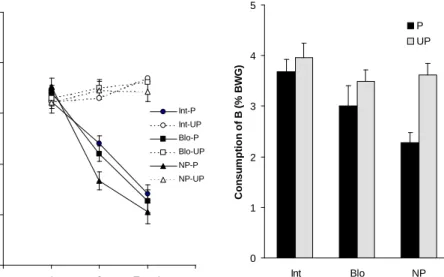
Experiment 1a. The results of this first experiment are depicted in Figure 1. The left panel illustrates the mean consumption (% of body weight gain) of solu-tion A of the different groups during condisolu-tioning and test trials. The right panel
Figure 1: Left panel (a), mean consumption (% body weight gain) of taste A during both conditioning and testing, as a function of conditioning and preexposure procedure. Right panel (b), mean consumption (% body weight gain) of taste B during the generalization test as a function of conditioning and preexposure procedure.
presents the mean consumption (% of body weight gain) of solution B for the dif-ferent groups during the generalization test.
As can be seen in Figure 1a, consumption was equivalent in all the groups on the first conditioning trial. On the second conditioning trial and on the test trial a decrease in consumption of solution A was observed for subjects that have re-ceived this solution paired with the US compared to unpaired controls. This indi-cates that the paired treatment produced taste aversion learning. Preexposed groups that received the paired treatment showed higher consumption than non preex-posed subjects on the second trial of conditioning; thisseems to indicate a re-tardation of acquisition. However, a 3 (Preexposure) x 2 (Conditioning) x 3 (Trial) ANOVA, with consumption of solution A as the dependent variable, revealed no significant effect of preexposure, but significant main effects of conditioning,
F(1,66) = 173.45, trial F(2,132) = 36.82, and the interaction between conditioning and trial, F(2,132) = 69.65. Posthoc analyses of this interaction indicated that on conditioning trial 2 and on the aversion test, but not on the first conditioning trial, consumption of subjects that have received the paired treatment (Groups Int-P, Blo-P, and NP-P) was significantly lower than in the unpaired condition (Groups Int-UP, Blo-UP, and NP-UP). The analyses also revealed a significant decrease of consumption across trials in subjects that have received the paired treatment (Groups P, Blo-P, and NP-P) but not for the unpaired treatment (Groups Int-UP, Blo-UP and NP-UP).
Since a clear differential effect of conditioning treatment was found, and the aim was to assess the effect of preexposure on conditioning, it was considered useful to analyze the effect of preexposure for paired treatment separately from the unpaired treatment. A 3 (Preexposure) x 3 (Trial) ANOVA, with consumption of
Conditioning 0 1 2 3 4 5 1 2 Test A Trial Consumption of A (% BWG) Int-P Int-UP Blo-P Blo-UP NP-P NP-UP (a) Generalization Test 0 1 2 3 4 5 Int Blo NP Preexposure Consumption of B (% BWG) P UP (b)
solution A as the dependent variable of the paired treatment, revealed a significant effect of trial F(2,66) = 127.76, and a significant interaction between preexposure and trial, F(4,66) = 2.77. Posthoc analyses of the interaction indicated that only on trial 2 Group Int-P consumed significantly more than Group NP-P. No significant differences were found between Groups Blo-P and NP-P, or between Groups Blo P and Int-P. When the same ANOVA was made with the consumption of the un-paired groups as the dependent variable, neither the main effects nor the interaction were significant.
The results of the generalization test show that groups that received the paired conditioning treatment consumed apparently less that the unpaired groups (see Figure 1b). However, this difference was remarkably reduced in
both preexposure conditions, especially for subjects that had received the inter-mixed stimulus preexposure condition. This seems to indicate that conditioning to taste A was generalized to taste B, and that this generalization was reduced after taste exposure. The 3 (Preexposure) x 2 (Conditioning) ANOVA, with consump-tion of soluconsump-tion B as dependent variable, revealed significant effects of preexpo-sure, F(2,66) = 6.67, and conditioning, F(1,66) = 9.55, as well as a significant in-teraction between them, F(2,66) = 3.65. Posthoc analyses of the interaction con-firmed the initial impressions indicating that Groups Int-P and Blo-P consumed significantly more than Group NP-P. Groups Int-UP, Blo-UP, and NP-UP did not differ among them. The significant difference between Groups NP-P and NP-UP, attributable to generalization of the conditioned aversion, was observed neither between Groups Int-P and Int-UP, nor between Groups Blo-P and Blo-UP.
Although consumption of solution B of subjects from Group Int-P was higher than Group Blo-P, this difference was not statistically significant. This lack of difference could be indicating that the primary tastes employed were relatively easy to discriminate and therefore there was little room to see a differential effect of the preexposure procedure. Even though pups did generalize between the condi-tioned taste A and the tested taste B (subjects from Group NP-P differed from sub-jects from Group NP-UP), the degree of such generalization apparently was not very high. Planned within-subject comparisons revealed that consumption on test B was significantly superior to consumption on test A for all three paired groups: Int-P, F(1,33) = 375.39, Blo-P, F(1,33) = 303.10, and NP-P, F(1,33) = 109.43. This indicates that subjects, both preexposed and no preexposed to the stimuli, discriminated between the trained stimulus A and the tested stimulus B. No differ-ences between consumption on test A and B were found for the three unpaired groups. Thus, a weak generalization could have masked any effect of the preexpo-sure procedure. If similarity between stimuli is increased, a stronger generalization would be expected and, therefore, there would be a larger scope for observing a differential effect between Groups Int and Blo. As was mentioned before, in stud-ies with domestic chicks it was found that intermixed preexposure was more effec-tive in enhancing stimulus discrimination than blocked preexposure, especially when stimuli were more similar (Honey et al., 1994; Honey & Bateson, 1996). Therefore, in Experiment 1b, a common taste C was added to stimuli A and B, in order to enhance their similarity.
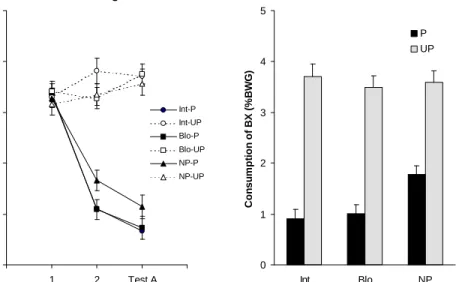
Figure 2: Left panel (a), mean consumption (% body weight gain) of taste AC during both conditioning and testing, as a function of conditioning and preexposure procedure. Right panel (b), mean consumption (% body weight gain) of taste BC during the gener-alization test as a function of conditioning and preexposure procedure.
Experiment 1b. Figure 2a illustrates mean consumption of solution AX for the different groups from Experiment 1b during two conditioning trials and the conditioning test trial; the right panel shows mean consumption of solution BX of the different groups on the generalization test.
On the first conditioning trial consumption of solution AC was equivalent among the six groups. On the second trial and on the conditioning test a decrease in consumption was observed for those subjects that have received paired presenta-tions of the CS and US during conditioning in relation to those that received them unpaired. Yet, contrary to what was observed in Experiment 1a, those subjects that received stimulus preexposure reduced even more their intake during conditioning trial 2 than subjects without preexposure, indicating that a faster conditioning oc-curred. However, a 3 (Preexposure) x 2 (Conditioning) x 3 (Trial) ANOVA, with consumption of solution AC as dependent variable, indicated no significant effects of preexposure but, significant effects of conditioning, F(1,66) = 192.99, and of trial, F(2,132) = 52.22, as well as their interaction, F(2,132) = 96.24. Posthoc analyses of this interaction indicated that conditioned groups consumed signifi-cantly less than nonconditioned groups on conditioning trial 2 and on the test trial, but not on trial 1. These analyses also revealed a significant decrease of consump-tion across trials for the paired treatment (Groups Int-P, Blo-P and NP-P), but not for the unpaired treatment (Groups Int-UP, Blo-UP and NP-UP).
For the same reasons described in the previous experiment, separate analy-ses were computed for paired and unpaired groups to inquire into the preexposure effect. A 3 (Preexposure) x 3 (Trial) ANOVA, with consumption of solution AC for the paired groups revealed a significant effect of preexposure, F(2,33) = 4.40,
Conditioning 0 1 2 3 4 5 1 2 Test A Trial Consumption of AX (% BWG) Int-P Int-UP Blo-P Blo-UP NP-P NP-UP (a) Generalization Test 0 1 2 3 4 5 Int Blo NP Preexposure Consumption of BX (%BWG) P UP (b)
and of trial F(2,66) = 242.72, together with a significant interaction between pre-exposure and trial, F(4,66) = 2.45. Posthoc analyses of the interaction indicated that only on conditioning trial 2 Groups Int-P and Blo-P consumed significantly less than Group NP-P. However, no significant differences were found between Groups Int-P and Blo-P. A 3 (Preexposure) x 3 (Trial) ANOVA, with consump-tion of soluconsump-tion AC for the unpaired groups revealed only a significant effect of preexposure, F(2,33) = 10.85. Posthoc analyses of this effect indicated that both preexposed conditions (Groups Int-UP and Blo-UP) consumed significantly more than Group NP-UP. This result could reflect a habituation of neophobia by stimu-lus preexposure.
As shown in Figure 2b, subjects that received the paired treatment con-sumed solution BC notably less than the unpaired groups; yet, this difference seems to be more marked in the preexposed subjects. A 3 (Preexposure) x 2 (Con-ditioning) ANOVA, with consumption of solution BC as dependent variable, re-vealed a significant effect of conditioning, F(1,66) = 228.28, a borderline effect of preexposure, F(2,66) = 2.99, p = 0.057, and a significant interaction between preexposure and conditioning, F(2,66) = 3.32. Further analyses revealed that Groups Int-P and Blo-P did not differ, but both showed stronger generalized aver-sion when compared to Group NP-P. Consumption was significantly lower for all paired conditions compared to the unpaired conditions.
Within-subject planned comparisons were also computed on consumption in tests AC and BC. These tests revealed higher significant consumption of solu-tion BC than AC only for Group NP-P, F(1,33) = 11.30. No significant differences on consumption were found for both preexposed paired groups (Int-P and Blo-P), and for all unpaired groups.
This indicates that increasing similarity between stimuli apparently in-creased generalization, but failed to produce a differential effect of preexposure procedure in infant rats. Considering these results, it can be concluded that when using more similar stimuli, both procedures of preexposure, intermixed and blocked, produced equivalent effects on conditioning and generalization, although opposite to the results of Experiment 1a. That is, conditioning was facilitated and generalization increased by stimulus preexposure. Why did preexposure to the compound tastes facilitate conditioning but not stimulus differentiation? The in-crease in stimulus similarity by adding a third common taste (C) could have led to an increase in stimulus complexity for the infant rat. So that preexposure could have improved stimulus perception enhancing conditioning but could not be enough to help differentiation between similar complex stimulus. Previous data showed that more experience is necessary with similar compound tastes in order to observe a reduction on generalization between them after exposure in infant rats (Chotro & Alonso, 1999). These results suggest that increasing the number of pre-exposure trials would provide a better opportunity to discriminate the compound stimuli used in Experiment 1b, and perhaps in this way a differential effect of pre-exposure procedure would be found. Therefore, in Experiment 1c the number of preexposure trials was increased in a new attempt to observe differential effects of stimulus preexposure procedure.
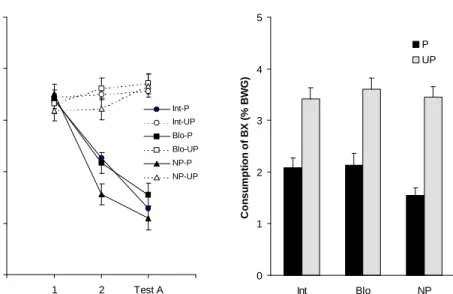
Figure 3: Left panel (a), mean consumption of taste (% body weight gain) AC during both conditioning and testing as a function of conditioning and preexposure procedure. Right panel (b), mean consumption (% body weight gain) of taste BC during the gener-alization test as a function of conditioning and preexposure procedure.
Experiment 1c. Mean consumption of solutions AC and BC is shown in Figures 3a and 3b, respectively.
As can be noticed in Figure 3a, consumption of solution AC was equiva-lent among the six groups on the first conditioning trial. On trial 2 and on the test trial, however, a decrease in consumption was exhibited by those infants that had received the paired treatment on conditioning in relation to those from the unpaired groups. Nevertheless, those subjects that received stimulus preexposure showed a higher consumption of solution AC during trial 2 and test trial, indicating that a slower conditioning occurred for these groups. A 3 (Preexposure) x 2 (Condition-ing) x 3 (Trial) ANOVA, with consumption of solution AC as dependent variable, indicated significant effects of preexposure, F(2,66) = 3.42, conditioning, F(1,66) = 194.50, trial, F(2,132) = 57.60, as well as the interactions Preexposure x Trial,
F(4,132) = 2.48, and Conditioning x Trial, F(2,132) = 104.13. However, no inter-action among the three factors was observed. Posthoc analysis of the first interac-tion, Preexposure x Trial, indicated that preexposed groups consumed significantly more than nonpreexposed groups only on conditioning trial 2. The analysis of the second interaction, Conditioning x Trial, indicated that conditioned groups con-sumed less than nonconditioned groups on trial 2 and on the test trial. These analy-ses also revealed a significant decrease of consumption across trials in conditioned groups but not for nonconditioned groups.
A separate 3 (Preexposure) x 3 (Trial) ANOVA, with consumption of solu-tion AC for subjects receiving the paired condisolu-tion, confirmed the significant ef-fects of preexposure F(2,33) = 4.84, and trial F(2,66) = 173.97, and revealed a significant interaction between both factors, F(4,66) = 3.48. Further analyses of the interaction indicated that on trial 2 subjects from preexposed groups (Int-P and
Conditioning 0 1 2 3 4 5 1 2 Test A Trial Consumption of AX (% BWG) Int-P Int-UP Blo-P Blo-UP NP-P NP-UP (a) Generalization Test 0 1 2 3 4 5 Int Blo NP Preexposure Consumption of BX (% BWG) P UP (b)
Blo-P) did not differ between them but that both consumed significantly more of the conditioned solution than pups from Group NP-P. This indicates that condi-tioning was retarded by preexposure. The 3 (Preexposure) x 3 (Trial) ANOVA, with the consumption of the unpaired groups as the dependent variable, revealed neither significant main effects nor a significant interaction.
As shown in Figure 3b subjects that received the paired treatment con-sumed less than unpaired subjects and that, in the former condition, preexposed subjects consumed more than nonpreexposed ones. The 3 (Preexposure) x 2 (Con-ditioning) ANOVA, with consumption of solution BC as dependent variable, re-vealed a significant effect of conditioning, F(1,66) = 143.60, and a significant in-teraction between preexposure and conditioning, F(2,66) = 3.35. Further analyses of the interaction revealed that preexposure only was significant for the paired condition: Group Int-P did not differ from Group Blo-P but both showed weaker generalized aversions when compared to Group NP-P. Consumption for the paired condition was significantly lower than for the unpaired condition in all preexpo-sure treatments.
Within-subject comparisons revealed a significantly higher consumption of solution BC than solution AC for all three Groups in the paired condition: Int-P,
F(1,33) = 74.32, Blo-P, F(1,33) = 29.55, and NP-P, F(1,33) = 17.08. No signifi-cant differences between consumption were found for unpaired groups.
Token together, these results and those from Experiment 1b suggest that when using compound and similar tastes, relatively little previous experience with the stimuli facilitates conditioning and increases generalization of a conditioned aversion. Only when the number of preexposure trials to the compounds is in-creased, slower conditioning and reduction of generalized aversion are obtained. In both cases, the procedure of stimulus preexposure did not affect conditioning or generalization between stimuli.
More generally, the results of these three experiments suggest that in infant rats the level of generalization between stimuli is determined by the acquisition of conditioning, which, in turn, is affected by the amount of preexposure and the similarity of the stimuli, rather than by the procedure of stimulus preexposure. That is, every time stimulus preexposure produced a slowing of conditioning a reduction of generalization was detected, but whenever preexposure facilitated conditioning a greater generalized response was observed.
The results of these experiments also suggest that, for infant rats, simple tastes may be easier to perceive completely during conditioning, and a short preex-posure to the stimuli (Experiment 1a) produces learning about its lack of conse-quences, which leads to a latent inhibition effect. This same effect was found with compound tastes (relatively more similar stimuli) only after a long exposure (Ex-periment 1c). This may indicate that the compound tastes are perceived as more complex stimuli and that the short exposure during conditioning may not be enough for its complete perception, therefore previous exposure may facilitate its perception (a latent facilitation effect, without learning about its lack of conse-quences) resulting in faster conditioning (Experiment 1b).
Experiment 2
Given that generalization between compound tastes observed in the previ-ous experiments depended on the acquisition rate of conditioning, and this seems to be affected by the amount of CS preexposure, Experiment 2 was conducted to test directly the effect of CS preexposure on during conditioning. The question was whether CS exposure affected conditioning in a similar manner when stimulus exposure occurs before or during conditioning. If the effect of facilitation of condi-tioning to a compound stimulus by preexposure observed in infant rats were de-pendent on a sufficient experience with the stimulus in order to perceive it com-pletely, this should occur independently of whether this experience takes place during or before conditioning, and it would depend only on the total amount of exposure to the stimulus. To test this hypothesis, total exposure time to the stimuli, before or during conditioning, was varied among five different experimental groups. The strength of the conditioned aversion to a compound taste was com-pared among two lengths of CS exposure during conditioning, short (15-min) and long (60-min), and three conditions of preexposure that either equated or exceeded the total amount of exposure time of the long CS on conditioning.
Method
Subjects and Apparatus. Subjects were 50 rat pups (PD 13-16) from 6 litters, 25 males and 25 females. The animals' housing and rearing conditions were as those described for Experiment 1. Apparatus and solutions, as well as the way of administering them, were the same as previously described.
Procedure. Pups were distributed within 5 groups (see Table 1). On PD 13-14 pups re-ceived 2 preexposure sessions (one per day). Each session consisted of three 15-min trials. On each trial subjects received an intraoral infusion equivalent to 5.5% of their body weight. Group ACBC-S received solutions AC and BC in an alternate trials (like Groups Int- in Experiment 1b). Group AC6-S received only solution AC in all trials. Group AC3-AC6-S received solution AC and water in alternated trials. Finally, Groups NP-S and NP-L received water in all trials. The interval between trials was 120 min, being the total duration of each session 405 min, in all cases.
Only one conditioning trial was administered on PD 15. During this conditioning trial, all preexposed groups and one of the nonpreexposed (Groups ACBC-S, AC6-S, AC3-S and NP-S) received a 15-min administration of solution AX paired with the US. The remaining nonpreexposed group (Group NP-L) received a 60-min administration of AC immediately followed by the US. In this last group, consumption of AC during the conditioning trial was measured after the first 15 min of the infusion trial.
Total exposure time to the stimuli for each group, when taking preexposure and condition-ing phases together, was as follows: for Group ACBC-S, a total of 105 min (45 min to taste BC plus 60 min to taste AC); for Group AC6-S, 105 min to taste AC; for Group AC3-S, 60 min to taste AC; for Group NP-S, 15 min to taste AC and for Group NP-L, 60 min to taste AC.
On PD 16 all pups were tested only in their consumption of solution AC. Testing proce-dures were similar to those described before.
Results and Discussion
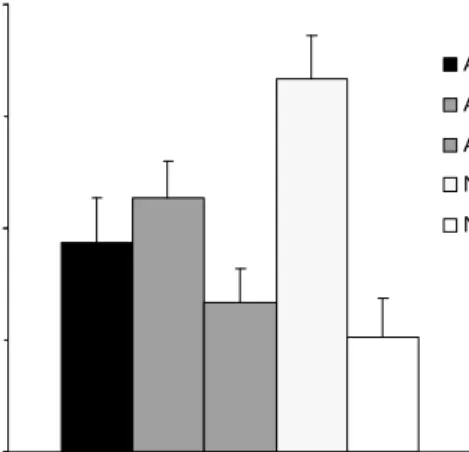
The results are shown in Figure 4, which illustrates the mean consumption of solution AC for the different groups during the conditioned aversion test.
Figure 4: Mean consumption (% body weight gain) of taste AC during the conditioned aversion test as a function of CS preexposure and duration of the CS on conditioning.
Consumption of solution AC was similar among groups on the day of con-ditioning, and after one conditioning trial it was affected by previous stimulus ex-posure as well as by CS duration during conditioning. Compared to subjects that received no preexposure, the short CS resulted in the weakest aversion and the long CS in the strongest one. As was expected, when the CS was preexposed dur-ing a total time equivalent to the nonpreexposed long CS a high level of aversion was also observed. Longer preexposure, to either AC alone, or AC and BC, slightly reduced this high level of aversion.
These impressions were confirmed by the result of a 5 (Group) x 2 (Trial) ANOVA, with consumption of solution AC during conditioning and test as the dependent variable. The analysis indicated significant effects of group, F(4,45) = 8.17, trial, F(1,45) = 920.04, and the interaction between these factors, F(4,45) = 5.37. Further analyses of this interaction revealed that while no significant differ-ences were observed among groups on the conditioning trial, groups differed on the test trial. On that trial Group NP-S showed the highest consumption differing significantly from Groups ACBC-S, AC6-S, AC3-S, and NP-L. Moreover, Groups ACBC-S and AC6-S consumed significantly more than Group NP-L. Lastly, Group AC6-S consumed more of the conditioned solution than Group AC3-S on the test trial. The remaining pairwise differences between groups were not signifi-cant. These analyses also revealed that consumption of solution AC for all groups decreased significantly between conditioning and test trial.
These results indicate that the strength of the conditioned aversion to the compound taste depended on the total amount of time of stimulus exposure either during conditioning alone or during preexposure and conditioning together. Only 15 min of CS exposure during conditioning seemed not enough for generating a conditioned aversion as strong as with the longer CS (60 min). However, the short CS during conditioning resulted in an equivalently strong aversion to that of the long CS when the total time of exposure to it was made equal by preexposure to the CS. Although of a lower magnitude, a relatively strong aversion was also ob-tained when subjects received previous exposure to either the CS alone or together
0 1 2 Consumption of AX (% BWG) AXBX-S AX6-S AX3-S NP-S NP-L GROUP
with a similar stimulus, in a total amount of time exceeding the long CS without preexposure. This last difference observed between preexposed groups and the group receiving only the long CS on conditioning may indicate a certain degree of latent inhibition as a consequence of CS preexposure. That is, more exposure than the one received by the group showing the strongest aversion may weaken the CR. This result seems to agree with previous studies demonstrating that the most im-portant parameter of latent inhibition is total CS-preexposure time (Ayres, Philbin, Cassidy, Bellino, & Redlinger, 1992; De la Casa & Lubow, 1995).
Experiment 3
In Experiments 1a and 1b, a differential effect on conditioning and gener-alization of the CR as a function of the similarity of preexposed stimuli was ob-served. This difference was cancelled out by an increase in the number of preexpo-sure trials (Experiment 1c). These effects were not affected by the procedure of stimulus preexposure. It was argued that enhancing stimulus similarity may have affected gustatory perception and, therefore, conditioning and its subsequent gen-eralization in the infant rat. Compound tastes may be more difficult to perceive than simple tastes for infant rats. As a result, preexposure may have helped to process compound tastes better, and a longer preexposure may have cancelled out the initial disadvantage of the compound taste over the simple taste. That exposure before and/or during conditioning can lead to a better perception seems to be dem-onstrated in Experiment 2, in which the effect of CS duration was assessed. Once the total duration of CS exposure necessary for successful conditioning (and likely a better perception) with similar stimuli has been established, the doubt still re-mains whether any previous stimulus exposure may improve stimulus perception beyond conditioning, enhancing stimulus discrimination. In this case, it would be interesting to know whether a differential effect of the procedure of stimulus pre-exposure on the generalization level is found in infant rats. The aim of Experiment 3 was to confirm and extend the previous results, as well as to test this hypothesis. Thus, the effect of preexposing stimuli intermixed or in two separate blocks on the generalization of a conditioned taste aversion was evaluated as a function of CS duration during conditioning.
Method
Subjects and Apparatus. The subjects were 60 rat pups (PD 13-16) from 9 litters, 32 males and 28 females. Housing and rearing conditions were as those described for previous experiments. The apparatus and solutions were the same as described in Experiment 1b.
Procedure. Preexposure procedures were similar to those described for Experiment 1 (see Table 1). On PD 13-14 pups received 2 preexposure sessions, each consisting of three 15-min in-traoral infusion trials separated by a 120-min interval. Groups Int-S and Int-L received solutions AC and BC intermixed, and Groups Blo-S and Blo-L received them in two blocks (similar to groups Int- and Blo- from Experiment 1b, respectively). Finally, Groups NP-S and NP-L received intraoral infu-sions of water.
As in Experiment 1, conditioning consisted of 2 trials administered on two consecutive days (PD 15-16). However, there were two procedural differences in the present experiment: CS duration was varied and all pups received the CS paired with the US. Half of the pups from each preexposure condition received a 15-min infusion of solution AC (Group Int-S, Group Blo-S and
Group NP-S). The other half received a longer CS, i.e., a 60-min infusion of solution AC (Group Int-L, Group Blo-L and Group NP-L), although their consumption was measured after the first 15 min. The CS was immediately followed by the injection of LiCl in all groups, as before.
Total exposure time to the stimuli for each group, when taking preexposure and condition-ing phases together, was as follows: for Groups Int-S, and Blo-S, a total of 105 min (45 min to taste BC plus 60 min to taste AC); for Groups Int-L, and Blo-L, a total of 150 min (45 min to taste BC plus 105 min to taste AC; for Group NP-S, 15 min to taste AC; and for Group NP-L, 60 min to taste AC.
On PD 17 all pups were evaluated in their consumption of the conditioned solution AC alone (conditioning test) and of the nonconditioned solution, BC (generalization test), following the same procedure as that described for Experiment 1b. Tests were separated by a 4-h interval and their order was counterbalanced within each group.
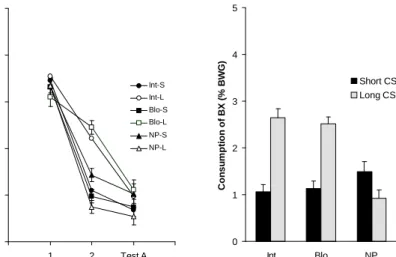
Figure 5: Left panel (a), mean consumption (% body weight gain) of taste AC during both conditioning and testing as a function of CS duration on conditioning and the preexposure schedule. Right panel (b), mean consumption (% body weight gain) of taste BC during the generalization test as a function of CS duration on conditioning and procedure of stimulus preexposure.
Results and Discussion
The results are depicted in Figure 5, which illustrates mean consumption of solutions AC and BC for the different groups. Consumption of solution AC was equivalent among groups on the first conditioning trial, as can be observed in Fig-ure 5a. As expected, on conditioning trial 2 and on test trial a decrease in consump-tion of AC was observed for all groups. However, on the second trial consumpconsump-tion differed in pups preexposed to the stimuli and in pups nonpreexposed to them, depending on the duration of the CS during conditioning. Nonpreexposed pups receiving the long CS during conditioning showed lower consumption of solution AC than those that received the short CS. Also on this trial, pups that received either intermixed or blocked stimulus preexposure showed the opposite tendency in their consumption with respect to nonpreexposed subjects. The long CS on con-ditioning after stimulus preexposure produced higher consumption of solution AC than without preexposure, whereas with the short CS, preexposure decreased
con-Generalization Test 0 1 2 3 4 5 Int Blo NP Preexposure Consumption of BX (% BWG) Short CS Long CS (b) Conditioning 0 1 2 3 4 5 1 2 Test A Trial Consumption of AX (% BWG) Int-S Int-L Blo-S Blo-L NP-S NP-L (a)
sumption of AC when compared to consumption of the nonpreexposed pups. This indicates that, conditioning occurred slower with the long CS than with the short CS, after preexposure, when compared to the corresponding nonpreexposed groups. Finally, the magnitude of the retardation effect of stimulus preexposure on conditioning was greater than the facilitation effect. This tendency was more marked with the blocked than with intermixed preexposure, although the differ-ence between both preexposed groups did not seem too robust.
A 3 (Preexposure) x 2 (CS-duration) x 3 (Trial) ANOVA, with consump-tion of soluconsump-tion AC as the dependent variable, indicated significant effects of Pre-exposure, F(2,54) = 4.16, CS-Duration, F(1,54) = 7.79, and trial, F(2,108) = 351.52. Also significant were the interactions Preexposure x CS-Duration, F(2,54) = 12.58, CS-Duration x Trial, F(2,108) = 5.11, and, most importantly, Preexposure x CS-Duration x trial, F(4,108) = 4.85. Further analyses of this last interaction revealed that only on the second conditioning trial groups’ consumption of taste AC was affected by stimulus preexposure and CS-duration. Group Int-L did not differ significantly from Group Blo-L and both groups showed a significantly higher consumption of the conditioned solution when compared to Group NP-L. This confirmed the retardation of conditioning by preexposure when the duration of the CS was long. It was also observed that Group Int-S did not differ signifi-cantly from Group Blo-S, and that both groups showed signifisignifi-cantly lower con-sumption of the conditioned solution than Group NP-S. This also confirmed the facilitatory effect of preexposure on conditioning, when the duration of the CS was short. Furthermore, Group NP-S consumed significantly more of the conditioned solution than Group NP-L, in agreement with the results of the previous experi-ment, indicating that conditioning of the long CS was better than conditioning of the short CS. On the contrary, Group Int-S consumed significantly less than Groups Int-L, and Group Blo-S less than Group Blo-L corroborating that condi-tioning was affected by the duration of the CS after preexposure (reverting the differences found without preexposure), but not by the preexposure procedure. These analyses also revealed that consumption of solution AC for all groups de-creased significantly across trials.
Figure 5b shows that subjects that have received stimulus preexposure and the long CS during conditioning show less generalized aversion than subjects that have received a similar preexposure but short CS on conditioning, and than non-preexposed subjects trained with long or short CS on conditioning. It can also be observed that, among subjects that had received the short CS during conditioning, preexposed pups showed more generalized aversion than nonpreexposed pups. Once again, no marked differences were evidenced between the two ways of pre-exposure (intermixed or in two separate blocks) on the generalization test of the conditioned aversion. The 3 (Preexposure) x 2 (CS-duration) ANOVA, with con-sumption of solution BC as the dependent variable, revealed a significant effect of preexposure, F(2,54) = 20.60, of CS-duration, F(1,54) = 143.60, and a significant interaction between them, F(2,54) = 55.40. Further analyses revealed that stimulus preexposure affected consumption according to the CS-duration. These posthoc analyses indicated that Group Int-L did not differ from Group Blo-L and that both groups showed significantly reduced generalized aversions when compared to Group NP-L. On the other hand, Groups Int-S and Blo-S did not differ from each
other, but Group Int-S showed a significantly stronger generalization when com-pared to Group NP-S, while Group Blo-S did not differ significantly from this last group. Similarly to what occurred during conditioning, Groups Int-S and Blo-S consumed significantly less than Groups Int-L and Blo-L. By contrast, Group NP-S consumed significantly more than Group NP-L.
Within-subjects comparisons performed between consumption in test AC and BC, revealed significant higher consumption of solution BC than solution AC only for Groups Int-L, F(1,54) = 57.23, and Blo-L, F(1,54) = 40.19. All the re-maining differences were not significant.
In agreement with the results obtained in the previous experiment, the long CS led to a faster conditioning and a greater generalization than the short CS. As before, the degree of generalization was affected by stimulus preexposure in the opposite direction. With a short CS during conditioning, preexposure facilitated the acquisition of the conditioned aversion and increased its generalization. Con-versely, with a more prolonged CS, preexposure produced a reduction in generali-zation preceded by a slower rate of conditioning. However, in contrast to what was expected, a better conditioning was not accompanied by a better discrimination after preexposure, and once again no differential effects of the stimulus preexpo-sure procedure (intermixed vs. blocked) were observed during conditioning or generalization.
General Discussion
One of the aims of this study was to determine whether variations in the procedure of preexposing stimuli (intermixed or blocked preexposure) produced a differential effect on the generalization of taste aversions in infant rats. The results of the present series of experiments with infant rats (PD 13-17) clearly indicate that, at least with the parameters used here, intermixed and blocked preexposure affect generalization of a taste aversion, but not differentially. Moreover, these results suggest that the effect of stimulus preexposure on generalization in infant rats depends directly on the effect of stimulus preexposure on the acquisition rate of conditioning.
With simple primary tastes, both procedures of preexposure retarded ac-quisition (Experiment 1a), as happened with compound tastes and a longer preex-posure (Experiment 1c). Both preexpreex-posure schedules reduced generalization of the conditioned aversion. With compound tastes, however, a relatively short preexpo-sure resulted in facilitation of conditioning and an intensification of generalization, and, again, those effects were similar for both preexposure arrangements (Experi-ment 1b). Furthermore, CS duration affected conditioning (Experi(Experi-ment 2). It was found that when the CS duration on conditioning was not enough to promote an optimum conditioned aversion response, a facilitation of conditioning would be evidenced either by preexposing the stimulus or by increasing the duration of the CS on conditioning. Finally, with stimulus preexposure, an increase in the length of the CS during conditioning retarded conditioning and decreased generalization (Experiment 3), in the same way as previous experiments demonstrated that this occurs by increasing the amount of stimulus preexposure. But once more there was a failure to observe an effect of preexposure procedure on these results.
The lack of effects of stimulus preexposure procedure on generalization, with either simple or compound stimuli, could be interpreted as a developmental deficit related to the short-term memory capacity of developing subjects in altricial species. If the process of stimulus comparison is responsible for the results ob-served with adult rats (Symonds & Hall, 1995) and with chicks (Honey et al., 1994), one could argue that perhaps the result was not evidenced due to the infant rats’ memory deficits (Spear & Riccio, 1994). It is possible that the interval be-tween stimulus presentations used here in the intermixed condition was too long (90 min in Eperiment 1c and 120 min in the other experiments) for the pups to retain specific properties of the stimuli (Kraemer, Hoffmann, & Spear, 1988) and therefore the comparison process would not be favored by an intermixed preexpo-sure vs. a blocked preexpopreexpo-sure. Thus, preexposing stimuli in an alternated fashion would not be so different from presenting them in two separated blocks, as seems to be the case with adult rats (Bennett & Mackintosh, 1999) or young subjects of precocial species (Honey & Bateson, 1996). Nevertheless, a differential effect of intermixed and blocked procedures of stimulus preexposure has not always been reported with adult rats (Sanjuán, 2001). Other studies have shown that the advan-tage of the alternation procedure over the blocked procedure disappears when the interval between preexposure episodes was zero (Bennett & Mackintosh, 1999) or with concurrent presentations (Alonso & Hall, 1999). In any case, the possibility also exists that the lack of difference between both procedures of preexposure in the present studies could be due to a low sensibility of the test employed here. Although these testing procedures seem appropriate to assess other kinds of learn-ing capabilities in infant rats they could be less sensitive for reveallearn-ing the differen-tial effects of preexposure procedures.
Another important issue raised by the present results is why with com-pound tastes relatively few preexposure trials facilitated conditioning. Hoffmann and Spear (1989) reported a facilitation of conditioning after stimulus preexposure in infant rats. They found that preexposure parameters that produced retardation of conditioning in adult rats facilitated conditioning in infants; additional stimulus preexposure was needed to observe latent inhibition (Hoffmann & Spear, 1989). With adult subjects similar facilitation effects of preexposure were reported in a contextual learning situation (Fanselow, 1990; Takigasaki, 1993, 1994). Under somewhat special conditions— one conditioning trial, a complex taste, and a rela-tively short CS duration during conditioning— a facilitation of conditioned taste aversion learning after stimulus preexposure has been found as well with adult rats (Bennett, Tremain, & Mackintosh, 1996). This facilitation was explained by means of the process of unitization proposed by McLaren and Mackintosh (2000), an explanation that could be applied to the present results as well as to similar results found in a previous study (Chotro & Alonso, 1999). The unitization process that could take place during stimulus preexposure, would act improving stimulus repre-sentation and favoring an especially difficult conditioning task, either because the CS is complex and/or because the CS is of short duration. Nonetheless, if the fa-cilitation effect of preexposure on conditioning found in the present study were mediated by a unitization process, then the question still remains as to why the same process did not result in better discrimination. Given that preexposure would
yield to a more complete representation or perception of the stimulus, this better perception should also result in a better differentiation of the stimuli.
This question may be answered by considering, on the one hand, that the unitization process is based on the formation of excitatory associations between stimulus elements, and, on the other, the special characteristics of infant rats for information processing. Thus, the intensification of generalization observed in this case (i.e., with compound tastes and relatively few preexposure trials), could re-spond to a process of acquired equivalence mediated by the presence of the com-mon taste, as has been observed in infant rats (Spear, Kraemer, Molina, & Smoller, 1988). So, instead of enhancing the discrimination, preexposure would result in excitatory associations between the simple components of the compound taste that would make pups treat them as equivalent, responding similarly to both stimuli. In this case, preexposure would not facilitate stimulus discrimination; on the contrary, the stronger the conditioned aversion to the CS, the stronger the generalized re-sponse to the alternative taste.
With respect to the effect of increasing the number of preexposure trials or the total time of stimulus exposure with compound tastes, it is interesting to note that, although a decreased generalization was observed, this effect was apparently weaker than with simple tastes and short preexposure. Rudy, Vogt, and Hyson (1984) suggested that learning processes mediating the execution of simple tasks emerge before those necessary for performing relatively more complex tasks. They have shown that 12-14 days old rat pups can acquire a conditioned aversion to a sound but is not until they are 16-17 days old that they can show a differential response to another similar sound. This differential response, however, can be observed in younger pups when the CSs are very different. With this perspective in mind, we could conceive that, with simple tastes, pups of the age used in the pre-sent experiments can rapidly acquire a conditioned aversion to the CS, and with relatively few preexposure trials they can show a differential response to the alter-native solution, suggesting that stimulus discrimination was enhanced. With more complex and similar tastes, however, pups would have had a harder time to acquire a conditioned aversion to them and preexposure will first facilitate that associative learning, and will not produce the enhanced stimulus discrimination observed with simpler and more different flavors. In this case, in order to observe this reduced generalization effect, pups require more experience with the stimuli.
References
Alonso, G., & Hall, G. (1999). Stimulus comparison and stimulus association processes in the perceptual learning effect. Behavioural Processes, 48, 11-23.
Ayres, J., Philbin, D., Cassidy, S., Bellino, L., & Redlinger, E. (1992). Some parameters of la-tent inhibition. Learning and Motivation, 23, 269-287.
Bennett, C. H., & Mackintosh, N. J. (1999). Comparison and contrast as a mechanism of per-ceptual learning? Quarterly Journal of Experimental Psychology, 52B, 253-272.
Bennett, C. H., Tremain, M., & Mackintosh, N. J. (1996). Facilitation and retardation of fla-vour aversion conditioning following prior exposure to the CS. Quarterly Journal of Experimental Psychology, 49B, 220-230.
Campbell, B. A., & Haroutunian, V. (1983). Perceptual sharpening in the developing rat.
Chotro, M. G., & Alonso, G. (1999). Effects of stimulus preexposure on the generalization of conditioned taste aversions in infant rats. Developmental Psychobiology, 35, 448-462.
De la Casa, G., & Lubow, R. E. (1995). Latent inhibition in conditioned taste aversion: The roles of stimulus frequency and duration and the amount of fluid ingested during preexposure. Neu-robiology of Learning and Memory, 64, 125-132.
Fanselow, M. S. (1990) Factors governing one-trial contextual conditioning. Animal Learning and Behavior, 18, 264-270.
Gibson, E. J. (1969). Principles of perceptual learning and development. New York: Apple-ton-Century-Crofts.
Gibson, E. J., & Walk, R. D. (1956). The effect of prolonged exposure to visually presented patterns on learning to discriminate them. Journal of Comparative and Physiological Psychology, 49, 239-242.
Hall, G. (1996). Learning about associatively activated stimulus representations: Implications for acquired equivalence and perceptual learning. Animal Learning and Behavior, 24, 233-255.
Hall, G. (2001). Perceptual learning: Association and differentiation. In: R. R. Mowrer & S. B. Klein (Eds.), Handbook of contemporary learning theory (pp. 367-407).Hillsdale, NJ: Erlbaum.
Hall, W. G., & Rosenblatt, G. (1977). Suckling behavior and intake control in the developing rat pup. Journal of Comparative and Physiological Psychology, 91, 1232-1247.
Hoffmann, H., Hunt, P., & Spear, N. E. (1991). Ontogenetic differences in CS palatability fol-lowing conditioned taste aversion training. Learning and Motivation, 22, 329-352.
Hoffmann, H., & Spear, N. E. (1989). Facilitation and impairment of conditioning in the pre-weanling rat after prior exposure to the conditioned stimulus. Animal Learning and Behavior, 17, 63-69.
Honey, R. C., & Bateson, P. (1996). Stimulus comparison and perceptual learning: Further evidence and evaluation from an imprinting procedure. Quarterly Journal of Experimental Psychol-ogy, 49B, 259-269.
Honey, R. C., Bateson, P., & Horn, G. (1994). The role of stimulus comparison in perceptual learning: An investigation with domestic chick. Quarterly Journal of Experimental Psychology, 47B, 83-103.
Honey, R. C., & Hall, G. (1989). Enhanced discriminability and reduced associability follow-ing flavor preexposure. Learning and Motivation, 20, 262-277.
Kraemer, P., Hoffmann, H., & Spear, N. E. (1988). Attenuation of the CS-preexposure effect after a retention interval in preweanling rats. Animal Learning and Behavior, 16, 185-190.
Mackintosh, N. J., Kaye, H., & Bennett, C. H. (1991). Perceptual learning in flavour aversion conditioning. Quarterly Journal of Experimental Psychology, 43B, 297- 322.
McLaren, I. P. L., & Mackintosh, N. J. (2000). An elemental model of associative learning: I. Latent inhibition and perceptual learning. Animal Learning and Behavior, 28, 211-246.
McLaren, I. P. L., Kaye, H., & Mackintosh, N. J. (1989). An associative theory of the repre-sentation of simuli: Applications to perceptual learning and latent inhibition. In R. G. M. Morris (Ed.), Parallel distributed processing: Implications for psychology and neurobiology (pp. 102-130). New York: Clarendon Press.
Rudy, J. W., Vogt, M. B., & Hyson, R. L. (1984). A developmental analysis of the rat’s learned reactions to gustatory and auditory stimulation. In R. Kail & N. E. Spear (Eds.), Comparative perspectives on the development of memory (pp. 181-208). Hillsdale, N.J.: Erlbaum.
Sanjuán, M. C. (2001). Efecto de la experiencia previa con los estímulos sobre su discriminación posterior. Unpublished Doctoral Dissertation. Universidad del Pais Vasco.
Spear, N. E., Kraemer, P., Molina, J. C. & Smoller, D. E. (1988). Developmental change in learning and memory: Infantile disposition for unitization. In J. Delacour & J. C. S. Levy (Eds.),
Systems with learning and memory abilities (pp. 27-52). Amsterdam: Elsevier.
Spear, N. E., & Mackinzie, D. L. (1994). Intersensory integration in the infant rat. In D. J. Lewkowicz & R. Lickliter (Eds.), The development of intersensory perception: Comparative perspec-tives. Hillsdale, NJ: Lawrence Erlbaum.
Spear, N. E., & Riccio, D. C. (1994). Memory: Phenomena and principles. Boston, MA: Al-lyn and Bacon.
Symonds, M., & Hall, G. (1995). Perceptual learning in flavor aversion conditioning: Roles of stimulus comparison and latent inhibition of common stimulus elements. Learning and Motivation, 26, 203-219.
Takigasaki, T. (1993). Effects of contextual preexposure on the context-shock conditioning in rats. Japanese Psychological Research, 35, 148-152.
Takigasaki, T. (1994). Facilitation effect of contextual preexposure on the freezing of rats.
Perceptual and Motor Skills, 79, 1283-1287.
Received February 11, 2002. Revision received May 31, 2002. Accepted June 16, 2002.