CHAPTER 2
Gathering Network Requirements
Objectives
Upon completion of this chapter, you should be able to answer the following questions:
■ What occurs during the six phases of the
PPDIOO model?
■ What is the proper way to respond to a Request
for Proposal or Request for Quote?
■ What are the roles of a network partner team?
■ How are business goals prioritized to determine
technical requirements for a network upgrade project?
■ How do constraints affect the design of a network?
Key Terms
This chapter uses the following key terms. You can find the definitions in the Glossary.
business case page 50 availability page 51 reliability page 51 security page 51 scalability page 51 manageability page 51 PPDIOO page 51
Request For Proposal (RFP) page 53 Request For Quote (RFQ) page 53 system-level acceptance testing page 55 network baseline page 56
Network Management System (NMS) page 70 Simple Network Management Protocol version 3
(SNMPv3) page 70
In this chapter you are introduced to StadiumCompany, a sports facility management company that manages a stadium located outside of a major city. StadiumCompany needs to upgrade its existing computer network to provide state-of-the-art services. To do this, StadiumCompany management outlines a three-phase project. In the first phase, StadiumCompany is contracting with NetworkingCompany, a local Cisco business partner, to prepare a network design requirements document. In the second phase, the stadium management plans to issue a contract for the detail network design. After the design is completed, the final phase will be the installation and implementation of the network upgrade. StadiumCompany is also in the process of negotiating a contract with FilmCompany, a film production company located in the nearby major city. FilmCompany will be responsible for producing, filming, and delivering high-quality video for download from the stadium website. StadiumCompany management is also requiring FilmCompany to produce live video displays during the sporting events and concerts held at the stadium.
Follow the progress of NetworkingCompany as it helps both StadiumCompany and FilmCompany plan and design their network upgrades.
The StadiumCompany story demonstrates concepts in the main text, media, and PacketTracer (PT) activities. The FilmCompany story provides context for the corresponding student practice in the hands-on labs.
As you job-shadow the NetworkingCompany team, you will learn the skills needed to plan and design the StadiumCompany network upgrades. Your new design skills enable you to support the NetworkingCompany team plan and design similar upgrades for the smaller FilmCompany network. The design portfolio you create during this work assignment will enable you to develop and present your network upgrade proposal to the FilmCompany management team.
In general, the StadiumCompany design project is used in the main text, media, and PT activities. The FilmCompany design project is completed in the hands-on labs. The StadiumCompany story (see Appendix B) and the FilmCompany story (see Appendix C) are located in the appendixes and on the accompanying CD-ROM.
Introducing Cisco Lifecycle Services
The world of networking is evolving. Networking is no longer just about connecting computers. Networking has become intelligent and plays a vital role in helping to improve business performance. Businesses are eager to expand their networks. Taking advantage of advances in technology, companies can add new services and increase productivity.
Cisco Lifecycle Services is designed to support evolving networks. Cisco Lifecycle Services is a six-phase approach. Each phase defines the activities required to successfully deploy and operate Cisco technologies. It also details how to optimize performance throughout the lifecycle of a network.
The six phases of the Cisco Lifecycle Services are as follows:
■ The Prepare phase: The Prepare phase involves establishing the organizational requirements,
developing a network strategy, and proposing a high-level conceptual architecture identifying technologies that can best support the architecture. The Prepare phase can establish a financial justification for network strategy by assessing the business casefor the proposed architecture.
■ The Plan phase: The Plan phase involves identifying initial network requirements based on
goals, facilities, user needs, and so on. This phase involves characterizing sites and assessing any existing networks. It also includes performing a gap analysis to determine whether the existing system infrastructure, sites, and operational environment are able to support the proposed system.
A project plan is useful to help manage the tasks, responsibilities, critical milestones, and resources required to implement changes to the network. The project plan should align with the scope, cost, and resource parameters established in the original business requirements.
■ The Design phase: The initial requirements that were derived in the Plan phase drive the activities
of the network design specialists. The network design specification is a comprehensive, detailed design that meets current business and technical requirements. It incorporates specifications to support availability, reliability,security,scalability, and manageability. The design specification is the basis for the implementation activities.
■ The Implement phase: After the design has been approved, implementation (and verification)
begins. The network is built, or additional components are incorporated, according to the design specifications. The goal is to integrate devices without disrupting the existing network or creating points of vulnerability.
■ The Operate phase: Operation is the final test of the appropriateness of the design. The Operate
phase involves maintaining network health through day-to-day operations, including maintaining high availability and reducing expenses. The fault detection, correction, and performance monitoring that occur in daily operations provide initial data for the Optimize phase.
■ The Optimize phase: The Optimize phase involves proactive management of the network. The
goal of proactive management is to identify and resolve issues before they affect the organization. Reactive fault detection and correction (troubleshooting) is needed when proactive management cannot predict and mitigate failures. In the PPDIOO process, the Optimize phase may prompt a recommendation for network redesign. Redesign may be necessary if too many network problems and errors arise, if performance does not meet expectations, or if new applications are identified to support organizational and technical requirements.
This process is often referred to as PPDIOO, based on the first letters of each of the six phases.
Case Study: Sports Stadium Network
The management organization of a stadium is working with the NetworkingCompany to renovate and update the stadium network. Over the years, the stadium network has grown. However, little thought was given to overall business goals and infrastructure design. Some new projects went forward. But the network administrators did not have a realistic understanding of the bandwidth, traffic prioritiza-tion, and other requirements needed to support such an advanced and business-critical network. The stadium management now wants to add new high-tech features, but the existing network is not capable of supporting them.
NetworkingCompany representatives meet with the stadium management to discuss the process they intend to use to design the new network. Although the Design phase is only one of the phases in the network lifecycle, all of the PPDIOO phases impact the design decisions.
In the Prepare and Plan phases, the network designer and stadium staff identify the business goals and technical requirements of the stadium organization as well as any design constraints. The requirements gathering that occurs during these phases influences the decisions made during the Design phase. The Implement phase begins after the approval of the design. It includes the initial integration of the new design into the existing network.
During the Operate and Optimize phases, the stadium personnel analyze and monitor the network performance.
The Network Lifecycle Prepare Phase
During the Prepare phase, the stadium management and NetworkingCompany staff define the following business goals:
■ Improve customer experience ■ Reduce costs
■ Add additional services ■ Support company expansion
These goals provide a foundation for a business case. The business case is used to justify the financial investment required to implement the technology change. The company considers possible business constraints, including budget, personnel, company policies, and schedule limitations.
The five business case components are as follows:
1. Purpose of the Project
■ How the project meets company business goals ■ Main benefits and risks
■ Success measurements
2. Cost/Benefit Analysis
■ Options to meet business goals ■ Nonfinancial benefits
3. Sourcing Options
■ Sources required for services (outside vendors, network installation companies) ■ Purchasing procedures
4. Budgeting
■ Affordability and funding sources (internal and external) for whole project at once or over a
period of time
5. Project Management
■ Project plan and roles ■ Timeline
■ Major risks and plan to minimize impact ■ Emergency plans if project not accomplished ■ Skills and personnel requirements
After the business case is accepted, the NetworkingCompany staff assists in the development of the high-level technology strategy and solution.
This strategy identifies the following:
■ Advanced technologies that support the new network solution
■ Current and planned network applications and services, and their priorities based on business goals ■ People, processes, and tools required to support the operations and management of the technology
The Prepare phase is typically done before a company issues a Request For Proposal (RFP)or
Request For Quote (RFQ). RFPs and RFQs describe the requirements for the new network. They include information about the process that the company uses to purchase and install networking technologies.
The Network Lifecycle Plan Phase
During the Plan phase, the network designer performs a comprehensive site and operations assessment. This assessment evaluates the current network, operations, and network management infrastructure. The NetworkingCompany staff identifies all physical, environmental, and electrical modifications. They assess the ability of the current operations and network management infrastructure to support the new technology solution. All changes to infrastructure, personnel, processes, and tools must be completed before the implementation of the new technology solution. Sample assessment areas are as follows:
■ Environmental
■ Potential electrical issues
■ Space issues in racks/wiring closets ■ UPS or backup power issues ■ AC issues with additional equipment ■ Adequate cabling infrastructure ■ Personnel
■ Adequate number of staff for maintaining planned upgrade ■ Technical knowledge level of staff adequate or staff needs training
Custom applications that add to the feature and functionality requirements for the new network are also identified in this phase. The NetworkingCompany staff creates a document that contains all of the design requirements.
The Project Plan
In this phase, the NetworkingCompany staff and stadium management create a plan to help manage the project. The project plan includes the following:
■ Tasks
■ Timelines and critical milestones ■ Risks and constraints
■ Responsibilities ■ Resources required
The plan needs to be within the scope, cost, and resource limits established in the original business goals. Both the stadium management and the NetworkingCompany assign individuals to manage the project.
Lab 2-1: Creating a Project Plan (2.1.3)
In this lab, you will identify the business goals and constraints for the FilmCompany. Refer to the hands-on lab in Part II of this Learning Guide. You may perform this lab now or wait until the end of the chapter.
The Network Lifecycle Design Phase
In the Design phase, the NetworkingCompany staff uses the initial requirements determined during the Plan phase to direct its work. Figure 2-1 shows the initial topology identified during the Plan phase.
Figure 2-1 Physical Connections
Ticket Sales Office ISP2 ISP1 Edge Router Team
Switch VendorSwitch Luxury SuitesSwitch
Stadium Switch
Web
E-Commerce
Stadium LAN Team Services LAN Vendor Services LAN VIP Services LAN
Payroll Accounting Accounting Accounting DNS ISP3 VPN
(Over DSL) (Over DSL)VPN Vendor
(Souvenir Shop) Internet
Physical Connections
The design requirements document supports the specifications identified in the Prepare and Plan phases for the following:
■ Availability ■ Scalability ■ Security ■ Manageability
The design must be flexible enough to allow for changes or additions as new goals or needs emerge. The technology must be integrated into the current operations and network management infrastructure.
Planning the Installation
At the end of the Design phase, the network designer creates plans that guide the installation and ensure that the end result is what the customer requested. Plans include the following:
■ Configuring and testing connectivity ■ Implementing the proposed system
■ Demonstrating the functionality of the network ■ Migrating network applications
■ Validating network operation
■ Training end users and support personnel
During the Design phase of the stadium network upgrade, the design of the network is completed. Any new equipment and technologies are specified and tested. A review of the proposed design confirms that the business goals are met. A final proposal is generated to continue with the implementation of the network upgrade.
Interactive Activity 2-1: Identify the Aspects of the PPDIOO Network Lifecycle Phases (2.1.4)
In this interactive activity, you match the characteristics of the hierarchical model and the Cisco Enterprise Architecture to their correct location. Use file ia-214 on the CD-ROM that accompanies this book to perform this interactive activity.
The Network Lifecycle Implement Phase
The Implement phase begins after the NetworkingCompany completes the design and the customer approves it. The network is built according to the approved design specification. The Implement phase verifies the success or failure of the network design.
Testing the New Network
Testing all or part of a new network solution in a controlled environment helps to identify and resolve any implementation issues before the actual installation.
After the issues have been resolved, the NetworkingCompany staff installs the new solution and integrates it into the existing network. When the installation is complete, additional testing is done.
System-level acceptance testingchecks that the new network meets the business goals and design requirements. The results of this test are recorded and become part of the documentation provided to the customer. Any training required for the stadium staff needs to be completed during this phase.
Interactive Activity 2-2: Matching Terms to Definitions (2.1.5)
In this interactive activity, you match the terms to the appropriate definition. Use file ia-215 on the CD-ROM that accompanies this book to perform this interactive activity.
The Network Lifecycle Operate Phase
The Operate and Optimize phases are ongoing. They represent the day-to-day operations of a network. The stadium staff monitors the network and establishes a network baselinethrough the use of software such as Cisco Internetwork Performance Monitor. This monitoring helps the company achieve maximum scalability, availability, security, and manageability.
After the new network is installed, stadium personnel manage the network to ensure that it is performing to the design specifications outlined in the Prepare and Plan phases.
Defining Policies and Procedures
Policies and procedures are needed to handle network issues, such as the following:
■ Security incidents ■ Configuration changes ■ Equipment purchases
Updating these policies and procedures after an upgrade reduces downtime, operating costs, and change-related issues. If there are no policies and procedures in place, it is important to create them.
Lab 2-2: Observing Traffic Using Cisco Network Assistant (2.1.6)
In this lab, you will use Cisco Network Assistant to observe traffic. Refer to the hands-on lab in Part II of this Learning Guide. You may perform this lab now or wait until the end of the chapter.
The Network Lifecycle Optimize Phase
Optimizing the network is a continuous process. Its purpose is to improve network performance and reliability by identifying and resolving potential network problems before they happen. The Cisco Security Device Manager (SDM) is an example of one utility used for keeping the network optimized. Optimizing the network ensures that the business goals and requirements of the company are maintained. Common network problems that could be discovered in the Optimize phase include the following:
■ Feature incompatibilities ■ Insufficient link capacity
■ Device performance problems when multiple features are enabled ■ Scalability of protocols
As business goals change, the technology strategy and operations may not adapt. At some point, a redesign may be required and the PPDIOO cycle starts again.
Interactive Activity 2-3: Match the Appropriate Action to the Lifecyle Phase (2.1.7)
In this interactive activity, you determine if an action is part of the Prepare, Plan, Design, Implement, Operate, or Optimize phase of the network lifecycle. Use file ia-217 on the CD-ROM that accompa-nies this book to perform this interactive activity.
Explaining the Sales Process
The documentation generated each time a project is designed must be complete and accurate. To this end, the network designer must understand the process from start to finish on how to create a response document and submit it for client approval. The response document begins with a customer’s RFP or RFQ.
Respond to a Customer Request for a Proposal or Quote
When a business or organization decides to upgrade or replace their existing network, they usually generate a Request for Proposal (RFP) or a Request for Quote (RFQ). In the PPDIOO model, this occurs at the end of the Prepare phase. RFPs and RFQs include specifications that define the format and content of the expected responses from the potential contractors. It is critical for contractors to follow the instructions contained within the document as accurately as possible. Not following the directions or missing sections of the request could mean that the project is awarded to another contractor. In addition to the response format and content, RFPs and RFQs contain schedules that must be followed. The company that sent out the RFP may reject a late response.
Each section of the response document should be as detailed as possible. Unless otherwise indicated, the section numbers of the response document should correspond with the section numbers of the request. The response should be written with the target audience in mind. Technical terms and concepts need to be explained where necessary.
To ensure that the response document is easy to read, a table of contents is used to organize the material. An introductory letter is included to introduce the material.
Response Document
The response document comprises the following elements:
■ Cover Letter: Document prepared on the company letterhead that includes the following: ■ All relevant contact information for the company, including the following:
Name of main contact person for the project and other appropriate staff Phone numbers and fax numbers for company and personnel listed
■ A brief, concise summary of the proposed project ■ Executive Summary: Section that includes the following:
■ Definition of the problem or requirements of the customer ■ Recommended solution and its value or benefit to the customer ■ Reason why your company is the right one to do the job
■ Proposed Solution:Section that includes, but is not limited to, the following: ■ Detailed descriptions of solution
■ Project management team and timeline (with explicit tasks and dates if possible) ■ Cutover or turnover schedule
■ Onsite or remote support details relating to type of support and time period available ■ Warranty or defective parts information identifying the following:
Length of coverage
Procedure for repair or replacement Timeline for response
Repair commitment for problems identified
■ Description of what is considered a major or minor problem ■ Emergency installations or responses if a disaster happens
■ Responsibilities of company relating to any interaction required relating to ISP or service level
agreement with the ISP
■ Environmental or facility upgrade requirements and who is responsible
■ Any terms and conditions for damage by company, equipment or personnel to customer’s site ■ Proposed Cost: Section with budget details that may include, but are not limited to, the following:
■ Software and application components ■ Hardware components and interfaces ■ Licensing required
■ Fees or permit costs ■ Training charges
■ Warranty, maintenance, and support costs
■ Labor cost per hour or flat fees related to staff working on project ■ Travel expenses if applicable
■ Telecommunication service provider charges for changes and upgrades ■ Specific tools or equipment required to complete the job
■ Removal or disposal costs if applicable
■ Costs related to equipment rental such as forklifts needed for implementation ■ Electrician charges
■ Methods of payments including leasing options if appropriate ■ Final payment method after acceptance
■ Signature Page: Section of proposal that is signed by customer representative with authority to
accept the project.
■ Appendixes: Section with additional information supporting proposal, which may include the
following:
■ Detailed lists of equipment and services
■ Diagrams and forms related to equipment and services list
■ Background company information, which may include items such as the following:
Size of the company as it relates to total number of employees and revenues earned Services and products the company provides
Reference list of previous customers for projects similar to the current RFP
Brief biographies of employees that will be working on the project including their education and certifications
The insurance and liability coverage of the company relating to projects
Identification of outside vendors if the company plans to use subcontractors as part of the service and product structure
Attend a Prebid Meeting
Prior to the deadline for submitting RFP responses, the customer may schedule an informational meeting. This meeting may be referred to as a prebid meeting or presubmittal conference. The purpose of the meeting is to provide the following:
■ An opportunity to review the project scope with the customer
■ Additional information and documentation identified but not included in the original RFP ■ Clarification of formatting and project timeline details not included in the original RFP
The meeting enables the contractor to get an estimate of the number of other companies that are interested in submitting a bid on the project. If a prebid meeting is not scheduled, the information or documentation can be requested by contacting the appropriate personnel identified in the RFP.
Explain the Request for a Proposal
Businesses usually send a copy of the RFP to contractors. Occasionally the RFPs may be posted on the business website. Responses to an RFP help the customer compare services, products, pricing, and support offered by the different contractors.
Typically an RFP for a network project includes the following:
■ Business goals for the project ■ Anticipated project scope
■ Information on the existing network and applications ■ Requirements for the new network
■ Business, technical, or environmental constraints ■ Preliminary schedule with milestones and deliverables ■ Legal contractual terms and conditions
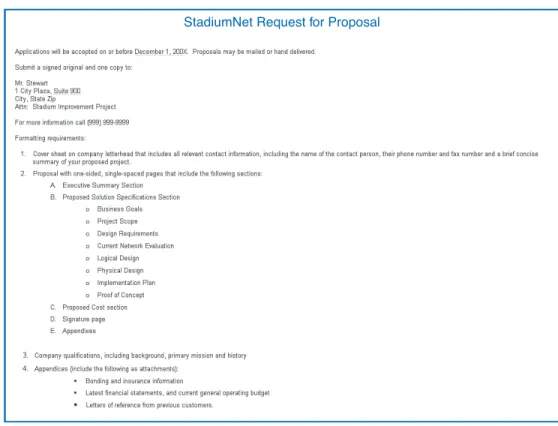
Figure 2-2 illustrates the formatting requirements for an RFP. When responding to an RFP, it is impor-tant that every item listed on the RFP is answered. The company that sent out the RFP may reject an incomplete proposal.
Figure 2-2 Sample Request for Proposal
StadiumNet Request for Proposal
Explain the Request for Quote
Businesses use an RFQ instead of an RFP when the technical specifications of the project are already known. If a business has a skilled networking support staff, the staff can write an RFQ to obtain the costs for the necessary services and equipment. An RFQ is usually much simpler to respond to than an RFP, because the costs associated with an RFQ can easily be obtained or estimated.
An RFQ can vary in content but will generally have three main parts. Like an RFP, the RFQ response may have formatting requirements. Proposal deadlines may be strictly enforced.
The main parts of an RFQ are as follows:
■ Organizational Overview: This section of an RFQ contains background information on the
company issuing the RFQ. It provides some insight into what type of business the RFQ is for.
■ Required Deliverables: This section of an RFQ describes what the end product of the project
must be—for example, the company issuing the RFQ is looking for a company to install an 1841 router or similar device. The deliverables section would include the device type and the scripting that may be required (VLANs and so on).
■ Assumptions/Agreements: This section describes the terms of the project, such as project budget,
submission date, the types of support the company will provide to the contractor, the process used to approve services and materials, and so on. By submitting a response to an RFQ, the contractor or designer agrees to the terms in this section.
The same guidelines used to respond to an RFP should be followed when responding to an RFQ. Follow all directions precisely and submit the response before the deadline to ensure that it is considered.
Interactive Activity 2-4: Identify Sections and Components in an RFQ (2.2.4)
In this interactive activity, you drag the characteristics on the right to the matching part of an RFQ. Use file ia-224 on the CD-ROM that accompanies this book to perform this interactive activity.
Explain the Role of the Account Manager
When the NetworkingCompany receives the RFP from the StadiumCompany, the task of responding to it is assigned to an account manager. NetworkingCompany account managers are responsible for maintaining a continuing relationship between the company and its customers. This relationship begins when an account manager first contacts a potential customer. It continues throughout all phases of the PPDIOO network lifecyle. Business customers rely on the knowledge and expertise of their account manager to help them determine network requirements. Gaining and keeping a customer’s trust is critical to an account manager’s success. The account manager assigned to the stadium account is responsible for ensuring a good business relationship between the StadiumCompany and the NetworkingCompany.
Communications Channel
The account manager serves as the primary NetworkingCompany contact for stadium management personnel. A good account manager needs excellent interpersonal skills and a thorough knowledge of the customer’s business. The account manager communicates with the stadium management through face-to-face meetings, phone calls, e-mail, or a combination of more than one method, depending on the customer’s preferences.
Account Manager Responsibilities
In some companies, account managers are responsible for contacting all customers and potential cus-tomers within a geographic area or territory. Other companies assign account managers to accounts based on the customer’s type of business. Although specific duties may vary from position to position, most account managers are responsible for the following:
■ Meeting their assigned sales and revenue goals
■ Communicating information about new products or technologies to customers and potential customers ■ Directing local sales, service, and support teams
■ Planning and budgeting for sales and support projects
■ Responding to customer requests for proposals, demonstrations, quotations, and information ■ Negotiating and maintaining sales or service contracts
At the NetworkingCompany, account managers are required to take sales and customer management training, in addition to demonstrating basic networking skills.
Explain the Role of the Presales Systems Engineer
The NetworkingCompany employs both presales and postsales technical staff to assist the account manager in providing support for their customers.
Presales systems engineers (sometimes called presales technical support engineers) help the account manager and the customer to determine the need for upgrades or additions to the customer’s network. Account managers rely on the technical expertise of the presales systems engineers to ensure that any
new equipment and services are appropriate for the customer’s network needs. In the Plan and Design phases of the PPDIOO lifecycle, presales systems engineers provide assistance to determine the technical requirements and feasibility of proposed network changes. These engineers, as well as network technicians who work with them, are responsible for the following:
■ Evaluating the customer’s current network
■ Determining if a network upgrade or addition can meet the technical requirements ■ Ensuring that the proposed changes can be integrated into the existing customer network ■ Testing and evaluating proposed solutions
The presales systems engineer assists the network designer in identifying problems with the existing network or possible problems that changes to the network may cause. Early identification and problem resolution is pivotal to a successful network upgrade or installation. The presales systems engineer plays a vital role in creating an accurate response document to an RFP.
Training requirements for presales systems engineers include network design courses, as well as network technology courses. Many presales systems engineers are required to obtain network design certifications. An example of such certification is the Cisco Certified Design Associate (CCDA).
Explain the Role of the Network Designer
A network designer needs a thorough understanding of the capabilities of all types of networking technologies and equipment. These skills enable the designer to provide customers with a network design that meets the customer requirements for scalability, availability, security, and manageability. The designer is involved in the Plan and Design phases of the PPDIOO network lifecycle. In some smaller companies, a presales systems engineer may also perform the role of network designer. In larger companies, there may be a team of network designers working on a single project. In this course, a single network designer will be used.
A good network designer takes the time to learn about the customer’s business, in addition to the customer’s network requirements. This helps the designer anticipate changes that might occur as the business grows and succeeds. A designer is responsible for the following:
■ Analyzing customer goals and constraints in order to determine the technical requirements for the
new design
■ Evaluating the current installed network
■ Selecting the technologies and equipment capabilities to meet the defined network requirements ■ Diagramming the placement and interconnection of various network devices and services ■ Designing and supervising proof-of-concept testing
■ Assisting the account manager in preparing presentations to the customer
At the NetworkingCompany, the design staff is made up of highly skilled network professionals. The network designer must stay up to date about technologies, as well as new design-recommended practices. The designer is required to obtain network design certifications, in addition to technical networking professional certifications.
The designer assigned to the stadium upgrade is a Cisco Certified Design Professional (CCDP). By obtaining this advanced certification, the designer has demonstrated the competencies necessary to design a complex network for the stadium company.
Explain the Role of the Postsales Field Engineer
During the Implementation, Operation, and Optimize phases of the PPDIOO network lifecycle, the postsales field engineer (sometimes called the postsales technical support engineer) takes over the technical support responsibility from the presales staff. It is usually a postsales field engineer who is responsible for the smooth installation of new network equipment. Postsales field engineers work with the customers to ensure that the network upgrade functions as designed.
Responsibilities of the postsales field engineer include the following:
■ Provide installation assistance and acceptance testing.
■ Support and organize troubleshooting of components or systems. ■ Resolve technical problems the customer may encounter.
■ Provide customer training and assistance with managing and configuring devices.
The postsales field engineer helps develop recommended changes to the network design throughout the PPDIOO lifecycle.
Training requirements for postsales field engineers include basic and advanced networking technology courses. Some technologies, like IP voice, require the postsales field engineer to take additional advanced training courses. A Cisco Certified Network Associate (CCNA) certification is considered a minimum requirement for most postsales field engineer positions.
Interactive Activity 2-5: Identify the Appropriate Activity Area (2.2.8)
In this interactive activity, you drag the appropriate position to match its activity. Use file ia-228 on the CD-ROM that accompanies this book to perform this interactive activity.
Preparing for the Design Process
The network designer must work effectively with the client to ensure the successful deployment of a proposed design. Interaction between designer and client is instrumental in creating a design that meets the needs of the client and users of the network. After the users are identified, the network designer can tailor the design to ensure that it meets the business goals of the organization as a whole.
Working with the Customer
In designing the new network for the stadium, the NetworkingCompany interacts with personnel from the stadium offices. When the network designer and staff meet with the stadium personnel, it is important that they behave in a professional manner.
The Importance of Interpersonal Skills
Good interpersonal skills are critical when interacting with customers. A calm and courteous manner instills confidence in customers. The customer believes that the NetworkingCompany designer and staff can perform the necessary tasks.
The following skills are essential when working with clients:
■ Listening and accurately summarizing information
■ Corresponding with clients in a style, format, and level of detail appropriate for the intended audience ■ Presenting well-organized technical material in a logical fashion
The ability to develop a good rapport with a client is crucial. Establishing a trusted business relation-ship eliminates many potential problems and contributes enormously to the success of the project for both companies. The following is a checklist of good interpersonal skills:
■ Positive attitude
■ Good communication skills ■ Courteous ■ Flexible ■ Trustworthy ■ Teamwork-oriented ■ Self-directed ■ Disciplined ■ Motivated
Defining the Customer
To create a comprehensive plan, the network designer needs to understand how the network users interact with the network resources and services. The designer gathers information about all internal and external access to the existing network infrastructure. Without full knowledge of who has access to the network, the designer may overlook some user requirements. As a result, the designer may present a design that is incomplete. Failure to submit an adequate design generates delays and increased costs.
Identifying Relevant Information
When gathering information on the infrastructure, the designer works with stadium personnel to identify all user groups. The customer’s organizational chart is one of many components the designer must acquire. It is important to look beyond the organizational chart to determine all the end users and stakeholders who access the customer network.
The stadium management identifies the following potential end users:
■ Branch and field office staff ■ Remote workers
■ Sales and support personnel working offsite ■ Vendors, suppliers, and partners
■ Board members
■ Consultants and contractors ■ Customers
Adding User Access
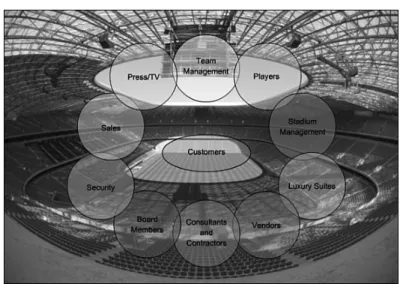
The designer also needs to assess the impact of adding new user groups to the network. Some end-user groups that currently do not have network access may need access to new stadium network resources in the future. Figure 2-3 illustrates the different users that may need access to the stadium network. The designer works with stadium management to identify the following:
■ New user groups
■ The type of access required ■ Where access is allowed ■ The overall impact on security
Including this information in the Plan and Prepare phases helps to ensure an accurate and successful new design.
Figure 2-3 Stadium Customers
Lab 2-3: Creating a Network Organization Structure (2.3.2)
In this lab, you will create a network organization structure of the FilmCompany. Include all stake-holders in the structure—internal network users, IT organizations, external customers, suppliers, and partners. Refer to the hands-on lab in Part II of this Learning Guide. You may perform this lab now or wait until the end of the chapter.
Identifying Business Goals and Priorities
The goal of every business is to be successful. Before beginning any network project, business managers analyze the feasibility of the project based on how it contributes to business success. They must consider the following:
■ Profitability: Can the project reduce costs or help the business avoid costs in the future? ■ Business growth and market share: Can the project help the business grow more efficiently or
create competitive advantages?
■ Customer satisfaction: Can the project improve the customer experience and increase customer
This feasibility analysis enables the business managers to put together a list of high-level goals for the network project. The network designer notes these goals and records any issues or concerns that are mentioned.
Prioritizing Goals
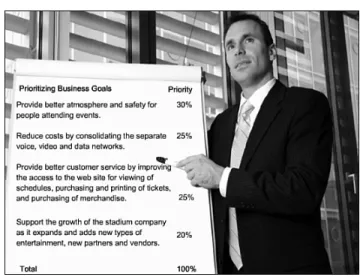
In consultation with the stadium management, the designer prioritizes the business goals. The priori-ties are based on which goals present the best opportunipriori-ties to contribute to the success of the busi-ness. For example, the relative importance of each goal can be rated as a percentage of the overall total of 100.
After the NetworkingCompany obtains the list of the prioritized business goals as illustrated in Figure 2-4, the Plan phase begins.
Figure 2-4 Prioritizing Business Goals
Lab 2-4: Prioritizing Business Goals (2.3.3)
In this lab, you will ensure that the information gathered is accurate and create a checklist of the business goals of the FilmCompany. Refer to the hands-on lab in Part II of this Learning Guide. You may perform this lab now or wait until the end of the chapter.
Identifying Technical Requirements and Constraints
Network designers prioritize the business goals of an organization in an effort to ensure success of the network they design. The next element of the network design includes the technical requirements and the constraints that may require a change in the design. The designer must be able to adapt the design in a manner that meets both the business goals and the technical requirements of the client.
Defining Technical Requirements
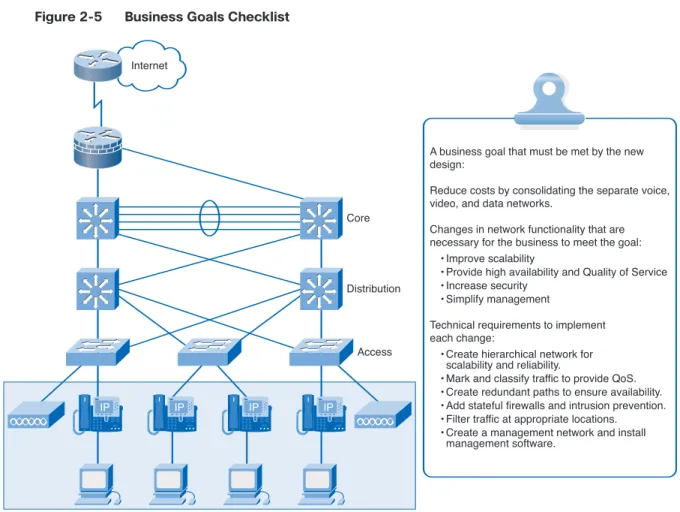
After obtaining the prioritized business goals, the network designer determines the network functionality needed to meet each goal. The designer lists the business goals that must be met by the new design and then decides what is required technically to implement each change. Figure 2-5 illustrates an example of common business goals.
Figure 2-5 Business Goals Checklist IP IP IP IP Distribution Core Access Internet
A business goal that must be met by the new design:
Reduce costs by consolidating the separate voice, video, and data networks.
Changes in network functionality that are necessary for the business to meet the goal:
• Improve scalability
• Provide high availability and Quality of Service • Increase security
• Simplify management
Technical requirements to implement each change:
• Create hierarchical network for scalability and reliability.
• Mark and classify traffic to provide QoS. • Create redundant paths to ensure availability. • Add stateful firewalls and intrusion prevention. • Filter traffic at appropriate locations. • Create a management network and install
management software.
Determining the technical requirements enables the designer to establish the scope of the project. These requirements drive the selection of technologies, equipment, and management software. Technical requirements include, but are not limited to, the following:
■ Improving network scalability
■ Increasing network availability and performance ■ Enhancing network security
■ Simplifying network management and support
The network designer maintains this list and can modify it if changes to the proposed design are identified during the design process.
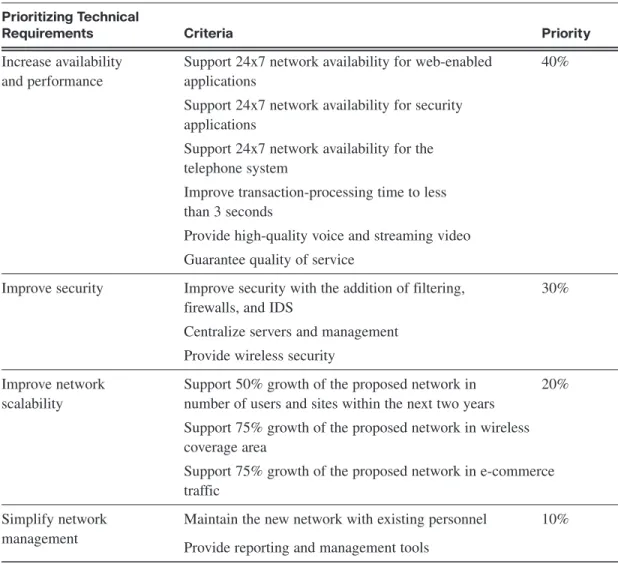
The network designer works with the customer to create a prioritized list of technical requirements, such as the one for the Stadium case study diagrammed in Table 2-1. This project list defines the project scope.
Table 2-1 Stadium Technical Requirements Prioritizing Technical
Requirements Criteria Priority
Increase availability Support 24x7 network availability for web-enabled 40% and performance applications
Support 24x7 network availability for security applications
Support 24x7 network availability for the telephone system
Improve transaction-processing time to less than 3 seconds
Provide high-quality voice and streaming video Guarantee quality of service
Improve security Improve security with the addition of filtering, 30% firewalls, and IDS
Centralize servers and management Provide wireless security
Improve network Support 50% growth of the proposed network in 20% scalability number of users and sites within the next two years
Support 75% growth of the proposed network in wireless coverage area
Support 75% growth of the proposed network in e-commerce traffic
Simplify network Maintain the new network with existing personnel 10% management
Provide reporting and management tools
This information provides direction for the following decisions:
■ Selecting network equipment ■ Choosing protocols
■ Designing network services
When discussing technical requirements with the customer, the designer considers the technical level of the audience. The customer may not clearly understand technical terms and jargon. Such terms should either be avoided or tailored to the level of detail and complexity that the customer can understand. The StadiumCompany case study (see Appendix B) contains a more detailed description of the technical requirements for the Stadium network design.
Lab 2-5: Establishing Technical Requirements (2.4.1)
In this lab, you will use the FilmCompany business goals to create and prioritize the technical requirements for the network. Refer to the hands-on lab in Part II of this Learning Guide. You may perform this lab now or wait until the end of the chapter.
Identifying Constraints
Every company wants to have the most advanced and efficient network available. In reality, various business constraints affect network design. Common constraints include the following:
■ Budget: Limited resources may require some compromises in design due to the costs of equipment,
software, or other components.
■ Company policies: The design must take into account the customer’s existing policies regarding
protocols, standards, vendors, and applications.
■ Scheduling: The project time frame should be aligned with the customer schedules. ■ Personnel: The availability of trained personnel at the implementation and operation phases
might be a design consideration.
Constraints can and do affect network design and should be identified early in the PPDIOO lifecycle process. The relative importance of the constraints varies from project to project. Budget constraints are not always the main consideration for a large project.
For the stadium network project, the stadium management does not want the implementation to be scheduled during their sports season.
Lab 2-6: Identifying Organizational Constraints (2.4.2)
In this lab, you will identify the constraints for the FilmCompany network design. Refer to the hands-on lab in Part II of this Learning Guide. You may perform this lab now or wait until the end of the chapter.
Identifying Manageability Design Considerations
The creation of a network design requires that the network be manageable. The network designer must consider the business goals and technical requirements in the design of the network to ensure that it meets the client’s needs. Upon identification of these requirements, the designer must ensure that even with trade-offs, the network is easy to manage and maintain. The approach used is extremely important as maintenance and monitoring become a daily occurrence in a production environment.
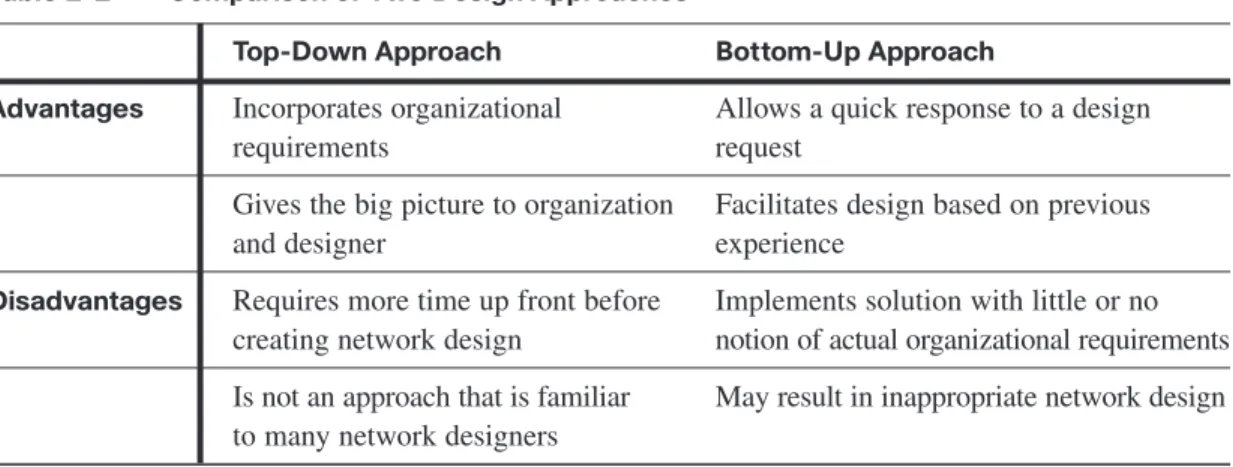
Using the Top-Down or Bottom-Up Approach
There are two common approaches for network design:
■ Top-Down: The top-down approach adapts the network infrastructure to the needs of the
organi-zation. Top-down design clarifies the design goals and initiates the design from the perspective of the required applications and network solutions, such as IP telephony, content networking, and video conferencing. The PPDIOO methodology uses the top-down approach.
■ Bottom-Up: A common approach—but one that is not recommended—is the bottom-up design. In
this approach, the network designer selects network devices and technologies based on previous experience rather than from an understanding of the organization. Because this approach does not include information on the business goals, the proposed network design may not be able to support the required applications.
Table 2-2 Comparison of Two Design Approaches
Top-Down Approach Bottom-Up Approach
Advantages Incorporates organizational Allows a quick response to a design requirements request
Gives the big picture to organization Facilitates design based on previous and designer experience
Disadvantages Requires more time up front before Implements solution with little or no creating network design notion of actual organizational requirements Is not an approach that is familiar May result in inappropriate network design to many network designers
Monitoring Network Operations
After implementation, it is important to ensure that the network design specifications are met. The sta-dium network personnel monitor and manage the performance of the network. Network management includes the following functions:
■ Managing configuration changes to the network ■ Identifying network faults
■ Monitoring performance levels
■ Providing security and accounting management for individual and group usage of the network
A typical network management architecture consists of the following elements:
■ Network Management System (NMS): A system that uses an application to monitor and control
managed network devices, such as CiscoWorks
■ Network Management Protocol: A protocol that facilitates the exchange of information between
network devices and the NMS, such as the Simple Network Management Protocol version 3 (SNMPv3)
■ Managed Devices: Network devices that are managed by an NMS, such as a router or switch ■ Management Agents: Software on managed devices that collect and store network management
information
■ Management Information: Data collected by the NMS
Figure 2-6 Network Monitoring Locations
Internet Internet
NMS using SNMP to monitor and manage network devices. NMS also receives Syslog messages
from network devices.
Centralized Management
Information Database Syslog Server
Managed Switch with SNMP and Syslog Agents
Managed Switch with SNMP and Syslog Agents
Managed Switch with SNMP and Syslog Agents Managed Routers with
SNMP and Syslog Agents
Web Server with SNMP Agent
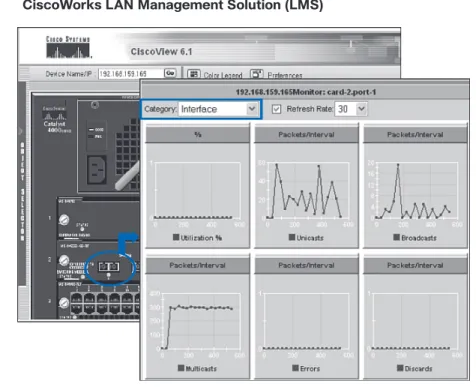
CiscoWorks LAN Management Solution (LMS) (see Figure 2-7) is a suite of powerful management tools that simplify the configuration, administration, monitoring, and troubleshooting of Cisco networks. It integrates these capabilities into a best-in-class solution that provides the following benefits:
■ Improves the accuracy and efficiency of the network operations staff
■ Increases the overall availability of the network by simplifying configuration and quickly identifying
and fixing network problems
■ Maximizes network security through integration with access control services and audit of
Figure 2-7 CiscoWorks LAN Management Solution (LMS)
Lab 2-7: Monitoring Network Performance (2.5.2)
In this lab, you will use a software program to monitor network performance. Refer to the hands-on lab in Part II of this Learning Guide. You may perform this lab now or wait until the end of the chapter.
Using Tools for Network Monitoring
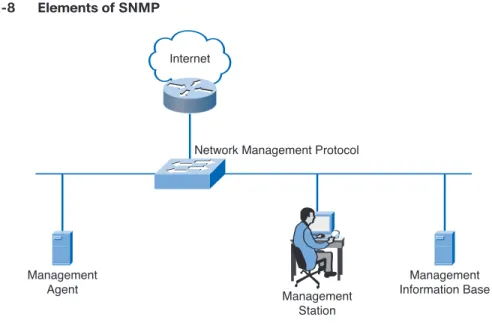
SNMP is the most common network management protocol to use. The protocol enables network administrators to gather data about the network and corresponding devices. SNMP management system software is available in tools such as CiscoWorks. SNMP management agent software is often embedded in operating systems on servers, routers, and switches.
As illustrated in Figure 2-8, SNMP has four main components:
■ Management station: A computer, with the SNMP management application loaded, which is
used by the administrator to monitor and configure the network.
■ Management agents: Software installed on network devices managed by SNMP.
■ Management Information Base (MIB): A standardized database that a device keeps about itself
concerning network performance parameters.
■ Network management protocol: The communication protocol used between the management
Figure 2-8 Elements of SNMP
Internet
Network Management Protocol
Management Station Management
Agent Information BaseManagement
As part of a network management system, SNMP tools can respond to network errors or failures in several ways. Generally, when a network fault occurs, or when predefined thresholds are met, the SNMP tools can react by sending any of the following:
■ An alert on the network ■ A message to a pager ■ An e-mail to an administrator
Because stadium management may want to offer service level agreements to their vendors, they need to purchase network management software.
Lab 2-8: Investigating Network Monitoring Software (2.5.3)
In this lab, you will investigate the capabilities and reports available in network monitoring software. Refer to the hands-on lab in Part II of this Learning Guide. You may perform this lab now or wait until the end of the chapter.
Summary
Cisco Lifecycle Services is a six-phase approach to deploying and operating Cisco technologies. The six phases of the network lifecycle are as follows:
■ Prepare ■ Plan ■ Design ■ Implement ■ Operate ■ Optimize
In the Prepare phase, the business goals of the project are identified and a business case is created to justify the installation of the network upgrade.
During the Plan phase, the network designer performs a comprehensive site and operations assessment of the current network.
A project plan is created that includes the tasks, timelines, risks, responsibilities, and the resources required to complete the network design project.
In the Design phase, the designer creates a flexible design that can integrate new technologies into the current operations and existing network infrastructure.
During the Implement phase, the network is built according to the approved design specifications and tested to ensure that it meets the business goals and requirements.
The Operate and Optimize phases of the network lifecycle are ongoing and represent the day-to-day operations of the network.
Optimizing a network is a continuous process that identifies and resolves potential weaknesses before they become problems for network operations.
Requests for Proposal (RFP) and Requests for Quote (RFQ) solicit proposals from networking contractors to provide design services, equipment, installation, and support. RFPs and RFQs provide information as to a company’s business goals and requirements for new technologies and outline the process to follow to submit a proposal.
Following the required format and schedule is critical to submitting a successful proposal to provide network services.
A team of individuals from the networking contractor responds to the customer’s request. This team includes an account manager, system engineers, network designers, and postsale field engineers. Account managers serve as the primary point of contact between their customers and the networking contractor.
Presales system engineers are responsible for assisting the account manager to determine the need for upgrades or additions to the current network. They assist the network designers to ensure that the new equipment and services can integrate into the existing network.
Network designers provide customers with a network design that meets the customer requirements for scalability, availability, security, and manageability.
Postsales field engineers are responsible for the smooth installation of the network upgrade and ensure that the network functions as designed.
All members of the networking contractor staff must demonstrate effective interpersonal skills to instill confidence in their abilities to provide the necessary network services.
Factors that limit the ability of the business to incorporate new technology include the amount of the budget, policies, schedules, and the availability of qualified personnel.
Constraints can and do affect the network design and need to be considered early in the design process. Top-down network design strategies have the best chance to succeed because the designers take into account the business goals of the customer before selecting technology solutions.
Bottom-up design strategies start with the selection of equipment and technologies, and then determine how to incorporate them into the network.
A primary technical requirement for any network is the availability of qualified support personnel. To simplify ongoing network operations, network monitoring and management software should be part of network design.
Interactive Activity 2-6: Business Goals/Constraints Practice Scenario (2.6.2)
In this critical thinking interactive activity, you will answer a series of questions about business goals and constraints based on the provided scenario. Use file ia-262 on the CD-ROM that accompanies this book to perform this interactive activity.
Chapter Activities and Labs Summary
Interactive Activities on the CD:Activity 2-1: Identify the Aspects of the PPDIOO Network Lifecycle Phases (2.1.4) Activity 2-2: Matching Terms to Definitions (2.1.5)
Activity 2-3: Match the Appropriate Action to the Lifecyle Phase (2.1.7) Activity 2-4: Identify Sections and Components in an RFQ (2.2.4) Activity 2-5: Identify the Appropriate Activity Area (2.2.8) Activity 2-6: Business Goals/Constraints Practice Scenario (2.6.2)
Hands-on Labs in Part II of this book:
Lab 2-1: Creating a Project Plan (2.1.3)
Lab 2-2: Observing Traffic Using Cisco Network Assistant (2.1.6) Lab 2-3: Creating a Network Organization Structure (2.3.2) Lab 2-4: Prioritizing Business Goals (2.3.3)
Lab 2-5: Establishing Technical Requirements (2.4.1) Lab 2-6: Identifying Organizational Constraints (2.4.2) Lab 2-7: Monitoring Network Performance (2.5.2)
Check Your Understanding
Complete all the review questions listed here to check your understanding of the topics and concepts in this chapter, Answers are listed in Appendix A, “Check Your Understanding and Challenge Questions Answer Key.”
1. Cisco Lifecycle Services consists of how many phases? A. 4
B. 5 C. 6 D. 7
2. During what phase of the PPDIOO is the network built according to the design specifications? A. Prepare
B. Plan C. Design D. Implement
3. During the Implement phase, what is the practice of verifying that a network meets the business goals and design requirements of a business called?
A. System verification testing B. System-level acceptance testing C. Security system testing
D. None of the above
4. When monitoring network performance over a certain period of time to create a point of reference for future network evaluations, you are creating what?
A. Network baseline B. Network data path C. Network security policy D. Network operating procedure
5. What are common network problems that could be discovered in the Optimize phase? (Select all that apply.)
A. Feature incompatibilities B. Insufficient link capacity C. Device performance problems D. Scalability of protocols
6. Which page of a response to an RFP includes insurance and liability coverage of the company that will be designing the network?
A. Cover letter B. Executive summary C. Appendixes D. Proposed cost
7. What are the main parts to an RFQ? A. Organizational overview
B. Required deliverables C. Assumptions and agreements D. All of the above
8. On a network design team, which member communicates with the customer through face-to-face meetings, phone calls, e-mail, or a combination of more than one method?
A. Presales systems engineer B. Account manager C. Network designer D. Postsales field engineer
9. Business managers analyze the feasibility of a project based on how it contributes to business success. They do this by rating the business goals as what percentage of the overall total? A. 100%
B. 80% C. 75%
D. None of the above
10. What are examples of common constraints that affect network design?
Challenge Question and Activities
These questions are more challenging and require you to bring together knowledge from various parts of the chapter. Answer all questions in this part. Answers are listed in Appendix A.
The XYZ Insurance Company has 350 agent offices around the United States. Each agent office has a Frame Relay link to corporate headquarters. Because of corporate policy, the bandwidth of the agent links is determined by and paid for by the agents working in the offices. The agents use the network connection primarily to access various database systems at headquarters and also for e-mail and Internet access.
XYZ has budgeted $5 million to upgrade their outdated network infrastructure at headquarters to a fully redundant Gigabit and Fast Ethernet LAN. The management believes the upgrade will reduce long-term network costs and improve the scalability, availability, security, and manageability of the LAN infrastructure. The company is starting a recruiting effort that it hopes will result in the addition of 200 new agent offices in the next three years. The company needs higher capacity to meet the potential demand of the new agents. The project must be completed in three months because of the anticipated demands of a new e-commerce system, which will increase revenue, and a new customer service system, which will improve customer satisfaction.
The existing LAN equipment is from another vendor, although the WAN infrastructure is a complete Cisco solution. The company wants the LAN to be a complete Cisco solution as well, in part because they hope to save costs of operating the LAN with a single vendor solution. The company outsources its IT staff. The Cisco WAN is managed remotely. The IT staff who work onsite have limited training
in Cisco networking. The company’s website is also outsourced. Even though the management is out-sourced, the servers are located at headquarters and connect directly to the LAN because of XYZ company’s policy, which is that all company data must be physically stored in company facilities. The insurance database systems use Oracle on Unix servers with custom-developed client software. The e-mail system is based on Eudora e-e-mail client software.
1. Which business goals of XYZ Insurance apply to this network design project? (Choose two.) A. Increased customer satisfaction from the new customer service system
B. Equipment vendor selection
C. Increased performance from Gigabit Ethernet D. Increased scalability of database systems
E. Reduced costs from managing the LAN
2. Which of the following items are business constraints imposed by the XYZ Insurance company on this new network design project? (Choose two.)
A. A high-performance LAN B. Existing non-Cisco LAN C. Outsourced IT staff D. The Eudora e-mail system
E. $5 million budget
3. Which of the following are technical requirements of XYZ Insurance with regards to this network design project? (Choose two.)
A. Increased usage of the Oracle databases
B. Increased availability and performance of the new network C. A simplified, manageable network design
D. Increased profitability due to reduced costs E. Increased customer satisfaction
4. Which constraint imposed by XYZ Insurance on this network design project affects the ability of the design to meet the technical requirements?
A. Reliability of the Eudora e-mail system B. $5 million budget
C. Experience of the IT staff D. Three months completion date