Playing
Dissertation
zur Erlangung des akademischen Grades Doktor rerum naturalium (Dr. rer. nat.)
vorgelegt an der
Technischen Universit¨at Dresden Fakult¨at Informatik
eingereicht von
Dipl.-Inf. Stephan Schiffel
geboren am 15. 09. 1980 in SebnitzGutachter: Prof. Michael Thielscher, University of New South Wales Prof. Yngvi Bj¨ornsson,
H´ask´olinn ´ı Reykjav´ık Datum der Verteidigung: 29.07.2011
General Game Playing (GGP) is concerned with the development of systems that can play well an arbitrary game solely by being given the rules of the game. This problem is considerably harder than traditional artificial intelligence (AI) game playing. Writing a player for a particular game allows to focus on the design of elaborate strategies and libraries that are specific to this game. Systems able to play arbitrary, previously unknown games cannot be given game-specific knowledge. They rather need to be endowed with high-level cognitive abilities such as general strategic thinking and abstract reasoning. This makes General Game Playing a good example of a challenge problem, which encompasses a variety of AI research areas including knowledge representation and reasoning, heuristic search, planning, and learning.
Two fundamentally different approaches to GGP exist today, we call them knowledge-free andknowledge-based approach. The knowledge-free approach considers the game rules as a black box used for generating legal moves and successor states of the game. Players using this approach run Monte-Carlo simulations of the game to estimate the value of states of the game. On the other hand, the knowledge-based approach considers the components of a state (e. g., positions of pieces or tokens on a board) and, based on this information, evaluates the potential of a state to lead to a winning state for the player. This requires to automatically derive knowledge about the game that can be used for a meaningful evaluation.
In this thesis, we present a knowledge-based approach to GGP that is im-plemented in our general game playing system Fluxplayer. Fluxplayer has participated in all the international general game playing competitions since 2005. It won the competition in 2006 and has scored top ranks since then. Flux-player uses heuristic search with an automatically generated state evaluation function and applies several techniques for constructing search heuristics by the automated analysis of the game.
Our main contributions are
• the automatic construction of heuristic state evaluation functions, • the automated discovery of game structures,
• an automated system for proving properties of games, and • detecting symmetries in general games and exploiting them.
Over the last few years, many people helped to make this thesis a reality. I want to thank my adviser Michael Thielscher for introducing me to this wonderful topic. I am grateful for his constant reminder to publish the results and his invaluable support at writing papers and proof-reading them, even when they were only finished at the last minute.
The people at TU-Dresden and especially my colleagues of the Computational Logic group made the last years a very enjoyable time. There was always someone to discuss ideas or problems and give helpful feedback for papers and presentations. Special thanks go to Conrad for many insightful discussions, some of which were even related to this work. Daniel who was always there for discussing new ideas at length and writing papers at night, and Sebastian whose ideas and suggestions on earlier versions of the thesis considerably helped to improve it.
Finally, I am indebted to my wife Ute for bearing with me all this time. Thank you for urging me to finish this thesis and for struggling through all those unintuitive formulas while proof-reading.
Contents vii 1. Introduction 1 1.1. The GGP Problem . . . 2 1.2. Contributions . . . 3 2. Preliminaries 5 2.1. Games . . . 5 2.1.1. Deterministic Actions . . . 7 2.1.2. Complete Information . . . 7 2.1.3. Finiteness . . . 7
2.2. Game Description Language (GDL) . . . 8
2.2.1. General GDL Syntax . . . 8
2.2.2. GDL Keywords . . . 9
2.2.3. GDL Restrictions . . . 11
2.3. Semantics of the GDL . . . 13
2.4. Fuzzy Logic . . . 15
2.5. Answer Set Programs . . . 17
2.6. Summary . . . 18 3. Components of Fluxplayer 21 3.1. Overview . . . 21 3.2. Communication . . . 22 3.3. Reasoning . . . 24 3.3.1. Objective of Reasoning . . . 25 3.3.2. Implementation . . . 25 3.4. Strategy . . . 28 3.5. Summary . . . 28
4. Game Tree Search 29 4.1. Game Tree Search In General . . . 29
4.2. Heuristic Search . . . 31
4.2.1. Turn-taking N-Player Games . . . 32
4.2.2. Turn-taking, Constant-sum, Two-player Games . . . 33
4.2.3. General N-player Games . . . 34
4.3. Monte-Carlo Tree Search (MCTS) . . . 36
4.4. Search Method of Fluxplayer . . . 36
4.5. Summary . . . 38
5. Generating State Evaluation Functions 41 5.1. The Basic State Evaluation Function . . . 42
5.1.1. Evaluation of Formulas . . . 43
5.1.2. The Value of Parameter p . . . 46
5.1.3. The Choice of T-norm and T-Conorm . . . 46
5.1.4. Theoretical Properties of the Fuzzy Evaluation . . . 49
5.1.5. State Evaluation Function . . . 49
5.2. Identifying Structures in the Game . . . 51
5.2.1. Domains of Relations and Functions . . . 52
5.2.2. Static Structures . . . 54
5.2.3. Dynamic Structures . . . 55
5.3. Using Identified Structures for the Heuristics . . . 59
5.3.1. Order Relations . . . 60
5.3.2. Quantities . . . 61
5.3.3. Game Boards . . . 63
5.4. Evaluation . . . 64
5.5. Summary . . . 68
6. Distance Estimates for Fluents and States 69 6.1. Motivating Example . . . 69
6.2. Distance Estimates Derived from Fluent Graphs . . . 70
6.2.1. Fluent Graphs . . . 70
6.2.2. Distance Estimates . . . 72
6.3. Constructing Fluent Graphs from Rules . . . 74
6.3.1. Constructing φ . . . 76
6.3.2. Selecting Preconditions for the Fluent Graph . . . 80
6.3.3. Overview of the Complete Method . . . 81
6.4. Examples . . . 81 6.4.1. Tic-Tac-Toe . . . 81 6.4.2. Breakthrough . . . 83 6.5. Evaluation . . . 84 6.6. Future Work . . . 87 6.7. Summary . . . 88
7. Proving Properties of Games 89 7.1. Proving Game Properties Using Answer Set Programming . . . . 90
7.2. The General Proof Method and its Correctness . . . 92
7.3. An Automated Theorem Prover . . . 96
7.4. Optimizations . . . 97
7.4.2. Improved Domain Calculation . . . 100
7.4.3. Order of Proofs . . . 104
7.4.4. Reducing the Number of Properties to Prove . . . 105
7.5. Experimental Results . . . 105
7.6. Summary and Outlook . . . 107
8. Symmetry Detection 109 8.1. Games and Symmetries . . . 109
8.2. Rule Graphs . . . 111 8.3. Theoretic Results . . . 117 8.4. Exploiting Symmetries . . . 119 8.5. Discussion . . . 123 9. Related Work 125 9.1. Search Algorithms . . . 125 9.1.1. Single-Player Games . . . 125
9.1.2. Multi-player Games with Heuristic Search . . . 127
9.1.3. Multi-player Games with Monte-Carlo Search . . . 128
9.2. Heuristics . . . 128
9.2.1. Heuristics in Other GGP Systems . . . 129
9.2.2. Feature Construction and Evaluation . . . 133
9.2.3. Heuristics in Automated Planning . . . 135
9.3. Summary . . . 135
10. Discussion 137 10.1. Contributions . . . 137
10.2. Future Work . . . 139
10.3. Publications . . . 140
A. The Rules of Breakthrough 141
Computer systems are used nowadays in many different environments, and new applications are developed every day. In more and more of them computers are not just executing a fixed sequence of tasks but have to take decisions based on their perceptions and a goal they have to achieve. Examples for such systems:
• auto pilots in air planes,
• automated parking systems in cars, but also • automated trading systems in financial markets.
All these systems have in common that they have an overall goal to achieve. For example, flying or driving to a destination without crashing or making high profits with minimum risk. Furthermore, the environment of these systems and the actors in it behave according to certain rules. Some of these rules might change. For example, if the autopilot is deployed on a new model of an air plane that behaves differently or if tax laws or restrictions of financial markets are changed. In these cases the programs in the systems, more specifically, the conditions under which certain decisions are taken, have to be adapted to the changed environment by hand.
Now consider a program that is given the rules of the environment and the goal that must be achieved. This program shall now automatically make the right decisions to reach its goal. Such a program could fly an air plane, park a car and invest money with a profit automatically. Changes of the environment must only be reflected in the rules that are given to the program. Then the program will automatically adapt to the new environment without the need for further human intervention.
General Game Playing (GGP) is concerned with the development of systems that can play well an arbitrary game solely by being given the rules of the game. Every environment that changes according to rules and contains actors with (possibly conflicting) goals can be easily described as a game. Thus, a true general game playing system would be able to solve many problems that today have to be solved with specific programs, such as, the examples named above. Of course, the complex rules for flying an air plane and large financial markets with thousands of traders are difficult to handle – even for today’s computer systems. However, even if general game playing systems cannot compete with special purpose systems directly, they can still be valuable for the development of new special purpose systems: For example, we can use GGP to automatically derive a strategy for an actor in an environment and then this strategy can be hard-coded into the system. In the case of the auto-pilot the developers of a new air plane could use a GGP system to derive a good strategy for the auto-pilot. The system can run in a simulated environment of the plane, thus,
eliminating the problem that decisions have to be taken in real-time. Once the GGP systems has found a good strategy, this strategy can be used as the program that controls the auto-pilot.
The idea of having a program playing arbitrary games was first published under the name of “General Game Playing” in 1968 [Pit68]. It was then long forgotten and picked up again by Barney Pell in his dissertation about Metagamer [Pel93]. Today there is a growing international community of researchers in the area. The annual GGP competitions, hosted by Stanford University since 2005 [GLP05], provide a forum for measuring progress and discussing future research directions.
1.1. The GGP Problem
The goal of General Game Playing is to develop a system, called general game player, that is able to automatically play previously unseen games well. The general game player gets the rules of the game describing
• the roles or players, • the initial state,
• the move options of the players,
• how the game state evolves depending on the moves taken by the players, • under which conditions the game ends, and
• the conditions for winning the game.
The system has only limited time to “think” about the rules before the game begins. Then, the player is repeatedly asked to submit a move and told about the decisions of the other players until the game ends. Typically, the time limits for the analysis of the game and submitting moves are too small to search the whole state space for a winning strategy. Thus, decisions have to be taken without knowing all consequences of the decisions in advance.
The original motivation for developing game playing programs was that winning games is connected to exhibiting intelligent behaviour. Thus, research in com-puter game playing was supposed to lead to artificial intelligence. Unfortunately, success in particular games, such as Chess, has shown that often the intelligence is exhibited by the programmers as opposed to the computer program. Writing a player for a particular game allows to focus on the design of elaborate strategies and libraries that are specific to this game. For example, the strategy of Deep Blue [Mor97], the first program to beat a human world champion in Chess, is composed of thousands of features that were hand-selected by chess experts. The game of Checkers was solved with the help of a large library of Checkers endgames [SBB+07]. Dozens of computers were running for years to produce this library, which is only applicable to Checkers. In contrast, the GGP principle is to give the rules of the game to the program instead of giving them to the programmer. Thus, the player has to do the game analysis on its own. This new problem is considerably harder than traditional AI game playing.
Systems able to play arbitrary, previously unknown games cannot be given game-specific knowledge. They rather need to be endowed with high-level cognitive
abilities such as general strategic thinking and abstract reasoning. This makes General Game Playing a good example of a challenge problem, which encompasses a variety of artificial intelligence (AI) research areas including
• knowledge representation and reasoning, • heuristic search,
• planning, and • learning.
In this way, General Game Playing also revives some of the hopes that were initially raised for game playing computers: To develop human-level AI [Sha50].
1.2. Contributions
Most game playing programs use some form of game tree search together with a state evaluation function or heuristics. That means, players compute the states that will be reached by executing certain moves and try to evaluate those states according to their potential to lead to a winning state for this player. Based on this evaluation, a player chooses the move that seems most advantageous to him.
The main problem of General Game Playing is that we cannot predefine an eval-uation function for assessing game states for all games but have to automatically derive it for the game at hand. Two basic kinds of state evaluation functions are used in today’s general game systems. We call them knowledge-free and knowledge-based approach.
The knowledge-free approach uses Monte-Carlo simulations of the game to estimate the value of a state. That means, random simulations of the game are played to see how likely it is for the player to win the game starting in a specific state. The approach is called knowledge-free because no further knowledge about the structure of the game states is necessary. The only information that is needed is given directly by the game rules:
• which moves the players can take,
• what the resulting state is when certain moves are taken, and • who wins in a certain terminal state.
In contrast to the knowledge-free approach, the knowledge-based approach considers the components of a state (e. g., positions of pieces or tokens on a board) and, based on this information, evaluates the potential of a state to lead to a winning state for the player.
Although knowledge-free players seem to dominate the general game playing competitions lately, we believe that automatically acquiring knowledge about the game is the key to the success of general game playing systems. The recent introduction of heuristics to guide the Monte-Carlo simulations in systems like Cadiaplayer [FB10] supports our belief. Therefore, in this thesis, we focus on approaches that automatically acquire and use information about a game to improve state evaluation functions and, thus, the performance of general game players.
In this thesis, we present an approach to General Game Playing that is im-plemented in our general game playing system Fluxplayer. Fluxplayer has participated in all the international general game playing competitions since 2005. It won the competition in 2006 and has scored top ranks since then. In Fluxplayer, we use a knowledge-based approach including a heuristic search method for evaluating states and several techniques for constructing search heuristics by the automated analysis of the game.
The remainder of the thesis is organised as follows: In Chapter 2, we will give an introduction to the set up used in the General Game Playing competitions. We will introduce the Game Description Language, which is used to formally describe the rules of the game. Furthermore, we will present other preliminaries for the remaining chapters including Fuzzy Logic and Answer Set Programs. In the remaining chapters, we will present own research starting with the structure of Fluxplayer (Chapter 3) and an overview of the search algorithms that we use for the different classes of games (Chapter 4). Our main contributions are: Semantics of the Game Description Language (GDL) In Section 2.14 we
de-fine a formal semantics of the game description language GDL as a state transition system. This semantics is used in the remainder of the work for formal definitions and proofs.
State Evaluation Function We develop a method to construct effective state evaluation functions for general games in Chapter 5. Our state evaluation function is constructed directly from the rules of the game and does not require expensive learning. Furthermore, we develop methods to automatically find structures in the game, such as game boards, quantities, and, order relations. We show how these discovered structures can be used to improve the quality of our state evaluation functions.
Distance Estimates In Chapter 6, we present an algorithm to compute ad-missible estimates for the number of steps needed to fulfil atomic game properties. Again, these distance estimates can be used to improve state evaluation functions.
Proving Properties More knowledge about the game can be extracted by hy-pothesising and proving state invariants. In Chapter 7, we present a method for this, based on Answer Set Programming. The obtained knowl-edge can be used for the state evaluation function and for selecting an appropriate strategy for the game.
Symmetry Detection Symmetries, such as symmetric roles or symmetries of the board, occur in many games. Exploiting symmetries can greatly reduce the search space as well as the complexity of other game analysis. In Chapter 8, we develop a sound method for detecting and exploiting symmetries in general games.
In Chapter 9, we discuss related work. We conclude the thesis with a discussion of the results and suggestions for future work in Chapter 10.
In this chapter, we will introduce several topics that are necessary for under-standing the remaining chapters. We start with defining what a game is and how to formally describe games with the Game Description Language. Furthermore, we present the classes of games that we will consider in this thesis. We will also introduce Fuzzy Logics which is used later in the thesis for generating state evaluation functions in Chapter 5. Finally, we introduce the Answer Set Programming paradigm which we use for proving game properties in Chapter 7.
2.1. Games
Encyclopedia Britannica defines a game as “a universal form of recreation generally including any activity engaged in for diversion or amusement and often establishing a situation that involves a contest or rivalry.” [Bri11]. Clearly, this definition leaves a lot of room for interpretation.
In this work, we restrict ourselves to games that can be modelled as finite state machines. That means, we only consider games with a fixed finite number of players and finitely many different states. The transitions between states depend on the actions (sometimes called moves) of the players. Effects of actions occur instantaneously, that means, actions have no duration. For each state transition, every player has to select one action. Games with alternating moves, such as Chess or Checkers, where only one of the players moves at a time, can be modelled by introducing anoop action, that is, an action that has no effect. Players whose turn it is not can only choose this action.
We will now formally define what we consider as a game.
Definition 2.1 (Game). A game is a state transition system (R, s0, T, l, u, g) over sets of statesS and actions A with
• R, a finite set of roles;
• s0 ∈ S, the initial state of the game; • T ⊆ S, the set of terminal states; • l:R× A × S, the legality relation;
• u: (R→ A)× S → S, the transition or update function; • g:R× S →N, the reward or goal function.
The game starts in some fixed initial states0. In every non-terminal states∈ S, each playerri∈R has to choose one of its legal moves, i. e., an actionai such
that l(ri, ai, s) holds. The successor state s0 = u({r1 7→a1, . . . , rn7→an}, s)
depends on the current state s and the joint action of all players. The joint action is a functionA:R→ Athat specifies for each playerri ∈R which action
ai =A(ri) this player selects. Finally, when a terminal state is reached, each
player r gets his reward g(r, s). The goal of each player should be to maximize its own reward.
In the remainder of this thesis, we will consider games over a set of ground terms, such that roles and actions of the game are ground terms and states of the game are finite sets of ground terms:
Definition 2.2 (Game Over a Set of Ground Terms). Let Σ be a set of ground terms and 2Σ be the set of finite subsets of Σ. A game over a set of ground terms Σ is a game(R, s0, T, l, u, g) with
• states S = 2Σ, • actions A= Σ, and • roles R= Σ.
With the definition above, the states of a game are just defined as finite sets of ground terms. Not all of these states can occur in an actual match of the game. Some of the states are not reachable from the initial state by executing legal actions. We define the notion of a legal joint action and the set of reachable states of a game as follows.
Definition 2.3 (Legal Joint Action). Let(R, s0, T, l, u, g) be a game with states S and actions A. We call a joint action A ∈ A a legal joint action in state
s∈ S if and only if the actionA(r) of every role r∈R is legal in s. We define the following abbreviation to denote that A is a legal joint action in s:
l(A, s)def= (∀r ∈R)l(r, A(r), s)
Definition 2.4 (Reachable States). Let (R, s0, T, l, u, g) be a game with states S and actions A. The set of reachable states Sr of the game is the smallest set
such that
• s0∈ Sr, and
• for all s∈ S and joint actions A:R → A, if s∈ Sr, s /∈T and l(A, s)
thenu(A, s)∈ Sr.
Furthermore, a state s∈ Sr is called finitely reachable if it is reachable from the initial state s0 by a finite sequence of joint actions, that is, there areA1, . . . , An
such that s=u(An, u(An−1, . . . u(A0, s0). . .)).
Informally, the definition says that the initial states0 is reachable. Furthermore, every state u(A, s) is reachable if it is the result of executing a legal joint action
A in a reachable and non-terminal state s. Note that in games that always end after finitely many steps, all reachable states are also finitely reachable.
The observant reader may notice that the above definition of a game (Defini-tion 2.1) does not allow games with non-deterministic ac(Defini-tions, such as rolling of dice. Until now, the General Game Playing competitions only considered a subset of games that adhere to the following three restrictions:
• deterministic actions, • complete information, and • finiteness.
Recently, Thielscher [Thi10] introduced a language for describing games with incomplete information and elements of chance. However, until now there is no large enough selection of games nor other systems for comparison that use this language. Thus, in this thesis we only consider finite deterministic games with complete information. We will explain these restrictions and their consequences in the next sections.
2.1.1. Deterministic Actions
The state transitions of a game are solely determined by the actions that are selected. Hence, effects of the actions only depend on the state in which the actions are executed but not on some random element.
Games with an element of chance, e. g., rolling of dice, can in principle easily be modelled by introducing an additional player. This player selects actions (e. g., rolling a dice with a predetermined outcome) randomly according to some random distribution. However, according to the general game playing protocol (see Section 3.2), a player does not know if some other player plays randomly. Thus, players cannot take the random distribution of the selected actions into account.
2.1.2. Complete Information
By complete information we mean that the rules of the game and the current state of the game are completely known by every player at all times. In particular, there is no information asymmetry like in card games, where typically one player knows his own cards, but not the cards of the opponents. This restriction actually excludes a large class of games. However there are still many interesting games that fall into this class. Some of these were or are still considered difficult for computer players, e. g., Chess, Checkers or Go.
The only information that is not known to the players is the strategy of the opponents, that is, which actions the opponents will select in a state. However, the players do observe the actions that have been selected by other players in previous states. There are other notions of incomplete information, e. g., incomplete information about the effects of actions or about the objectives of the other players. In this thesis, we will not consider any of these kinds of incomplete information.
2.1.3. Finiteness
A game in our sense is finite in different aspects. First, we only consider games with finitely many roles, actions and states, as mentioned in Definition 2.1. The second restriction is that we only consider games that end after finitely many
steps. That means, every sequence of state transitions that starts in the initial state of the game will reach a terminal state after finitely many steps. This excludes games were players can choose between an infinite number of moves, for example, betting money, if the upper bound on the amount is not known in advance. It also excludes games in which the maximal number of players is not known in advance. Finally, games are excluded that can go on forever, e. g., playing rock/paper/scissors until one of the player wins1. A game that can go on forever, is typically transformed into a finite game by ending the game in a draw after a fixed number of steps, in case no natural end was reached before.
2.2. Game Description Language (GDL)
In the GGP community, the Game Description Language [LHH+08] (GDL) is most widely accepted for encoding game rules. The GDL was developed by the Stanford Logic Group and is used for the annual GGP competitions. This language is suitable for describing finite and deterministicn-player games (n≥1) with complete information, as defined in Section 2.1. GDL is purely axiomatic, so that no prior knowledge (e. g., of geometry or arithmetics) is assumed. Although state transition systems provide an axiomatisation of games, describing and communicating games directly as a state transition system is infeasible for all but the smallest games. Even for simple games, such as Tic-Tac-Toe, the number of states are in the thousands. Enumerating all states of larger games is not possible with todays computers.
Instead, GDL uses a a modular representation of the states and actions of a game to encode the game rules. For the purpose of a compact encoding, states need to be composed of atomic properties. We call these properties fluents. In GDL, the fluents are encoded as terms, for example, cell(X,Y,P)representing that P is the content of square (X,Y) on a chess board. A game state is a finite set of such fluents. Thus, the number of states that can be described is exponential in the number of terms used for the game description. The actions are represented by terms, as well. For example, the term move(U,V,X,Y)could denote the action that moves the piece on square (U,V)to(X,Y).
2.2.1. General GDL Syntax
GDL is based on the standard syntax of logic programs [Llo87], including negation. That means, a game description in GDL is a logic program according to the following definition:
Definition 2.5 (Logic program).
• A term is either a variable, or a function symbol applied to terms that are the arguments of the function. A constantis a function symbol with no argument.
• Anatom is a predicate symbol applied to terms as arguments. • A literalis an atom or its negation.
• Aclause is an implication h⇐b1∧. . .∧bn where the head h is an atom
and thebody b1∧. . .∧bn is a conjunction of literals (with n≥0).
• A logic program is a set of clauses.
In GGP competitions, game descriptions are communicated to the players in the syntax of the Knowledge Interchange Format (KIF) [Gen98]. However, we believe that Prolog syntax is easier to read for humans. Thus, we use prolog syntax in the remainder of this thesis. We adopt the Prolog convention according to which variables are denoted by uppercase letters and predicate and function symbols start with a lowercase letter. We also write the inverse implication⇐ as:- and indicate the end of each rule with a dot. Clauses with an empty body (e. g.,h⇐) are written without the inverse implication as prolog facts (e. g., h.).
2.2.2. GDL Keywords
As a tailor-made specification language, GDL uses the following pre-defined predicate symbols with the respective informal meaning:
role(R)
Ris a player or role in the game.
init(P)
Pholds in the initial state.
true(P)
Pholds in the current state.
legal(R,M)
PlayerRhas legal moveMin the current state, i. e., Ris allowed to execute moveM.
does(R,M)
PlayerRdoes moveM in the current state.
next(P)
Pholds in the next state.
terminal
The current state is terminal.
goal(R,N)
PlayerRgets goal valueNin the current state if the current state is termi-nal. By convention, the goal value is a natural number between 0 and 100, where 0 means loosing and 100 means winning the game.
distinct(X,Y)
The termsXand Yare syntactically different.
As an example, Figure 2.1 shows the complete GDL description for the game Tic-Tac-Toe. Tic-Tac-Toe has two players: xplayerand oplayer, as defined in line 1. The game is played on a 3 by 3 board, which is encoded by the ternary function symbol cell (lines 2–6). The first and second argument encode the coordinates of the board location and the third argument stands for the content
1 r o l e( x p l a y e r ). r o l e( o p l a y e r ). 2 i n i t( c e l l ( a ,1 , b l a n k )). i n i t( c e l l ( a ,2 , b l a n k )). 3 i n i t( c e l l ( a ,3 , b l a n k )). i n i t( c e l l ( b ,1 , b l a n k )). 4 i n i t( c e l l ( b ,2 , b l a n k )). i n i t( c e l l ( b ,3 , b l a n k )). 5 i n i t( c e l l ( c ,1 , b l a n k )). i n i t( c e l l ( c ,2 , b l a n k )). 6 i n i t( c e l l ( c ,3 , b l a n k )). 7 i n i t( c o n t r o l ( x p l a y e r )). 8 9 l e g a l( P , m a r k ( X , Y )) : -10 t r u e( c o n t r o l ( P )) , t r u e( c e l l ( X , Y , b l a n k )). 11 l e g a l( P , n o o p ) : - r o l e( P ) , not t r u e( c o n t r o l ( P )). 12 13 n e x t( c o n t r o l ( o p l a y e r )) : - t r u e( c o n t r o l ( x p l a y e r )). 14 n e x t( c o n t r o l ( x p l a y e r )) : - t r u e( c o n t r o l ( o p l a y e r )). 15 n e x t( c e l l ( M , N , x )) : - d o e s( xplayer , m a r k ( M , N )). 16 n e x t( c e l l ( M , N , o )) : - d o e s( oplayer , m a r k ( M , N )). 17 n e x t( c e l l ( M , N , C )) : - t r u e( c e l l ( M , N , C )) , 18 d o e s( P , m a r k ( X , Y )) , d i s t i n c t( X , M ). 19 n e x t( c e l l ( M , N , C )) : - t r u e( c e l l ( M , N , C )) , 20 d o e s( P , m a r k ( X , Y )) , d i s t i n c t( Y , N ). 21 22 t e r m i n a l : - l i n e ( x ). 23 t e r m i n a l : - l i n e ( o ). 24 t e r m i n a l : - not o p e n . 25 26 l i n e ( P ) : - t r u e( c e l l ( a , Y , P )) , 27 t r u e( c e l l ( b , Y , P )) , t r u e( c e l l ( c , Y , P )). 28 l i n e ( P ) : - t r u e( c e l l ( X ,1 , P )) , 29 t r u e( c e l l ( X ,2 , P )) , t r u e( c e l l ( X ,3 , P )). 30 l i n e ( P ) : - t r u e( c e l l ( a ,1 , P )) , 31 t r u e( c e l l ( b ,2 , P )) , t r u e( c e l l ( c ,3 , P )). 32 l i n e ( P ) : - t r u e( c e l l ( a ,3 , P )) , 33 t r u e( c e l l ( b ,2 , P )) , t r u e( c e l l ( c ,1 , P )). 34 35 o p e n : - t r u e( c e l l ( X , Y , b l a n k )). 36 37 g o a l( xplayer , 1 0 0 ) : - l i n e ( x ).
38 g o a l( xplayer , 5 0 ) : - not l i n e ( x ) , not l i n e ( o ). 39 g o a l( xplayer ,0) : - l i n e ( o ).
40 g o a l( oplayer , 1 0 0 ) : - l i n e ( o ).
41 g o a l( oplayer , 5 0 ) : - not l i n e ( x ) , not l i n e ( o ). 42 g o a l( oplayer ,0) : - l i n e ( x ).
of the cell, which is blankinitially. Since the game is turn-taking, the player whose turn it is has to be specified. This is done using the functioncontrol in line 7.
In turn, each player places one of his markers on the board. The legal moves of the players are encoded using the keyword legalin terms of conditions that hold in the current state. The rule in lines 9–10 states that a player, whose turn it is (denoted bytrue(control(P))), can mark any cell that is currently blank (denoted bytrue(cell(X,Y,blank))). The other player can only do a noop
action (line 11).
The successor state is defined using the keyword nextin terms of the current state and the moves of the players. The first twonext-rules (lines 13–14) define whose turn it is in the successor state. The changes to the game board done by a move are defined in lines 15–16. For example, the rule starting in line 15 says that cell (M,N) contains the marker xafter xplayer marked the cell. For a complete description of the successor state, it is also necessary to define which fluents of the state stay unchanged. The rules in lines 17–20 state that the content of a cell is still valid in the next state if a different cell was marked. The game ends if any player managed to build a line of three of its symbols or if there is no blank cell left. This condition is encoded in lines 22–24 with the help of the additional predicatesline and open. These predicates are not keywords but specific to this game. They are again defined by GDL rules (26–35) in terms of the current state. Finally, when the game is over, the players receive a reward that is defined using the keywordgoal (26–35). In this case, a player receives full points, i. e., 100, if there is a line of three of its symbols, it gets zero points if there is a line of three of the opponents symbols and 50 points in case of a draw.
2.2.3. GDL Restrictions
Players must be able to use the game description for computing legal moves and successor states, among other things. To ensure that these computations can terminate, GDL imposes some general restrictions on the set of clauses. Before we state the restrictions, we first define the notion of a dependency graph for a game description following [LHH+08]:
Definition 2.6 (Dependency Graph). The dependency graph for a set D of clauses is a directed, labeled graph whose nodes are the predicate symbols that occur in D. There is a positive edgep→+q if Dcontains a clause p(s)⇐. . .∧
q(t)∧. . ., and anegativeedge p→−q ifDcontains a clausep(s)⇐. . .∧¬q(t)∧. . .. We can now define what constitutes avalid GDL specification.
Definition 2.7 (Valid GDL Specification). Let D be a finite set of clauses and
G be the dependency graph of D. We call D a valid GDL specification if it satisfies the following conditions:
1. There are no cycles involving a negative edge in G. This is also known as beingstratified [ABW87, vG89].
2. Each variable in a clause occurs in at least one positive atom in the body. This is also known as beingallowed [LT86].
3. Ifp and q occur in a cycle in G and Dcontains a clause
p(s1, . . . , sm) ⇐ b1(t1)∧. . .∧q(v1, . . . , vk)∧. . .∧bn(tn)
then for every i∈ {1, . . . , k}, • vi is variable-free, or
• vi is one of s1, . . . , sm, or
• vi occurs in some tj (1 ≤ j ≤ n) such that bj does not occur in a
cycle with p in G.
This is called recursion restriction in [LHH+08].
4. role only appears in the head of clauses that have an empty body. 5. init only appears as head of clauses and is not connected, in the
depen-dency graph for D, to any of the predicates true, legal, does, next,
terminal, andgoal.
6. true only appears in the body of clauses.
7. does only appears in the body of clauses and is not connected, in the dependency graph for D, to any of the predicates legal,terminal,and
goal.
8. next only appears as head of clauses.
Stratified logic programs are known to admit a specific standard model. We refer to [ABW87] for details and just mention the following properties:
1. To obtain the standard model, clauses with variables are replaced by their (possibly infinitely many) ground instances.
2. Clauses are interpreted as reverse implications.
3. The standard model is minimal if negation is interpreted as non-derivability. This is also known as the “negation-as-failure” principle [Cla78].
The second and third restriction in Definition 2.7 guarantee that a finite logic program entails afinite number of ground atoms via its standard model. This is necessary to enable agents to make effective use of a set of game rules. For example, it would be impractical if a player would have to deal with a state in which an infinite number of ground terms hold (e. g., if there is an infinite number of ground atoms of the form next(f) in the model). The remaining restrictions in Definition 2.7 are on the use of the GDL keywords. They ensure that:
• the roles of the game and the initial state are fixed,
• the legal moves, terminality and goalhood only depend on the current state, and
• the successor state only depends on the current state and the moves of each player.
The preceding definitions guarantee game descriptions with which players can reason, that is, compute legal moves, successor states and the outcome of the game. However, these syntactic restrictions are not enough to ensure expedient game descriptions. For example, the restrictions do not ensure that every player always has a legal move or that the outcome of the game is defined for every terminal state. The following definitions for well-formedness of a game description from[LHH+08] solve this problem.
Definition 2.8 (Termination). A game description in GDL terminates if all infinite sequences of legal moves from the initial state of the game reach a terminal state after a finite number of steps.
Definition 2.9(Playability). A game description in GDL is playable if and only if every role has at least one legal move in every non-terminal state reachable from the initial state.
Definition 2.10 (Monotonicity). A game description in GDL is monotonic if and only if every role has exactly one goal value in every state reachable from the initial state, and goal values never decrease.
Definition 2.11(Winnability). A game description in GDL is strongly winnable if and only if, for some role, there is a sequence of individual moves of that role that leads to a terminal state of the game where that roleˆas goal value is maximal. A game description in GDL is weakly winnable if and only if, for every role, there is a sequence of joint moves of all roles that leads to a terminal state where that roleˆas goal value is maximal.
Definition 2.12 (Well-formed Game Descriptions). A game description in GDL is well-formed if it terminates, is monotonic, and is both playable and
weakly winnable.
Many results of this thesis hold for all valid game descriptions regardless of their well-formedness. Especially, monotonicity is not required for any of the results. In fact, the example game description in Figure 2.1 does not obey the monotonicity requirement of well-formed game descriptions.
However, for defining the semantics of a game description in the next section, we find it helpful to restrict ourselves to games that fulfil a weaker version of monotonicity, which we calloutcome definedness:
Definition 2.13 (Outcome Definedness). A game description in GDL is out-come defined if and only if every role has exactly one goal value in every terminal state reachable from the initial state.
Observe, that we only require the goal value for each role to be defined in terminal states of the game.
2.3. Semantics of the GDL
While the other sections in this chapter merely introduce work by others, this section is a summary of own work published in [ST09b].
Based on the concept of the standard model [ABW87], a valid and outcome defined game description can be understood as a state transition system as defined in Definition 2.1. To begin with, any valid game description D in GDL contains a finite signature, i. e., a finite set of function symbols, including constants. This signature implicitly determines a set of ground terms Σ, the symbol base. The roles R, states S and actionsA of a game are constructed from this set Σ: Roles and actions of the game are ground terms in the game description while states of the game are finite sets of ground terms.
The players and the initial state of a game can be directly determined from the clauses for, respectively, role andinit inD. In order to determine the legal moves, update, termination, and goalhood for any given state, this state has to be encoded first, using the keyword true. To this end, for any finitesubset
s={f1, . . . , fn} ⊆Σ of a set of ground terms, the following set of logic program
facts encodes the state sas the current state of the game:
strue def= {true(f1)., . . . , true(fn).}
Furthermore, for joint action A, that is a function A:{r1, . . . , rn} → A that
assigns a move to each player r1, . . . , rn∈R, the following set of facts encodes
A as a joint action in GDL:
Adoes def= {does(r1, A(r1))., . . . , does(rn, A(rn)).}
With the help of the definitions of strue and Adoes we can now define the
semantics of a game description:
Definition 2.14 (Semantics of a GDL Specification). Let D be a valid GDL specification whose signature determines the set of ground terms Σ. Let2Σ be the set of finite subsets ofΣ. The semantics ofD is the game(R, s0, T, l, u, g) where
• A= Σ (the actions); • S = 2Σ (the states);
• R={r∈Σ :D|=role(r)} (the players); • s0={p∈Σ :D|=init(p)} (the initial state);
• T ={s∈ S :D∪strue |=terminal} (the terminal states);
• l ={(r, a, s) : D∪strue |= legal(r, a)}, wherer ∈ R, a∈ A, and s∈ S
(the legality relation);
• u(A, s) ={f ∈Σ :D∪strue∪Adoes |=next(f)}, for all A: (R→ A)and
s∈ S (the update function);
• g(r, s) =n iff G∪strue |=goal(r, n), for all r ∈ R, n∈
N, and s∈ S
(the goal function).
This definition provides a formal semantics by which a GDL description is interpreted as an abstract n-player game.
2.4. Fuzzy Logic
In Chapter 5, we will present our state evaluation function. This function evaluates states against the conditions for winning the game that are given by thegoalrules of the game description. We will use fuzzy logic for this evaluation. Therefore, we recapitulate some definitions for fuzzy logic from [KGK95] in this section.
Fuzzy logic is a multi-valued logic. Instead of the default truth values “true” and “false” of binary logics, fuzzy logic has truth values in the interval [0,1] of the real values. In fuzzy logic, a truth value denotes a degree of truth of a formula, where 0 stands for false, 1 stands for true, and the remaining values stand for “true to a certain degree”. Fuzzy logics are used for approximate reasoning. For example, the sentence “The sky is blue today.” may not be entirely true because there are some clouds or because the sky is not blue the entire day. Still, it might be true for most of the day. Thus, we could associate a truth value between 0 and 1 reflecting the degree of truth of the sentence, e. g., the percentage of the time the sky is blue. For evaluation whether a statesof a game is advantageous for our player, we are interested in the degree of truth of the sentence “the state
sis near to a goal state”.
Formally, fuzzy logics are defined in terms of fuzzy sets:
Definition 2.15 (Fuzzy set). Let X be a set of objects. A fuzzy set µof X is a function µ:X →[0,1], which associates each object in X a real number in the interval [0,1]representing the “grade of membership” of x in the fuzzy set. For example, the fuzzy setµmay contain all states of a game that are near to a goal state for a certain role. The functionµ(s) associates a value between 0 and 1 to each states, such that the value represents the grade of membership ofsin
µ. Thus, the value µ(s) denotes how nearsis to a goal state.
We define the three operations complement (¬), intersection (∧), and union (∨) on fuzzy sets in the following paragraphs.
Complement The complement¬µof a fuzzy setµis defined elementwise using a negation functionn:
(µ)(x) =n(x)
Definition 2.16 (Negation function). A negation function n is a function
n: [0,1]→[0,1] with the following properties: • n(0) = 1
• n(1) = 0
• a≤b⊃n(a)≥n(b)
The negation function that is used most often is n(x) = 1−x. We will also use this function in the remainder of the thesis.
Intersection The intersection of two fuzzy sets µ1,µ2 is a fuzzy set µ, i. e., a function mapping each object x to a value in [0,1] representing the grade of membership of x in both setsµ1, µ2. Such a function is called a t-norm and defined as follows:
Definition 2.17 (T-norm). A function>: [0,1]2 →[0,1] is called t-norm, if • >(a,1) =a (neutral element),
• a≤b⊃ >(a, c)≤ >(b, c) (monotonicity), • >(a, b) =>(b, a) (commutativity), and • >(a,>(b, c)) =>(>(a, b), c) (associativity).
Thus, the intersection of two fuzzy setsµ1 and µ2 is defined elementwise as (µ1∧µ2)(x) =>(µ1(x), µ2(x))
given some t-norm >. Several t-norms exist. An example of a t-norm is >(a, b) = min(a, b). All t-norms conform to the standard boolean conjunction if applied to the values 0 and 1 that stand for “false” and “true” respectively. For example, >(a,0) = 0 for all value of a.
We define a special form of t-norm, which we call continuous t-norm: Definition 2.18 (Continuous T-norm). A t-norm > is called continuous if
a < b∧c >0⊃ >(a, c)<>(b, c)
An example for a continuous t-norm is>(a, b) =a∗b. The rational behind this definition is that the value>(a, b) of a continuous t-norm always depends on both argumentsa andb, as opposed to, e. g., min(a, b) where the higher of the two values a,b has no influence.
Union The union of two fuzzy sets µ1 and µ2 is defined similarily to the intersection as
(µ1∨µ2)(x) =⊥(µ1(x), µ2(x)). The function⊥ is some t-conorm:
Definition 2.19 (T-conorm). A function ⊥: [0,1]2→[0,1]is called t-conorm, if
• ⊥(a,0) =a (neutral element),
• a≤b⊃ ⊥(a, c)≤ ⊥(b, c) (monotonicity), • ⊥(a, b) =⊥(b, a) (commutativity), and • ⊥(a,⊥(b, c)) =⊥(⊥(a, b), c) (associativity).
Each t-norm> defines a dual t-conorm⊥ in the following way: ⊥(a, b) = 1− >(1−a,1−b)
Examples for t-conorms are ⊥(a, b) = max(a, b), which is dual to >(a, b) = min(a, b), and⊥(a, b) =a+b−a∗b, which is dual to >(a, b) =a∗b.
Using the above definitions of complement, intersection and union of fuzzy sets together, we can interpret a propositional formula as a fuzzy set and provide a fuzzy evaluation of a propositional formula. Thus, the degree of truth of the sentence “the state sis near to a goal state” can be computed by a function
f(s) where f is a propositional formula representing the goal of the game. For example, in Tic-Tac-Toe, one subgoal for thexplayer is to complete one of the eight possible lines, that is
f = true(cell(a,1,x))∧true(cell(b,1,x))∧true(cell(c,1,x))∨
true(cell(a,2,x))∧true(cell(b,2,x))∧true(cell(c,2,x))∨
. . .
true(cell(a,3,x))∧true(cell(b,2,x))∧true(cell(c,1,x)) We can interpret f as a fuzzy set f(s) if we provide a suitable interpretation of the atomstrue(. . .) of this formula as fuzzy sets true(. . .)(s), that is, if we provide functions true(t)(s) for all fluents t that estimate the likelyhood of makingt true in the future if we are currently in state s. The method that we use to provide such functions and our choice of t-norm and t-conorm is presented in Chapter 5.
2.5. Answer Set Programs
In Chapter 7, we will use the Answer Set Programming (ASP) paradigm to prove properties of games. Answer sets provide models of logic programs with negation according to the following definition (for details, see, e. g., [Gel08]): Definition 2.20 (Answer Set). Let P be a logic program with negation over a given signature, and letground(P) be the set of all ground (i. e., variable-free) instances of rules in P. For a set M of ground atoms (i. e., predicates with variable-free arguments), thereduct of ground(P) wrt.M is obtained by deleting
1. all rules with some ¬p in the body such that p∈M, and 2. all negated atoms in the bodies of the remaining rules.
Then M is an answer setfor P if M is the least Herbrand model of the reduct of ground(P) wrt. M.
According to this definition, an answer set is a least model of a logic program. Thus, it fulfils the closed world assumption, i. e., the assumption that only those things hold that are stated explicitely in the rules, while everything that is not explicitely stated is false. The same assumption applies to the GDL rules defining a game. For example, the rules of Tic-Tac-Toe (Figure 2.1) do not say anything about another legal action exceptmark andnoop, Thus, according to the closed world assumption, we assume that only those two actions can be legal.
Answer sets provide an alternative semantics for GDL specifications. Unless additional rules are added, there is exactly one answer set for a GDL specification. This answer set coincides with the standard model for logic programs [ABW87]. In order to prove properties of a game, we need two additional constructs of answer set programs, which were introduced in [NSS99]:
weight atom A weight atom is a construct of the form
m {p:d(~x) }n
The weight atom holds in an answer set M of a logic program iff the atom phas at least m and at mostn different instances inM such that the instances satisfyd(~x). The numbers m or ncan be omitted, in which case there is no lower or upper bound, respectively. A weight atom may occur in the same place as any other atom, that is, as head of a rule or as a literal in the body of a rule.
constraint A constraint is a rule with an empty head, that is, a rule of the form
:-b1, . . . , bk
If a logic programP contains the constraint:-b1, . . . , bk, answer sets that
satisfy b1, . . . , bk are excluded. That means, all answer sets of P entail
that at least one ofb1, . . . , bk is false.
As an example, consider the following simple program:
1 i n i t( c e l l ( a ,1 , b l a n k )). ... i n i t( c e l l ( c ,3 , b l a n k )). 2 i n i t( c o n t r o l ( x p l a y e r )). 3 4 c d o m ( x p l a y e r ). 5 c d o m ( o p l a y e r ). 6 t0 : - 1 { i n i t( c o n t r o l ( X )) : c d o m ( X ) } 1. 7 : - t0 .
The program contains the rules describing the initial state of Tic-Tac-Toe from Figure 2.1. In addition, there are two rules defining the predicate cdom, which encodes the domain of the control fluent. The rule in line 6 defines the predicate t0 with the help of a weight atom. The rule says that t0 holds if there is exactly one instance of init(control(X)) that satisfies cdom(X), that means, there is exactly one player who has control in the initial state, either
xplayeror oplayer. Finally, the constraint in line 7 excludes any answer set that fulfilst0. Since t0 is clearly entailed by the definition of the initial state, the above program has no answer set.
We use programs such as the one above, to prove properties of games in Chapter 7.
2.6. Summary
In this chapter, we defined what a game is and how its rules are described with the Game Description Language (GDL). We presented a summary of own
work [ST09b] on the semantics of GDL. Furthermore, we introduced Fuzzy Logic as a many-valued logic, which we will use in Chapter 5 for evaluating non-terminal states of the game. Finally, we introduced the Answer Set Programming (ASP) paradigm, which provides an alternative semantics for logic programs and, thus, game descriptions in GDL. We will use ASP in Chapter 7 to prove or refute hypotheses about properties of a game.
In this chapter, we describe the structure and components of a general game player. In particular, we present how our player, Fluxplayer, works. In the following chapters we will present improvements to some of these basic compo-nents.
3.1. Overview
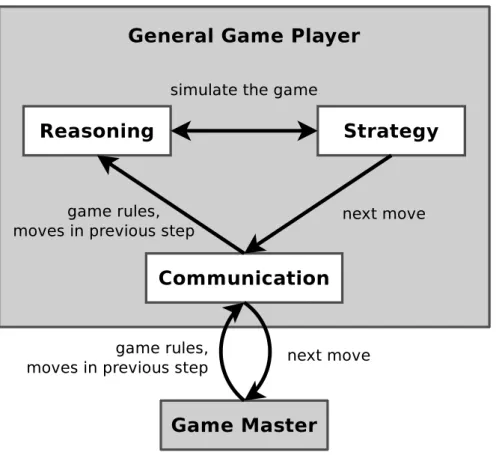
Figure 3.1.: The structure of a typical general game player and its communication with the game master.
A typical game playing system, as depicted in Figure 3.1, consists of three main components:
Communication The player has to communicate with a game master program to be informed about the progress in the match.
Reasoning The player also has to be able to reason about the game rules in order to know the current state of the match and the legal move options it has.
Strategy Finally, the player has to take a decision about which move to make next. This decision determines its strategy. Typically, choosing a move involves simulating the game to some extend in order to see the implications of choosing certain moves.
We will describe all three components in the following sections.
3.2. Communication
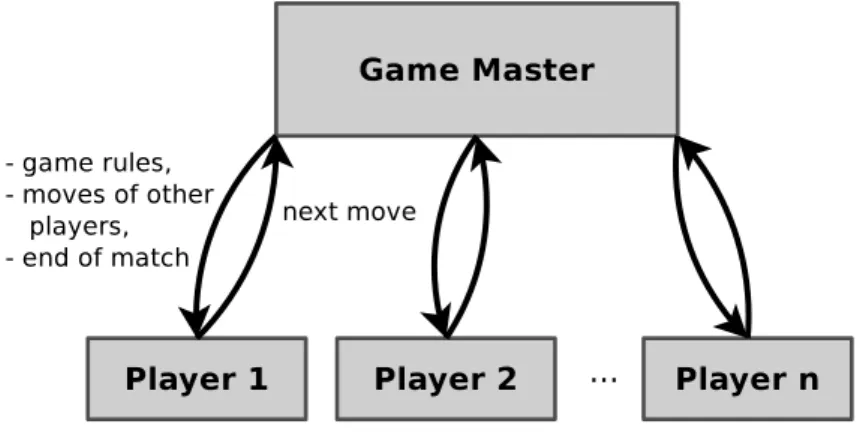
In the annual general game playing competitions players are set up to play matches of previously unknown games against each other. The infrastructure for the competitions requires a game master, i. e., a program that
• sends out the game descriptions to the players,
• collects the moves from the player and makes sure that moves are submitted on time,
• checks the legality of the submitted moves,
• informs all players about the previous moves of the competitors, • informs all players about the end of the match.
Figure 3.2.: The game master communicates game rules and game state infor-mation to the players. The players reply to the messages with their next move.
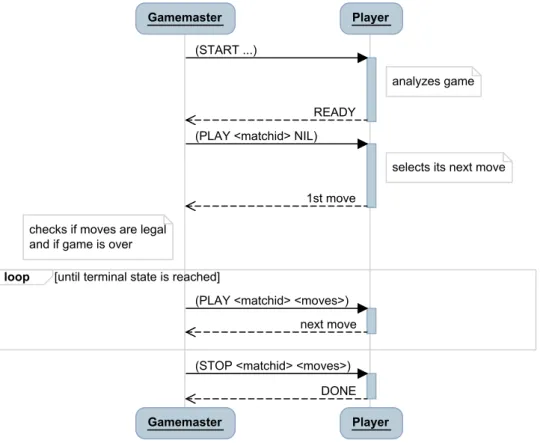
Each player of a match has to communicate with the game master. Technically, the players are simple HTTP servers that handle requests from the game master. Instead of serving web pages, their replies are the moves they want to make in the current state of the game. The communication protocol allows three requests from the game master, start,play and stop. The communication between the game master and a player is depicted in Figure 3.3 and defined in the following.
Start Message The first message in a match that the game master sends to the players is a start message. It has the structure:
(START <matchid> <role> <game rules> <start clock> <play clock>)
The start message contains the following fields:
<matchid> is a unique identifier for the match that is beginning.
<role> is the name of the role that the player receiving the message is supposed to play in the match. A game has one role for each player, e. g., white and black in chess.
<game rules> contains a formal encoding of the rules of the game. The language that is used is the Game Description Language that we introduced in Section 2.2.
<start clock> is the time in seconds that the player has to its disposal in order to learn or analyse the game before the match actually starts.
<play clock> is the time in seconds that the player has in every step of the game to decide which move to make.
After at most<start clock>seconds the players are supposed to reply to the start message withREADY to signal that they are ready to play the match. If all players responded to the start message or the<start clock>is over, the game master sends the first play message.
Play Message The play message has the following format:
(PLAY <matchid> <moves>)
<matchid> is the identifier for the match to which the play message belongs.
<moves> contains the moves that all players selected in the previous step. For the first play message in a match,<moves>is NIL, that is, empty.
Based on the previous game state and the moves of all players every player can compute the current game state. The players have to respond to the play message within <play clock> seconds with their next move. The play clock was sent with the start message before and is the same for every step of the match. When all players have responded, the game master checks the legality of the moves and sends the next message. If the match is not over yet, this is again a play message. If some player sends an illegal move or does not respond in time, the game master selects an arbitrary legal move on that player’s behalf. Additionally, in competitions, this player will typically receive zero points for the match, regardless of the outcome.
Stop Message If the match is over, that is, a terminal state of the game is reached, a stop message is sent instead of a play message:
The stop message contains the same information as a play message and allows the players to compute the result of the game. It is considered polite if players respond to the stop message with DONE. However, since the game is officially over, this is not necessary.
Gamemaster Gamemaster Player Player (START ...) analyzes game READY
(PLAY <matchid> NIL)
selects its next move 1st move
checks if moves are legal and if game is over
(PLAY <matchid> <moves>) next move loop [until terminal state is reached]
(STOP <matchid> <moves>) DONE
Figure 3.3.: Sequence of messages sent between the game master and a player during a match.
The communication component can be easily implemented in any programming language that supports socket communication. For Fluxplayer, we use a slight adaptation of the freely available NanoHTTPD [Elo10], which is implemented in Java. The only change that was necessary was to “serve” moves instead of web pages.
3.3. Reasoning
3.3.1. Objective of Reasoning
In order to submit legal moves, each player has to be able to compute the state the match is in and its own legal moves in the current state. However, in order to play good moves as opposed to just random legal moves, all players perform some kind of search of the game tree. That means, they simulate the game to some extend to see what happens under the assumption that certain decisions are made by each player. Therefore, the following reasoning tasks are performed by each player:
1. computing the initial state of the game;
2. given a state of the game, computing the legal moves of each player; 3. given a state and a move for each player, computing the successor state; 4. deciding if a state is terminal, i. e., if the match ends at this state; 5. given a terminal state, computing the outcome for each player.
In fact, these five reasoning tasks correspond to computing the componentss0, l,
u,T and g of the game (R, s0, T, l, u, g) (Definition 2.1) for a game description according to the semantics of a game description (Definition 2.14):
1. s0 ={p∈Σ :D|=init(p)} (the initial state);
2. l={(r, a, s) :D∪strue|=legal(r, a)} (the legality relation);
3. u(A, s) ={f ∈Σ :D∪strue∪Adoes|=next(f)} (the update function);
4. T ={s∈ S :D∪strue|=terminal} (the terminal states);
5. g(r, s) =n iff G∪strue |=goal(r, n) (the goal function).
3.3.2. Implementation
All of the reasoning tasks presented in the previous section can be performed by computing the consequences of a logic program. Depending on the reasoning task, this program consists of the game descriptionDpossibly combined with a suitable encoding of the current state and the joint action of the players. For example, to compute the legal moves of a roler in a state sof a game described by the rulesD, a player has to find all ground termsasuch thatD∪strue |=legal(r, a),
wherestrue is a suitable encoding ofsas a logic program.
There are two main ways to compute the consequences of a logic program: bottom-upand top-down reasoning.
Bottom-up reasoning The bottom-up approach computes a complete model for a program. Once a model is computed, the answers to the reasoning task can just be read from the model.
Bottom-up reasoning can, for instance, be implemented using an answer set programming system as described in Section 2.5. However, current ASP systems (e. g., clingo [oP10], DLV [LPFe10], smodels [Sim08]), come with a considerable overhead: They need to ground the input program, that is, replace each rule
by every ground instance of it. Grounding game descriptions is expensive with respect to both time and memory consumption. In the worst case, a grounded game description is exponentially larger than the one with variables. For some games, grounding the game description is not feasible because of memory or time consumption. This makes ASP systems an unsuitable solution for the reasoning tasks mentioned above because a general game player should be able to play as many games as possible.
Top-down reasoning Instead of computing a complete model, the top-down approach only checks whether some formula is entailed by the program. Usually, that formula contains existentially quantified variables and an answer of the reasoning system is a substitution for these variables such that the formula is entailed. One top-down reasoning approach is resolution. We use a variant of resolution, first-order SLDNF resolution [Llo87], which is implemented in every prolog system. As the name suggests, first-order SLDNF resolution uses first-order logic. Thus, grounding is not necessary. Standard SLDNF resolution can be used to perform all reasoning tasks mentioned above.
Translation from GDL to Prolog For efficiency, we directly use the prolog inference by automatically translating the game rulesD into prolog rules at the start of the match. Note that for some of the reasoning tasks, we need to add additional rules containing a suitable encoding of the current state and the moves chosen by the players. For example, to compute the legal moves of a role r in a state s, we have compute all instances ofa such thatD∪strue |=legal(r, a).
In this case, the rules strue that encode the state sas a logic program need to
be added to the game descriptionD.
Because we want to avoid asserting and retracting facts to and from the prolog rule database, we encode states of the game by prolog terms and add an additional argument to all predicates that depend on the current state. These predicates are, for example, legal, goal, and terminal, but may include game specific predicates. The same is done for the previous moves of the players and predicates that depend on these moves, e. g., next. For example, the rule
1 l e g a l( P , m a r k ( X , Y )) :
-2 t r u e( c o n t r o l ( P )) , t r u e( c e l l ( X , Y , b l a n k )).
from Figure 2.1, which describes when a playerP can do the movemark(X,Y), is translated to the following prolog rule:
1 l e g a l( P , m a r k ( X , Y ) , S t a t e ) : -2 t r u e( c o n t r o l ( P ) , S t a t e ) ,
3 t r u e( c e l l ( X , Y , b l a n k ) , S t a t e ).
We translate a game description Dfrom GDL to a prolog program P according to the following schema: