Brand Community Coping
HENRI WEIJO JONATHAN BEAN JUKKA RINTAMÄKI
Abstract: The successful alignment of co-creative practices between brand communities and marketers promises many benefits, including stronger consumer brand relationships. Yet recent research has identified the inherent difficulty of creating or maintaining such an alignment. This study builds on these cautionary tales to show how marketer-initiated brand transgressions impact communal brand relationships built on extensive histories of successful co-creation. Building theory through netnographic inquiry of the drama surrounding a poorly managed brand transgression in a video game brand community and a counterexample of positive marketer action, this study introduces a theoretical model of brand community coping and its four stages of instigation, distillation, mobilization, and remembrance. Overall, the study provides new insights on brand transgressions, consumer coping, brand relationships, and co-creation.
1. INTRODUCTION
Brand relationships, particularly in brand communities, have received much interest from marketing scholars and practitioners alike (Cova, Pace, & Skålén, 2015a, 2015b; Fournier, 1998; Muñiz & O’Guinn, 2001). This interest has intensified as marketers have introduced co-creation practices into the brand relationship dynamic (Cova et al., 2015a, 2015b; Gebauer, Füller, & Pezzei, 2013; Healy & McDonagh, 2013; Prahalad & Ramaswamy, 2004). Yet previous works do not explain how brand communities,especially in the case of extensively co-created brands, respond to strong brand relationship ruptures orbrand transgressions (e.g., Aaker, Fournier, & Brasel, 2004; Ward & Ostrom, 2006). We address this gap in literature by presenting a
theoretical model of brand community coping. We base our findings on a case study of a brand transgression inflicted upon a video game brand community. We extend the literature by showing how brand community coping and its four stages of instigation, distillation,
mobilization, and remembrance dramatically reconfigure communal brand relationships and co-creation dynamics. We also provide a brief comparative case that illuminates how swift action can help marketers preempt undesirable coping outcomes. Overall, our study shows that despite the significant benefits from cultivating communal brand relationships and embracing systematic co-creation, marketers should proceed with caution.
2. THEORETICAL BACKGROUND
2.1 Contemporary Brand Relationships and Co-Creation
Fournier’s (1998) seminal work on brand relationships unveiled that consumers form relationships to brands that can have similar intimacy, longevity, and staying power to real human relationships. The study emphasized reciprocity as central to brand relationships, especially in relationship forms characterized by intimate and enduring ties. In other words, consumers expect brands and their marketers to act in ways consistent with the type and history of the relationship (Aaker et al., 2004), rewarding such behavior with brand loyalty and
advocacy. This initial focus on the consumer-brand relationship, however, downplayed the role of relationships between consumers with a shared brand interest. The brand community literature reconceptualized relationships as a consumer-brand-consumer triad and showed how reciprocal consumer sociality can emerge through a shared brand interest (Muñiz & O’Guinn, 2001). Further elaboration of the brand community concept added the marketer into the network of communal brand relationships (McAlexander, Schouten, & Koenig, 2002).
This literature showed the value of brand communities for marketers and made communal relationships a foundational pillar of theories of value co-creation (Prahalad & Ramaswamy, 2004; Vargo & Lusch, 2004). Co-creation theories further emphasized the notion of reciprocity and introduced various co-creation platforms, procedures, and policies for the systematic cultivation of -- and new types of -- brand relationships and communities. Digital platforms became central to co-creation, as they induce consumer-marketer communality and enable novel co-creative practices and facilitate transparency of marketer actions (Arvidsson, 2011; Gebauer et al., 2013; Gyrd-Jones & Kornum, 2013; Healy & McDonagh, 2013; Schau et
al., 2009; Veloutsou & Moutinho, 2009). They also provide consumers with an outlet for creative expression and play (Kozinets, Hemetsberger, & Schau, 2008; Martineau & Arsel, 2017).
Co-creation brings with it undeniable benefits. For example, it gives marketers new ideas for brand development (Gebauer et al., 2013; Kozinets et al., 2008), improves the match between consumer tastes and the brand (Arvidsson, 2011), and turns consumers into brand advocates (Gyrd-Jones & Kornum, 2013; Schau et al., 2009). Yet co-creation can also pose a hazard to the brand. For example, consumers can use digital platforms to create anti-brand messages
(Gatzweiler, Blazevic, & Piller 2017; Gebauer et al., 2013). Badly executed co-creation can lead to consumer disenchantment and even value destruction (Echeverri & Skålen, 2011). Consumers can also use co-creation platforms in ways that splinter brand communities or encourage
consumption of competitors’ brands (Cova & White, 2010).
To avoid such outcomes, the literature emphasizes an alignment between consumer-marketer expectations and the brand relationship history (Gambetti & Graffina, 2015; Russell, Russell, & Honea, 2015), and, more importantly, the integration of brand community and the marketer in a shared set of practices (Schau et al., 2009; Skålen, Pace, & Cova, 2015). Practice alignment poses difficulties, as consumers often perceive the marketer’s attempts to control the conversation in a brand community as an overreach, and expect marketers to perform additional social and emotional brand labor to prove their commitment, which can drain resources (Cova et al., 2015b; McAlexander et al., 2002). If co-creation does fail, research reveals collaborative practices of realignment, including compliance, interpretation, and orientation, that brand communities and marketers enact to rebalance the relationship (Skålen et al., 2015).
In sum, co-creation is an increasingly important management imperative that promises many marketer benefits, but the growth of co-creation initiatives also poses increased risk. Recent work suggests that managers can recover from blunders in co-creation to salvage the brand relationship. But based on our review of the literature, prior works do not account for an abrupt and severe fracture in a communal brand relationship that has developed and flourished through successful co-creation. Can such a relationship recover after it has been badly fractured? To address this question, we turn to the literature on coping, which has been predominantly developed through the study of individual response to a traumatic experience.
2.2 Consumer Coping
Coping studies investigate the processes of managing the emotional upheaval after trauma (Hobfoll, 2001; Pennebaker & Harber, 1993). Coping strategies are dynamic processes that fall into three rough categories: 1) attempts to resolve or overturn the trauma, 2) mitigating emotional turmoil—especially by seeking social support, or 3) creating distance from the trauma (e.g. Duhacheck, 2005; Lazarus & Folkman, 1984). Often, however, effective coping strategies combine elements from all three categories (Duhacheck, 2005, Pennebaker & Harber, 1993), and the severity of the trauma and perceived control of the situation give structure to coping
approaches (Hobfoll, 2001; Lazarus & Folkman, 1984; St. James, Handelman, & Taylor, 2011). Though coping is usually associated with serious personal trauma (for example, falling
victim to a crime or losing a loved one), it can also result from relationship ruptures.
Relationships are bilateral and built on the principle of reciprocity, which usually entails trusting and gradually deepening acts of self-disclosure and displays of vulnerability (McKenna, Green & Gleason, 2002). If one relationship party ceases to reciprocate, the relationship begins to suffer (Archer, 1980). In an extreme case, one party may betray the relationship’s trust entirely by acting against tacitly understood relationship rules, which may prompt the offended party to seek closure through coping (e.g., Lazarus & Folkman, 1984; Pennebaker & Harber, 1993).
Previous consumer research has identified coping in contexts such as ego threats, decision-making stress, service failures, product discontinuations, and periods of uncertainty or role transitions (e.g., Duhacheck, 2005; Mick & Fournier, 1998; Russell & Schau, 2014; St. James et al., 2011). Recent works have applied coping theory to study brand relationships (Aaker et al., 2004; Russell & Schau, 2014; Ward & Ostrom, 2006). These studies have concentrated on brand transgressions where one relationship party, typically the marketer, acts against existing relationship understandings (Aaker et al., 2004; Ward & Ostrom, 2006). In response, consumers cope by, for example, spreading negative word of mouth and boycotting (Ward & Ostrom, 2006), cathartic venting (Lee-Wingate & Corfman, 2011), severing ties with the brand (Aaker et al., 2004; Schmalz & Orth, 2012), or engaging in revenge consumption (Elliot et al., 1996). In contrast to coping outside the consumption sphere, consumer coping efforts usually take a more active approach and seek to realign the brand relationship by overturning perceived
transgressions rather than merely managing emotions or creating distance (Duhacheck, 2005). Social support, particularly from peers, is often a central element of effective coping (Cohen & Willis, 1985; Pennebaker & Harber, 1993; Rimé et al., 1998; Russell & Schau, 2014). When a traumatic event impacts a community, it can trigger communal coping, in which
members collaborate by dividing coping tasks to match individual capabilities and needs to achieve more effective and above all collective coping outcomes (e.g. Cohen & Willis, 1985; Lyons et al., 1998; Silver, Wortman & Crofton, 1990). Communality, however, can also hinder coping processes when member consensus on coping goals fails to emerge or when coping responsibilities overburden certain members (Lyons et al., 1998; Rangeslip & London, 1986; Silver et al., 1990). Previous consumer coping studies acknowledge communities as important resources for individual coping efforts (Russell & Schau, 2014; St. James et al., 2011; Ward & Ostrom, 2006), but do not discuss coping as communally performed. In other words, the dynamics of communal coping outcomes have yet to be explored in consumer research—
particularly in response to brand transgressions. To address this research gap in the literature, this study presents a theory of brand community coping. We elaborate on our research context and method next.
3. CONTEXT AND METHOD
Previous netnographic work has used gaming contexts to study communal brand relations where co-creation plays a major role (Cova & White, 2010; Hong & Chen, 2013). In line with
this work, we investigated the disappointment and conflict surrounding the final installment of Bioware’s popular video game trilogy Mass Effect (ME, 2007-2013). Mass Effect is a role-playing franchise set in a future where humans have mastered interstellar travel and made contact with alien life. All three games in the trilogy are dynamically interconnected through narrative and game design. Players develop characters in the first game and these characters and players’ narrative choices influence gameplay in the second and third games. Typically, players use the characters created in the first game throughout the trilogy. As our data will attest, this often leads to strong emotional character attachments during the extended gameplay experience.
Hong and Chen (2013) show that Bioware has a history of systematic co-creation through idea solicitation via their online forum, Bioware Social Network (BSN). Bioware used feedback from BSN extensively when working on Mass Effect 2. Before Bioware released the third installment in the franchise, brand communitarians on BSN worried about Bioware’s ability to provide a proper conclusion to what had become a complex narrative. Bioware recognized this anticipation and made the dynamism of the conclusion a key selling point in the final game’s advertising. Mass Effect 3 (ME3) launched in March 2012 to critical acclaim within the gaming press, but the brand community quickly declared the narrative’s conclusion a failure. ME3 made all prior in-game choices regarding character narratives largely irrelevant, giving all players similar endings where the main protagonist invariably ended up dead. In other words, the marketer reneged on explicit promises made to the community regarding co-creation outcomes, leading to a strong sense of unfair treatment (Gebauer et al., 2013). The community’s severe disappointment in the story conclusion provides the focal brand transgression for this research.
The first and third authors began following the transgression first out of personal interest as both had played through the ME trilogy and the third author was a BSN member. Personal interest turned into collaborative inquiry in April 2012 when the transgression was still
unfolding. We gathered data through non-participatory netnographic observation predominantly in the BSN online community (Kozinets, 2010). Data collection focused on acts of coping and was particularly attuned to identifying strong emotional reactions to the transgression (Lazarus & Folkman, 1984). Our initial analysis followed Lyons and colleagues’ (1998) communal coping framework, which defines three overlapping coping stages: 1) fostering a communal orientation, 2) communicating about the problem, and 3) taking collective action to address the situation. Our analysis led us to expand on these categories to better fit the brand community context. Our fieldwork first concluded at the end of 2013. However, revisiting the community in the following years uncovered consumers periodically re-living the transgression. This prompted us to
incorporate literature on collective memory (e.g., Halbwachs, 1991; Olick & Robbins, 1998; Zerubavel, 1996) into our analytical framework and extend our emergent theoretical model.
The BSN community data set consisted of approximately two hundred threads dedicated to the transgression (length varied from a few replies to hundreds). Following Weijo and
colleagues (2014), we also expanded our inquiry outside of BSN by following incoming and outgoing links to other sites, which led to insights into how the transgression was perceived outside the community. These secondary sources consisted of videos, images, blog posts, and
news reports. Data gathering, analysis, and engagement with previous literature all overlapped throughout the research project (Miles & Huberman, 1994). Familiarity and personal interest in the brand facilitated analysis. The second author, who was not familiar with ME3, offered alternative interpretations and helped ensure rigorous analysis (ibid.).
Our analysis found that the brand community coping process unfolds through four overlapping stages: 1) instigation, 2) distillation, 3) mobilization, and 4) remembrance. In the following sections, we review each in turn and conclude with a brief comparative case of the IKEA hacker brand community.
4. FINDINGS
4.1. Instigation: Building Communal Consensus on the Relationship Transgression
Brand community coping begins when a critical mass of community members perceives the betrayal as collective our problem instead of an individual my problem (Lyons et al., 1998). In the case of ME3, players who had completed the game first went through a personal shock that prompted many on BSN to make statements similar to this one:
The ending to Mass Effect 3 has made me kind of depressed. Does anyone else feel this way?… I put so many hours into these games and this is the kind of ending Bioware gives the loyal and dedicated fans?… I am so damn sad right now. I never thought a video game would make me feel this way. (BobbiL, March 2012)
BobbiL’s words communicate shock and confusion: is this a reasonable way to feel about a video game? These questions are consistent with coping studies that describe how early-stage emotional turbulence creates difficulties in articulating feelings (Rangeslip, 2001). We also see BobbiL requesting peer validation (“Does anyone else feel this way?”) for her emotions (Silver et al., 1990) and casting herself as a community member of “us dedicated fans.” The post prompted multiple replies such as these that concur with the shock of the ending:
You're with friends here. I beat [the game] around 1 in the morning and just felt
absolutely hurt. Came here and found comfort in the fact that a substantial majority of the people hated the way things turned out. Ever since, I've been sitting in denial and
watching a lot of Parks and Rec because being reminded of those endings feels pretty damn miserable. (Schwinn, March 2012)
I really was [depressed]. And I'm kinda relieved to see I'm not the only one. I spent the entire next day on these forums and GameFAQ forums talking about the ending and trying to see if there was another secret ending. I am very fond of the ME universe, and to end the Mass Effect Saga in such a slapped together way was Massively disappointing. I felt as though I had lost a loved one. (DonGrande, March 2012)
These two replies provide multiple evidence of communal coping. Schwinn affirms the original inquiry relating to the transgression and expresses relief about sharing the emotional reaction. Schwinn exercises avoidance of the transgression’s source (Lazarus & Folkman, 1984), indicating strong emotional distress. For DonGrande, the transgression has triggered sense-making and shows how the transgression prompted seeking out people who were similarly
affected (Rimé et al., 1998). DonGrande also likens the transgression to the loss of a loved one. Using extreme rhetoric to attract attention to coping efforts is common in communities with weaker social ties, such as consumption communities (Rangeslip, 2001; Ward & Ostrom, 2006). Extreme rhetoric also exemplifies cathartic venting (Lee-Wingate & Corfman, 2011); we found multiple posts strewn with profanity. Cathartic venting and the lack of a shared vocabulary further suggests that the community is only beginning to make sense of the brand transgression.
A community can come to see an event as a transgression either through the agitation and championing of community members with credible standing (Ward & Ostrom, 2006) or through the aggregation of widely shared individual beliefs (Lyons et al., 1998). Aggregation was the case in ME3, where the community quickly developed a shared sense of betrayal via discourse spread across multiple discussion threads on BSN. Our analysis found no evidence of centralized or external influence in jumpstarting coping. After reaching consensus that the transgression was a communal problem, the discussion transitioned to exploring the full extent of the damage to the brand relationship. We discuss this next.
4.2. Distillation: Articulating the Transgression’s Impacts on the Relationship
Transgressions trigger s the critical assessment of existing understandings of a
relationship and a flurry of meaning-making activities (Aaker et al., 2004). These meanings are further explored, contested, and ultimately distilled into new points of consensus for future action. Much of this exploration concentrates on blame (Ward & Ostrom, 2006). Early discussions on BSN ran the gamut from total damnation to advocating a tempered approach toward Bioware:
They are doing this to do the one thing they swore they wouldn't do... milk the franchise and shepherd for future installations and are frolicking their way to the bank… They make vague crappy endings because it leaves it open to have another game… Every creative writer and producer is subject to the holding companies’ want for more money making goodness. (C, March 2012)
Maybe I'm an optimist, but I refuse to believe that Bioware's writers did this on purpose. I can picture them utterly crushed by our response, and I kind of feel for them. They made a miscalculation… it happens. I hope they fix it, but the rest of the game proves that they should know what they're doing. (Sumac, March 2012)
Carripups sees Bioware’s actions as driven by a malicious intent and motive of profiteering, while Sumac presents the ending as an innocent mistake. Sumac’s perspective draws on the company's history as a trusted, co-creative brand partner and tries to cushion some members’ stronger reactions (Wright, Dinsmore, & Kellaris, 2013). But for others, Bioware’s history of co-creation only made the transgression a worse offense:
You showed you listened to smaller complaints related to gameplay and user interface; why won't you listen when the emotions, trust, and loyalty of your most devoted fans is on the line? You had so much less to lose when you listened to us before. You have so much more to lose here! (Yup55, April 2012)
Yup55 references earlier instances of Bioware listening to fan feedback and modifying the games in response. Importantly, Bioware’s failure to integrate community feedback in developing the ending is presented as a failure to deliver on its earlier commitment to co-creation. Here, cathartic venting not only communicates a shared sense of betrayal, but also accelerates the community coping process and facilitates consensus (Lee-Wingate & Corfman, 2011). The heated debate over the betrayal eventually worked to build communal consensus as members presented extensive arguments for different positions. For example, one discussion thread titled “Bioware didn't ‘betray’ anyone; Bioware made a huge mistake” was started in defense of the company. A heated debate followed with dozens of replies, including this one:
Have you seen that "Pre-Release promises" thread here on the forum? If not, I must ask you to look at it and then think about your title again. Bioware BOTH betrayed us AND made numerous mistakes about ME3. (Joao931, March 2012)
Here we see critical elements in distillation: emergent meanings are compared, contested, and evaluated. Joao931’s post references Bioware’s earlier statements about the game’s ending in a different thread on the same forum as proof that the transgression was not a mistake, but instead a deliberate betrayal of explicit promises. This illustrates how coping induces brand curation (Schau et al., 2009); community members collected and sorted information relating to the transgression from a variety of sources, including gaming media and blogs. For example, prominent media sources, such as Forbes and NBC, covered the ending drama, thus validating the transgression framing. Members also kept track of the transgression’s unfolding and highlighted company reactions (Ward & Ostrom, 2006). When Bioware first publicly acknowledged the complaints, they defended the ending by citing “artistic integrity” and
suggesting that the complaints represented a “vocal minority.” This was not received well by the brand community:
Bioware, these forums are filled (or were filled) with your biggest fans. These are the same people that gave you all that feedback that you love to gloat about acknowledging, respecting, and taking to heart. Bioware Social Network may be a “vocal minority,” but without it, where would you get all the feedback that helped you improve Mass Effect?… Facebook polls and twitter? Give me a break… Now, when someone criticizes your work with valid and well thought-out arguments, you have to shove your fingers in your ears and start screaming “vocal minority” and “artistic integrity.” (BillSmith, August 2012) BillSmith calls Bioware out for actively promoting its co-creation history and frames the current brand transgression as a betrayal of that alignment pattern (Skålen et al., 2015). The poster also envisions a future where Bioware would lose the co-creative support of its community and paints it as a loss for Bioware. A follow-up post echoed this sentiment:
I'm Susanne and I'm a lurker for the most part. I'm decloaking to say that I'm part of the (maybe not so Vocal) Minority. If people like me, who hang out here lurking would speak up more often, the Minority might not be so Minor, but I often find others better at voicing what I and many more think about the ending. Like [the original poster] I am still upset about the ME3 because I love these games so much. I love Mass Effect and I love
Bioware for making them. I'm just upset ME3 was not as good as it could have been, actually far from it… And we are NOT a minority. (Susanne, August 2012)
Susanne’s words show how the transgression gave voice to previously invisible community members (Lyons et al., 1998) by instigating the peripheral members of lurkers to become contributors (Kozinets, 1999). In the first week after the game's release, we saw frequent examples of new members citing that they “had to register to post” because they had been
shocked into action by the ending. BillSmith and Susanne’s posts reflect an emergent community agreement that the transgression calls into question Bioware’s stewardship of the ME brand.
While the first stage showed that a transgression unifies community through ‘useful communal drama’ (Fournier & Lee, 2009), disagreements and competing tribes are byproducts of distillation, the second stage of the coping process. For example, we saw extreme rhetoric directed at fellow members, especially those expressing opinions misaligned with the emerging communal consensus. Coping processes thus accentuate friction over authenticities of brand fandom (Beverland, Farrelly, & Quester, 2010). A subset of communitarians over-dramatized expressions of betrayal, appearing to vie for the most compelling coping story in a game of status-oriented one-upmanship. This generated accusations of disingenuous complaining. One lamented that “I have seen the phrase ‘5 years of gaming ruined in 5 minutes’ so many times on this forum it makes my eyes bleed” (Lemonwizard, March 2012). In a thread titled "So the ending sucked… but I can live with that" some were urging the community to move on, as the transgression had occurred “a few weeks ago already.” This time frame is consistent with regular coping studies’ findings of when people transition from sensemaking to avoidance strategies (Pennebaker & Harber, 1993).
4.3. Mobilization: Co-Creating Responses To Rebalance The Relationship
In the third stage, the new communal meanings and collective affect are mobilized into initiatives to rebalance the brand relationship. This marks a shift from managing emotional turmoil to action-oriented coping (Duhacheck, 2005). Some of these initiatives were highly divisive, while others enjoyed almost universal support. We call these responses 1) cooling the relationship, 2) creating brand fiction, and 3) engaging in brand activism.
Cooling the relationship is similar to individual responses to brand transgressions, such as after a bad service encounter: consumers re-evaluate the relationship and scale back patronage (Aaker et al., 2004; Ward & Ostrom, 2006). In a communal context, however, the mediation of cooling makes it a social process. Members call on a collective cooling of brand fandom:
I would not buy anything Bioware until I see actual player footage on YouTube and get true reviews from players… I will tell everyone and anyone who ask me to do the same simply because I can no longer trust Bioware to do the right thing or even follow up on promises / statements they themselves make about a game. (Carillioner, August 2012) I'm not going to abandon [Bioware] games just because of this; however, whereas I used to preorder collectors editions and go out of my way to avoid spoilers as I play through a new game, I am - at least for now - going to wait for reviews, watch clips, and pay more
attention before I spend money on [Bioware] games. (Joey, August 2012)
Carillioner and Joey show deliberate skepticism towards the transgressing brand and advocate a cautious wait-and-see approach to future brand consumption. The marketer’s word is not to be trusted, as indicated by the intention to wait for “true” player reviews or game footage prior to future purchase decisions. Importantly, the second post makes note of avoiding spoilers and not buying collector’s editions, which denotes a calculated step down from ‘true believer’ to a colder, transactional brand relationship. Some members became highly confrontational in their cooling efforts through acts of revenge consumption (cf. Elliott et al., 1996). In our context, championing competing brands was the most prominent revenge response. For example, the critically acclaimed Witcher and Elder Scrolls role-playing series garnered frequent mentions as new, preferred brands for spurned gamers. Members posted videos and pictures of destroyed game memorabilia, such as ME3 game discs. These acts represented publicized acts of purging brands from identities and daily use (Russell & Schau, 2014).
In contrast to the defeatist undertones of brand cooling, in the second response, brand fiction, the community uses the meanings articulated in the previous coping stage to imagine alternative brand relationship trajectories. Following distillation of a response to ME3’s ending, the community used the BSN forums to share alternative endings including videos, pictures, and several full-length film production scripts. However, community members generally do not assume these fictions will lead to a marketer response, similar to vigilante marketing (Muñiz & Schau, 2007). Rather, brand fiction serves as speculative entertainment (cf. Jenkins, 2006) and as a mode of an alter-brand community emergence (Cova & White, 2010). Many of these works exhibited considerable effort and understanding of the ME lore and reflected the emerging consensus around the disappointment of the original ending. For example:
Bioware is not listening… If you’ve browsed the forums at all the last month or so I have no doubt that you have seen various fan re-writes and ideas behind new endings. Some of them are amazing compared to what Bioware delivered. (PropaneX, April 2012)
As the excerpt shows, charismatic brand fiction underlines the marketer’s failure and reaffirms the communal consensus of the transgression’s validity. One brand fiction project, a write-up titled “Marauder Shields,” originally valorized the last in-game enemy (a type called
“marauder”) as ‘shielding’ players from the horrible ending, a clever repurposing of communal affect and meanings into a cathartic expression. Yet the project became so popular that it generated a web comic that explored the Mass Effect mythoverse in great detail, ran for several years, and became more serious in tone; the alter-brand community began to morph and
resemble a counter-brand community (Cova & White, 2010) As one member remarked, it was an effective substitute for the frustration of the original conclusion:
Seriously, [Marauder Shields] is better than most official Mass Effect art, and storytelling. It keeps getting better, and now with voice work, it’s my canon ending. It’s exciting, emotional, and stays true to the Mass Effect themes. (PurplePrince, June 2012)
Brand fiction can thus facilitate finding closure in communal coping (cf. Russell & Schau, 2014). The post hails the web comic’s storyline as a new preferred narrative, similar to how Apple
Newton devotees embrace alternative ‘truths’ about the discontinued brand (Muñiz & Schau, 2007). Brand fiction also promoted tribal fragmentation within the community (Kozinets, 1999), again fueling disputes over true fandom (Beverland et al., 2010). For example, one YouTube video featured an ME3 ending support group that portrayed the complainers as losers.
In the last response, brand activism, the community fights to undo the marketer’s transgression. In the case of ME3, one of the most visible initiatives was called Retake Mass Effect 3. Members behind the initiative put up websites and Facebook pages to raise awareness of the transgression, counter Bioware’s responses, and advocate for Bioware to provide a new ending for the game. These crusaders worked to maintain the momentum for change by reminding others of the emotional significance of the transgression. As one wrote:
Remind yourself of why you were so offended by the endings, and demanded a change in the first place. If you don't want to play the game again until it's changed, watch the endings again. Complacency will not get you what you want. Stoke that fire... Be loud... Be upset... Embrace it, but don't shoot yourself in the foot. Be civil and respectful. But remember that change will not come easily. You will be frustrated. You will want to be angry, but don't give developers, producers, and press a reason to write you off. Keep the faith. Fight for change. (Dogtrot, April 2012)
Perhaps sensing the winding down of the coping process, the poster is trying to whip up support for an action-oriented goal: making the marketer correct its error (Ward & Ostrom, 2006). The movement’s most publicized effort, picked up by the gaming press, was the organization of a charity drive for a children’s hospital. The drive’s online description doubled as a public condemnation of Bioware and its profiteering sins. The initiative also helped position the ‘complainers’ as constructive. As one BSN member commented, “this is a great idea. It's an official and well-intentioned plan that will show people that it isn't merely 12-year old whiny, entitled fanboys” (ImmortalOne, March 2012). The effort generated over $80,000 in pledges before it was taken down by the charity organization, citing reasons of bad publicity and misappropriation of charity causes.
Three months after the game’s release, Bioware released free additional content that addressed some of the ending’s narrative problems. While the communal response to Bioware’s solution was lukewarm, the community eventually agreed that this was as much of a concession as Bioware was likely to provide. This reduced the momentum of other coping processes, especially brand activism like Retake Mass Effect; the community accepted reality and moved on. However, the transgression has not been forgotten. As we show next, transgressions can be become part of communal brand relationship histories through remembrance.
4.4. Remembrance: Passing the Transgression into Collective Memory
The Mass Effect series remains important for Bioware as intellectual property and to the brand community for its emotional history. Research on collective memory emphasizes that memories are malleable and constantly evolving through mnemonic struggles within or between different mnemonic communities (Halbwachs, 1991; Olick & Robbins, 1998). These
communities can be families, ethnic groups, or in our case, a brand community and an organization (Zerubavel, 1996). The ME ending saga has in our view become a point of mnemonic contestation that keeps the conflict between Bioware and certain brand community factions alive.
Remembrance manifests itself chiefly through commemoration, where mnemonic communities preserve images of the past and influence collective memories through purposeful framing of the past to serve present interests (Hobsbawm & Ranger, 1983). Bioware has sought to commemorate the Mass Effect trilogy by creating an annual day of remembrance in 2012 in honor of N7, the name of the military regimen of the game’s deceased protagonist. Bioware annually celebrates N7 Day on November 7, using #N7Day and #neverforget hashtags on social media to engage the Mass Effect brand community. Members, however, appropriate the
#neverforget hashtag to refer instead to the ME3 ending transgression. Four years after the release of the final game, we found several newly created discussions on BSN that
commemorated the transgression. Of these several include newly created YouTube videos. As coping is usually a relatively short-term process (Rangeslip, 2001), these commemorative
practices underline the perceived severity of Bioware’s transgression and serve as a reminder for the community never again to trust Bioware completely. This post, written four years after ME3’s release, is indicative of the category:
Whoever is running Bioware at the moment needs to take a long hard look in the mirror. I STILL don't trust Bioware after the ending to [ME3] and the babyrage that followed from their staff members. (Adam, KitGuru Blog, February 2016)
Whereas organizational transgressions often rouse initial attention but are eventually forgotten (Mena et al., 2016), the memory of Bioware’s perceived transgression has remained alive for years. At the extreme, community members hijack official marketer commemorations. In other instances, members harness every available opportunity to remind others of Bioware’s unforgivable transgression. For example, Bioware’s posts on its official Facebook page often elicit topically unrelated comments in the vein of “good for you, still a terrible ending for ME3.” Using Martin and Tesser’s (1989) term, rumination—holding on to a grudge—can occur in the seemingly mundane context of brand transgressions, if the brand had been a loved one.
After concluding our primary ME3 fieldwork, another brand transgression between IKEA and its “hacking” brand community offered us the opportunity to further develop our theoretical model and identify alternative coping outcomes, specifically preemptive closure thanks to swift marketer action. We illustrate this case next.
4.5. Comparative Case: IKEA Hackers
IKEA hacking, which crystallized around the highly trafficked site Ikeahackers.net, involves modifying IKEA products and sharing the results online. Hacks run the gamut from modifications of inexpensive commodities to elaborate art projects such as a coffin made from IKEA bookcases (Rosner & Bean, 2009). IKEA hacking illustrates consumer empowerment in the cocreation of value (Lemon & Veroff, 2016). In 2014, IKEA sent a cease-and-desist letter to
the operator of Ikeahackers.net and threatened legal action lest the domain name be transferred to the IKEA corporation. The woman behind the site, known by her pseudonym, Jules Yap, made her plight public. On June 14, 2014, Yap made a long post under the headline “IKEA Hackers: Now that I can’t use this four letter word… will this be the end of us?” Her post received hundreds of comments condemning IKEA. One reply read:
I used to work at IKEA… I love Ikea AND your site… your site HELPED [IKEA] developers and designers create new products, and not only that, the last catalog was nearly a tribute to YOUR BLOG! Telling us how we could use our creativity with their products to make our homes our own – isn’t that what IH is all about? I also recall a page on their sight [sic] that encouraged creative use of their product. They should be paying you – and this should be your full time job. (Katherine, IkeaHackers blog, June 14, 2014) The reply, bolstered by claims of insider knowledge, is similar in tone to what we found with ME3 in the instigation and distillation stages of the coping process. Katherine asserts that IKEA has directly benefited from past co-creative efforts and describes IKEA’s actions as an affront to the hacker community. Yap’s reaction to IKEA’s letter also caught the attention of influential journalists and bloggers on sites such as reddit, Ars Technica, Gizmodo, and Fast Company, which moved awareness of the transgression from the hacker community to the greater IKEA brand public (Arvidsson & Caliandro, 2016). This suggests that media, like consumer-created complaint websites (Ward & Ostrom, 2006), can play a significant role in shaping emergent meanings during the distillation stage of the communal coping process. For example, many responses on social media appropriated the language of Corey Doctorow’s
widely-circulated BoingBoing article, which broke the story and characterized IKEA as a “bully” and called the cease and desist letter sent to Yap “steaming bullshit.” The coverage and Yap’s public appeals galvanized a sense of anger towards IKEA. A few days later, IKEA changed course, granting Yap the right to use the name provided she remove advertisements from the website. Later, Yap was invited to IKEA’s corporate headquarters, an experience she shared on her site. The communal drama did not move all the way to mobilization, let alone remembrance. IKEA’s name and brand-inspired blue and yellow color scheme currently remain on Yap’s site, as do advertisements. IKEA has since explored ways to better harness the value created by hacking, announcing plans in 2015 to “offer customers the materials and instructions needed to modify at least the products IKEA deems ‘hackable.’ These particular products will be marked with a sign indicating their ‘hack-ability,’ and a ‘hack kit’ will be sold separately” (Panzer, 2015). In a possible display of penance, IKEA has also shown a renewed commitment to co-creation, for example by establishing a comical new product line of stuffed animals directly modeled on children’s drawings submitted to an IKEA-sponsored contest.
5. DISCUSSION
Fournier’s (1998) seminal work on brand relationships was based on the simple premise that consumers enact their relationships with brands similarly to their relationships with people. This pioneering work was limited in scope. Until recently the literature, especially that on
co-creation (Cova & White, 2010; Echeverri & Skålen, 2011; Gebauer et al., 2013), has shied away from the negative dynamics of brand relationships. This study has illuminated the breach of trust between a marketer and a brand community that had been cultivated through extensive,
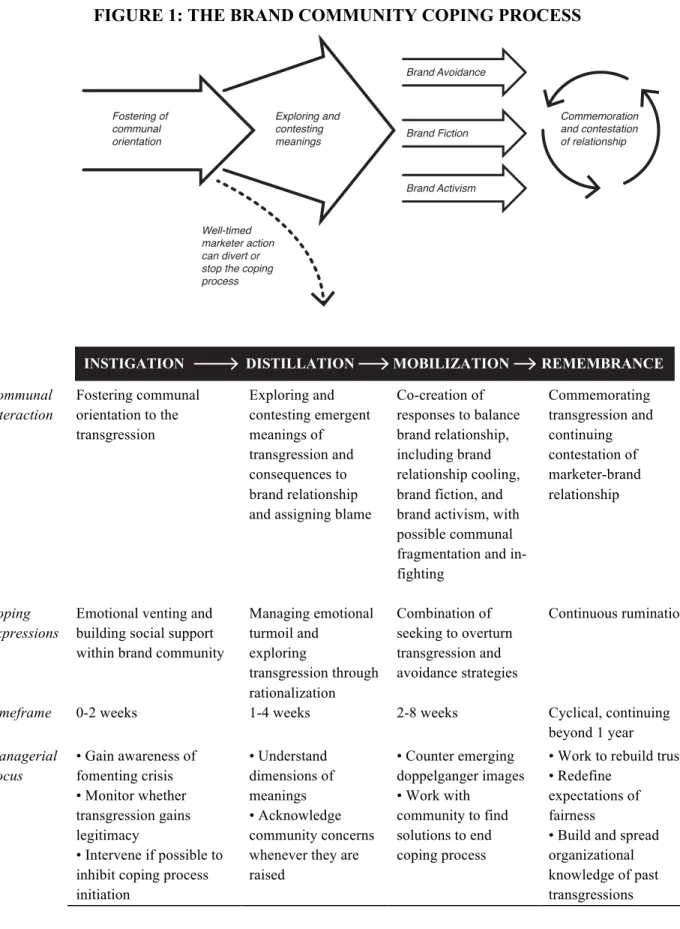
enthusiastic, and mutually beneficial co-creation. We offer three principal contributions. First, we extend the literature on brand relationships by illustrating new communal dynamics of a severe brand transgression. Second, we extend the literature on consumer coping by providing a framework for brand community coping. Third, we provide new theoretical and managerial implications on managing brand relationships and co-creation. Figure 1 summarizes our model of brand community coping and identifies key managerial foci.
<< === INSERT FIGURE 1 ABOUT HERE === >>
The study of brand transgressions has adopted an individual focus (e.g., Aaker et al., 2004; Trump, 2014). Our findings show how consumers that are active in brand communities experience brand transgressions. Because many consumers in brand communities begin as “true believers” (Muñiz & O’Guinn, 2001), transgressions are likely to have a greater impact. Yet our findings further suggest that peer validation in brand communities can fan the flames of moral outrage to accentuate brand transgressions (Ward & Ostrom, 2006). In other words, our study emphasizes that the inherent sociality of brand communities, especially in the age of social media, creates instability in brand relationships and induces novel, collective responses (Russell & Schau, 2014). As the Bioware case makes clear, for marketers, this increases the likelihood of the transgression becoming more severe and leading to campaigns of consumer retaliation.
We identified four overlapping stages of brand community coping: instigation,
distillation, mobilization, and remembrance. Similar to brand relationship studies, research on consumer coping has largely concentrated on individuals. The literature accounts for various consumer coping strategies, such as managing emotional turmoil, brand avoidance, seeking emotional support from peers, and overturning the transgression (Duhachek, 2005). While brand community coping mixes these approaches, especially early on, it ultimately coalesces into a communal endeavor to overturn the transgression.
Our findings extend those of Russell and Schau (2014) who identified consumer responses in cases of ending branding narratives. However, the unexpected nature of the ME3 transgression, especially in light of Bioware’s promise of a well-resolved ending — stands in contrast to the conclusion of a television series, a format where consumer preferences have been molded to expect twists and turns.. Furthermore, their study defined brand communities as coping resources for individuals — places of respite where consumers could share in each others’ grief. Our study, on the other hand, foregrounded the communal level of analysis and identified coordinated and dynamically changing collective action. Similar to findings from non-consumption contexts, our findings also show that communities can both help and hinder
individual coping outcomes (Lyons et al., 1998; Silver et al., 1990). Recall, for example, the coping benefits from peer support and validation of personal experiences, but also the heated and insult-laden communal in-fighting that caused further individual grief.
community’s remembrance practices, which continue years after the initial brand transgression, provide a significant departure from the short-term focus of previous coping studies (cf.
Duhachek, 2005; Mick & Fournier, 1998; Russell & Schau, 2014; St. James et al., 2011). Here our findings also run counter to prior studies suggesting that firms are able to erase memories of their transgressions in the mid to long term (Mena et al., 2016). Instead, we found that a
transgression can pass into collective memory and make a community permanently hostile towards the marketer. This perspective jibes with the constantly circulated betrayal stories in the Apple Newton brand community after it was abandoned by the marketer (Muñiz & Schau, 2005; 2007). This ongoing communal remembrance also serves as a testament to why marketers need to take especially online brand communities seriously. Communities serve as archival
repositories for brand histories, which presents brand managers with both opportunities and constraints for future actions (e.g., Fournier & Lee, 2009; Muñiz & O’Guinn, 2001; Schau et al., 2009). Our findings show how a brand transgression can become a memorable dark chapter in a brand’s history.
Fostering co-creation between brand communities and marketers necessitates congruity in goals and practices as well as an implicit understanding of fair reciprocity between the parties involved (Gyrd-Jones & Kornum, 2013; Healy & McDonagh, 2013; Schau et al., 2009). Our findings illustrate the difficulty of maintaining such an alignment and what a sudden
misalignment in the form of a brand transgression means for marketers. Bioware had extensively used co-creation in developing the Mass Effect brand, yielding financial benefits for the firm as well as stronger brand relationships for consumers (Hong & Chen, 2013). Our analysis showed that a brand transgression and the ensuing communal coping process can significantly alter the dynamics of established co-creative practices between a marketer and a brand community. When compared to the typology of collaborative practices by Skålen and colleagues (2015), a brand transgression and the ensuing coping process can lead to a severe breakdown of Q&A,
dialoguing, translating, praising, managing, and governing. In addition, the collaborative practice of branding can quickly turn to destroy value, as when the community channeling its anger into producing damaging doppelgänger brand images , made more potent because they were created by previous brand fans rather than by those who already opposed the brand (Thompson,
Rindfleisch, & Arsel, 2006). Perhaps most harmful to the community itself, the practice of mirroring — evidenced in the conversations about who had the right to belong to the brand community) can become contentious and divisive.
Our findings indicate that teaching a brand community co-creative practices poses risks for a marketer, as these practices can one day be retooled and turned against the marketer, turning previously productive co-creative practices “from light to dark” (Gyrd-Jones & Kornum, 2013). Many of the practices that the brand community used to enact its revenge on the marketer -- especially brand curation and user generated content -- were ones that the community had previously used to the marketer’s benefit. Also, the speed with which the IKEA and ME3 transgressions transitioned from instigation to distillation shows how adept brand communities can be at weaponizing co-creative practices. Indeed, coping studies show that established
communal hierarchies, understanding of skill divisions, and practices are potent resources for effective coping processes (Lyons et al., 1998). For the ME community, shaming Bioware became a competitive sport that offered entertainment and potential status gains for individual members. We posit that brand communities with problem-solving or speculative tendencies and related structures (Fournier & Lee, 2009; Muñiz & Schau, 2007) are better equipped for
communal coping and, therefore, potentially more dangerous to marketers when provoked. Our findings reify the notion that consumer-marketer relationships -- and by extension their collaborative alignments -- are often governed by implied social contracts rather than contractual agreements (Russell et al., 2015). In other words, while Bioware from a legal standpoint gets to decide how co-creative efforts ultimately become marketplace offerings (cf. Arvidsson, 2011), our findings showed that co-creation introduces community expectations that the marketer will maintain established levels of collaboration. It is likely that marketers become blind to these implicit relationship understandings because consumers and marketers’ views of brands differ (Gambetti & Graffina, 2015). This implicitness was particularly evident in the symbiotic co-creative relationship between IKEA and the hacker community prior to the
transgression (Lemon & Veroff, 2016; Rosner & Bean, 2009). Such incongruences put marketers at risk, as the lack of understanding can make transgressions more likely and stall the
mobilization of damage control. More specifically, our study emphasizes that marketers cannot suddenly begin cherry picking from communal property if previous actions signal a mutual co-creative relationship. Any potential decision to renegotiate co-co-creative efforts requires careful preparation and open dialogue with the brand community. However, the different approaches between Bioware (denial, refusal to engage, antagonizing of community) and IKEA (proactive measures to undo the damage, recommitting to co-creative practices) show that marketers can influence coping outcomes and perhaps even undo the damage.
Our findings are bounded by our focus on virtual brand communities. Future research should investigate if brand communities with face-to-face interaction develop co-creative relationships with marketers or perform coping practices in different ways. As consumer
expectations shift and more marketers invest in co-creative relationships, future research should also examine whether and how a co-creative relationship can be dismantled or scaled back without alienating the brand community.
6. REFERENCES
Aaker, J., Fournier, S., & Brasel, S. A. (2004). When Good Brands Do Bad. Journal of Consumer Research, 31(1), 1–16.
Archer J. L. (1980) Self-disclosure, In D. Wegner & R. Vallacher (Eds.), The Self in Social Psychology. London: Oxford University, 183–204.
Arvidsson, A., 2011. Ethics and value in customer co-production. Marketing Theory, 11(3), 261– 78.
Arvidsson, A., and Caliandro, A. (2016). Brand Public. Journal of Consumer Research, 42(5), 727-748.
Beverland, M. B., Farrelly, F., & Quester, P. G. (2010). Authentic subcultural membership: Antecedents and consequences of authenticating acts and authoritative performances. Psychology & Marketing, 27(7), 698–716.
Cohen, S., & Wills, T. a. (1985). Stress, social support, and the buffering hypothesis. Psychological bulletin, 98(2), 310–57.
Cova, B., Pace, S., and Skålen, P. (2015a). Brand volunteering: Value co-creation with unpaid consumers. Marketing Theory, 15(4), 465-485.
Cova, B., Pace, S., and Skålen, P. (2015b). Marketing with working consumers: The case of a carmaker and its brand community. Organization, 22(5), 682-701.
Cova, B. and White, T. (2010). Counter-brand and alter-brand communities: The impact of Web 2.0 on tribal marketing approaches. Journal of Marketing Management, 26(3-4), 256-270.
Duhachek, A. (2005). Coping: A multidimensional, hierarchical framework of responses to
stressful consumption episodes. Journal of Consumer Research, 32(1), 41-53.
Echeverri, P. & Skalen, P. (2011) Co-creation and co-destruction: A practice-theory based study of interactive value formation. Marketing Theory, 11(3), 351–373.
Elliott, R., Eccles, S., & Gournay, K. (1996). Revenge, existential choice, and addictive consumption. Psychology & Marketing, 13(December), 753–768.
Fournier, S. (1998) Consumers and their brands: Developing relationship theory in consumer research. Journal of Consumer Research, 24(4), 343-353.
Fournier, S., & Lee, S. (2009). Getting Brand Communities Right. Harvard Business Review, (April), 105–111.
Gambetti, R.C. & Graffigna, G. (2015). Value co-creation between the “inside” and the “outside” of a company: Insights from a brand community failure. Marketing Theory, 15(2), 155–178.
Gatzweiler, A., Blazevic, V., and Piller, F. T., (2017). Dark side or bright light: Destructive and constructive deviant content in consumer ideation contests. The Journal of Product Innovation Management, 34(6), 772-789.
Gebauer, J., Füller, J. & Pezzei, R., (2013). The dark and the bright side of co-creation: Triggers of member behavior in online innovation communities. Journal of Business Research, 66(9), 1516–1527.
Gyrd-Jones, R.I. & Kornum, N., (2013). Managing the co-created brand: Value and cultural complementarity in online and offline multi-stakeholder ecosystems. Journal of Business Research, 66(9), 1484–1493.
Halbwachs, M. (1992). On collective memory. The University of Chicago Press.
Healy, J.C. & McDonagh, P., (2013). Consumer roles in brand culture and value co-creation in virtual communities. Journal of Business Research, 66(9), 1528–1540.
Hobfall, S., (2011). The influence of culture, community, and the nested-self in the stress process: Advancing conservation of resources theory. Applied Psychology, 50(3), 337-421.
Hobsbawm, E. & Ranger, T. (1983). (Eds.). The Invention of Tradition. Cambridge University Press.
Hong, R., & Chen, V. (2013). Becoming an Ideal Co-creator: Web Materiality and Intensive Laboring Practices in Game Modding. New Media & Society, 16(2), 290-305.
Jenkins, H. (2006). Convergence Culture: Where Old and New Media Collide. New York University Press.
Johnson, D. W., & Johnson, F. P. (1996). Joining together: Group theory and group skills (5th ed.). Englewood Cliffs, New Jersey: Prentice Hall.
Kozinets, R. V. (1999). E-Tribalized Marketing?: The Strategic Implications of Virtual Communities of Consumption. European Management Journal, 17(3), 252–264. Kozinets, R. V. (2010). Netnography: Doing Ethnographic Research Online. London: Sage. Kozinets, R. V., Hemetsberger, A. & Schau, H.J., (2008). The Wisdom of Consumer Crowds:
Collective Innovation in the Age of Networked Marketing. Journal of Macromarketing, 28(4), 339–354.
Lazarus, R. S., & Folkman, S. (1984). Stress, appraisal and coping. New York: Springer. Lee-Wingate, S. N., & Corfman, K. P. (2011). The effect of consumer emotional disclosure on
fairness perceptions. Psychology & Marketing, 28(9), 897–908.
Lemon, K., and Verhoef, P. (2016). Understanding customer experience throughout the customer journey. Journal of Marketing, 80(6), 69-96.
Lyons, R. F., Mickelson, K. D., Sullivan, M. J. L., & Coyne, J. C. (1998). Coping as a Communal Process. Journal of Social and Personal Relationships, 15(5), 579–605. Martin, L. L., & Tesser, A. (1989). Toward a motivational and structural theory of ruminative
thought. In J. A. Bargh (Ed.), Unintended thought (pp. 306–326). New York, New York, USA: Guilford Press.
Martineau, E. and Arsel, Z. (2017). Managing communities of co-creation around consumer engagement styles. Journal of the Association of Consumer Research 2(2), 179-195. McAlexander, J., Schouten, J., and Koenig, H. (2002). Building brand community. Journal of
Marketing 66(1), 38-54.
McKenna, K. Y. A., Green, A. S., & Gleason, E. J. (2002) Relationship formation on the Internet: What’s the big attraction?, Journal of Social Issues, 58, 9–31.
Mena, S., Rintamäki, J., Spicer, A., & Fleming, P. (2016). On the Forgetting of Corporate Irresponsibility. Academy of Management Review, 41(4), 720-738.
Mick, D. G., and Fournier, S. (1998). Paradoxes of technology: Consumer cognizance, emotions, and coping strategies. Journal of Consumer Research, 25(2), 123-143.
Miles, M. B., & Huberman, A. M. (1994). Qualitative Data Analysis: An Expanded Sourcebook (2nd ed.). Thousand Oaks, CA: Sage.
Muñiz, A. M., and Schau, H. J. (2005). Religiosity in the Abandoned Apple Newton Brand Community. Journal of Consumer Research, 31(March), 737–747.
Muñiz, A. M., and Schau, H. J. (2007). Vigilante marketing and consumer-created communications. Journal of Advertising, 36(3), 35–50.
Muñiz, A. M. and O’Guinn, T. (2001). Brand community. Journal of Consumer Research, 27 (4), 412-432.
Olick, J., & Robbins, J. (1998). Social memory studies: From “collective memory” to the historical sociology of mnemonic practices. Annual Review of Sociology, 24, 105–140. Panzer, Tess. To All You IKEA Hackers Out There - IKEA Wants to Help. Yahoo! Makers,
https://www.yahoo.com/makers/to-all-you-ikea-hackers-c1433273826157.html. Accessed October 28, 2015.
Pennebaker, James W., & Harber, K. D. (1993). A Social Stage Model of Collective Coping: The Loma Prieta Earthquake and The Persian Gulf War. Journal of Social Issues, 49(4), 125– 145.
Prahalad, C.K. & Ramaswamy, V. (2004) Co-creating unique value with customers. Strategy & Leadership, 32(3), 4–9.
Rangeslip, S. E. (2001). The Influence of Culture, Community, and the Nested-Self in the Stress Process: Advancing Conservation of Resources Theory. Applied Psychology, 50(3), 337– 421.
Rangeslip, S. E., & London, P. (1986). The Relationship of Self-Concept and Social Support to Emotional Distress Among Women During War. Journal of Social and Clinical
Psychology, 4(2), 189–203.
Rimé, B., Finkenauer, C., Luminet, O., Zech, E., & Philippot, P. (1998). Social Sharing of Emotion: New Evidence and New Questions. European Review of Social Psychology, 9(1), 145–189.
Rosner, D. and Bean, J. (2009). Learning from IKEA hacking: “I’m not one to decoupage a tabletop and call it a day.” Proceedings of the SIGCHI Conference on Human Factors in Computing Systems. ACM, 419-422.
Russell, C. A., & Schau, H. J. (2014). When Narrative Brands End: The Impact of Narrative Closure and Consumption Sociality on Loss Accommodation. Journal of Consumer Research, 40(6), 1039–1062.
Russell, C.A., Russell, D.W. & Honea, H., (2015). Corporate Social Responsibility Failures: How do Consumers Respond to Corporate Violations of Implied Social Contracts? Journal of Business Ethics.
Schau, H. J., Muñiz Jr., A. M., & Arnould, E. J. (2009). How Brand Community Practices Create Value. Journal of Marketing, 73(5), 30–51.
Schmalz, S., & Orth, U. R. (2012). Brand Attachment and Consumer Emotional Response to Unethical Firm Behavior. Psychology & Marketing, 29(11), 869–884.
Silver, R. C., Wortman, C. B., & Crofton, C. (1990). The Role of Coping on Support Provision: The Self-presentational Dilemma of Victims of Life Crisis. In B. R. Sarason, I. G. Sarason, & G. R. Pierce (Eds.), Social Support: An Interactional View (pp. 397–426). New York: Wiley.
Skålen, P., Pace, S., and Cova, B. (2015). Firm-brand community value co-creation as alignment of practices. European Journal of Marketing, 49 (3/4), 596-620.
St. James, Y., Handelman, J.M. & Taylor, S.F., (2011) Magical Thinking and Consumer Coping. Journal of Consumer Research, 38(4), 632–649.
Thompson, C. J., Rindfleisch, A., & Arsel, Z. (2006). Emotional Branding and the Strategic Value of the Doppelgänger Brand Image. Journal of Marketing, 70(January), 50–64. Trump, R. K. (2014). Connected consumers' responses to negative brand actions: The roles of
transgression self-relevance and domain. Journal of Business Research, 67(9), 1824-1830.
Vargo, S.L. & Lusch, R.F. (2004) Evolving to a New Dominant Logic for Marketing. Journal of Marketing, 68(1), 1–17.
Veloutsou, C. & Moutinho, L., (2009). Brand relationships through brand reputation and brand tribalism. Journal of Business Research, 62(3), 314–322.
Ward, J. C., & Ostrom, A. L. (2006). Complaining to the Masses: The Role of Protest Framing in Customer- Created Complaint Web Sites. Journal of Consumer Research, 33(2), 220– 230.
Weijo, H., Hietanen, J. & Mattila, P. (2014). New insights into online consumption communities and netnography. Journal of Business Research, 67(10), 2072–2078.
Wright, S. A., Dinsmore, J. B., & Kellaris, J. J. (2013). How Group Loyalties Shape Ethical Judgment and Punishment Preferences. Psychology & Marketing, 30(3), 203–210. Zerubavel, E. (1996). Social memories: Steps to a sociology of the past. Qualitative Sociology,
FIGURE 1: THE BRAND COMMUNITY COPING PROCESS Communal Interaction Fostering communal orientation to the transgression Exploring and contesting emergent meanings of transgression and consequences to brand relationship and assigning blame
Co-creation of responses to balance brand relationship, including brand relationship cooling, brand fiction, and brand activism, with possible communal fragmentation and in-fighting Commemorating transgression and continuing contestation of marketer-brand relationship Coping Expressions
Emotional venting and building social support within brand community
Managing emotional turmoil and exploring transgression through rationalization Combination of seeking to overturn transgression and avoidance strategies Continuous rumination
Timeframe 0-2 weeks 1-4 weeks 2-8 weeks Cyclical, continuing beyond 1 year Managerial Focus • Gain awareness of fomenting crisis • Monitor whether transgression gains legitimacy • Intervene if possible to inhibit coping process initiation • Understand dimensions of meanings • Acknowledge community concerns whenever they are raised • Counter emerging doppelganger images • Work with community to find solutions to end coping process
• Work to rebuild trust • Redefine
expectations of fairness
• Build and spread organizational knowledge of past transgressions Brand Avoidance Brand Fiction Brand Activism Well-timed marketer action can divert or stop the coping process Fostering of communal orientation Exploring and contesting meanings Commemoration and contestation of relationship
INSTIGATION DISTILLATION MOBILIZATION REMEMBRANCE
View publication stats View publication stats