ASSESSING ALTERNATIVE MONETARY POLICY
FRAMEWORKS AND INSTRUMENTS IN
SELECTED AFRICAN ECONOMIES
Austin Belewa Chiumia
Supervisor:
Professor Christopher Malikane
A thesis submitted to the Faculty of Commerce, Law and Management, Uni-versity of the Witwatersrand, Johannesburg, in Ful…llment of the Require-ments for the Degree of Doctor of Philosophy in Economics
Declaration
I declare that this thesis, which I hereby submit for the degree of Doctor of Philosophy (Economics) at the University of the Witwatersrand, Johannes-burg, is my own work and has not been submitted by me for any degree or examination at any other University.
Signed:
Name of Student: Austin Belewa Chiumia
Dedication
Dedicated to my wife Lonia, my daughters Taonga and Hannah and my son Vitumbiko.
Acknowledgements
I thank God for his amazing grace. I also deeply thank my supervisor, Profes-sor Christopher Malikane, for his technical guidance during the entire period of study. I equally thank the Reserve Bank of Malawi for granting me the scholarship to pursue this study. This work was going to be extremely di¢ -cult without support from my family. Ceaseless prayers, moral and …nancial support from my wife Lonia, our daughters Taonga and Hannah and our son Vitumbiko helped me to get this far. These family members endured my lengthy absence and sacri…ced their time and resources.
I am also grateful to the African Economic Research Consortium and the International Monetary Fund (IMF) for o¤ering me a visiting scholarship to the IMF in Washington DC where part of this thesis was presented. Several academic members of sta¤, such as Dr. Tshepo Mokoka, Ms. Pholile Dladla, Professor Tendai Gwatidzo and Dr. Nyansha Mahonye gave me encourage-ment during the study period. I would like to sincerely thank them. I am also thankful to colleagues from the School of Economic and Business Sciences at the University of the Witwatersrand for their comradely support. Lastly, I would like to recognize the support o¤ered by the administrative sta¤ in the School of Economic and Business Studies and the Faculty of Commerce, Law and Management.
Abstract
This thesis contains three core chapters that assess the performance of alter-native monetary policy frameworks and instruments in stabilizing 10 selected African economies. Literature and practice show that Advanced Economies (AEs) and Emerging Market Economies (EMEs) are mostly adopting the in-‡ation targeting (IT) framework. This framework relies on active use of the interest rate as a policy instrument for macroeconomic stabilisation. Di¤er-ent from AEs and EMEs, the majority of African countries are characterized by low …nancial market development, frequent supply shocks and volatile terms of trade. These features impede the e¢ ciency of the IT framework and the interest rate instrument. Supply shocks imply that in‡ation is not only demand driven. Volatile terms of trade translate into excessive exchange rate ‡uctuations.
Due to these factors, policy practice in Africa remains largely divergent from the global trend. Authorities still rely on monetary aggregate tar-geting (MAT) with de facto managed exchange rates. However, the MAT framework is also failing to stabilize economies. This follows instability of the key factors, such as the money demand, upon which the framework is anchored. Furthermore, controlling exchange rate movements is a challenge due to weak balance of payments positions. It is not surprising, therefore, that the majority of African economies still remain in the grip of macroeco-nomic instability. In‡ation and GDP targets are rarely met and they also remain volatile. The perverse macroeconomic features and the perceived fail-ure of the MAT regime have necessitated the search for alternative monetary frameworks and instruments.
In this study, we join the search by speci…cally focussing on three questions. First, given the macroeconomic landscape in Africa, what is the relative performance of the interest rate vis-à-vis the monetary aggregate as
instru-ments for macroeconomic stabilization? Secondly, how do these instruinstru-ments perform when apart from in‡ation and output stabilization, monetary pol-icy also engages in smoothing exchange rate ‡uctuations? Thirdly, what is the relative performance of in‡ation targeting vis-à-vis nominal GDP target-ing as alternative monetary policy regimes for macroeconomic stabilization in African economies? Although the success of monetary policy largely re-lies on appropriate con…guration of monetary policy frameworks and instru-ments, answers to these questions remain controversial and scanty for African economies.
In order to address these questions, we formulate a New Keynesian Dynamic Stochastic General Equilibrium (DSGE) model. In this model, money is non-separable from consumption in the utility function. We estimate the model using the Maximum Likelihood method with quarterly data mostly from 1990 to 2014. The data is obtained from the International Financial Statistics (IFS). The thesis has …ve chapters. Chapter 1 is the general back-ground to the research problem. Chapters 2, 3 and 4 are distinct but related core chapters addressing three speci…c research questions. Chapter 5 is the conclusion.
In Chapter 2, we compare the performance of the monetary aggregate and the interest rate as alternative instruments for stabilizing in‡ation and out-put in 10 selected countries. Results show that the monetary aggregate is superior in stabilizing 5 economies. In the other 5 countries, it is the interest rate instrument which performs better. In the former group of countries, the monetary aggregate plays a relatively large role in macroeconomic dynamics while in the latter the interest rate is more signi…cant. These results partly re‡ect di¤erences in …nancial market development between the two groups of countries. Overall, we …nd a weak role of the interest rate compared to the monetary aggregate in driving aggregate demand dynamics. The exchange rate is also found to be a key driver of macroeconomic dynamics. Our
re-sults suggest three things: First, authorities in Africa need to be cautious of a blanket adoption of the interest rate as a sole monetary policy instru-ment. Second, authorities will …nd it di¢ cult to stabilize economies using the interest rate based frameworks. Third, exchange rate stability is key to macroeconomic stability in Africa.
In Chapter 3, we extend the authorities’objective function. In addition to minimizing in‡ation and output volatility, authorities also use the interest rate or money supply rules to smooth exchange rate ‡uctuations. The re-sults show that macroeconomic performance is enhanced when authorities smooth exchange rate ‡uctuations in 4 of the 10 countries. The gains from exchange rate smoothing mostly arise from a reduction in in‡ation and ex-change rate volatility but not from output. In the other 6 countries, exex-change rate smoothing worsens macroeconomic performance. These results re‡ect the fact that the exchange rate exerts a relatively large in‡uence in macro-economic dynamics in the …rst group of countries compared to the latter. Exchange rate smoothing therefore minimizes the pass-through of the ex-change ‡uctuations to in‡ation and output leading to better performance. Overall, the …ndings suggest that exchange rate smoothing is harmful in Africa. Where exchange rate smoothing delivers gains, appropriate thresh-olds of smoothing need to be observed to avoid policy induced macroeconomic instability. Authorities should also smooth temporal rather that structural shifts in the exchange rate level.
In Chapter 4, we compare the performance of in‡ation targeting (IT) vis-à-vis nominal GDP targeting (NGDPT) as alternative monetary policy frame-works for macroeconomic stabilization. We examine the strict and ‡exible versions of these policy regimes. We also include a hybrid regime which combines elements of IT and NGDPT. Results show that the hybrid regime performs better in 5 countries. In the other 4 countries, it is the strict in‡ation targeting that performs better. In 1 country, ‡exible in‡ation
tar-geting is optimal. The results also reveal that demand shocks dominate but are closely trailed by supply and exchange rate shocks in explaining macroeconomic ‡uctuations. The multiplicity of signi…cant shocks is key in explaining the dominance of the hybrid regime. The hybrid regime suc-cessfully handles shocks that can neither be optimally handled by the IT regime nor the NGDPT regime alone. These results have several implica-tions. First, demand management alone is insu¢ cient to stabilize African economies. Second, identifying dominant shocks is critical for choosing ro-bust monetary policy regimes. Third, the multiplicity of signi…cant shocks implies that choosing monetary policy frameworks and hence macroeconomic management process is more complex for African policy makers.
Overall, the results have several policy implications which are outlined in Chapter 5. First, they suggest a cautious approach towards generalized adoption of the interest rate over the monetary aggregate as a monetary policy instrument in African economies. This contradicts the current wave of monetary policy changes sweeping across African countries. Secondly, the signi…cance of the exchange rate renders credence to exchange rate smoothing in Africa. The …ndings, however, suggest that exchange rate smoothing can either enhance or worsen macroeconomic performance. Where it enhances macroeconomic performance, authorities must carefully consider the thresh-olds of smoothing to avoid creating macroeconomic instability. Authorities need not …ght structural shifts in exchange rates levels through smoothing. This would help to preserve the shock absorbing role of the exchange rate. Finally, the prevalence of demand, supply as well as exchange rate shocks makes the hybrid monetary policy regime which combines elements of IT regime as well as NGDPT regime to perform relatively better in stabilizing the majority of the economies. Given the multiplicity of shocks, authorities in Africa need to complement demand management with policies that address supply side and exchange rate bottlenecks to ensure sustainable
macroeco-nomic stability. Overall, the …ndings suggest that there is scope to improve monetary policy performance in Africa by adopting suitable frameworks and instruments. The results also highlight the problem of tackling monetary policy issues with a "one size …ts all" approach.
Contents
1 Introduction 1
1.1 Background to the study . . . 1
1.2 Stylized facts . . . 6
1.2.1 Volatile macroeconomic performance . . . . 6
1.2.2 Weak interest rate transmission . . . 8
1.2.3 Dominant agriculture/food sectors . . . 9
1.2.4 Frequent terms of trade (ToT) shocks . . . . 13
1.2.5 Low …nancial market development . . . 14
1.2.6 Attempts to migrate to in‡ation targeting . 16 1.2.7 Multiple monetary policy objectives . . . 19
1.3 Motivation of the study . . . 19
1.4 Objectives of the study . . . 21
1.5 Research questions . . . 22
1.6 Contribution of the study . . . 22
1.7 Signi…cance of the study . . . 24
2 Assessing alternative monetary policy instruments in se-lected African economies 25 2.1 Introduction . . . 25
2.2 Literature review . . . 28
2.3 Theoretical exposition . . . 30
2.3.1 Basic tenets of a New Keynesian DSGE model 31 2.3.2 The demand block (IS curve) . . . 32
2.3.3 The supply block (Phillips curve) . . . 37
2.3.4 Monetary policy conduct . . . 40
2.4.1 Households . . . 42
2.4.2 Exchange rate determination . . . 50
2.4.3 Money market dynamics . . . 52
2.4.4 Firms . . . 55
2.4.5 Monetary policy reaction function . . . 61
2.4.6 Estimable System . . . 67
2.5 Data, parameterization and estimation . . . 69
2.5.1 Data . . . 69
2.5.2 Model parameterization . . . 71
2.5.3 Estimation . . . 71
2.6 Results . . . 74
2.6.1 Parameter estimates . . . 74
2.6.2 Impulse responses and variance analysis . . . 92
2.7 Conclusion . . . 99
2.8 Appendix to Chapter 2: Derivation of the UIP Con-dition . . . 101
3 Should central banks smooth exchange rate ‡uctuations in Africa? 103 3.1 Introduction . . . 103 3.2 Literature review . . . 105 3.3 The Model . . . 108 3.3.1 Aggregate demand . . . 110 3.3.2 Aggregate supply . . . 110
3.3.3 Money market dynamics . . . 111
3.3.4 Exchange rate determination . . . 111
3.3.5 Monetary policy conduct . . . 112
3.4 Data, calibration and simulation . . . 116
3.4.1 Data . . . 116
3.4.2 Calibration . . . 117
3.5 Results . . . 119
3.5.1 Variance of output and in‡ation . . . 119
3.5.2 Impulse responses . . . 123
3.6 Conclusion . . . 129
4 In‡ation targeting versus nominal income targeting in se-lected African economies: An empirical assessment 132 4.1 Introduction . . . 132
4.2 Literature review . . . 135
4.3 The model . . . 139
4.3.1 Aggregate demand . . . 140
4.3.2 Aggregate supply . . . 141
4.3.3 Money market dynamics . . . 142
4.3.4 Exchange rate determination . . . 142
4.3.5 Monetary policy conduct . . . 143
4.4 Data, calibration and simulation . . . 148
4.4.1 Data and simulation . . . 148
4.4.2 Calibration . . . 149
4.5 Results . . . 151
4.5.1 Historical decomposition . . . 151
4.5.2 Impulse responses . . . 159
4.5.3 Optimal monetary policy regimes . . . 161
4.6 Conclusion . . . 166
5 Conclusion and policy options 176
6 References 181
7 Appendix to Chapters 3 and 4: Model derivations and
List of Tables
1 In‡ation developments . . . 7
2 Real GDP growth . . . 8
3 Sectoral contribution to GDP (percent) . . . 13
4 Monetary policy frameworks and instruments . . . 17
5 The sample periods for each country . . . 71
6 Parameter estimates for the IS curve . . . 88
7 Parameter estimates for the Phillips curve . . . 89
8 Parameter estimates for the money demand . . . 90
9 Parameter estimates for the interest rate policy rule . . . 91
10 Variance of in‡ation and output . . . 98
11 The reduced form DSGE model . . . 109
12 Data description . . . 116
13 The estimable system . . . 119
14 The variance estimates . . . 126
15 The reduced form New Keynesian DSGE model . . . 140
16 Con…guration of policy regimes based on the loss function . . 148
17 Data description . . . 149
18 The variance of output and in‡ation under di¤erent monetary policy regimes . . . 164
19 The variance of output and in‡ation and optimal monetary policy regimes, cont’d . . . 165
20 Optimal monetary policy regimes under dominant shocks . . . 166
21 Parameter estimates for the IS curve . . . 203
22 Parameter estimates for the Phillips curve . . . 204
23 Parameter estimates for the money demand . . . 205
24 Parameter estimates for the interest rate policy rule . . . 206
25 Parameter estimates for the money supply rule . . . 207
26 Parameters of the exogenous variables-AR(1) coe¢ cients . . . 208 27 Correlation between policy instruments, in‡ation and output . 208
List of Figures
1 Policy rates and market interest rates (Kenya and Uganda) . . 9
2 Contribution to overall in‡ation (percent) . . . 11
3 Contribution to overall in‡ation (percent) . . . 12
4 Terms of trade and exchange rate developments . . . 14
5 Financial market development . . . 15
6 The theoretical DSGE model . . . 32
7 Impulse responses of output gap to monetary policy shocks . . 96
8 Impulse responses of in‡ation to monetary policy shocks . . . 97
9 Impulse responses of in‡ation and output to the interest rate shock . . . 127
10 Impulse responses of output to the monetary aggregate shock . 128 11 Historical decomposition of in‡ation . . . 157
12 Historical decomposition of output . . . 158
13 Impulse responses of in‡ation to the supply shock . . . 170
14 Impulse responses of in‡ation to the demand shock . . . 171
15 Impulse responses of in‡ation to the exchange rate shock . . . 172
16 Impulse responses of output to the supply shock . . . 173
17 Impulse responses of output to the demand shock . . . 174
18 Impulse responses of output to the exchange rate shock . . . . 175
1
Introduction
1.1
Background to the study
Persistent shocks a¤ect macroeconomic performance in several African coun-tries. These shocks exert negative impact on macroeconomic stability and social welfare. In order to preserve and improve macroeconomic performance, authorities are increasingly searching for monetary policy frameworks and in-struments that are robust to the prevailing shocks. As de…ned by Mishkin (1999), monetary policy frameworks are institutional arrangements which guide the conduct of monetary policy. Monetary policy instruments are de-…ned as tools that central banks use to in‡uence money market and credit conditions in order to meet monetary policy objectives.
Literature on monetary policy frameworks can be located in the Mundell-Flemming theory. In this theory, an economy is typically deemed to be unable to simultaneously pursue three objectives. These objectives are: a …xed exchange rate system, an open capital account and an independent monetary policy. This theory is also known as the Impossible Trinity or the Trilemma. It is a hypothesis based on two factors. First, is the Uncovered Interest rate Parity condition (UIP). Second, is the …nding from empirical studies where countries that have tried to simultaneously pursue all three ob-jectives have failed. There are various monetary policy regimes. The popular ones are: i) Exchange Rate Targeting (ERT) which is mostly implemented when a country has chosen to lose monetary policy independence. In this study, we assume that authorities have chosen independent monetary policy. Therefore, they can implement monetary policy using any of the following regimes: (ii) Monetary Aggregate Targeting (MAT), (iii) In‡ation Targeting (IT) and (iv) Nominal GDP Targeting (NGDPT). The choice of any of these frameworks together with the instruments used to achieve policy objectives ideally depends on a country’s macroeconomic conditions.
According to Mishkin (1999), ERT involves …xing the value of a domestic currency to a low in‡ation currency. In this framework, authorities rely on information conveyed by the exchange rate. The ERT is quite successful in anchoring in‡ation expectations in small open economies (Frankel 2014). However, by de…nition, the exchange rate target does not allow the exchange rate to move in line with changes in macroeconomic fundamentals. For ex-ample, a demand shock arising from increased demand for domestic exports should result in an appreciation of the domestic currency. However, the ex-change rate will not be allowed to appreciate in order to absorb the shock. Instead, authorities will buy foreign exchange on the market to defend it. In Africa, poor terms of trade, weak balance of payments positions and weak central bank balance sheets make defending the exchange rate an extremely di¢ cult task. Furthermore, the shocks that hit the anchor country are di-rectly transferrable to the domestic economy under the ERT. Under these circumstances, the ERT poses particular challenges since African countries may lack the capacity to withstand imported shocks. Therefore, the ERT regime may not be a feasible option in many African countries.
After the collapse of the Bretton Woods system around 1971, several coun-tries opted for the MAT. The MAT is based on the quantity theory of money. It basically involves estimating potential output growth and velocity trends. Then through a quantity-equation framework, the target growth rate of the monetary aggregate is backed out. Authorities then withdraw or inject liq-uidity to ensure that the actual growth in the monetary aggregate is consis-tent with the backed out target. The MAT involves reliance on information conveyed by a monetary aggregate. Berg et al. (2010) argue that one key advantage of this framework is that under imperfect information, monetary aggregates may contain information about aggregate demand and interest rates that can not be conveyed by interest rates or the exchange rate and can also not be readily observed in real time. In addition, interest rates may not be market clearing in shallow …nancial markets such as in the majority
of African economies. In which case, it becomes di¢ cult to infer the true opportunity cost of future consumption based on prevailing interest rates. Furthermore, the use of MAT also results from the authorities’unprepared-ness to implement forward looking regimes. This may be due to lack of operational and …scal independence. Under these constraints, strict mon-etary targeting provides a bulwark against …scal dominance. However, as observed by Mishkin (1999), the e¤ectiveness of the MAT relies on the sta-bility of velocity and money multiplier. Some studies, such as Sichei and Kamau (2010) …nd that the velocity and the money multiplier are unstable in Africa. Under a demand shock, authorities …nd it increasingly di¢ cult to determine the exact amount of liquidity to withdraw from the economy in order to remain consistent with the policy targets. Countries which pursue the MAT also su¤er a number of other drawbacks. These include poor liq-uidity management and absence of well-articulated frameworks for assessing how monetary policy should respond to shocks (Mishra et al. 2012). These challenges are rendering the MAT framework ine¤ective and have generated a quest for alternative regimes. One of the alternatives to the MAT is the IT framework.
A key feature of the IT regime is the announcement of a numerical target for in‡ation. The announcement comes with an institutional commitment by the monetary authority to achieve the target. Monetary policy decisions are guided by the deviation of forecasts of future in‡ation from the announced target and deviation of actual output from trend. Taylor (1993) provides useful empirical insight to this. He states that actual monetary policy de-cisions could be usefully approximated by a simple interest-rate rule that is increasing in the expected in‡ation-rate gap and output gap. According to Frankel (2014), the IT framework is gaining more popularity in AEs and EMEs. This follows its robustness to aggregate demand shocks. Demand shocks are dominant in these economies. Under IT, central banks typically
treat the nominal interest rate as their policy instrument.
The characterization of monetary policy conduct under IT shows that when in‡ation is rooted in demand factors, the IT regime together with the interest rate instrument do not generate policy trade-o¤s. When there is a demand shock, contractionary monetary policy closes both the output gap as well as the in‡ation gap. The challenge occurs when an economy is faced with a negative shock to output due for example, to droughts or collapse in terms of trade. In such cases, monetary policy conduct is not straight forward. Strict adherence to IT which calls for a rise in interest rates may worsen output gap and exacerbate in‡ationary pressures. In Africa, several studies, such as Heintz and Ndikumana (2011) show that in‡ation is driven by supply or trade shocks. IMF (2011) also shows that the probability of terms of trade and disaster shocks are higher in Africa compared to AEs and EMEs. Fur-thermore, …scal dominance and …nancial stability concerns compel African authorities not to strictly adhere to interest rates rules.
Frankel (2014) shows that when supply shocks dominate, NGDP targeting performs better in reducing macroeconomic volatility than the IT. A supply shock will reduce real GDP and raise in‡ation. This implies that the in‡a-tion gap as well as the output gap will rise. The di¤erence occurs in the way authorities under the IT and the NGDP regimes respond to this shock. Under NGDPT, monetary policy response ensures that the supply shock is apportioned between prices and the real GDP. Authorities will allow in‡a-tion to rise to compensate for a fall in real GDP thereby maintaining the NGDP target. Allowing the in‡ation to rise implies that monetary policy response will relatively be less hawkish under the NGDPT compared to the IT. Under the IT, a supply shock is borne by prices alone. Authorities will tighten monetary policy which deals with in‡ation threats but doing so tends to worsen the performance of GDP.
can also be analyzed via the transmission process of the interest rate sig-nals. Under the interest rate instrument, authorities typically conduct mon-etary policy by buying and selling short-term government securities in a well-functioning …nancial market. In doing so, the objective is to control the value of some …nancial market variable, such as the interbank interest rate (IBR). The IBR is assumed to in‡uence long-term retail rates and hence output and in‡ation (Mishra et al. 2012). This process is buttressed by the exchange rate channel. Under ‡oating exchange rates and perfect capital mobility, arbitrage between domestic and foreign short-term government se-curities causes incipient capital ‡ows which change the equilibrium value of the exchange rate. However, the e¤ectiveness of the exchange rate channel depends on several factors. These include the authorities’willingness to allow the exchange rate to move, the degree of capital mobility and the strength of expenditure switching e¤ects.
As shown by Mishra et al. (2012), the conventional description of inter-est rate and exchange rate transmission relies on e¤ective arbitrage along several margins. These include arbitrage between di¤erent short-term secu-rities, short-term and long-term secusecu-rities, long-term securities and equities, domestic and foreign securities and …nancial and real assets. This transmis-sion process is thus intended for economies with developed and competitive …nancial systems, independent central banks, high degree of international capital mobility and ‡oating exchange rate systems. African economies do not compete favorably in most of these features. For example, Fig. 5 shows that …nancial market development has largely stagnated in Africa. To the extent that the features that characterize African countries di¤er from those of the developed economies, it would be expected that the standard policy transmission process will also di¤er. Under these circumstances, monetary policy conduct using the IT and the interest rate instruments may fail to successfully stabilize economies.
Frankel et al. (2008), also shows that the appeal of the interest rate rules over money-targeting rules as a means of delivering lower in‡ation and output volatility only holds when demand shocks dominate. When supply shocks dominate, interest rates continue to deliver lower in‡ation volatility but at the cost of higher output volatility. Under these circumstances, a conventional money-based rule will result in lower output volatility and the unambiguous welfare-based argument in favour of the IT and interest rates disappears. Figs. 2 and 3 capture the contribution of food to in‡ation while Fig. 4 shows the contribution of agriculture to GDP in Africa. These …gures reveal that supply side factors can not be dispelled in Africa. As observed by IMF (2015) and Berg et al. (2010), these factors also explain why the MAT regimes and money supply rules remain a common practice in Africa.
This notwithstanding, the global direction in monetary policy conduct to-wards in‡ation targeting and interest rate rules is exerting signi…cant in‡u-ence on policy direction in Africa. Although the success of monetary policy largely relies on the appropriate con…guration of monetary policy frameworks and instruments, abundant research on the subject is only available for AEs and some EMEs, but little on Africa. Besides, the available literature is also not synchronized. This lack of synchrony compounded by the paucity of literature is putting speed bumps on the monetary policy modernization process in Africa.
1.2
Stylized facts
1.2.1 Volatile macroeconomic performance
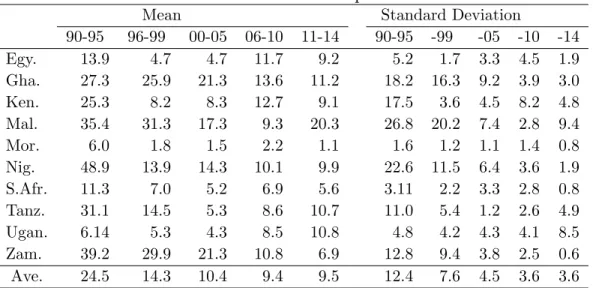
African countries still remain in the grip of macroeconomic instability. Country-speci…c analysis reveals that the majority of African countries struggle to meet their in‡ation objectives using the prevailing monetary policy frame-works and instruments. For example, Ghana adopted an in‡ation target of
Table 1: In‡ation developments
Mean Standard Deviation
90-95 96-99 00-05 06-10 11-14 90-95 -99 -05 -10 -14 Egy. 13.9 4.7 4.7 11.7 9.2 5.2 1.7 3.3 4.5 1.9 Gha. 27.3 25.9 21.3 13.6 11.2 18.2 16.3 9.2 3.9 3.0 Ken. 25.3 8.2 8.3 12.7 9.1 17.5 3.6 4.5 8.2 4.8 Mal. 35.4 31.3 17.3 9.3 20.3 26.8 20.2 7.4 2.8 9.4 Mor. 6.0 1.8 1.5 2.2 1.1 1.6 1.2 1.1 1.4 0.8 Nig. 48.9 13.9 14.3 10.1 9.9 22.6 11.5 6.4 3.6 1.9 S.Afr. 11.3 7.0 5.2 6.9 5.6 3.11 2.2 3.3 2.8 0.8 Tanz. 31.1 14.5 5.3 8.6 10.7 11.0 5.4 1.2 2.6 4.9 Ugan. 6.14 5.3 4.3 8.5 10.8 4.8 4.2 4.3 4.1 8.5 Zam. 39.2 29.9 21.3 10.8 6.9 12.8 9.4 3.8 2.5 0.6 Ave. 24.5 14.3 10.4 9.4 9.5 12.4 7.6 4.5 3.6 3.6
Source: International Financial Statistics
8.5 percent ( 2) in 2007 with active use of the interest rate instrument. In 2008, the country was faced with severe oil and food price shocks which per-sistently led to in‡ation deviating from the target. Even prior to 2007 when Ghana was using the monetary aggregate targeting framework, her in‡ation remained fairly high (see Table 1).
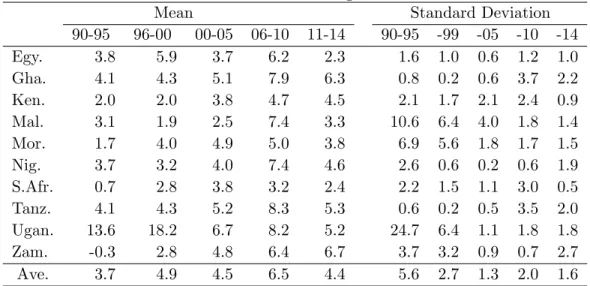
Table 1 also reveals that there has been some decline in aggregate in‡ation over time with more stability registered in the past decade. Similarly, real GDP has been on the rise with substantial growth registered in the past decade (see Table 2). According to O’Connell (2011) this macroeconomic progress places many African countries on the right path to use interest rate instruments and in‡ation targeting frameworks. However, risks to sustained macroeconomic stability remain elevated. Nguyen et al. (2017) identify high vulnerability to natural disasters, oil price shocks and terms of trade shocks as some key risks. It is not surprising, therefore that Tables 1 and 2 also show that in‡ation rates have mostly been above targets while real GDP growth rates are mostly below the conventional 6 percent mark.
Table 2: Real GDP growth
Mean Standard Deviation
90-95 96-00 00-05 06-10 11-14 90-95 -99 -05 -10 -14 Egy. 3.8 5.9 3.7 6.2 2.3 1.6 1.0 0.6 1.2 1.0 Gha. 4.1 4.3 5.1 7.9 6.3 0.8 0.2 0.6 3.7 2.2 Ken. 2.0 2.0 3.8 4.7 4.5 2.1 1.7 2.1 2.4 0.9 Mal. 3.1 1.9 2.5 7.4 3.3 10.6 6.4 4.0 1.8 1.4 Mor. 1.7 4.0 4.9 5.0 3.8 6.9 5.6 1.8 1.7 1.5 Nig. 3.7 3.2 4.0 7.4 4.6 2.6 0.6 0.2 0.6 1.9 S.Afr. 0.7 2.8 3.8 3.2 2.4 2.2 1.5 1.1 3.0 0.5 Tanz. 4.1 4.3 5.2 8.3 5.3 0.6 0.2 0.5 3.5 2.0 Ugan. 13.6 18.2 6.7 8.2 5.2 24.7 6.4 1.1 1.8 1.8 Zam. -0.3 2.8 4.8 6.4 6.7 3.7 3.2 0.9 0.7 2.7 Ave. 3.7 4.9 4.5 6.5 4.4 5.6 2.7 1.3 2.0 1.6
Source: International Financial Statistics
1.2.2 Weak interest rate transmission
According to IMF (2015), while the majority of African countries still use the MAT regime some have introduced policy rates for signaling the stance of monetary policy. However, these countries often do not have the operational support required to align market rates with the policy rate. For example, Fig. 1 shows that Kenya and Uganda have largely succeeded in aligning central bank rates (CBR) with the interbank rate. However, there still remains a divergence between the interbank rate and the retail rates (lending and savings rates). This implies that the de facto and de jure policy stance are di¤erent. This leaves questions regarding the e¤ectiveness of interest rate instruments in fragmented markets. Other countries, such as Malawi, Zambia and Tanzania which use the MAT system also have a disjoint between the operating targets and the retail rates.
Uganda Kenya
Figure 1: Policy rates and market interest rates (Kenya and Uganda) 1.2.3 Dominant agriculture/food sectors
Figs. 2 and 3 show that food prices signi…cantly contribute to overall Con-sumer Price Index (CPI) in all countries. According to the International Financial Statistics (IFS), the 2016 weights of food and beverages in the overall CPI are recorded as follows (from highest to lowest): Zambia (53.5%), Nigeria (51.8%), Malawi (50.2%), Tanzania (47.8%), Egypt (44.4%), Ghana (43.9%), Morocco (39.3%), Kenya (36%), Uganda (28.5%) and South Africa (17.2%). This data shows that in Zambia, Nigeria, Malawi and Tanzania food prices contribute nearly half to the overall price dynamics. In the other countries, food in‡ation still contributes more to overall in‡ation but com-paratively less than in the …rst …ve countries. Even though South Africa has the smallest weight on food compared to the rest of the countries, it is still higher than many AEs. These weights suggest that supply factors can not be ignored in the …ght against in‡ation. This data is consistent with Nguyen et al. (2017) who show that 45 percent of in‡ation variations in Africa arise from general supply shocks. Of the 45 percent, two thirds is attributed to domestic supply and commodity price shocks.
According to the 2011 World Bank Development Indicators, expenditures on food in AEs are estimated as follows: Japan (14.7%), Germany (11.5%), Aus-tralia (10.8%), Canada (9.3%), United Kingdom (8.8%) and United States
(5.7%). These …gures show that ‡uctuations in food prices may have neg-ligible impact on overall in‡ation. This suggests that in‡ation is largely demand driven in these countries. These statistics do not compare favorably with those from African economies where food expenditures are relatively large. Large food sectors imply that non-monetary GDP is relatively large. Monetary policy implemented using the IT framework and the interest rate instrument is likely to succeed in countries with smaller expenditures on food than in the majority of African economies. Durevall et al. (2012) argue that traditional interest rate channels make less sense in countries that predom-inantly dependent on agricultural sector with huge informal sector. Given these observations, identifying monetary policy frameworks and instruments which are consistent with the in‡ation dynamics in African economies re-mains an empirical issue.
Similarly, Table 3 reveals that as a single item, agriculture commands a huge share of output in African economies1. It literally surpasses the contribution
of industry in Malawi, Kenya, Tanzania and Uganda. The relatively large share of agriculture implies that output and in‡ation ‡uctuations are not entirely under the control of monetary policy. Considering that the agricul-tural sector is largely small scale and rain driven makes overall GDP and in‡ation susceptible to weather shocks. This raises a critical question of whether standard monetary policy frameworks and instruments which are e¤ective in handling aggregate demand shocks in AEs and EMEs can equally perform well in these circumstances.
1The classi…cation is based on the United Nations Industry Classi…cation System called
Source: International Financial Statistics
Source: International Financial Statistics
Table 3: Sectoral contribution to GDP (percent)
Zam. S.Af Mor. Mal Egy. Gha. Kenya Tanz. Nig. Uga.
Serv. 56.5 68.1 57.7 49.7 49.9 49.9 50.4 43.5 55.5 50.8
Industry 33.8 29.5 29.3 17.0 39.0 27.7 19.4 25.0 24.3 22.0
Agric. 9.64 2.5 12.9 33.3 11.1 22.4 30.3 31.5 20.2 27.2
Source: 2011Word Bank Development Indicators
1.2.4 Frequent terms of trade (ToT) shocks
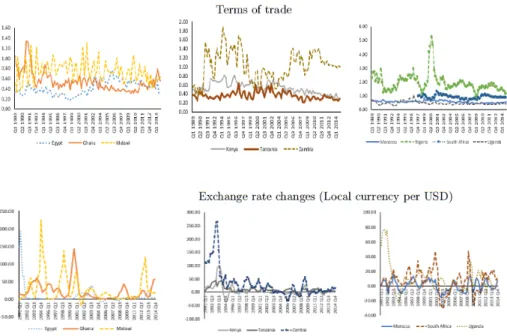
The top part of Fig. 4 shows ‡uctuations in ToTs while the bottom part shows ‡uctuations in exchange rates. ToTs are de…ned as the ratio of an index of the country’s exports to the index of the country’s imports. The ToTs are mostly driven by ‡uctuations in prices and demand for commodity exports. The higher the ratio, the better the ToTs as this entails that a country generates enough export proceeds to sustain its import bills. This is a necessary condition for exchange rate stability. Declining ToTs signal pressure on the exchange rate. In addition to volatility, Fig. 4 also shows that the ToTs for Nigeria, Zambia, Malawi, Kenya, South Africa, Egypt and Tanzania have been declining after the 2009 …nancial crisis.
The majority of African countries are commodity exporters and the plunge in global commodity prices had considerable negative e¤ects on ToTs in Africa. Thus, a key feature of Fig. 4 is that the majority of African countries su¤er volatile and declining ToTs. Volatile and declining ToTs result into frequent exchange rate ‡uctuations and depreciations. The bottom part of Fig. 4 shows that the exchange rates in the selected countries exhibit signi…cant ‡uctuations. These ‡uctuations as argued by Sanchez (2008) have negative implications for macroeconomic performance. This raises another critical question for policy makers in Africa: should monetary policy respond to exchange rate ‡uctuations to mitigate the impact of terms of trade shocks? Again, literature on this question is mostly available on AEs and EMEs but not Africa.
Figure 4: Terms of trade and exchange rate developments 1.2.5 Low …nancial market development
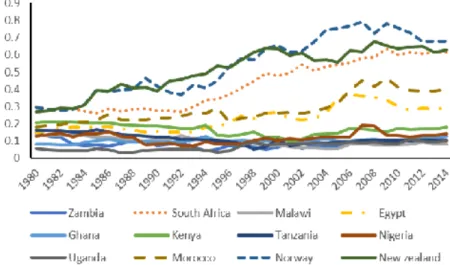
We use an index of …nancial development (FDI) developed by Svirydzenka (2016) to compare the status of …nancial development in the selected African countries. We compare these indices with that of Norway, representing AEs. We also include the FDI for Newzealand which was the …rst country to prac-tice IT. The FDI combines two indices, namely …nancial institutions index (FII) and …nancial markets index (FMI). The FII further combines …nancial institutions access index and …nancial institutions e¢ ciency index (FIEF). The FMI combines …nancial market development, …nancial market access and …nancial market e¢ ciency. The resulting aggregate index, namely the FDI is therefore more representative than the traditionally used measures, such as the ratio of private sector credit to GDP and the ratio of stock market to GDP. The higher the index the better the …nancial market development2.
Figure 5: Financial market development
Fig. 5, reveals that …nancial market development has largely stagnated in Malawi, Zambia, Kenya, Uganda, Tanzania, Ghana and Nigeria. However, South Africa, Morocco and Egypt display some upward trend in …nancial development. South Africa compares favorably with some AEs. Morocco and Egypt appear to be below South Africa and above the rest of the countries in our sample. According to Mishra et al. (2012), …nancial market development is key in transmitting interest rate signals under interest rate frameworks. The status of Africa’s …nancial market development, therefore, raises critical questions on whether interest rate instruments would be e¤ective in dealing with output and in‡ation ‡uctuations.
1.2.6 Attempts to migrate to in‡ation targeting
Within the described unique macroeconomic landscape that characterize African countries, there are still signi…cant attempts to migrate to in‡ation targeting and interest rate instruments. A summary of the current mone-tary policy frameworks and instruments in the selected African economies is presented in Table 4. The Table is based on the 2016 International Mone-tary Fund Annual Report on Exchange Rate Arrangements and Exchange Restrictions (IMF AREAER-2016). The classi…cation used is based on each country’s actual or de-facto arrangement. This implies that the o¢ cially an-nounced or de jure arrangement may di¤er from the de facto policy conduct. For example, Kenya is denoted as an IT country by authorities as well as by IMF (2015). However, based on the IMF AREAER (2016) Kenya’s status has changed from pursuing MAT as categorized in IMF AREAER (2014) to pursuing "Other" monetary policy framework. Authorities in Kenya have only taken preliminary steps toward in‡ation targeting.
A part from monetary policy regimes, IMF AREAER (2016) also classi…es the exchange rate systems. The classi…cation is primarily based on the degree to which the exchange rate is determined by the market rather than by o¢ cial action-the market-determined rates being on the whole more ‡exible. The presentation of exchange rate arrangements alongside monetary policy frameworks in Table 4 highlights that similar exchange rate regimes can be consistent with di¤erent monetary policy frameworks.
Table 4 further shows that 3 countries, namely South Africa, Ghana and Uganda are pursuing the IT regime. The other 3 countries, namely Egypt, Kenya and Zambia are characterized as pursuing "Other" monetary regimes. "Other" regimes imply that these countries have no stated nominal anchor. In practice, this has been a transitory stage from MAT to IT. The other 3 countries, namely Tanzania, Malawi and Nigeria are using the MAT regime
T a b le 4 : M o n et a ry p o li cy fr a m ew o rk s a n d in st ru m en ts P ol . F ram. P ol . In st. Op. T ar g. In t. T arg. M ai n P o l. Goa l E x . R. P ol. IM F Pr og. Egypt O the r a, b, RM Br oad Pri ce O M F Ar t.4 (200 6) c, d IBR mone y S tab ilit y (2015 ) G h ana IT a, b, IBR In‡ ati on P rice Stab. Floa t E CF (200 7) c, d forec a st (8 : 5 2) (201 5) Ken y a Other a, b , IBR Broad P rice Stab. Float S F (201 1) c, d RM mone y (5 2) 2015 Mal. M A T a, b , RM B road Pri ce & Fi n . F loat ECF (199 4) c, d IBR mone y S tab ilit y 2012 Mor. E x . T arg . a, b , -P rice CP P LL c, d S tab ilit y 2015 Nig er ia MA T a, b, RM Broa d P rice & F in. S A Ar t.4 c, d IBR mone y S tab ilit y 2014 S. Af rica IT a, b, IBR In ‡ ati on P rice Floa t None (200 0) forec a st S tab . (3 6) T anz. MA T a, b, RM Br oad Pri ce Fl oat PS I (199 2) c, d IBR mone y S tab ilit y 2014 Uganda IT a, b, IBR In‡ a tion Price, XR Fl oat PS I (201 4) c, d forec a st S tab . (5 ) 2013 Zam b ia Other a, b, RM Broad P rice & F in . Float Art . 4 (201 5) c, d IBR mone y S tab ilit y 2015 Notes: M A T ) Mon etar y Aggr egat e T ar geting, RM ) Res erv e Mon ey , IT ) In‡ ati on T a rgeting, Exr, T ar ) Exc hange rate targeting, IBR=In terban k rate, CP = Con v etio n al p eg, a=P oli cy rate, b=Op en Mark et Op erat ions ,c = Liquidit y Rese rv e Requir emen t, F in=Fi n ancial, d=F orex Exc hange Op erat ions ; ECF=Ext end ed Cr edit F acili ty , SA=Stabili sat ion. Arr an gemen t, O M F =Ot h er Man ag ed F loat , Ar t.4= Arti cl e 4 con sultati on s, PS I= P oli cy Sup p ort Instrume n t, SF=Stand in g F acilit y, P o l.= P oli cy , In st. =Ins tr u men t, T arg .=T a rget, Prog. =Progr amme , PLL= P re cautionary a n d L iquidit y Line in t=i n terest, XR=exc h a n ge rate st ab ilit y. () in‡ a tion targets
while Morocco is implementing the ERT. The diversity in monetary pol-icy frameworks is a re‡ection of diverse challenges that these economies are facing. Contrary to AEs, which recently have been using the interest rate instrument only, Table 4 shows that several African countries tend to use the interest rate alongside the monetary aggregate instruments to deal with macroeconomic ‡uctuations (see also Davoodi et al. 2013 and IMF 2015). Recently, there has been greater use of the interest rate as an operating target while weight is placed on both the interest rate and the monetary aggregates in setting the monetary policy stance. Dornbusch and Fischer (1992) argue that central banks may not achieve their objectives if they actively deploy money and interest rate instruments, simultaneously.
The correlation coe¢ cients between the policy instruments, in‡ation and output are presented in Table 27. These coe¢ cients suggest that there is a negative relationship between output and interest rate in all the countries. The magnitude is estimated at a relatively high value of -0.25 for the IT countries, followed by those pursuing other regimes at -0.14. The correlation between output and interest rate in countries that pursue MAT is estimated at 0.07. In Morocco which pursues conventional peg, it is estimated at -0.01. These correlations suggest that authorities raise interest rates when faced with aggregate demand pressures. The correlation between money and in‡ation is negative. At -0.55, the correlation is strongest in countries that pursue other regimes. This is followed by those that pursue IT regimes whose correlation is estimated at -0.35. The correlation in MAT countries is estimated at -0.26 whilst for Morocco which pursues conventional peg it is estimated at -0.15. These correlations suggest that authorities contract money supply when faced with in‡ation threats. Except in the MAT coun-tries, in all the other councoun-tries, authorities inject money supply to support growth. This is suggested by the positive correlations between money and output.
1.2.7 Multiple monetary policy objectives
According to IMF (2015) Low Income Countries including those from Africa place price stability as a prime objective of monetary policy. However, in practice they pursue additional objectives, such as exchange rate stability (see also Table 4 ). At times, concerns over the exchange rate supersede price stability concerns. As a result, monetary policy in many African coun-tries can go through periods of excessive accommodation or tightening and contribute to in‡ation and output volatility. The pursuit of multiple pol-icy objectives which are more than available polpol-icy instruments (violation of the Timbergen principle) complicates policy design and is often a recipe for policy ine¤ectiveness. Although these challenges are present for all central banks, they are more pronounced in Africa, given the absence of clear frame-works. According to Zhang (2009), these features may also re‡ect imperfect monetary policy transmission mechanism.
1.3
Motivation of the study
This study is motivated by three key issues pertaining to monetary policy instruments and frameworks in Africa. First is the contradiction in the global trend in monetary policy research and conduct vis-à-vis the practice in Africa. Conventional new Keynesian literature on AEs, such as Ireland (2004) and Woodford (2003) and literature on emerging economies, like Frömmel et al. (2011) and Mohanty and Klau (2004), largely assume that central banks use the interest rate policy instrument. Recent studies, such as Araujo (2015) and Castelnouvo (2012), …nd that the monetary aggregate plays an important role in driving macroeconomic dynamics. These …ndings gesture the need to re-look at the monetary aggregate as a policy instrument. The need is stronger for Africa.
…nancial markets which can impair interest rate transmission (see also Figs. 1 and 5). Furthermore, Africa is characterized by the dominance of agriculture and hence large supply shocks (see Figs. 2, 3 and Table 4). According to Bhattacharya and Sigh (2008) when real shocks dominate, authorities can improve welfare by using the monetary aggregate instead of interest rate instruments. Despite the divergence in views, there is no literature in Africa which compares the performance of the monetary aggregate and the interest rate rules to aid monetary policy decisions. This question is tackled in Chapter 2.
Chapter 3 is motivated by the controversy surrounding the con…guration of the monetary policy instruments, particularly, whether engaging in exchange smoothing using monetary policy rules is consistent with the goals of macro-economic stabilization. This question is critical for African economies due to frequent ToTs Shocks (see Fig. 4) and also volatility in commodity prices which together with the "Fear of Floating" make policy makers in Africa to be sensitive to exchange rate movements. Some studies, e.g. Mohanty and Klau (2004) and Hufner (2004), estimate simple policy rules and …nd that the exchange rate is signi…cant. This class of studies only addresses the question of whether monetary authorities react to the exchange rate and not the impact of this reaction on macroeconomic stability.
The studies that examine the e¤ect of exchange rate smoothing on macro-economic stability also produce con‡icting results. For example, Batini et al. (2000) argue in favour of exchange rate smoothing while Garcia et al. (2011) argue against it. Apart from this dichotomy in literature, the major-ity of these studies are either on developed or emerging market economies. Alpanda et al. (2009) examines this question for South Africa. They …nd no evidence that the South African Reserve Bank reacts to the exchange rate. However, Gupta and Jooste (2014) provide this evidence. Four limitations appear in the literature on Africa: First, the studies are few. Second, the
few available studies are only on South Africa. Third, these studies …nd di-vergent results. Finally, these studies do not examine whether exchange rate smoothing has implications for macroeconomic performance.
Lastly, research and practice on monetary policy regimes is concentrated on the IT. Despite en masse adoption of the IT regime, recent studies such as Summers (2015), Woodford (2014) and Frankel (2014), have raised concerns on its success. For example, Frankel (2014) argues that the performance of IT regime is subdued when shocks relating to supply or terms of trade dominate. In Africa, several studies, such as Heintz and Ndikumana (2011) and Loening et al. (2009) show that in‡ation is mostly driven by supply shocks. The …ndings from these studies are corroborated by the in‡ation decomposition presented in Figs. 2 and 3. In the many African countries, food in‡ation which largely depends on supply factors is a major contributor to overall in‡ation.
IMF (2011) further argues that the probability of terms of trade and disaster shocks are higher in Africa than in AEs and EMEs. This again is supported by Fig. 4 which shows signi…cant ‡uctuations in ToTs. Despite this evi-dence, there is paucity of literature in Africa on alternative frameworks like the NGDP targeting. According to Jensen (2002), the NGDP targeting is superior to the IT regime in handling supply shocks. The global direction of research and practice is thus at odds with the prevailing macroeconomic landscape and policy practice in many African economies. Therefore, Chap-ter 4 is motivated by the lopsidedness in liChap-terature and the practice in favour of the IT regimes and AEs.
1.4
Objectives of the study
The broad objective of this study is to compare the performance of alterna-tive monetary policy instruments and frameworks in macroeconomic
stabi-lization in 10 selected African economies.3 Speci…cally, the study seeks to:
i) Compare the performance of the monetary aggregate and the interest rate as alternative instruments for macroeconomic stabilization in the selected African economies.
ii) Assess the implications of exchange rate smoothing by central banks on macroeconomic performance in the selected African economies.
iii) Compare the performance of In‡ation Targeting and Nominal GDP Tar-geting as alternative monetary policy frameworks for macroeconomic stabi-lization in the selected African economies.
1.5
Research questions
The study addresses the following speci…c research questions:
i) Which of the monetary policy instruments, between the monetary aggre-gate and the interest rate, performs better in macroeconomic stabilization of the selected African economies?
ii) Does including exchange rate smoothing as an objective of monetary policy a¤ect macroeconomic performance in the selected economies?
iii) How does macroeconomic performance under the IT regime compare with the performance under the NGDP targeting regime in the selected countries?
1.6
Contribution of the study
This thesis contributes to the current state of knowledge on monetary policy frameworks and instruments in Africa. Theoretically, unlike vast literature in Africa which uses vector autoregressive models, our study uses a New Keynesian DSGE model. The model is formulated on the assumption that
3The 10 selected countries are: Egypt, Nigeria, Ghana, South Africa, Zambia, Uganda,
money and consumption are non-separable in the utility function. Therefore, the model explicitly introduces the role of real balances as one of the critical variables driving macroeconomic dynamics in Africa.
Furthermore, most standard new Keynesian DSGE studies e.g. Gali et al. (2001) give prominence only to inertial behavior in both in‡ation and out-put. Others, such as Benchimol and FourÇans (2012), de-emphasize iner-tial behavior in order to assess the role of the monetary aggregates. We build on these studies and combine inertial behavior and the monetary ag-gregates in order to examine the possible role of both, the interest rate and the monetary aggregates in Africa. Also di¤erent from standard literature in AEs and EMEs, our model features the exchange rate, foreign in‡ation and foreign input prices. These variables are considered critical in driving macroeconomic dynamics in Africa. In addition, unlike the majority of the studies, e.g. Baldini et al. (2015), all our policy rules are derived from the central bank’s optimization behavior. The study thus advances a potential theoretical framework for monetary policy analysis in African countries. Speci…cally, in Chapter 2, we build on other studies like Baldini et al. (2015), Muhanji and Ojah (2011), Peiris and Saxegaard (2010) and Berg et al. (2010). These studies use one policy rule. This chapter extends this lit-erature by empirically examining the performance of two alternative policy rules, the interest rate and the monetary aggregate. In Chapter 3, we build on similar studies like Wollmershäuser (2006) who examine macroeconomic performance under the interest rate rule. We also build on studies, such as Alpanda et al. (2010) who examine the signi…cance of the exchange rate in the policy rule. We extend this literature by responding to a question raised by Taylor (2001) on how the monetary aggregate can respond to the exchange rate. We thus extend literature by including a comparison of the performance of the interest rate and money supply rules when exchange rate smoothing features as a central bank objective. In Chapter 4, we recognize
the paucity of studies on monetary policy frameworks. Therefore, we empir-ically contribute to literature by comparing two potential monetary policy regimes for Africa, namely the IT and the NGDP targeting regimes.
1.7
Signi…cance of the study
The signi…cance of the study is threefold. Firstly, it will assist authorities to minimize macroeconomic instability that results from suboptimal mone-tary and exchange rate policy choices in Africa. According to Baldini et al. (2015), inappropriate policy choices can worsen macroeconomic performance. Secondly, the study will assist authorities to improve the credibility of mon-etary policy in Africa. When authorities use appropriate monmon-etary policy instruments and frameworks, monetary policy credibility is enhanced. With credible policies, the chances of achieving policy objectives rise. Thirdly, the study proposes a theoretical model which can prove useful to African authorities as they seek assistance from international partners to improve the performance of monetary policy. This is particularly important at this point in time when several African countries are seeking assistance to their modernize monetary policy conduct.
2
Assessing alternative monetary policy
in-struments in selected African economies
2.1
Introduction
In this chapter, we compare the performance of the monetary aggregate and the interest rate as policy instruments for macroeconomic stabilization in 10 selected African economies. The International Monetary Fund (IMF) (2014) notes that there has been a 25 percent global drop in the use of money based instruments towards interest rates between 2003 and 2011. This drop follows evidence from several studies, such as Svensson (2002) and Ire-land (2004), which show the declining signi…cance of monetary aggregates in driving macroeconomic dynamics.
As observed by Berg et al. (2010), this tilt in global policy conduct contra-dicts the practice in Africa where policymakers have to contend with perverse macroeconomic factors. Some studies, therefore, such as IMF (2008) argue that the continued use of monetary aggregates as policy instruments is con-sistent with macroeconomic stabilization in Africa. Others, such as Peiris and Saxegaard (2010) suggest the adoption of interest rates as instruments for monetary policy. In this vein, a number of countries, such as Kenya, Uganda and Ghana have recently started to implement regimes that increase the role of the interest rate in monetary policy conduct.
However, IMF (2015) observes that these countries still lack the operational support necessary to align market rates with the policy rate. While some countries, such as, Uganda have succeeded in aligning short-term rates with the policy stance, ultimately it is the transmission from short-term rates to retail rates that matters for policy e¤ectiveness. There are often large and persistent deviations of the market rates from the policy rates. The
corresponding huge gap between the de facto and de jure policy stance tends to weaken the transmission mechanism. According to Mishra et al. (2012), this raises questions on the e¤ectiveness of the transmission of interest rate signals to aggregate demand and in‡ation. With such unclear outcomes, the choice between the monetary aggregate and the interest rate as instruments of macroeconomic stabilization remains a major unresolved issue in Africa. The importance of this study is that it will assist policymakers to reduce macroeconomic instability that is induced by sub-optimal choices of mone-tary policy instruments. As shown by Baldini et al. (2015), inappropriate instrument choice can worsen macroeconomic performance. Furthermore, Mishkin (1999) and Kasekende and Brownbridge (2011) argue that mone-tary policy implementation and e¤ectiveness in low income countries (LICs) are a¤ected by several structural factors which are absent in AEs. Therefore, by including some Africa-speci…c features, this study will assist authorities to make evidence-based choices between the two policy instruments. Fur-thermore, when authorities use appropriate monetary policy instruments, the chances of achieving policy objectives tend to rise. When this happens, monetary policy credibility is enhanced.
The gap that is …lled by this paper is that standard New Keynesian liter-ature, such as Ireland (2004), Woodford (2003), and Clarida et al. (1999), tends to assume that central banks use the interest rate as the policy in-strument. Even single-equation studies that explore policy rules in emerging market economies, such as Mohanty and Klau (2004), Moura and Frömmel et al. (2011) and de Carvallo (2010), consider only the interest rate as a mon-etary policy instrument. In this regard, Mehrotra and Sanchez-Fung (2010) stand out in that they provide a comprehensive assessment of policy rules under di¤erent instruments across countries. These authors, however, con-duct their study in a single-equation framework. From the standpoint of New Keynesian models, several recent studies, like Araujo (2015) and Castelnouvo
(2012), …nd that the monetary aggregate plays a signi…cant role in driving macroeconomic dynamics.
These …ndings signal the need to re-examine the role of the monetary ag-gregate as a policy instrument. This need is stronger for African economies, where real rather than nominal shocks and also supply rather than demand factors dominate. Under real shocks, Bhattacharya and Sigh (2008) argue that welfare is enhanced by using the monetary aggregate and not the interest rate. Furthermore, although the monetary aggregate has been a dominant policy instrument in Africa, its operability is increasingly being questioned due to the perceived shift in the velocity of money and the money multiplier. It is therefore important to examine the relative e¢ ciency of the two policy instruments in African economies in light of the perceived shift.
The contribution of this paper is fourfold: First, di¤erent from Baldini et al. (2015), Muhanji and Ojah (2011), Berg et al. (2010) and Peiris and Saxe-gaard (2010) who use one policy instrument, this paper compares two policy instruments, the monetary aggregate and the interest rate. Secondly, di¤er-ent from these studies, we derive both policy instrumdi¤er-ents from the cdi¤er-entral bank’s optimization behavior. Thirdly, unlike the vast literature in Africa which uses vector autoregressive models, this paper uses a New Keynesian model that is formulated on the assumption that money and consumption are non-separable in the utility function.
Finally, our model explicitly introduces the role of real balances as a pivotal variable in driving macroeconomic dynamics in Africa. Most standard New Keynesian DSGE models, such as Gali et al. (2001), give prominence to inertial behavior in both in‡ation and output. Others, such as Benchimol and FourÇans (2012), de-emphasize inertial behavior in order to analyze the role of the monetary aggregates. In our study, we combine inertial and the monetary aggregate in the same framework and proceed to investigate the
possible role of the interest rate and the monetary aggregates in African economies.
The rest of the Chapter is organized as follows: Section 2.2 reviews the litera-ture. Section 2.3 lays out the theoretical model. In Section 2.4, we derive the model. Section 2.5 describes the data and the estimation technique. Section 2.6 discusses the results while Section 2.7 concludes with policy options.
2.2
Literature review
Empirical evidence on the choice of money and interest rate instruments remains divided. The literature converges on the fact that when economic shocks are real, the use of money-based policy instruments is superior in macroeconomic stabilisation. On the contrary, when shocks are nominal, in-terest rate policy instruments perform better. Early evidence for this has been documented by Canzoneri and Henderson (1989), Gordon (1979) and Poole (1970). However, other earlier studies, such as Taylor (1999) and Sar-gent and Wallace (1975), argue that equilibrium indeterminacy gives interest rates a natural disadvantage. They contend that when in‡ation is very high or negative, in‡ation expectations are not stable. In such cases, the interest rate instrument loses its advantage over money supply.
The divergence of views on the role of monetary aggregates and interest rates in driving macroeconomic ‡uctuations is also re‡ected in recent litera-ture. For example, Ireland (2004) and Rudebusch and Svensson (2002) use the New Keynesian framework and reject the role of monetary aggregates in driving business cycles. Resurrecting a nearly concluded debate, Favara and Giordani (2009) argue that estimation techniques could be responsible for the insigni…cance of monetary aggregates. Indeed, recent studies e.g. Araujo (2015), Benchimol and FourÇans (2012), Castelnouvo (2012) and
Canova and Menz (2011), …nd a signi…cant role of monetary aggregates in driving macroeconomic dynamics. While reporting the signi…cance of mon-etary aggregates, these studies, however, do not examine the e¤ectiveness of money-based instruments as stabilization tools.
The divide in the literature on policy instruments also applies to Africa. For example, Berg et al. (2010) argue that strict adherence to interest rates is not bene…cial for in‡ation and output stabilization in Tanzania, Uganda and Ghana. On the contrary, Andrle et al. (2013), …nd that monetary targeting has not played a systematic role in Kenya. This is corroborated by Peiris and Saxegaard (2010) who compare the exchange rate with the interest rate and show that due to higher interest rate volatility, the interest rate performs better in stabilizing the real sector in Mozambique. Furthermore, as shown by Baldini et al. (2015), high risk aversion in‡uences liquidity conditions in Africa and hence credit, output and in‡ation. Given these conditions, interest rates alone fall short in dealing with macroeconomic dynamics across di¤erent countries.
A number of other scholars have examined the role of respective monetary policy instruments in Africa. For example, Rasaki and Malikane (2015) iden-tify monetary aggregates as signi…cant contributors to business cycle ‡uctua-tions. Muhanji et al. (2013) combine the Taylor (1993) and McCallum (1994) rules and argue that to design context-speci…c optimal policy, there is need to correctly con…gure key policy parameters. Davoodi et al. (2013) show that in the East African Community, the reserve money and policy rate in-struments are often deployed simultaneously. Most often, these inin-struments exert divergent impacts on macroeconomic dynamics. We build on these studies which do not directly compare the performance of the interest and the monetary aggregate in stabilizing African economies.
Several factors make the examination of the two instruments in African con-text compelling. Firstly, the key feature under interest rate rules in New
Keynesian models is that they focus on management of aggregate demand represented by output gap. In these models, in‡ation is positively related to output gap and output gap is negatively related to interest rates. When mon-etary policy is tightened, both gaps close. Frankel et al. (2008), show that the appeal of interest rate rules over money-targeting rules as a means of deliver-ing lower in‡ation volatility and lower output volatility only holds true when demand shocks dominate. When supply shocks dominate, strict interest rate rules continues to deliver lower in‡ation volatility but at the cost of higher output volatility. In these circumstances, a conventional money-based an-chor will result in lower output volatility and the unambiguous welfare-based argument in favour of interest rates rules disappears.
From a policy perspective, there is need to design speci…c policy rules fo-cusing on African countries operating under conditions of imperfect …nancial markets, dependence on commodity exports and imports, volatile terms of trade and …scal slippages. The policy instruments debate must therefore recognize that the majority of authorities in Africa are still pursuing mone-tary policy objectives via balance-sheet instruments rather than the interest rate instruments adopted in more conventional New Keynesian models and in AEs. Meanwhile, while pursuing monetary policy through balance-sheet instruments remains common practice, the global direction in policy conduct that uses interest rate instruments is exerting signi…cant in‡uence on policy direction in Africa.
2.3
Theoretical exposition
The theoretical discussion assumes that a country has chosen a ‡exible ex-change rate system and therefore has room to implement independent mon-etary policy with the broad objective of stabilizing output, in‡ation and ex-change rate. There are contending views regarding the impact of monetary
policy on output and in‡ation. These views are re‡ected in the real business cycle (RBC) and the New Keynesian (NK) schools. The RBC school pro-posed by Prescott (1986) contends that in‡ation and output ‡uctuations are a true re‡ection of decisions undertaken by rational economic agents. This implies that there is no role for monetary policy because economies tend to achieve self equilibrium without policy intervention.
The RBC …rmly establishes the use of the Dynamic Stochastic General Equi-librium (DSGE) models for macroeconomic analysis. On the other hand, the New Keynesian school argues that monetary policy can yield dividends in the short-run. Proponents of this school extend the RBC-DSGE model to include assumptions of nominal wage and price rigidities-a la Calvo features. According to Mankiw (1985), price rigidities can be exploited so that mon-etary policy a¤ects output and in‡ation. The New Keynesian framework is located within the traditional IS-LM model, but is grounded in dynamic general equilibrium theory.
2.3.1 Basic tenets of a New Keynesian DSGE model
In a typical New Keynesian model, the economy is described by three in-terrelated equations, namely aggregate demand (IS curve), aggregate supply (Phillips curve) and the monetary policy reaction function (see Fig. 6). The equations that de…ne these blocks are derived from micro-foundations which detail explicit assumptions about the behavior of the main economic agents in the economy, namely households, …rms and the monetary authori-ties. Households and …rms interact in markets that clear every period leading to the general equilibrium feature of the models. Based on Sbordone (2010), we use Fig. 6 to describe the basic tenets of the New Keynesian DSGE model.
Source: Sbordone (2010)
Figure 6: The theoretical DSGE model 2.3.2 The demand block (IS curve)
The IS curve represents the intertemporal Euler consumption equation which results from household’s desire to maximize its expected discounted lifetime utility subject to a budget constraint. Mathematically, households seek to maximize: Et0 1 X s=0 s b t0+s[log(Ct0+s Ct0+s 1) Z 1 0 v(Ht0+s(i))di] (2.1)
subject to the sequence of budget constraints:
PtCt+ Bt Rt Bt 1 + Z 1 0 wt((i)Ht(i)di] (2.2) fort=t0; t0+1; ::::1;and givenBt0 1:Households like consumptionCthence it enters the utility function with a positive sign. Households dislike working
denoted by number of hour Ht hence a negative sign. The level of dislike is represented by a convex function v: The ‡ow of utility depends on current as well as past consumption de…ned by (habit formation as in Smets and Wouters 2003). As a result of this, consumers are unhappy if their level of consumption falls below their recent past.
In order to consume, households work a certain amount of hours Ht(i) in a number of i-…rms where they earn nominal wage Wt(i). Wages are taken as given when households decide how much to work. Using the income earned, households can purchase …nal goods at price Pt or save by accumulating one period discounted government bonds Bt which earns a return of Rt between
t and t+ 1. From the perspective of time t, the household discounts utility in period t+ 1 by a time varying factor bt+1=b; where bt+1=bt is an exoge-nous random process. Changes to this process represent traditional demand shocks.
Finding the optimal paths of the solution requires forming a Lagrangian function of the form:
L = Et0 1 X s=0 f s bt0+s[log(Ct0+s Ct0+s 1) Z 1 0 v(Ht0+s(i))di] (2.3) t0+s(Pt0+s 1Ct0+s+ Bt0+s Rt0+s Bt0+s 1 Z 1 0 wt0+s((i)Ht0+s(i)di]g
where is the Lagrangian operator. The …rst order condition of L with respect to Bt, Ct and Ht are:
@l @Bt
@L @Ct : t bt pt= 1 Ct Ct 1 Et bt+1=bt Ct+1 Ct (2.5) @L @Ht(i) : v 0(Ht(i)) t=bt =Wt(i) (2.6)
for t = t0; t0+1; :::::1 and 8i [0;1]: These conditions yield full state contin-gent household choices, namely how much to work, how much to consume and how much to invest in bonds. Although the household is uncertain at any point in time about the way in which the future will unfold, it is as-sumed that it is aware of the random shocks that can a¤ect its decisions. Households also know the probability of occurrence of such shocks. Based on this, households can form expectations about future outcomes which have a feedback on current decisions. These expectations are assumed rational as they are based on the knowledge of the economy and the shocks that bu¤et it. Et(Xt+s) is thus used to denote these expectations which are formed at time t of any future variable Xt+s:
Combining eqs.(2.5) and (2.6) after setting = 0; yields:
1 Ct =Et bt+1 bt 1 Ct+ 1 Rt Pt+1=Pt (2.7) Eq.(2.7) is an Euler equation where consumption decreases when gross real in-terest rate P Rt
t+1=Pt increases, when expected future consumption decreases and when households become more patient (bt+1 goes up). Log-linearisation of the Euler consumption equation together with macroeconomic equilibrium condition which assumes that in this particular economy the only source of aggregate demand in consumption ,i.e Yt =Ct; generates the demand block in Fig.6. This block determines real activity yt as a negative function of the ex ante real interest rate (it Et t+1)and a positive function of expectations about f