R
egional
i
mpact
and
i
mplications
of
a
uto
i
ndustRy
t
RansfoRmation
to
a
g
Reen
e
conomy
Driving Workforce Change
Driving Workforce Change
Regional Impact and Implications of Auto Industry
Transformation to a Green Economy
This project was supported by a grant from the
U.S. Employment and Training Administration
For more information on the Driving Change Project, visit www.drivingworkforcechange.org
Indiana
• Indiana Department of Workforce Development—Research & Analysis
• Indiana University, Kelley School of Business, Indiana Business Research Center
Michigan
• Michigan Department of Technology, Management, and Budget—Bureau of Labor Market Information and Strategic Initiatives
• Center for Automotive Research
Ohio
• Ohio Department of Jobs & Family Services—Labor Market Information Bureau • Case Western Reserve University
May 2011
This workforce solution was funded by a grant awarded by the U.S. Department of Labor’s Employment and Training Administration. The solution was created by the grantee and does not necessarily reflect the official position of the U.S. Department of Labor. The Department of Labor makes no guarantees, warranties, or assurances of any kind, express or implied, with respect to such information, including any information on linked sites and including, but not limited to, accuracy of the information or its completeness, timeliness, usefulness, adequacy, continued availability, or ownership. This solution is copyrighted by the institution that created it. Internal use by an organization and/or personal use by an individual for non-commercial purposes is permissible. All other uses require the prior authorization of the copyright owner.
Acknowledgments
The consortium would like to acknowledge the numerous people that have contributed to this study and this report. Many experts in industry, government and universities provided valuable data and insights that not only guided the formation of conclusions, but also, at a more fundamental level, inspired the asking of the right questions. Additionally, in spite of the perennial demands of the business of manufacturing, firms took considerable time to share their experiences. Many opened their doors to us, let us talk to workers, and allowed us to concretely experience the challenges and triumphs of their world firsthand. To all of these people we are
deeply indebted. Through their participation, this report is more than a collection of the thoughts of its authors. It is an expression of a community—bound by its shared values and concerns and enhanced by its variety of perspectives.
The Consortium
Table of Contents
Acknowledgments ... i
The Consortium ... i
Executive Summary ... 1
1. Introduction ...5
1.1 This Study: Rationale and Objectives ...6
2. The Auto Industry Transformation: Dimensions of Change ...7
2.1 Powertrain and Fuels ...7
2.2 Materials and Forming ...9
2.3 Electronics, Software and Controls ...10
3. Employer Responses to Auto Industry Changes ... 13
3.1 Automakers and Tier 1 Suppliers ...14
3.2 Supply Chain Transformation among Small Firms ... 20
3.3 Implications on Supply and Demand for Skills ...24
3.4 Educational Programs ...26
3.5 High-Road Production Strategies ... 28
4. Who Are the Displaced Workers? ... 30
4.1 Job Change by Occupation ... 30
4.2 Demographics and Education for Affected Workers ...31
4.3 Finding Work ...32
5. Are Green Jobs the Future? ...33
5.1 Green Jobs Survey Results ...33
5.2 Recent Trends in Green-Related Industries ... 36
5.3 Occupational Prospects for the Future ...37
6. Career Pathway Clusters ...43
6.1 What Are Career Pathway Clusters? ...43
6.2 The Seven Pathway Clusters ... 44
6.3 Finding and Closing the Skills Gap ...47
7. Closing the Skills Gap ... 49
7.1 Measuring Skills Gaps ...49
7.2 Results of the Trip-Time Method...51
7.3 Trip Times for Automotive Occupations ...52
Index of Tables
Table 1: Projected U.S. Market Share of Alternative and Advanced Powertrain Types, 2011 and 2015 ... 8
Table 2: Increase in Material Content from 2009 to 2020 ... 10
Table 3: Green Automaker Investment in Indiana, Michigan and Ohio, By Company and By State, 2010-2011 Announcements ... 13
Table 4: American Recovery and Reinvestment Act (ARRA) Awards for Electric Drive Vehicle, Battery and Component Manufacturing ... 14
Table 5: Projected Major Automaker Employment in Indiana, Michigan, Ohio and the United States in 2010, 2015 and 2020 ... 15
Table 6: HR Manager Perspective on Skill Shortage by Type of Worker ... 24
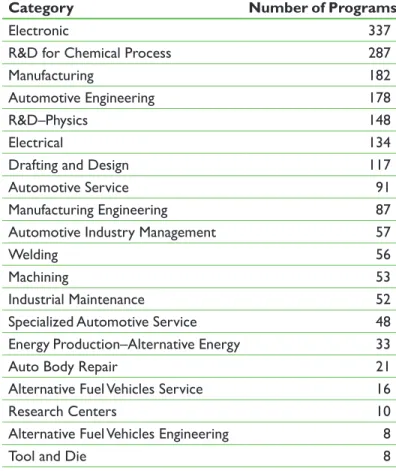
Table 7: Tri-State Auto-Related Educational Programs by Major Program Categories ... 26
8. Conclusion: Workforce Implications ...55
8.1 Employer Challenges ...55
8.2 Workforce Challenges ...55
Appendix A: Auto-Related Degree Programs in the Tri-State Region ... A-1
Appendix B: Green Automaker Investments in the Tri-State Region, 2010-2011
Announcements ... A-3
Appendix C: Supplier Survey Methodology ... A-4
Appendix D: Assessing the Green Jobs Survey Results ... A-5
Appendix E: Occupational Prospects by O
*NET Green Categories ... A-7
Appendix F: Project Team and Contacts ... A-10
Index of Figures
Figure 1: Michigan, Indiana and Ohio Engine Production as a Percent of Total U.S. Engine Production, 1995-2010 and 2011-2017 Forecast ... 9Figure 2: U.S. Motor Vehicle Electronics Employment, 2002-2009 ...11
Figure 3: Long-Term Claimants by Broad Occupational Category ... 31
Figure 4: Long-Term Claimants by Educational Attainment ... 31
Figure 5: Long-Term Claimants by Age Group ... 32
Figure 6: Selected Occupations in the Production, Construction and Engineering Cluster ... 48
Figure 7: Selected Occupations in the Same Cluster as an Industrial Machinery Mechanic ... 49
Figure 8: Trip Times to Transition from an Industrial Machinery Mechanic to Selected Occupations ... 50
Figure 9: Percentage of Occupations in Each Job Zone, Selected Clusters ... 51
Figure 10: Average Trip Time from Production, Construction and Engineering Clusters to All Clusters ... 52 Figure A-1: Total Programs ...A-1 Figure A-2: Automotive Programs by Type of Program ...A-1 Figure A-3: Types of Degrees ...A-2 Figure A-4: Automotive Programs by State ...A-2
The Driving Change study has been a collaborative effort of three states’ workforce development agencies and their strategic partners. The following table indicates those partners primarily responsible for the various chapters and an email contact for further information.
2
The Auto Industry Transformation: Dimensions of Change
Center for Automotive Research:[email protected]
3
Auto Industry Supply Chain Transformation
Weatherhead School of Management, Case Western Reserve University:4
Who Are the Displaced Workers?
Indiana Department of Workforce Development: [email protected]
5
Are Green Jobs the Future?
Indiana Business Research Center: [email protected]
6
Career Pathway Clusters
Indiana Business Research Center: [email protected]
7
Closing the Skills Gap
Indiana Business Research Center:[email protected]
Table 8: Tri-State Occupational Employment Loss in Transportation Equipment Manufacturing, 2006 to 2009 ... 30
Table 9: Auto Sector§ Employment Change by Sex and Selected Age Brackets for the Tri-State Region, 2006 to 2009 ... 32
Table 10: Share of Direct Green Jobs by Core Area ... 34
Table 11: Select Industries§ Generating Direct Green Jobs: Direct Green Jobs by Industry and Green Jobs as a Percent of Industry Employment 35 Table 12: Prominent Green Occupations§ in Indiana and Michigan, Occupations as a Percent of Total Direct Green Jobs ... 36
Table 13: Tri-State Top 15 Green Auto Occupation§ Postings and Expected Job Change to 2018 ... 39
Table 14: Tri-State Top 15 Green and Growing Non-Automotive Occupation Postings and Expected Job Change to 2018 ...40
Table 15: Tri-State Top 15 Non-Green Occupation Postings and Expected Growth to 2018 ... 41
Table 16: Summary of Career Pathway Clusters ... 45
Table 17: Engineering and Applied Technology Sub-Cluster: Key Occupation Factors ... 46
Table 18: Construction and Extraction, Equipment Operation and Repair Sub-Cluster: Key Occupation Factors ... 46
Table 19: Design and Production Sub-Cluster: Key Occupation Factors ... 47
Table 20: Sample Career Transitions from Automotive Occupations to Green, High-Wage/High-Demand Occupations ... 53
Table 21: Sample Career Transitions from Automotive Occupations to Non-Green, High-Wage/High-Demand Occupations ... 54 Table A-1: Tri-State Top Five Green Increased Demand Automotive Occupations by Job Postings and Expected Job Change to 2018 ...A-7 Table A-2: Tri-State Top Five Green Enhanced Skills Automotive Occupations by Job Postings and Expected Job Change to 2018 ...A-8 Table A-3: Tri-State Top Five Green New and Emerging Occupations by Job Postings and Expected Job Change to 2018 ...A-8 Table A-4: Tri-State Top Five Green Enhanced Skills Occupations by Job Postings and Expected Job Change to 2018 ...A-9 Table A-5: Tri-State Top Five Green Increased Demand Occupations by Job Postings and Expected Job Change to 2018 ...A-9
Executive Summary
Before the Great Recession, the auto industry in Indiana, Michigan and Ohio was in the throes of restructuring—applying new technologies and
production efficiencies, reducing costs, and modifying product lines to equal or beat global competitors— accompanied by an extended period of downsizing. Overlaying the recession on the restructuring compounded the challenges the industry was already facing.
This report is a reality check, accepting that the regional economy is at a fundamentally different place and cannot return from where it came. However, as the auto sector works toward its revival, there are workforce issues to be addressed, particularly in the context of the growing evolution and demands of a green economy.
At the outset of this study, there was limited understanding of the specific nature of the transformation in skills relevant to efficient and renewable vehicle technologies and other career opportunities in the green economy. To more
effectively serve the large numbers of dislocated auto industry workers, Indiana, Michigan and Ohio formed the Driving Change consortium to address this subject and in doing so developed four overarching goals:
1. Chronicle the transformation from the old auto industry to a new, more efficient auto industry, especially focusing on the new skill and training requirements of the auto workforce.
2. Identify the effects of this structural transformation on the auto parts supply chain workforce.
3. Examine green job opportunities now and in the future as alternative career pathways for displaced workers.
4. Identify the skills gap and the
required educational and technical training
needed for dislocated workers to transition into new occupations.
Technology Drives Change
The pace of vehicle technology change is accelerating, particularly in response to changes in consumer taste and expectations, higher safety standards, and the drive toward a low-carbon future embodied in more aggressive government fuel economy standards and more stringent greenhouse gas emissions rules. When considering changes in automotive technology that support the “greening” of automotive transportation, most people think first about advanced powertrains, materials and electronics.
These three technology sectors play a significant role in the transformation of the new auto industry:
• The most noteworthy change occurring in the powertrain and fuels sector of the industry is the re-emergence of the electric vehicle. The development of alternative forms of energy storage (primarily batteries) is rapidly progressing, but the internal combustion engine could remain the dominant technology for the next decade and beyond. As powertrain technologies advance, the locations of powertrain production and employment may shift. The tri-state region of Indiana, Michigan and Ohio represented 62.2 percent of total U.S. traditional engine production in 2010. It is possible that new vehicle propulsion systems will be produced outside the region and/ or that advanced technologies may require fewer workers to produce the same number of propulsion systems. In either event, a large-scale displacement of traditional engine production by alternative technologies puts the tri-state region’s powertrain employment at risk.
• The need to make vehicles lighter for improved fuel economy is a major driver in the development of automotive materials and forming. Vehicle lightweighting focuses on
finding the optimal combination of materials to achieve the desired vehicle weight reduction. Currently, the adoption of new materials is impeded by risks of performance issues and the lack of reliable simulation models to predict potential problems. The ability to develop a regionalized supply base is also a major role in the adoption of new materials for vehicle lightweighting. The U.S. workforce’s strength is in steel use, but less so in alternative materials. While there are only a few domestic metallurgy programs focused on lightweight materials, Europe and Asia have much more experience in this field.
• Electronics, software and controls in vehicles will continue to increase at a rapid rate. Today electronics account for about 25 percent of a vehicle’s value. In the next five to 10 years, that figure will climb to 40 percent or more. Although the tri-state region is poised to benefit from the research and development, design, engineering, and systems integration side of the electronics used in vehicles, the area will face stiff competition from other automotive regions that are stronger in electronics manufacturing, particularly those in Europe and Asia.
Workforce Implications
Today’s auto industry needs engineering and technical employees who consider the interactions among vehicle systems in order to optimize solutions more broadly. This need for systems thinking means that individuals who work in research, development and engineering must also possess the soft skills that enable cross-cultural communication, collaboration and teamwork. Production and skilled trades workers must adapt to an increasingly fast cadence of new product, process and technology introductions. These workers, too, require communication and teamwork skills that enable problem solving and continuous improvement in process and quality systems. Fortunately, the tri-state region has the educational infrastructure to meet these challenges and prepare the workforce for the occupations and careers of the future. Out of nearly 900 accredited postsecondary
institutions in the region, more than one-third offer programs relevant to the engineering, design, production and maintenance of automobiles.
Investing in the Future
Despite the recession, financial constraints, market and regulatory uncertainty, automakers and suppliers are investing in the technologies discussed above to produce greener products and processes. Automaker announcements in 2010 and thus far in 2011 total $4.3 billion in “green” investment in the tri-state region alone.
Auto production rebounded significantly in 2010 and many firms have seen profit margins return. Nonetheless, management appears to be concerned about the rebound’s permanence and hesitates to expand hiring or production at the rate of previous economic recoveries. Management, it appears, continues to operate in a cost-cutting mode.
Unfortunately, simple cost-cutting models of survival alone are not viable in the long run. Firms also need to build on their strengths and the strengths of the knowledge and skills of their workers.
This study concluded that the U.S. auto supply chain could prosper by adopting a “high-road” production approach in which firms, their employees and
suppliers work together to optimize investment, labor, quality and technology development.
Adopting high-road policies requires that everyone in the value chain be willing and able to share knowledge. Production will also gravitate toward decentralization and greater reliance upon all workers. Our fieldwork found examples of firms that are thriving because they adopted an agile production model—a variety of products for a variety of industries delivered quickly. They use advanced equipment enhanced with cutting-edge information technology; but in addition to changing their product and operations strategies, they have also transformed their human resource policies.
Green Opportunities
Even if labor and management work together to advance the productivity of the value-chain,
many workers who have lost jobs due to industry restructuring or the Great Recession still need work, and many will never be hired back into the auto industry. Team assemblers and assemblers/fabricators were the two auto manufacturing occupations
experiencing the largest job losses, accounting for more than 57,000 dislocated workers in the three states. More than 60 percent of these workers have only a high school education—a troubling statistic. Where will these displaced workers find jobs in tomorrow’s economy? How will they increase their training and skills in order to secure the jobs of the future? What are their alternatives? Is the green economy a viable alternative?
The project partners conducted surveys to benchmark the number of green jobs in each state and the
industries they are concentrated in. While the percentage of jobs considered green differs among states, survey results show that green jobs span a wide range of industries and occupations from engineering jobs to production jobs.
The surveys found that green jobs were concentrated in manufacturing and construction, the industries most affected by the recent economic downturn. Demand for these jobs varied across the region, based on the industry mix and employers’ perceptions of green.
Employers reported that most green jobs require only on-the-job training. Considering that a large number of green jobs are in production, this finding also supports the findings of the automaker interview and survey responses. Automakers also stated that green products and production techniques will have a more profound effect on engineering and technical staff requirements than on the production and trades worker skill sets.
The green engineering and technology occupations with the greatest demand now and projected for the future tend to require expanded skill sets and more education and training. This trend in “up-skilling” of occupational requirements is true of green jobs as well as most other in-demand occupations.
Alternative Career Pathways
Given restructuring in the auto industry, many displaced workers need help to find suitable alternative jobs. The two-step pathway cluster and skills gap analyses developed in this study offer valuable guidance to displaced workers charting pathways to new career opportunities.
The technique used to group occupations into pathway clusters is groundbreaking. Pathway clusters are organized based not upon industries or functions, but upon the similarities and differences of worker and job characteristics. Not only are occupations in a given pathway cluster considered similar to one another in terms of their knowledge and skill requirements; the pathway cluster analysis also measures the degree to which worker traits such as “highly social” or “attentive to detail” make occupations more or less similar. Job transitions within a given cluster, therefore, would be easier than moving from one cluster to another.
There are seven pathway clusters. Auto industry occupations are concentrated in the production, construction and engineering cluster, but there are dozens of green or high-wage, high-demand jobs in the same cluster that make good target occupations for each displaced worker. Except for the health, social and personal services cluster, green occupations are well distributed throughout the seven pathway clusters.
Knowing the alternative occupations that are most similar to one’s current occupation—those in the same pathway cluster—is a good first step. A worker still needs to know the relative difficulty or ease in closing the skills gap between two occupations. The uniform measure, or common denominator, to gauge the difficulty or ease of making the transition from one occupation to another is the amount of time required to prepare for a new occupation.
The skills gap is the education, training or
apprenticeship time required to transition from one occupation to another. The skills gap analysis then measures the time (“trip time”) required to change from one occupation to another based on the extent
of preparation required for the new job. While the trip time measure is not perfect, it is a great advance over many previous career pathway tools because it provides users an easily understandable measure of a worker’s skills gap.
Finally, this study produced a tri-state training program database for green and growing occupations as a resource to complement the trip time results. After a displaced worker generates a set of suitable alternative occupations, he or she can match those occupations with postsecondary educational,
technical and vocational programs in the region. The skills gap and training program databases, together with all the Driving Change analysis and research results, are available on the web free of charge at
www.drivingworkforcechange.org.
Workforce Implications
Several practical responses emerged from this research:
• The need for ongoing access to capital for the supplier network is critical to the stabilization of this sector.
• Emerging green and cross-functional systems approaches to design, manufacturing, equipment maintenance and building construction will demand corresponding changes in the training of workers from the design center to the shop floor. • Strategic training for managers that emphasizes long-term planning, worker training benefits and the need to integrate complex investments could improve acceptance of the associated investment costs.
• Current differences among definitions of green jobs and inconsistent use of occupational coding systems frustrate and complicate research efforts aimed at identifying and quantifying these jobs and identifying training opportunities.
• Many of the workers displaced from the auto sector who will need to transition to alternate occupations are starting with limited education (high school or less). These workers will be especially challenged in finding acceptable replacements for their old jobs and will need support throughout that process.
1. Introduction
T
he recent national recession has altered the economic and workforce landscape for years to come. The manufacturing sector is near the bottom of a long-term decline, displacing generations of middle class jobs, and the auto industry is one of the hardest hit.In 2009, automotive sales were only 10.4 million units—the worst year for the market in almost 30 years. Correspondingly, U.S. production levels fell to just 5.7 million units, the lowest level since 1982. The economies of Indiana, Michigan and Ohio depend heavily on automotive and parts production, accounting for 44 percent of all U.S. production in 2009 and nearly 47 percent in 2010. As a result, the automotive crisis and broader economic recession hit these three states particularly hard.
While the U.S. transportation equipment
manufacturing (TEM) industry, as measured by automotive and parts employment, declined 50.4 percent between 2000 (the most recent peak) and 2010, automotive and parts employment in Indiana, Michigan and Ohio fell by 57.8 percent. In Michigan alone, auto industry employment contracted 64.1 percent. Also, the Detroit Three (Chrysler, Ford and General Motors) have lost significant U.S. market share in the past half century. Whereas the Detroit Three’s share of the U.S. market was 65.6 percent in 2000, it had declined to 45.1 percent by 2011.1
It is highly unlikely that the losses in motor vehicle and parts employment attributable to structural changes will be mitigated in the near future. However, some employment recovery is evident
1 Automotive News Data Center, www.autonews.com. Data reflect year totals
of core Detroit Three brands.
since the employment losses due to the cyclical downturn. Since the low point in June 2009, motor vehicle and parts manufacturing has added almost 50,000 jobs, reaching 577,100 in January 2011.2
It is important to remember that the automotive industry’s restructuring was well underway when the financial crisis hit in the fall of 2008. Already, many automotive manufacturing and supplier plants had been shuttered, and communities were dealing with the impact of thousands of workers who had been bought out, retired or laid off. It is fortunate that the industry’s underlying demographics meant that a large portion of the workers were able to retire rather than be laid off, as would have been the case in previous recessions. However, the crisis and the subsequent government-orchestrated bankruptcies of both General Motors and Chrysler accelerated the workforce transition, leaving the industry forever changed. For many workers, their jobs were gone, and they weren’t coming back. For talented younger workers who might have considered an automotive career, the instability of the industry has led them to look elsewhere.
The automotive industry is also facing pressures to produce greener vehicles that meet higher fuel economy and greenhouse gas emission mandates, stricter safety regulations, and consumer demand for greater safety, connectivity and entertainment. Developing, engineering and manufacturing these advanced vehicle technologies drives the transformation of the workforce and skill needs as well.
2 Bureau of Labor Statistics, “Current Employment Statistics.” Data reflect
NAICS 3361 and 3363, March 2011.
Between 2000 (the most recent peak) and 2010, automotive and
parts employment in Indiana, Michigan and Ohio fell by 57.8 percent.
In some cases, it means the industry is seeking new employees with a brand new set of skills; in others, it means adding more of certain types of workers already employed by the industry; and finally, it means upgrading the skills of the incumbent workforce to handle the increased complexity of the products and processes. Educating and training the automotive workforce was made all the more difficult because many internal corporate training programs were cut back or suspended, partnerships with outside organizations and educational institutions were put on hold, and many workforce development efforts were shelved during the crisis.
The federal government has invested heavily in the resurgence of the automotive industry, and a large portion of the recent public and private automotive investments have been made in the three states of Indiana, Michigan and Ohio. The tri-state region has attracted new investments from existing employers, as well as new automotive-related industries (such as energy storage) and other new entrants to the automotive market.
New opportunities are arising in other sectors of the green economy. Investment drives innovation and ultimately results in more jobs. While the automotive industry may never return to previous employment levels, there is a future for substantial automotive and green employment in the tri-state region. Preparing a skilled green workforce for automotive and related green industries should remain a priority in this region for years to come.
1.1 This Study: Rationale and Objectives
At the outset of this study, there was limited understanding of the specific nature of the
transformation and skills relevant to efficient and renewable vehicle technologies and other career opportunities in the green economy. In the last two years, job losses in the TEM industry, as well as the national recession and its aftermath, have impacted Indiana, Michigan and Ohio particularly hard. This has led to an overwhelming number of mass layoffs, forcing states to seek emergency assistance from the federal government to serve dislocated workers. Approximately 70 percent of employees in
manufacturing have a high school diploma or less3 and are finding it difficult to compete for current job opportunities in high-growth and high-demand industries.
In order to more effectively serve the large numbers of dislocated auto industry workers and those at risk of losing their jobs, Michigan, Ohio and Indiana formed the Driving Change consortium to investigate this matter and provide analysis to:
• Characterize the structural
transformation from the “old” auto industry to the “new” auto industry and identify new skill and training requirements
• Identify the auto parts supply
chain impact of auto industry structural transformation
• Find alternative career path
opportunities for dislocated auto and auto parts workers for jobs in demand, including those in the green economy
• Determine current and projected skills
gaps of the auto and auto parts workforce and the required training needed to compete for jobs in demand and green job opportunities
The consortium offers its findings to those in the workforce, industry and education arenas with the anticipation of fostering ongoing collaborative efforts between these fields for the benefit of all and the economic well-being of the region.
2. The Auto Industry Transformation:
Dimensions of Change
I
n the past 30 years, the motor vehicle has undergone a remarkable evolution. The personal passenger vehicle is now the most high-techpurchase most households will ever make: today’s cars contain more computer chips and lines of software code than the first vehicles launched into space. These days, the pace of vehicle technology change is accelerating, particularly in response to changes in consumer taste and expectations, higher safety standards, and the drive toward a low-carbon future embodied in more aggressive government fuel economy standards and more stringent greenhouse gas emissions rules. When considering changes in automotive technology that support the “greening” of automotive transportation, most people think first about advanced powertrains—including hybrids, plug-in hybrids, battery electrics, advanced internal combustion engines and advanced diesels—and secondly about alternative fuels, including renewables such as biofuels, solar and hydrogen.
Changes in materials and forming aimed at producing lighter weight and safer vehicles also contribute to a greener vehicle fleet requiring less fuel to propel. Increasing electronics, software and controls, and technology content enables many fuel-saving technologies as well, including navigation assistance to reduce idle time and traffic congestion and the many sensors, actuators and controls that are used to optimize vehicle performance for fuel economy. This section will review the advances in motor vehicle technology, provide possible timelines for implementation of the technologies, and examine the implications for the workforce needed to research, develop, engineer and manufacture these products. While specific skill4 sets are in demand in each of the
three technology areas covered in this chapter, vehicle
4 This report uses the term “skill” in several different and significant ways.
Skills or skill sets can refer to a broad range of requirements for an occupation, from interpersonal competencies to hours of experience in an apprenticeship
producers and suppliers across the board have told us they want more out of their engineering workforce than technical skill and competency. The industry needs engineering and technical employees who can consider the interaction of vehicle systems and can work to optimize solutions more broadly.
This need for systems thinking, as well as the truly global nature of this industry, means that individuals who work in research, development and engineering must also possess the “soft skills” that enable cross-cultural communication, collaboration and teamwork. On the hourly side, production and skilled trades workers must adapt to an increasingly fast cadence of new product, process and technology introductions. These workers, too, must possess communication and teamwork skills that enable problem solving and continuous improvement in process and quality systems.
2.1 Powertrain and Fuels
Perhaps the most noteworthy change occurring within the automotive industry is the reemergence of the electric vehicle (EV). The development of alternative forms of energy storage (primarily batteries) is rapidly progressing, but the internal combustion engine (ICE) may remain the dominant technology for the next decade and beyond. Significant technological innovations are necessary for the cost of electric vehicles to fall dramatically. Absent these innovations, the business case for EVs remains challenging. In addition, the ICE is a moving target. Respondents to a recent Center for Automotive Research (CAR) survey agreed that, even at $2.50 per gallon, half of gasoline
to advanced academic training. In this sense, the term “skills” is something of shorthand for all occupational requirements. Skill can also be used in a stricter sense as the capacity to do a particular activity, e.g., the capacity to un-jam the photocopier, irrespective of whether one is support staff or company CEO. A skill set can describe a collection of capacities that are similar and related to a particular job. An occupation may require several skill sets, in addition to educational attainment or experience, to be performed well. Unless otherwise stated, skills or skill set refers to the broad understanding of the requirements for an occupation.
engines sold in 2015 may be at least 20 percent more efficient than similar 2009 engines.5 Automakers are constantly finding ways to improve the overall efficiency of traditional engines, further lowering the cost and economy targets that electric vehicles must reach to be viable in the marketplace. Gauging future powertrain market volumes is exceptionally challenging. CAR recently surveyed 17 powertrain experts from vehicle manufacturers, powertrain suppliers and powertrain
engineering services firms. Most of the respondents had engineering backgrounds and were selected based on their wide range of expertise in both technical and market factors. Table 1 summarizes their forecast for 2011 and 2015 at two gasoline price options—$2.50 per gallon and $6.00 per gallon for the years 2011 and 2015. For the brief duration of this forecast, the internal combustion engine will remain the dominant power source.
As with other vehicle systems, government policy has had an important role in powertrain development. Policy has played, and will continue to play, an important role in setting targets for powertrain technology development. Through the establishment of future corporate average fuel economy (CAFE) standards and other actions, there are numerous avenues by which policy can impact powertrain development. Policy mandates will drive the pace of continued technological development in the powertrain arena, but it is the shape and form of innovations that have the most potential to initiate drastic changes in the skill set required of workers. The technology path is uncertain, and vehicle
manufacturers and suppliers are developing multiple technology solutions, requiring a wide range of technical skills.
5 Brett C. Smith, Zachery Adams and Jennifer Wong, Powertrain Forecast and
Analysis: What is Coming and What Are the Implications for the Specialty Equipment and Performance Aftermarket Industry (Ann Arbor: The Center for the Automotive
Transportation, August 2009); Brett C. Smith and Chris Powers, Automotive
Powertrain Forecast, U.S. Market 2011 and 2016 (Ann Arbor: The Center for Automotive Research, 2007).
A number of unique skill sets are emerging as
essential to the continued development of powertrain technology and the future of the industry. These skills include increased emphasis on chemical, electronic, software and coatings expertise, but the most critical skills cited were those of systems engineers that relate to the increased connectedness and integration of the various vehicle systems. Many engineering positions will require integration of more than one discipline in the future (e.g., engineers with mechanical expertise will require some knowledge of electronic systems that will interact and possibly control the mechanical systems in a vehicle). There will be few automotive engineering positions requiring mastery of only one discipline. It is clear that educators will need to turn out engineers that are cross-trained system thinkers, regardless of their specific core discipline. While changes in powertrain development are resulting in substantial changes in the requisite skills and competencies of engineers, those same changes are having a lesser impact on the skill
requirements for production workers. The powertrain itself may become more green or complex, but the manufacturing of these advanced powertrains will not change significantly. In most powertrain production facilities, working on advanced technologies requires only a few hours more training than would be needed for any new product introduction. However, since modern vehicle manufacturing plants increasingly utilize lean manufacturing concepts and team organization, production workers need the critical thinking and communication skills formerly
$2.50/gallon $6.00/gallon
2011 2015 2011 2015
All Gasoline
(Includes Hybrid Electric and Plug-In Hybrid Electric Vehicles)
96.5% 93.8% 95.0% 89.0%
Dedicated Gasoline 91.5% 83.8% 89.0% 69.0%
Hybrid Electric Vehicle 5.0% 10.0% 6.0% 20.0%
Diesel 3.0% 5.0% 4.0% 7.5%
Battery Electric Vehicle 0.1% 1.0% 0.5% 2.5%
Source: CAR/Specialty Equipment Market Association (SEMA)
Table 1: Projected U.S. Market Share of Alternative and
Advanced Powertrain Types, 2011 and 2015
associated with at least some
postsecondary education. For hourly workers, technologies, processes and jobs will continually evolve; workers will need to keep learning and adapt their skills to meet these new challenges. Educators at all levels must deliver lifelong learners: problem solvers who are able to communicate effectively.
As powertrain technologies
advance, the locations of powertrain production and the requisite
employment in these plants may shift. The tri-state region of Indiana, Michigan and Ohio represented 62.2 percent of total U.S. traditional engine production in 2010 (see Figure 1). It is possible that new vehicle propulsion systems will be produced outside the region and/or that advanced technologies may require fewer workers to produce the same number of propulsion systems. In either event, a large-scale displacement of traditional engine production by alternative technologies puts the tri-state region’s powertrain employment at risk.
2.2 Materials and Forming
The need to make vehicles lighter with the intent of improving vehicle fuel economy is the primary driver of development and changes in the realm of automotive materials. This process, often referred to as vehicle lightweighting or mass reduction, has been advancing for a number of years. Recent improvements in vehicle lightweighting have primarily been achieved through use of advanced grades of steel, the dominant material in the modern automobile. The development of new alloys with increased strength-to-weight ratios, combined with the relatively low cost of steel, has contributed to its prevalence. With the prolonged entrenchment of steel as an automotive material, an expansive infrastructure dedicated to steel production, supply, forming and joining has been built up over the years. Coupled with the development of a vast workforce knowledge base, economies of scale have developed further contributing to the dominance of steel in the automotive industry. While there are many
situations where steel is the preferred material in terms of cost and performance, aluminum, magnesium and composites can be cost competitive and technologically superior in other instances. Vehicle lightweighting focuses on finding the optimal combination of materials to achieve the desired vehicle weight reductions.
Although the introduction of new materials may at first appear to be a minor alteration, developing a thorough understanding of material interactions and material performance under extreme conditions is no small task for any automaker. Currently, the adoption of new materials is impeded by risks of performance issues and the lack of a complete body of knowledge necessary to produce reliable simulation models to predict potential problems. Given the need for durability, safety and sustained performance, changes in vehicle materials require thorough research,
development and testing.
In addition to the need to develop complete knowledge of a given material, automakers face additional
challenges before large-scale utilization of a new material can take place. The processes to form and join new materials may require development to reach the cycle times required to assemble high-volume vehicles, as well as capital investment in new tooling and manufacturing equipment. The ability to develop a regionalized supply base plays a major role in the adoption of new materials for vehicle lightweighting. 0% 10% 20% 30% 40% 50% 60% 70% 19 95 19 96 19 97 19 98 1999 2000 2001 2002 2003 2004 2005 2006 2007 0820 2009 2010 2011 2012 1320 2014 2015 2016 2017
Figure 1: Michigan, Indiana and Ohio Engine Production as
a Percent of Total U.S. Engine Production, 1995-2010 and
2011-2017 Forecast
In order to establish regionalized supply, an adequate local knowledge base must exist, along with general stability in the supplier sector. For example, Japan is currently the hub of carbon fiber production and technology across the world. In Washington, a long history with the aerospace industry has supported development of both a knowledge foundation and a supply base that could be leveraged for the expanded use of carbon fiber within the automotive industry. Additionally, China is currently the largest supplier of magnesium in the world. Given China’s extensive domestic needs, supply chain risks exist due to potential export restrictions that may be imposed. This potential disruption in the supply base limits the adoption of this metal in the automotive industry. Table 2 shows the projected change in vehicle content of various lightweight materials. These new materials will be added at the expense of mild strength steels, although advanced and ultra-high-strength steels will continue to comprise a large portion of motor vehicles. Despite the challenges facing the widespread adoption of various materials for vehicle lightweighting,
the push to increase vehicle fuel economy without compromising vehicle size continues to increase. Optimizing material use for minimal vehicle weight means automakers and suppliers need engineers with expertise in finite element analysis (FEA), materials science and metallurgy. The challenge of balancing competing objectives such as cost, manufacturability and performance will require systems engineering and systems thinking to arrive at the optimal combination of materials. In addition, a compartmentalized approach to vehicle design and manufacturing will not be possible, requiring management and corporate structures that enable a more systems-oriented approach to new
vehicle development.
Unfortunately, the U.S. workforce lags in the fundamentals of material science and metallurgy. While there are only a few domestic metallurgy programs focused on lightweight materials, Europe and Asia have a much more extensive background in these fields.
Advances in vehicle lightweighting will require very little additional training for production workers that is over and above standard new product training. Industry expectations are that production workers are willing to continue to acquire new skills, and that they have the ability to participate in problem solving, continuous improvement and other team-based endeavors. While there is an increasing need for employees with a background in advanced lightweight materials, it will not necessarily result in a net increase in employment. Many employees will be able to shift their skills from traditional materials to advanced lightweight materials through continuous learning. The tri-state region of Indiana, Michigan and Ohio is equipped to shift toward manufacturing research and development and computer-aided engineering of advanced lightweight materials. However, the tri-state region may lose out in metallurgy and basic chemistry jobs that have a stronger base in Europe and Asia.
2.3 Electronics, Software and Controls
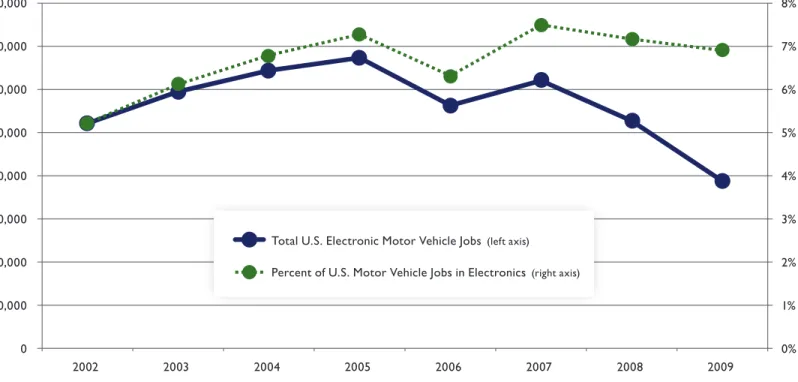
The amount of electronic content in vehicles has increased at a rapid rate since the 1970s, and this trend is expected to continue. Presently, electronics account for about 25 percent of a vehicle’s value; that figure is expected to climb to 40 percent or more in the next five to 10 years. This growth in electronics content has also had an effect on employment to date. As shown in Figure 2, even though total U.S. employment in motor vehicle electronics has
Material Change in Vehicle Content by 2020 (lbs. increase)
Advanced and Ultra-
High-Strength Steel 350
Aluminum 31 to 70
Magnesium 10 (130 to 350 possible)*
Plastics and Composites 25
* N. Lutsey, “Review of Technical Literature and Trends Related to Automobile Mass-Reduction Technology,” Institute of Transportation Studies, University of California, Davis, Research Report UCD-ITS-RR-10-10, 2010.
Source: R. Schultz, et al., “Metallic Material Trends for North American Light Vehicles,” 2009.
Table 2: Increase in Material Content from
2009 to 2020
declined since 2005, U.S. motor vehicle electronics employment as a percentage of total U.S. motor vehicle employment has shown a net upward trend since 2002.
Electronics are a part of nearly every major vehicle system, including those that are mechanical in nature; electronic content is particularly critical for sensors and actuators, powertrain and transmission controls (especially as electric drive systems
become more prevalent), vehicle safety systems, infotainment systems and vehicle communications, as well as the overall vehicle electrical architecture. Through power electronics, smart sensors, electronic control units (ECUs) and other components, vehicle electronics contribute significantly to a vehicle’s improved fuel economy and reduced emissions. In addition, emerging electronic systems, such as those associated with connected vehicle systems (vehicle-to-vehicle and/or vehicle-to-infrastructure wireless communication), enable drivers to navigate more efficiently and avoid traffic congestion. They also take advantage of enhanced situational awareness to provide drivers with feedback on how to optimize
green driving or directly control operation of the powertrain to achieve a similar outcome. All these developments can contribute significantly to the improved environmental performance of motor vehicle transportation.
Electronic content is increasing in response to the technical demands of increasingly complex vehicle systems, as well as consumer demand for a more personalized driving experience and the ability to access information and entertainment options instantaneously. The integration of electronic systems will be required to support more on-board applications, and the vehicle’s electronic architecture must be consolidated due to increasing electronic content and faster data transmission. Because ECUs are expensive, vehicle manufacturers will integrate them across functional systems and incorporate more powerful, dual-core processors into the vehicle’s electronic architecture. The industry will face increasing demands for ensuring the cyber-physical security of the vehicle. Needs will increase for electronic system validation and certification, as well as analysis of interactions between systems.
Figure 2: U.S. Motor Vehicle Electronics Employment, 2002-2009
Source: Bureau of Labor Statistics
0% 1% 2% 3% 4% 5% 6% 7% 8% 0 10,000 20,000 30,000 40,000 50,000 60,000 70,000 80,000 2002 2003 2004 2005 2006 2007 2008 2009
Total U.S. Electronic Motor Vehicle Jobs(left axis)
Components such as the CAN bus (and FlexRay) will facilitate this interaction and communication between vehicle systems.6 The “head unit” of a
vehicle, which houses the radio, music, temperature controls, navigation and other systems, will be increasingly significant as more technological
functionality is added (e.g., the ability to interface with
third-party consumer electronics, such as smart phones). The vehicle aftermarket will play an important role in making communications available on existing vehicles and expanding the range and capability of electronic technologies available to consumers.
To support growth in vehicle electronics, software and controls, the industry will demand more electrical and electronic engineers, as well as those with expertise in radio frequency technology, computer science, software engineering and cyber security. As electronic technologies become more integrated, employers will also require candidates trained in a systems approach to the integration of these electronics throughout the vehicle. The workforce will need to understand the whole system, not just individual, autonomous pieces of the system. Although increased demand for employees with these skills may require a major transformation of automotive industry skill sets, the end result may not be a net increase in motor
6 CAN bus stands for Controller Area Network. This network consists of
multiple micro-controllers that communicate with each other to direct electronic actions within the vehicle. The “bus” refers to the wire or cable platform through which the micro-controllers transfer information. FlexRay is a newer and more robust version of CAN.
vehicle employment. The tri-state region of Indiana, Michigan and Ohio is poised to benefit from the research and development, design, engineering and systems integration side of the business, but will face stiff competition from other regions of the global automotive industry that are stronger in electronics manufacturing (particularly producers in Europe and Asia).
Driven by the opportunity to create a more environmentally friendly product, the automotive industry is undergoing a far-reaching change. While the pace and completeness of the change is uncertain, it is clear the change will impact job skill requirements. It is also apparent the tri-state region has an opportunity to take advantage of this changing vehicle landscape. Whether it can reap the benefits of the change in many ways depends upon creating a well-trained and effective green workforce. This report has identified technologies, skills and the associated opportunities to help the region’s workforce trainers proactively prepare.
To support growth in vehicle electronics, software
and controls, the industry will demand more
electrical and electronic engineers, as well as those
with expertise in radio frequency technology,
computer science, software engineering and
cyber security.
3. Employer Responses to Auto Industry
Changes
A
s discussed in the previous chapter, the automotive industry has been impacted by the introduction of green technology in its vehicles, production equipment and facilities. The recent economic crisis has also had a significant financial impact on the industry—driving two major domestic automakers and a large number of automotive suppliers into bankruptcy. Many suppliers did not survive the crisis, and all remaining automakers and suppliers are facing critical financial and capacity constraints. In addition, the automotive industry faces an uncertain future with regard to government fuel economy, emissions and safety standards, and the level of consumer demand for green vehicles.Despite the financial constraints and market and regulatory uncertainty, automakers and suppliers are investing in greener products, processes and equipment. Automaker announcements made in 2010, and thus far in 2011, total $4.3 billion in green investments in Indiana, Michigan and Ohio alone (see Table 3). Suppliers are investing in green research, technologies and products, as well.
The federal government is backing green investments in the tri-state region’s automotive industry. Over $8.4 billion of the $25 billion available to automakers through the Department of Energy’s Advanced Technology Vehicles Manufacturing Loan Program (Section 136) has been awarded (see Table 4). Ford will invest a share of its $5.9 billion in funds from this program in Michigan, Ohio and three other states, to produce more fuel efficient vehicles. Of the more than $2.3 billion in American Recovery and Reinvestment Act (ARRA) awards to automakers and suppliers for electric drive vehicle, battery, and component manufacturing, approximately $1.4 billion went to companies and facilities in Indiana, Michigan and Ohio.7
Investment is an important leading indicator for hiring. Spending on research and development and new products drives increased engineering and technical employment; investment in plants and equipment leads to hiring additional hourly and skilled trades workers throughout the region.
7 U.S. Department of Energy, http://www.energy.gov/recovery/data.htm.
Company (in millions)Indiana Michigan (in millions) (in millions)Ohio Tri-State Total (in millions)
Bright $11.0 $11.0
Chrysler $1,271.3 $302.0 $1,573.3
Ford $1,183.5 $420.0 $1,603.5
General Motors $111.0 $613.2 $186.2 $910.4
Honda $70.0 $70.0
Subaru (SIA Toyota) $81.0 $81.0
Think $43.5 $43.5
Total $1,506.8 $2,109.7 $676.2 $4,292.7
Table 3: Green Automaker Investment in Indiana, Michigan and Ohio, By Company and By
State, 2010-2011 Announcements
Note: More detail is available in Appendix B. Source: Center for Automotive Research
3.1 Automakers and Tier 1 Suppliers
Indiana, Michigan and Ohio are the heart of the U.S. automotive industry. The tri-state region is home to the global headquarters of Chrysler, Ford and General Motors, and the North American headquarters of Honda. In addition to these companies, Mitsubishi, Subaru and Toyota produce vehicles in these states, and nearly every global automaker or top supplier has a research and development or engineering presence in the region. The three states currently account for 46.9 percent of U.S. automotive production, manufacture 62.2 percent of all U.S.-built engines and 75.1 percent of all U.S.-built transmissions.8
Over 84.5 percent of all private automotive research and development in the United States is located in Indiana, Michigan and Ohio, with 73.4 percent in Michigan alone.9 The green transformation of this
8 Source: IHS Global Insight, 2010.
9 National Science Foundation/Division of Science Resources Statistics, Survey
of Industrial Research and Development: 2007, Table 32: Funds for industrial R&D
industry presents considerable opportunity for these three states. However, there is formidable risk should new green automotive technologies produced outside the region supplant those currently being manufactured in Indiana, Michigan and Ohio. Interviews were conducted with manufacturing and engineering human resources managers at the major vehicle manufacturing firms in the United States, as well as with the union that represents most hourly workers at the Detroit Three automakers, the International Union, United Automobile, Aerospace and Agricultural Implement Workers of America
performed in the United States, by industry and company size, by state: 2007 and Table B-8: Funds for industrial R&D, sales, and employment for companies that performed industrial R&D in the United States, by expanded industry and company size: 2007.
Program Amount Awarded States Benefitting Companies
Cell, Battery and Materials
Manufacturing Facilities $1.2 billion MITN, GA, PA, IN, OR, FL , A123, Dow Kokam, LG Chem, GM, JCI, Enerdel, Saft, Exide/Axion Electric Drive Component
Manufacturing Facilities $465 million MICO, IN, MD, ND, GM, Delphi, Allison Trans., Ford, Remy, UQM Technologies, Magna E-Car
Advanced Vehicle Electrification $254 million AZ, CA, OR, WA, TN,
MI, KY, IN, IL Nissan/ETEC, Chrysler, SCAQMD, Cummins Advanced Battery Supplier
Manufacturing Facilities $235 million NC, SC, NV, NY, IL, OH, OR, LA, AR, CT
Celgard, Toda, Chemetall Foote, Honeywell, BASF, EnerG2, Novolyte, FutureFuel, Pyrotek, H&T Waterbury Advanced Vehicle Electrification
and Transportation Sector Electrification
$71 million MI, MO
GM, Ford, Smith Electric Vehicles Advanced Electric Drive
Vehicle Education Program $39 million MICO, GA, MO, , WV, SC, IN, MA, VA, CA
WVU, Purdue, Colorado State, MUST, WSU, MTU, UM, National Fire Protection Association, Reynolds CC,
City College of San Francisco Electric Drive Subcomponent
Manufacturing Facilities $32 million SC, VT, PA KEMET, SBE, Powerex
Transportation Sector
Electrification $22 million OR Cascade Sierra
Advanced Lithium-Ion Battery
Recycling Facilities $9.5 million OH TOXCO
Table 4: American Recovery and Reinvestment Act (ARRA) Awards for Electric Drive Vehicle,
Battery and Component Manufacturing
(UAW). The UAW considers the issue of green jobs critical and is working to make sure any new content related to greening the vehicle takes place in the United States.
While the drive to improve fuel economy is not new, government standards that must be met and the speed of change have changed significantly in recent years. For the production workforce, green jobs are those that are tied to making green products. Automakers indicate that trends in greening the products and processes of producing parts and components are having a much more profound impact on engineering
and technical staff than on production and trades workers.
3.1.1 Employment Outlook
A common thread in the industry and union responses is that the light vehicle sector is a major contributor to greenhouse gas (GHG) and fuel consumption reduction, and as such, the companies and the union feel that almost every job in the auto industry is a green job. It was difficult to disentangle employment effects of overall changes in the industry from those that are as a direct result of the greening of the product and the process. U.S. vehicle sales are highly cyclical. In order to maintain the constant labor cost per vehicle, automotive manufacturing companies adjust their labor force according to the supply and demand of vehicles. Table 5 shows a projection for hourly and salary automaker employment in the tri-state region and the U.S. for the top five automotive manufacturing companies in the United States. U.S. vehicle production, as estimated by IHS Global Insight, shows steady increases through 2015. Increasing vehicle production impacts employment in Indiana, Michigan and Ohio differently; this is due to the differences in each state’s automotive firms, type of facilities and occupational mix. The tri-state region’s hourly and salaried employment levels are expected to increase through 2015 due to the output recovery of domestic automotive manufacturing firms. Michigan is projected to benefit the most, with a 34 percent employment gain, because it has a higher concentration of domestic automotive manufacturing factories and non-manufacturing facilities. Indiana automotive employment is expected to rise 22 percent, and Ohio’s by 9 percent in the 2010-2015 period.
Table 5: Projected Major Automaker
Employment in Indiana, Michigan, Ohio and
the United States in 2010, 2015 and 2020
Source: Center for Automotive Research
2010 2015 2020 Indiana Hourly 15,143 18,544 16,757 Salaried 1,279 1,548 1,495 Total 16,422 20,092 18,252 Michigan Hourly 54,568 80,173 75,829 Salaried 48,283 57,737 55,037 Total 102,851 137,910 130,866 Ohio Hourly 31,474 34,637 35,186 Salaried 6,217 6,632 6,519 Total 37,692 41,269 41,704 Tri-State
Region HourlySalaried 101,186 133,354 127,771 55,779 65,917 63,051
Total 156,965 199,271 190,822
U.S. Total Hourly 144,917 179,982 170,450 Salaried 79,268 91,262 87,938 Total 224,185 271,245 258,388 Tri-State as a Percent of U.S. Hourly 69.8% 74.1% 75.0% Salaried 70.4% 72.2% 71.7% Total 70.0% 73.5% 73.9%
Automakers indicate that trends in greening the products and processes
of producing parts and components are having a much more profound
impact on engineering and technical staff than on production and
trades workers.
Between 2015 and 2020, overall U.S. automotive employment is expected to decrease by about 5
percent. Indiana and Michigan are expected to mirror the national trend with employment declines in this period. Indiana’s 10 percent employment decline is related to expected production cutbacks at two of the state’s automakers; while Michigan’s 5 percent employment reduction is closely tied to cuts in the domestic manufacturers’ overall output levels. During this same period, Ohio employment is expected to increase slightly (by 1 percent) due to firm mix and the forecast for products that are expected to be allocated to Ohio’s automotive manufacturing facilities.
3.1.2 The Greening of the Automotive
and Tier 1 Supplier Production and Trades
Workforce
Respondents reported that while there is a perception of green impact on workforce skills, the changes for individual production employees are not
revolutionary. For skilled trades workers, the changes are greater; these changes may require different skills to maintain LEED-certified manufacturing facilities, as well as more complex manufacturing equipment. No automaker or supplier tracks production or skilled trades training by any green category.
Respondents indicated most training for production workers that could be considered green is actually part of new product training. They report that a change under the hood impacts only a few processes on the assembly line. In some areas, such as
machining fuel injection parts for diesel engines or building hybrid transmissions, the tolerances may be tighter or there might be more content, but the work itself is essentially the same. The most common green training for production workers involves recycling and proper use of products (primarily those required
for cleaning or lubricating). Green practices, such as recycling scrap, are prevalent throughout the industry. Automakers and suppliers seek production workers who can contribute to the company’s overall continuous improvement efforts. Many times, these efforts produce greener outcomes; for example, a company might see lower energy usage from turning off equipment when not in use. Respondents reported that workers involved in hybrid or electric vehicle production do undergo additional safety training having to do with working in a high-voltage environment; this training, on average, takes less than a day.
There are two exceptions that may require new production and skilled trades worker skills and training: the introduction of new lightweight materials and battery manufacturing. Lightweight materials require new ways of forming and joining parts; lightweighting is a developing area, and the training impact for the workforce has not yet been fully realized.
Battery manufacturing, while it is new to the auto industry, is not a new industry. Workers in these plants must have a basic knowledge of how to work in a process environment, versus a discrete parts production environment. The training for workers in these plants is more geared toward operating equipment than manual assembly. Production and skilled trades workers in these firms generally undergo a longer period of initial training, including more intensive health and safety curriculum, an understanding of basic chemistry concepts, and instruction in clean room procedures required in these environments.
There are two exceptions that may require new production and skilled
trades worker skills and training: the introduction of new lightweight
materials and battery manufacturing.
For the skilled trades workforce, the changes are greater. Maintaining LEED-certified buildings, green plant and equipment—such as rainwater collection or solar panels—and more complex manufacturing equipment does require additional skills and training. Newer manufacturing plants are being built with environmental design, energy and water conservation in mind. Environmental and sustainability goals impact the skilled trades workforce; most automakers offer training in hazardous materials and waste, waste water, and power plant maintenance.
Increasingly, new equipment purchases are moving toward electrical and electronic machines (rather than hydraulic) and that is changing the mix of skilled trades workers required.
3.1.3 Up-Skilling of Incumbent Workers
As discussed in the previous section, respondents report that much of the green training curriculum for hourly workers is centered on technology changes in the product and is categorized as product training rather than up-skilling.10 Respondents reported thathourly worker training consists of the mandatory subjects—such as health and safety, equal employment opportunity, or quality—as well as problem solving, continuous improvement and teamwork. For skilled trades and maintenance personnel, incumbent worker training focuses on cross-training for higher trades utilization (percent of time spent working). At the Detroit Three automakers, the primary driver of cross-skilling and additional training for skilled trades workers is the reduction in the number of skilled trades classifications. Respondents related that
10 As stated earlier, this report uses the term skill and skills in several different
and significant ways. Skills or skill sets can refer to a broad range of requirements
for an occupation, from interpersonal competencies to hours of experience in an apprenticeship to advanced academic training. “Up-skilling” uses the term skills in this broad sense. Up-skilling is a term that employers were comfortable with and used frequently in interviews to describe any type of skill set enhancement or
improvement, from on-the-job training to academic certification, for all classes of
occupations.
the most effective training results in workers putting their new skills to work on the job immediately. Several automaker respondents commented on the lack of available funding for incumbent worker training. For companies, the majority of the cost of training is the wages paid to workers while they are in training. There are few government programs that pay a wage subsidy for incumbent worker training.
3.1.4
Job Classification Impact of Green
Initiatives
No automaker reported any changes in occupations or job classifications of production or skilled trades workers related to greening the product or process. The mix of skilled trades classifications may change as more electrical and electronic equipment is employed and as more focus is placed on the environmental aspects of managing water and waste streams.