E
CUADOR
P
ROGRAM FOR THE
R
ENEWAL OF
TAME’
S
A
IRCRAFT
F
LEET
(EC-L1045)
L
OANP
ROPOSALThis document was prepared by the project team consisting of: Esteban Diez-Roux (INE/TSP), Project Team Leader; Miroslava Errazuriz de Nevo, Melanie Glass, Giovanna Mahfouz, Pablo Guerrero (INE/TSP); and Diego Buchara (LEG/SGO).
PROJECT SUMMARY
I. DESCRIPTION AND MONITORING OF OUTCOMES...1
A. Introduction...1
B. Background, problem, and rationale ...1
C. Objective, components, and cost ...6
1. Objective ...6
2. Components ...6
3. Costs ...8
D. Outcomes and indicators (PPMR monitoring) ...9
II. FINANCING STRUCTURE AND MAIN RISKS...9
A. Lending instruments and contractual conditions...9
B. Environmental and social risks and mitigation measures ...9
C. Fiduciary risk ...11
D. Other issues and risks ...13
III. IMPLEMENTATION AND ADMINISTRATION PLAN...13
ANNEXES
Annex I Results Framework Annex II Procurement Plan
APPENDICES
Proposed resolution
Electronic Links and References REQUIRED
1. Annual Work Plan
http://idbdocs.iadb.org/wsdocs/getDocument.aspx?DOCNUM=1165892 2. Monitoring and Evaluation Plan
http://idbdocs.iadb.org/wsdocs/getDocument.aspx?DOCNUM=1187968 3. Environmental and Social Management Report
If required, as specified in Policy OP-730 and the Disaster Management Policy http://idbdocs.iadb.org/wsdocs/getDocument.aspx?DOCNUM=1169365
OPTIONAL
1. Description of the institutional structure for air transportation
http://idbdocs.iadb.org/wsdocs/getDocument.aspx?DOCNUM=1204315 2. Airport fee structure
http://idbdocs.iadb.org/wsdocs/getDocument.aspx?DOCNUM=1204336 3. TAME operational statistics
http://idbdocs.iadb.org/wsdocs/getDocument.aspx?DOCNUM=1204345 4. Rationale for selection of Embraer aircraft
http://idbdocs.iadb.org/wsdocs/getDocument.aspx?DOCNUM=1204473 5. TAME business plan, business strategy, and market studies
http://idbdocs.iadb.org/wsdocs/getDocument.aspx?DOCNUM=1204482 6. Financial/economic analysis
http://idbdocs.iadb.org/wsdocs/getDocument.aspx?DOCNUM=1204427 7. Economic and social impact
ECUADOR
PROGRAM FOR THE RENEWAL OF TAME’S AIRCRAFT FLEET (EC-L1045)
Financial Terms and Conditions1
Borrower: TAME Línea Aérea del Ecuador Amortization period: 20 years
Guarantor: Republic of Ecuador Grace period: 1 year
Executing agency: TAME Línea Aérea del Ecuador Disbursement period: 2 years
Source Amount Interest rate: Variable
IDB (Ordinary Capital) US$ 62,250,000 Inspection and supervision fee: 0.00%
Local US$ 450,000 Credit fee: 0.25%
Total US$ 62,700,000 Currency: U.S. dollars from the
Single Currency Facility Project at a Glance
Program objective and description:
The objective of the program is to facilitate integration and connectivity in Ecuador, especially among the country’s most isolated and disadvantaged areas, through improvements in the operations and commercial air transportation services provided by TAME, by renewing its fleet of aircraft and strengthening its business capacity. To meet this objective, financing will be provided for the purchase of two Embraer ERJ-190AR aircraft to replace part of TAME’s existing fleet, and for a business capacity-building program. The program will: (i) enhance the quality, reliability, and safety of TAME’s air services; (ii) lower the cost of operating and maintaining TAME’s fleet of aircraft, and reduce its environmental impact; (iii) improve TAME’s business management through better margins and easier access to private sector lending; and (iv) increase TAME’s domestic market share by providing continuity on certain routes flown exclusively by TAME that fulfill a clear corporate purpose of supporting local development.
Special execution conditions:
The borrower agrees that: (i) it will use the aircraft to be financed with the loan proceeds solely and exclusively for its activities and operations in accordance with its charter and the objective of this program; the use of such aircraft for any other purpose—whether military, civilian, or governmental—is expressly prohibited; (ii) it will produce evidence, to the Bank’s satisfaction, within twelve months following the date of this contract, that: (a) the executing agency has a system up and running for publishing its procurement and contracting activities on its website, and (b) requirements are approved and in force for the publication of TAME’s financial statements on its website.
Exceptions to Bank policies: None.
Project consistent with country strategy: Yes [X] No [ ]
Project qualifies as: SEQ [ ] PTI [ ] Sector [ ] Geographic [ ] Headcount [ ]
1
The interest rate, credit fee, and inspection and supervision fee mentioned in this document are established pursuant to document FN-568-3 Rev. and may be changed by the Board of Executive Directors, taking into account the available background information, as well as the respective Finance Department recommendations. In no case will the credit fee exceed 0.75%, or the inspection and supervision fee exceed 1% of the loan amount.*
*
With regard to the inspection and supervision fee, in no case will the charge exceed, in a given six-month period, the amount that would result from applying 1% to the loan amount divided by the number of six-month periods included in the original disbursement period.
I.
D
ESCRIPTION ANDM
ONITORING OFO
UTCOMESA. Introduction
1.1 TAME is Ecuador’s leading airline, providing service to 15 domestic destinations1 as well as to Cali, Colombia. It is also the leading provider of direct air service between Quito and Guayaquil and the sole provider of air service to a number of cities in Ecuador. The airline’s objective since its founding has been to promote economic and social development in Ecuador by improving transportation and communications, with a special emphasis on the effort to integrate the most remote areas of the country, which are not attractive to other commercial airlines.
1.2 Nearly 50 percent of TAME’s fleet is now more than 20 years old. The company has developed a renewal plan that calls for adding new aircraft to serve its domestic and regional routes. As part of this renewal plan, the Government of Ecuador has requested financial assistance from the Bank to purchase and begin operating two new regional aircraft and to strengthen TAME’s business capacity.
B. Background, problem, and rationale
1.3 The company. Under Law 104 of 1990 (as amended by Law 132 of 1996), TAME Línea Aérea del Ecuador is an administratively and financially independent State-owned company with separate legal status and assets, attached to the Ecuadorian Air Force. It has more than 44 years of experience in Ecuador. The principal corporate purpose is to provide domestic and international commercial air transportation of passengers, cargo, and mail, along with other activities related to that purpose. TAME is governed by its charter, special applicable laws, and its own bylaws and regulations. TAME is not funded by the general government budget; it is responsible for its own business and financial obligations and repays loans out of its operational earnings.2
1.4 The company’s supreme governing body is its Board of Directors, which consists of four representatives of the Ecuadorian Air Force, one representative of the company’s employees, and the company president. The duties of the Board of Directors include setting the company’s management objectives and policies and appointing the chief executive officer and management team.
1.5 The domestic air transportation market. Ecuador’s domestic air transportation market includes 19 routes organized into a hub-and-spoke configuration based in Quito.3 Air traffic is heavily concentrated in the Quito–Guayaquil route, which accounts for 43.5% of all passengers served on domestic flights. The five leading routes4 account for a combined 77% of all domestic air traffic. The prominence of
1
These include two destinations in the Galapagos Islands.
2
TAME receives no government funding and is one of Ecuador’s biggest payers of income tax.
3
Of the 19 existing routes, 14 are to or from Quito.
4
the Quito–Guayaquil route and the concentration of air traffic in a small number of routes are the salient features of Ecuador’s domestic air transportation market. 1.6 In 2006, some 2.6 million air passengers were served in the domestic market.
Passenger totals are projected to continue increasing, up to 2.94 million in 2007. The National Civil Aviation Administration (DAC) predicts that the number of domestic passengers will grow at an average annual rate of 10%.
1.7 TAME’s domestic market share. Five airlines provide domestic air service in Ecuador. In 2006 approximately 45.4% of all passengers on domestic routes5 flew on TAME. AeroGal is the number-two airline, with a market share of approximately 28.5%, followed by ICARO, with a 22.3% market share. These three airlines serve 96.2% of all domestic passengers. VIP and Saero have a marginal presence, with market shares of 2.5% and 1.4%, respectively. At least 12 of the 19 domestic routes demonstrate effective competition.6
1.8 TAME’s current network includes 15 regular domestic destinations and one international destination with regular flights to Cali, Colombia. All of TAME’s destinations, except for the Galapagos routes, lie within a 400-mile radius of Quito or Guayaquil. Except for the Quito–Guayaquil and Guayaquil–Galapagos routes, all other routes average no more than 100 passengers per flight.
1.9 TAME’s social and national integration function.TAME operates an average of 163 weekly domestic and crossborder flights, providing service to remote destinations in Ecuador that, due to their market size and rate conditions, are not attractive to private airlines. TAME reports operating deficits on five of its routes.7 These routes—known as “social-purpose routes”—are maintained, despite the operating losses they incur, as part of TAME’s mandate to ensure connectivity throughout the country and constitute a major social commitment to the local communities served. Also, in some of its most marginal and disadvantaged destinations,8 TAME assists local residents by offering a 50% discount off the normal airfare for Peruvian passengers. This fare was applied to 46,400 people in 2005, for an equivalent of US$1.6 million.
1.10 TAME’s role in supporting national integration through its service has direct implications on social development, business, tourism, and production in Ecuador. However, TAME’s ability to fulfill this role is largely related to the success of its commercial operations, giving rise to the company’s domestic cross-subsidies from profitable routes to “social-purpose routes.” To ensure the continuation of TAME’s social-purpose operations, the profitability of its commercial operations must be
5
Equivalent to 1.18 million passengers.
6
No airline controls more than 70% of the market on any route.
7
Macas, San Cristóbal, Santa Cruz, Lago Agrio, and Coca.
8
maintained by making them more competitive and ensuring that they meet the standards that the market demands.
1.11 The fleet. TAME has a fleet of nine aircraft, four of which have an average age of 20 to 30 years. The fleet includes two 1970s-era Boeing 727-200 aircraft, and two Fokker F-28 aircraft manufactured in 1986. These airplanes account for 44% of the fleet’s operational capacity in terms of number of seats. TAME also has two Airbus A-320, two Embraer ERJ-170, and one ERJ-190 aircraft.
1.12 There are a number of problems with the older planes in the fleet, such as: (i) high operating costs due to high fuel consumption, crew costs,9 and airport fees; the Boeing 727-200 are old, fuel-inefficient three-engine airplanes, and airport taxes are proportionate to the weight of the aircraft;10 (ii)
high maintenance costs, due to the age of the aircraft and the unavailability of spare parts; (iii) unreliability of the flight schedule, due to the large number of unforeseeable problems11 leading to flight delays and cancellations, which entails additional costs to the company;12 and (iv) high environmental externalities, including noise pollution and emissions. In short, the older planes in TAME’s fleet are nearing obsolescence. This translates into high current operating costs and a significant risk in the medium term that these aircraft cannot be kept airworthy and/or cannot comply with technical and legal requirements.
1.13 The fleet renewal process. In September 2000, TAME’s leadership decided to embark upon a process to renew its fleet13 and appointed a Special Committee for Fleet Renewal and a Technical Subcommittee to support this process. The company adopted a gradual, three-step approach. Its first priority was to replace the Boeing 727 aircraft, which are the oldest in the fleet. In the initial phase of the renewal process, two Airbus A-320 aircraft (manufactured three years ago) were leased. This phase has concluded and these aircraft are scheduled to remain with the company until September 2008. Both aircraft have a full-economy configuration with 172 seats. This configuration reflects the market they serve, targeting the Quito–Guayaquil route and the charter market.
1.14 The second phase of the renewal process replaced part of the fleet flying certain domestic routes with lower levels of demand than those on the Quito–Guayaquil route. In 2003, the Commercial Support Committee conducted a study entitled, “Commercial Study on Regional Jets,” exploring various scenarios and alternatives for the TAME fleet based on market size. After determining the aircraft size
9
The 727s require a crew of three, compared to two on the ERJ-190.
10
These aircraft weigh 20% to 50% more than equivalent modern aircraft.
11
The aircraft lack the self-diagnostic systems found on modern airplanes.
12
Lodging and rerouting of passengers, as well as tarnishing of the company’s image.
13
A detailed analysis of the existing fleet was done, and it was concluded that for technical, financial, commercial, and maintenance reasons, the company’s entire old fleet had completed its useful life and needed to be renewed.
necessary to meet projected demand, and after considering the various options for manufacture and development, the selected aircraft were evaluated for operational capacity and performance both on the runway and enroute, given the specific conditions under which TAME operates. The conclusions of the comparative study of the preselected aircraft14 were presented in a report prepared by the company’s Technical Support Committee.
1.15 The commercial, technical, and economic evaluations concluded that the regional aircraft best suited to meet the needs of TAME and its markets were the Embraer ERJ-170 and the Bombardier Q400, both with a capacity of 70 passengers. However, Embraer offered the possibility of expanding capacity in the future, as the ERJ line has planes with capacities of 70 and 118 passengers, while the Bombardier Q400 is the highest-capacity airplane in its line.
1.16 Based on these evaluations, and in order to standardize the fleet, TAME purchased three Embraer aircraft15 with the help of 80% financing from Brazil’s National Economic and Social Development Bank over a 12-year period. TAME added two Embraer ERJ-170 aircraft to its fleet in March 2006, and in May 2006 added the Embraer ERJ-190.
1.17 The third phase of the fleet renewal process—which is the phase to be financed by this proposed operation—calls for replacing both Fokker F28 aircraft and one Boeing 727-200 with two Embraer ERJ-190 aircraft. These aircraft, given their technical and economic features (larger aircraft such as the Airbus 318 and Boeing 737 and 727 cannot fly into smaller airports due to runway length, and are very costly to operate on low-demand routes), are best suited to serve several of TAME’s domestic routes, including the “social-purpose routes.”
1.18 Rationale for the Bank’s participation and program strategy. TAME is a public corporation that provides a vital service to ensure accessibility and integration of remote and isolated parts of the country unserved by private airlines. Demand on these routes is financially unattractive and would not be absorbed by private companies if TAME’s services were discontinued. This would further isolate remote areas of the country and directly affect their development and economic growth. The nature and features of these social services (low demand and long distances) keep the company’s operating margins thin. In addition, TAME is prohibited by Ecuador’s Law on Financial Administration and Control from pledging its assets as collateral to secure loans, and this reduces its access to private-sector bank lending. Even so, TAME has continued to make investments to meet growing demand through its renewal plan, securing financing on disadvantageous terms.16
14
ART 42 500, Bombardier DHC Q200 and Q400, and Embraer 120ER, ERJ-145XR, and ERJ-170-100.
15
Two Embraer ERJ-170 aircraft and one Embraer ERJ-190 aircraft, all of which are just one year old.
16
TAME has a US$64 million liability to BNDES with a 12-year maturity at LIBOR + 400 basis points. The current balance owed is approximately US$58 million.
1.19 The Bank’s participation will also help the company to improve its operating margins, by providing continuity for largely unprofitable “social-purpose routes” with their social and development benefits. Additionally, the Bank’s participation will make the company more competitive by lowering its operating and maintenance costs, enhancing the reliability of its flight schedule, improving air safety, lessening the incidence of failures, and reducing environmental externalities. 1.20 Bank participation will provide financial additionality in terms of amortization
period and interest rates available only for a sovereign guaranteed operation.
1.21 TAME needs to continue progressing with its capital investment plan, while at the same time embarking upon the processes necessary to become a modern, efficient public corporation. To meet the challenge of modernization, TAME requires support both in renewing its fleet and building the corporate capabilities necessary for such a transformation. Consequently, the operation takes a two-pronged approach: (i) support for capital investment; and (ii) actions to support modernization of the company. The program comprises an investment plan and activities over the course of 24 months.
1.22 Regarding point (i), the program will support the aircraft fleet renewal necessary to meet growing demand and the competitiveness requirements of TAME’s business plan. The investments are urgently needed, given rising operating costs and the need for better operating margins. The company must also reduce environmental externalities (noise and pollution), improve reliability and safety, and provide better service with less risk of delays. As outcomes of the renewal process, all aircraft in the fleet more than 20 years old are to be replaced, with the exception of a Boeing 727 that will be kept a while longer as an emergency backup aircraft. The replaced aircraft will be taken out of service and scrapped.
1.23 Activities under point (ii) will be tailored to the specific features of the sector. They will include a management diagnostic of TAME, followed by preparation of a business plan to ensure the company’s development and long-term sustainability. This assessment will focus on three main areas: (i) update of the company’s strategic plan; (ii) strengthening of the company’s financial area, including analysis of the current fare policy and the introduction of modern accounting and revenue management systems; and (iii) preparation of a business plan to identify the tasks necessary for the activities previously identified.
1.24 Several points should be noted in relation to the sector’s specific features: (i) as an administratively autonomous entity, TAME has a separate budget subject to external audit; (ii) TAME receives no government subsidies; it is responsible for its own business and financial obligations and repays loans out of its operational earnings; (iii) the “social-purpose routes” (flights to noncommercial destinations and routes and discounts to Galapagos Island inhabitants) are a key part of the national government’s integration strategy; (iv) although a public corporation, TAME pays taxes to the national treasury (VAT, import duties, etc.); (v) TAME has posted positive financial results in recent years; and (vi) TAME is in
compliance with airline environmental standards and made them a priority in program design.
1.25 The program will support improvements in the company’s operations, expanding its routes and frequencies and enhancing the flight schedule, services, and safety, while lessening environmental externalities. Program support is expected to contribute to TAME’s gradual and sustained modernization, helping it through solid and efficient air operations to access nonsovereign guaranteed financing in the medium term.
C. Objective, components, and cost 1. Objective
1.26 The objective of the program is to facilitate integration and connectivity in Ecuador, especially among some of the country’s most remote and disadvantaged areas, through improvements in the operations and commercial air transportation services provided by TAME, by renewing its fleet of aircraft and strengthening its business capacity. To this end, financing will be provided for the purchase two Embraer ERJ-190LR aircraft to replace part of TAME’s existing fleet that is nearing obsolescence, and for a business capacity-building program. The program will: (i) enhance the quality, reliability, and safety of TAME’s air services; (ii) lower the cost of operating and maintaining TAME’s fleet of aircraft, and reduce its environmental impact; (iii) improve TAME’s business management through better margins and easier access to private sector lending; and (iv) increase TAME’s domestic market share by providing continuity on certain routes flown exclusively by TAME that fulfill a clear corporate purpose of supporting promote local development.
2. Components
1.27 Component 1. Renewal of the aircraft fleet (IDB: US$62 million). This includes the procurement of two new Embraer ERJ-190AR aircraft directly from the manufacturer, along with spare parts and crew training.17 This component will be financed solely with loan proceeds.
1.28 Rationale for the selection of the Embraer ERJ-190. There are three main considerations: (i) from a technical standpoint, the Embraer ERJ-190 is the only aircraft of its size that is technically capable of serving several airports in Ecuador, due to infrastructure limitations and altitude-related issues, including the ability to land and take off from difficult runways; although small mainliners (Airbus 318 and Boeing 737-600) have more capacity than large regional jets (ERJ-190 and ERJ-195), they cannot serve certain routes and airports in Ecuador;18 (ii) from a
17
The sales contract for the three Embraer aircraft procured in 2006 included the option to purchase four additional aircraft from the same line. This operation would exercise that option to purchase two additional aircraft.
18
The Airbus 318 and Boeing 737 are not certified to fly into the airports of San Cristóbal and La Toma, due to the runway length and topographical conditions.
financial standpoint, small mainliners cost US$40 million to US$50 million, about US$20 million more than the large ERJ-190 regional jets; and (iii) from an operational standpoint, the need to standardize TAME’s fleet of aircraft. As the airline already has three Embraer aircraft, standardizing the fleet would mean significant savings for the company. Fleet standardization would enable the company to purchase parts for the entire fleet, use the same shops and mechanics, secure volume contracts for spare parts and offline maintenance, and use the same flight crews throughout its fleet, as well as enjoy efficiencies in training and availability of human resources. Thus, the addition of Embraer aircraft is fully justified from a technical, financial, and operational standpoint, and would represent a step toward standardizing the company’s fleet of aircraft.
1.29 Component 2. Costs of introducing the new aircraft (Local: US$350,000). Includes costs associated with the transportation, inspection, licensing, and training of technical personnel. This component will be financed solely through local counterpart funding provided by TAME.
1.30 Component 3. Strengthening of TAME’s business capacity (IDB: US$250,000). This component will involve a four-part specialized consulting assignment to develop a business plan to strengthen TAME’s business capacity:
1. Strategic review. A review of the company’s strategic plan19 that includes the following activities: (i) definition of the company’s business; (ii) definition of target markets and development of a marketing strategy; (iii) analysis of product type and service level based on the strategic plan; (iv) identification of noncore activities and outsourcing opportunities; (v) development of objectives and targets for each department; (vi) review of the company’s organizational structure; (vii) criteria for the introduction of revenue management (including system implementation); (viii) analysis of current business partnerships with other airlines and strategy for future partnerships; (ix) reserve system analysis and strategy; and (x) development of short-term implementation measures. Based on these factors, a strategic plan will be developed for the company. 2. Financial analysis. A review of all financial statements and their sources of
information, including reports on operations and accounting systems. The starting point for the analysis will be a diagnostic assessment of current conditions and identification of areas for improvement. The objective will be the formulation of proposals for establishing financial and accounting guidelines that will make the company more profitable and generate cash flow. The analysis will include: (i) current financial position, including costs, revenues, and profitability and valuation of the company; (ii) setting of profitability targets based on cost structure for each route and aircraft, including the quantification 19
TAME’s current strategic plan was prepared with the international consulting firm, Speedway, and covers the period 2003-2007.
and sustainability of cross-subsidies for social-purpose routes; (iii) proposed accounting and financial guidelines; (iv) proposed pricing policy for use in the revenue management system; (v) policy-setting on trade credits and financial claims; and (vi) analysis of financial exposure (hard currency, fuel, etc.) and mitigation mechanisms.
3. Operational analysis. A review of TAME’s current operational structure that includes: (i) review of the scheduling of routes, frequencies, and capacities dedicated to each one; (ii) fleet utilization for each route, fleet renewal program, and rationale; (iii) analysis of code sharing strategies for each route; (iv) review of the maintenance plan; and (v) review of the crew rostering plan.
4. Business plan. At culmination of the analysis, the recommendations will be incorporated into a comprehensive business plan that includes: (i) a strategic plan; (ii) a financial plan; and (iii) an operational plan.
5. Dissemination and corporate management. Financing will be provided for a citizen interaction system that provides information on TAME management, including the publication of audited financial statements and procurement processes. It will also release information on procurements and their outcomes via expansion of TAME’s website.
3. Costs
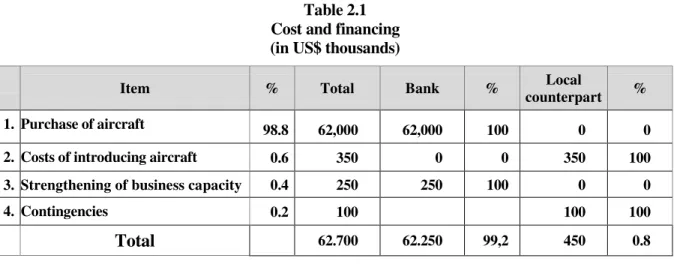
1.31 The cost of the operation will be US$62.7 million, 99.2% of which will be financed by the Bank. The current price of an Embraer ERJ-190AR is US$31 million, including the aircraft, flight crew training (pilot and copilot), mechanic training, spare parts, and launch promotion budget (estimated at approximately US$100,000 per aircraft). Based on recent Embraer 190 transactions (between 2003 and 2007), the stated unit price falls within market parameters.
Table 2.1 Cost and financing (in US$ thousands)
Item % Total Bank % Local
counterpart % 1. Purchase of aircraft 98.8 62,000 62,000 100 0 0 2. Costs of introducing aircraft 0.6 350 0 0 350 100 3. Strengthening of business capacity 0.4 250 250 100 0 0
4. Contingencies 0.2 100 100 100
D. Outcomes and indicators (PPMR monitoring)
1.32 The specific outcomes that the program is designed to achieve are summarized in the following table, and are further detailed in the attached Outcomes Matrix. TAME, acting through its relevant units,20 will be responsible for tracking the proposed indicators and will deliver semiannual progress reports to the Bank.
Key indicators Measurement time Reason for selection 5% increase in TAME’s domestic
market share.
Improved integration and air
interconnectivity at the national level. Improvement in the company’s operating margin from 3.5% to 10%.
One year after the end of program execution.
To confirm that financial investments and human resources are up and running, providing a safer, more reliable and more efficient passenger transportation service.
20% reduction in number of days planes are grounded.
20% reduction in number of
complaints filed in relation to service quality and comfort.
Same. To confirm that service
reliability has improved and is providing a direct benefit to travelers.
20% reduction in fuel consumption per block hour.
10% reduction in maintenance costs per flight hour.
Same. To confirm that productivity per service unit has improved.
II.
F
INANCINGS
TRUCTURE ANDM
AINR
ISKSA. Lending instruments and contractual conditions
2.1 The program for the renewal of TAME’s aircraft fleet will be executed as an investment loan. The term for the loan will be 20 years, and the grace period will be two years. The execution and disbursement period will be two years.
B. Environmental and social risks and mitigation measures
2.2 Environmental impacts. In general, aircraft operation causes three main environmental impacts: noise pollution, air pollution and greenhouse gas emissions as a result of combustion, and, to a lesser extent, the handling and disposal of chemical pollutants used as fuel or as maintenance and cleaning agents. The first two types of pollution are regulated by the International Civil Aviation Organization (ICAO), of which Ecuador is a member. Inside Ecuador, the
20
Office of the Operations Manager, the Office of the Maintenance Manager, Customer Service Department, Office of the Planning Adviser, Office of the Business Manager.
organization responsible for overseeing compliance with regulations is the Civil Aviation Office.
2.3 Noise pollution. Federal aviation regulations in the United States specify acceptable levels of noise based on effectively perceived noise levels measured in decibels. Acceptable limits have been set in stages, with Stage 3 levels in effect for aircraft currently in operation, and Stage 4 levels for aircraft models manufactured on or after 1 January 2006. The turbines for the TAME aircraft to be replaced no longer meet current standards, inasmuch as they were designed according to Stage 2 standards, whereas the turbines of Embraer jets meet Stage 4 standards. Thus, the program will significantly reduce noise pollution.
2.4 Emissions. Emissions of gaseous pollutants from aircraft engines are mainly related to fuel efficiency. Replacing three-engine aircraft with two-engine aircraft, and the concomitant reduction in fuel consumption (by more than 50%), will yield a significant reduction in hydrocarbon and carbon monoxide emissions (between 60% and 90%).21 Nitrogen oxide emissions are also lower with the new engines, though not significantly so. In all, the project will prevent the emission of an estimated 4,650 tons of gaseous pollutants over a 20-year period.
2.5 The aircraft that TAME has procured as part of its fleet renewal process (Airbus A320, Embraer 170, and Embraer 190) already comply with the International Civil Aviation Organization’s noise pollution and chemical pollution standards, according to certifications issued by the Brazilian Aeronautical Administration (Brazil is the country of origin of the aircraft) and by the United States Federal Aviation Administration. Emissions and noise levels will be an estimated 20% to 50% lower than those caused by the airplanes in the old fleet.
2.6 Maintenance. The old aircraft need major repairs requiring the use of solvents, oils, and a larger number of spare parts, entailing higher risks of pollution and waste generation. Replacing aircraft that have been in service for more than 20 years will significantly reduce maintenance and repair needs, thereby helping to reduce the potential impact of pollution by general airline operations.
2.7 Environmental management. TAME has an integrated quality, safety, and environmental management system staffed with personnel trained in environmental issues in all business units of the company. This environmental management system is ISO 14001 certified, which ensures that pollutants produced by operations are handled in accordance with acceptable procedures and properly monitored.
2.8 Socioeconomic impact. The program will yield a number of socioeconomic benefits, ensuring access to air service for residents of remote areas of the country. As TAME’s has a mandate to serve all regions of Ecuador, having aircraft with lower operating costs will help the airline reduce losses, support a positive financial
21
According to ICAO data, hydrocarbon and carbon monoxide emissions are 60% to 90% less for the new GE engines on Embraer aircraft than for the Pratt & Whitney models on Boeing aircraft and the Rolls Royce engines on Fokker aircraft.
position, and maximize profitability in its profit-generating operations. Lower operating costs with the new fleet, compared to the current fleet, will save the company money by helping it to maintain the affordable fares and continue operations on commercially unprofitable social-purpose routes, thereby fulfilling its social obligations to the country. If the current fleet were maintained, the continued increase in operating costs can be expected to jeopardize the company’s “social-purpose” operations, and that would have direct consequences on the integration and socioeconomic development of certain areas of the country.
2.9 TAME’s coverage of remote destinations in Ecuador, as part of its mission of promoting domestic integration, is vital to the development of local communities. Areas that depend entirely on TAME as an air connection with the rest of the country consider its service vital to its development and in many cases have helped promote air service by building and maintaining local airfields, which in many cases are administered by municipal governments on behalf of the community. Improving the quality of service to these destinations will directly benefit communities and municipal governments, and the operational savings will enable TAME to expand future service to still-isolated areas. The availability of air service at the national level helps to promote regional economic activity such as tourism and the promotion of airport service22 companies, inter alia, in addition to being the only viable way for residents of remote areas to gain access to basic healthcare and educational services.
2.10 Meanwhile, the company’s discounts to residents through preferential fares for certain local groups also have a direct impact on disadvantaged users. If this discount were eliminated, fares would double for these users, and increase by approximately 15% for other users of unprofitable routes, directly impacting the most vulnerable users.
C. Fiduciary risk
2.11 TAME’s financial capacity. TAME’s per-passenger revenues are relatively low, so its margins are thin. TAME’s operating margin is 6%, while its net margin is virtually 0%. These thin margins are partly due to its policy of maintaining low fares and providing discounts on some routes to meet its objective of promoting regional integration. In terms of TAME’s operating cost structure, fuel expenses are relatively low, and maintenance expenses are considerably high, in relation to revenue (due in part to the age of the fleet; these expenses are generally 4% and 6% of an airline’s revenues, while for TAME they are 15.7%).
2.12 TAME reports liquid assets of US$6.1 million on total current assets of US$34 million. Meanwhile, profitability rates reported for 2006 reveal small net margins (US$163,000 on total sales of US$77.6 million).
2.13 The three Embraer aircraft previously procured by TAME are, according to the purchase agreement signed in April 2005, worth a total of US$77 million, 20% of
22
which has been paid with the company’s own funds, and the remainder paid through a loan from Proveedor de Embraer/BNDES guaranteed by the Government of Ecuador under an executive decree. The addition of these aircraft has increased the company’s assets by 74.75%, and its liabilities by 74%, from 2005 to 2006 due to the debt incurred to purchase the aircraft. However, the new aircraft led to a 48% increase in gross profits.
2.14 In 2006, TAME’s financial structure included US$139.6 million in total assets; US$88.4 million in liabilities, and a net worth of US$51.2 million. Of its total assets, 24.38% are current assets and 65.78% are fixed assets, including the three Embraer aircraft added during the second phase of the renewal process. On the assets side of the ledger, 37% fall under cash/banks, investments, or accounts receivable, which means there is a sizeable margin of immediate liquidity to cover short- and medium-term obligations.
2.15 Adding the two new aircraft and their respective technological advancements will have direct impacts on the costs of operating and maintaining the aircraft, by minimizing the economic burden on the company and maximizing the operability of the fleet. Renewing the fleet will also help the company renew its net worth with earning assets, and replace assets that have placed it at a disadvantage in terms of the image portrayed in its financial statements. This will increase the company’s net worth. The 20-year surrender value is estimated at US$18.6 million, using the current depreciation formula for aircraft (a 30-year useful life with a 10% residual value).
2.16 TAME projects that it will repay the debt incurred in the purchase of the aircraft through revenue generated by the company’s air service operations. Revenues for the first year after addition of the aircraft is projected at US$16.4 million, assuming average fares current as of 2007. Investment costs and other related costs in the first year include the cost of the two aircraft (US$62 million), as well as loan insurance premiums (US$950,000), administrative fees (US$420,000), other up-front expenses (US$800,000), and contingencies (US$100,000). Coming into play as of the first year will be the direct costs of operating the aircraft, such as fuel consumption, maintenance costs, travel costs, airport services, etc. The operational budget will be financed through revenues and production generated by the addition of the aircraft.
2.17 By combining data on project revenues and costs, a positive net present value of US$23.3 million is obtained with a discount rate of 12%, meaning that the plan to add two Embraer ERJ-190AR as a financed purchase is financially viable.23
2.18 It may be concluded that the flows generated by expanding and modernizing the fleet will help the company cover operational, administrative, and financial costs,
23
These figures have been obtained using current traffic data on routes in operation and actual growth rates. Adding new aircraft that will provide improved service may lead to higher growth rates with improved revenues.
leaving a surplus for each year of operation. Therefore, despite the company’s thin margins, it is not expected to have major problems repaying the loan.
D. Other issues and risks
2.19 Competition. The leading routes in the domestic market display reasonable levels of competition. The lack of regulations against the use of outdated equipment allows the use of aircraft with levels of service and operational safety that fall short of modern standards. While the new equipment means greater operational efficiency, operating old aircraft does entail savings in capital spending. Thus, TAME’s fleet renewal will not necessarily lead to a competitive advantage over airlines that continue to use old equipment.
2.20 Nor does the financial assistance to TAME place the private airlines at a disadvantage, since they also have the ability to access relatively favorable financing options, either by leasing or through the support of multilateral organizations such as the International Finance Corporation. This means that other airlines would also be able to embark upon a fleet renewal program by gaining access to outside financing.
2.21 Regulatory landscape. The National Civil Aviation Council (CNAC)24 is responsible for granting concessions and operating permits to domestic and foreign airlines operating in Ecuador. It is also authorized to approve airport taxes and aeronautical facilities in Ecuador. All existing rules and regulations governing aeronautical activity in Ecuador are applicable nationwide, and the Ecuadorian Constitution states that any airline in compliance with all laws and regulations has an equal opportunity to be granted operating permits. Meanwhile, Article 55 of the Tourism Act grants airlines the discretion to set their own fares. The aeronautical authority merely records the fares posted by the airlines.
III.
I
MPLEMENTATION ANDA
DMINISTRATIONP
LAN3.1 Summary of implementation measures. The borrower and executing agency for the project will be TAME,25 which will also be legally liable to the Bank for the
24
The National Civil Aviation Council consists of nine members: six representatives of the public sector (representing various ministries) and three members of the private sector (Chamber of Tourism, Chamber of Production, and a representative of national aviation companies).
25
TAME is headed by a Board of Directors, which is responsible for setting the company’s policies and objectives, and an executive body consisting of a president and an executive vice president, who are responsible for implementing programs to comply with these policies and objectives. The company also has a number of advisory units for planning, safety, and legal matters, as well as a unit for internal auditing and control. Lastly, TAME has a number of managers, both in technical and administrative areas (human resources, communications, information technology, logistics, etc.) and in operational areas (business, maintenance, operations, etc.). TAME has obtained ISO 9001 certification for quality management, ISO 14001 certification for environmental management, and ISO 18001 certification for occupational health, which has led to a number of changes and improvements in the company’s management processes. It is currently in the process of obtaining OHSAS certification as well.
local contribution and for repayment of the debt (principal, interest, and fees). The guarantor will be the Republic of Ecuador. The guarantee to be issued by the Republic of Ecuador to TAME will be a joint and several guarantee, i.e. it will cover both the financial obligations stemming from the loan and from the local counterpart resources, as well as performance requirements, in accordance with the Bank’s Manual of Operational Policies and Strategies (OP-303).
3.2 The TAME units responsible for project execution will be the Office of the Planning Adviser and the Office of the Air Fleet Renewal Adviser, which will be in charge of for general planning and coordination with the operational and technical areas of the company, in order to ensure a smooth transition from procurement to operation of the aircraft. These units will be directly responsible for executing, planning, monitoring, and evaluating the program’s activities, including those related to monitoring, contract execution, preparation of progress reports, disbursement requests and processing, contracting, administration and oversight of contracting processes, as well as all support documentation needed.
3.3 As monitoring performance indicators is part of the activities routinely carried out by the various units of TAME, no special monitoring structure or system is deemed necessary for this purpose. TAME will collect, store, and maintain all information, indicators, and parameters needed to prepare the loan performance report and the program completion report for the Bank.
3.4 TAME has the authority and the capacity to take on the proposed operation, as evidenced in the fact that it carried out a similar operation in 2006, in which it purchased three Embraer aircraft through direct purchasing. These aircraft were procured and placed in operation on form and on time, and are currently providing regular service.
3.5 Procurement. Goods and services will be procured, and consulting services will be selected and contracted in accordance with Bank policies as set forth in documents GN-2349-7 and GN-2350-7. The attached procurement plan provides a detailed description of the contracting processes to be conducted for the program.
3.6 Direct contracting will be used to purchase the two Embraer aircraft, as described in Section 3.6 of document GN-2349-7 on the procurement of goods and works. Direct contracting in this case is fully justified: (i) from a technical standpoint, because these are the aircraft best suited to the infrastructure and operating conditions in Ecuador; (ii) from a financial standpoint, based on the findings of a study of the market and similar aircraft (small mainliners cost US$40 million to US$50 million, about US$20 million more than the ERJ-190s); and (iii) from an operational standpoint, because the company already has three Embraer aircraft, and standardization would entail considerable savings for the company since fleet standardization is a crucial part of cost control and leveraging economies of scale. Fleet standardization would enable the company to purchase parts for the entire fleet, use the same shops and mechanics, secure volume contracts for spare parts and offline maintenance, and use the same flight crews throughout its fleet, as well
as enjoy efficiencies in training and availability of human resources. Thus, using Embraer as the sole supplier is under these circumstances perfectly justifiable and is the only approach for the renewal plan.
3.7 Summary of outcome monitoring measures. An administration mission will be conducted every twelve months during program execution, at which time a midterm review of TAME’s financial and operational progress will be done. Progress will also be assessed in relation to implementation of the business plan, tracking the company’s main financial and operational indicators to provide early warnings for preventive or corrective measures without affecting normal project performance, and to ensure that all activities are directed toward meeting the proposed objectives. 3.8 Auditing. The financial statements of TAME26 and of the program will be audited during program execution, in accordance with Bank policies (documents AF-100, AF-300).
26
TAME has financial statements from 2000 to 2003, audited by Price Waterhouse Coopers of Ecuador, and from 2004 to 2005, audited by Ecuador’s Office of the General Comptroller.
PROGRAM FOR THE RENEWAL OF TAME'S AIRCRAFT FLEET
(EC-L1045)
Results Framework Matrix of Indicators
Program objective
The objective of the program is to facilitate integration and connectivity in Ecuador, especially among the country’s most isolated and disadvantaged areas, through improvements in the operations and commercial air transportation services provided by TAME, by renewing its fleet of aircraft and strengthening its business capacity. To meet this objective, financing will be provided for the purchase of two Embraer ERJ-190AR aircraft to replace the planes in TAME’s existing fleet, and for a business capacity-building program. The program will: (i) enhance the quality, reliability, and safety of TAME’s air services; (ii) lower the cost of operating and maintaining TAME’s fleet of aircraft, and reduce its environmental impact; (iii) improve TAME’s business management through better margins and easier access to private sector lending; and (iv) increase TAME’s domestic market share by providing continuity on certain routes flown exclusively by TAME that fulfill a clear corporate purpose of supporting local development.
Outcome indicator Baseline Target Increased productivity per service unit
- Reduced costs of aircraft operation US$965.93 per block hour
US$774,544 -20% Baseline average fuel consumption per block hour, divided by the actual average fuel consumption per block hour with the new aircraft.
Fuel consumption will be measured by fleet type, based on flight logs. TAME Office of the Operations Manager.
- Reduced costs of aircraft maintenance
US$1,271.38 per flight hour
US$1,144.24 -10% Baseline average cost of aircraft maintenance per flight hour, divided by the actual average cost of aircraft maintenance with the new aircraft. - Reduced delays and offline time for
aircraft
250 days/year for entire fleet
200 days -20% Baseline number of days grounded for the fleet, divided by the days grounded with the new fleet composition.
The Office of the Maintenance Manager presents monthly statistics on grounding of the 2 aircraft for unforeseen failures. These statistics show that the new aircraft have improved reliability.
Improved service reliability and safety - Improvements in comfort and
service quality
XX year YY year -20% Baseline number of complaints filed, divided by the number of complaints filed with the new fleet.
The Customer Service Department measures the number of complaints filed by users, and so will be responsible for measuring how these complaints are addressed.
Baseline Year 1 Year 2 Year 3 Year 3 / Target Component. Renewal of the aircraft fleet
Purchase of aircraft Outputs
- Two (2) ERJ-190 aircraft in operation
0 0 2 n.d. 2
Final outcomes
- Increase in TAME’s domestic market share
1.18 M 1.33 M 1.4 M 1.47 M 1.47 M Number of domestic passengers flown by TAME, divided by the total number of domestic passengers in the domestic market.
- Improved integration and air interconnectivity at the national level
150 150 157 164 164 Optimization of use of new aircraft,
and increase in number and
frequencies on domestic routes and destinations.
- Improvement in the company’s operating margin
3.25% 8% 10% 10% 10%
Component. Institutional strengthening Outputs
- Updated business plan 2002 n.d 80% 100% 100% Executive, financial, and business
offices are involved. Final outcomes
- Strategic, financial, and operational plans implemented
0 n.d 80% 100% 100%
- TAME has a system for accounting identification of the macro processes of its
individualized activity, as well as trained personnel and efficient planning tools.
PROGRAM FOR THE RENEWAL OF TAME'S AIRCRAFT FLEET EC-L1045
PROCUREMENT PLAN
GENERAL INFORMATION Country: Ecuador
Borrower: TAME Línea Aérea del Ecuador
Executing agency: TAME
Project name: Program for the Renewal of TAME’s Aircraft Fleet
Project and loan contract numbers: EC-L1045
Brief description of the project’s objectives and components: The project calls for the procurement of two Embraer ERJ-190AR aircraft to replace the planes in TAME’s current fleet that are nearing obsolescence and to move toward modernization and standardization of the fleet.
Estimated date of project approval by the Board of Executive Directors: 28 November 2007
Estimated date of signature of the loan contract: December 2007
Estimated date of the final disbursement: December 2009
A) Introduction
Procurements for the proposed project will be carried out in accordance with the Policies for the Procurement of Works and Goods Financed by the Inter-American Development Bank (document GN-2349-4), of July 2006; and the Policies for the Selection and Contracting of Consultants Financed by the Inter-American Development Bank (document GN-2350-7), of July 2006, and with the provisions established in the loan contract and this procurement plan.
B) Procurement plan
The procurement plan for the Program for the Renewal of TAME’s Aircraft Fleet
covering the first 18 months of the project execution period has been agreed between the
Bank and TAME. The plan indicates the procedure to be used for the procurement of goods,
the contracting of services, and the method of selecting consultants, for each contract or group of contracts. The procurement plan will be updated annually or whenever necessary or as required by the Bank.
C) Project procurement
Works procurement: N/A
Goods procurement: Direct contracting will be used to procure two Embraer ERJ-190AR aircraft, as described in Section 3.6 of the Bank’s Policies for the Procurement of Works and Goods Financed by the Inter-American Development Bank (document GN-2349-7), of July 2006.
Direct contracting in this case is fully justified: (i) from a technical standpoint, these are the aircraft best suited to the infrastructure and operating conditions in Ecuador; and (ii) from a financial standpoint, a market study found that the price obtained for this procurement is much lower than for other, similar aircraft; and (iii) from an operational standpoint, fleet standardization is a crucial part of cost control and enjoying the advantages of economies of scale. Fleet standardization would enable the company to purchase parts for the entire fleet, use the same shops and mechanics, secure volume contracts for spare parts and offline maintenance, and use the same flight crews throughout its fleet, as well as enjoy efficiencies in training and availability of human resources. Thus, using Embraer as the sole supplier is under these circumstances perfectly justifiable and is the only logical approach for the renewal plan.
As stated above, one of the main reasons for selecting this type of aircraft is technical in nature. The Embraer ERJ-190 is the only aircraft of its size that is technically capable of serving several airports in Ecuador, due to infrastructural limitations and altitude-related issues, including the ability to land on and take off from difficult runways; although small mainliners (Airbus 318 and Boeing 737-600) have more capacity than large regional jets (ERJ-190 and ERJ-195), they cannot serve certain routes and airports in Ecuador.
A second factor is financial in nature. Small mainliners cost US$40 million to US$50 million, about US$20 million more than large regional jets (Embraer ERJ-190AR).
Furthermore, it is desirable to standardize TAME’s fleet of aircraft. As the airline already has three Embraer aircraft, standardizing the fleet would mean significant savings in equipment, training, spare parts, and maintenance. Thus, the addition of Embraer aircraft is fully justified from a technical, financial, and operational standpoint, and would represent a step toward standardizing the company’s fleet of aircraft.
Procurement of nonconsulting services: N/A.
Procurement of consulting services: Consulting services will be required for institutional strengthening studies. The appropriate method will be used to evaluate proposals for the selection of consulting firms, from among the following: Quality-based selection (QBS); Quality-and-cost-based selection (QCBS); Least-cost selection (LCS); and Selection under a fixed budget (FBS). Individual consultants will be selected on the basis of their qualifications to perform the required work.
Others: N/A
Advance contracting and retroactive financing: N/A
D) Bank review of procurement decisions
a) The specifications of the aircraft and the sales contract have been reviewed, and are in compliance with international standards for this type of procurement operation.
Appendix 1: Procurement plan Country: Ecuador
Borrower: TAME Línea Aérea del Ecuador
Executing agency: TAME
Project name: Program for the Renewal of TAME’s Aircraft Fleet
Project and loan contract numbers: EC-L1045
Brief description of the project’s objectives and components: The project calls for the procurement of two Embraer ERJ-190AR aircraft to replace the planes in TAME’s current fleet that are nearing obsolescence and to move toward modernization and standardization of the fleet.
Date of project approval by the Board of Executive Directors: 28 November 2007
Date of signature of the loan contract: December 2007
Estimated date of the final disbursement: December 2009
Address of the executing agency office responsible for the procurement plan:
Project: EC-L1045, Program for the Renewal of TAME’s Aircraft Fleet Period covered in this procurement plan: September 2007 to December 2008
Source of financing and percentage Estimated dates Ref. No. Category and description of procurement contract Estimated cost of procurement (US$000) Procurement method Review (prior or post) IDB % Local/ other % Prequali-fication (Yes/No) Publication of specific procurement notice Completion of contract Status (pending, in process, awarded, cancelled) Comments 1. Goods 2 Embraer aircraft 62,000 Direct contracting
2. Services
Diagnostic study
and development
of business plan for
TAME
CAPACITY OF THE EXECUTING AGENCY AND SUPERVISION OF PROCUREMENT BY THE BANK
Assessment of the executing agency’s capacity to administer procurement
TAMEwill be responsible for carrying out project procurements. Having assessed the capacity
of the executing agency to procure aircraft and contract for institutional strengthening activities, the Bank rates the overall risk to the project arising from the administration of procurement as
low.
Frequency of procurement supervision