Rest Interval between Sets in
Strength Training
Belmiro Freitas de Salles,
1,2Roberto Sima˜o,
2Fabrı´cio Miranda,
2Jefferson da Silva Novaes,
2Adriana Lemos
2and
Jeffrey M. Willardson
31 Laboratory for Clinical and Experimental Research in Vascular Biology (BioVasc), Biomedical Center, State University of Rio de Janeiro, Rio de Janeiro, Brazil
2 School of Physical Education and Sports, Universidade Federal do Rio de Janeiro, Rio de Janeiro, Brazil 3 Kinesiology and Sports Studies Department, Eastern Illinois University, Charleston, Illinois, USA
Contents
Abstract. . . 765
1. Literature Search . . . 766
2. Acute Responses and the Rest Interval between Sets . . . 767
2.1 Influence of Rest Interval Length on Repetition Performance Over Multiple Sets . . . 767
2.2 Influence of Rest Interval Length on Repeated Maximal Strength Assessments . . . 769
2.3 Influence of Rest Interval Length on Acute Expression of Muscular Power . . . 770
2.4 Influence of Rest Interval Length on Acute Hormonal Responses and their Influence on Muscular Hypertrophy . . . 770
3. Chronic Adaptations and the Rest Interval between Sets . . . 772
3.1 Influence of Rest Interval Length on Muscular Strength and Power Adaptations . . . 772
3.2 Influence of Rest Interval Length on Muscular Endurance Adaptations. . . 774
4. Conclusions . . . 775
5. Recommendations . . . 776
Abstract
Strength training has become one of the most popular physical activities for increasing characteristics such as absolute muscular strength, endurance, hypertrophy and muscular power. For efficient, safe and effective training, it is of utmost importance to understand the interaction among training vari-ables, which might include the intensity, number of sets, rest interval between sets, exercise modality and velocity of muscle action. Research has indicated that the rest interval between sets is an important variable that affects both acute responses and chronic adaptations to resistance exercise programmes. The purpose of this review is to analyse and discuss the rest interval between sets for targeting specific training outcomes (e.g. absolute muscular strength, endurance, hypertrophy and muscular power). The Scielo, Science Citation Index, National Library of Medicine, MEDLINE, Scopus, Sport Discus and CINAHL databases were used to locate previous original scientific investiga-tions. The 35 studies reviewed examined both acute responses and chronic adaptations, with rest interval length as the experimental variable. In terms of acute responses, a key finding was that when training with loads between 50% and 90%of one repetition maximum, 3–5 minutes’ rest between sets allowedfor greater repetitions over multiple sets. Furthermore, in terms of chronic adaptations, resting 3–5 minutes between sets produced greater increases in absolute strength, due to higher intensities and volumes of training. Similarly, higher levels of muscular power were demonstrated over multiple sets with 3 or 5 minutes versus 1 minute of rest between sets. Conversely, some experi-ments have demonstrated that when testing maximal strength, 1-minute rest intervals might be sufficient between repeated attempts; however, from a psychological and physiological standpoint, the inclusion of 3- to 5-minute rest intervals might be safer and more reliable. When the training goal is muscular hypertrophy, the combination of moderate-intensity sets with short rest intervals of 30–60 seconds might be most effective due to greater acute levels of growth hormone during such workouts. Finally, the research on rest interval length in relation to chronic muscular endurance adaptations is less clear. Training with short rest intervals (e.g. 20 seconds to 1 minute) resulted in higher repetition velocities during repeated submaximal muscle actions and also greater total torque during a high-intensity cycle test. Both of these findings indirectly demonstrated the benefits of utilizing short rest intervals for gains in muscular endurance. In summary, the rest interval between sets is an important variable that should receive more attention in resistance exercise prescription. When prescribed appropriately with other important prescriptive variables (i.e. volume and intensity), the amount of rest between sets can influence the efficiency, safety and ultimate effectiveness of a strength training programme.
Strength training has been heavily studied during the last 50 years, and is now an integral component of a well-rounded exercise pro-gramme. Strength training has been shown to contribute to improvements in sports perfor-mance, as well as treatment and prophylaxis of some illnesses.[1,2]Studies have focused on
mani-pulation of the different variables involved in resistance exercise prescription to gain a better understanding of how to best achieve different muscular characteristics. Strength training has been proven to stimulate chronic adaptations within the muscles that lead to increases in strength, hypertrophy, muscular endurance and power.
According to the American College of Sports Medicine,[1,2]the main methodological variables
of prescription are the intensity, number of sets and repetitions (i.e. volume), rest interval be-tween sets, order of exercises, movement velocity and training frequency. Among such variables, the rest interval between sets has received little attention, relative to other prescriptive variables
such as intensity and volume. The existing research has demonstrated that different rest intervals between sets can produce differing acute responses and chronic adaptations in the neuro-muscular and endocrine systems.[3-15]
The rest interval between sets is commonly prescribed based on the training goal (e.g. strength, power, muscular hypertrophy and en-durance).[1,16]However, there are still conflicting
findings in the literature, which often makes the identification of the appropriate rest interval difficult. Therefore, the purpose of this review is to analyse and discuss the rest interval between sets for targeting specific training outcomes (i.e. absolute strength, muscular endurance, hyper-trophy and power).
1. Literature Search
The Scielo, Science Citation Index, National Library of Medicine, MEDLINE, Scopus, Sport Discus and CINAHL databases were used to locate previous literature original scientific
investigations. The studies reviewed examined both acute responses and chronic adaptations, with rest interval length as the experimental variable. The search utilized the following key-words: ‘rest interval’, ‘rest period’, ‘recovery’, ‘recovery time’ and ‘fatigue’, combined with the keywords ‘training volume’, ‘repetitions’, ‘sets’, ‘resistance training’, ‘resistance exercise’ and ‘strength training’. The names of authors cited in some studies were also utilized. Hand searches of relevant journals and reference lists obtained from articles were also conducted in the Federal University of Rio de Janeiro and State University of Rio de Janeiro libraries. Such combinations resulted in the inclusion of 35 original research articles addressing the rest interval between sets in strength training. The last search was per-formed on 17 July 2009.
Criteria for inclusion were as follows:
1. Only studies from journals with an impact factor ‡1.0. We included this impact factor because the median impact factor for journals in sport science is 1.0, which is similar to that of many other biomedical disciplines. Those with an impact factor <1.0 are considered low-impact journals by the Sports Science Organization.[17]
2. Studies must have examined the effects of the rest interval as the experimental variable on performance, strength, power, hypertrophy and/or muscular endurance.
2. Acute Responses and the Rest Interval between Sets
2.1 Influence of Rest Interval Length on Repetition Performance Over Multiple Sets
Several studies have demonstrated that the execution of a single set becomes less effective for trained people versus performing multiple sets;[18,19]however, the rest interval between sets
may determine the effectiveness of performing a multiple set programme. Although recom-mendations concerning rest intervals between multiple sets are based on training goals such as strength, power, hypertrophy and muscular endurance, the achievement of these goals may depend on the ability to maintain the number of
repetitions within a prescribed zone over conse-cutive sets.[16]
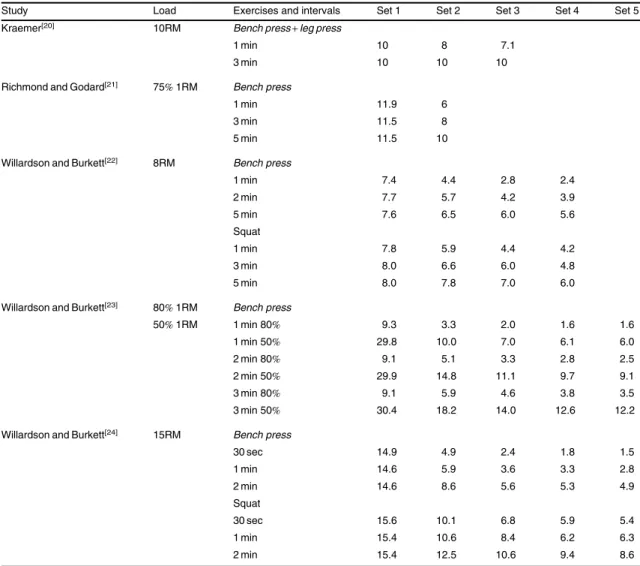
With regard to the maintenance of repeti-tions over consecutive sets, some authors demon-strated that resting less than 3 minutes can result in a significant decrease in repetitions (see table I). Kraemer[20] tested the effects of 1- and
3-minute rest intervals on the total number of repetitions completed in three consecutive sets with a 10 repetition maximum (RM) load on the bench press and leg press exercises. Twenty American football players who had participated in resistance exercise for two consecutive years participated in the study. The findings indicated that resting 3 minutes between sets was sufficient to allow for completion of 10 repetitions on each set. However, resting 1 minute between sets resulted in a significant decrease in the total repetitions completed.
Conversely, Richmond and Godard[21]found
that for 12RM loads, 3- and 5-minute rest inter-vals were not sufficient to maintain repetitions over two consecutive sets. In this experiment, 3-and 5-minute rest intervals allowed for comple-tion of approximately 8 and 10 repeticomple-tions on the second set, respectively.
Such results were in conflict with the results reported by Kraemer,[20]in which 3 minutes
al-lowed for consistent repetitions. This discrepancy between studies might be due to the samples uti-lized; for example, highly trained athletes in the study by Kraemer[20] versus healthy
recrea-tionally trained men in the study by Richmond and Godard.[21] Therefore, practitioners must
consider the training status of individuals when prescribing the rest interval between sets. For untrained individuals, 5 minutes’ rest between sets might be necessary if the goal is consistency in repetitions over high-intensity sets.
Corroborating with Richmond and Godard,[21]
Willardson and Burkett[22,23] demonstrated that
3- and 5-minute rest intervals were not sufficient to maintain consistent repetitions in recrea-tionally trained men who had performed approxi-mately three strength workouts per week during the previous 3 years. For example, Willardson and Burkett[22]compared three different rest
for the squat and bench press exercises. Three test sessions were conducted, during which four sets of the squat and bench press were perform-ed with a constant 8RM load and 1, 2 or 5 minutes’ rest between sets. For each exercise, a significant decline occurred in the number of repeti-tions completed between the first and the fourth sets; however, for a given rest interval there were greater total repetitions performed for the squat versus the bench press. This finding sug-gests that the muscles of the lower body possessed greater endurance characteristics versus the
muscles of the upper body. These results indicated that the specific combination of muscles involved affects the prescription of the rest interval; therefore, practitioners may prescribe longer rest intervals for compound upper body exercises (e.g. bench press) and shorter rest intervals for compound lower body exercises (e.g. barbell back squat).
Willardson and Burkett[24] also compared
30-second and 1- and 2-minute rest intervals on the number of repetitions completed for the squat and bench press over five sets with a constant Table I.Acute effect of different rest intervals between sets over the number of repetitions maximum (RM). Values are expressed as RM Study Load Exercises and intervals Set 1 Set 2 Set 3 Set 4 Set 5 Kraemer[20] 10RM Bench press+leg press
1 min 10 8 7.1
3 min 10 10 10
Richmond and Godard[21] 75%1RM Bench press
1 min 11.9 6
3 min 11.5 8
5 min 11.5 10
Willardson and Burkett[22] 8RM Bench press
1 min 7.4 4.4 2.8 2.4 2 min 7.7 5.7 4.2 3.9 5 min 7.6 6.5 6.0 5.6 Squat 1 min 7.8 5.9 4.4 4.2 3 min 8.0 6.6 6.0 4.8 5 min 8.0 7.8 7.0 6.0
Willardson and Burkett[23] 80%1RM Bench press
50%1RM 1 min 80% 9.3 3.3 2.0 1.6 1.6 1 min 50% 29.8 10.0 7.0 6.1 6.0 2 min 80% 9.1 5.1 3.3 2.8 2.5 2 min 50% 29.9 14.8 11.1 9.7 9.1 3 min 80% 9.1 5.9 4.6 3.8 3.5 3 min 50% 30.4 18.2 14.0 12.6 12.2 Willardson and Burkett[24] 15RM Bench press
30 sec 14.9 4.9 2.4 1.8 1.5 1 min 14.6 5.9 3.6 3.3 2.8 2 min 14.6 8.6 5.6 5.3 4.9 Squat 30 sec 15.6 10.1 6.8 5.9 5.4 1 min 15.4 10.6 8.4 6.2 6.3 2 min 15.4 12.5 10.6 9.4 8.6
15RM load. Significant declines in the number of repetitions occurred between the first and the fifth sets, irrespective of the rest interval. For both exercises, the 2-minute rest interval resulted in significantly greater repetitions versus the 30-second rest interval. These results suggest that when short rest intervals are utilized to develop muscular endurance, the intensity (i.e. load) may need to be progressively lowered over subsequent sets to sustain repetitions within the range conducive to this training goal. Future research should establish the extent to which the resistance should be lowered between sets in order to sustain repetitions for muscular en-durance training.
A limitation of the aforementioned studies was the evaluation of only one or two exercises; only one study to date has examined the influence of different rest intervals in the context of a typical training session that involves multiple exercises. Miranda et al.[25]compared the effects of 1- versus
3-minute rest intervals between sets on the number of repetitions completed for each exercise during an upper body workout. Fourteen recreationally trained men with a minimum of 2 years and a mean of 6.34 years of experience performed two training sessions; both sessions consisted of three sets with 8RM loads for six upper extremity ex-ercises (e.g. wide grip lat pull-down, close-up grip pull-down, machine seated row, barbell row lying onto bench, dumbbell seated arm curl and ma-chine seated arm curl).
Miranda et al.[25] demonstrated that for all
exercises significantly fewer repetitions were com-pleted when resting 1 minute between sets. How-ever, significant reductions were noted between the first and third sets in four of the six exercises, irre-spective of the rest interval. These results suggest that when training for muscular strength, resting for ‡3 minutes might be advantageous to accu-mulate a higher training volume while also main-taining the intensity of the load lifted. It is important to emphasize that for any intensity or objective in strength training, the rest interval length may vary when sets are not performed to concentric failure, according to the exercises used and/or practitioner’s level of conditioning. Ad-ditionally, recent studies demonstrated that
prac-titioners should also consider age and sex when prescribing rest intervals between sets.[26,27]
2.2 Influence of Rest Interval Length on Repeated Maximal Strength Assessments
The rest interval between sets when testing maximal strength is crucial because the reliability of testing may depend on the ability to recover. Contrary to what has been practiced in most ex-periments (i.e. utilizing longer rest intervals be-tween sets when testing for maximal strength), some studies have demonstrated that 1-minute rest intervals were sufficient between repeated 1RM attempts.[28,29]Weir et al.[28] examined the
effect of rest interval length on repeated 1RM bench press performance. On the first day of testing, the 1RM load was determined for 16 re-creationally trained men with a minimum of 2 years of bench press experience who could bench press at least 125% of their bodyweight. Four subsequent test sessions involved the per-formance of two 1RM attempts, separated by 1, 3, 5 or 10 minutes’ rest. The results demonstrated that all of the rest intervals tested allowed for approximately the same number of subjects to successfully complete the second attempt.
Similarly, Matuszak et al.[29]compared the
ef-fects of different rest intervals in 17 recreationally trained men with a minimum of 2 years of squat experience who could back squat at least 1.5 times their bodyweight. Three subsequent test sessions involved the performance of two 1RM attempts, separated by 1, 3 or 5 minutes’ rest. The results demonstrated that for the 1-minute rest condition, 75%of the subjects completed the second attempt successfully, with 94.1% and 88.2% successful completions for the 3- and 5-minute rest condi-tions, respectively. The results of these studies in-dicate that in some cases 1-minute rest intervals might be sufficient; however, from a psychological and physiological standpoint, the inclusion of 3- to 5-minute rest intervals might be safer and more reliable. In short, testing for maximal strength is a process that should not be rushed, especially when testing compound exercises like the back squat and bench press, which require high levels of neuro-muscular coordination.
2.3 Influence of Rest Interval Length on Acute Expression of Muscular Power
Power performance is highly dependent on anaerobic energy metabolism (primarily the phosphagen system). The rest interval between sets when training for muscular power should closely match the time required for replenishment of phosphocreatine (PCr), which requires a minimum of 4 minutes’ recovery.[30] If the rest
interval is not sufficient to allow for replenish-ment of PCr, energy production shifts to empha-size the glycolytic system. This results in the accumulation of H+ ions and disturbances in the concentration gradients of other ions (i.e. Na+, K+, Ca2+Mg2+, Cl-), resulting in a lowered intracellular pH. At low pH values, both the peak isometric force and the maximal velocity of shortening are substantially depressed.[7]
Abdessemed et al.[31] examined the effect of
recovery duration on muscular power and blood lactate concentration during the performance of ten sets of six maximal effort bench press repeti-tions performed at 70%of 1RM and with 1, 3 or 5 minutes’ rest between sets in ten untrained men. Measurements of force and displacement of the bar and mean power during each repetition were calculated. Blood lactate was evaluated before and immediately after each interval. No signifi-cant variation in mean power occurred between the first and the tenth sets when resting 3 or 5 minutes betweens sets; lactate did not increase significantly from baseline with either of these rest conditions. Conversely, the 1-minute rest condition resulted in a significant decrease in mean power and a significant elevation in blood lactate.
These results suggest that the 1-minute rest condition was not sufficient to replenish PCr, which placed greater emphasis on glycolytic energy production, as demonstrated by the signif-icant elevation in blood lactate.[31] Therefore,
resting 3–5 minutes between sets may allow for maintenance of force and power production over multiple sets and repetitions. However, longitudinal research is necessary to determine whether greater acute power during individual workouts would translate into performance gains
in activities that require high power output, such as the vertical jump.
2.4 Influence of Rest Interval Length on Acute Hormonal Responses and their Influence on Muscular Hypertrophy
The maintenance of training intensity is not the main focus in strength training directed to-ward muscular hypertrophy, and research sug-gests that successive sets should be performed prior to full recovery. Several cross-sectional studies suggest that short periods (£1 minute) might provide a superior stimulus for hyper-trophy due to the acute elevations in growth hormone.[3-5,10,31-32]
Kraemer et al.[4]compared the acute hormonal
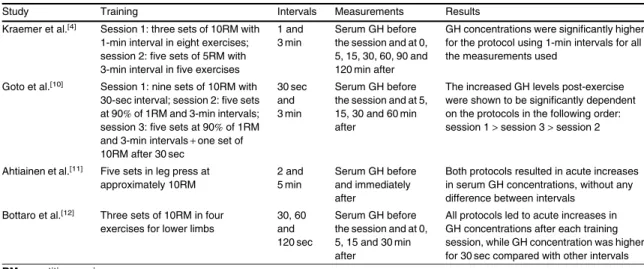
responses to different resistance exercise protocols. Nine recreational trained young men (not compe-titive lifters) performed a protocol that involved three sets of eight exercises with a 10RM load and a 1-minute interval between sets, and another pro-tocol that involved five sets of five exercises with a 5RM load and a 3-minute rest interval between sets. Blood hormonal concentrations of total tes-tosterone, free testes-tosterone, cortisol, growth hor-mone and blood lactate were collected prior to the exercise session and at 0, 5, 15, 30, 60, 90 and 120 minutes following the session. The results indicated that acute elevations in growth hormone were sig-nificantly greater for the protocol that involved 1-minute rest intervals and 10RM loads. However, a limitation of this study was that changes in mus-cular hypertrophy were not examined over time.
The studies by Kraemer et al.[4]in young men
and women[5]indicated that shorter rest intervals
(i.e. 1 vs 3 minutes) were associated with greater acute elevations in growth hormone. However, they also observed higher values for corticotropin and cortisol, which have antagonistic effects to growth hormone in terms of the catabolic effects on skeletal muscle. Therefore, the acute eleva-tions in growth hormone may not reflect the long-term potential for muscular hypertrophy.
Goto et al.[10] conducted a study that
ex-amined both acute responses and chronic adap-tations to hypertrophy- and strength-oriented programmes. All the subjects were recreationally
trained, but they had not participated in a regular training programme for at least 6 months prior to commencement of the study. Acute elevations in growth hormone were measured in response to three leg extension workouts, which included: (i) moderate intensity (nine sets of approximately 10RM, with 30-second rest intervals and intensity reduction as the sets progressed); (ii) high inten-sity (five sets at 90% of 1RM and 3-minute rest intervals); or (iii) combined (high-intensity plus one low-intensity set after 30 seconds). Acute elevations in growth hormone post-exercise were significantly different between protocols, in the following order: moderate intensity > combined > high intensity. In addition, after 4 weeks of training, the combined programme demonstrated significantly larger increases versus the high-intensity programme in quadriceps cross-sectional area, 1RM leg press, maximal iso-kinetic strength and muscular endurance for the leg extension.
Conversely, Ahtiainen et al.[11] indicated that
hormonal responses and hypertrophic adaptations did not vary with 2- or 5-minute rest intervals in 13 recreationally trained men (with an experience of 6.6–2.8 years of continuous strength training). This experiment involved a crossover design so that two groups trained for 3 months with each rest condition. The maximal strength of the leg
extensors and the quadriceps cross-sectional area were assessed before and after completion of each condition. Other variables that were assessed included electromyographic activity of leg extensor muscles, concentrations of total testosterone, free testosterone, cortisol, growth hormone and blood lactate.
The results demonstrated that, for both con-ditions, acute responses and chronic adaptations were similar in terms of the hormonal con-centrations, strength development and increases in quadriceps cross-sectional area. A key finding by Ahtiainen et al.[11]was that the 5-minute rest
interval allowed for the maintenance of a higher training intensity (approximately 15% higher); however, the volume of training was equalized so that the 2-minute condition required more sets at a lower intensity, while the 5-minute condition required less sets at a higher intensity. Thus, the strength and hormonal responses appeared to be somewhat independent of training intensity as long as an equal volume was performed. Buresh et al.[33]also compared the chronic effects of
dif-ferent interset rest intervals after 10 weeks of strength training. Twelve untrained males were assigned to strength training programmes using either 1- or 2.5-minute rest between sets, with a load that elicited failure only on the third set of each exercise. Measures of body composition, Table II.Acute effects of different rest intervals on serum levels of growth hormone (GH)
Study Training Intervals Measurements Results Kraemer et al.[4] Session 1: three sets of 10RM with
1-min interval in eight exercises; session 2: five sets of 5RM with 3-min interval in five exercises
1 and 3 min
Serum GH before the session and at 0, 5, 15, 30, 60, 90 and 120 min after
GH concentrations were significantly higher for the protocol using 1-min intervals for all the measurements used
Goto et al.[10] Session 1: nine sets of 10RM with
30-sec interval; session 2: five sets at 90%of 1RM and 3-min intervals; session 3: five sets at 90%of 1RM and 3-min intervals+one set of 10RM after 30 sec
30 sec and 3 min
Serum GH before the session and at 5, 15, 30 and 60 min after
The increased GH levels post-exercise were shown to be significantly dependent on the protocols in the following order: session 1>session 3>session 2
Ahtiainen et al.[11] Five sets in leg press at
approximately 10RM 2 and 5 min Serum GH before and immediately after
Both protocols resulted in acute increases in serum GH concentrations, without any difference between intervals
Bottaro et al.[12] Three sets of 10RM in four
exercises for lower limbs
30, 60 and 120 sec
Serum GH before the session and at 0, 5, 15 and 30 min after
All protocols led to acute increases in GH concentrations after each training session, while GH concentration was higher for 30 sec compared with other intervals
hormone response, thigh and arm indirectly cross-sectional area, and 5RM loads on squat and bench press were assessed before and after a 10-week programme. The results showed that 10 weeks of both strength training programmes resulted in similar significant increases in 5RM squat and bench press strength, thigh and arm cross-sectional area, and lean mass. However, 1-minute rest elicits a greater hormonal response than 2.5-minute rest intervals in the first training weeks, but these differences disappear after 10 weeks of training. These results also suggest that hormonal response may not necessarily be pre-dictive of hypertrophic gains after a 10-week training programme performed by untrained healthy males.
Recently, Bottaro et al.[12]examined the acute
hormonal responses to three different rest inter-vals between sets for strength training sessions that involved lower body exercises. Twelve recreationally trained women completed three sessions of strength training with either 30, 60 or 120 seconds between sets. The sessions consisted of three sets of four exercises (e.g. knee extension, hack squat, knee flexion and leg press), per-formed to concentric failure with 10RM loads. Growth hormone and cortisol concentrations were measured prior to exercise, immediately following each session and 5, 15 and 30 minutes following the session.
Following the sessions, significantly greater elevations of growth hormone were demonstrated for the 30-second rest condition.[12] Contrary to
previous studies, cortisol was not significantly different between rest conditions.[4,5] Thus, the
combination of moderate-intensity sets with very short rest intervals seemed to be most effective for acute elevations in growth hormone (see table II). However, more research is needed examining the hypertrophic adaptations consequent to such training prescriptions.
One must take into consideration that the number of motor units increases with the in-creasing load. Although a 10RM load appears to be ideal, this represents a relatively low intensity, and in several studies the load was lowered pro-gressively over consecutive sets. In such cases, there may not be adequate stimulation to higher
threshold muscle fibres capable of the grea-test increases in hypertrophy. There might be higher acute elevations in growth hormone with 30 seconds’ to 1 minute’s rest between sets, but this represents one variant that may or may not be associated with long-term increases in muscular hypertrophy. Other anabolic hormones such as testosterone and insulin-like growth factor-I are not elevated with short rest intervals between sets, possibly due to the influence of acidity and heat shock proteins. Therefore, there is still much research to be done examining how the rest interval should be structured to promote muscular hyper-trophy on a long-term basis.
3. Chronic Adaptations and the Rest Interval between Sets
3.1 Influence of Rest Interval Length on Muscular Strength and Power Adaptations
For programmes targeting absolute strength and power development, the American College of Sports Medicine[1,2]recommended 2- to 3-minute
rest intervals between sets when performing multi-joint exercises and 1- to 2-minute rest inter-vals between sets for single-joint exercises. Longer rest intervals may allow for maximal voluntary activation of motor units and main-tenance of training intensity. These recom-mendations were validated by Pincivero et al.[8]
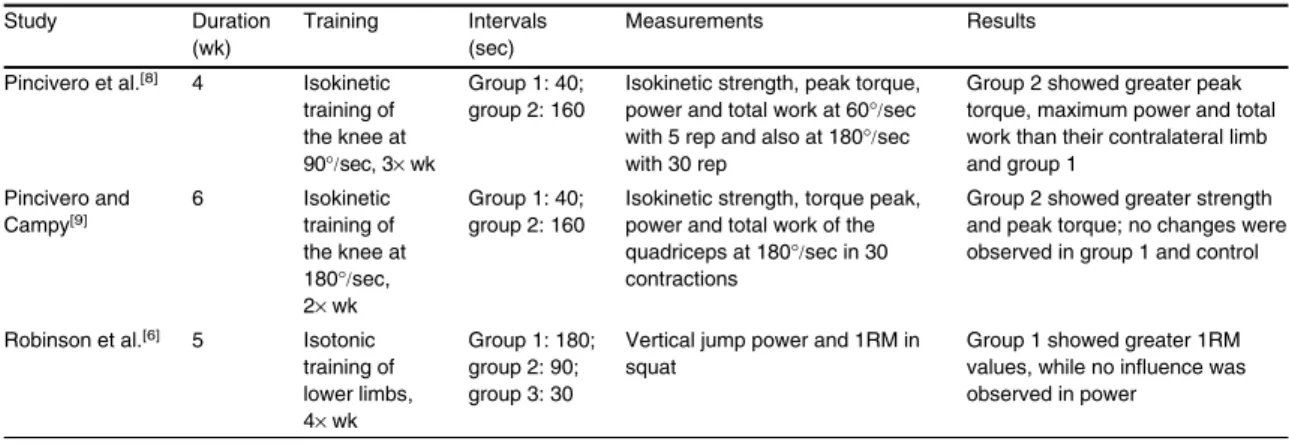
for isokinetic-type training. Fifteen untrained men were divided into group 1 (40 seconds) and group 2 (160 seconds). One leg of each subject was assigned to a 4-week, 3-days-per-week iso-kinetic protocol that involved concentric knee extension and flexion muscle actions performed at 90/sec. Changes in quadricep and hamstring function were evaluated with five repetitions performed at 60/sec and 30 repetitions per-formed at 180/sec. The 160-second rest group demonstrated significantly greater increases in peak torque, average power and total work at 180/sec.
Robinson et al.[6]demonstrated findings that
were consistent with Pincivero et al.[8] for free
weight training. In this study, the effects of three different intervals (3 minutes, 90 seconds and
30 seconds) were compared on vertical jump power and maximum strength. Thirty-three moderately trained college-age men performed a free weight training programme 4 days per week for 5 weeks. The group that rested 3 minutes between sets demonstrated significantly greater increases in maximal squat strength versus the 90-second and 30-second rest groups; however, none of the groups demonstrated significant improvements in vertical jump power.
Willardson and Burkett[15] compared squat
strength gains and volume components with 2 minutes’ versus 4 minutes’ rest between sets over 13 weeks. After the first squat 1RM assessment, 15 recreationally trained men were divided into group 1 (2 minutes) and group 2 (4 minutes). Each group performed the same training pro-gramme, with the only difference being the length of the rest interval between sets. Subjects per-formed two squat workouts per week. The squat workouts varied in the intensity, number of sets and repetitions performed per set in a nonlinear periodized manner. Differences in strength gains and volume components (load utilized per set, repetitions performed per set, intensity per set and volume performed per workout) were com-pared between groups.
The key finding was that during the entire training period, group 2 (4 minutes) demon-strated significantly higher total volumes dur-ing the high-intensity workouts.[15]However, the
groups were not significantly different in squat strength gains. These findings suggest that there was a threshold in terms of the volume necessary to gain a certain amount of strength. Resting 2 minutes between sets resulted in sufficient vol-ume to achieve the same strength gains as resting 4 minutes between sets. Therefore, athletes at-tempting to achieve specific volume goals may need longer rest intervals initially but may later adapt, so that shorter rest intervals can be utilized without excessive fatigue, leaving additional time to focus on other conditioning priorities.
The findings of these studies suggest that longer rest intervals (i.e. 2–3 minutes) result in sig-nificantly greater increases in strength compared with shorter rest intervals (i.e. 30–90 seconds) [table III]. Longer rest intervals allow for higher intensities and volumes of training. Furthermore, the evidence also indicates that excessively long rest intervals (i.e. 4 minutes) are not necessary, and may detract from other conditioning priorities.[6,8,15]
However, the few longitudinal studies conducted on different rest interval lengths have focused so-lely on lower body strength and did not examine the full spectrum of rest intervals (i.e. from short to long to very long) within the same study. There-fore, more research is necessary to ascertain the effects of different rest interval lengths on upper body exercises, and the influence of very dissimilar rest interval lengths (i.e. 1- vs 5-minute rest) on strength development.
Table III.Chronic effects of different rest intervals on strength gains and muscular power Study Duration
(wk)
Training Intervals (sec)
Measurements Results
Pincivero et al.[8] 4 Isokinetic
training of the knee at 90/sec, 3·wk
Group 1: 40; group 2: 160
Isokinetic strength, peak torque, power and total work at 60/sec with 5 rep and also at 180/sec with 30 rep
Group 2 showed greater peak torque, maximum power and total work than their contralateral limb and group 1 Pincivero and Campy[9] 6 Isokinetic training of the knee at 180/sec, 2·wk Group 1: 40; group 2: 160
Isokinetic strength, torque peak, power and total work of the quadriceps at 180/sec in 30 contractions
Group 2 showed greater strength and peak torque; no changes were observed in group 1 and control
Robinson et al.[6] 5 Isotonic
training of lower limbs, 4·wk Group 1: 180; group 2: 90; group 3: 30
Vertical jump power and 1RM in squat
Group 1 showed greater 1RM values, while no influence was observed in power
3.2 Influence of Rest Interval Length on Muscular Endurance Adaptations
Local muscular endurance can be defined as the capacity to sustain submaximal muscle actions for an extended period of time. In strength train-ing, where the goal is the development of muscular endurance, the typical recommendation has been to utilize relatively low-intensity resistance combined with high repetitions and very short rest intervals between sets.[34-36]As a result of the use
of low intensities, the prescription of short rest in-tervals has been theorized to allow for sufficient recovery betweens sets; however, the ability to re-cover may depend on whether sets are being performed to the point of voluntary exhaus-tion.[24,37-40]Muscular endurance training has been
thought to stimulate increases in mitochondria and capillary density, allowing for submaximal muscle actions to continue because of greater reliance on oxidative metabolism.[3,34,36]
Ratamess et al.[13]examined the effects of
dif-ferent rest intervals on the intensity, volume and metabolic responses to the bench press exercise. Eight trained men (minimum 3 years of experience with the bench press exercise) performed ten ran-domized protocols (five bench press sets at 75%or 85% of 1RM for ten repetitions and five repeti-tions, respectively, using different intervals be-tween sets [30 seconds, 1, 2, 3, 5 minutes]). The oxygen consumption was measured during exercise
and for 30 minutes thereafter. For the 30-second and 1-minute rest intervals, 15–55%reductions in intensity and volume were observed (sets 5<4<3< 2< 1). For the 2-minute rest interval, the perfor-mance was maintained during the first two sets, but declined 8–29%during the third, fourth and fifth sets. For the 3-minute rest interval, a volume re-duction was noted for the fourth and fifth sets (approximately 21% lower than the first, second and third sets). At 5 minutes, a reduction was ob-served only for the fifth set. Overall, the greatest reductions in performance occurred with very short rest intervals (<1 minute) and performance was maintained during the first 3–4 sets when 3- to 5-minute rest intervals were utilized.
The mean oxygen consumption and ventilation progressively increased as the rest interval de-creased. As could be expected, the mean oxygen consumption was higher when ten repetitions ver-sus five repetitions were performed, irrespective of the intensity level. Following each bench press workout, oxygen consumption, ventilation and re-spiratory exchange ratio were still elevated at 30 minutes. These data demonstrate that rest inter-val length of£1 minute leads to a more continuous elevation in oxygen consumption, which could have potential ramifications for training programmes targeting muscular endurance or aerobic fitness.
Garcı´a-Lo´pez et al.[41]examined the effects of
different rest intervals over 5 weeks on muscular endurance performance and mean repetition Table IV.Chronic effects of different rest intervals on muscular endurance
Study Duration (wk)
Training Intervals Measurements Results
Garcı´a-Lo´pez et al.[41] 5 Three sets to
concentric failure at 60–75%of MVC in the machine seated arm curl exercise, 2·wk
Group 1: 1 min; group 2: 4 min
Number of RM and average velocity of performance in moderate intensity (60%of MVC) before and after the training period
The average velocity presented by group 1 in post-training was higher than the corresponding average velocity in pre-training conditions, while no significant difference was observed in group 2 and in the control group Hill-Haas et al.[14] 5 Two to five sets of
15–20RM in 11 whole body exercises, 2·wk Group 1: 20 sec; group 2: 80 sec
Strength for 3RM in leg press, total torque in cycle ergometer during five maximum sprints, with 6 sec duration and 30 sec intervals, before and after each training period
Strength for 3RM was greater in group 2 (45.9%) compared with group 1 (19.6%); total torque during the test was higher in group 1 (12.5%) compared with group 2 (5.4%)
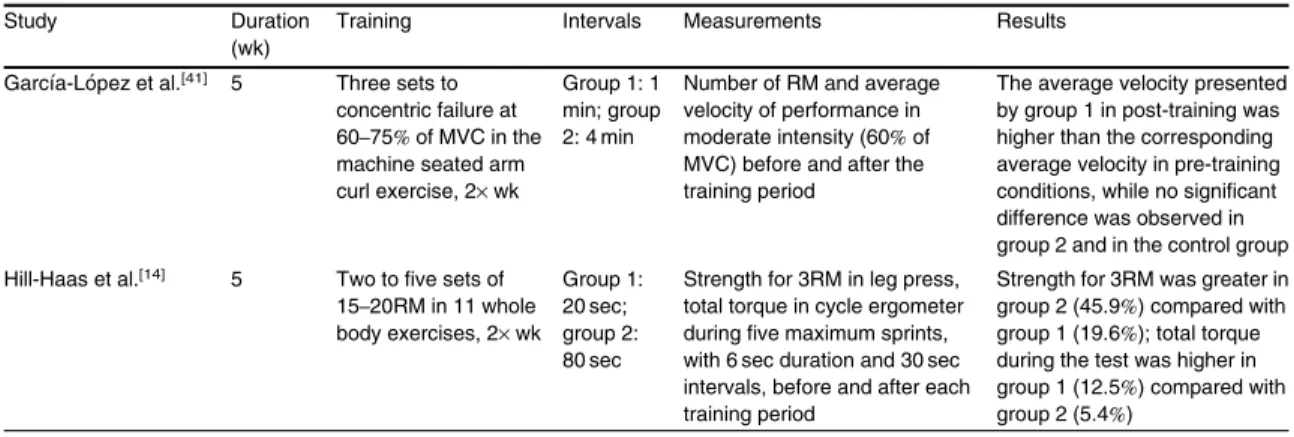
velocity during a moderate-intensity set of elbow flexion contractions (60%maximal voluntary con-traction [MVC]). Twenty-one untrained subjects were divided into three groups: group 1 (1 minute), group 2 (4 minutes) and a control group. Groups 1 and 2 performed three sets to concentric failure in the seated arm-curl machine, 2 days a week, for 5 weeks, with moderate loads (60–75% MVC). Group 2 demonstrated a significantly higher total training volume than group 1 following the inter-vention. However, both training groups demon-strated similar gains in muscular endurance performance, with an increased repetitions perfor-mance with the pre-training 60%MVC. The mean repetition velocity demonstrated by group 1 fol-lowing training at 40%, 50%, 60%, 70%, 80%and 90%of the total number of repetitions completed was significantly higher than the corresponding mean repetition velocity prior to training, while no significant difference was observed for group 2 or in the control group. Coaches can apply this find-ing when trainfind-ing athletes for sports such as soccer and basketball, which require repeated sub-maximal muscle actions while maintaining high velocities of movement.
Hill-Haas et al.[14] also examined muscular
endurance-related performance adaptations result-ing from different rest intervals durresult-ing strength training. Eighteen active women, who had not un-dertaken strength training for a least 1 year, were divided into group 1 (20 seconds) and group 2 (80 seconds). The intensity and volume were equa-ted between groups; each group trained 3 days per week for 5 weeks, performing 2–5 sets of 15–20RM for 11 exercises encompassing the entire body.
Subjects in each group were evaluated for 3RM leg press strength, total torque in cycle ergometer during the performance of five maximum sprints of 6 seconds duration and 30-second rest intervals between sprints, and anthropometric measures. The results demonstrated that the percentage in-crease in 3RM leg press strength was significantly higher in group 2 (80 seconds; 45.9%) versus group 1 (20 seconds; 19.6%). Conversely, the total torque during the cycle ergometer test was significantly higher in group 1 (20 seconds; 12.5%) versus group 2 (80 seconds; 5.4%); no change was observed in skinfold (% fat) and circumference measures.
These results show that despite a smaller increase in strength, extremely short intervals may allow for greater maintenance of relative force levels. This study demonstrates that high repetition can improve repeated-sprint ability in untrained re-creationally active team-sport players, and that this improvement is greater when there is a shorter rest interval between sets, with training load and vol-ume matched.
In summary, shorter intervals between sets (i.e. <1 minute) benefit performance variables re-lated to localized muscular endurance (table IV) and aerobic endurance development due to greater oxygen consumption.[13] However, the utilization
of extremely short rest intervals may not allow for the maintenance of repetitions per set, even when utilizing relatively low-intensity loads. Therefore, when utilizing extremely short rest intervals (i.e. <1 minute), the load should be reduced as needed over consecutive sets to maintain repetitions within the range conducive to this training goal.[24]
4. Conclusions
When training for muscular strength with loads smaller than 90%of 1RM (up to 50%) for multiple sets, 3- to 5-minute rest intervals are necessary to maintain the number of repetitions performed per set within the prescribed zone without great re-ductions in training intensity. On the other hand, contrary to what was observed in most of the experiments concerning muscular strength, some evidence suggests that 1-minute intervals allowed for sufficient recovery during repeated 1RM at-tempts; however, from a psychological and physio-logical standpoint, the inclusion of 3- to 5-minute rest intervals might be safer and more reliable. The acute expression of muscular power was best maintained when including 3- or 5-minute rest in-tervals versus 1-minute rest inin-tervals between sets. When the training goal is muscular hypertrophy, the combination of moderate-intensity sets with short intervals of 30–60 seconds might be the best alternative, due to higher acute increases of growth hormone, which can contribute to the hyper-trophic effect. Finally, similar to hypertrophy training, extremely short intervals (e.g. 20 seconds to a minute) between sets allowed for greater
muscular endurance development. In the case of muscular endurance training, a progressive reduc-tion of training intensity during the performance of consecutive sets may be a way to maintain the number of repetitions within the prescribed zone. It is worth noting that, for any intensity or goal in strength training, the rest interval between sets may vary between practitioners of different ages, when the sets are not performed to concentric failure, according to the exercise and/or according to the athlete’s level of conditioning.
5. Recommendations
There is a scarcity of studies concerning chronic adaptations and rest interval length. This review should provide some direction for future studies investigating aspects related to strength, power, hypertrophy and muscular endurance develop-ment. Additional investigations concerning acute responses are also necessary, involving women or individuals with different levels of physical con-ditioning, and potential interactions between the order of exercises and rest interval length. Fur-thermore, comparison between different rest in-tervals for exercises that involve relatively large versus small muscle groups would be useful from a practical standpoint. Overall, there is still much research to be done on this topic.
Acknowledgements
Dr Roberto Sima˜o would like to thank the Brazilian National Board for Scientific and Technological Development (CNPq) and Research and Development Foundation of Rio de Janeiro State (FAPERJ) for the research grant support.
The authors have no conflicts of interest that are directly relevant to the content of this review.
References
1. American College of Sports Medicine. Position stand: pro-gression models in resistance training for healthy adults. Med Sci Sports Exerc 2002; 34: 364-80
2. American College of Sports Medicine. American College of Sports Medicine Position Stand. Appropriate physical ac-tivity intervention strategies for weight loss and prevention of weight regain for adults. Med Sci Sports Exerc 2009; 41: 459-71
3. Kraemer WJ, Noble BJ, Clark MJ, et al. Physiologic responses to heavy-resistance exercise with very short rest periods. Int J Sports Med 1987; 8: 247-52
4. Kraemer WJ, Marchitelli L, Gordon SE, et al. Hormonal and growth factor responses to heavy resistance exercise protocols. J Appl Physiol 1990; 69: 1442-50
5. Kraemer WJ, Fleck SJ, Dziados JE, et al. Changes in hormo-nal concentrations after different heavy resistance exercise protocols in women. J Appl Physiol 1993; 75: 594-604 6. Robinson JM, Stone MH, Johnson RL, et al. Effects of
different weight training exercise/rest intervals on strength, power, and high intensity exercise endurance. J Strength Cond Res 1995; 9: 216-21
7. Larson GD, Potteiger JA. A comparison of three different rest intervals between multiple squat bouts. J Strength Cond Res 1997; 11: 115-8
8. Pincivero DM, Lephart SM, Karunakara RG. Effects of rest interval on isokinetic strength and functional performance after short-term high intensity training. Br J Sports Med 1997; 31: 229-34
9. Pincivero DM, Campy RM. The effects of rest interval length and training on quadriceps femoris muscle, part I: knee extensor torque and muscle fatigue. J Sports Med Phys Fitness 2004; 44: 111-8
10. Goto K, Nagasawa M, Yanagisawa O, et al. Muscular adaptations to combinations of high and low intensity resistance exercises. J Strength Cond Res 2004; 18: 730-7 11. Ahtiainen JP, Pakarinen A, Alen M, et al. Short vs long rest
period between the sets in hypertrophic resistance training: influence on muscle strength, size, and hormonal adapta-tions in trained men. J Strength Cond Res 2005; 19: 572-82 12. Bottaro M, Martins B, Gentil P, et al. Effects of rest dura-tion between sets of resistance training on acute hormonal responses in trained women. J Sci Med Sport 2009; 12: 73-8 13. Ratamess NA, Falvo MJ, Mangine GT, et al. The effect rest interval length on metabolic responses to the bench press exercise. Eur J Appl Physiol 2007; 100: 1-17
14. Hill-Haas S, Bishop D, Dawson B, et al. Effects of rest interval during high-repetition resistance training on strength, aerobic fitness, and repeated-sprint ability. J Sports Sci 2007; 25: 619-28
15. Willardson JM, Burkett LN. The effect of different rest in-tervals between sets on volume components and strength gains. J Strength Cond Res 2008; 22: 146-52
16. Willardson JM. A brief review: factors affecting the length of the rest interval between resistance exercise sets. J Strength Cond Res 2006; 20: 978-84
17. Hopkins WG. Olympian impact factors: top journals in exercise and sports science and medicine for 2008. Eur Sportsci 2008; 12: 22-4
18. Rhea MR, Alvar BA, Burkett LN. Single versus multiple sets for strength: a meta-analysis to address the con-troversy. Res Q Exerc Sport 2002; 73: 485-8
19. Peterson MD, Rhea MR, Alvar BA. Applications of the dose-response for muscular strength development: a review of meta-analytic efficacy and reliability for de-signing training prescription. J Strength Cond Res 2005; 19: 950-8
20. Kraemer WJ. A series of studies: the physiological basis for strength training in American football: fact over philoso-phy. J Strength Cond Res 1997; 11: 131-42
21. Richmond SR, Godard MP. The effects of varied rest periods between sets of failure using bench press in recreationally trained men. J Strength Cond Res 2004; 18: 846-9 22. Willardson JM, Burkett LN. A comparison of 3 different
rest intervals on the exercise volume completed during a workout. J Strength Cond Res 2005; 19: 23-6
23. Willardson JM, Burkett LN. The effect of rest interval length on bench press performance with heavy vs light load. J Strength Cond Res 2006; 20: 396-9
24. Willardson JM, Burkett LN. The effect of rest interval length on the sustainability of squat and bench press re-petitions. J Strength Cond Res 2006; 20: 400-3
25. Miranda H, Fleck SJ, Sima˜o R, et al. Effect of two different rest period lengths on the number of repetitions performed during resistance training. J Strength Cond Res 2007; 21: 1032-6
26. Theou O, Gareth JR, Brown LE. Effect of rest interval on strength recovery in young and old women. J Strength Cond Res 2008; 22: 1876-81
27. Faigenbaum AD, Ratamess NA, McFarland J, et al. Effect of rest interval length on bench press performance in boys, teens, and men. Pediatr Exerc Sci 2008; 20: 457-69 28. Weir JP, Wagner LL, Housh TJ. The effect of rest interval
length on repeated maximal bench presses. J Strength Cond Res 1994; 8: 58-60
29. Matuszak ME, Fry AC, Weiss LW, et al. Effect of rest interval length on repeated 1 repetition maximum back squats. J Strength Cond Res 2003; 17: 634-7
30. Harris RC, Edwards RH, Hultman E, et al. The time course of phosphorylcreatine resynthesis during recovery of the quadriceps muscle in man. Pflugers Arch 1976; 28: 137-42 31. Abdessemed D, Duche P, Hautier C, et al. Effect of recovery
duration on muscular power and blood lactate during the bench press exercise. Int J Sports Med 1999; 20: 368-73 32. Mccall GE, Byrnes WC, Fleck SJ, et al. Acute and chronic
hormonal responses to resistance training designed to
promote muscle hypertrophy. Can J Appl Physiol 1999; 24: 96-107
33. Buresh R, Berg K, French J. The effect of resistive exercise rest interval on hormonal response, strength, and hyper-trophy with training. J Strength Cond Res 2009; 23: 62-71 34. Anderson T, Kearney JT. Effects of three resistance training programs on muscular strength and absolute and relative endurance. Res Q Exerc Sport 1982; 53: 1-7
35. Campos GER, Luecke TJ, Wendeln HK, et al. Muscular adaptations in response to three different resistance-training regimens: specificity of repetition maximum training zones. Eur J Appl Physiol 2002; 88: 50-60 36. Stone WJ, Coulter SP. Strength/endurance effects from
three resistance training protocols with women. J Strength Cond Res 1994; 8: 231-4
37. Stull GA, Clarke DH. Patterns of recovery following isometric and isotonic strength decrement. Med Sci Sports Exerc 1971; 3: 135-9
38. Yates JW, Kearney JT, Noland MP, et al. Recovery of dynamic muscular endurance. Eur J Appl Physiol 1987; 56: 662-7
39. Sahlin K, Ren JM. Relationship of contraction capacity to metabolic changes during recovery from a fatiguing con-traction. J Appl Physiol 1989; 67: 648-54
40. Bilcheck HM, Kraemer WJ, Maresh CM, et al. The effects of isokinetic fatigue on recovery of maximal isokinetic concentric and eccentric strength in women. J Strength Cond Res 1993; 7: 43-50
41. Garcı´a-Lo´pez D, De Paz JA, Moneo E, et al. Effects of short vs long rest period between sets on elbow-flexor muscular endurance during resistance training to failure. J Strength Cond Res 2007; 21: 1320-4
Correspondence:Roberto Sima˜o, PhD, School of Physical Education and Sports, Rio de Janeiro Federal University, Av. Carlos Chagas Filho, Cidade Universita´ria, Rio de Janeiro 21941-590, Brazil.