Orbital Solar Panels
New Mexico Supercomputing Challenge
Final Report
4/5/2011
Team #109
Sandia Preparatory
Alex Burd
Caitlyn Scharmer
Mr. Neil McBeth
#109 Page 2
Table of Contents
Executive Summary Page 3 Statement of Problem Page 4 Methodology Page 4 Results Page 8 Conclusions and Future Plans Page 9 Supplemental Information Page 9 Significant Original Achievement Page 9 Acknowledgements Page 10 References Page 11
#109 Page 3
Executive Summary
It’s a well known fact that solar panels work. The original motivation for our project was to determine how much better solar panels work in space than on the ground and if orbital solar panels could transfer energy to Earth. A cable from the surface of the earth to a
geostationary (GEO) orbit would need to be 22,000 miles long, so if made of ½ inch copper, the cable would weigh about 76,665,600 pounds – that’s a lot of copper. So, I thought a better solution might be wireless power transfer (WPT).
WPT, a wireless transfer of power can be used in the microwave band with near zero loss of radiation. Therefore it is a good solution from an engineering standpoint; however, it has some environmental issues. If improperly aimed, the microwave rads would be high enough to cause cancer and even death in humans. Also, any organic matter (birds, trees, ect.) that gets in the way of the beam would be killed.
As a new option, we briefly considered the use of a high altitude platform. However, this idea ultimately was a major problem. For starters, the only way of holding it up would be
balloons, and it would take lots of them to hold up the heavy platform. Also, the amount of steel cable anchors would weigh an incredible amount too. In addition, due to shifting winds, the microwave beam would constantly have to be repositioned.
We finally made the decision to stick with the original plan and investigate the use of orbital solar panels with WPT, ignoring environmental issues. My mentor advised me of the importance of feasibility studies. Therefore, our final project was based on the fact that orbital solar panels and WPT are feasible from an engineering standpoint, but that such a project might not be feasible from a financial standpoint. My calculations have mainly switched from engineering to economics by completing a comparison of the orbital solar panels and WPT to conventional ground based solar panels. This was readily accomplished using Excel.
#109 Page 4
Statement of problem
A review of science magazines and internet web sites as well as a conversation with our mentor supported many of the ideas we had for our project. Does the technology exist to support space based solar power generation and earth transfer? A quick answer is yes. Solar panels have been used in space to sustain satellites for many years and the physics of wireless based transfer are understood. However, is space based solar power generation and earth transfer economically feasible? That is the topic of our study. It is our intent to determine the cost associated with putting solar panels in space and transferring the energy to a surface based station.
Methodology
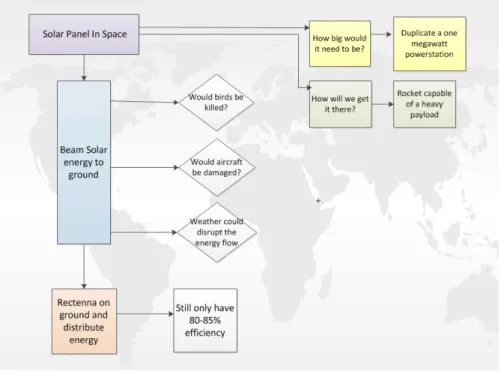
To start this project I completed a number of flow charts to attempt to document necessary components of this project. I made one for all the different ideas that I had and I tried to include both strengths and weaknesses of each idea I had. Discussions with my mentor helped greatly. Additionally, I showed some of these at the project evaluation and received some feedback from the judges. The flow chart for my final configuration appears below.
#109 Page 5
The next major step was focused on researching the components. This was mainly accomplished using science magazines, the Internet, and newspaper articles. I first had to choose between photovoltaic panels and a heat engine. I ultimately chose the heat engine style because they are slightly more efficient on the ground and are far more efficient in space than photovoltaic panels [8]. After that, I had to figure out what type of rocket we had to use. The best one out of three candidates was the SpaceX Falcon 9 Heavy. With over twice the cargo ability of any other competitor, it was chosen be the payload rocket [6]. Next, I had to find the launch success rate to determine how many rockets we were going to lose [10]. Then I had to determine the cost per solar dish to orbit. Finally, I had to calculate input and output power, followed by calculation of total sales during the lifespan of the system [13].
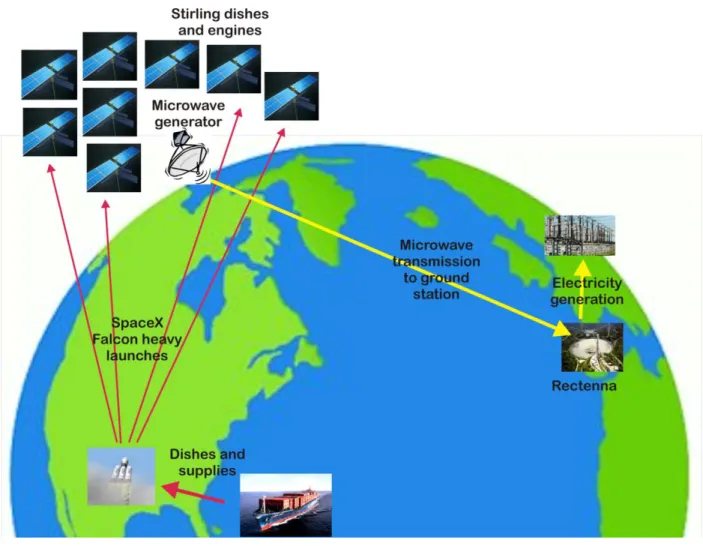
The third step was to start crunching numbers. I drew a figure that defined the five major components, or functions, that contribute to the cost of my project. They are:
A. The launch cost function. This function determines the total cost to launch all the dishes into space.
B. Launch loss function. This function determines the amount of dishes that actually make it to orbit due to the launch failure rate.
C. Power generated function. This function determines the total amount of kilowatts generated by the panels (dishes).
D. WPT transfer function. This function determines the power lost during the actual transfer (in this case it is assumed to be 0%).
E. Receiving electricity function. This function determines the total number of kilowatts after the rectenna efficiency loss.
These five functions all contribute to the actual cost to process each kilowatt during the life of the operation, and are illustrated in Fig. 2.
#109 Page 6
Figure 2. Operational Diagram of the components, or functions, of the proposed solar power/wpt configuration.
The programming step of this project came next. I used Excel to calculate estimates of the costs associated with this project. The functions are explained here:
A. The launch cost function. This is computed using the total number of panels (dishes) multiplied by the launch cost per panel (dish).
B. Launch loss function. This is obtained by starting with the number of panels that make up the solar station then multiplying by the catastrophic (CATO) loss rate.
C. Power generated function. This is simply the kilowatts per dish multiplied by the number of dishes.
D. WPT transfer function. This is the actual amount of energy generated by the solar dish array that is transferred into the microwave WPT and to the ground.
#109 Page 7
E. Receiving electricity function. This is the amount of electricity generated after being converted fro microwaves into DC through the rectenna.
The actual functions are here:
A. Number of dishes x launch cost per dish B. # of dishes sent x (100% - CATO%) C. B x kw/dish
D. C x % power transferred
E. D x power conversion success %
Which ultimately gets expressed by $$$ ÷ total usable power on Earth = $/kw where $$$ = A + cost/dish x # of dishes
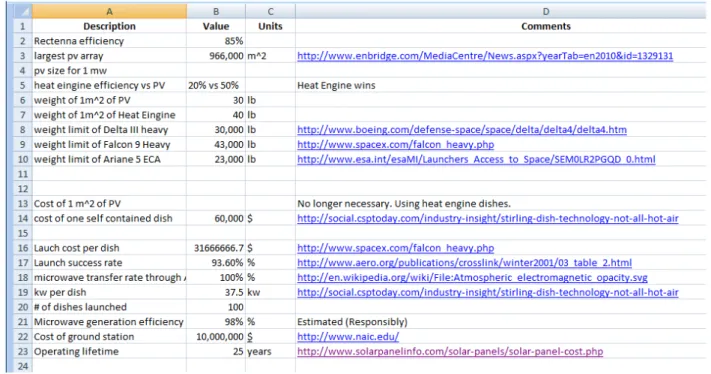
I researched various sources for sound estimates of the parameters described above, and entered them into a spreadsheet. I kept track of the sources from which the final values were chosen.
#109 Page 8
The final step was to write formulas to determine the cost of energy received at the surface from the proposed operational configuration shown in Fig. 2. The final cost estimate presented in this paper was then compared to current commercial power rates.
Results
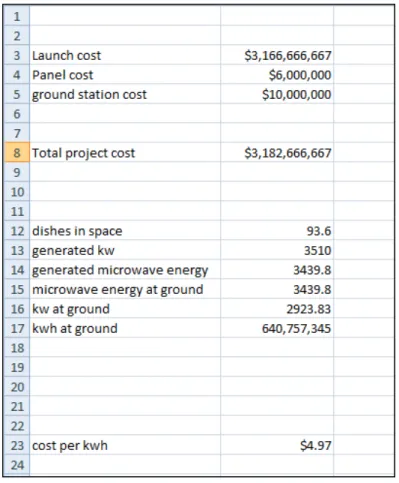
Various combinations of variables and estimates were entered into the Excel spreadsheet to determine a realistic scenario of the costs associated with this solar array/WPT system. One of my most probable results is shown in Fig. 4.
Figure 4. An example of the calculations page for the estimated shown in Fig. 3. Final cost is in KW per hour and is compared to average current commercial cost.
In this scenario, the cost per KWh is $4.97.However, due to a very recent shift in SpaceX launch prices and error in calculating the correct KW per dish, the price has dropped to $4.19.
#109 Page 9
An average cost of commercial energy in the U.S. is 9.51 cents according to the Department of Energy [13], so clearly this is far more expensive than what is available now. Some other
interesting facts found in the calculations is that the rocket launches to get the solar dishes into space are by far the most expensive component. The cost of the ground station was less than I expected, I thought the rectenna dish would be more [3].
Conclusions and Future Plans
Although the technology is improving and many governments and space agencies are building prototypes, I could not make this a cost effective alternative. But, this is “cleaner” than coal or oil, so it could be worth spending more on this type of energy production system.
To improve this study, we would need to complete a sensitivity analysis. This would allow us to produce a wider range of results and to account for factors that we didn’t take into consideration.
Additionally, changes in technology are occurring so quickly they can make the computations difficult. For example, current rectenna efficiency only has an 85% conversion rate. This technology, as well as many others, may get better in the future, but for now is not practical enough for feasible use. Also, solar energy efficiency is not good enough for practical operation.
Supplemental Information
To complete this project, I used Microsoft Excel for the calculations and Microsoft Visio for the flow charts. Figure 2 was constructed using CorelDraw.
Significant Original Achievement
Although I read much information about this topic, I never found an example the entire system (as shown in my Fig. 2) or a cost. It was interesting to try to estimate the cost, and I have my mentor to thank for that suggestion.
#109 Page 10
Personal achievements were many. I took this project from start to finish and met deadlines – the first time I have finished a Supercomputing Challenge. I also discovered that while I enjoy reading about technology and brainstorming about ideas and projects, the toughest part of a project like this is writing it up!
Acknowledgements
We would like to thank Mr. McBeth and Sandia Preparatory for sponsoring us in the Supercomputing Challenge.
#109 Page 11 References [1] Jonathan Amos: [2] [3] [4] [5] [6] [7] [8] [9] [10 [ [12 [13