INTER-AMERICAN INSTITUTE FOR COOPERATION ON AGRICULTURE Headquarters / P.O. Box: 55-2200 San Jose, Vazquez de Coronado,
San Isidro 11101, Costa Rica Phone: (506) 2216-0222 / Fax: (506) 2216-0233 E-mail: [email protected] / Web site: www.iica.int
2014-2018
MEDIUM-TERM PLAN
AGRICULTURE: OPPORTUNITY FOR
DEVELOPMENT IN THE AMERICAS
2014-2018 MEDIUM-TERM PLAN • AGRICULTURE: OPPORTUNITY FOR DEVE
LOPMENT IN THE AMERICAS
OFFICIAL DOCUMENTS SERIES N.° 94
94More than 70 years ago, a group of visionaries recognized the need to create an agency specializing in agriculture for the American continent, with a purpose that still remains valid today: to promote agricultural development and rural well-being in this region. As a result, the Inter-American Institute for Cooperation on Agriculture (IICA) was born. Throughout this time, the Institute has succeeded in identifying challenges and opportunities and, most importantly, evolving into an international technical cooperation organization that permanently responds to the new demands of the agricultural sector.
Our mission is to encourage, promote and support our Member States in their efforts to achieve agricultural development and rural well-being through international technical cooperation of excellence.
In partnership with our Member States, our vision is to create a competitive, inclusive and sustainable inter-American agriculture that feeds the hemisphere and the world, while at the same time generating opportunities to reduce hunger and poverty among farmers and rural dwellers.
We provide cooperation by working closely and continuously with our 34 Member States, addressing their needs in a timely manner. Our most valuable asset is undoubtedly the close
relationship we nurture with the beneficiaries of our work.
We have a wealth of experience in areas such as technology and innovation for agriculture, agricultural health and food safety, agribusiness, agricultural trade, rural development, natural resource management and training.
We are also committed to achieving results. Our 2014-2018 Medium Term Plan contributes to the evolution of our technical cooperation model with the aim of consolidating IICA as an organization geared toward accomplishing concrete and visible results. We work to facilitate the positive changes that our Member States wish to achieve in the agricultural and rural sectors.
2014-2018
MEDIUM-TERM PLAN
AGRICULTURE: OPPORTUNITY FOR
DEVELOPMENT IN THE AMERICAS
2014-2018 Medium Term Plan Agriculture: opportunity for development in the Americas by IICA is licensed under a Creative Commons
Attribution-ShareAlike 3.0 IGO (CC-BY-SA 3.0 IGO) (http://creativecommons.org/licenses/by-sa/3.0/igo/)
Based on a work at www.iica.int
IICA encourages the fair use of this document. Proper citation is requested.
This publication is also available in electronic (PDF) format from the Institute’s Web site: http://www.iica.int
Editorial coordination: Víctor Villalobos, Miguel García, Héctor Iturbe, Yanko Goic, Miguel Ángel Arvelo and Federico Sancho
Translation: Elizabeth M. Lewis, Paul Murphy, Christina Feeny Layout: Carlos Umaña
Cover design: Carlos Umaña Printed: IICA Print Shop
San José, Costa Rica 2014
Inter-American Institute for Cooperation on Agriculture
2014-2018: Medium Term Plan. Agriculture: opportunity for development in the Americas / IICA – San José, C.R: IICA, 2014. viii, 77 p.; 21 x 16 cm (Official Documents Series / IICA,
ISSN 1018-5704; no. 94) ISBN13: 978-92-9248-538-2
Published also in Spanish, French and Portuguese
1. International cooperation 2. International organizations 3. Technical assistance I. IICA II. Title III. Series
AGRIS DEWEY
TABLE OF CONTENTS FOREWORD
I. INTRODUCTION
II. MAJOR CHALLENGES FACING AGRICULTURE IN THE HEMISPHERE OVER THE MEDIUM TERM
III. IICA: MISSION, VISION AND FUNDAMENTAL VALUES IV. A RESULTS-ORIENTED IICA
V. STRATEGIC OBJECTIVES, TRANSFORMATIONS, CONTRIBUTIONS, PRODUCTS, SERVICES AND AREAS OF FOCUS FOR IICA
VI. THE TECHNICAL COOPERATION MODEL
Foundations of IICA’s technical cooperation Key functions of IICA
From the hemispheric to the country level: constructing “IICA country strategies” Projects as the articulating units of IICA’s cooperation and other instruments of action
- Flagship projects - Externally funded projects - Rapid response actions
- Pre-investment initiatives of the Technical Cooperation Fund Collaborative work via networks
Technical services to support cooperation Evolution of the technical cooperation model
VII. CORPORATE MANAGEMENT FOR TECHNICAL COOPERATION VIII. FINDING JOINT SOLUTIONS THROUGH PARTNERSHIPS IX. INSTITUTIONAL MODERNIZATION BEYOND THE MTP X. MEASURING THE CONTRIBUTIONS OF IICA’S ACTION ANNEXES:
- Annex 1: Main interrelationships between the four strategic objectives (so),
IICA’s 11 contributions and the four flagship projects
- Annex 2: indicators to measure compliance with the 2014-2018 MTP
ACRONYMS v 1 5 15 17 21 31 31 33 35 37 38 43 43 44 44 45 46 49 59 63 65 67 69 70 75
FOREWORD
In the Americas, the second decade of the 21st century has brought new challenges and opportunities for agriculture, which is destined to become a real engine of development, capable of generating economic growth and prosperity for the region’s population. Unlocking the agricultural sector’s potential in our countries is crucial if we are to meet one of the greatest challenges facing humankind: achieving food security.
More than 70 years ago, visionary men identified the need for an agency specializing
in agriculture for the Americas with an objective that is just as relevant today: that of promoting agricultural development and rural well-being in the hemisphere. It was thus that the Inter-American Institute for Cooperation on Agriculture (IICA) was born. Since then,
the organization has consistently identified new challenges and opportunities and, most
importantly, evolved as an international technical cooperation agency that is continually able to respond to the new needs of the agricultural sector.
The Institute provides its cooperation through daily, close and permanent collaboration with its 34 Member States, whose needs it addresses expeditiously in order to achieve increasingly inclusive, competitive and sustainable agriculture. Without a doubt, IICA’s most valuable asset is the close relationship it maintains with
the beneficiaries of its work.
Notwithstanding the above, the Institute can improve the efficiency, effectiveness and
relevance of its technical cooperation by interpreting correctly the continuous changes taking place in the agricultural sector and having a clear understanding of its Member States’ mandates. For that reason, regularly updating its strategic planning and operating instruments is essential for an institution like IICA.
The member countries are quite clear about this; hence, in 2010 they approved a Strategic Plan (SP) through 2020 whose frame of reference was designed to enable the Institute to give continuity to its actions and serve as the basis for subsequent medium-term plans (MTPs), the road maps for IICA’s activities over four-year periods.
Since my administration has now embarked on its second term, it was necessary to present the proposed MTP for 2014-2018, which has already been approved by our Executive Committee (IICA/CE/Res. 592 (XXXIV-O/14)), the Institute’s governing
body authorized to do so by the Inter-American Board of Agriculture (IICA/JIA/Res. 481
The 2014-2018 MTP renews our commitment to strengthening IICA’s technical capabilities in order to tackle the challenges facing the sector established in the aforementioned SP. This obliges us to redouble efforts to undertake, together with the countries, the tasks that will make it possible to address those challenges effectively, tapping all the opportunities available, devising innovative solutions and achieving results of excellence that have an impact on agriculture and rural territories.
This MTP was drawn up through a dialogue involving the Institute’s different units, a
broad process of consultation with the countries through our offices, and a review of our
technical cooperation instruments and model.
After four years at the helm of the Institute, we view the future with optimism, as
reflected in the ambitious but viable objectives set in the Plan. In drafting it, we took into
account the fact that agriculture now enjoys a position of unprecedented importance on
development agendas, and took advantage of the progress made in modernizing IICA up
to 2014. Furthermore, the MTP is designed to spur the evolution of the Institute’s technical
cooperation model, with a view to consolidating IICA as an organization geared toward the
achievement of concrete and visible results, and facilitating the positive transformations that the Member States wish to achieve in the agricultural and rural sectors.
The Plan also recognizes that achieving the overarching objectives of agriculture calls
for coordinated action by countless numbers of actors working at the national, regional and hemispheric levels. Moreover, if the Institute wishes to achieve a positive impact, it must focus its efforts on the tasks that it is equipped to perform with excellence and for which it possesses proven capacity.
For the above reasons, this MTP focuses on making eleven major contributions to IICA’s member countries through a variety of technical cooperation instruments: a)
large-scale, integrating projects known as “flagship projects”; b) rapid response actions, which give the cooperation model flexibility; c) pre-investment initiatives, through the Technical
Cooperation Fund; and, d) externally funded projects linked to technical cooperation. The operation of the Institute will be strengthened through the integration of all its technical and administrative services; the strengthening of the institutional culture of results-driven management; the improvement of monitoring and evaluation processes; and transparency and accountability in all its activities.
vii
Inter-American Institute for Cooperation on Agriculture
My thanks to the entire staff of the Institute, for the many hours they spent working on the analysis, design and construction of this MTP; to the authorities of all the member countries, for the open dialogue that enabled us to incorporate their different opinions; and to our Executive Committee, for improving and approving the draft of the Plan.
Following the example of thousands of farmers who approach each new planting season with courage and hope, the Institute, under the banner of “A Single IICA,” is committed to achieving results in support of agricultural development and rural well-being in the Americas. We look forward to reaping a speedy and bountiful harvest. Sincerely,
Victor M. Villalobos Director General
I. INTRODUCTION
The First Regular Meeting of the Inter-American Board of Agriculture (IABA)1 asked
the Director General of the Inter-American Institute for Cooperation on Agriculture (IICA)
to prepare a Medium-term Plan (MTP) clearly defining the Institute’s duties and results
and how it would use its budget, in keeping with the provisions of a then-new convention
(1979) that transformed IICA into a cooperation agency for agriculture. That first MTP was approved on October 28, 1982, during the Second Special Meeting of the IABA. The IABA has issued similar mandates every four years since that time so that the Institute would have an MTP running concurrently with the term of office of the Director General.
This practice lays the foundation that guides IICA’s technical cooperation, and the plan can therefore respond to new conditions in the member countries as experience accumulates.
Past MTPs have not only addressed matters of national scope, but have also served hemisphere-wide initiatives arising from the ministerial conferences on agriculture. Such initiatives cover matters of particular interest to agricultural sector leaders in the
countries and are articulated as ministerial declarations and specific resolutions. The Fifteenth Regular Meeting of the IABA, held in 2009, asked IICA to
develop a strategic plan (SP) outlining a vision toward the year 2020, “as part of
a comprehensive strategy to enable the Institute to reposition itself and thereby address the technical cooperation needs of Member States and solve some of the structural problems that have accumulated.”2 The IABA gave specific instructions
for the development of the plan: “[…] the proposed Strategic Framework should take
into account both the factors and emerging challenges that could affect agriculture and the rural milieu, the role of institutions and other groups of key players in emerging and future scenarios, and the Institute’s role as an intergovernmental organization with a hemispheric mandate […]”.3
On that same occasion, the Board decided: “To instruct the Director General to prepare the 2010-2014 Medium Term Plan of IICA in consultation with the Member States, considering as basic guidelines: (i) the mandates on agriculture and rural life of
1 Held on August 12, 1981.
2 IICA (Inter-American Institute for Cooperation on Agriculture, CR). 2010. Report of the Fifteenth Regular Meeting of the
Inter-American Board of Agriculture. Montego Bay, JM. Resolution No. 444, approved October 30, 2009, pg. 51, whereas
clause three.
3 IICA (Inter-American Institute for Cooperation on Agriculture, CR). 2010. Report of the Fifteenth Regular Meeting of the
Inter-American Board of Agriculture. Montego Bay, JM. Resolution No. 444, approved October 30, 2009, pg. 51, whereas
the Summit of the Americas Process; (ii) the mandates emanating from the Ministerial Meetings on Agriculture and Rural Life, in particular the AGRO 2003-2015 Plan, (iii) the resolutions in force of the IABA and of the Executive Committee, and (iv) the guidelines contained in the 2010-2020 Strategic Framework of IICA.” 4
This task concluded when the Director General submitted the two plans to the IICA Executive Committee, which approved both plans at its Thirtieth Regular Meeting (San
Jose, Costa Rica, October 6, 2010).
Two agricultural ministerial meetings took place during the term of implementation
of the 2010-2014 MTP.5 Each of the events raised a specific topic for the national sectoral
authorities to discuss: innovation (San Jose 2011) and the integrated management of water
resources for agriculture (Argentina 2013); on both occasions, the ministers adopted
hemisphere-wide commitments and gave IICA specific mandates to help meet those
commitments.
The IABA met in Buenos Aires, Argentina, in September 2013, and instructed the
newly reelected Director General to prepare a new MTP for 2014-2018.
The MTP introduced herein follows the guidelines of the 2010-2020 SP as well as the various mandates and commitments from the last two meetings of ministers. Thus, it continues to strengthen the Institute as a forum for innovation, creativity and commitment to its responsibilities, competencies and faculties of technical cooperation in agriculture
and in promoting rural well-being, all part of its rightful task as a specialized agency of the
Inter-American System.
Although the scope of IICA’s mandate is hemispheric, its work dovetails with the global agenda, especially with the interests of the countries with respect to post-2015
development in terms of equality and sustainability,6 as well as the resolutions and priority
topics of the Organization of American States (OAS),7 Economic Community of Latin
4 IICA (Inter-American Institute for Cooperation on Agriculture, CR). 2010. Report of the Fifteenth Regular Meeting of the
Inter-American Board of Agriculture. Montego Bay, JM. Resolution No. 446, approved October 30, 2009, pg. 56.
5 The ministerial meetings on agriculture take place every two years as part of the “Summits of the Americas” process coordinated by the OAS. The agreements and recommendations of these meetings are then submitted to the presidents and heads of state of the Americas to be added to the hemisphere’s agenda.
6 Ensuring climate stability, preventing soil degradation, guaranteeing sustainable use of water and protecting the basis of the
natural resources, including biodiversity, are some of the immediate priorities.
OAS (Organization of American States). 2012. Declaration of Cochabamba on “Food Security with Sovereignty in the Americas” (online). Cochabamba, BO. Available at http://scm.oas.org/42ag/documentos/DEC_ENG.doc
3
Inter-American Institute for Cooperation on Agriculture
America and the Caribbean (ECLAC),8 the Group of Twenty (G20)9 and the Rio+2010
Conference, among other regional bodies, forums and mechanisms.
This MTP, which will be implemented subject to budgetary resources available, establishes a clear link between the challenges facing agriculture in the Americas and the projects and actions that IICA plans to conduct by 2018.
Its entire content is organized around four strategic objectives set forth in the
2010-2020 SP, which served as a basis for identifying the main general transformations expected to occur in agriculture in the countries of the Americas. The document
also lays out the eleven contributions that IICA is committed to making, classified
according to the functions, products and services it provides, in a concrete manner, in
order to achieve, and even exceed, the defined goals.
In order to achieve this, the technical cooperation model is explained in detail, which includes the project instruments, rapid-response actions (RRA) and pre-investment initiatives outlined in the IICA country strategies, and which also incorporates institutional networks, technical services, strategic partnerships and corporate management.
The latter (corporate management) is a key component; its role is to keep the
Institute economically and financially sound by following a resource management
strategy bound to rigorous principles of austerity, fairness, discipline and transparency, and by striving at all times to improve processes that not only add value to the work, but also give IICA’s member countries and partners the assurance that it is sound, safe and trustworthy.
With this MTP, the Institute will reassert the leadership it has held for over 72 years of standing side by side with the agricultural authorities of its Member States, and will target its actions more intensely toward achieving a competitive, sustainable agricultural sector with rural prosperity and inclusiveness. The plan addresses today’s challenges and opportunities, and those still to come, with an innovative vision intended to deepen a technical cooperation
model that stands on firm foundations; thus, IICA will be consolidated as a relevant institution
at the service of its countries, even beyond 2018.
8 Which give the highest priority to food and nutritional security, land ownership, agricultural development, support to small farmers as well as to the Latin American and Caribbean Zero Hunger Initiative 2025.
9 Actions by the working groups related to improvement of the sustainability of agricultural production include development
of financial mechanisms, channeling investment towards agriculture, establishing mechanisms for market transparency and
promoting best practices to increase agricultural productivity.
10 The conference prioritized sustainable development, poverty reduction, food security, sustainable agriculture, protection of water, risk reduction and resilience, among other topics.
II. MAJOR CHALLENGES FACING
AGRICULTURE IN THE HEMISPHERE OVER
THE MEDIUM TERM
Recent joint reports by the Food and Agriculture Organization of the United Nations
(FAO), the Economic Commission for Latin America and the Caribbean (ECLAC) and IICA repeatedly identify the different challenges associated with agriculture that require urgent
attention. In addition, these reports continue to recognize the role that this sector plays in the development and prosperity of nations, in fighting poverty and inequality and in achieving
environmental sustainability and food security. Several world and regional fora related to global development have pointed to future challenges in terms of prosperity, sustainability and equity in general, including the protection of human rights, poverty reduction, hunger eradication, improvement of nutrition, protection of ecosystems, construction of knowledge societies and development of inclusive economies, among others.
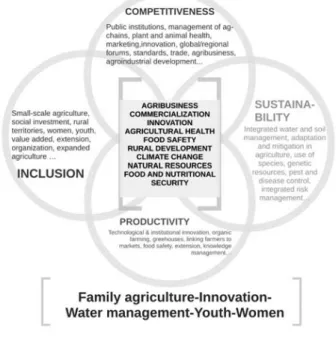
Some of these challenges fall within IICA’s frame of activity, stated as the four strategic objectives set forth in the 2010-2020 SP, related to: productivity and competitiveness; rural inclusion; adaptation of agriculture to climate change and integrated natural resources management (sustainability); and food and nutritional security. Other challenges not explicitly included in the SP, but pointedly discussed in the 2011 and 2013 ministerial meetings and therefore requiring greater attention from IICA, involve innovation and the integrated management of water resources.
These challenges provide opportunities to demonstrate agriculture’s potential in the Americas and the sector’s promising circumstances today. The countries will need modern,
dynamic policy and institutional frameworks in order to seize these opportunities. Farmers need to transform their organizational skills, the private sector needs to become involved, and local stakeholders need to be engaged. New technical and scientific know-how needs to be
developed, adapted and put to use, and new leaders, as well as a new brand of professionals need to be trained in order to build up a 21st-century agricultural sector.
Over the next four years, IICA will play a leading role in addressing the four strategic objectives and thus help its member countries to address these challenges, avail themselves of opportunities and overcome the constraints such challenges may bring. In order to
effectively achieve these objectives, it is necessary to recognize how complex and interrelated agricultural and rural development are, the limited availability of financial resources from the international community for the hemisphere and the fierce competition for them.
The challenges and opportunities that these objectives represent are explained briefly below:
Regarding productivity and competitiveness
The coming decades will be marked by greater demand for agricultural products,
especially foodstuffs, with greater nutritional value and of higher quality;11 however,
innovative alternatives to current production models will be needed to meet this challenge fully and sustainably.
The Americas are well positioned to play a major role in providing the world with food; the truth, however, is that growth rates for agricultural productivity and yield in this hemisphere show clear signs of stagnation. The region responded to the increase in demand for food by putting more land into cultivation. However, much of existing agricultural land is now degraded, and innovative technologies must be implemented for a more intensive and sustainable use of soil.
A number of variables come into play in addition to the pressures inherent in higher demand for agricultural products: price volatility, the presence of pests and diseases, climate variability, natural disasters, the right to land and water, the aging rural population and the migration of rural youths to cities. These and other factors have a combined impact on agricultural productivity in the hemisphere.
Not only do productivity levels need to improve, but the region’s agriculture also
faces a problem of competitiveness. This is accentuated by the difficulty in accessing
increasingly dynamic markets, with rivals from other parts of the world, as a result of the conditions imposed by trade integration, changes in the structure and interworking of agricultural chains, more and more demanding consumers, more multinational investment in production factors such as land and water, and the emergence of new public regulations and “private standards” that condition trade in agricultural and agrifood products.
The challenge of boosting productivity and competitiveness calls for the generation, adaptation and validation of technologies, and the development of innovative processes to
improve yields and make more efficient, sustainable use of natural resources, especially
water and soil. Good practices should be adopted, such as making intelligent use of 11 Based on a variety of studies, the world’s middle class will have grown by three billion people by the year 2050. Over the
next 12 years, the world population will have grown by one billion people, for a total of 9.6 billion. UN (United Nations US). 2012. World population prospects: the 2012 revision. New York, US. Available at http://www.un.org/en/development/ desa/population/publications/pdf/trends/WPP2012_Wallchart.pdf
7
Inter-American Institute for Cooperation on Agriculture
energy sources, using agricultural machinery and implements that are less contaminating, improving post-harvest management, using new inputs, including the so-called bio-inputs,
producing higher quality products, making changes in organizational management and distributing the benefits of trade better.
A significant factor for improving productivity and competitiveness is to raise the
levels of public and private investment in the sector. This calls for stronger institutional frameworks and better governance by means of clear policies and rules of the game to safeguard investments as well as intellectual and industrial property rights and to foster public-private partnerships. At the same time, sound risk management programs and projects will provide a certain safety margin for this activity that is so heavily dependent on climatic and economic externalities.
Regarding sustainability and climate change
The countries are fully aware of the need to generate production models that will increase production and have less of an impact on the environment. Intensive production
models have sometimes been blamed for soil erosion, inefficient use of water and energy,
loss of genetic resources and biodiversity and the emission of large quantities of greenhouse gas emissions into the atmosphere.
Clearly, agriculture depends heavily on climate, which is expected to become more volatile in association with the general phenomenon known as climate change. This means that agricultural activities need innovation in order to adapt to new climatological conditions as quickly as possible.
Climate change introduces new risks and exacerbates existing ones. Unfortunately, small and large countries alike are unprepared to deal with excessive rainfall and cloudiness, or with increased temperatures and other consequences of climate change. The 14 million small farmers in LAC are particularly vulnerable to these events since
they have fewer technological and financial resources with which to face them.
Given the extent of climate change and the speed with which it is occurring, the ancestral knowledge and empirical adaptations on which the farmers generally rely are often ineffective, especially with respect to environmentally degraded systems. It is essential to engage in the use of strategically designed adaptations that are the result of
Among the most serious circumstances facing farmers is the growing frequency of
catastrophic climate events such as drought, flood, frost, changes in rainfall patterns, hurricanes, landslides and new pests and diseases, all of which jeopardize productivity
and call for integrated risk management as a tool for making agricultural activities less vulnerable.
Agriculture needs two essential processes for responding to these issues: mitigation and adaptation. One of the greatest areas of opportunity for IICA and for coordinated action by all the countries of the hemisphere is to help farmers and other stakeholders in
agriculture recognize this dual need and implement innovations that respond to it. Seeking
opportunities in climate change will lead to actions for improving the productive systems, their resilience and their sustainability.
Regarding inclusion
Poverty continues to be a widespread social and economic problem. Data from ECLAC show that 164 million Latin Americans still live in poverty (27.9 % of the population) and depend on agriculture as their primary economic activity. The great majority of these people live in rural areas and indigenous communities.
There is a clear correlation between rural prosperity and agricultural development, so
that this sector will always have a crucial role to play in fighting poverty. Indeed, one of
the most effective poverty-reduction strategies is to invest in agriculture. Nevertheless, any comprehensive response to these problems clearly requires agriculture to rise above
mere production concerns and address other issues including organization, the addition
of value in chains, access to information, exchange of knowledge, good governance of territories, and the like.
It is unrealistic in this day and age to conceive of agriculture independently from the rural environment where it is practiced. One of the greatest unmet challenges is to combine these two and draw in relevant stakeholders, thereby improving the quality of life for those who work in agriculture and live in rural territories.
Agriculture in Latin America and the Caribbean (LAC) can be transformed into a sector that promotes economic growth and seeks rural prosperity only if producers and other rural dwellers are included more fully in the benefits of development, diversification and added value. Equity needs to be promoted as well, using mechanisms that promote greater benefits from trade, social responsibility and
9
Inter-American Institute for Cooperation on Agriculture
efforts to raise the social and economic value of farm work and keep value in rural areas, among other factors.
Inclusion applies to all population groups. It implies positive actions to recognize
the role of women, young people and the indigenous populations in agriculture and rural territories, and to strengthen their participation in the economy and development by means of interventions that will guarantee their rights and empower them. It will be critically
important to raise the profile of agriculture and the important role played by producers, to
make this activity attractive to young people. Moreover, the contribution of rural women
to family farming and food security needs to be recognized more fully.
Rural women are one of the driving forces of the economy in the rural areas, holding equal responsibility for family development, stability and survival. Women, as producers of foodstuffs through family agriculture and critical participants in decisions on the use and distribution of family income, are key stakeholders for attaining food and nutritional security in the countryside. Despite their important contribution, rural women continue to experience discrimination and exclusion and, as a result, are still unable to fully exercise their rights and gain access to better services (e.g. loans, land ownership, etc) and are not completely integrated into production systems.
One of the starkest realities facing agriculture in some countries is the extensive migration of farmers into other economic activities or non-agricultural regions. This is especially true of young people moving to the cities to explore greater opportunities than agriculture seems to hold, but at a high social and productive cost over the medium term, and with a devastating impact, unless measures are taken to bond young people to the land.
Indigenous peoples also need to be incorporated into development processes, including production. They need to assert their rights, enjoy access to production
goods and be recognized as subjects of all rights and obligations, receiving the same
development opportunities as other members of society. Their ancestral knowledge holds immeasurable value, especially with respect to methods that are consistent with protecting the environment and using natural resources and genetic diversity sustainably, as well as empirical knowledge associated with these uses.
It is essential to create the conditions needed for people to have access to real
development opportunities and finding mechanisms by which organized producers in rural
territories can enter agricultural chains on an equal footing. Moreover, opportunities are needed for small- and medium-scale agriculture, especially family farming, to perform
the strategic role of nurturing social inclusion in rural territories, while at the same time making an effective contribution to the food supply and to achieving environmental sustainability in the poorest communities.
Regarding food and nutritional security
Currently, some 842 million people in the world are undernourished or suffer from
chronic hunger; of these, approximately 47 million are in LAC.12 This region will need to
be feeding a population of nearly 1.3 billion people by the year 2050. In 2009, the middle
class in LAC comprised 150 million people.13
Meeting the challenge of food and nutritional security depends on whether progress is made to overcome the three challenges discussed above (productivity and competitiveness, sustainability and climate change, as well as inclusion), given that food security exists “when all people, at all times, have physical and economic access to
sufficient, safe and nutritious food to meet their dietary needs and food preferences for an
active and healthy life.”14
The countries of the hemisphere hold the shared aspiration of achieving food and nutritional security for all, and they reiterated this intention at the 32nd General Assembly
of the OAS (Cochabamba, Bolivia 2012), broadly recognizing that agriculture plays a
leading role in achieving this security.
Safeguarding everyone’s right to food does not depend on actions by the agricultural sector alone. Admittedly, agriculture is a key activity in the productive phase; however, gaining physical and economic access to high-quality food and using it well depends on many factors that lie beyond the realm of the agrifood sector.
Over the past few years, two phenomena have had an especially significant impact
on food security. One is the adverse international economic climate, which has resulted in greater market instability and more volatile prices for agricultural goods. Another is the effect of climate change, discussed above.
12 FAO (Food and Agriculture Organization of the United Nations, IT). 2013. The State of Food Insecurity in the World, summary 2013 (online) Roma, IT. Available at http://www.fao.org/docrep/018/i3458s/i3458s.pdf
13 Ferreira, FHG; Messina, J; Rigolini, J; López-Calva, LF; Lugo, MA; Vakis, R. 2013 (online). La movilidad económica y
el crecimiento de la clase media en América Latina. Washington, DC, US, World Bank. Available at http://siteresources.
worldbank.org/EXTLACOFFICEOFCE/Resources/MobilityFlagshipFullRptSpanish.pdf
14 Taken from paragraph 1 of the World Food Summit Plan of Action from the Rome Declaration on World Food Security, November, 1996.
11
Inter-American Institute for Cooperation on Agriculture
It should be emphasized that millions of people suffer from food insecurity because they
live in poverty, and their limited income hampers their ability to acquire food. Paradoxically, this fact is especially visible in rural territories, where food is presumably produced.
Rural smallholders can be less vulnerable to poverty and, consequently, hunger, if small-scale and family agriculture receives support such as fostering better management
and organization in rural territories, improving training activities, promoting participation and access by these farmers in agricultural chains and using the land efficiently for
sustainable agriculture.
The Declaration of Cochabamba states that food security also depends on the nutritional quality of foods consumed; this is where agriculture has a powerful role to play and requires more emphasis on research and innovation in the region’s native, traditional
and high-potential crops.15 Respect for the customs and practices of agricultural and rural
communities needs to appear on the agenda of the Member States in order to bring about an agricultural sector that is more competitive and sustainable and at the same time can guarantee prosperity as well as food and nutritional security for rural dwellers.
One factor that can make a practical contribution to improving conditions for food and nutritional security is to lessen post-harvest and post-processing losses, which are
estimated to top 1.3 billion tons worldwide every year.16 The agricultural sector can help
by practicing better post-harvest management and by strengthening linkages all along the agrifood chains.
The problems of food can be addressed successfully through consistent public
policies and cooperation among everyone involved in bringing final solutions to the
structural problems surrounding food and nutritional security. Moreover, the shared
agenda of the countries needs to dovetail with action by international organizations
concerned with eliminating hunger. Among other things, this means improving livelihoods of rural populations, making effective public and private investments in the agrifood sector, promoting an international agricultural and food trade system that is founded on openness, transparency, equity, clear rules and inclusive systems,
encouraging and financing scientific research, responding quickly to emergencies and preventing the disasters that jeopardize production, and fostering the preservation of
local traditions related to food, varieties and cultures.
15 OAS General Assembly, Bolivia 2012: Food Security with Sovereignty in the Americas, 3-5 June.
16 FAO (United Nations Food and Agriculture Organization, IT). 2011. Global Food Losses and Food Waste. (Online) Rome, IT. Available at http://www.fao.org/docrep/014/mb060e/mb060e00.pdf
Regarding innovation17
We live in the “age of innovation” associated with such concepts as changing, exploring, salvaging, inventing, reinventing, creating, risking and managing opportunities.
Innovation is a transformative process that broadens the horizon of possibilities for a
company, productive sector or country. Innovations are the force that continually drives growth for countries, and one of the essential strategies for modern societies to maintain their competitive edge.
Agricultural innovation is a catalyst for growth and positive change. Promoting innovation is vitally important to increase productivity and competitiveness, boost income, reduce poverty and inequality, lessen the environmental impact of the agricultural sector, respond to natural disasters, broaden access to new technologies, adapt to climate change and, consequently, achieve food security and the best possible quality of life for our peoples.
Agriculture needs a wide-ranging process of innovation that will develop new
production, institutional, organizational and knowledge paradigms for meeting the
challenges of competitiveness, inclusion and sustainability.
Countries hoping to induce processes of innovation in agriculture must provide a favorable environment that includes coordinated policies, rigorously applied by means of instruments to encourage production, develop a critical mass for research and development, strengthen innovation systems, attract investments and develop new business models in agriculture.
The potential to innovate can be put to use primarily in three areas: (a) technology (including extension and communication), to boost productive capacity, (b) markets, to boost competitiveness, and (c) institutions, to improve governance.
The 2011 Meeting of Ministers of Agriculture of the Americas, held in San Jose, Costa
Rica, stated that “innovation in the agrifood sector should include: better practices and new technologies, wholesome and safe products, better infrastructure to support production and marketing, technology transfer, sharing knowledge and building relationships through 17 Innovation, in general terms, is the implementation of something new or better (whether technology or otherwise) in
products (goods or services), processes, marketing avenues or ways to organize. In other words, it is the application of
ideas, knowledge and practices to create something new and useful, or to make someone or something better, so as to create positive changes that meet needs or attain the goals of institutions or groups of people. Such novelties and useful changes
could be substantial (a large change or improvement) or cumulative (small improvements that together produce a significant
13
Inter-American Institute for Cooperation on Agriculture
value chains, training and extension services, access to credit, and a science-based legal
and policy framework.”18
Innovation in agriculture develops best through national agrifood innovation systems, especially if these systems work in coordination with one another through other regional
or hemispheric platforms.19 To strengthen such systems, to promote technology transfer
under mutually agreed terms and to share knowledge and good practices should be high-priority tasks for governments and for society.
Innovation in general, and the processes that trigger it, do not simply appear out of nowhere or spring from decisions based on goodwill; innovation takes place in a given socioeconomic context and reacts to the presence (or absence) of favorable conditions that
allow it to prosper, including most particularly, sufficient domestic development, institutional
and regulatory frameworks, a reservoir of knowledge and human skills, a society that is calling out for innovation, and a welcoming regional and global environment. The challenge for agriculture, therefore, is to unleash and strengthen intensive, lasting processes of innovation and virtuous circles of innovation with the participation of all stakeholders.
Regarding the integrated management of water resources
Achieving more productive and sustainable agriculture depends largely on the sector’s
ability to manage water resources well and thus efficiently transform water into food; this,
in turn, requires a new type of agricultural system that uses water more responsibly.
The Americas possess relatively abundant water resources.20 The region is endowed
with great environmental, social, economic and political wealth and diversity, equipping it to identify water management models that can be shared among the countries to improve their public policies and investment plans and to build up their systems for innovation in sustainable water management.
18 IICA (Inter-American Institute for Cooperation on Agriculture, CR). 2011. Report of the Meeting of Ministers of Agriculture
of the Americas 2011 and the Sixteenth Regular Meeting of the Inter-American Board of Agriculture. San Jose, CR. San Jose
Declaration of Ministers of Agriculture 2011, pg. 79, paragraph 3.
19 These systems include “a wide range of actors, who guide, support, create, transfer or adopt innovation, and who advise and
inform farmers and the public about innovations. Governments provide strategic guidance, financial support to researchers
and advisors in public and private organisations, and research infrastructure such as databases, laboratories and information and communication technologies (ICT).…Researchers, private businesses and farmers create innovations.…other intermediaries...help diffuse innovation…Charities and non-governmental organisations (NGOs) play a role in funding innovation, and providing information and advice....markets and consumers provide signals on demand for innovation...
OECD (Organization for Economic Cooperation and Development, FR). 2013. Agricultural innovation systems: a
framework for analysing the role of the government, Paris, FR.
Water needs to be used much more productively in agriculture as a matter of
urgency;21 technological, institutional and organizational innovations are therefore
crucial. Data collection needs to improve as well. Meteorological and hydrological information systems need to function in the countries and be combined at the regional level and then coordinated in and with international networks so that decisions can be made expeditiously at the local level, based on collective experience.
The representatives of the countries at the 2013 Meeting of Ministers of Agriculture of the Americas, held in Argentina, committed to a number of issues involving integrated water management, from shaping and implementing public policies that ensure access to water supplies in the quantity and quality necessary for agriculture, to managing innovations that will help agricultural activities adapt to climate change.
21 According to Molden et al., water productivity can be interpreted in several different ways: “For some, it means increased production per unit of water transpired; for others, it implies greater production per amount of water supplied, and for yet others, it means improvements in well-being per total amount of water used...” Quoted in: IICA (Inter-American Institute
for Cooperation on Agriculture, CR). 2014. Water to feed the land, San Jose, CR. It can also be understood as the amount of
III. IICA: MISSION, VISION AND
FUNDAMENTAL VALUES
IICA’s mission is to:
“encourage, promote and support the efforts of
the Member States to achieve their agricultural development and rural welfare”22 by means
of international technical cooperation of excellence.
The Institute’s vision alongside its Member States is:
“to contribute to the development of an Inter-American agriculture that is competitive, inclusive and sustainable and that will feed the
hemisphere and the world and, at the same time create opportunities to reduce hunger and
poverty among producers and rural dwellers.”
IICA’s close and continuous work with the agricultural institutions must be guided by the
principles established in the 2010-2010 Strategic Plan. Those that best characterize IICA
were selected for this MTP. Thus, the Institute will be:
• Innovative: This principle has two facets. It can be seen on the outside in innovative
cooperation activities, and on the inside, in modernization of processes, development of outputs and institutional transformations. IICA promotes a fluid exchange of ideas and creates opportunities for dialogue and mechanisms for visionary change to find the
best solutions to developmental problems in its Member States and among the people involved in agriculture and in rural territories. Similarly, the Institute stands out for its dedication to the countries and its closeness to them, so it is clearly committed to creating innovative international public goods.
• Purposeful: IICA, with its understanding of real conditions for agriculture and rural areas, takes the initiative to offer responsible solutions, whether hemisphere-wide,
multinational or national, in a spirit of cooperation and based on scientific, social, political, cultural and economic knowledge. As an organization with open doors and
technical authority, it is highly analytical, proactive, and critical of its own responses
or action proposals. Its work displays the ability to be thoughtful, flexible and attentive to the specific needs (including urgent ones) of its Member States.
• Respectful: In all its actions, IICA respects the principles of international law and the
laws and customs of peoples. Because the hemisphere is home to such a diversity of
conditions and is highly pluralistic, the Institute takes a neutral stance when it seeks to draw maximum value from the experiences and peculiarities of each Member State. • Inclusive: The Institute recognizes the basic rights of all human beings, making
no distinction for race, gender, religion, culture or preferences. Therefore, its policies and processes are designed to support the development of fair and equal
opportunities for all. By its very nature, focused on development and inclusion,
the Institute is an entity that promotes fairness, and this is manifested in-house and in all its technical cooperation or institutional management actions.
• Transparent: IICA bases its work on transparency and has adopted and promotes models for communication and information exchange designed to hold the trust and backing of its Member States and partners. The fact that IICA resources come from public coffers imposes the need for transparent management and for making all possible efforts to explain how resources are being invested appropriately.
• Committed to accountability: The Institute’s work is organized conceptually as a chain of outcomes achieved by means of cooperation projects and actions; with this structure, IICA can faithfully honor its commitment to accountability and to keeping its principals informed of what has actually been achieved compared with what was initially planned.
• Environmentally responsible: IICA promotes an institutional culture of environmental responsibility, both in its cooperation actions and in its corporate management, which includes policies to save energy, conserve water and use it carefully, and recycle waste.
IV. A RESULTS-ORIENTED IICA
The Institute is an international organization with hemispheric mandates. It seeks to
generate international public goods, innovative responses and synergies that draw on its
own human, technological, financial and administrative capacities combined with those of
the member countries, its strategic partners and the private sector, among others.
This 2014-2018 MTP proposes a renewed vision for providing cooperation services at the hemispheric, regional, multinational and national levels, harnessing IICA’s competitive
and comparative advantages to achieve greater outcomes for the benefit of all its Member
States. The Institute’s main strength lies in its technical capacities and its stable presence in
the hemisphere, through both its Headquarters and its offices in the countries. As a result, its plans and its outcomes come together in the form of findings, public goods and practical,
timely and high-quality responses at all four geographic levels, and above all in what could be called “on-the-ground solutions.”
In program terms, the Institute rises to the great challenges posed in this MTP
through projects that will make intensive use of all its capacities, experience and
international resources. At the same time, IICA’s operational flexibility and its close work
with institutions that request its technical cooperation allow it to address unanticipated situations using the Institute’s rapid-response mechanisms.
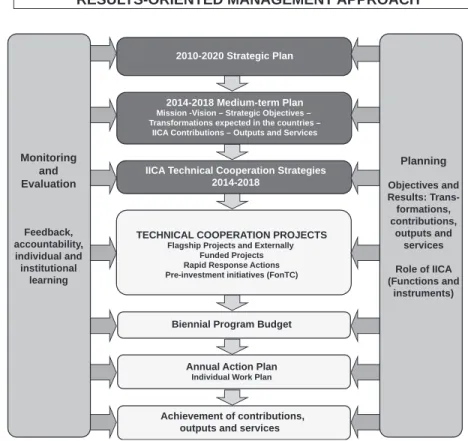
In order to maximize the efficiency and potential of its work, IICA will adopt a
“results-based management” approach.23 The idea is for its technical cooperation to lead the hemisphere as a whole, and each of the member countries in particular, toward the
changes required for achieving the four strategic objectives defined in the SP. Furthermore,
its contributions should help move the Member States closer to their own aspirations for sustainability, competitiveness, rural well-being and food security.
This approach, as proposed, will draw a direct relationship between the Institute’s projects
and actions and the concreteresults IICA expects to achieve, thus facilitating the processes
of planning, scheduling, monitoring, evaluation and accountability, and at the same time
simplifying the identification of lessons learned and good practices. The results are understood
as a measurable change that occurs in the situation of a country, society, organization, group or
sector, in this case agriculture, achieved as the result of a planned intervention.
23 A management approach that seeks higher levels of responsibility for achieving specific results, identified in advance by the
organization. Processes, resources, activities, monitoring, evaluation, accountability and incentives should be geared toward
18 Medium-Term Plan 2014-2018
IICA’s work will be based on a causal chain of results related with the
strategic objectives in which each higher-order result is the consequence of the
aggregate accomplishment of lower-level results. The Institute identifies three levels of
results: “transformations” (higher-level, impact), “contributions” (intermediate level, outcomes) and “outputs” (lower level), as can be seen in the following illustration:
Figure 1. Chain of results led by IICA: strategic objectives, expected transformations, contributions, outputs and services.
“Transformations” are those results that demonstrate the achievement of the strategic objectives of the SP. These transformations are substantial changes that occur as a consequence of the intervention of many stakeholders, including IICA. They are accomplished as a consequence of national decisions, and they are the responsibility of the country; therefore, the Institute can only offer specific
“contributions.”
Thus, a “contribution” allows for a change to be made in some issue or
situation, and as explained above, it occurs thanks to direct intervention by IICA or by IICA in collaboration with its partners. Contributions support the achievement of “transformations” taking place in the member countries, and consequently are the
best example of technical cooperation. Because they are defined with a high degree of specificity, the contributions are a clear indication of transparency in Institute activities,
and this facilitates accountability.
RESULTADOS A NIVEL DE PRODUCTO
CONTRIBUCIONES DEL IICA, EN CONJUNTO CON LAS CONTRIBUCIONES DE OTROS ACTORES, PERMITE LOGRAR COMO "IMPACTO" LAS TRANSFORMACIONES
EN LOS PAÍSES.
LA COMBINACIÓN DE PRODUCTOS Y SERVICIOS ENTREGADOS POR EL IICA PERMITE COMO "EFECTO" CONCRETAR
LAS CONTRIBUCIONES INSTITUCIONALES. CONTRIBUCIÓN DE OTROS ACTORES PRODUCTO SERVICIO PRODUCTO SERVICIO
CONTRIBUCIÓN DEL IICA
PRODUCTO SERVICIO PRODUCTO SERVICIO RESULTADOS A NIVEL DE EFECTO RESULTS IN TERMS OF PRODUCTS
THE COMBINATION OF IICA´S CONTRIBUTIONS AND THE CONTRIBUTIONS OF OTHERS ACTORS HAS
AN “IMPACT” ON THE TRANSFORMATIONS IN THE COUNTRIES
THE “EFFECT” OF THE COMBINATION OF PRODUCTS AND SERVICES DELIVERED BY IICA ALLOWS FOR THE CONSOLIDATION OF
INSTITUTIONAL COUNTRIES EXPECTED TRANSFORMATIONS IN THE COUNTRIES
CONTRIBUTION OTHER ACTORS PRODUCT SERVICE PRODUCT SERVICE PRODUCT SERVICE PRODUCT SERVICE IICA CONTRIBUTION RESULTS IN TERMS OF IMPACT RESULTS IN TERMS OF EFFECTS
19
Inter-American Institute for Cooperation on Agriculture
“Contributions” are built on and understood through the generation of tangible and intangible products and services (deliverables) that IICA provides directly to its Member States as international public goods, and through concrete solutions “on the ground.”
Every institutional contribution is related directly to at least one of the four strategic
objectives of the 2010-2020 SP, depending on the specific issues addressed by the technical
cooperation.
Finally, IICA’s products or services are the “deliverables” or tangible goods that
are the culmination of a set of activities carried out. The production of tangibles is thus only a small part of what the Institute desires to achieve, especially because, as explained
V. STRATEGIC OBJECTIVES, TRANSFORMATIONS,
CONTRIBUTIONS, PRODUCTS, SERVICES AND
AREAS OF FOCUS FOR IICA
Strategic objectives of the 2010-2020 Strategic Plan
Achieving significant results is the main goal of IICA’s strategic actions until 2020. In order to accomplish that goal, IICA must, within its financial possibilities, support and work closely with its member countries, not only in addressing their specific needs, but
also in formulating and managing major development initiatives and projects that facilitate comprehensive articulation of international cooperation efforts and taking full advantage of the knowledge and shared experiences between them, according to the four strategic objectives of the 2010-2020 SP.
During the 2014-2018 period, the Institute will continue its technical cooperation efforts aimed at achieving its complementary and interrelated major strategic objectives
as defined below:
Strategic objective 1: To improve the productivity and competitiveness of the agricultural sector
The Institute will support its Member States in: a) building, strengthening and managing agricultural innovation systems, including the development of productive,
organizational and business solutions; b) strengthening agricultural health and food safety
services; c) developing trade and agribusiness; d) establishing regulatory frameworks and positions based on consensus in international forums, and e) designing innovative systems of incentives.
Strategic objective 2: To strengthen agriculture’s contribution to the development of rural areas and the well-being of the rural population
Using a holistic approach, IICA encourages its member countries to effectively integrate the agricultural sector into the rural milieu, as the best pathway to achieving equity and inclusion. This implies at least: a)developing public policies that promote investment in rural areas, the aggregation of value and retaining value in the production areas, as well as social inclusion plans and land planning and management processes; b) strengthening agricultural extension and advisory services; c) developing models,
methodologies and instruments to strengthen small and medium-scale agriculture, as well as family agriculture; d) linking agricultural producers to value chains and markets; and e) improving access to production resources, information, training, technology and markets.
Strategic objective 3: To improve agriculture’s capacity to mitigate and adapt to climate change and make better use of natural resources
In order to develop a sustainable agriculture, IICA will support its member countries
in: a) developing and implementing harmonized policies and programs to promote
planning processes to adapt agriculture to climate change and mitigate its effects,
effective soil management and the efficient use of water resources; b) increasing and
improving the capacity of innovation systems to develop practices and materials that
facilitate the efficient adaptation of agriculture to climate change and the development
and application of technologies and processes to reduce the impacts of agriculture on the climate and on natural resources; c) increasing farmers’ knowledge so that they can apply “environment-friendly” practices; d) strengthening climate information systems, and e) strengthening integrated risk management programs.
Strategic objective 4: To improve agriculture’s contribution to food security
In order to add value to the different initiatives aimed at resolving the problem of food and nutritional insecurity, IICA will promote: a) the formulation of public policy proposals aimed at ensuring availability of and access to quality foods in vulnerable rural areas and populations; b) innovation as a means to boost productivity and competitiveness as central elements of food and nutritional security; c) the preparation and application of competitive, sustainable and inclusive business models, particularly in family agriculture, to guarantee a supply of good quality food and better incomes; d) cooperation in reducing losses of raw materials and food in the processing stage; e) promoting family agriculture’s contribution to the food supply; and f) an increase in institutional capabilities in the area of food and nutritional security.
23
Inter-American Institute for Cooperation on Agriculture
The chain of results: Transformations, contributions and products of technical cooperation in 2014-2018
- Desired transformations in the countries
In order to achieve the four strategic objectives, the Institute will strive to promote the
following transformations in its member countries:
• Enhanced governability and governance of agriculturaland agrifood systems,
led by the Ministries of Agriculture as the institutions responsible for sectoral policies and actions. This will be expressed by developing agricultural policies and strategies with emphasis on family agricultural systems, improved performance of sanitary and phytosanitary services, agricultural and agrifood innovation systems, agricultural extension/advisory services and agricultural, trade and marketing bodies, and other incentives or transfer systems for food security, agricultural competitiveness and rural well-being. Similarly, the Member States will design and implement new policies and strategies
for agriculture and rural well-being and will harmonize them to ensure agriculture’s
adaptation to climate change and to reduce its impact on the environment.
• Increased inter-sectoral coordination and action by the ministries and other
public institutions present in the rural territories, in order to improve the processes of associativity, aggregation of value, advisory services, investment, land ownership, social inclusion and sustainability. This implies working at different levels of government: federal, state (provincial, departmental) and municipal.
• Building international consensus in global and regional forums, exchange of knowledge and constructive dialogue to reach agreements of interest to agriculture and rural areas.
• Increased dynamism, efficiency and transparency in agricultural markets,
including efforts to strengthen agricultural chains and link small and medium-scale farmers to markets and of the joint and responsible action by civil society, producers, the
business sector and academia, promoting the inclusive and equitable participation
of women, young people and ethnic communities (indigenous and Afro-descendent) in markets and in the development processes of their territories.
• Reduced socioeconomic vulnerability among rural inhabitants and small and medium-scale farmers, including those engaged in family agriculture.
• Increase in the quality and quantity of agricultural products and improved sustainable access to markets for the products of agrifood chains and family agriculture, thereby increasing their income levels.
• Improved performance of small and medium-scale agriculture in terms of
production and business in rural areas, which will be reflected in greater access to
and use of production and business resources, information, training and technology etc.
• Increased level of adoption and dissemination of innovative practices, as well
as sustainable processes and technologies that optimize the sustainable productivity
of agricultural and agrifood systems.
• Incorporation of the principles and practices of sustainable production
throughout the agricultural chains and their linkages, with special emphasis on integrated management of water and sustainable use of soil for agriculture.
• Adoption of a strong culture of risk prevention in agricultural and food systems
and reduced levels of vulnerability in those systems, with better programs and actions for integrated risk management.
• Improvements in the nutritional quality of agricultural products, reduction of
pre- and post-harvest losses of food and raw materials, and increased use of native
species and promising crops, promoting their consumption among vulnerable populations. - IICA’s contributions
To enable the countries to achieve these transformations, the Institute will focus
its efforts on 11 contributionsrelated to the four strategic objectives of the
2010-2020 SP (See Annex 1), which are set forth in the following box:
1) Strengthening the capabilities of the Member States at the national, regional, multinational and hemispheric levels to establish public policies and institutional frameworks in order to make agriculture more productive and competitive, improve management of rural territories, adapt to and mitigate the impact of climate change, and promote food and nutritional security.
25
Inter-American Institute for Cooperation on Agriculture
2) Implementing, through public and private institutions, technological, institutional and business innovations aimed at boosting the productivity and competitiveness of agriculture and the production of basic foodstuffs of high nutritional quality.
3) Increasing the capabilities of the public and private sectors to ensure agricultural health and food safety and thereby improve productivity, competitiveness and food security.
4) Strengthening the business and associative capabilities of the different stakeholders in the agricultural production chains.
5) Increasing the capacity for area-based social management24 among
stakeholders in rural areas, especially those involved in family agriculture, in order to improve food security and rural well-being.
6) Enhancing the capabilities of different stakeholders of the agricultural chains and rural areas in the integrated management of water and sustainable use of soil for agriculture.
7) Increasing the capacity of public and private institutions to promote and implement measures for adapting agriculture to climate change and mitigating its effects, as well as promoting integrated risk management in agriculture.
8) Improving the efficacy and efficiency of food and nutritional security
programs in the Member States.
9) Ensuring that producers and consumers benefit from greater use of native
species, promising crops and native genetic resources with food potential. 10) Improving institutional capacity to reduce losses of food and raw materials
throughout the agricultural chains.
11) Strengthening the Member States’ capacity for consensus and participation in international forums and other mechanisms for the exchange of
knowledge and mobilization of relevant resources for inter-American
agriculture.
24 This includes planning processes, leadership, associativity, social cohesion, access to goods and services, promotion of dialogue, formulation of proposals, capacity building, partnerships, etc.
- IICA outputs and services
The Institute will define its work based on the eleven contributions listed above, the
achievement of which will be demonstrated by the following deliverables (outputs or services):
• Policy proposals and strategies aimed at improving the governance and
management of agricultural and agrifood systems; harmonizing plans among public
and private environmental and agricultural institutions to improve agriculture’s adaptation to climate change and integrated risk management, promoting agricultural innovation and strengthening food and nutritional security programs.
• Specialized methodologies and instruments for the agricultural sector, including those that:
i. Improve public administration in aspects such as area-based management,
agricultural health, innovation, agribusiness and adaptation to climate change.
ii. Promote increased trade in agricultural production chains and family
agriculture.
iii. Boost the levels of productivity and competitiveness in agriculture and
improve the distribution of incomes in rural areas.
iv. Strengthen governance and management in rural areas.
v. Increase investment in rural territories and improve access to resources,
including systems of local incentives, information and communication technologies and social media, etc.
vi. Improve land use planning and management, as well as agro-ecological
zoning, so that agricultural production systems and the efficient use of
resources go hand in hand.
vii. Increase the levels of participation of the member countries in international
forums, the consolidation of positions and the monitoring of agreements and commitments related to agriculture and the environment.
viii. Determine more precisely agriculture’s contribution to food security and
identify the causes and risk factors of food insecurity (e.g. observatories, information systems, courses, etc.).
ix. Promote effective policies and actions in programs to reduce hunger and
increase agricultural production and incomes in rural areas.
x. Promote private sector participation and its coordination with the public