DISTRIBUTED PROBLEM-BASED LEARNING IN
A LOW- RESOURCES SETTING
The design and evaluation of a problem-based, web-based
curriculum for training family doctors in Brazil
Cover and layout by Marcos José Nunes de Oliveira Printed by Escola de Saúde Pública do Ceará, Fortaleza
Copyright © José Batista Cisne Tomaz, Fortaleza, 2013.
All rights reserved. No part of this publication may be reproduced, stored in a retrieval system, or transmitted in any form or by any means, electronic, mechanical, photocopying,
recording or otherwise, without prior permission of the author. T655d. Tomaz, Jose Batista Cisne
Distributed Problem Based Learning in Low Resources Setting / José Batista Cisne Tomaz – Fortaleza. Escola de Saúde Pública do Ceará, 2013.
324p.
1. Educação à Distância. 2. Aprendizagem Baseada em Problema I. Título
3
Distributed Problem Based Learning in a Low Resources
Setting
The design and evaluation of a problem-based, web-based curriculum for training family doctors in Brazil
Probleemgestuurd onderwijs in een arm gebied
De ontwikkeling en evaluatie van een probleemgestuurd, web-based
curriculum voor de opleiding van huisartsen in Brazilië
Thesis
to obtain the degree of Doctor from the
Erasmus University Rotterdam
by command of the
rector magnificus
Prof. dr. H.A.P. Pols
and in accordance with the decision of the Doctorate Board
The public defence shall be held on
Friday November 29th, 2013 at 09.30 hours
by
José Batista Cisne Tomaz
Born in Sobral, Brazil
Doctoral Committee
Promotor:
Prof. dr. H.T. van der Molen
Other members:
Dr. A.A.C.M. Smeets
Prof. dr. H.G. Schmidt
Prof. dr. D.H.J.M. Dolmans
5
CONTENTS
Chapter 1 Introduction: The content and structure of the thesis 7
Chapter 2 The urgent need for training family health professionals 21
in Brazil Chapter 3 Review of literature: Distance Education (DE), 47
Constructivism and Problem-based Learning (PBL) Chapter 4 Understanding family health professionals as prospective 117
students in distance education Chapter 5 The design and programme evaluation of a distributed 145
Problem-Based Learning curriculum for training family doctors in Brazil Chapter 6 Effectiveness of a distributed Problem-Based Learning 193
curriculum for training family health doctors in Brazil Chapter 7 Summary of the study findings, implications and future 229
directions Appendices 251 Sumário 295 Acknowledgments 317 Curriculum vitae 321 Author’s publications 323
7
Chapter 1 – Introduction: the content
and the structure of the thesis
9
This thesis explores the use of Problem Based Learning (PBL) at distance for training family health professionals in a low-resources setting. This introduction aims at providing the reader with an overview of the content and structure of the thesis. It is divided into five sections: Background information; the subject of this thesis and theoretical framework; the aim and purposes of this thesis; the central research questions, and the structure of the thesis.
Background information
In this section, we describe when, why and where the ideas for this study arose. Initially, we present some reasons why there is an urgent need for training the family health professionals in Brazil, which are analysed in more detail in Chapter 2. Afterwards, we describe the context and the place where the studies were carried out – the State of Ceará, Brazil.
The ideas for the present study emerged from the challenges brought by the implementation of the so-called Programa Saúde da Família – PSF (Family Health Programme) in Brazil in 1994 – a Primary Health Care (PHC) based programme. The main goal of the PSF is to improve the health care and the health indicators (in particular the infant morbidity and mortality rates) in the country, mainly in poor and rural areas. Gradually, thousands of professionals – including family doctors, nurses, dentists and other health professionals – started being enrolled in the PSF. At present, there are around 33.000 family health teams in the whole country (Brasil/MS, 2013). However, in Brazil, doctors and other health professionals enroll in the PSF without being required to have a board certified degree, differently to what happens in other countries, such as the United States of
America (ABFM, 2013) and the Netherlands (GMC, 2013). Therefore, they need to acquire knowledge and skills necessary to perform the new tasks requested by the family health practice while they are already working. But how to train them, so many people scattered in a so huge territory? That was the big challenge. Some residential family health training programmes were implemented in several states of the country, but this strategy has not been able to respond to the current and growing demand. Thus, other alternatives for training them have been proposed
and distance education appeared the most adequate. However, research should be conducted to evaluate the feasibility, acceptability, effectiveness and efficiency of such an approach. The set of studies conducted in this thesis contributes to clarify two of these aspects: the acceptability - under students’ point of view (Chapter 4) - and the effectiveness of the distance education curriculum (Chapter 6).
A summary of the rationale and the process of implementation of PSF in Brazil as well as an analysis of the need and strategies for training the family health professional are described in Chapter 2.
The studies were carried out in the State of Ceará – Brazil. Brazil is a big South American country with a geographical area of more than 8 million km2. That is one
of the good reasons to implement DE programmes. Its population is around 190 million of inhabitants concentrated more in the southeast and south regions (IBGE, 2010). Its Human Development Index (HDI) is 0.730 (85th in the world) (PNUD, 2013). The infant mortality rate (IMR) is 16.0 deaths/1,000 live births (Brasil/MS, 2010). In the northeast region of Brazil, where Ceará is located, the situation is worse; the IMR is 19.1 deaths/1,000 live births, the highest rate in Brazil (Brasil/MS, 2010). Ceará is one of the poorest states of Brazil. Its HDI is 0.723, 22nd among the 27 Brazilian states (CEPAL/PNUD/OIT, 2008). Its geographical
area is around 146 thousand km2. Its size justifies the implementation of distance
education (DE) programmes. It has a population of around 8.5 millions of
inhabitants (IBGE, 2010), one third of them concentrated in the capital - Fortaleza. The infant mortality rate (IMR) is 16.2 deaths/1,000 live births (Brasil/MS, 2010), one of the highest in Brazil.
Since the 80’s a huge Health Reform Project has been implemented by the
Ministry of Health in Brazil based on the decentralisation of the health care and the increment of Primary Health Care (PHC). The implementation of Programa Saúde da Família (PSF) is one of the most important strategies.
11
Ceará was one of the first states in Brazil to implement PSF. In 1994, it started the programme in 12 municipalities. Nowadays, the PSF is implemented in all 184 municipalities and there are around 1,800 family health teams (Brasil/MS, 2013).
Theoretical framework and the subject of this thesis
The design of the studies developed in this thesis was based on three theoretical frameworks: constructivism, Problem-based Learning and Distance Education (DE). The studies were focused on: (a) the understanding of the profile and needs of prospective students (family health professionals) in DE, (b) a dPBL programme evaluation, and (c) an evaluation of the effectiveness of a dPBL curriculum for training family health professionals. The understanding of prospective students in DE was based on the work carried out by Evans from the Faculty of Education, Deakin University, Australia (Evans, 1994) and by Rowntree´s (1992) work. In their work, they investigated in detail a variety of themes ranging from the learners’ social and educational backgrounds to important aspects of students’ lives and the interrelationships with their broader contexts. The programme evaluation was based on Donabedian`s (1999) work in which four components of programme evaluation are established: structure, process, results and impact. The first three aspects were included in this thesis. The evaluation of the effectiveness of the PBL, DE curriculum was based on a pretest, posttest, control group design. The educational concepts and theories that underlie the theoretical framework of this thesis are described in detail in Chapter 3.
The subject of this thesis is the use of PBL at distance. Therefore, it deals with the combination of two educational approaches: Problem-based Learning and
Distance Education, namely distributed PBL (dPBL) (Wheeler, 2006), and its application on health professional education. This is a theme that has been gradually investigated during the last decade around the world, but still needs more exploration, mainly in low resources settings, such as the northeast region of Brazil.
In this thesis, DE is defined as Moore and Kearsley (1996) proposed:
“Distance education is planned learning that normally occurs in a different place from teaching and as a result requires special techniques of course design, special instructional techniques, special methods of
communication by electronic and other technology, as well as special organisation and administrative arrangements.” pp 2.
Problem-based Learning (PBL) is defined as the learning which results from a process oriented to the understanding and resolution of a specific problem (Barrows & Tamblyn, 1980), or more precisely as a teaching and learning
approach in which students deal with specific problems in small groups under the supervision of a tutor (Schmidt, 1993). In dPBL, according to Wheeler (2006), “learning is mediated through computer technology, and a shared, ‘virtual’
distributed learning environment is used to enable students to collaborate” (p.176).
PBL since its beginning has been implemented in a face-to-face format and is already well established. The description of PBL experiences and its effectiveness in such format have been extensively studied by many authors, for instance Berkson (1993), Schmidt (1983; 1993), Vernon & Blake (1993), Schmidt & Van der Molen (2001), Dochy, Segers, Van den Bossche, & Gijbels (2003), Schmidt, Vermeulen & Van der Molen (2006) and others. Over the past decade, PBL and DE have been combined as educational approaches in higher education (e.g. Cameron, Barrows & Crooks, 1999; Valaitis, Sword, Jones & Hodges, 2005; Brodie & Porter, 2008; Chagas, Faria, Mourato, Pereira & Santos, 2012).
However, in our context, there are only a few PBL courses or programmes which use a web-based, distance education approach. Thus, the challenge of our thesis was to propose the design and to evaluate the effectiveness of a curriculum using both educational approaches.
13 The aims of this thesis
The main aim of this thesis was to explore the use of dPBL in a low-resources setting. We developed a constructivist, competence-based, problem-based, web-based curriculum for training family doctors in Brazil and evaluated its
effectiveness.The goal of this curriculum is to enhance the competencies (medical knowledge and diagnostic skills) of family doctors in order to deal with elderly people with dementia.
This thesis has scientific and educational purposes. We expect that the results obtained from the studies carried out in this thesis may contribute to the production of knowledge about the relationship of two relevant fields: Problem-based Learning and Distance Education. In fact, there is an immediate and vital need to develop a more integrated programme of research in DE area based on a well-established theoretical framework. To our knowledge, this is one of the first effectiveness studies on distributed PBL in health professional education in a low-resources context.
In terms of educational purposes, this thesis aims at obtaining knowledge that will contribute to the solution of a real life problem (Crowl, 1996). Therefore, a general purpose of this thesis is to provide a framework that can be used in Brazil and elsewhere in the world with a similar context. It also has the purpose of contributing to the provision of information in order to develop a strategy to elaborate a continuing education programme for family health professionals in the State of Ceará. The studies carried out in this thesis were focused on a course about strategies to approach elderly people with dementia, using a dPBL curriculum for training family doctors. The course “Clinical Approach for Elderly with Dementia” was offered by the School of Public Health of Ceará and is described in detail in Chapter 2. The other professionals of the family health team (nurse, dentist, auxiliary nurse, community health worker and others) can be included in later research.
In addition, we also expect that the results of this thesis may serve individual and collective family health professionals, administrators and community interests. Since the results of our studies, overall, indicated that the dPBL curriculum is acceptable and effective in a low resource context, family health professionals may be more motivated in participating in an interactive and challenging DE programme. Besides that, they may have the benefits of participating in the continuing education programme without wasting money and time in travels. Administrators would be more satisfied in having the professionals working more time and the community would benefit from the more present and qualified family health professionals.
Research questions
Based on the central question of this thesis - Does distributed PBL work in a low-resources setting? - we elaborated three research questions:
1. Is distance education an acceptable educational strategy to train the family health professionals in the State of Ceará under their perspective? 2. How do family health doctors appreciate a dPBL course that was
developed for them?
3. How effective is this curriculum to achieve its purposes in terms of enhancement of medical knowledge and diagnostic skills?
In order to address the first question, we conducted a study with Brazilian family health professionals, reported in Chapter 4. The goal of this first study was to investigate the acceptability of the DE approach for prospective students. We were interested in describing the family health professionals’ characteristics,
perceptions, opinions and attitudes as prospective students in a distance education course.
To address the second research question we conducted a comprehensive programme evaluation study with family doctors who had participated in a dPBL course. This study is reported in Chapter 5. The aim of this study was to describe
15
the curriculum design process and the evaluation results of the course “Clinical Approach for Elderly with Dementia” from the participants’ perspective. Our intention was to explore the use of the combination of PBL and DE in the context of health professional education in a low-resources setting.
Finally, the third research question was addressed by a quasi-experimental study aiming at evaluating the effectiveness of the dPBL course in terms of
enhancement of knowledge and diagnostic skills on dementia. Chapter 6 reports its results.
The structure of the thesis
This thesis is structured into seven chapters. After this introductory chapter, Chapter 2 has the objective of describing the context within which this thesis was conducted. It presents and analyses the urgent need for training family health professionals in Brazil. Therefore, it provides the reader with an overview of the rationale for developing a DE programme for training health professionals in Brazil. In this chapter, we also present the dPBL curriculum of the Course “Clinical Approach for Elderly with Dementia” offered by the School of Public Health of the State of Ceará, Brazil.
In Chapter 3, we present the theoretical basis of this thesis. We discuss the most relevant concepts and principles involved in this dissertation related to Distance Education, Constructivism and Problem-Based Learning. It focuses mainly, under the constructivism perspective, on the two educational approaches explored by the studies developed in this thesis: the combination of web-based DE and PBL - the distributed PBL (dPBL). It has the purpose of providing the reader with an optimal understanding of the theoretical framework, the concepts, and research evidences that underlie the studies described in this thesis. This review of the literature also gives insights into the ideas that were incorporated in our own research. It is divided into three sections. Section I – Distance Education: learning without limits - describes a review of DE literature and research. It addresses the
theme of DE as an important modality of education that promotes access to learning without limits. Section II – Constructivism in Distance Education: an old approach to a new era - describes the main concepts and principles of this educational theory and its implications for learning and instruction, in particular at distance. The third section - Problem-based Learning: a constructivist educational innovation – is dedicated to the description of PBL as an alternative to
conventional education and as the conceptual foundation for dPBL.
In Chapter 4, we present the report of the study that was undertaken to understand family health professionals as prospective students in distance education. The objective of this first study was to know the prospective students’ (family doctors and nurses) perceptions and attitudes towards distance education. The purpose was to gather information about the feasibility and adequacy, in terms of students’ point of view, of a DE programme in the family health context. The results of this study have also been used in the design and development of the web-based, problem-based curriculum of the Course Clinical Approach for Elederly with Dementia, described in Chapter 2.
Chapter 5 describes the curriculum design process and the programme evaluation of the distributed PBL course that has been developed for family health doctors - Course Clinical Approach for Elderly with Dementia. This study had the objective of evaluating the quality of the first version of the dPBL curriculum in order to improve the programme. A variety of aspects regarding the structure and process of the programme were addressed, including the quality of infrastructure
(equipment, learning resources, web-page etc.) and how adequate the functioning of the course was (quality of interaction between tutors,
students-students; tutors’ performance, access to the web-page, the functioning of dPBL methodology etc.). Emphasis was given to pedagogical aspects in detriment of technological aspects. We evaluated the students’ perceptions about the programme.
17
The study into the effectiveness of the dPBL course is presented in Chapter 6. This study was conducted following a pretest, posttest, control group design in which we measured the effectiveness of the course in terms of enhancement of medical knowledge and diagnostic skills. Thirty students were enrolled in the experimental group and the same amount in the control group. In order to test the enhancement of medical knowledge, we used a multiple choice knowledge test covering the knowledge goals of the course. In order to test the enhancement of diagnostic skills we used behavioural tests.
Finally, in Chapter 7, we present a summary of the study findings and discuss some implications of these findings for the design and delivery of educational programmes based on dPBL in our context. In addition, we point out future directions for further research on the theme.
References
ABFM - American Board of Family Medicine (2013). Certification MC-FP Exam. Available at: https://www.theabfm.org/cert/index.aspx. [Accessed 14 May 2013]. Brasil/MS (2010). Indicadores de Mortalidade. C.1 Taxa de Mortalidade Infantil. Available at: http://tabnet.datasus.gov.br/cgi/idb2011/c01b.htm. [Accessed 14 May 2013].
Brasil/MS (2013). Evolução do credenciamento e implantação da estratégia Saúde da Família. Available at:
http://dab.saude.gov.br/historico_cobertura_sf.php. [Accessed 14 May 2013]. CEPAL/PNUD/OIT (2008). Emprego, Desenvolvimento Humano e Trabalho Decente – A experiência brasileira recente.Available at:
http://www.cepal.org/brasil/noticias/noticias/3/34013/EmpregoDesenvHumanoTrab Decente.pdf. [Accessed 14 May 2013].
Barrows, H. S., & Tamblyn, R. (1980) Problem-Based Learning: An Approach to Medical Education. New York, Springer.
Berkson, L. (1993). Problem-based learning: have the expectations been met? Academic Medicine, 68(10), 579-588.
Brodie, L. M., & Porter, M. (2008). Engaging distance and on-campus students in problem-based learning. European Journal of Engineering Education, 33(4), 433-443.
Cameron, T., Barrows, H. S., & Crooks, S. M. (1999). Distributed problem-based learning at Southern Illinois University School of Medicine. Proceedings of the 1999 Conference on Computer Support for Collaborative Learning, Palo Alto, California, USA.
Chagas, I., Faria, C., Mourato, D., Pereira, G. & Santos, A. (2012). Problem-based Learning in an online course of health education. European Journal of Open, Distance and E-Learning. Available at:
http://www.eurodl.org/?p=archives&year=2012&halfyear=1&article=505. [Accessed 18 February 2012].
Crowl, T. K. (1996). Fundamentals of Educational Research. Brown & Benchmark Publishers, USA.
19
Dochy, F., Segers, M., Van den Bossche, P., & Gijbels, D. (2003). Effects of problem-based learning: a meta-analysis. Learning and Instruction, 13, 533–568. Donabedian, A. (1988). The quality of care. How can it be assessed? JAMA, 260, 1743-1748.
Evans, T. (1994). Understanding learners in open and distance education. Kogan Page, London, UK.
GMC - General Medical Council (2013). Evidence of qualifications – Netherlands. Available at:
http://www.gmcuk.org/doctors/registration_applications/eea_evidence_netherlands .asp. [Accessed 18 February 2012].
IBGE- Instituto Brasileiro de Geografia e Estatística (2010). Censo demográfico 2010. Available at:
http://www.ibge.gov.br/home/estatistica/populacao/censo2010/default.shtm. [Accessed 25 April 2013].
IBGE- Instituto Brasileiro de Geografia e Estatística (2010). Censo demográfico 2010. Estados@- Ceará. Available at:
http://www.ibge.gov.br/estadosat/perfil.php?sigla=ce. [Accessed 25 April 2013]. Moore, M. G., & Kearsly, G., (1996). Distance Education: A Systems View. Belmont: Wadsworth.
PNUD - Programa das Nações Unidas para o Desenvolvimento (2013). Relatório do Desenvolvimento Humano 2013: A Ascenção do Sul: Progresso Humano num Mundo Diversificado. Available at:
http://hdr.undp.org/en/media/HDR13%20Summary%20PT%20WEB.pdf. [Accessed 14 May 2013].
Schmidt,H. G. (1983).Problem-based learning: rationaleanddescription. Medical Education; 17, 11-16.
Schmidt, H. G. (1993). Foundations of problem-based learning: some explanatory notes. Medical Education, 27, 422–432.
Schmidt, H. G., & Van der Molen, H. T. (2001). Self-reported Competency Ratings of Graduates of a Problem-based Medical Curriculum. Academic Medicine, 76, 466-468.
Schmidt, H. G., Vermeulen, L., & Van der Molen, H. T. (2006). Long term effects of problem-based learning: a comparison of competencies acquired by graduates of a problem-based and a conventional medical school. Medical Education, 40, 562-567.
Valaitis, R. K., Sword, W. A., Jones, B., & Hodges, A. (2005). Problem-based learning online: perceptions of health science students. Advances in Health Sciences Education: Theory and Practice, 10(3): 231-252.
Vernon, D. T. A., & Blake, R. L. (1993). Does problem-based learning work? A meta-analysis of evaluative research. Academic Medicine, 68, 550–563. Wheeler, S. (2006). Learner support needs in online problem-based learning. The Quarterly Review of Distance Education, 7 (2), 175–184.
21
Chapter 2 - The urgent need for
training Family Health professionals
23
Abstract
This chapter has the objective of describing the context within which this thesis was conducted. It presents and analyses the urgent need for training family health professionals in Brazil. It provides the reader with an overview of the rationale for developing a DE programme for continuing education of the health professionals in Brazil. Initially, it describes the rationale, the process of implementation and the organization of the
Programa Saúde da Família - PSF (Family Health Programme - FHP) in Brazil – a primary health care based model. In addition, some reasons why there is an urgent need for training the family health professions in Brazil are presented and analysed. Following, we describe briefly the maininitiatives for training family health professionalsthat have been proposed by Ministry of Health and various educational institutions, in particular those based in DE approach.Finally, we make a detailed description of the problem-based, web-based Course
Clinical Approach for Elderly with Dementia offered by the School of Public Health of the State of Ceará) and evaluated in this thesis.
The Family Health Programme in Brazil
“Health for all by the year 2,000” – that was the goal established by more than 150 countries in the International Conference in Primary Health Care (PHC), in Alma-Ata, former USSR, in 1978. Health should be understood here in its
comprehensive sense, that is the complete physical, mental and social welfare, and not only the absence of the disease and seen as a fundamental human right (WHO, 1978). Primary Health Care (PHC) was chosen as the main strategy to reach that goal. PHC is the first level of contact between the individual, the family and the community with the health system and focuses on the main problems in the community, implementing health promotion, prevention of disease, basic health care and rehabilitation. However, providing PHC for all in a huge country as Brazil has been a great challenge. The first important question was: What model of health care should be established in order to provide PHC for all?
Before the PSF was launched, the model of health care in Brazil focused on the “disease” instead of the “health”. The hospital was seen as the centre of the health care system. The medical doctor had the power in detriment of the other health
professionals. The health strategies were “top-down” and centralized, that is, defined by central health managers and did not take into account the
characteristics and the autonomy of the community. The human body is
“segmented” according to the medical specialities and it is not seen as a whole. Generally, this traditional health care model does not take into account the social and economic factors in the health-disease process. This model is inefficient and ineffective and has not changed the health indicators at the community (Starfield, 1998). Therefore, there was an urgent need to break this paradigm. The model based on family health, the Family Health Programme (FHP) was proposed as an alternative (Brasil/MS, 1994; Brasil/MS, 1997; Tomaz, 1997).
The FHP model is based on the tripod: health promotion, citizenship, and quality of life (Brasil/MS, 1997). The health is the centre of the health system and not the disease. It stimulates the holistic health practice and emphasises multidisciplinary work. It recognises the family and the community in their own living places. It gives priority to the family and groups with major risk of becoming sick or of dying. It takes into account the biological, environmental, cultural, social and economic factors in the causal explanation of the development of health-disease process. It links the health professionals to a specific geographical area where they should work, and recovers the feeling of responsibility and the affection between the health team and the community.
The FHP model is based on other models being implemented in various countries, such as Canada, 1954, United Kingdom, 1955, Holland, 1957, Mexico, 1971, Denmark, 1973, Portugal, 1974 and Cuba, 1984 (WHO, 1994), although there are important differences in the bases and format of the models. One of the reasons for implementing this family health approach is that this health care model has high positive impact on health indicators mainly among poor populations and it is highly cost-effective (Atun, 2002). In Brazil, the first experience started in Ceará in January 1994. The Ministry of Health launched the Programa Saúde da Família – PSF (Family Health Programme) at the national level in March 1994 (Brasil/MS,
25
1994). Each family health team (FHT) is formed by at least one medical doctor, one nurse, one auxiliary nurse and eight to ten community health workers. The FHT is responsible for providing continuous primary care to on average 1,000 families or 4,500 people through a broad scope of activities oriented to health promotion. Nowadays, according to Ministry of Health of Brazil (Brasil/MS, 2013), there are around 33,000 FHT in Brazil spread over 5,260 municipalities covering a population of over 105 million inhabitants, corresponding to roughly 55% of the Brazilian population. In Ceará, there are around 1,800 FHT distributed over 179 out of 184 municipalities covering around 5.7 million of inhabitants – about 67% of the population of Ceará (Brasil/MS, 2013). These numbers shows the great challenge for training all the health professionals enrolled in PSF.
As we can observe PSF is an important part of the health policies in Brazil. In fact, in an evaluation of the programme supported by the Ministry of Health in two municipalities (Quixadá in Ceará and Camaragibe in Pernambuco), important results were found. The results showed progressive reduction of admission of patients, decrease in the number of referrals of patients to other municipalities and reduction of the costs with in-patients, mainly among those between 0 and 4 years old (Brasil/MS, 1999). Besides that, it has facilitated the access to the health services mainly in rural areas and, to a certain extent, has increased the satisfaction of the population towards the health services (Andrade, 1998). In addition, some PSF experiences, such as one implemented in Niterói – Brazil, have had a positive impact on the local health services organisation (Senna & Cohen, 2002; Hubner & Franco, 2007).
The urgent need for training
The paucity of health professionals with knowledge and skills necessary to perform the new tasks requested by the family health practice is thought to be a great constraint on the achievement of a comprehensive impact by the PSF. In 1995, the Escola de Saúde Pública do Ceará (ESP-Ce) (School of Public Health of Ceará), one of the institutions in charge of the continuing education of the
Ceará health system professionals, was challenged to train the FHT that were already working in the field. To that end, the School developed a planning process to design a continuing education programme directed to medical doctors and nurses engaged in the PSF. The process of programme design was based on the competence-based curriculum approach (Harden, 2002). PBL was chosen as the instructional method (Schmidt, 1983; 1993). Other institutions also implemented educational programmes in family health in Ceará and in the most regions of the country. However, they have not been able to respond to all the growing demands. Most programmes for training family health professionals are face-to-face with limited capacity to train all demand. To increase their capacity would require a great deal of investments in terms of human, material, financial and infrastructural resources. If we take the case of Ceará and consider the total estimated number of family health professionals (about 5,400 professionals, including doctors, nurses and dentists), it would take several years to train all of them.
For the whole country, the situation is not so different. Few institutions, nowadays, have the capacity to train the current demand. They need urgent investments, mainly in terms of human and financial resources.
Initiatives for training family health professionals
Several initiatives for training family health professionals have been proposed by the Ministry of Health and various educational institutions. The description of all initiatives is out of the scope of this thesis. Most educational initiatives were in a face-to-face format with limited places. Therefore, these initiatives were not able to cope with the crescent demand. Two important factors affected the
implementation of the educational initiatives. First, most family professionals work in rural areas, sometimes a hundred or thousand (in case of Amazon, for instance) kilometres from the educational institutions. Second, the difficulty of the family health professionals reconciling the combination of work and study since most of them work on average more than 60 hours a week (Tomaz & Van der Molen, 2011).
27
One important initiative was the National Policy on Continuing Education for the workers of Unique Health System (SUS) proposed by the Ministry of Health in 2004 (Brasil/MS, 2004a). This Policy was implemented by the Centers of
Permanent Education in Health for the Unique Health System (Brasil/MS, 2004b). These Centers were formed by a pool of educational institutions from the whole country aiming at training all health professionals from the Brazilian National Health System (Unique Health System - SUS) including the family health professionals. Among a series of guidelines, the proposal established the allocation of resources in order to stimulate the utilization of DE as an important pedagogical approach for continuing education of health professionals in Brazil. Actually, a variety of investment projects in terms of financing, educational and human resource development has been planned in the DE field in Brazil. However, the use of DE for training family health professionals in Brazil is not disseminated yet. There were some relevant projects such as the Distance Education Project for Training Community Health Workers. The Ministry of Health launched this project in 1998. The project used printed material, video and other technologies. A series of 25 videos and 25 brochures were produced for training around 70.000 community health workers in the whole country (Tomaz, 1998).
More recently, in 2008, the Ministry of Health created the Open University of the National Health System (UNA-SUS) aiming at fostering collaboration between the educational institutions in order to develop continuing education programmes based on DE for training health professionals. The first action of the UNA-SUS was to offer a specialization course in family health for physicians, dentists and nurses of the Family Health Program (PSF), (Brasil/MS, 2008).
In 2010, ESP-Ce in partnership with Elderly Care Center, Federal University of Ceará, developed a dPBL course for training family doctors aiming at the implementation of strategies to approach elderly with dementia. The design and
evaluation of this programme were part of this thesis. A description of this course is presented in the next paragraph.
The Course Clinical Approach for Elderly with Dementia
In this section, we describe in detail the Course Clinical Approach for Elderly with Dementia. The description includes the rationale of the course, the learning objectives, the learning method, the educational strategies, the course structure, the estimated workload, and the learning and course system evaluation. This course was designed as part of a proposal for continuing education for professionals working in elderly care at the level of primary health care (PHC), especially those that are part of the Family Health Program (FHP). The course was designed specifically for physicians, since it covers aspects related to diagnosis and treatment of dementia in the elderly, with emphasis on Alzheimer's Disease.
Rationale of the course: Why training health professionals in elderly care in Brazil Brazil is currently faced with a rapid process of aging of its population (IBGE, 2008). It is estimated that in less than thirty years, it will be the sixth country in the world with the highest number of elderly people, which would imply a large impact on health services (WHO, 2008; Wong & Carvalho, 2006). The clinical problems prevalent in the elderly are usually chronic and multiple, requiring continuous multidisciplinary monitoring (WHO, 2002). The elderly are the largest users of health services; they occupy more often hospital beds, and have a longer hospital stay when compared with other age groups (WHO, 2008). Therefore, the
development of elderly care is presented as an urgent task to the health sector.
There is evidence of the effectiveness of many interventions that reduce the impact of the aging population on health services, and that contribute to improved quality of life in old age (Brasil/MS, 2006a). The absence of specific strategies for healthcare for the elderly results in lower quality of care, increased morbidity and
29 mortality and increased costs.
Several initiatives in this regard have already been developed in different states in Brazil. In 1999, the Ministry of Health launched the National Policy for the Elderly. It was proposed to encourage the creation of centers of geriatrics and gerontology in institutions of higher education and to stimulate the training of multidisciplinary teams. (Brasil/MS, 1999). In 2006, the Ministry of Health reinforced and updated this policy (Brasil/MS, 2006b).
In 1999, the first population study tracing the multidimensional profile of the elderly in Ceará, specifically in the city of Fortaleza, was published (Coelho Filho & Ramos, 1999). The high level of physical and mental morbidity among the elderly in Ceará reinforces the urgent need for the design of actions specifically targeting this age group.
The lack of health professionals specialized in geriatrics and gerontology, as well as of primary health care professionals able to provide appropriate care for the elderly are some of the important limiting factors to the development of services and programs for the geriatric population. The need for professional development in this area involves not only training specialists in geriatrics, but also, more importantly, training health professionals working in primary health care, mainly those who are part of the Family Health Program (PSF) (WHO, 2008). The course “Clinical Approach for Elderly with Dementia” ismeant to be a first initiative that composes the continuing education programme in the elderly care for family medical doctors in the State of Ceará -Brazil.
Curriculum Design
The course “Clinical Approach for Elderly with Dementia” was conceived and executed by the School of Public Health of Ceará – Brazil and the Elderly Care Center of the Federal University of Ceará – UFC. It is a web-based refresher course offered to physicians working in primary health care, particularly family health doctors of the various municipalities of the State of Ceará – Brazil.
A differential aspect of this course, in our context, is the approach used for the design of its curriculum, which was based on the model called Competence-based Education (CBE). This model is one of the types of outcome-based education in which institutions are expected, to each curriculum, to have set out learning outcomes (competences), educational strategies that enable students to reach them and assessment tools to demonstrate the achievement (Harden, 2002). The first step in this approach is the identification of a list of competencies that are expected to be acquired by the student during the course. Competence can be defined as the ability to do a task, action or activity, which includes a set of knowledge, skills and attitudes to be developed in an educational programme (Harden, 2002). The concepts regarding CBE are discussed in more detail in Chapter 3.
The preparation of the list of competencies was based on the analysis of new epistemological, social and health system contexts, an analysis of community needs and the needs analysis of potential participants with regard to health care for the elderly with dementia in primary care. From the list of competencies, learning objectives were formulated and educational strategies established.
We considered the specific competencies of the physician who must act on primary care in our context. A multidisciplinary team comprising a specialist in distance education, computer technicians (webmaster and web designer) and content specialists (geriatrician and a public health specialist) was responsible for the design of the curriculum.
The basis of this whole process was established by the guiding documents for international, national and state health care for the elderly with dementia. These documents provided information about the roles and functions of the health professionals that should guide the definition of competencies expected. Materials already existing of national and international health care programmes for the elderly, as the document of the World Health Organization - Active Ageing: Health
31
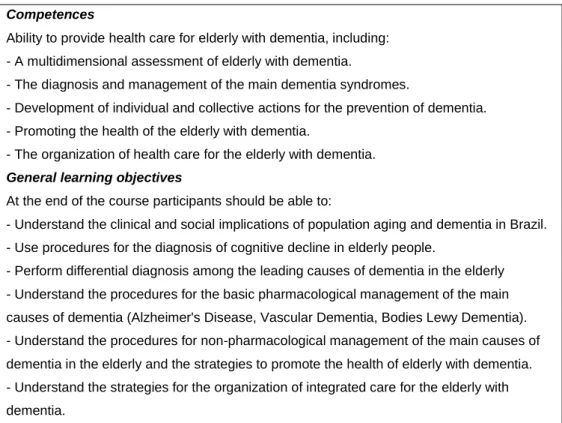
Policy (WHO, 2002), also contributed to the design of the learning objectives and the content of the course. In Table 2.1 we present the list of competences and the learning objectives of the course.
The curriculum structure and delivery
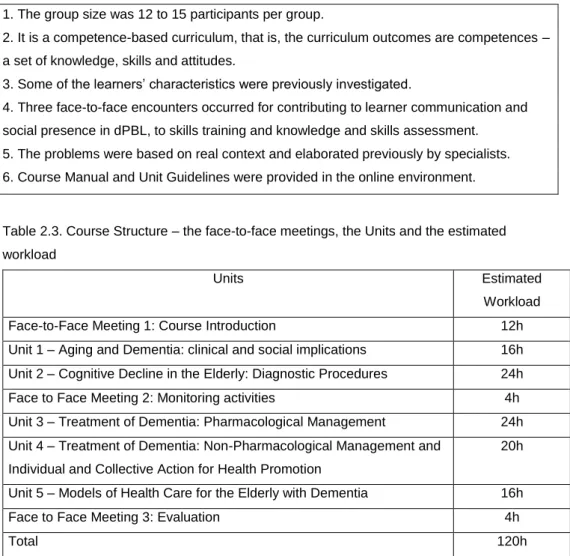
The course is 120 hours long (100 hours at distance and 20 hours face-to-face). Participants were expected to perform the course activities at a mean rate of 10 hours per week, with a total duration of 12 weeks (3 months). Each group should determine a work schedule with their tutor, including deadlines for completion of each educational activity. Students experienced a period of adaptation (one week) to the online environment. Other elements of course structure and delivery are presented in Table 2.2.
Three face-to-face meetings were included in the schedule, at the beginning, at the middle, and at the end of the course, aiming at, respectively, introducing the course (first meeting), monitoring the learning process and skills training (second meeting), and evaluating students’ learning and the curriculum (third meeting). The curriculum was structured into five Units. The face-to-face meetings, the units and estimated workload are presented in Table 2.3.
The method used in the course
The teaching and learning method used in the course was based on the
combination of two innovative approaches to education - Problem-Based Learning and Distance Education – dPBL. These approaches are discussed in detail in Chapter 3. The PBL method was based on the PBL approach described by Barrows (2002), and on the seven steps model presented by Schmidt (1983) adapted to distributed, web-based context. The PBL described by Barrows includes four keys: (a) Real world based, unresolved ill-structured problems are presented to the learners at the beginning of learning cycle, stimulating free inquiry; (b) PBL is a learner-centered method, so learners should assume responsibility for their own learning process; (c) The teacher has to act as
facilitator of the learning process, rather mere transmitter of knowledge; (d) The problems presented to the learners should be based on real world context,
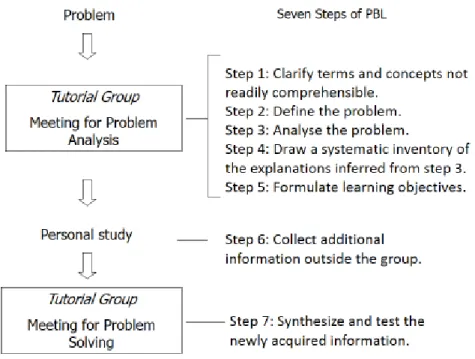
“making PBL an authentic learning process”. The seven steps model, described by Schmidt (1983), is presented in Figure 2.1.
Table 2.1.Competences and learning objectives
Competences
Ability to provide health care for elderly with dementia, including: - A multidimensional assessment of elderly with dementia.
- The diagnosis and management of the main dementia syndromes.
- Development of individual and collective actions for the prevention of dementia. - Promoting the health of the elderly with dementia.
- The organization of health care for the elderly with dementia.
General learning objectives
At the end of the course participants should be able to:
- Understand the clinical and social implications of population aging and dementia in Brazil. - Use procedures for the diagnosis of cognitive decline in elderly people.
- Perform differential diagnosis among the leading causes of dementia in the elderly - Understand the procedures for the basic pharmacological management of the main causes of dementia (Alzheimer's Disease, Vascular Dementia, Bodies Lewy Dementia). - Understand the procedures for non-pharmacological management of the main causes of dementia in the elderly and the strategies to promote the health of elderly with dementia. - Understand the strategies for the organization of integrated care for the elderly with dementia.
33 Table 2.2. Elements of course structure and delivery 1. The group size was 12 to 15 participants per group.
2. It is a competence-based curriculum, that is, the curriculum outcomes are competences – a set of knowledge, skills and attitudes.
3. Some of the learners’ characteristics were previously investigated.
4. Three face-to-face encounters occurred for contributing to learner communication and social presence in dPBL, to skills training and knowledge and skills assessment. 5. The problems were based on real context and elaborated previously by specialists. 6. Course Manual and Unit Guidelines were provided in the online environment.
Table 2.3. Course Structure – the face-to-face meetings, the Units and the estimated workload
Units Estimated
Workload Face-to-Face Meeting 1: Course Introduction 12h Unit 1 – Aging and Dementia: clinical and social implications 16h Unit 2 – Cognitive Decline in the Elderly: Diagnostic Procedures 24h Face to Face Meeting 2: Monitoring activities 4h Unit 3 – Treatment of Dementia: Pharmacological Management 24h Unit 4 – Treatment of Dementia: Non-Pharmacological Management and
Individual and Collective Action for Health Promotion
20h Unit 5 – Models of Health Care for the Elderly with Dementia 16h
Face to Face Meeting 3: Evaluation 4h
Total 120h
In sum, the PBL process (Figure 2.1) works as follows: from analysis and reflection of a problem situation presented, the participants in small groups (Tutorial Groups) identify their key knowledge gaps and establish what they need to learn (learning goals) to solve the problem. During the study of the problem situation participants have to rely on literature research, personal study,
consultations with specialists, if necessary, and seminars available on the Internet, in order to achieve the learning objectives, and at the end of cycle, solve the problem (Schmidt, 1993). This entire process occurs in seven steps.
Figure 2.1. The PBL process
The dPBL model applied in the course works as follows. Virtual Tutorial Groups (VTGs) are created. Each VTG is formed by groups of 10 to 15 participants, supervised by a facilitator. The VTGs are the main strategy for reaching the cognitive learning objectives. The VTGs are performed in virtual forums in which the students could communicate with each other asynchronously. The virtual forum works as a whiteboard, in which the group records ideas and hypotheses, acquired information and pursued learning issues. Synchronous communication tools (chats) are also used when needed for complementing the discussion or concluding the problem solving.
Just like in face-to-face tutorial groups, there are three phases in the VTG:
Problem Analysis, Individual Study and Problem Solving, and the students have to follow the seven steps proposed for PBL (see Figure 1). The detailed description
35
of each step of the PBL is presented in the General Guidelines for Study (Tomaz, 2010), further in this chapter. In each VTG meeting, one student exercises the role of chair, and another participant fulfils the role of scribe. The chair is responsible for conducting the discussions, and the scribe has to prepare a report describing the results of the discussions during problem analysis and problem solving. Participants are expected to dedicate around eight hours (three hours for Problem Analysis, two for Individual Study and three hours for Problem Solving) to
complete the PBL cycle. Because of difficulties with access to libraries and learning resources, some basic literature is available in the virtual library, but students are encouraged to seek additional references. Before the beginning of the course, students should attend a four hours face-to-face workshop to learn how the VTG works.
The problems are ill structured and elaborated by course planners previously, taking into account the real context. Questions for reflection are included in order to focus and orient the online discussion. See an example in Appendix 3. The facilitator´s main role is to promote the learning process of the students, to ensure the proper implementation of the dPBL cycle and a good interaction between students, so that learning objectives are met and skills are developed. Moreover, the tutor has to keep the flow of discussions in order to avoid deviations, detect possible misinformation, provide feedback, promote the development of each individual and the group as a whole, and assess student achievement (formative and summative). Three geriatricians are the facilitators; each one is responsible for tutoring a group of 10 to 15 participants. They are trained in “how dPBL works”, including the use of mediating technology through three training sessions of two hours. Continuing education meetings occurs at least twice a month. In these meetings, the tutors and the course coordinator discuss the main problems and difficulties in tutoring.
Complementary educational strategies are used, such as clinical skill trainings, team and individual projects and community practice in order to accomplish the
development of the competences. A Course Guide, including General Guidelines for Study at Distance (Tomaz, 2010), and Study Guides for each Unit are provided in the course website in order to support learning. A CD-ROM with part of the course material is also given to participants at the beginning of the course. The course is funded by the School of Public Health of Ceará and the students do not have to pay fees. The facilitators are paid for the job.
The distance education tools
The course uses DE tools, particularly the Internet, with the aim of facilitating access to all professionals working within the field of care for the elderly in
different municipalities of Ceará. In sum, we use as DE tools a website, a Learning Manegement System (LMS), virtual forum, chat and email. In addition, video-lectures are available on the website and a CD-ROM with the video-video-lectures and texts are distributed to the participants. The website was specially designed for the course. The LMS used is MOODLE®, version 1.96, a worldwide used free
software programme for collaborative learning support. Three kinds of virtual forums are used as asynchronous communication tool. A first type of virtual forum is used during the virtual tutorial groups (VTGs) for group interaction during problem analysis and problem solving. The course coordinator and the tutors used a second type of forum to evaluate the process of the course. A third forum can be used by the participants for free interaction – a kind of “hallways chat” - in order to stimulate socialization among them. Chat is used as synchronous communication tool. It is used as a complementary tool. It can be used by some tutors to
complement and to deal more deeply with a specific issue discussed in the virtual forum. The email is used mainly for communicating with participants who are absent in the virtual environment of the course in order to bring them back to the course.
Educational strategies and learning resources
In the course, we use Virtual Tutorial Groups – VTG, Interactive Virtual Seminars, Skills Training, Projects, Practice in the Community (PC), General Guidelines for
37
Study and Tutoring as educational strategies and learning resources. They are briefly described as follow:
Virtual Tutorial Group – VTG
The VTG is a tutorial group that occurs at distance under the supervision of a tutor. How this educational strategy works in general was already describe previously in this chapter. We describe in more detail in this section how the three phases (Problem Analysis Meeting, Individual Study and Problem Solving
Meeting) and the seven steps adapted to web environment work (See Figure 2.1).
Phase 1 - Problem Analysis Meeting - aims at stimulating reflection and discussion about a given problem situation, using the forum of the Unit (Topic - Problem Analysis) and thereby activate the student's knowledge about the topic under discussion. For this purpose, the group must follow step 1 to step 5. In Step 1 - Clarify terms and concepts not readily comprehensible - the students must undertake a critical reading of the text of the problem, seeking to give greater attention to the points they find most relevant. If there is a term that they do not understand very well, students should write it down and try to elucidate it in a dictionary or, if any, provided in the literature itself. If not, what normally should not occur, the students should seek help from their peers. If no member can clarify, the group may request clarification from the facilitator. In Step 2 - Define the problem - each group of students must come to consensus on what the problem is to be discussed. In case of difficulty, the facilitator should help. The aim of this step is to focus discussion and to avoid the group to discuss issues outside of the learning objectives proposed for the VGT. After defining the problem, students should go to Step 3 - Analyse the problem. In the beginning of this step, they should make individually a reflection and analysis on matters they consider relevant in the problem, based on notes made while reading. They should use their prior knowledge and prior experience on the topic. To help students in this task some questions after the text of the problem situation are proposed. Students then should write down the points and relevant issues on which they reflected, as well as their hypotheses to explain the problem. Then, after this initial reflection,
the students should participate in the analysis of the problem in their VGT, sharing their thoughts and assumptions. This entire process takes place within the virtual forum (topic- Analysis of the problem), via Internet and is accompanied by their facilitator. After analyzing the problem, the group should systematize the discussion in Step 4 - Draw a systematic inventory of the explanations inferred from step 3. In this step, they should try to organize the topics and hypotheses discussed in the previous step and remove what is not relevant to this issue. Phase 1 ends with the Step 5 - Formulate learning objectives. In this last step of problem analysis, the group has to produce the specific learning objectives, based on the knowledge gaps identified during the discussion of the problem.
Phase 2 – Individual Study - includes Step 6 - Collect additional information outside the group. At this point, students should acquire the information necessary to solve the problem under study, through searching and reading of texts and articles. Participants must individually seek information from various sources that helps to focus their attention on those aspects that answer the questions made during the analysis of the problem. In the Virtual Library of the course, the student can find a basic bibliography on the topic. However, students are also encouraged to seek other sources to enrich their study material.
During the individual study, it is recommended that the student prepares a proposal for solving the problem (individual synthesis), based on the newly acquired information and answers to the questions proposed.
The last phase of the PBL cycle - Phase 3 – Problem Solving Meeting - includes Step 7 - Synthesize and test the newly acquired information. In this step, based on the search and acquisition of new information / knowledge, the group, using the forum (topic – Problem Solving), should share and discuss their proposal for solving the problem, based on the individual summaries, and test their
hypotheses. At this point, the contributions of each participant should be based on evidence gathered from the textbooks and articles studied.
39 Interactive Virtual Seminar
Interactive Virtual Seminars (IVS) consist of virtual exhibitions on videos or CD-ROMS of topics related to the cognitive learning objectives. The IVS are
performed by specialists and have a duration ranging from 15 to 30 minutes. They are in the form of lectures or interviews. Digital handouts with copies of the presentations of themes approached during the IVS including the related bibliography are available in the Virtual Library. Comments can be made and questions may be clarified in specific virtual forums (see General Guidelines for the Study further in this section).
Skills Training
The Skills Training (ST) is an educational strategy that aims at training the diagnostic and treatment skills to be acquired during the course. Each skill is presented and demonstrated through video or slides show. The cognitive part of the skill can be learnt in VTG or IVS.
Projects
The Projects are intended to meet the more complex learning objectives, such as the understanding of the procedures for non-pharmacological management of the main causes of dementia in the elderly and the strategies to promote the health of elderly with dementia. They are elaborated at distance under the assistance of the facilitator. Guidelines for each Project are available. The Projects are also a component of the student assessment system.
Practice in the Community (PC)
This strategy is intended to provide an opportunity for students to apply the knowledge and skills acquired during the course in their workplace. It is done individually or in groups. Guidelines are available for every PC. Students have the guidance of the facilitator. Participants must prepare a report on each PC that also comprises the student assessment system.
General Guidelines for Study
In each unit there is a Unit Guide that orients the study during the course. The guide follows the order of the educational strategies proposed in each unit. It can be observed that, in general, the logic is to have the Problem (Virtual Tutorial Group - VTG) as a starting point for learning, followed by other complementary strategies such as the Interactive Virtual Seminar (IVS) and Skill Training (TH), concluding with the application of knowledge and skills acquired - Team or Individual Project and Community Practice (PC).
Tutoring
There is a tutoring system to facilitate and monitor the process of teaching and learning. Within this system, there is a facilitator (tutor) for each group of 10 to 15 students.
The main general roles of facilitators are:
- Guiding the students to study remotely stimulating the acquisition of autonomy in learning.
- Helping the students in the identification of literature relevant to the themes of the course.
- Guiding the students in their questions quickly and objectively, without giving answers, encouraging them to develop the capacity for self-learning.
- Following the students on accomplishment of each educational strategy proposed in the course including the PBL steps.
- Interacting with students through various means, principally the LMS (Learning Management System). Exceptionally, other means may be used, such as email, fax or phone.
- Creating empathy with their students, knowing each one of them (study habits, expectations, motivations to study, etc. ...).
41 Course Assessment System and Certification
Finally, we present some comments regarding the Course Assessment System and Certification. The system of student assessment is formative and summative. Several assessment tools are used, such as essays and reports, testing and evaluation of cognitive abilities. There is also a cognitive pretest and a posttest in order to assess the degree of achievement of learning objectives at the beginning and at the end of the course. As stated previously, in each of the Units of the Course, the projects and PC are used as assessment tools.
Finally, there is a Course Evaluation System, which uses a questionnaire to identify the positive aspects as well as those that need improvement. Students and faculty should fill in the questionnaire after the conclusion of the course.
At the end of the course, participants who complete all the units and who achieve the minimum score established (70%) receive a certificate issued by the School of Public Health of Ceará.
References
Andrade, F. M. (1998). O Programa de Saúde da Família no Ceará. Expressão Gráfica e Editora Ltda, Fortaleza – Ce, Brazil.
Atun, R. (2002). A experiência da Grã-Bretanha. In: Bessa, O. (Org.), Penaforte, J. (Org.), Atun, R., Rosser, W., Sloane, P., Dinan, G. J., & Monreal, A. (2002). Médico de Família – Formação, Certificação e Educação Continuada. Escola de Saúde Pública do Ceará, Fortaleza-Ce, Brazil.
Barrows, H. (2002). Is it truly possible to have such a thing as dPBL? Distance Education, 23(1), 119 - 122.
Brasil/MS (1994). Programa de Saúde da Família. Brasília, COSAC. Brasil/MS (1997). Saúde da família: uma estratégia para a reorientação do modelo assistencial. Brasília-DF, Brazil.
Brasil/MS (1999a). I Seminário de Experiências Internacionais em Saúde da Família. Available at:
http://bvsms.saude.gov.br/bvs/publicacoes/seminario_experiencias.pdf. [Accessed 14 May 2013].
Brasil/MS (1999b). Portaria Nº 1.395 de 10 de Dezembro de 1999. Available at:
http://dtr2004.saude.gov.br/susdeaz/legislacao/arquivo/Portaria_1395_de_10_12_ 1999.pdf. [Accessed 14 May 2013].
Brasil/MS (2004a). PORTARIA Nº 198/GM em 13 de fevereiro de 2004. Available at: http://dtr2001.saude.gov.br/sas/PORTARIAS/Port2004/GM/GM-198.htm. [Accessed 25 May 2013].
Brasil/MS (2004b). Política de Educação e desenvolvimento para o SUS:
Caminhos da Educação Permanente em Saúde: Pólos de Educação permanente em Saúde. Available at:
http://bvsms.saude.gov.br/bvs/publicacoes/politica2_vpdf.pdf. [Accessed 25 May 2013].
43
Brasil/MS (2006a). Envelhecimento e saúde da pessoa idosa - Cadernos de Atenção Básica - n.º 19. Available at:
http://189.28.128.100/dab/docs/publicacoes/cadernos_ab/abcad19.pdf. [Accessed 14 May 2013].
Brasil/MS (2006b). PORTARIA Nº 2.528 DE 19 DE OUTUBRO DE 2006. Available at:
http://portal.saude.gov.br/portal/arquivos/pdf/2528%20aprova%20a%20politica%2 0nacional%20de%20saude%20da%20pessoa%20idosa.pdf. [Accessed 22 May 2013].
Brasil/MS (2008). Universidade Aberta do Sistema Único de Saúde (UNA-SUS). Available at:
http://portal.saude.gov.br/portal/saude/visualizar_texto.cfm?idtxt=29886. [Accessed 14 May 2013].
Brasil/MS (2013). Evolução do credenciamento e implantação da estratégia Saúde da Família. Available at:
http://dab.saude.gov.br/historico_cobertura_sf.php. [Accessed 14 May 2013]. Coelho Filho, J., M., & Ramos, L., R. (1999). Epidemiologia do envelhecimento no Nordeste do Brasil: resultados de inquérito domiciliar. Revista de Saúde Pública, 33(5), 445-453.
Harden, R. M. (2002). Developments in outcome-based education. Medical Teacher, 24(2), 117-120.
Hubner, L. C. M., & Franco, T. B. (2007). O Programa Médico de Família de Niterói como Estratégia de Implementação de um Modelo de Atenção que Contemple os Princípios e Diretrizes do SUS. Revista. Saúde Coletiva, 17(1), 173-191.
IBGE (2008). IBGE: população brasileira envelhece em ritmo acelerado. Available at:
http://saladeimprensa.ibge.gov.br/noticias?view=noticia&id=1&busca=1&idnoticia=
1272. [Accessed 22 May 2013].
Starfield, B. (1998). Primary Care: balancing health needs, services, and technology. Oxford University Press, Inc. New York, N.Y. USA.
Schmidt,H. G. (1983).Problem-based learning: rationaleanddescription. Medical Education; 17, 11-16.
Schmidt, H. G. (1993). Foundations of problem-based learning: some explanatory notes. Medical Education, 27, 422–432.
Senna, M. C. M., & Cohen, M. M. (2002). Modelo assistencial e estratégia saúde da família no nível local: análise de uma experiência. Ciência e Saúde Coletiva, 7(3), 523-535.
Tomaz, J. B. C. (1997). Saúde da Família – o resgate da dignidade da atenção à saúde. Journal O POVO, Fortaleza-Ce, Brazil.
Tomaz, J. B. C. (1998). Treinando agentes comunitários de saúde à distância. In: II Jornada de Educação à Distância do Mercosul – Anais. Fortaleza-Ce. Brazil. Tomaz, J. B.C (2010). General Guidelines for Study at Distance. Escola de Saúde Pública do Ceará - ESP-Ce, Fortaleza, Brazil. (unpublished)
Tomaz, J. B. C., & Van der Molen, H., T. (2011). Compreendendo os profissionais de saúde da família como potenciais estudantes na educação à distância. Revista Brasileira de Educação Médica. [online], 35(2), 201-208.
WHO (1978). Declaration of Alma-Ata International Conference on Primary Health Care, Alma-Ata, USSR, 6-12 September 1978. Available at:
http://www.who.int/publications/almaata_declaration_en.pdf. [Accessed 25 May 2013].
WHO (1994). Making medical practice and education more relevant to people’s needs: the contribution of the family doctor. In: WHO-WONCA Conference, Ontario, Canada.
WHO (2002). Active Ageing: A Policy Framework. Available at:
http://whqlibdoc.who.int/hq/2002/WHO_NMH_NPH_02.8.pdf. [Accessed 27 March 2011].
WHO (2008).Age-friendly Primary Health Care (PHC) Centres Toolkit. Available at:
45
Wong, L. L. R., & Carvalho, J. A. (2006). O rápido processo de envelhecimento populacional no Brasil: sérios desafios para as políticas públicas. Revista Brasileira de Estudos de População, 23(1), 5-26.
47
Chapter 3 – Review of literature:
Distance Education (DE),
Constructivism and
49 Abstract
In this chapter, we present the most relevant concepts and principles involved in this thesis related to three themes: Distance Education (DE), Constructivism and Problem-Based Learning (PBL). It has the purpose of providing the reader with an optimal understanding of the theoretical framework, the concepts, and research evidence that underlie the studies described in this thesis. This review of the literature also gives insights into the ideas that were incorporated in our own research. It is divided into three sections. Section I – Distance
Education: learning without limits describes a review of DE literature and research. It addresses the theme of DE as an important modality of education that promotes access to learning without limits. It starts with a review of the concepts and characteristics of DE, making, in some moments, a parallel with face-to-face education. Afterwards some reasons and limitations to implement DE programmes are presented and a relevant aspect for the DE course design is addressed: the learners. Finally, we describe what research says about the effectiveness of DE programmes. In Section II – Constructivism in Distance Education: an old approach to a new era, we describe the main concepts and principles of this educational theory. Initially, the definitions, origins and main characteristics of constructivism are presented. Then, the implications of constructivism for learning and instruction, in particular at distance are analysed. Next, the main constructivist strategies for distance education are described, focusing on those relevant for the studies developed in this thesis. This second section ends with an analysis of the new roles and characteristics of teachers in a constructivist perspective. The third section -Problem-based Learning: a constructivist educational innovation – is dedicated to the description of PBL as an
alternative to conventional education and as the conceptual foundation for PBL at distance. It starts with the presentation of the description, origins, processes and characteristics of PBL. In addition, we introduce the debate on what PBL is and what it is not. We believe that this discussion is relevant for this dissertation because our proposal is to design and evaluate a “real” PBL distance education course. After that, we describe in detail the main concepts used in this thesis regarding the combination of PBL and DE as educational approaches. This combination has been called distributed problem-based learning (dPBL). In the description, we present a summary of the research and evaluation literature on dPBL, focusing on the main findings of the studies. The third section ends with some comments on the theoretical basis for the competence-based dPBL curriculum design and
Section I – Distance Education: learning without limits
In this first section, we present a review of DE literature and research. The theme of DE is addressed as an important modality of education that faciltates access to learning. In the beginning, we made a review of the concepts and characteristics of DE, comparing DE, in some moments, with face-to-face education. Afterwards, we present some reasons and limitations to implement DE programmes and address a relevant aspect for the DE course design: the learners. Finally, we describe what research says about the effectiveness of DE programmes.
Distance education: concepts and characteristics
The fundamental concept of distance education is simple enough: students and teachers are separated by distance and sometimes by time (Moore & Kearsley, 1996). Many authors use different terms and different perspectives in distance education. Rowntree (1992), from The Open University in the UK, for instance, makes a difference between open learning and distance learning. Open learning is a philosophy – a set of beliefs about teaching and learning; and a method – a set of techniques for teaching and learning. Distance learning is learning while at a distance from one’s teacher – usually with the help of recorded, pre-elaborated, packaged learning mate